Commercial Aircraft Aviation Fuel Market Overview:
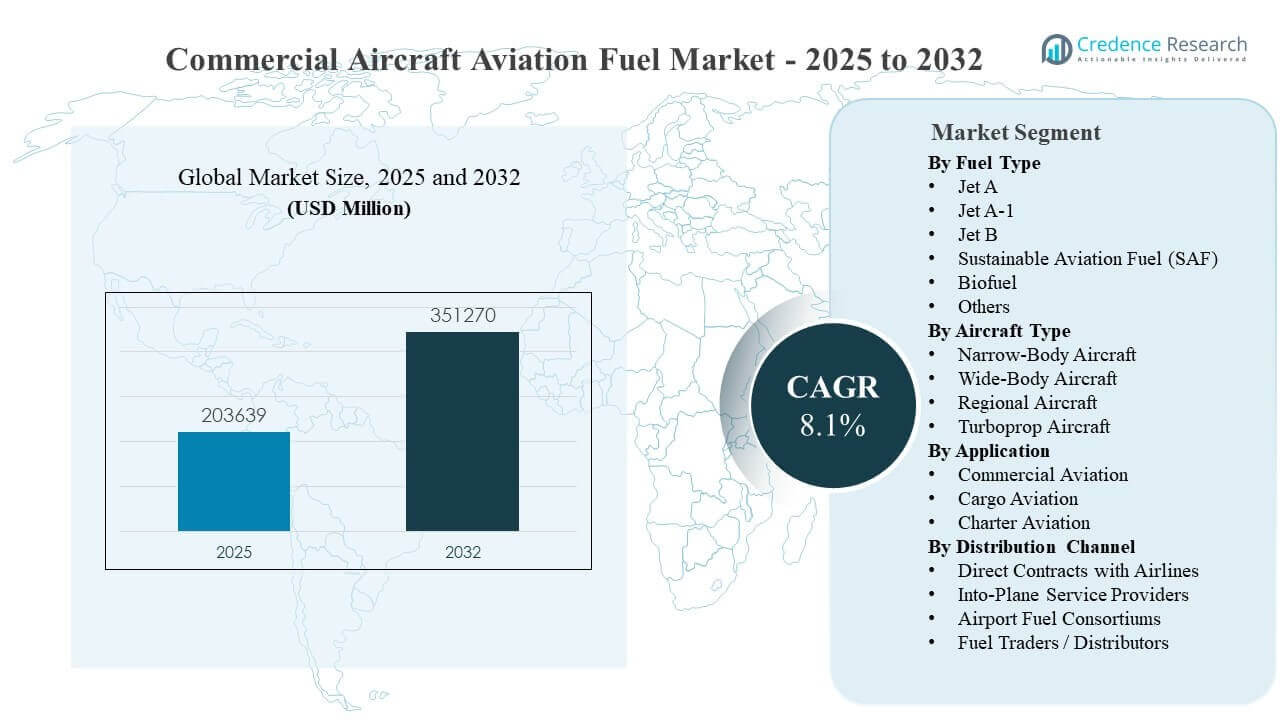
The global commercial aircraft aviation fuel market size was estimated at USD 203,639 million in 2025 and is expected to reach USD 351,270 million by 2032, growing at a CAGR of 8.1% from 2025 to 2032. Growth is anchored in sustained flight-cycle intensity across short- and medium-haul networks, where airline capacity additions and higher aircraft utilization translate into consistent uplift demand at major hubs and secondary airports. Commercial aircraft aviation fuel market expansion is also supported by progressive fuel-specification compliance and widening SAF blending activity that is reshaping procurement, quality assurance, and distribution models across global airport fueling systems.
| REPORT ATTRIBUTE | DETAILS |
|---|---|
| Historical Period | 2020-2024 |
| Base Year | 2025 |
| Forecast Period | 2026-2032 |
| Commercial Aircraft Aviation Fuel Market Size 2025 | USD 203,639 million |
| Commercial Aircraft Aviation Fuel Market, CAGR | 8.1% |
| Commercial Aircraft Aviation Fuel Market Size 2032 | USD 351,270 million |
Key Market Trends & Insights
- The commercial aircraft aviation fuel market is projected to increase from USD 203,639 million (2025) to USD 351,270 million (2032).
- The commercial aircraft aviation fuel market is forecast to grow at 8.1% CAGR during 2025–2032 as fleet utilization and route density expand.
- Asia Pacific accounted for 41.9% share in 2025, reflecting the largest regional demand concentration in the commercial aircraft aviation fuel market.
- Into-plane service providers represented 84.7% share in 2025, indicating operational dominance in airport fueling delivery for the commercial aircraft aviation fuel market.
- Conventional aviation fuel held 96.9% share in 2025, showing that the commercial aircraft aviation fuel market remains structurally dependent on legacy jet fuel despite decarbonization efforts.
Segment Analysis
Commercial aircraft aviation fuel market demand is shaped by airline network economics, airport infrastructure constraints, and fuel-quality governance that prioritize reliability, on-time turnaround performance, and consistent fuel availability. Procurement decisions typically balance contracted supply stability with spot-market flexibility, especially for high-frequency airports where disruptions can cascade into delay costs. The commercial aircraft aviation fuel market also reflects rising compliance requirements tied to emissions reporting, traceability expectations, and sustainability-linked contracting that influences blending, certification, and delivery documentation.
Buyer behavior in the commercial aircraft aviation fuel market increasingly favors suppliers and service partners that can combine storage access, hydrant or truck operations, quality management, and consistent fueling performance. Cost sensitivity remains high because fuel is a major airline operating expense, which pushes contracting toward long-term agreements, index-linked pricing, and supply diversification. The commercial aircraft aviation fuel market is also seeing stronger focus on SAF integration pathways, where availability, blending logistics, and verifiable chain-of-custody systems drive adoption pacing.
By Fuel Type Insights
Conventional aviation fuel accounted for the largest share of 96.9% in 2025. Conventional aviation fuel leads because aircraft and airport systems are optimized around established jet-fuel specifications, making reliability and compatibility the primary procurement priorities. Conventional aviation fuel also benefits from mature refining capacity, storage infrastructure, and standardized quality assurance processes across global hubs. Sustainable Aviation Fuel adoption is rising, but supply constraints and cost premiums keep conventional aviation fuel dominant in the commercial aircraft aviation fuel market.
By Aircraft Type Insights
Narrow-Body Aircraft accounted for the largest share of 57.6% in 2025. Narrow-Body Aircraft leadership is reinforced by dense short-haul schedules and high flight-cycle frequency that drive repeated refueling activity across domestic and intra-regional routes. Network strategies centered on point-to-point and hub-feeder operations keep narrow-body utilization structurally high in many airline fleets. Narrow-Body Aircraft fuel demand also benefits from route resilience, where shorter sectors recover faster after disruptions and maintain consistent uplift patterns.
By Application Insights
Commercial Aviation accounted for the largest share of 75.4% in 2025. Commercial Aviation leads because scheduled passenger operations concentrate the highest uplift volumes through regular frequencies, larger route networks, and high aircraft utilization. Airport fueling systems and service contracts are primarily designed around scheduled passenger turnaround performance, reinforcing commercial dominance. Commercial Aviation demand is also supported by expanding connectivity, where new routes and higher load factors amplify operational fuel throughput.
By Distribution Channel Insights
Into-Plane Service Providers accounted for the largest share of 84.7% in 2025. Into-Plane Service Providers dominate because airports and airlines prioritize on-time fueling execution through specialized ramp operations, hydrant interface capabilities, and quality-controlled delivery. Centralized into-plane models also reduce coordination complexity at multi-airline airports by standardizing safety, equipment, and service-level performance. Into-Plane Service Providers leadership is further supported where airports rely on integrated service partners to maintain consistent fueling availability during peak movement windows.
Commercial Aircraft Aviation Fuel Market Drivers
Rising aircraft utilization and route densification
Commercial aircraft aviation fuel market growth is supported by higher utilization rates across airline fleets as carriers optimize schedules and expand frequencies on profitable corridors. Route densification increases the number of daily refueling events, strengthening uplift volumes even when average stage lengths remain stable. Network expansion also increases demand at secondary airports, where newer routes require reliable fueling access and service coverage. Commercial aircraft aviation fuel market demand benefits when fleet renewal programs keep aircraft flying more hours with improved operational reliability and tighter turnaround windows.
- For instance, Ryanair reported 3,500 daily flights from 95 base airports and 184 million guests in FY2024, while 146 Boeing 737-8200 “Gamechanger” aircraft in its fleet provide 4% more passenger capacity and burn 16% less fuel, supporting quick and efficient turnarounds across a high-frequency network.
Expansion of airport fueling infrastructure and service standardization
Commercial aircraft aviation fuel market performance improves when airports invest in hydrant systems, fuel farms, and modernized fueling fleets that reduce delays and improve throughput. Service standardization strengthens airline confidence in into-plane delivery performance, especially at high-traffic hubs where ramp coordination is complex. Commercial aircraft aviation fuel market growth is reinforced by safety and quality frameworks that reduce contamination risk and strengthen compliance readiness. Infrastructure upgrades also enable better inventory management, supporting more consistent supply during demand peaks.
- For instance, Exolum’s new facility at Lima’s Jorge Chávez Airport includes four storage tanks with a combined capacity of 35,000 cubic meters, raises fuel stock autonomy from two days to eight days, and uses six high-capacity pumps feeding a 10-kilometre hydrant network that serves 130 aircraft stand positions from a centralized control centre.
Policy and corporate decarbonization commitments accelerating SAF integration
Commercial aircraft aviation fuel market dynamics are shifting as airlines and corporates increase demand for lower-carbon fuel options to support emissions targets. SAF blending, certification, and traceability requirements push suppliers to develop scalable logistics and documentation systems across airport networks. Commercial aircraft aviation fuel market growth is supported where mandates and voluntary programs increase the certainty of demand signals for SAF offtake. The shift also encourages longer-term contracting and stronger supplier partnerships focused on reliable SAF availability and blending capability.
Strengthening global supply chains and diversified sourcing strategies
Commercial aircraft aviation fuel market resilience improves when suppliers diversify sourcing across refineries, terminals, and trading networks to reduce disruption exposure. Airlines increasingly favor robust contracting structures that secure volumes, stabilize pricing relationships, and support consistent fueling operations. Commercial aircraft aviation fuel market growth is reinforced by integrated logistics, including storage access and distribution coordination that improves service continuity. Supply-chain optimization also supports better response to demand volatility linked to seasonality, geopolitics, and refinery maintenance cycles.
Commercial Aircraft Aviation Fuel Market Challenges
Commercial aircraft aviation fuel market stability faces pressure from fuel price volatility, where rapid changes in crude and refining margins can disrupt airline budgeting and procurement strategies. Supply disruptions tied to geopolitical events, refinery outages, and shipping constraints can tighten availability and raise operational risk for airports and airlines. Commercial aircraft aviation fuel market participants must also manage strict quality requirements, where contamination incidents can trigger grounding risks and reputational damage. Compliance and reporting burdens can increase administrative complexity across contracting, blending, and delivery.
Commercial aircraft aviation fuel market adoption of SAF faces structural constraints linked to limited supply, certification complexity, and cost premiums versus conventional fuels. Airport-level blending logistics require coordinated investments in storage segregation, handling procedures, and chain-of-custody controls. Commercial aircraft aviation fuel market scaling can be slowed when stakeholders face uncertainty on long-term policy consistency or when incentives are insufficient to narrow price gaps. Supplier networks also must balance SAF ramp-up with ongoing demand for conventional fuels that remains dominant in global operations.
- For instance, Neste began SAF production at its Rotterdam refinery in April 2025 after modifying the facility to produce up to 500,000 tons of SAF per year, increasing its global SAF production capability to 1.5 million tons, or around 1.875 billion liters annually, which demonstrates that SAF expansion depends on large-scale refinery upgrades and sustained ecosystem support.
Commercial Aircraft Aviation Fuel Market Trends and Opportunities
Commercial aircraft aviation fuel market trends include broader use of long-term supply agreements that combine conventional jet fuel and SAF volumes under unified service expectations. Airlines increasingly seek procurement models that provide traceability, emissions accounting support, and operational reliability in fueling delivery. Commercial aircraft aviation fuel market opportunities expand where airports and suppliers implement scalable blending pathways that reduce friction in certification and documentation. Digital fuel management tools also improve inventory visibility and quality controls, supporting more consistent service performance.
- For instance, Shell Aviation’s agreement to supply Delta with 10 million gallons of neat SAF over two years for use at Los Angeles International Airport also includes testing the blockchain-powered Avelia platform for fuel-use and emissions-data tracking, and Shell reported that by March 31, 2025, more than 57 corporations and airlines had made transactions through Avelia with over 33 million gallons of SAF injected into the existing fuel network.
Commercial aircraft aviation fuel market opportunity growth is supported by expanding regional production and import infrastructure for SAF, which can improve availability across more airports and reduce logistics bottlenecks. Partnerships between fuel suppliers, airlines, and airport operators can accelerate deployment of fueling upgrades and SAF-ready handling procedures. Commercial aircraft aviation fuel market participants can also benefit from differentiated offerings such as integrated into-plane services, quality assurance programs, and multi-airport network coverage. These shifts strengthen competitive positioning as buyers prioritize reliability and compliance-ready supply.
Regional Insights
North America
Commercial aircraft aviation fuel market activity in North America represented 27.8% share in 2025, supported by high domestic flight frequency and mature airport fueling infrastructure. The commercial aircraft aviation fuel market benefits from dense hub networks that drive consistent uplift volumes and strong supplier coverage at major airports. SAF integration activity is growing where airlines and corporates increase demand for lower-carbon options and where airports strengthen handling readiness. Contracting structures remain focused on supply reliability, service performance, and risk management during volatility.
Europe
Commercial aircraft aviation fuel market demand in Europe accounted for 20.6% share in 2025, supported by dense short-haul connectivity and compliance-driven procurement practices. The commercial aircraft aviation fuel market in Europe is influenced by regulatory momentum that accelerates SAF adoption, traceability, and reporting requirements across airport systems. Suppliers and into-plane service providers gain advantage when logistics and documentation systems support consistent blending and delivery performance. Cost discipline remains a strong theme, with airlines prioritizing stable supply and efficient turnaround support.
Asia Pacific
Commercial aircraft aviation fuel market revenue in Asia Pacific led at 41.9% share in 2025, reflecting large passenger volumes, route expansion, and continued airport infrastructure development. The commercial aircraft aviation fuel market benefits from capacity growth across domestic and regional corridors that increase refueling intensity at major hubs and emerging secondary airports. Supply strategies emphasize scale, reliability, and expanded storage access to support growth in aircraft movements. SAF readiness is developing unevenly across markets, creating opportunities for suppliers that can expand availability and build blended-fuel logistics.
Latin America
Commercial aircraft aviation fuel market activity in Latin America represented 4.4% share in 2025, with demand concentrated around key hubs and national carrier routes. The commercial aircraft aviation fuel market is shaped by infrastructure variability, where fueling reliability and service quality can differ across airports. Suppliers and distributors that improve terminal access and into-plane execution can strengthen performance in high-traffic nodes. SAF availability remains limited in many locations, creating longer-term opportunity tied to infrastructure upgrades and policy support.
Middle East & Africa
Commercial aircraft aviation fuel market performance in the Middle East and Africa reached 5.3% share in 2025, supported by hub operations, long-haul connectivity, and integrated energy logistics in key markets. The commercial aircraft aviation fuel market benefits where major airports maintain high uplift volumes driven by transfer traffic and wide-body operations. Supply reliability and quality control remain critical due to high utilization at hub airports and the operational costs of disruptions. Expansion of airport infrastructure and service partnerships can further strengthen throughput and support future SAF integration.
Competitive Landscape
Commercial aircraft aviation fuel market competition centers on supply reliability, airport network coverage, service execution quality, and the ability to manage price volatility through diversified sourcing and contracting discipline. Integrated offerings that combine storage access, quality assurance, and into-plane delivery can strengthen positioning with airlines focused on minimizing turnaround risk. Differentiation increasingly depends on SAF readiness, traceability capabilities, and the ability to support compliance-linked procurement at scale. Multi-airport service consistency remains a major selection factor for airlines operating across broad networks.
Exxon Mobil Corporation participates in the commercial aircraft aviation fuel market through broad refining capacity, supply-chain scale, and established aviation fuel distribution relationships that support reliability requirements for airlines and airports. Exxon Mobil Corporation strengths can include consistent product quality controls, logistics coordination across terminals, and the ability to support high-volume uplift at major hubs. Exxon Mobil Corporation positioning can be strengthened when supply planning and contracting structures reduce disruption exposure for airline customers. Commercial aircraft aviation fuel market dynamics also favor suppliers that can develop credible pathways for lower-carbon fuel options alongside core jet fuel supply.
The industry research and growth report includes detailed analyses of the competitive landscape of the market and information about key companies, including:
- Exxon Mobil Corporation
- Chevron Corporation
- Shell Aviation
- BP plc
- TotalEnergies
- World Fuel Services
- Avfuel Corporation
- Puma Energy
- Neste
- World Energy
- Indian Oil Corporation Ltd. (IOCL)
- Bharat Petroleum Corporation Ltd. (BPCL)
Qualitative and quantitative analysis of companies has been conducted to help clients understand the wider business environment as well as the strengths and weaknesses of key industry players. Data is qualitatively analyzed to categorize companies as pure play, category-focused, industry-focused, and diversified; it is quantitatively analyzed to categorize companies as dominant, leading, strong, tentative, and weak.
Recent Developments
- In January 2026, Boeing announced a joint initiative with Alaska Airlines and Pacific Northwest leaders to advance the production and use of lower-emission jet fuel, highlighting continued collaboration around aviation fuel decarbonization in commercial aviation.
- In January 2026, Indian Oil Corporation Ltd signed a Letter of Intent with Akasa Air at Wings India 2026 to explore the future supply of sustainable aviation fuel, with both companies planning to evaluate supply volumes, delivery locations, timelines, and approved feedstocks.
- In February 2026, Neste extended its relationship with World Fuel Services through a five-year agreement that expands the availability of Neste-supplied SAF to more than 100 airports across World Fuel’s UK and European network for commercial, business, and general aviation customers.
- In August 2025, IndianOil and Air India signed a Memorandum of Understanding for the supply of sustainable aviation fuel, marking a strategic step toward integrating certified green fuel into commercial airline operations in India.
Report Scope
| Report Attribute | Details |
| Market size value in 2025 | USD 203,639 million |
| Revenue forecast in 2032 | USD 351,270 million |
| Growth rate (CAGR) | 8.1% (2025–2032) |
| Base year | 2025 |
| Forecast period | 2026-2032 |
| Quantitative units | USD million |
| Segments covered | By Fuel Type, By Aircraft Type, By Application, By Distribution Channel |
| Regional scope | North America, Europe, Asia Pacific, Latin America, Middle East & Africa |
| Key companies profiled | Exxon Mobil Corporation; Chevron Corporation; Shell Aviation; BP plc; TotalEnergies; World Fuel Services; Avfuel Corporation; Puma Energy; Neste; World Energy; Indian Oil Corporation Ltd. (IOCL); Bharat Petroleum Corporation Ltd. (BPCL) |
| No. of Pages | 326 |
Segmentation
By Fuel Type
- Jet A
- Jet A-1
- Jet B
- Sustainable Aviation Fuel (SAF)
- Biofuel
- Others
By Aircraft Type
- Narrow-Body Aircraft
- Wide-Body Aircraft
- Regional Aircraft
- Turboprop Aircraft
By Application
- Commercial Aviation
- Cargo Aviation
- Charter Aviation
By Distribution Channel
- Direct Contracts with Airlines
- Into-Plane Service Providers
- Airport Fuel Consortiums
- Fuel Traders / Distributors
By Region
- North America
- U.S.
- Canada
- Mexico
- Europe
- Germany
- France
- U.K.
- Italy
- Spain
- Rest of Europe
- Asia Pacific
- China
- Japan
- India
- South Korea
- South-east Asia
- Rest of Asia Pacific
- Latin America
- Brazil
- Argentina
- Rest of Latin America
- Middle East & Africa
- GCC Countries
- South Africa
- Rest of the Middle East and Africa

Request a Free Sample
Fill in your details and we'll send you a free sample report.
- Sample data tables & charts
- Research methodology
Need a Custom Version of This Report?
Tailor the scope, geography, or segments to your exact requirements.
- Custom geography or segment scope
- Direct access to our analyst team
Frequently Asked Questions
What is the current and forecast market size for commercial aircraft aviation fuel market?
What is the CAGR for commercial aircraft aviation fuel market?
What is the largest segment in commercial aircraft aviation fuel market?
What factors are driving growth in commercial aircraft aviation fuel market?
Which companies are profiled in commercial aircraft aviation fuel market?
Which region leads commercial aircraft aviation fuel market?
Table of Content
Chapter 1 Market Segmentation
- 1.1 Segmentation Framework
- 1.1.1 Product and Service Classification
- 1.1.2 Application and End-Use Classification
- 1.1.3 Technology and Solution Classification
- 1.1.4 Customer and Distribution Channel Classification
- 1.1.5 Geographic Segmentation
- 1.1.6 Market Segment Definitions and Boundaries
Chapter 2 Introduction
- 2.1 Report Objectives and Scope
- 2.2 Product Definition and Industry Terminology
- 2.3 Market Inclusions and Exclusions
- 2.4 Research Process
- 2.4.1 Primary Research and Expert Interviews
- 2.4.2 Secondary Research and Source Review
- 2.4.3 Top-Down and Bottom-Up Estimation
- 2.4.4 Data Triangulation and Verification
- 2.5 Market Size Measurement Basis
- 2.5.1 2025: USD 203,639 million → 2032: USD 351,270 million
- 2.6 Historical and Forecast Reference Periods
- 2.6.1 Base Year: 2025
- 2.6.2 Forecast Period: 2025-2032
- 2.7 Research Assumptions and Limitations
Chapter 3 Executive Summary
- 3.1 Market Snapshot and Key Findings
- 3.2 Base-Year Market Size, 2025
- 3.3 Forecast Market Size, 2032
- 3.4 Revenue and Volume Growth Outlook
- 3.5 Key Demand and Supply Indicators
- 3.6 Leading Market Segments
- 3.7 Fastest-Growing Market Opportunities
- 3.8 Regional Performance Highlights
- 3.9 Technology and Industry Transformation
- 3.10 Competitive Landscape Summary
- 3.11 Analyst View and Strategic Implications
Chapter 4 Global Commercial Aircraft Aviation Fuel Market Trends and Developments
- 4.1 Historical Industry Development
- 4.2 Recent Market Trends and Developments
- 4.3 Demand and Customer Behavior Trends
- 4.4 Technology and Product Innovation
- 4.5 Artificial Intelligence, Automation and Digitalization
- 4.6 Local Manufacturing and Supply Chain Realignment
- 4.7 Industry Partnerships, Mergers and Acquisitions
- 4.8 Sustainability and Circular Economy Developments
- 4.9 Government and Private Sector Investment Trends
- 4.10 Emerging Business Models and Commercialization
- 4.11 Industry Developments and Announcements
Chapter 5 Global Commercial Aircraft Aviation Fuel Market Production, Supply and Demand Analysis
- 5.1 Demand Trend and Consumption Analysis
- 5.2 Demand Forecast, 2025-2032
- 5.3 Production and Output Trend
- 5.4 Production and Output Forecast, 2025-2032
- 5.5 Installed Capacity and Capacity Utilization
- 5.6 Company-Wise Production Plants and Statistics
- 5.6.1 Installed Production Capacity
- 5.6.2 Actual Production
- 5.6.3 Planned Capacity and Expansion Targets
- 5.7 Supply Chain Structure and Procurement Trends
- 5.8 Supply-Demand Gap and Bottlenecks
- 5.9 Import Dependence and Sourcing Structure
- 5.10 Contract Manufacturing and Outsourcing
- 5.11 Regional Supply and Demand Concentration
Chapter 6 Global Commercial Aircraft Aviation Fuel Market Pricing Analysis
- 6.1 Pricing Structure and Measurement
- 6.2 Historical Pricing Trends
- 6.3 Pricing Outlook, 2025-2032
- 6.4 Average Selling Price and Unit Economics
- 6.5 Pricing by Product and Market Segment
- 6.6 Geographic Pricing Differences
- 6.7 Key Input, Energy, Labor and Logistics Costs
- 6.8 Contract Pricing and Purchasing Models
- 6.9 Pricing Sensitivity and Competitive Positioning
- 6.10 Price, Margin and Profitability Implications
Chapter 7 Global Commercial Aircraft Aviation Fuel Market Dynamics
- 7.1 Market Growth Drivers
- 7.1.1 Demand-Side Drivers
- 7.1.2 Technology and Innovation Drivers
- 7.1.3 Infrastructure and Investment Drivers
- 7.1.4 Regulatory and Policy Drivers
- 7.2 Market Restraints
- 7.2.1 Cost and Affordability Constraints
- 7.2.2 Technology and Adoption Barriers
- 7.2.3 Supply Chain and Operational Constraints
- 7.3 Market Challenges
- 7.3.1 Competitive Pressure and Margin Erosion
- 7.3.2 Skills, Infrastructure and Implementation Gaps
- 7.4 Emerging Market Opportunities
- 7.5 Market Dynamics Impact and Time-Horizon Assessment
Chapter 8 Global Commercial Aircraft Aviation Fuel Value Chain Analysis
- 8.1 Industry Value Chain Overview
- 8.2 Upstream Suppliers and Critical Inputs
- 8.3 Technology and Component Providers
- 8.4 Manufacturing or Service Delivery
- 8.5 Distribution, Channel Partners and Integrators
- 8.6 Downstream Applications and End Users
- 8.7 Value Addition and Profit Pools
- 8.8 Vertical Integration and Outsourcing
- 8.9 Supplier Concentration and Risk
- 8.10 Supply Chain Localization and Resilience
Chapter 9 Global Commercial Aircraft Aviation Fuel Market Regulations and Policies
- 9.1 Relevant Laws, Standards and Compliance Frameworks
- 9.2 Product, Service, Safety and Quality Requirements
- 9.3 Government Policies, Incentives and Subsidies
- 9.4 Imports, Exports and Trade Barriers
- 9.5 Public Procurement and Local Content Requirements
- 9.6 Environmental and Sustainability Compliance
- 9.7 Upcoming Policy Changes and Market Implications
Chapter 10 Global Commercial Aircraft Aviation Fuel Market Hotspots and Opportunities
- 10.1 Market Opportunity Mapping and Growth Hotspots
- 10.2 High-Growth Applications and Customer Groups
- 10.3 Underserved Markets and White-Space Opportunities
- 10.4 Emerging Technology and Product Opportunities
- 10.5 New Capacity and Investment Hotspots
- 10.6 Market Entry and Expansion Opportunities
- 10.7 Distribution and Partnership Opportunities
- 10.8 Near-Term and Long-Term Commercial Potential
- 10.9 Opportunity Attractiveness and Execution Risks
Chapter 11 Global Commercial Aircraft Aviation Fuel Market Outlook, 2025-2032
- 11.1 Market Size and Analysis
- 11.1.1 Revenue (Market Measurement: 2025: USD 203,639 million → 2032: USD 351,270 million)
- 11.1.2 Market Volume and Quantity Sold
- 11.1.3 Historical Market Size
- 11.1.4 Base-Year Market Size, 2025
- 11.2 Market Forecast, 2025-2032
- 11.2.1 Revenue Forecast to 2032
- 11.2.2 Volume Forecast to 2032
- 11.2.3 CAGR and Year-on-Year Growth
- 11.2.4 Incremental Revenue Opportunity
- 11.3 Forecast Assumptions and Scenario Analysis
- 11.3.1 Base-Case Forecast
- 11.3.2 Optimistic and Conservative Scenarios
- 11.3.3 Technology, Pricing and Policy Sensitivities
- 11.4 Market Attractiveness and Growth Outlook
Chapter 12 Global Commercial Aircraft Aviation Fuel Market Segmentation and Outlook
- 12.1 Segmentation Summary and Market Shares, 2025
- 12.2 Largest and Fastest-Growing Segments
- 12.3 Segment Growth Comparison
- 12.4 Segment Attractiveness and Priority Matrix
Chapter 13 Global Commercial Aircraft Aviation Fuel Geographic Market Outlook, 2025-2032
- 13.1 Regional Market Size and Share, 2025
- 13.2 Regional Market Forecast, 2025-2032
- 13.3 Regional Pricing, Production and Demand Differences
- 13.4 North America
- 13.4.1 United States
- 13.4.2 Canada
- 13.4.3 Mexico
- 13.5 Europe
- 13.5.1 Germany
- 13.5.2 France
- 13.5.3 Italy
- 13.5.4 United Kingdom
- 13.5.5 Spain
- 13.5.6 Poland
- 13.5.7 Russia
- 13.5.8 Netherlands
- 13.5.9 Belgium
- 13.5.10 Sweden
- 13.5.11 Denmark
- 13.5.12 Norway
- 13.5.13 Rest of Europe
- 13.6 Asia Pacific
- 13.6.1 China
- 13.6.2 India
- 13.6.3 Japan
- 13.6.4 South Korea
- 13.6.5 Thailand
- 13.6.6 Indonesia
- 13.6.7 Vietnam
- 13.6.8 Malaysia
- 13.6.9 Australia
- 13.6.10 Rest of Asia Pacific
- 13.7 Latin America
- 13.7.1 Brazil
- 13.7.2 Argentina
- 13.7.3 Colombia
- 13.7.4 Chile
- 13.7.5 Rest of Latin America
- 13.8 Middle East
- 13.8.1 Saudi Arabia
- 13.8.2 United Arab Emirates
- 13.8.3 Turkey
- 13.8.4 Israel
- 13.8.5 Iran
- 13.8.6 Rest of the Middle East
- 13.9 Africa
- 13.9.1 South Africa
- 13.9.2 Egypt
- 13.9.3 Nigeria
- 13.9.4 Morocco
- 13.9.5 Rest of Africa
- 13.10 Regional Investment, Policy and Supply Chain Differences
- 13.11 Regional Competitive Landscape
- 13.12 Geographic Growth Hotspots
Chapter 14 Global Commercial Aircraft Aviation Fuel Technology, Innovation and Sustainability Outlook
- 14.1 Technology Landscape and Maturity
- 14.2 Product, Process and Service Innovation
- 14.3 AI, Automation and Digital Tools in the Industry
- 14.4 Technology Adoption and Performance Benchmarking
- 14.5 Innovation Pipeline and R&D Investment
- 14.6 Patent and Intellectual Property Trends
- 14.7 Energy Efficiency and Resource Management
- 14.8 Sustainability, Recycling and Circularity
- 14.9 Technology Roadmap, 2025-2032
- 14.10 Risks of Obsolescence and Technology Substitution
Chapter 15 Global Commercial Aircraft Aviation Fuel Market Key Strategic Imperatives
- 15.1 Growth and Market Entry Priorities
- 15.2 High-Return Products and Segments
- 15.3 Pricing, Profitability and Cost Optimization
- 15.4 Technology Investment and Product Differentiation
- 15.5 Supply Chain Localization and Resilience
- 15.6 Distribution and Customer Acquisition
- 15.7 Partnership, Acquisition and Capacity Strategy
- 15.8 Regional Expansion Priorities
- 15.9 Short-, Medium- and Long-Term Actions
Chapter 16 Competition Outlook
- 16.1 Industry Competition Characteristics
- 16.2 Market Structure and Concentration
- 16.3 Market Share and Competitive Positioning, 2025
- 16.4 Company-Wise Revenue and Product Benchmarking
- 16.5 Production and Service Capacity Benchmarking
- 16.6 Technology, Pricing and Differentiation
- 16.7 Regional Footprint and Distribution Strength
- 16.8 Mergers, Acquisitions and Strategic Alliances
- 16.9 New Entrants and Competitive Threats
- 16.10 Porter's Five Forces and Industry Attractiveness
- 16.11 Competitive Outlook, 2025-2032
Chapter 17 Company Profiles
- 17.1 Company Coverage and Selection Criteria
- 17.2 Leading Market Participants – Standard Profile Structure
- 17.2.1 Business Description
- 17.2.2 Company Ownership and Geographic Presence
- 17.2.3 Product and Service Portfolio
- 17.2.4 Manufacturing and Operating Footprint
- 17.2.5 Production Capacity and Expansion Plans
- 17.2.6 Financial Performance and Investment
- 17.2.7 Market Share and Competitive Position
- 17.2.8 Technology and Innovation Capabilities
- 17.2.9 Strategic Alliances or Partnerships
- 17.2.10 Recent Developments
- 17.2.11 Growth Strategy and Outlook
- 17.3 Other Relevant Market Participants
Note: Every listed company is profiled on the structure shown under the first company. The company list is preliminary and may change based on research findings, market developments, data availability and client requirements.
Chapter 18 Disclaimer
- 18.1 Research and Forecast Disclaimer
- 18.2 Data Source and Estimation Limitations
Note: The depth of individual sections depends on data availability for this market. Volume, capacity, trade and other unit-based metrics are included where applicable.