
Market Overview
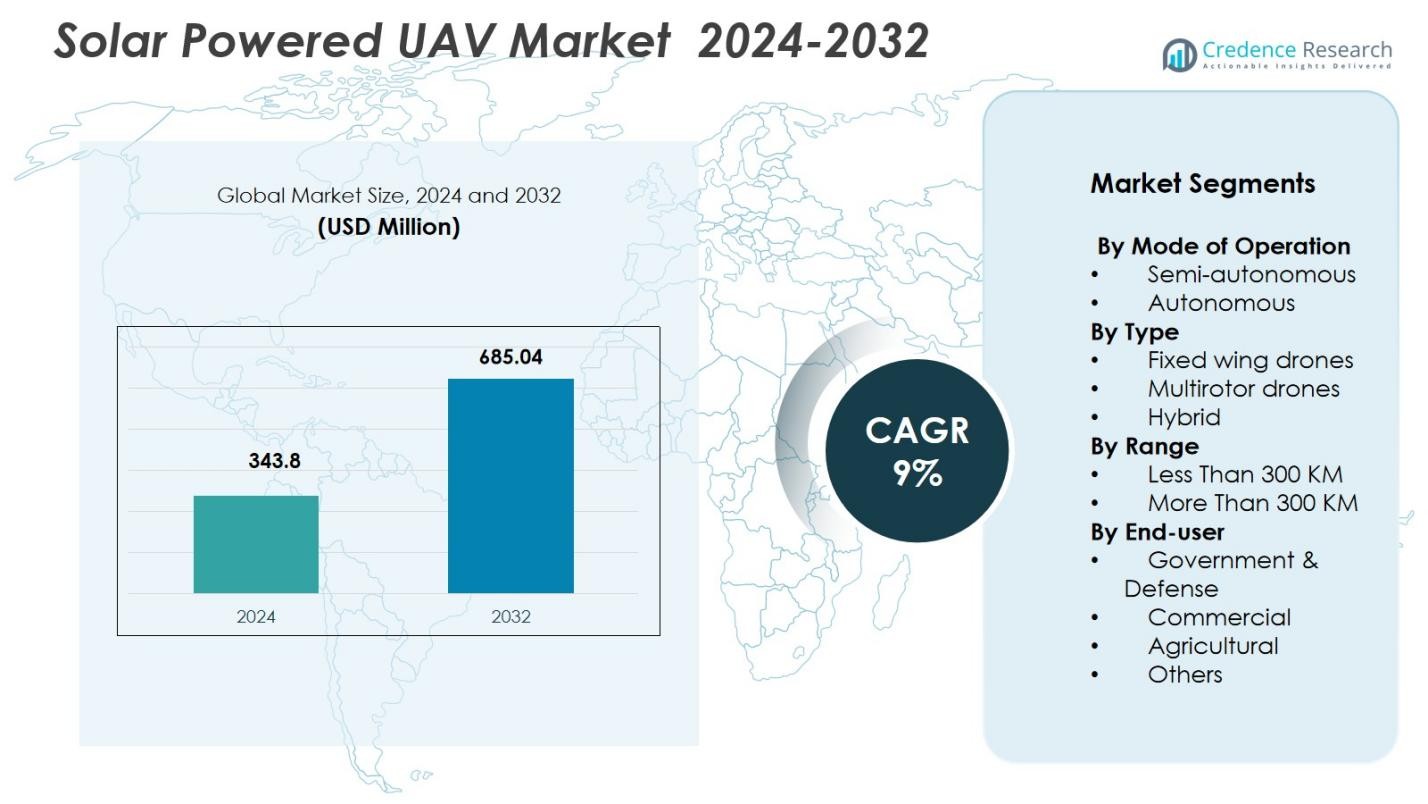
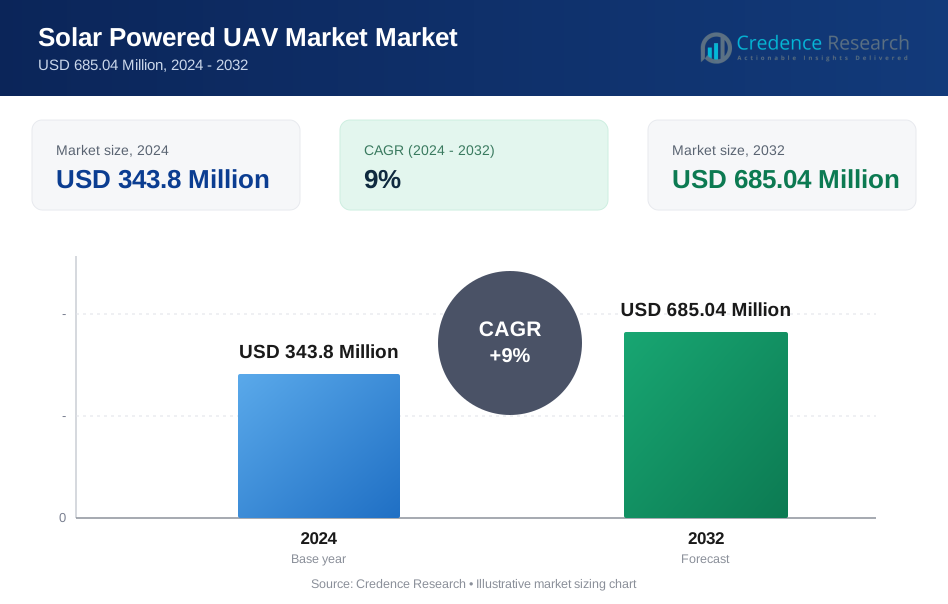
Solar Powered UAV Market size was valued USD 343.8 Million in 2024 and is anticipated to reach USD 685.04 Million by 2032, at a CAGR of 9% during the forecast period.
| REPORT ATTRIBUTE | DETAILS |
|---|---|
| Historical Period | 2020-2023 |
| Base Year | 2024 |
| Forecast Period | 2025-2032 |
| Solar Powered UAV Market Size 2024 | USD 343.8 Million |
| Solar Powered UAV Market, CAGR | 9% |
| Solar Powered UAV Market Size 2032 | USD 685.04 Million |
Solar Powered UAV Market features strong participation from leading players such as AeroVironment Inc., Airbus SE, Aurora Flight Sciences, Atlantik Solar, Avy, BAE Systems, DJI, Elektra, Eos Technologie, and the Chinese Academy of Aerospace Aerodynamics, all of which actively invest in long-endurance platforms, advanced solar integration, and autonomous capabilities. These companies expand their portfolios through innovations in lightweight materials, high-efficiency photovoltaic systems, and stratospheric flight technologies. Regionally, North America leads the market with a 34.6% share in 2024, supported by robust defense spending, extensive R&D activities, and strong adoption of high-altitude solar-powered UAVs for surveillance, communication, and environmental monitoring applications.
Market Insights
- The Solar Powered UAV market was valued at USD 343.8 million in 2024 and is projected to reach USD 685.04 million by 2032, growing at a CAGR of 9%.
- Market growth is driven by rising demand for long-endurance surveillance, increasing adoption in environmental monitoring, and expanding use across commercial sectors such as agriculture, infrastructure inspection, and telecommunications.
- Key trends include advancements in high-efficiency solar cells, lightweight composite materials, and AI-enabled autonomous navigation, enabling multi-day flight capability and enhancing mission versatility across industries.
- Major players such as AeroVironment Inc., Airbus SE, Aurora Flight Sciences, and BAE Systems strengthen the market through R&D investment, high-altitude UAV development, and strategic collaborations with defense and research institutions.
- North America leads with a 34.6% share, followed by Europe at 28.3% and Asia-Pacific at 24.7%, while fixed-wing UAVs dominate with a 58.7% segment share due to superior endurance and energy-harvesting efficiency.
 Market Segmentation Analysis
By Mode of Operation
The Solar Powered UAV market by mode of operation is led by autonomous systems, capturing 62.4% market share in 2024. Their dominance stems from increasing demand for long-endurance missions, real-time decision-making capabilities, and reduced human intervention in defense, environmental monitoring, and surveillance operations. Autonomous UAVs integrate advanced sensors, AI-based navigation, and automated flight control systems that enhance mission efficiency and operational safety. Semi-autonomous UAVs continue to grow steadily as industries adopt hybrid human-machine control for precision applications, yet full autonomy remains the preferred choice due to superior reliability and extended operational capability.
- For instance, Airbus Zephyr S, a solar-powered high-altitude pseudo-satellite (HAPS), completed a maiden autonomous flight exceeding 25 days in Arizona, USA, in 2018, operating at 21 km altitude above weather disruptions.
By Type
Fixed-wing drones dominate the Solar Powered UAV market, accounting for 58.7% market share in 2024, driven by their exceptional endurance, aerodynamic efficiency, and suitability for high-altitude, long-distance missions. These drones are widely adopted for border surveillance, atmospheric research, and large-area mapping. Multirotor drones are gaining traction for short-range commercial applications requiring high maneuverability, while hybrid UAVs, combining VTOL capabilities with fixed-wing endurance, show rising adoption among emergency response and logistics operators. However, fixed-wing platforms retain leadership due to their superior flight efficiency and ability to maximize solar energy harvesting.
- For instance, ETH Zurich’s AtlantikSolar fixed-wing UAV achieved an 81.5-hour continuous solar-powered flight over 2,338 km, validating multi-day endurance for low-altitude mapping and atmospheric measurement applications.
By Range
Solar Powered UAVs with a range of more than 300 km hold the dominant position, securing 64.1% market share in 2024, primarily due to their extensive use in strategic defense missions, long-duration surveillance, disaster assessment, and scientific data collection. Their larger wingspan allows improved solar panel integration, enabling multi-day endurance without refueling. UAVs with less than 300 km range serve sectors like agriculture, infrastructure inspection, and commercial monitoring where shorter missions suffice, yet long-range platforms remain preferred for mission-critical operations demanding uninterrupted flight and broad-area coverage.
Key Growth Drivers
Rising Demand for Long-Endurance Surveillance and Monitoring
The Solar Powered UAV market is significantly driven by the growing need for long-endurance surveillance across defense, environmental monitoring, and disaster management sectors. Governments and security agencies increasingly deploy solar-powered UAVs for border patrolling, maritime surveillance, and persistent intelligence gathering due to their ability to remain airborne for days without refueling. Their extended operational capability supports real-time data acquisition over vast areas, making them highly efficient for climate research, wildlife tracking, and forest fire detection. As sustainability becomes a strategic priority, solar-powered UAVs offer a cost-effective, energy-efficient alternative to fuel-based UAVs, reducing operational expenses and minimizing carbon emissions. The continual rise in geopolitical tensions and environmental monitoring mandates further amplifies adoption, cementing long-endurance capability as a fundamental growth catalyst for the market.
- For instance, Airbus’ Zephyr completed endurance trials surpassing 25–30 days of continuous flight, enabling persistent border monitoring and military ISR operations for agencies such as the U.S. Army.
Technological Advancements in Solar Efficiency and Lightweight Materials
Rapid advancements in photovoltaic efficiency, battery storage, and lightweight composite materials are accelerating the development of next-generation Solar Powered UAVs. Improved solar cell technologies, such as thin-film and multi-junction cells, enable higher energy conversion rates even under low-light conditions, extending flight duration across varied geographies. Simultaneously, innovations in lithium-sulfur and solid-state batteries enhance energy density, supporting long-range missions with reduced charging cycles. Lightweight carbon fiber and advanced polymers reduce structural weight while improving durability and aerodynamic performance. These technological improvements allow manufacturers to design UAVs with larger wingspans, superior energy harvesting capabilities, and enhanced payload capacity. As research institutions and aerospace companies increase investment in next-generation solar UAV platforms, these advancements serve as a major driver enabling broader commercial, industrial, and defense applications.
- For instance, BAE Systems’ PHASA-35 solar UAV combines ultra-lightweight solar cells with long-life battery packs across a 35 m composite wingspan, targeting stratospheric endurance of up to 12 months for missions such as environmental monitoring and border surveillance.
Growing Adoption Across Commercial and Civil Applications
Commercial and civic sectors are rapidly embracing Solar Powered UAVs due to their operational efficiency, low energy costs, and suitability for high-frequency monitoring tasks. Industries such as agriculture, infrastructure, telecommunications, and renewable energy utilize solar UAVs for activities like crop health assessment, power line inspection, land mapping, and asset monitoring. Their ability to operate without frequent battery swaps or fueling makes them ideal for remote or hazardous locations. Government agencies increasingly rely on these UAVs for disaster response, flood assessment, and environmental compliance tracking. The expanding role of UAVs in delivering broadband connectivity and supporting remote communication networks especially in developing regions further enhances market demand. As businesses prioritize predictive analytics, automation, and sustainability, solar-powered UAV platforms are becoming essential tools that enable continuous, cost-effective aerial intelligence, driving widespread adoption across diverse sectors.
Key Trends & Opportunities
Integration of AI, Autonomy, and Advanced Data Analytics
A major trend shaping the Solar Powered UAV market is the rapid integration of AI-driven autonomy, onboard analytics, and edge computing. These technologies enable real-time decision-making, automated route optimization, and intelligent mission management without constant ground control supervision. AI-enabled object recognition, anomaly detection, and predictive maintenance capabilities unlock new opportunities in security surveillance, precision agriculture, and industrial asset monitoring. The combination of solar energy and autonomous capability ensures continuous, self-sustaining UAV operations, enhancing their appeal for large-scale, long-duration projects. As industries demand more accurate, real-time insights, the fusion of AI and solar-powered UAVs is transforming them into strategic tools for data-driven enterprises.
- For instance, Skydweller Aero's MAPS drone, with a 236-foot wingspan covered in over 17,000 solar cells generating up to 100kW, integrates Thales' AI-powered AirMaster S radar for autonomous target classification and maritime surveillance during multi-week flights.
Increasing Use in Telecommunications and Connectivity Expansion
Solar Powered UAVs are emerging as a promising solution for extending telecommunications networks, particularly in remote and underserved regions. High-altitude long-endurance (HALE) solar UAVs can function as airborne communication relays, providing temporary or supplementary connectivity during emergencies, natural disasters, or large public events. Telecom operators explore partnerships to deploy these UAVs as cost-efficient alternatives to satellites for rural broadband coverage and IoT network expansion. Their ability to operate at stratospheric altitudes for extended periods enables stable line-of-sight communication, supporting 5G backhaul and real-time sensor ecosystems. This trend presents significant commercial opportunities as countries focus on bridging digital divides and enhancing digital infrastructure resilience.
- For instance, Airbus’ Zephyr has been evaluated in collaboration with defense and telecom partners such as the UK Ministry of Defence to demonstrate stratospheric communication relay capabilities, supporting resilient connectivity during missions.
Key Challenges
Limitations in Energy Storage and Weather Dependency
Despite rapid technological improvements, energy storage limitations and weather dependency remain substantial barriers for Solar Powered UAV operations. Cloud cover, seasonal variations, and insufficient sunlight can significantly reduce energy harvesting, limiting mission endurance and affecting operational reliability. Battery performance degrades under extreme temperatures, further constraining UAV functionality in harsh environments. Night-time operations depend entirely on stored energy, which restricts mission duration during winter or high-latitude deployments. These challenges force manufacturers to explore hybrid propulsion systems or ultra-efficient materials, yet overcoming natural environmental constraints remains a complex technical hurdle affecting market scalability.
High Development Costs and Regulatory Restrictions
The development of Solar Powered UAVs incurs high costs due to advanced photovoltaic systems, lightweight structural materials, long-endurance design requirements, and sophisticated navigation technologies. Such investment-intensive development often limits adoption among small and mid-sized enterprises. Additionally, regulatory restrictions related to beyond-visual-line-of-sight (BVLOS) operations, high-altitude flights, and cross-border UAV missions pose significant challenges for commercial deployment. Airspace permissions, safety certifications, and data privacy regulations vary across regions, slowing market penetration. Heightened concerns over national security, unauthorized surveillance, and data misuse further intensify scrutiny. These financial and regulatory constraints collectively impede widespread adoption and commercialization of solar-powered UAV platforms.
Regional Analysis
North America
North America leads the Solar Powered UAV market with a 34.6% share in 2024, driven by strong defense modernization programs, rising investment in long-endurance UAV platforms, and the presence of advanced aerospace manufacturers. The U.S. Department of Defense and NASA actively adopt solar UAVs for border surveillance, atmospheric research, and communication relay missions, strengthening regional demand. Expanding applications in disaster response, wildfire monitoring, and infrastructure inspection further support market growth. Favorable regulatory frameworks for UAV testing and innovation, combined with continuous technological advancements, position North America as a dominant hub for long-endurance solar UAV development.
Europe
Europe holds a 28.3% market share in 2024, supported by large-scale R&D initiatives, environmental monitoring programs, and strong participation from aerospace leaders focusing on next-generation solar UAV platforms. The region increasingly deploys solar UAVs for climate studies, maritime monitoring, and cross-border security operations, driven by stringent sustainability and emission-reduction policies. Countries such as Germany, France, and the U.K. invest in long-endurance UAV technologies for civil and defense applications. The strong presence of high-altitude platform system (HAPS) projects and supportive EU aviation regulations further enhance Europe’s position as a key contributor to global solar UAV advancement.
Asia-Pacific
Asia-Pacific accounts for 24.7% of the Solar Powered UAV market in 2024, driven by expanding defense budgets, rapid technological adoption, and growing use of UAVs in agriculture, infrastructure, and disaster management. China, Japan, South Korea, and India are leading adopters, focusing on long-endurance UAVs for border monitoring, communication support, and environmental surveillance. The region’s vulnerability to natural disasters increases demand for continuous aerial monitoring solutions, while government-led drone modernization programs accelerate adoption. Rising investments in solar technology manufacturing and UAV ecosystem development further strengthen Asia-Pacific as a rapidly growing regional market.
Latin America
Latin America captures a 6.4% share of the market in 2024, supported by increasing reliance on UAVs for environmental monitoring, agricultural management, and forest protection. Countries such as Brazil, Chile, and Mexico deploy solar-powered UAVs for monitoring deforestation, optimizing large-scale farming operations, and conducting disaster assessment. Limited infrastructure in remote zones drives interest in long-endurance UAVs capable of extended missions without refueling. Although budget constraints and regulatory challenges slow rapid adoption, growing government interest in climate surveillance and border monitoring creates steady opportunities for solar UAV deployment across the region.
Middle East & Africa
The Middle East & Africa region holds a 6% market share in 2024, with demand primarily driven by defense surveillance needs, border security operations, and infrastructure monitoring in remote areas. Countries in the Gulf region invest in solar-powered UAVs for oil pipeline inspection, desert surveillance, and strategic communications. In Africa, solar UAVs are increasingly adopted for wildlife monitoring, anti-poaching programs, and agricultural assessment across vast landscapes. Harsh climatic conditions favor solar UAVs capable of long-endurance flights, while rising interest in renewable technologies and national security modernization programs supports gradual but steady market expansion.
Market Segmentations
By Mode of Operation
- Semi-autonomous
- Autonomous
By Type
- Fixed wing drones
- Multirotor drones
- Hybrid
By Range
- Less Than 300 KM
- More Than 300 KM
By End-user
- Government & Defense
- Commercial
- Agricultural
- Others
By Geography
- North America
- U.S.
- Canada
- Mexico
- Europe
- Germany
- France
- U.K.
- Italy
- Spain
- Rest of Europe
- Asia Pacific
- China
- Japan
- India
- South Korea
- South-east Asia
- Rest of Asia Pacific
- Latin America
- Brazil
- Argentina
- Rest of Latin America
- Middle East & Africa
- GCC Countries
- South Africa
- Rest of the Middle East and Africa
Competitive Landscape
The Solar Powered UAV market features a dynamic competitive landscape defined by continuous innovation, strategic collaborations, and a strong focus on long-endurance platform development. Leading companies such as AeroVironment Inc., Airbus SE, Aurora Flight Sciences, Atlantik Solar, Avy, BAE Systems, DJI, Elektra, Eos Technologie, and the Chinese Academy of Aerospace Aerodynamics drive advancements in photovoltaic integration, lightweight structures, and high-altitude flight capabilities. These players invest heavily in R&D to enhance solar efficiency, battery storage, and autonomous navigation systems, enabling multi-day mission endurance. Partnerships with defense agencies, environmental research organizations, and telecom operators further accelerate product deployment across surveillance, climate monitoring, and communication relay applications. New entrants focus on niche solutions such as hybrid VTOL-solar UAVs and specialized payload systems, intensifying competition. As government demand for sustainable aerial intelligence grows, companies prioritize scalability, reliability, and technological differentiation to maintain market leadership.
Key Player Analysis
- Aurora Flight Sciences
- DJI
- Elektra
- Airbus SE
- Atlantik Solar
- Avy
- AeroVironment Inc.
- Chinese Academy of Aerospace Aerodynamics
- BAE Systems
- Eos Technologie
Recent Developments
- In July 2025, Skydweller Aero partnered with Thales to launch the solar-powered drone Skydweller designed for ultra-long endurance maritime surveillance and capable of flying continuously for up to 90 days.
- In July 2025, XSun and H3 Dynamics announced a collaboration to build the world’s first UAV that combines solar, hydrogen fuel-cell, and battery power aiming for extended endurance and lower emissions.
- In February 2025, Kea Aerospace achieved its first stratospheric flight with its solar-powered UAV (the “Kea Atmos”) reaching 56,284 ft altitude and flying 420 km in 8 hours 20 minutes, a milestone toward long-duration solar flight.
Report Coverage
The research report offers an in-depth analysis based on Mode of Operation, Type, Range, End-User and Geography. It details leading market players, providing an overview of their business, product offerings, investments, revenue streams, and key applications. Additionally, the report includes insights into the competitive environment, SWOT analysis, current market trends, as well as the primary drivers and constraints. Furthermore, it discusses various factors that have driven market expansion in recent years. The report also explores market dynamics, regulatory scenarios, and technological advancements that are shaping the industry. It assesses the impact of external factors and global economic changes on market growth. Lastly, it provides strategic recommendations for new entrants and established companies to navigate the complexities of the market.
Future Outlook
- The market will witness increased adoption of long-endurance UAVs for defense, environmental monitoring, and strategic communication missions.
- Advancements in high-efficiency solar cells will enhance energy harvesting and extend operational flight duration.
- Integration of AI and autonomous navigation systems will improve mission accuracy and reduce dependency on human control.
- High-altitude platform systems (HAPS) will gain traction as alternatives to satellites for connectivity and surveillance.
- Hybrid solar-electric propulsion designs will emerge to overcome weather limitations and ensure consistent performance.
- Commercial sectors such as agriculture, mining, and infrastructure inspection will expand their use of solar-powered UAVs.
- Governments will increase investments in renewable aviation technologies to meet sustainability and emission-reduction goals.
- Lightweight materials and aerodynamic innovations will enable larger wingspans and improved payload capacity.
- Telecom operators will explore solar UAVs for rural broadband deployment and emergency communication support.
- Regulatory frameworks will gradually evolve to support BVLOS operations and high-altitude UAV integration into national airspace.
Request a Free Sample
Fill in your details and we'll send you a free sample report.
- Sample data tables & charts
- Research methodology
Need a Custom Version of This Report?
Tailor the scope, geography, or segments to your exact requirements.
- Custom geography or segment scope
- Direct access to our analyst team
Frequently Asked Questions
What is the current market size for Solar Powered UAV market, and what is its projected size in 2032?
At what Compound Annual Growth Rate is the Solar Powered UAV market projected to grow between 2024 and 2032?
Which Solar Powered UAV market segment held the largest share in 2024?
What are the primary factors fueling the growth of the Solar Powered UAV market?
Who are the leading companies in the Solar Powered UAV market?
Which region commanded the largest share of the Solar Powered UAV market in 2024?
Table of Content
Chapter 1. Report Introduction
- 1.1 Report Description & Purpose
- 1.1.1 Report Title & Market Definition
- 1.1.2 Unique Selling Propositions (USP) & Key Differentiators
- 1.1.3 Value Proposition for Stakeholders
- 1.2 Research Objectives
- 1.2.1 Market Sizing Objectives (Volume & Revenue)
- 1.2.2 Segmentation Objectives
- 1.2.3 Competitive Intelligence Objectives
- 1.2.4 Forecast & Scenario Objectives
- 1.3 Report Scope
- 1.3.1 Solar Powered UAV Market Scope – Types & Subtypes Covered
- 1.3.2 Geographic Scope – Regions & Countries Covered
- 1.3.3 Historical Period, Base Year & Forecast Period (2024; forecast to 2032)
- 1.3.4 Inclusions & Exclusions
- 1.4 HS Code & Classification Framework
- 1.5 Currency, Units & Pricing Basis
- 1.6 Target Stakeholders
- 1.7 Limitations & Assumptions
Chapter 2. Executive Summary
- 2.1 Global Solar Powered UAV Market Market Snapshot
- 2.1.1 Market Size – Historical (2024) & Forecast (2024-2032) (2024: USD 343.8 Million → 2032: USD 685.04 Million)
- 2.1.2 Volume & Revenue – Global Totals
- 2.1.3 Key Market Highlights – Top Five Facts
- 2.2 Solar Powered UAV Market Market Segmentation Snapshot
- 2.2.1 Market Split by Region – 2024 vs. 2032
- 2.3 Competitive Snapshot
- 2.3.1 Top 10 Players by Revenue Share – 2024
- 2.3.2 Top 10 Players by Volume Share – 2024
- 2.3.3 Recent Strategic Developments (18-Month Summary)
- 2.4 Key Investment Highlights & Strategic Conclusions
Chapter 3. Solar Powered UAV Market Market Dynamics & Industry Analysis
- 3.1 Market Overview & Context
- 3.1.1 Solar Powered UAV Market Market Position in the Broader Automotive Value Chain
- 3.1.2 OEM vs. Replacement Market Dynamics
- 3.1.3 Market Maturity & Development Stage by Region
- 3.2 Solar Powered UAV Market Market Drivers
- 3.3 Solar Powered UAV Market Market Restraints & Challenges
- 3.4 Solar Powered UAV Market Market Opportunities
- 3.5 Porter's Five Forces Analysis
- 3.5.1 Threat of New Entrants
- 3.5.2 Bargaining Power of Suppliers
- 3.5.3 Bargaining Power of Buyers
- 3.5.4 Threat of Substitutes
- 3.5.5 Competitive Rivalry – Intensity Assessment
- 3.6 Solar Powered UAV Market Value Chain Analysis
- 3.6.1 Upstream – Raw Material/Input Suppliers
- 3.6.1.1 Raw Material/Input 1
- 3.6.1.2 Raw Material/Input 2
- 3.6.1.3 Raw Material/Input 3
- 3.6.2 Midstream – Production/Manufacturing/Service Delivery
- 3.6.2.1 Production/Process Overview
- 3.6.2.2 Key Facility Locations & Capacity by Manufacturer
- 3.6.3 Downstream – Distribution & End Consumer
- 3.6.3.1 Primary Channel – B2B/OEM
- 3.6.3.2 Secondary Channels – Dealer, Retail, Online, Direct
- 3.6.4 Value Chain Profitability Analysis
- 3.6.1 Upstream – Raw Material/Input Suppliers
- 3.7 PESTEL Analysis
- 3.7.1 Political Factors
- 3.7.2 Economic Factors
- 3.7.3 Social Factors
- 3.7.4 Technological Factors
- 3.7.5 Environmental Factors
- 3.7.6 Legal Factors
- 3.8 Solar Powered UAV Market Supply Chain Analysis
- 3.8.1 Raw Material/Input Supply Risk Assessment
- 3.8.2 Manufacturing Concentration Risk (Geographic Exposure)
- 3.8.3 Trade Disruption Impact Analysis
- 3.9 Regulatory & Policy Landscape
Note: The regulatory and policy landscape section covers regulations based on their applicability to the market, Solar Powered UAV Market category, geography, and scope of the study. Only regulatory frameworks with a material impact on operations, compliance, trade, sustainability, or market access are analyzed in detail.
Chapter 4. Key Investment Pockets & Opportunity Analysis
- 4.1 Solar Powered UAV Market Market Attractiveness Analysis
- 4.1.1 By Region – Investment Attractiveness Matrix (Volume × CAGR)
- 4.2 Absolute Revenue Growth Opportunity
- 4.2.1 By Region – Absolute USD Growth Through 2032
- 4.3 Incremental Volume Opportunity
- 4.3.1 By Region – Incremental Volume Through 2032
- 4.3.2 Segment – Incremental Volume
- 4.4 Emerging Submarket Opportunity Deep Dive (Subject to Applicability)
- 4.5 Emerging Market Opportunity Scorecards
- 4.5.1 United States
- 4.5.2 Europe
- 4.5.3 Asia
- 4.5.4 Middle East & Africa
Note: Emerging Market Opportunity Scorecards will be included based on relevance and strategic importance. Regions listed are indicative and may vary depending on data availability and market dynamics.
Chapter 5. Solar Powered UAV Market Import-Export Analysis & Trade Flows
- 5.1 Global Trade Overview
- 5.1.1 Global Export Value by Country (2024)
- 5.1.2 Global Export Volume by Country (2024)
- 5.1.3 Global Import Value by Country (2024)
- 5.1.4 Global Import Volume by Country (2024)
- 5.1.5 Net Trade Balance by Country (2024)
- 5.2 Export Analysis – Segment
- 5.2.1 Type 1 (HS Code)
- 5.2.2 Type 2 (HS Code)
- 5.2.3 Type 3 (HS Code)
- 5.2.4 Type 4 (HS Code)
- 5.2.5 Type 5 (HS Code)
- 5.3 Import Analysis – Segment
- 5.3.1 Type 1 (HS Code)
- 5.3.2 Type 2 (HS Code)
- 5.3.3 Type 3 (HS Code)
- 5.3.4 Type 4 (HS Code)
- 5.3.5 Type 5 (HS Code)
- 5.4 Average Unit Trade Prices
- 5.4.1 Average Export Price – Segment & Country
- 5.4.2 Average Import Price – Segment & Source Country
- 5.4.3 Price Trends (2024)
- 5.5 Key Trade Route Analysis
- 5.5.1 Trade Route 1
- 5.5.2 Trade Route 2
- 5.5.3 Trade Route 3
- 5.5.4 Trade Route 4
- 5.5.5 Trade Route 5
- 5.6 Trade Policy Impact Assessment
- 5.6.1 US Anti-Dumping & Section 301 Tariffs
- 5.6.2 EU Customs Union Impact
- 5.6.3 Major Free Trade Agreements
- 5.6.4 USMCA Rules of Origin
Note: Trade policy analysis will be included only where relevant to the Solar Powered UAV Market market.
Chapter 6. Competitive Landscape & Company Benchmarking
- 6.1 Solar Powered UAV Market Market Concentration & Structure
- 6.1.1 Herfindahl-Hirschman Index (HHI) – vs. 2024
- 6.1.2 Tier 1, Tier 2 & Tier 3 Market Structure
- 6.1.3 Global, Regional & Local Player Dynamics
- 6.2 Solar Powered UAV Market Market Share Analysis – 2024
- 6.2.1 Global Revenue Share by Company
- 6.2.2 Global Volume Share by Company
- 6.2.3 Regional Revenue Share
- 6.2.4 Market Share Evolution ( vs. 2024)
- 6.2.5 OEM Segment Share by Company
- 6.2.6 Replacement Segment Share by Company
- 6.3 Production/Delivery Capacity & Facility Analysis
- 6.3.1 Global Installed Capacity
- 6.3.2 Capacity Utilization Rates
- 6.3.3 Production/Output Volume
- 6.3.4 Facility Locations & Capacity Map
- 6.3.5 Planned Capacity Additions
- 6.4 Solar Powered UAV Market Competitive Benchmarking Matrix
- 6.4.1 Revenue, Volume, CAGR & Profitability Comparison
- 6.4.2 Channel Revenue Mix
- 6.4.3 Geographic Revenue Exposure
- 6.4.4 R&D Intensity
- 6.4.5 Sustainability Maturity
- 6.5 Strategic Developments in Solar Powered UAV Market (Last 24 Months)
- 6.5.1 Mergers, Acquisitions & Divestments
- 6.5.2 New Solar Powered UAV Market Launches
- 6.5.3 Facility Expansions
- 6.5.4 Strategic Alliances, Joint Ventures & Partnerships
- 6.5.5 Distribution Expansion & Market Entry
- 6.5.6 Sustainability & ESG Initiatives
- 6.6 Competitive Strategy Mapping
- 6.6.1 Leader, Challenger, Follower & Niche Classification
- 6.6.2 Pricing Strategy Comparison
- 6.6.3 Channel Strategy Matrix
Note: Strategic developments are included based on their materiality and the availability of reliable information.
Chapter 7. Global Solar Powered UAV Market Market – By Distribution Channel
- 7.1 Segment Overview
- 7.1.1 Volume & Revenue Split by Channel (2024 & 2032)
- 7.1.2 Channel Mix Evolution (2024-2032)
Chapter 8. Regional Market Analysis – Global Overview
- 8.1 Global Regional Overview
- 8.1.1 Regional Volume Share
- 8.1.2 Regional Revenue Share
- 8.1.3 Regional Volume by Region
- 8.1.4 Regional Revenue by Region
- 8.1.5 Regional Forecast Through 2032
- 8.2 Cross-Regional Segment Analysis
- 8.2.1 By Distribution Channel
- 8.2.2 By Brand/Price Tier
Chapter 9. North America Solar Powered UAV Market Market
- 9.1 United States
- 9.2 Canada
- 9.3 Mexico
Chapter 10. Europe Solar Powered UAV Market Market
- 10.1 Germany
- 10.2 France
- 10.3 Italy
- 10.4 United Kingdom
- 10.5 Spain
- 10.6 Poland
- 10.7 Russia
- 10.8 Netherlands
- 10.9 Belgium
- 10.10 Sweden
- 10.11 Denmark
- 10.12 Norway
- 10.13 Rest of Europe
Chapter 11. Asia Pacific Solar Powered UAV Market Market
- 11.1 China
- 11.2 India
- 11.3 Japan
- 11.4 South Korea
- 11.5 Thailand
- 11.6 Indonesia
- 11.7 Vietnam
- 11.8 Malaysia
- 11.9 Australia
- 11.10 Rest of Asia Pacific
Chapter 12. Latin America Solar Powered UAV Market Market
- 12.1 Brazil
- 12.2 Argentina
- 12.3 Colombia
- 12.4 Chile
- 12.5 Rest of Latin America
Chapter 13. Middle East Solar Powered UAV Market Market
- 13.1 Saudi Arabia
- 13.2 United Arab Emirates
- 13.3 Turkey
- 13.4 Israel
- 13.5 Iran
- 13.6 Rest of the Middle East
Chapter 14. Africa Solar Powered UAV Market Market
- 14.1 South Africa
- 14.2 Egypt
- 14.3 Nigeria
- 14.4 Morocco
- 14.5 Rest of Africa
Chapter 15. Solar Powered UAV Market Company Profiles
- 15.1 [Company 01]
- 15.1.1 Company Overview
- 15.1.2 Key Management Personnel
- 15.1.3 Products & Services Portfolio
- 15.1.4 Financial Performance
- 15.1.5 Key Market Focus & Geographic Presence
- 15.1.6 Recent Developments & Strategic Initiatives
Note: The company profile list is preliminary and may change based on research findings, market developments, data availability, and client requirements.
Chapter 16. Appendices
- Appendix A – List of Abbreviations & Acronyms
- Appendix B – Industry Classification Code Reference – Full Series
- Appendix C – Production & Capacity Data Tables
- Appendix D – End-Use & Demand Base Tables
- Appendix E – Consumption & Replacement Rate Assumptions
- Appendix F – ASP Reference Tables
- Appendix G – Manufacturing & Facility Database
- Appendix H – Import-Export Data Tables
- Appendix I – Regulatory Summary Tables
- Appendix J – Primary Research Participant List (Anonymized)
- Appendix K – Primary Research Questionnaire Framework
- Appendix L – Data Sources & Bibliography
- Appendix M – Market Size Divergence & Source Comparison
Chapter 17. Research Methodology
- 17.1 Research Framework & Philosophy
- 17.2 Secondary Research – Sources, Hierarchy & Data Extraction
- 17.3 Data Modeling – Bottom-Up & Top-Down Market Sizing
- 17.4 Primary Research – Stakeholder Framework, LOI & Sample Sizes
- 17.5 Forecast Methodology – Regression, Scenario & Sensitivity Analysis
- 17.6 Quality Control – Four-Layer Validation Framework
- 17.7 Limitations & Standard Assumptions
- 17.8 Disclaimer
