
| REPORT ATTRIBUTE | DETAILS |
|---|---|
| Historical Period | 2020-2023 |
| Base Year | 2024 |
| Forecast Period | 2025-2032 |
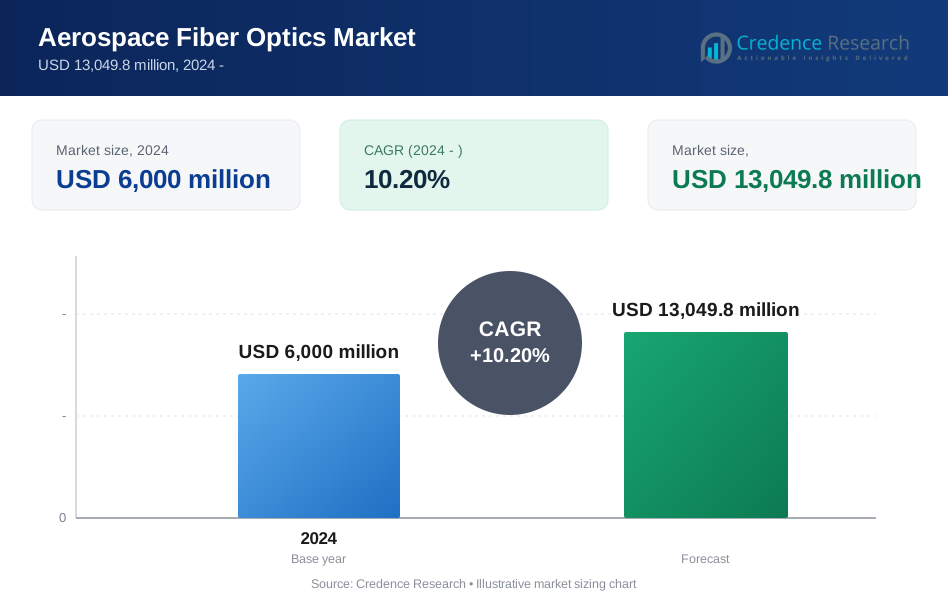
| Aerospace Fiber Optics Market Size 2024 | USD 6,000 million |
| Aerospace Fiber Optics Market, CAGR | 10.2% |
| Aerospace Fiber Optics Market Size 2032 | USD 13,049.8 million |
Market Overview
The aerospace fiber optics market is projected to grow from USD 6,000 million in 2024 to USD 13,049.8 million by 2032, registering a robust CAGR of 10.2% during the forecast period.
The aerospace fiber optics market is experiencing significant growth driven by increasing demand for lightweight, high-speed data transmission solutions in modern aircraft systems. As aerospace manufacturers prioritize weight reduction to improve fuel efficiency and performance, fiber optic technologies are increasingly replacing traditional copper wiring. The growing adoption of advanced avionics, in-flight entertainment systems, and real-time data communication in both commercial and military aircraft further accelerates demand. Enhanced reliability, electromagnetic interference resistance, and higher bandwidth capacity position fiber optics as a preferred choice for next-generation aerospace applications. Additionally, rising investments in space exploration, satellite systems, and unmanned aerial vehicles (UAVs) are expanding the market’s scope. Technological advancements in fiber optic sensors and connectors, along with growing interest in modular and scalable communication systems, also contribute to the market’s upward trajectory. As regulatory standards emphasize safety and performance, aerospace OEMs and suppliers are increasingly integrating fiber optic components to meet stringent compliance and operational requirements.
The aerospace fiber optics market spans key regions including North America, Europe, Asia Pacific, and the Rest of the World. North America leads with strong aerospace infrastructure and defense investment, followed by Europe, which benefits from established aviation manufacturing hubs and defense modernization programs. Asia Pacific is growing rapidly due to rising domestic aerospace production and military spending in countries like China and India. The Rest of the World, including Latin America, the Middle East, and Africa, shows emerging demand through infrastructure upgrades and satellite programs. Key players shaping the market include Prysmian Group, Corning, Amphenol, TE Connectivity, AFL Global, HFCL, OFS Fitel LLC, Radiall, Timbercon, Optical Cable Corporation, Interconnect Systems, Tech Optics, and WL Gore & Associates. These companies compete through innovation, strategic partnerships, and a focus on high-performance fiber solutions tailored to commercial, military, and space-based aerospace applications.
Market Insights
- The aerospace fiber optics market is projected to grow from USD 6,000 million in 2024 to USD 13,049.8 million by 2032, registering a strong CAGR of 10.2% during the forecast period.
- Demand is rising due to the need for lightweight, high-speed data systems in modern aircraft, replacing copper wiring to improve fuel efficiency and operational performance.
- Advanced avionics, in-flight connectivity, and real-time data transmission are key applications driving fiber optic integration across commercial and military platforms.
- Governments are increasing investments in defense modernization, satellite communications, and UAV systems, boosting demand for reliable and interference-free optical transmission.
- High initial installation costs and the need for skilled technicians remain challenges, particularly for retrofitting older aircraft or operating under budget constraints.
- North America leads with 38% market share, followed by Europe (27%), Asia Pacific (22%), and the Rest of the World (13%), each driven by specific aerospace priorities and investments.
- Key players including Prysmian Group, Corning, TE Connectivity, Amphenol, AFL Global, and others focus on innovation, compliance, and strategic partnerships to expand their market footprint.
Market Drivers
Rising Demand for Lightweight and High-Efficiency Systems
Aerospace fiber optics market growth is largely fueled by the increasing need to reduce aircraft weight while enhancing operational efficiency. Fiber optic cables are significantly lighter than traditional copper wires, making them ideal for aerospace applications where weight savings directly impact fuel consumption and payload capacity. OEMs and system integrators are choosing fiber optics to support the transition to more electric and fuel-efficient aircraft platforms. It also offers lower energy loss, improving power efficiency. The aerospace fiber optics market benefits from this dual advantage of weight and energy performance.
- For instance, TE Connectivity’s rugged fiber optic solutions for eVTOL systems have demonstrated up to 50% weight reduction and 25% space savings compared to electrical equivalents, enabling longer flight times or the addition of an extra passenger per 150 kg saved.
Advancements in Avionics and Data Transmission Systems
The aerospace fiber optics market is gaining traction due to the evolution of advanced avionics and real-time data transmission systems. Modern aircraft now require high-bandwidth networks to support cockpit displays, navigation systems, and in-flight communications. Fiber optics offer low latency and immunity to electromagnetic interference, making them ideal for critical signal transmission. It enables robust performance in harsh flight environments where reliability is essential. The increasing use of fly-by-light systems in next-generation aircraft further strengthens this demand. Fiber optics ensure accurate data flow, improving flight safety and control response.
- For instance, The F-35 Lightning II fighter jet uses fiber-optic networks to interconnect sensors, radar, and armament systems, allowing pilots to access and share real-time data for improved situational awareness.
Increased Investments in Defense and Space Programs
Defense modernization programs and expanding space missions significantly support the aerospace fiber optics market. Governments are increasing spending on satellite communication, electronic warfare systems, and missile defense platforms, all of which rely on high-speed, interference-free data transmission. Fiber optics provide the durability and precision needed in these sensitive applications. It also enables secure, high-volume data exchange between mission-critical systems. The market is witnessing rising contracts and collaborations focused on optical communication modules. Military aircraft upgrades and space-based systems consistently require fiber optic integration to meet mission demands.
Stringent Regulatory Requirements and Safety Standards
Strict industry standards for safety, performance, and electromagnetic compatibility continue to drive the adoption of fiber optics in aerospace applications. Regulatory bodies emphasize reducing system failures and improving communication clarity in aircraft, which positions fiber optics as a reliable solution. It meets international certification requirements and supports compliance across civil and defense aviation sectors. Fiber optics also offer excellent resistance to vibration, temperature extremes, and corrosive conditions. The aerospace fiber optics market benefits from the push toward enhanced reliability and reduced risk of system interference. Compliance-driven demand ensures steady uptake across aircraft platforms and ground support systems.
Market Trends
Integration of Fiber Optics in Next-Generation Aircraft Systems
The aerospace fiber optics market is evolving with the shift toward next-generation aircraft featuring advanced electronics and modular systems. Manufacturers are focusing on embedding fiber optic networks into core flight control, navigation, and communications systems. These networks offer superior data rates and noise immunity compared to copper-based alternatives. It supports seamless integration of more digital systems without adding significant weight. The trend reflects rising adoption of fly-by-light technology, which enhances control precision. Commercial and defense aviation sectors both seek to improve performance through embedded fiber optic infrastructure.
- For instance, NASA Lewis, in collaboration with the Department of Defense, developed the Fiber Optic Control System Integration (FOCSI) program to evaluate and advance fiber optic technology for aircraft control.
Adoption of Fiber Optic Sensors for Structural Health Monitoring
One key trend in the aerospace fiber optics market is the growing use of fiber optic sensors to monitor structural integrity in real time. These sensors help detect stress, vibration, and temperature changes within aircraft components. It enables proactive maintenance, reducing downtime and repair costs. Engineers value fiber optics for their ability to deliver precise, uninterrupted data under extreme flight conditions. Integration into wings, fuselage, and engine systems is becoming standard. Airlines and military forces rely on this technology to extend aircraft lifespan and improve safety margins.
- For instance, NASA Langley Research Center uses fiber optic sensors in morphing aircraft to simultaneously measure strain, temperature, vibration, and pressure for advanced structural monitoring.
Expansion of Optical Interconnects in Satellite and UAV Platforms
The aerospace fiber optics market is expanding with the rise of optical interconnects in satellite communication systems and unmanned aerial vehicles (UAVs). These platforms demand lightweight, high-speed data transmission to handle complex navigation, imaging, and telemetry operations. It provides a compact and efficient alternative to traditional wiring, supporting space-constrained designs. Space agencies and defense operators are incorporating fiber optics into spacecraft and drone systems to boost bandwidth and reduce electromagnetic interference. This trend is accelerating with increased launches and UAV deployments in reconnaissance and remote sensing missions.
Growth of Commercial Aviation and In-Flight Connectivity Requirements
Rising passenger expectations for in-flight connectivity and entertainment is shaping the aerospace fiber optics market. Airlines are upgrading their fleets with high-speed networks to deliver streaming, browsing, and live communication services. It enables stable, high-capacity data links without disrupting aircraft systems. Fiber optics allow integration of multiple services over a single network, improving system efficiency. Aircraft OEMs now prioritize fiber-ready designs during manufacturing. The need for fast, reliable onboard connectivity continues to push demand in commercial aviation.
Market Challenges Analysis
High Initial Costs and Complex Installation Requirements
One of the major challenges in the aerospace fiber optics market is the high initial cost of materials, components, and integration. Fiber optic systems, while efficient, require specialized connectors, splicing tools, and precision engineering that increase upfront investment. It demands skilled technicians for installation and maintenance, which raises labor costs and limits widespread adoption in smaller programs. Retrofits of existing aircraft also involve redesign and requalification, adding to overall complexity. This cost barrier often delays adoption in budget-sensitive or aging fleets. Price sensitivity remains a key restraint in commercial aviation sectors.
Durability Concerns and Limited Standardization Across Platforms
The aerospace fiber optics market faces challenges related to durability under extreme operating conditions. Although fiber optics offer strong electromagnetic resistance, they remain susceptible to mechanical stress, microbending, and installation errors. It requires strict handling and specialized enclosures to ensure long-term reliability in high-vibration and temperature-variable environments. A lack of standardization in components and testing protocols across global aerospace platforms further complicates integration. OEMs and system suppliers often face compatibility issues during design and maintenance. This variation can delay deployment timelines and increase lifecycle costs.
Market Opportunities
Expansion of Urban Air Mobility and Electric Aviation Platforms
The aerospace fiber optics market holds strong growth potential with the emergence of urban air mobility (UAM) and electric aviation platforms. These aircraft require lightweight, compact, and high-speed data systems to manage autonomous navigation, propulsion control, and real-time diagnostics. Fiber optics meet these demands while supporting reduced emissions and higher energy efficiency. It offers an ideal solution for electric vertical takeoff and landing (eVTOL) aircraft, where space and weight are tightly constrained. Companies investing in next-generation air transport view fiber optics as critical infrastructure. The shift toward sustainable aviation strengthens this long-term opportunity.
Rising Demand in Space-Based Communication and Exploration Programs
Increasing global investment in satellite constellations, deep-space missions, and lunar exploration presents new opportunities for the aerospace fiber optics market. Space systems demand high-performance data transmission with minimal weight and maximum reliability. Fiber optics provide bandwidth and resilience needed in vacuum and radiation-prone environments. It allows spacecraft to manage onboard systems, sensors, and communication payloads effectively. Government and commercial space initiatives are expanding rapidly, opening contracts for advanced optical technologies. The growing presence of private players further accelerates market entry points for fiber optic providers.
Market Segmentation Analysis:
By Type
The aerospace fiber optics market is segmented into single-mode and multi-mode fiber types. Single-mode fiber dominates in applications requiring long-distance, high-bandwidth communication due to its low signal attenuation and high precision. It is widely used in aircraft data backbones and satellite systems. Multi-mode fiber is preferred for short-distance data transmission within aircraft, especially in cabin systems and in-flight entertainment. It offers easier alignment and cost-effective installation. Both types are essential in designing efficient, high-speed aerospace communication networks.
- For example, OFS Optics, a leading provider of optical fiber for aerospace, has supplied single-mode fibers specifically engineered for satellite communication systems, ensuring reliable, high-speed data transmission over thousands of kilometers in space-based applications.
By Material
Based on material, the aerospace fiber optics market includes glass fiber and plastic fiber. Glass fiber leads in high-performance aerospace systems due to its superior bandwidth, heat resistance, and long-term durability. It performs reliably in harsh operating conditions such as high altitudes and extreme temperatures. Plastic fiber, while less durable, finds use in less demanding applications due to its flexibility and lower cost. It serves well in short-range and non-critical systems where ease of handling is a priority.
- For instance, Airbus has integrated glass fiber optic systems into the A350 XWB for advanced avionics and health monitoring, benefiting from the material’s ability to maintain signal integrity under thermal and mechanical stress.
By Application
By application, the aerospace fiber optics market is categorized into communication systems, weapons systems, intelligence, surveillance, and reconnaissance (ISR) systems, navigation and sensing, avionics, and others. Communication systems represent a significant share due to rising connectivity needs in both civil and defense aircraft. ISR and avionics systems increasingly rely on fiber optics for data accuracy and speed. It enhances performance in high-stakes operations requiring real-time data. Weapons systems and navigation also demand fiber optics to ensure precision and resilience in mission-critical scenarios.
Segments:
Based on Type:
- Single mode
- Multi-mode
Based on Material
- Glass fiber
- Plastic fiber
Based on Application
- Communication systems
- Weapons systems
- Intelligence, surveillance, and reconnaissance (ISR) systems
- Navigation & sensing
- Avionics
- Others
By Platform
- Commercial
-
- Narrow-body
- Wide-body
- Regional jets
- Turboprop
- Defense
-
- Airborne
-
-
- Combat aircraft
- Unmanned aerial vehicles
- Military transport aircraft
- Military helicopters
-
-
- Land
- Armored vehicles
- Unmanned ground vehicles
- Command, Control, Communications, Computers, Intelligence, Surveillance, and Reconnaissance (C4ISR)
- Marine
- Land
-
-
- Destroyers
- Frigates
- Unmanned maritime vehicles
- Submarines
- Offshore patrol vessels (OPVS)
- Aircraft carriers
-
- Space
-
- Space launch vehicles
- Satellites
Based on the Geography:
- North America
- U.S.
- Canada
- Mexico
- Europe
- Germany
- France
- U.K.
- Italy
- Spain
- Rest of Europe
- Asia Pacific
- China
- Japan
- India
- South Korea
- South-east Asia
- Rest of Asia Pacific
- Latin America
- Brazil
- Argentina
- Rest of Latin America
- Middle East & Africa
- GCC Countries
- South Africa
- Rest of the Middle East and Africa
Regional Analysis
North America
North America holds the largest share in the aerospace fiber optics market, accounting for 38% of the global revenue. The presence of major aerospace OEMs, defense contractors, and space agencies such as NASA drives strong demand. The United States leads in the adoption of advanced fiber optic systems across commercial, military, and space applications. It benefits from ongoing programs related to fighter aircraft upgrades, satellite deployment, and unmanned aerial vehicles. The region also sees high investment in avionics modernization and secure communication systems. Strong research and development infrastructure supports continued innovation in fiber optic technologies.
Europe
Europe represents 27% of the aerospace fiber optics market, driven by established aerospace manufacturing hubs in Germany, France, and the United Kingdom. The region supports both commercial aviation and defense modernization initiatives under the European Defence Fund. It sees growing integration of fiber optics in fighter jets, surveillance aircraft, and cross-border UAV programs. Major aircraft producers are embedding fiber optic systems in new aircraft designs to meet efficiency and emissions goals. The region also focuses on satellite and space exploration missions that require high-performance optical communication. Regulatory mandates around emissions and system reliability push fiber optic adoption further.
Asia Pacific
Asia Pacific accounts for 22% of the aerospace fiber optics market, with growth led by China, India, Japan, and South Korea. Expanding domestic aerospace programs and rising defense budgets are boosting demand for fiber optic-enabled systems. It supports regional ambitions in civil aviation expansion and military modernization. Local aerospace companies are increasing collaboration with global suppliers to adopt lightweight and high-speed communication systems. Growing interest in regional satellite launches and surveillance platforms adds to the momentum. Government-backed initiatives for indigenous aircraft production fuel long-term market potential in this region.
Rest of the World
The Rest of the World holds 13% of the aerospace fiber optics market share. Latin America and the Middle East are witnessing steady uptake through military procurement and airport infrastructure modernization. Africa is gradually investing in satellite communication and surveillance technologies, opening future opportunities. It remains a developing region for aerospace fiber optic integration.
Key Player Analysis
- Prysmian Group
- Optical Cable Corporation
- Radiall
- Tech Optics
- WL Gore & Associates
- AFL Global
- OFS Fitel LLC
- Timbercon
- Interconnect Systems
- Amphenol
- TE Connectivity
- Corning
- HFCL
Competitive Analysis
The aerospace fiber optics market features a competitive landscape dominated by global players focusing on innovation, performance, and reliability. Companies such as Prysmian Group, Corning, Amphenol, and TE Connectivity lead the market through advanced product offerings and strong distribution networks. It remains highly innovation-driven, with firms investing in ruggedized, high-bandwidth fiber solutions tailored for harsh aerospace environments. Players like AFL Global, HFCL, and OFS Fitel LLC emphasize technological advancements to meet evolving defense and commercial aviation needs. Companies such as Radiall, Timbercon, and WL Gore & Associates focus on precision components and customized interconnects to support avionics and data systems. Strategic collaborations with aerospace OEMs, along with compliance with stringent industry standards, enable firms to secure long-term contracts. The aerospace fiber optics market continues to see increased consolidation, with players expanding global presence and product portfolios to capture emerging opportunities in electric aviation and space applications.
Recent Developments
- In January 2024, Amphenol Corporation introduced a new series of high-performance fiber optic connectors tailored for use in harsh aerospace and military conditions.
- In June 2025, TE Connectivity unveiled its MULTIGIG Transceiver (TRX) platform during the Paris Air Show, designed to deliver up to 10 Gbps per channel for aerospace, defense, and marine sectors.
- In December 2024, Airbus, in collaboration with CNES, completed the TELEO optical communication test aboard the Badr-8 satellite, achieving multi-Gbps space-to-ground transmission capabilities.
- In February 2024, RTX Corporation formed a partnership with the U.S. Air Force to advance high-power laser technologies, enhancing fiber optic applications in defense and aerospace operations.
Market Concentration & Characteristics
The aerospace fiber optics market shows moderate to high market concentration, with a few global players holding significant shares due to their technical expertise, established supply chains, and long-standing relationships with aerospace OEMs. It is characterized by high entry barriers driven by strict certification requirements, specialized manufacturing processes, and the need for long-term performance reliability under extreme conditions. The market favors companies that can deliver lightweight, high-bandwidth, and ruggedized optical components tailored for both commercial and military applications. Innovation cycles are relatively long, and product development often involves close collaboration with aircraft manufacturers and defense agencies. The market is technology-driven, placing emphasis on durability, electromagnetic immunity, and high data throughput. It also exhibits strong demand for customization, with suppliers required to adapt solutions to fit evolving aircraft platforms. The competitive landscape is shaped by R&D intensity, patent portfolios, and the ability to meet stringent global aerospace standards.
Report Coverage
The research report offers an in-depth analysis based on Type, Material, Application, Platform and Geography. It details leading market players, providing an overview of their business, product offerings, investments, revenue streams, and key applications. Additionally, the report includes insights into the competitive environment, SWOT analysis, current market trends, as well as the primary drivers and constraints. Furthermore, it discusses various factors that have driven market expansion in recent years. The report also explores market dynamics, regulatory scenarios, and technological advancements that are shaping the industry. It assesses the impact of external factors and global economic changes on market growth. Lastly, it provides strategic recommendations for new entrants and established companies to navigate the complexities of the market.
Future Outlook
- Demand for fiber optic solutions will increase with the rising production of next-generation commercial and military aircraft.
- Electric and hybrid-electric aviation platforms will rely more on fiber optics to reduce weight and improve system efficiency.
- Space exploration programs and satellite deployments will continue to drive adoption of fiber optic communication systems.
- Advanced avionics and real-time flight data systems will require higher bandwidth and more reliable optical networks.
- Fly-by-light control systems will become more common, boosting the need for precise and interference-free fiber optics.
- Growing investments in UAVs and autonomous flight systems will create new opportunities for fiber optic integration.
- Regulatory requirements for safety, electromagnetic compatibility, and emissions will support wider fiber optic use.
- Regional growth in Asia Pacific and the Middle East will expand the customer base for aerospace fiber optic suppliers.
- Customizable and ruggedized fiber optic components will gain traction across space and defense applications.
- Companies will focus on strategic partnerships and R&D to deliver advanced, mission-critical fiber optic technologies.
Request a Free Sample
Fill in your details and we'll send you a free sample report.
- Sample data tables & charts
- Research methodology
Need a Custom Version of This Report?
Tailor the scope, geography, or segments to your exact requirements.
- Custom geography or segment scope
- Direct access to our analyst team
Frequently Asked Questions
What is the current size of the Aerospace fiber optics market?
What are the key segments within the Aerospace fiber optics market?
Who are the major players in the Aerospace fiber optics market?
What are some challenges faced by the Aerospace fiber optics market?
Table of Content
Chapter 1. Report Introduction
- 1.1 Report Description & Purpose
- 1.1.1 Report Title & Market Definition
- 1.1.2 Unique Selling Propositions (USP) & Key Differentiators
- 1.1.3 Value Proposition for Stakeholders
- 1.2 Research Objectives
- 1.2.1 Market Sizing Objectives (Volume & Revenue)
- 1.2.2 Segmentation Objectives
- 1.2.3 Competitive Intelligence Objectives
- 1.2.4 Forecast & Scenario Objectives
- 1.3 Report Scope
- 1.3.1 Aerospace Fiber Optics Scope – Types & Subtypes Covered
- 1.3.2 Geographic Scope – Regions & Countries Covered
- 1.3.3 Historical Period, Base Year & Forecast Period (2024; forecast to the forecast period)
- 1.3.4 Inclusions & Exclusions
- 1.4 HS Code & Classification Framework
- 1.5 Currency, Units & Pricing Basis
- 1.6 Target Stakeholders
- 1.7 Limitations & Assumptions
Chapter 2. Executive Summary
- 2.1 Global Aerospace Fiber Optics Market Snapshot
- 2.1.1 Market Size – Historical (2024) & Forecast (the forecast period) (2024: USD 6,000 million → forecast year: USD 13,049.8 million)
- 2.1.2 Volume & Revenue – Global Totals
- 2.1.3 Key Market Highlights – Top Five Facts
- 2.2 Aerospace Fiber Optics Market Segmentation Snapshot
- 2.2.1 Market Split by Region – 2024 vs.
- 2.3 Competitive Snapshot
- 2.3.1 Top 10 Players by Revenue Share – 2024
- 2.3.2 Top 10 Players by Volume Share – 2024
- 2.3.3 Recent Strategic Developments (18-Month Summary)
- 2.4 Key Investment Highlights & Strategic Conclusions
Chapter 3. Aerospace Fiber Optics Market Dynamics & Industry Analysis
- 3.1 Market Overview & Context
- 3.1.1 Aerospace Fiber Optics Market Position in the Broader Automotive Value Chain
- 3.1.2 OEM vs. Replacement Market Dynamics
- 3.1.3 Market Maturity & Development Stage by Region
- 3.2 Aerospace Fiber Optics Market Drivers
- 3.3 Aerospace Fiber Optics Market Restraints & Challenges
- 3.4 Aerospace Fiber Optics Market Opportunities
- 3.5 Porter's Five Forces Analysis
- 3.5.1 Threat of New Entrants
- 3.5.2 Bargaining Power of Suppliers
- 3.5.3 Bargaining Power of Buyers
- 3.5.4 Threat of Substitutes
- 3.5.5 Competitive Rivalry – Intensity Assessment
- 3.6 Aerospace Fiber Optics Value Chain Analysis
- 3.6.1 Upstream – Raw Material/Input Suppliers
- 3.6.1.1 Raw Material/Input 1
- 3.6.1.2 Raw Material/Input 2
- 3.6.1.3 Raw Material/Input 3
- 3.6.2 Midstream – Production/Manufacturing/Service Delivery
- 3.6.2.1 Production/Process Overview
- 3.6.2.2 Key Facility Locations & Capacity by Manufacturer
- 3.6.3 Downstream – Distribution & End Consumer
- 3.6.3.1 Primary Channel – B2B/OEM
- 3.6.3.2 Secondary Channels – Dealer, Retail, Online, Direct
- 3.6.4 Value Chain Profitability Analysis
- 3.6.1 Upstream – Raw Material/Input Suppliers
- 3.7 PESTEL Analysis
- 3.7.1 Political Factors
- 3.7.2 Economic Factors
- 3.7.3 Social Factors
- 3.7.4 Technological Factors
- 3.7.5 Environmental Factors
- 3.7.6 Legal Factors
- 3.8 Aerospace Fiber Optics Supply Chain Analysis
- 3.8.1 Raw Material/Input Supply Risk Assessment
- 3.8.2 Manufacturing Concentration Risk (Geographic Exposure)
- 3.8.3 Trade Disruption Impact Analysis
- 3.9 Regulatory & Policy Landscape
Note: The regulatory and policy landscape section covers regulations based on their applicability to the market, Aerospace Fiber Optics category, geography, and scope of the study. Only regulatory frameworks with a material impact on operations, compliance, trade, sustainability, or market access are analyzed in detail.
Chapter 4. Key Investment Pockets & Opportunity Analysis
- 4.1 Aerospace Fiber Optics Market Attractiveness Analysis
- 4.1.1 By Region – Investment Attractiveness Matrix (Volume × CAGR)
- 4.2 Absolute Revenue Growth Opportunity
- 4.2.1 By Region – Absolute USD Growth Through the forecast period
- 4.3 Incremental Volume Opportunity
- 4.3.1 By Region – Incremental Volume Through the forecast period
- 4.3.2 Segment – Incremental Volume
- 4.4 Emerging Submarket Opportunity Deep Dive (Subject to Applicability)
- 4.5 Emerging Market Opportunity Scorecards
- 4.5.1 United States
- 4.5.2 Europe
- 4.5.3 Asia
- 4.5.4 Middle East & Africa
Note: Emerging Market Opportunity Scorecards will be included based on relevance and strategic importance. Regions listed are indicative and may vary depending on data availability and market dynamics.
Chapter 5. Aerospace Fiber Optics Import-Export Analysis & Trade Flows
- 5.1 Global Trade Overview
- 5.1.1 Global Export Value by Country (2024)
- 5.1.2 Global Export Volume by Country (2024)
- 5.1.3 Global Import Value by Country (2024)
- 5.1.4 Global Import Volume by Country (2024)
- 5.1.5 Net Trade Balance by Country (2024)
- 5.2 Export Analysis – Segment
- 5.2.1 Type 1 (HS Code)
- 5.2.2 Type 2 (HS Code)
- 5.2.3 Type 3 (HS Code)
- 5.2.4 Type 4 (HS Code)
- 5.2.5 Type 5 (HS Code)
- 5.3 Import Analysis – Segment
- 5.3.1 Type 1 (HS Code)
- 5.3.2 Type 2 (HS Code)
- 5.3.3 Type 3 (HS Code)
- 5.3.4 Type 4 (HS Code)
- 5.3.5 Type 5 (HS Code)
- 5.4 Average Unit Trade Prices
- 5.4.1 Average Export Price – Segment & Country
- 5.4.2 Average Import Price – Segment & Source Country
- 5.4.3 Price Trends (2024)
- 5.5 Key Trade Route Analysis
- 5.5.1 Trade Route 1
- 5.5.2 Trade Route 2
- 5.5.3 Trade Route 3
- 5.5.4 Trade Route 4
- 5.5.5 Trade Route 5
- 5.6 Trade Policy Impact Assessment
- 5.6.1 US Anti-Dumping & Section 301 Tariffs
- 5.6.2 EU Customs Union Impact
- 5.6.3 Major Free Trade Agreements
- 5.6.4 USMCA Rules of Origin
Note: Trade policy analysis will be included only where relevant to the Aerospace Fiber Optics market.
Chapter 6. Competitive Landscape & Company Benchmarking
- 6.1 Aerospace Fiber Optics Market Concentration & Structure
- 6.1.1 Herfindahl-Hirschman Index (HHI) – vs. 2024
- 6.1.2 Tier 1, Tier 2 & Tier 3 Market Structure
- 6.1.3 Global, Regional & Local Player Dynamics
- 6.2 Aerospace Fiber Optics Market Share Analysis – 2024
- 6.2.1 Global Revenue Share by Company
- 6.2.2 Global Volume Share by Company
- 6.2.3 Regional Revenue Share
- 6.2.4 Market Share Evolution ( vs. 2024)
- 6.2.5 OEM Segment Share by Company
- 6.2.6 Replacement Segment Share by Company
- 6.3 Production/Delivery Capacity & Facility Analysis
- 6.3.1 Global Installed Capacity
- 6.3.2 Capacity Utilization Rates
- 6.3.3 Production/Output Volume
- 6.3.4 Facility Locations & Capacity Map
- 6.3.5 Planned Capacity Additions
- 6.4 Aerospace Fiber Optics Competitive Benchmarking Matrix
- 6.4.1 Revenue, Volume, CAGR & Profitability Comparison
- 6.4.2 Channel Revenue Mix
- 6.4.3 Geographic Revenue Exposure
- 6.4.4 R&D Intensity
- 6.4.5 Sustainability Maturity
- 6.5 Strategic Developments in Aerospace Fiber Optics (Last 24 Months)
- 6.5.1 Mergers, Acquisitions & Divestments
- 6.5.2 New Aerospace Fiber Optics Launches
- 6.5.3 Facility Expansions
- 6.5.4 Strategic Alliances, Joint Ventures & Partnerships
- 6.5.5 Distribution Expansion & Market Entry
- 6.5.6 Sustainability & ESG Initiatives
- 6.6 Competitive Strategy Mapping
- 6.6.1 Leader, Challenger, Follower & Niche Classification
- 6.6.2 Pricing Strategy Comparison
- 6.6.3 Channel Strategy Matrix
Note: Strategic developments are included based on their materiality and the availability of reliable information.
Chapter 7. Global Aerospace Fiber Optics Market – By Distribution Channel
- 7.1 Segment Overview
- 7.1.1 Volume & Revenue Split by Channel (2024 & )
- 7.1.2 Channel Mix Evolution (the forecast period)
Chapter 8. Regional Market Analysis – Global Overview
- 8.1 Global Regional Overview
- 8.1.1 Regional Volume Share
- 8.1.2 Regional Revenue Share
- 8.1.3 Regional Volume by Region
- 8.1.4 Regional Revenue by Region
- 8.1.5 Regional Forecast Through the forecast period
- 8.2 Cross-Regional Segment Analysis
- 8.2.1 By Distribution Channel
- 8.2.2 By Brand/Price Tier
Chapter 9. North America Aerospace Fiber Optics Market
- 9.1 United States
- 9.2 Canada
- 9.3 Mexico
Chapter 10. Europe Aerospace Fiber Optics Market
- 10.1 Germany
- 10.2 France
- 10.3 Italy
- 10.4 United Kingdom
- 10.5 Spain
- 10.6 Poland
- 10.7 Russia
- 10.8 Netherlands
- 10.9 Belgium
- 10.10 Sweden
- 10.11 Denmark
- 10.12 Norway
- 10.13 Rest of Europe
Chapter 11. Asia Pacific Aerospace Fiber Optics Market
- 11.1 China
- 11.2 India
- 11.3 Japan
- 11.4 South Korea
- 11.5 Thailand
- 11.6 Indonesia
- 11.7 Vietnam
- 11.8 Malaysia
- 11.9 Australia
- 11.10 Rest of Asia Pacific
Chapter 12. Latin America Aerospace Fiber Optics Market
- 12.1 Brazil
- 12.2 Argentina
- 12.3 Colombia
- 12.4 Chile
- 12.5 Rest of Latin America
Chapter 13. Middle East Aerospace Fiber Optics Market
- 13.1 Saudi Arabia
- 13.2 United Arab Emirates
- 13.3 Turkey
- 13.4 Israel
- 13.5 Iran
- 13.6 Rest of the Middle East
Chapter 14. Africa Aerospace Fiber Optics Market
- 14.1 South Africa
- 14.2 Egypt
- 14.3 Nigeria
- 14.4 Morocco
- 14.5 Rest of Africa
Chapter 15. Aerospace Fiber Optics Company Profiles
- 15.1 [Company 01]
- 15.1.1 Company Overview
- 15.1.2 Key Management Personnel
- 15.1.3 Products & Services Portfolio
- 15.1.4 Financial Performance
- 15.1.5 Key Market Focus & Geographic Presence
- 15.1.6 Recent Developments & Strategic Initiatives
Note: The company profile list is preliminary and may change based on research findings, market developments, data availability, and client requirements.
Chapter 16. Appendices
- Appendix A – List of Abbreviations & Acronyms
- Appendix B – Industry Classification Code Reference – Full Series
- Appendix C – Production & Capacity Data Tables
- Appendix D – End-Use & Demand Base Tables
- Appendix E – Consumption & Replacement Rate Assumptions
- Appendix F – ASP Reference Tables
- Appendix G – Manufacturing & Facility Database
- Appendix H – Import-Export Data Tables
- Appendix I – Regulatory Summary Tables
- Appendix J – Primary Research Participant List (Anonymized)
- Appendix K – Primary Research Questionnaire Framework
- Appendix L – Data Sources & Bibliography
- Appendix M – Market Size Divergence & Source Comparison
Chapter 17. Research Methodology
- 17.1 Research Framework & Philosophy
- 17.2 Secondary Research – Sources, Hierarchy & Data Extraction
- 17.3 Data Modeling – Bottom-Up & Top-Down Market Sizing
- 17.4 Primary Research – Stakeholder Framework, LOI & Sample Sizes
- 17.5 Forecast Methodology – Regression, Scenario & Sensitivity Analysis
- 17.6 Quality Control – Four-Layer Validation Framework
- 17.7 Limitations & Standard Assumptions
- 17.8 Disclaimer
