
Africa Nephrology & Dialysis Devices Market Overview:
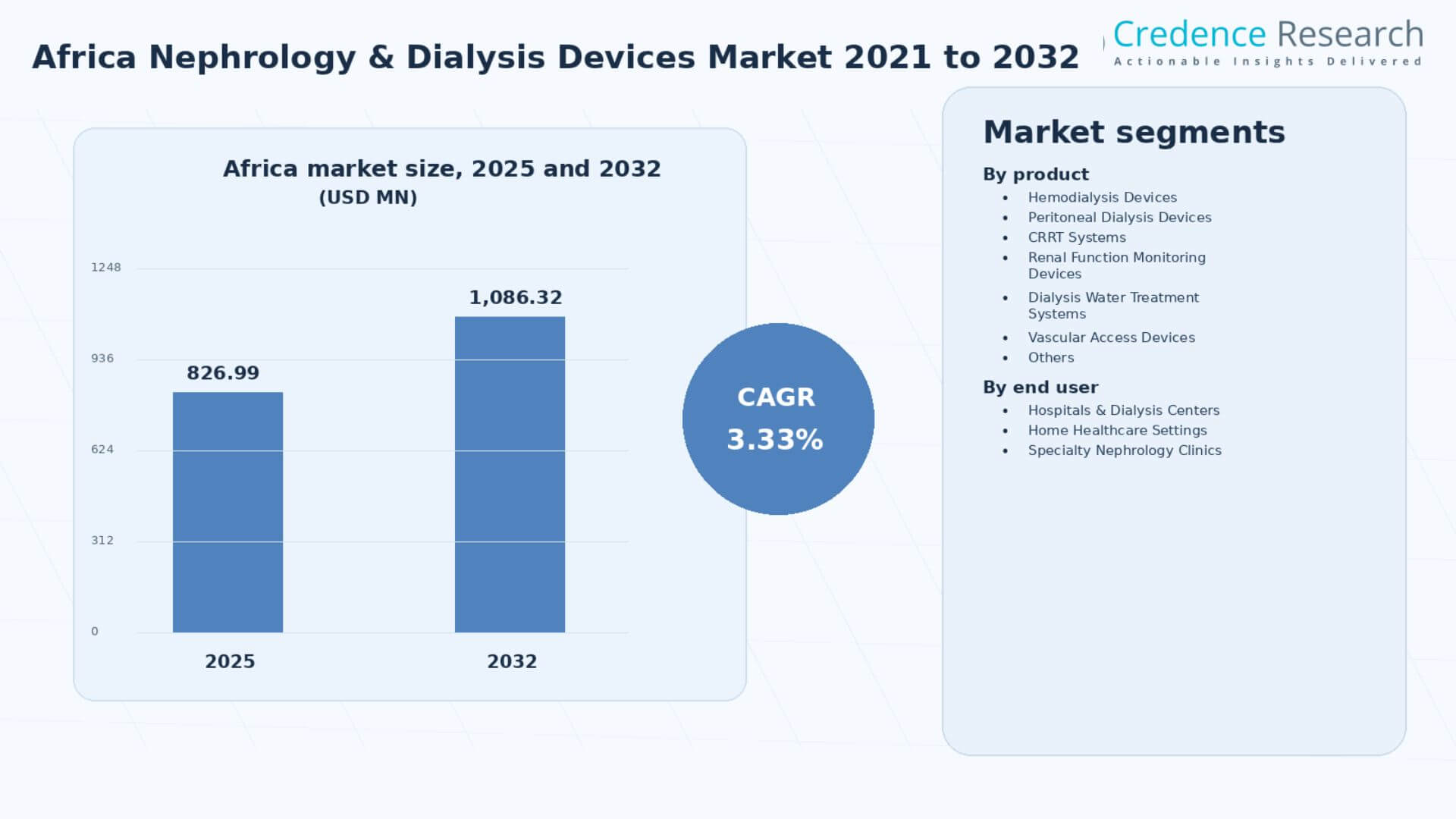
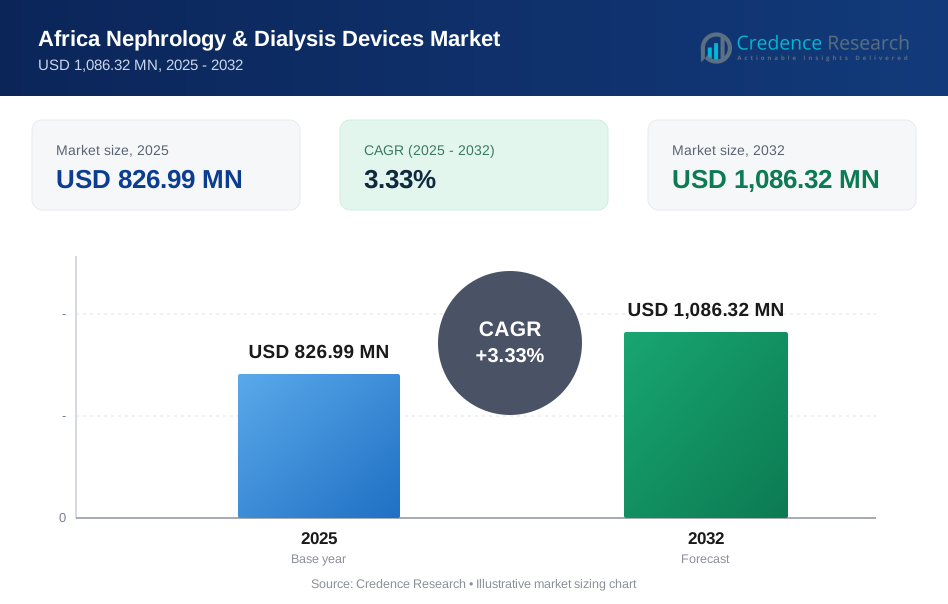
The Africa Nephrology & Dialysis Devices Market size was valued at USD 714.40 MN in 2021 and reached USD 826.99 MN in 2025. It is anticipated to reach USD 1,086.32 MN by 2032, growing at a CAGR of 3.33% during the forecast period.
| REPORT ATTRIBUTE | DETAILS |
|---|---|
| Historical Period | 2021-2024 |
| Base Year | 2025 |
| Forecast Period | 2025-2032 |
| Africa Nephrology & Dialysis Devices Market Size 2025 | USD 826.99 million |
| Africa Nephrology & Dialysis Devices Market, CAGR | 3.33% |
| Africa Nephrology & Dialysis Devices Market Size 2032 | USD 1,086.32 million |
Africa Nephrology & Dialysis Devices Market Insights
- Market growth is supported by rising chronic kidney disease burden, increasing dialysis access needs, hemodialysis infrastructure expansion, dialysis water treatment demand and growing use of renal monitoring systems in hospitals and dialysis centers.
- Hemodialysis Devices hold the strongest position because most kidney failure treatment in Africa is delivered through facility-based dialysis centers and hospital dialysis units.
- Peritoneal Dialysis Devices are gaining gradual relevance because home-based dialysis can improve access where travel distance, center capacity and recurring treatment visits restrict care.
- Hospitals & Dialysis Centers remain the leading end-user segment because dialysis requires specialist oversight, water treatment systems, trained nurses, vascular access management and recurring treatment infrastructure.
Africa Nephrology & Dialysis Devices Market Segment Insights
By product
By product, Hemodialysis Devices held the strongest position in 2025 because dialysis delivery across Africa is still largely center-based and depends on hemodialysis machines, dialyzers, bloodlines, concentrates, water treatment systems and vascular access support. Peritoneal Dialysis Devices are gaining importance because they can support home-based and decentralized kidney replacement therapy where patients face long travel distances to dialysis centers. Continuous Renal Replacement Therapy (CRRT) Systems support acute kidney injury treatment in intensive care units, though uptake remains concentrated in advanced hospitals. Renal Function Monitoring Devices are important for CKD diagnosis, acute kidney injury monitoring and dialysis adequacy. Dialysis Water Treatment Systems are essential for safe hemodialysis operations, while Vascular Access Devices support catheter placement, fistula management and dialysis continuity.
By end user
By end user, Hospitals & Dialysis Centers held the strongest position in 2025 because dialysis infrastructure, infection control, water treatment, medical supervision and emergency support remain concentrated in formal clinical settings. Home Healthcare Settings are growing gradually as peritoneal dialysis, remote follow-up and home care models gain attention, though adoption remains limited by training, supply logistics and affordability. Specialty Nephrology Clinics play an important role in CKD diagnosis, dialysis referral, vascular access follow-up and long-term treatment planning. End-user growth will depend on public reimbursement, private dialysis investment, specialist availability, patient transportation, consumable supply and equipment service networks.
Key Market Drivers
Rising kidney disease burden and dialysis need
Rising kidney disease burden and dialysis need represent major growth drivers for the Africa Nephrology & Dialysis Devices Market. WHO reported in 2026 that an estimated 674 million people have chronic kidney disease worldwide and that most live in low- and middle-income countries. WHO also stated that kidney replacement therapy, including dialysis or kidney transplantation, may be required for kidney failure, and the World Health Assembly adopted a May 2025 resolution on promoting kidney health, early detection and equitable access to essential services. This burden supports Hemodialysis Devices, Peritoneal Dialysis Devices, Renal Function Monitoring Devices and Hospitals & Dialysis Centers. Africa’s market will expand as CKD screening, diabetes care, hypertension management and referral pathways improve.
Facility-based hemodialysis dominance
Facility-based hemodialysis dominance supports demand for hemodialysis machines, dialyzers, bloodlines, concentrates and dialysis water treatment systems. Fresenius Medical Care said around 4.5 million patients worldwide regularly undergo dialysis treatment and that it cared for more than 292,000 patients across roughly 3,600 dialysis centers worldwide as of Dec. 31, 2025. The company also reported that hemodialysis products held more than 40% of the global hemodialysis products market in 2025, while dialyzers for hemodialysis represented the largest product group with around 450 million units sold worldwide. This driver supports Hemodialysis Devices, Dialysis Water Treatment Systems, Vascular Access Devices and Hospitals & Dialysis Centers.
Home dialysis and peritoneal dialysis access potential
Home dialysis and peritoneal dialysis access potential is increasing because center-based dialysis can be difficult for patients who live far from major cities or face transport costs. Fresenius Medical Care reported that Care Enablement revenue trends in 2025 were supported by higher revenue related to machines for chronic treatment, home hemodialysis products and peritoneal dialysis products. Vantive, formerly Baxter’s Kidney Care business, said about 4 million people worldwide receive dialysis treatment for chronic kidney disease and described its portfolio as including peritoneal dialysis, hemodialysis and organ support therapies.
Dialysis product and vascular access innovation
Dialysis product and vascular access innovation supports safer treatment delivery and higher procedural continuity. B. Braun describes hemodialysis as a renal replacement therapy used for end-stage renal disease and acute kidney injury and says its hemodialysis portfolio includes dialysis machines, bloodlines, dialyzers, concentrates, filters and customer-specific technical support. BD’s 2025 annual report listed acute dialysis catheters, vascular access technology, central lines, vascular care products, disinfecting caps, prefilled flush syringes and vascular preparation products within its BD Medical segment.
Key Trends and Opportunities
Peritoneal dialysis supports decentralized care
Peritoneal dialysis supports decentralized care because it can reduce dependence on center-based dialysis visits and expand kidney replacement therapy access where dialysis centers are limited. This trend is important for Africa because many patients face long travel distances, limited dialysis slots and high transport cost. Peritoneal Dialysis Devices can support Home Healthcare Settings if training, infection prevention, supply delivery and clinician follow-up improve. Vantive’s standalone kidney care platform reinforces continued industry investment in peritoneal dialysis and chronic dialysis therapies after Baxter completed its Kidney Care business sale. Growth will depend on reimbursement, patient education and supply chain reliability.
Dialysis water treatment becomes a critical infrastructure priority
Dialysis water treatment is becoming a critical infrastructure priority as more dialysis centers expand treatment capacity. Hemodialysis requires large volumes of treated water and strict quality controls to reduce infection and chemical exposure risks. Dialysis Water Treatment Systems are therefore essential for new dialysis center builds, facility upgrades and quality improvement programs. B. Braun’s hemodialysis product information highlights the need for technology, service support and maintenance management to ensure continuous technical support and equipment utilization. Vendors that combine dialysis machines, water treatment systems, service contracts and training will gain stronger positioning.
Renal function monitoring shifts attention toward earlier CKD management
Renal function monitoring is gaining importance as countries focus on early detection of CKD and management of diabetes and hypertension. WHO’s May 2025 kidney health resolution calls for improved early detection and management of kidney disease, especially among people with diabetes and hypertension. This trend supports Renal Function Monitoring Devices, Specialty Nephrology Clinics, Hospitals & Dialysis Centers and primary referral pathways. Earlier diagnosis can increase device demand indirectly by improving patient tracking, nephrology referral and preparation for vascular access or modality selection before kidney failure progresses.
Private dialysis networks and supplier partnerships expand
Private dialysis networks and supplier partnerships are expanding in countries where public-sector capacity remains constrained. Hospitals, dialysis chains and specialty clinics increasingly need integrated supply of machines, dialyzers, concentrates, water systems, vascular access devices and maintenance. Fresenius Medical Care said it supplied life-sustaining medical technology for patients in 140 countries and delivered more than 44 million dialysis treatments worldwide in 2025. This trend supports Hospitals & Dialysis Centers and all major product categories. Growth will depend on payer coverage, tendering, distributor strength and long-term service reliability.
Key Market Challenges
Affordability and reimbursement constraints
Affordability and reimbursement constraints remain major challenges for the Africa Nephrology & Dialysis Devices Market. Dialysis requires recurring treatments, machines, consumables, water systems, vascular access procedures, laboratory monitoring and trained staff. In markets with limited insurance coverage, out-of-pocket spending can reduce treatment continuity and delay diagnosis. The challenge is stronger for patients requiring lifelong hemodialysis or peritoneal dialysis supplies. Public reimbursement expansion, pooled procurement, donor support and local service models will be required to improve access and reduce financial discontinuation.
Limited dialysis center density and specialist workforce
Limited dialysis center density and specialist workforce restrict treatment access in many African countries. Dialysis care requires nephrologists, dialysis nurses, biomedical engineers, vascular access specialists, infection control staff and laboratory support. The ISN-Global Kidney Health Atlas maps kidney care readiness, capacity and access for acute kidney injury and chronic kidney disease across more than 160 countries, showing the importance of system capacity measurement for kidney care planning. Workforce shortages can limit utilization even when machines are installed. Training, retention and hub-and-spoke nephrology models will remain essential.
Consumable supply and maintenance risk
Consumable supply and maintenance risk can disrupt dialysis service continuity. Hemodialysis and peritoneal dialysis require dialyzers, tubing sets, concentrates, catheters, PD fluids, disinfectants, filters and spare parts. Equipment downtime can immediately reduce treatment capacity and patient access. Markets with weaker logistics, currency pressure or import delays face greater supply risk. Vendors must maintain local inventory, trained engineers, preventive maintenance plans and distributor reliability. Dialysis Water Treatment Systems also require ongoing monitoring, consumable replacement and technical support.
Infrastructure and water quality limitations
Infrastructure and water quality limitations affect hemodialysis expansion. Dialysis centers require stable electricity, treated water, infection control systems, waste management, biomedical engineering support and emergency response capability. Rural and secondary facilities may lack the infrastructure needed for safe hemodialysis operations. These constraints can slow adoption of Hemodialysis Devices, Dialysis Water Treatment Systems and CRRT Systems outside major urban hospitals. Peritoneal dialysis and home-based models can reduce some facility constraints, but they create separate challenges around training, sterile supplies and infection prevention.
Regional Analysis
South Africa
South Africa leads the Africa Nephrology & Dialysis Devices Market due to stronger hospital infrastructure, private dialysis networks, specialist nephrology capacity and more developed reimbursement channels than many regional peers. Hemodialysis Devices, Dialysis Water Treatment Systems, Vascular Access Devices and Renal Function Monitoring Devices remain key product categories. Hospitals & Dialysis Centers dominate end use, while Home Healthcare Settings have gradual growth potential through peritoneal dialysis and remote follow-up. Growth will depend on reimbursement stability, private provider investment, equipment replacement cycles and training.
Egypt
Egypt represents a strong growth market due to large population, high chronic disease burden, public hospital demand and private dialysis center expansion. Hemodialysis Devices remain central because facility-based dialysis is the dominant treatment model. Dialysis Water Treatment Systems, Vascular Access Devices and Renal Function Monitoring Devices also support expanding dialysis capacity. Specialty Nephrology Clinics are important for CKD referral and long-term follow-up. Growth will depend on public procurement, domestic distributor networks, service capability, affordability and patient access in urban and secondary cities.
Nigeria
Nigeria offers long-term growth potential due to large unmet need, rising diabetes and hypertension burden and limited dialysis access outside major cities. Hospitals & Dialysis Centers remain the primary end users, while Specialty Nephrology Clinics support diagnosis and referral in urban markets. Hemodialysis Devices and Dialysis Water Treatment Systems are critical for facility expansion, but cost, infrastructure and service constraints limit adoption. Peritoneal Dialysis Devices may gain relevance if patient training, supply delivery and infection prevention systems improve. Growth will depend on insurance expansion, public investment and local service networks.
Kenya
Kenya is an emerging market supported by regional referral hospitals, private health care investment and growing awareness of kidney disease. Hemodialysis Devices, Vascular Access Devices and Renal Function Monitoring Devices support treatment growth across hospitals and dialysis centers. Peritoneal Dialysis Devices and Home Healthcare Settings remain smaller but may gain importance as decentralization becomes a priority. Specialty Nephrology Clinics can support CKD screening, referral and modality education. Growth will depend on affordability, clinician availability, county-level access, water treatment systems and maintenance capacity.
Rest of Africa
Rest of Africa includes markets with varied dialysis infrastructure, reimbursement and specialist availability. Countries with stronger tertiary hospitals and private health care networks will adopt dialysis devices faster, while lower-resource markets will prioritize basic renal monitoring, essential hemodialysis access and public-sector procurement. WHO’s kidney disease fact sheet highlights the need for equitable access to essential kidney disease services, especially in low- and middle-income countries. Long-term growth will depend on national kidney health policies, donor support, regional procurement, training, local inventory and reliable equipment maintenance.
Report Attribute Details
| Report Attribute | Details |
| Historical Period | 2021–2024 |
| Base Year | 2025 |
| Forecast Period | 2025–2032 |
| Market Size in 2021 | USD 714.40 MN |
| Market Size in 2025 | USD 826.99 MN |
| Market Size in 2032 | USD 1,086.32 MN |
| CAGR | 3.33% |
| Segments Covered | Product, End User and Geography |
| Key Companies Covered | B.Braun Melsungen AG, Baxter International Inc., Nipro Corporation, Cantel Medical Corporation, Nikkiso Co. Ltd, BECTON, DICKINSON AND COMPANY, Dornier MedTech GmbH, BOSTON SCIENTIFIC CORPORATION, Asahi Kasei Corporation and Fresenius Medical Care AG & Co. KGaA |
Africa Nephrology & Dialysis Devices Market Segmentations
By Product
- Hemodialysis Devices
- Peritoneal Dialysis Devices
- Continuous Renal Replacement Therapy (CRRT) Systems
- Renal Function Monitoring Devices
- Dialysis Water Treatment Systems
- Vascular Access Devices
- Others
By End User
- Hospitals & Dialysis Centers
- Home Healthcare Settings
- Specialty Nephrology Clinics
Key Players
- B.Braun Melsungen AG
- Baxter International Inc.
- Nipro Corporation
- Cantel Medical Corporation
- Nikkiso Co. Ltd
- BECTON, DICKINSON AND COMPANY
- Dornier MedTech GmbH
- BOSTON SCIENTIFIC CORPORATION
- Asahi Kasei Corporation
- Fresenius Medical Care AG & Co. KGaA
Recent Developments
- In January 2025, Baxter International completed the sale of its Kidney Care business to Carlyle for an aggregate purchase price of USD 3.80 billion in cash, creating Vantive as a standalone kidney care business focused on chronic and acute dialysis therapies.
- In February 2025, Vantive said Baxter Kidney Care had become a new standalone vital organ therapy company and described its portfolio as including peritoneal dialysis, hemodialysis and organ support therapies.
- In 2025, Fresenius Medical Care reported that Care Enablement revenue was supported by higher revenues related to machines for chronic treatment, home hemodialysis products and peritoneal dialysis products.
- In 2025, Fresenius Medical Care reported that it held more than 40% of the global hemodialysis products market and that worldwide dialyzer sales volume reached around 450 million units.
- In April 2025, Asahi Kasei Medical began operating as a new company focused on medical devices and stated that it provides treatment to more patients through hemodialysis and therapeutic apheresis technology.
Report Coverage
The research report offers an in-depth analysis based on product, end user and geography. It details leading market players, providing an overview of their business positioning, nephrology device portfolios, hemodialysis systems, peritoneal dialysis products, CRRT systems, renal function monitoring devices, dialysis water treatment systems, vascular access devices, service networks and strategic relevance in the Africa Nephrology & Dialysis Devices Market. The report includes insights into the competitive environment, market trends, growth drivers, restraints and opportunities. It also examines CKD burden, dialysis access gaps, hemodialysis dominance, home dialysis potential, vascular access needs, water treatment infrastructure, device maintenance and supplier partnerships as major factors shaping market development. The report assesses the impact of affordability constraints, reimbursement gaps, workforce shortages, consumable supply risk, infrastructure limitations and water quality challenges on market growth. It provides strategic recommendations for dialysis device manufacturers, hospitals, dialysis centers, specialty nephrology clinics, home care providers, distributors, payers, investors and new entrants seeking to navigate Africa’s nephrology and dialysis device ecosystem.
Future Outlook
- Demand for nephrology and dialysis devices will continue to rise as CKD diagnosis, kidney failure treatment and dialysis access expand across Africa.
- Hemodialysis Devices will remain the leading product category due to dependence on facility-based dialysis centers and hospital dialysis units.
- Peritoneal Dialysis Devices will gain relevance as home-based and decentralized care models expand.
- CRRT Systems will grow gradually in advanced hospitals and ICUs managing acute kidney injury and critically ill patients.
- Renal Function Monitoring Devices will gain importance as health systems prioritize CKD detection, risk stratification and dialysis adequacy.
- Dialysis Water Treatment Systems will remain essential for safe hemodialysis operations and dialysis center expansion.
- Vascular Access Devices will support catheter placement, fistula care and continuity of hemodialysis treatment.
- Hospitals & Dialysis Centers will remain the leading end-user segment due to infrastructure, specialist oversight and recurring treatment demand.
- Home Healthcare Settings will expand slowly as peritoneal dialysis training, supply logistics and patient follow-up improve.
- Competition will increase as companies compete on equipment reliability, consumable availability, service uptime, pricing, training, financing and local distributor strength.
Request a Free Sample
Fill in your details and we'll send you a free sample report.
- Sample data tables & charts
- Research methodology
Need a Custom Version of This Report?
Tailor the scope, geography, or segments to your exact requirements.
- Custom geography or segment scope
- Direct access to our analyst team
Frequently Asked Questions
What is the current market size for the Africa Nephrology & Dialysis Devices Market and what is its projected size in 2032?
At what CAGR is the Africa Nephrology & Dialysis Devices Market projected to grow?
Which product segment is expected to lead the market?
Which product category has strong long-term opportunity?
Which end-user segment leads the market?
Who are the leading companies in the market?
Which countries are important in the Africa market?
Table of Content
Chapter 1. Report Introduction
- 1.1 Report Description & Purpose
- 1.1.1 Report Title & Market Definition
- 1.1.2 Unique Selling Propositions (USP) & Key Differentiators
- 1.1.3 Value Proposition for Stakeholders
- 1.2 Research Objectives
- 1.2.1 Market Sizing Objectives (Volume & Revenue)
- 1.2.2 Segmentation Objectives
- 1.2.3 Competitive Intelligence Objectives
- 1.2.4 Forecast & Scenario Objectives
- 1.3 Report Scope
- 1.3.1 Africa Nephrology & Dialysis Devices Scope – Types & Subtypes Covered
- 1.3.2 Geographic Scope – Regions & Countries Covered
- 1.3.3 Historical Period, Base Year & Forecast Period (2025; forecast to 2032)
- 1.3.4 Inclusions & Exclusions
- 1.4 HS Code & Classification Framework
- 1.5 Currency, Units & Pricing Basis
- 1.6 Target Stakeholders
- 1.7 Limitations & Assumptions
Chapter 2. Executive Summary
- 2.1 Global Africa Nephrology & Dialysis Devices Market Snapshot
- 2.1.1 Market Size – Historical (2025) & Forecast (2025-2032) (2025: USD 826.99 MN → 2032: USD 1,086.32 MN)
- 2.1.2 Volume & Revenue – Global Totals
- 2.1.3 Key Market Highlights – Top Five Facts
- 2.2 Africa Nephrology & Dialysis Devices Market Segmentation Snapshot
- 2.2.1 Market Split by Region – 2025 vs. 2032
- 2.3 Competitive Snapshot
- 2.3.1 Top 10 Players by Revenue Share – 2025
- 2.3.2 Top 10 Players by Volume Share – 2025
- 2.3.3 Recent Strategic Developments (18-Month Summary)
- 2.4 Key Investment Highlights & Strategic Conclusions
Chapter 3. Africa Nephrology & Dialysis Devices Market Dynamics & Industry Analysis
- 3.1 Market Overview & Context
- 3.1.1 Africa Nephrology & Dialysis Devices Market Position in the Broader Automotive Value Chain
- 3.1.2 OEM vs. Replacement Market Dynamics
- 3.1.3 Market Maturity & Development Stage by Region
- 3.2 Africa Nephrology & Dialysis Devices Market Drivers
- 3.3 Africa Nephrology & Dialysis Devices Market Restraints & Challenges
- 3.4 Africa Nephrology & Dialysis Devices Market Opportunities
- 3.5 Porter's Five Forces Analysis
- 3.5.1 Threat of New Entrants
- 3.5.2 Bargaining Power of Suppliers
- 3.5.3 Bargaining Power of Buyers
- 3.5.4 Threat of Substitutes
- 3.5.5 Competitive Rivalry – Intensity Assessment
- 3.6 Africa Nephrology & Dialysis Devices Value Chain Analysis
- 3.6.1 Upstream – Raw Material/Input Suppliers
- 3.6.1.1 Raw Material/Input 1
- 3.6.1.2 Raw Material/Input 2
- 3.6.1.3 Raw Material/Input 3
- 3.6.2 Midstream – Production/Manufacturing/Service Delivery
- 3.6.2.1 Production/Process Overview
- 3.6.2.2 Key Facility Locations & Capacity by Manufacturer
- 3.6.3 Downstream – Distribution & End Consumer
- 3.6.3.1 Primary Channel – B2B/OEM
- 3.6.3.2 Secondary Channels – Dealer, Retail, Online, Direct
- 3.6.4 Value Chain Profitability Analysis
- 3.6.1 Upstream – Raw Material/Input Suppliers
- 3.7 PESTEL Analysis
- 3.7.1 Political Factors
- 3.7.2 Economic Factors
- 3.7.3 Social Factors
- 3.7.4 Technological Factors
- 3.7.5 Environmental Factors
- 3.7.6 Legal Factors
- 3.8 Africa Nephrology & Dialysis Devices Supply Chain Analysis
- 3.8.1 Raw Material/Input Supply Risk Assessment
- 3.8.2 Manufacturing Concentration Risk (Geographic Exposure)
- 3.8.3 Trade Disruption Impact Analysis
- 3.9 Regulatory & Policy Landscape
Note: The regulatory and policy landscape section covers regulations based on their applicability to the market, Africa Nephrology & Dialysis Devices category, geography, and scope of the study. Only regulatory frameworks with a material impact on operations, compliance, trade, sustainability, or market access are analyzed in detail.
Chapter 4. Key Investment Pockets & Opportunity Analysis
- 4.1 Africa Nephrology & Dialysis Devices Market Attractiveness Analysis
- 4.1.1 By Region – Investment Attractiveness Matrix (Volume × CAGR)
- 4.2 Absolute Revenue Growth Opportunity
- 4.2.1 By Region – Absolute USD Growth Through 2032
- 4.3 Incremental Volume Opportunity
- 4.3.1 By Region – Incremental Volume Through 2032
- 4.3.2 Segment – Incremental Volume
- 4.4 Emerging Submarket Opportunity Deep Dive (Subject to Applicability)
- 4.5 Emerging Market Opportunity Scorecards
- 4.5.1 United States
- 4.5.2 Europe
- 4.5.3 Asia
- 4.5.4 Middle East & Africa
Note: Emerging Market Opportunity Scorecards will be included based on relevance and strategic importance. Regions listed are indicative and may vary depending on data availability and market dynamics.
Chapter 5. Africa Nephrology & Dialysis Devices Import-Export Analysis & Trade Flows
- 5.1 Global Trade Overview
- 5.1.1 Global Export Value by Country (2025)
- 5.1.2 Global Export Volume by Country (2025)
- 5.1.3 Global Import Value by Country (2025)
- 5.1.4 Global Import Volume by Country (2025)
- 5.1.5 Net Trade Balance by Country (2025)
- 5.2 Export Analysis – Segment
- 5.2.1 Type 1 (HS Code)
- 5.2.2 Type 2 (HS Code)
- 5.2.3 Type 3 (HS Code)
- 5.2.4 Type 4 (HS Code)
- 5.2.5 Type 5 (HS Code)
- 5.3 Import Analysis – Segment
- 5.3.1 Type 1 (HS Code)
- 5.3.2 Type 2 (HS Code)
- 5.3.3 Type 3 (HS Code)
- 5.3.4 Type 4 (HS Code)
- 5.3.5 Type 5 (HS Code)
- 5.4 Average Unit Trade Prices
- 5.4.1 Average Export Price – Segment & Country
- 5.4.2 Average Import Price – Segment & Source Country
- 5.4.3 Price Trends (2025)
- 5.5 Key Trade Route Analysis
- 5.5.1 Trade Route 1
- 5.5.2 Trade Route 2
- 5.5.3 Trade Route 3
- 5.5.4 Trade Route 4
- 5.5.5 Trade Route 5
- 5.6 Trade Policy Impact Assessment
- 5.6.1 US Anti-Dumping & Section 301 Tariffs
- 5.6.2 EU Customs Union Impact
- 5.6.3 Major Free Trade Agreements
- 5.6.4 USMCA Rules of Origin
Note: Trade policy analysis will be included only where relevant to the Africa Nephrology & Dialysis Devices market.
Chapter 6. Competitive Landscape & Company Benchmarking
- 6.1 Africa Nephrology & Dialysis Devices Market Concentration & Structure
- 6.1.1 Herfindahl-Hirschman Index (HHI) – vs. 2025
- 6.1.2 Tier 1, Tier 2 & Tier 3 Market Structure
- 6.1.3 Global, Regional & Local Player Dynamics
- 6.2 Africa Nephrology & Dialysis Devices Market Share Analysis – 2025
- 6.2.1 Global Revenue Share by Company
- 6.2.2 Global Volume Share by Company
- 6.2.3 Regional Revenue Share
- 6.2.4 Market Share Evolution ( vs. 2025)
- 6.2.5 OEM Segment Share by Company
- 6.2.6 Replacement Segment Share by Company
- 6.3 Production/Delivery Capacity & Facility Analysis
- 6.3.1 Global Installed Capacity
- 6.3.2 Capacity Utilization Rates
- 6.3.3 Production/Output Volume
- 6.3.4 Facility Locations & Capacity Map
- 6.3.5 Planned Capacity Additions
- 6.4 Africa Nephrology & Dialysis Devices Competitive Benchmarking Matrix
- 6.4.1 Revenue, Volume, CAGR & Profitability Comparison
- 6.4.2 Channel Revenue Mix
- 6.4.3 Geographic Revenue Exposure
- 6.4.4 R&D Intensity
- 6.4.5 Sustainability Maturity
- 6.5 Strategic Developments in Africa Nephrology & Dialysis Devices (Last 24 Months)
- 6.5.1 Mergers, Acquisitions & Divestments
- 6.5.2 New Africa Nephrology & Dialysis Devices Launches
- 6.5.3 Facility Expansions
- 6.5.4 Strategic Alliances, Joint Ventures & Partnerships
- 6.5.5 Distribution Expansion & Market Entry
- 6.5.6 Sustainability & ESG Initiatives
- 6.6 Competitive Strategy Mapping
- 6.6.1 Leader, Challenger, Follower & Niche Classification
- 6.6.2 Pricing Strategy Comparison
- 6.6.3 Channel Strategy Matrix
Note: Strategic developments are included based on their materiality and the availability of reliable information.
Chapter 7. Global Africa Nephrology & Dialysis Devices Market – By Distribution Channel
- 7.1 Segment Overview
- 7.1.1 Volume & Revenue Split by Channel (2025 & 2032)
- 7.1.2 Channel Mix Evolution (2025-2032)
Chapter 8. Regional Market Analysis – Global Overview
- 8.1 Global Regional Overview
- 8.1.1 Regional Volume Share
- 8.1.2 Regional Revenue Share
- 8.1.3 Regional Volume by Region
- 8.1.4 Regional Revenue by Region
- 8.1.5 Regional Forecast Through 2032
- 8.2 Cross-Regional Segment Analysis
- 8.2.1 By Distribution Channel
- 8.2.2 By Brand/Price Tier
Chapter 9. North America Africa Nephrology & Dialysis Devices Market
- 9.1 United States
- 9.2 Canada
- 9.3 Mexico
Chapter 10. Europe Africa Nephrology & Dialysis Devices Market
- 10.1 Germany
- 10.2 France
- 10.3 Italy
- 10.4 United Kingdom
- 10.5 Spain
- 10.6 Poland
- 10.7 Russia
- 10.8 Netherlands
- 10.9 Belgium
- 10.10 Sweden
- 10.11 Denmark
- 10.12 Norway
- 10.13 Rest of Europe
Chapter 11. Asia Pacific Africa Nephrology & Dialysis Devices Market
- 11.1 China
- 11.2 India
- 11.3 Japan
- 11.4 South Korea
- 11.5 Thailand
- 11.6 Indonesia
- 11.7 Vietnam
- 11.8 Malaysia
- 11.9 Australia
- 11.10 Rest of Asia Pacific
Chapter 12. Latin America Africa Nephrology & Dialysis Devices Market
- 12.1 Brazil
- 12.2 Argentina
- 12.3 Colombia
- 12.4 Chile
- 12.5 Rest of Latin America
Chapter 13. Middle East Africa Nephrology & Dialysis Devices Market
- 13.1 Saudi Arabia
- 13.2 United Arab Emirates
- 13.3 Turkey
- 13.4 Israel
- 13.5 Iran
- 13.6 Rest of the Middle East
Chapter 14. Africa Africa Nephrology & Dialysis Devices Market
- 14.1 South Africa
- 14.2 Egypt
- 14.3 Nigeria
- 14.4 Morocco
- 14.5 Rest of Africa
Chapter 15. Africa Nephrology & Dialysis Devices Company Profiles
- 15.1 [Company 01]
- 15.1.1 Company Overview
- 15.1.2 Key Management Personnel
- 15.1.3 Products & Services Portfolio
- 15.1.4 Financial Performance
- 15.1.5 Key Market Focus & Geographic Presence
- 15.1.6 Recent Developments & Strategic Initiatives
Note: The company profile list is preliminary and may change based on research findings, market developments, data availability, and client requirements.
Chapter 16. Appendices
- Appendix A – List of Abbreviations & Acronyms
- Appendix B – Industry Classification Code Reference – Full Series
- Appendix C – Production & Capacity Data Tables
- Appendix D – End-Use & Demand Base Tables
- Appendix E – Consumption & Replacement Rate Assumptions
- Appendix F – ASP Reference Tables
- Appendix G – Manufacturing & Facility Database
- Appendix H – Import-Export Data Tables
- Appendix I – Regulatory Summary Tables
- Appendix J – Primary Research Participant List (Anonymized)
- Appendix K – Primary Research Questionnaire Framework
- Appendix L – Data Sources & Bibliography
- Appendix M – Market Size Divergence & Source Comparison
Chapter 17. Research Methodology
- 17.1 Research Framework & Philosophy
- 17.2 Secondary Research – Sources, Hierarchy & Data Extraction
- 17.3 Data Modeling – Bottom-Up & Top-Down Market Sizing
- 17.4 Primary Research – Stakeholder Framework, LOI & Sample Sizes
- 17.5 Forecast Methodology – Regression, Scenario & Sensitivity Analysis
- 17.6 Quality Control – Four-Layer Validation Framework
- 17.7 Limitations & Standard Assumptions
- 17.8 Disclaimer
