
North America Contract Development & Manufacturing (CDMO) Market Overview:
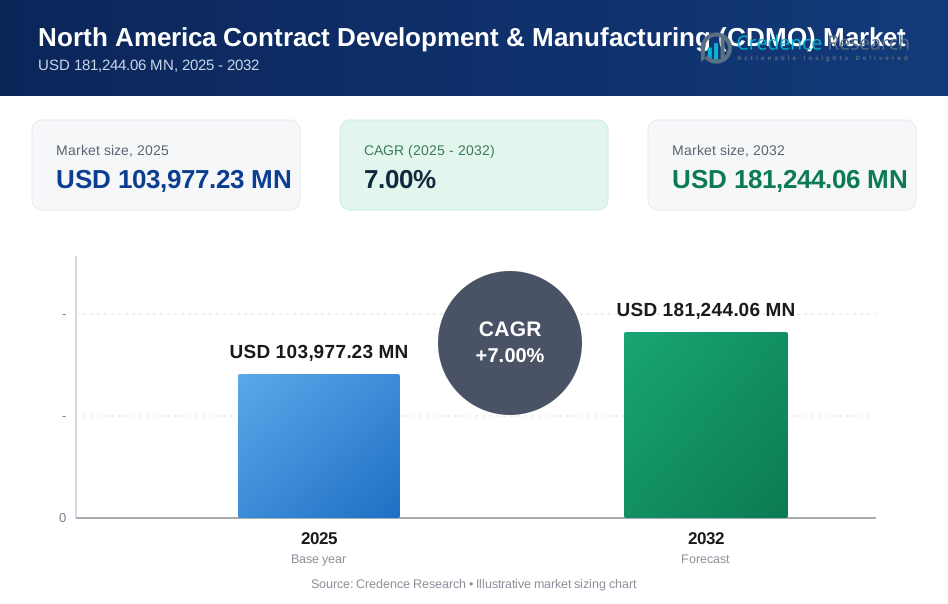
The North America Contract Development & Manufacturing (CDMO) Market size was valued at USD 78,825.77 MN in 2021 and reached USD 103,977.23 MN in 2025. It is anticipated to reach USD 181,244.06 MN by 2032, growing at a CAGR of 7.00% during the forecast period.
| REPORT ATTRIBUTE | DETAILS |
|---|---|
| Historical Period | 2021-2024 |
| Base Year | 2025 |
| Forecast Period | 2025-2032 |
| North America Contract Development & Manufacturing (CDMO) Market Size 2025 | USD 103,977.23 million |
| North America Contract Development & Manufacturing (CDMO) Market, CAGR | 7.00% |
| North America Contract Development & Manufacturing (CDMO) Market Size 2032 | USD 181,244.06 million |
North America Contract Development & Manufacturing (CDMO) Market Insights
- Market growth is supported by pharmaceutical outsourcing, biologics capacity expansion, API manufacturing demand, finished product manufacturing needs, fill-finish bottlenecks and early phase development services for biotech companies.
- Finished Product Manufacturing holds a strong position because injectable drugs, biologics, sterile products, oral solid dose products and complex delivery formats require validated commercial manufacturing capacity.
- API Manufacturing remains critical because pharmaceutical companies and biotech companies need reliable small-molecule, biologics and highly potent API supply to manage development and commercialization.
- Pharmaceutical Companies remain the leading end-user group due to higher commercial manufacturing scale, broader product portfolios and ongoing need for redundant supply capacity.
North America Contract Development & Manufacturing (CDMO) Market Segment Insights
By service type
By service type, Finished Product Manufacturing held the strongest position in 2025 because drug sponsors increasingly outsource sterile fill-finish, oral solid dosage, biologic drug product, injectable products and commercial packaging to reduce capital burden and accelerate market access. API Manufacturing remains a major service category due to continued demand for small molecules, highly potent APIs, biologics intermediates, peptides and advanced synthesis services. Early Phase Development Services are gaining demand as biotech companies seek formulation support, analytical development, process development, clinical batch production and regulatory documentation. Others include clinical trial supply, packaging, testing, stability studies, scale-up, technology transfer and specialty manufacturing support.
By end user
By end user, Pharmaceutical Companies held the strongest position in 2025 because large drugmakers rely on CDMOs for commercial supply, lifecycle management, redundant capacity and specialized manufacturing technologies. Biotech Companies are gaining share because many emerging developers lack internal manufacturing assets and use CDMOs from early development through clinical trial supply and commercialization. Chemical Companies represent a smaller but relevant user base for specialty intermediates, complex synthesis, high-potency compounds and chemistry-linked outsourcing. Growth across end users will depend on drug pipeline activity, capital availability, capacity constraints, regulatory requirements, technology specialization and supply chain strategy.
Key Market Drivers
Rising drug approval activity and development pipeline demand
Rising drug approval activity and development pipeline demand represent major growth drivers for the North America Contract Development & Manufacturing (CDMO) Market. Drug sponsors need API development, formulation work, clinical batches, process validation, commercial scale-up and finished product manufacturing as new therapies move through development.
FDA reported that CDER approved 46 novel drugs in 2025 and also made other approval decisions such as approving previously approved drugs for new uses and broader patient populations. This approval activity supports API Manufacturing, Finished Product Manufacturing and Early Phase Development Services. CDMOs benefit as pharmaceutical companies and biotech companies seek partners that can shorten development timelines, manage technical complexity and support regulatory submissions.
Pharmaceutical outsourcing and capital preservation
Pharmaceutical outsourcing and capital preservation are strengthening demand for CDMO services across North America. Drug sponsors increasingly use external partners to reduce fixed asset investment, access specialized capabilities and improve supply flexibility.
Lonza reported that CDMO capacity continues to outpace customer-owned facility capacity as large and small drug developers rely on manufacturing partners to support, complement and de-risk their path to market. The company also noted that small biotech businesses represent a higher proportion of the molecule pipeline, where outsourcing is built into business models to conserve capital resources. This driver supports Pharmaceutical Companies, Biotech Companies, Early Phase Development Services and Finished Product Manufacturing.
Biologics and sterile manufacturing capacity expansion
Biologics and sterile manufacturing capacity expansion support market growth because complex therapies require mammalian cell culture, sterile drug product manufacturing, fill-finish capability, quality systems and validated scale-up. FUJIFILM Biotechnologies opened its Holly Springs, North Carolina commercial-scale cell culture manufacturing site in September 2025, representing one of the largest commercial-scale cell culture biomanufacturing sites in North America. The first phase of the USD 3.2 billion site opened with 8 x 20,000 L mammalian cell culture bioreactors, while the second phase is expected to double capacity to 16 bioreactors. This driver supports Finished Product Manufacturing, API Manufacturing, Pharmaceutical Companies and Biotech Companies.
Expansion of integrated CDMO platforms
Expansion of integrated CDMO platforms is increasing market value as sponsors seek one partner for development, drug substance, drug product, fill-finish and commercial manufacturing. Lonza’s 2025 operating model organized its business into three CDMO platforms: Integrated Biologics, Advanced Synthesis and Specialized Modalities, covering biologics, highly potent APIs, antibody-drug conjugates, small molecules, cell and gene therapy, microbial, mRNA and bioscience capabilities. Thermo Fisher’s Laboratory Products and Biopharma Services segment includes outsourced services used by pharmaceutical and biotech industries for drug development, clinical research, clinical trials services and commercial drug manufacturing. This driver supports end-to-end outsourcing and strengthens demand for full-service CDMO providers.
Key Trends and Opportunities
North American biologics megasites gain strategic value
North American biologics megasites are gaining strategic value as pharmaceutical companies seek resilient domestic supply, large-scale mammalian capacity and faster access to commercial manufacturing. FUJIFILM’s Holly Springs facility is expected to employ 1,400 people by 2031 and is designed to support drug substance, drug product and finished goods capabilities. Lonza also highlighted its Vacaville, California site as one of the world’s largest biologics manufacturing facilities, with around 330,000 liters of total bioreactor capacity. This trend supports Finished Product Manufacturing, API Manufacturing and Biotech Companies seeking high-scale biologics supply.
Fill-finish outsourcing remains a high-growth opportunity
Fill-finish outsourcing remains a high-growth opportunity because biologics, injectable drugs, antibody-drug conjugates, prefilled syringes and sterile products require specialized equipment and regulatory expertise. Lonza reported that fill-finish manufacturing remains a key outsourcing area for small and midsized biotech companies that often lack in-house facilities and for pharmaceutical companies that need redundant supply. It also noted that complex modalities such as antibody-drug conjugates have increased demand for specialized fill-finish capabilities. This trend supports Finished Product Manufacturing, Pharmaceutical Companies and Biotech Companies. CDMOs with aseptic filling, lyophilization and high-potency containment will gain stronger positioning.
M&A reshapes CDMO competitive structure
M&A is reshaping the CDMO competitive structure as investors and strategic buyers target scaled manufacturing networks. Catalent announced in December 2024 that Novo Holdings completed its acquisition of Catalent in an all-cash transaction with a total enterprise value of approximately USD 16.5 billion. Catalent also said it is a leading global CDMO supporting product development, launch and full life-cycle supply across more than 40 global sites. This trend supports consolidation, platform specialization and capacity repositioning. Clients may benefit from stronger investment backing, but they may also reassess supplier concentration, site ownership and long-term supply agreements.
Key Market Challenges
Capacity planning and demand cyclicality
Capacity planning and demand cyclicality remain major challenges for the North America Contract Development & Manufacturing (CDMO) Market. CDMOs must invest years ahead of demand, yet utilization can shift with biotech funding cycles, clinical failures, product delays and changing customer forecasts. Lonza noted that biotech venture capital funding remained selective in 2025 and was concentrated in fewer, larger rounds, although the company expected funding to stabilize or modestly rebound as interest rates ease. This challenge affects Early Phase Development Services, Biotech Companies and specialized manufacturing assets that need high utilization to protect margins.
Regulatory compliance and quality risk
Regulatory compliance and quality risk remain critical barriers because CDMO operations must meet strict standards for process validation, documentation, data integrity, sterility assurance, batch release and post-approval changes. Finished Product Manufacturing and API Manufacturing are highly exposed because any quality event can delay launches, disrupt commercial supply or trigger remediation costs. Biologics and sterile products add complexity through aseptic processing, cell culture variability, cleaning validation and cold-chain control. CDMOs must maintain inspection readiness, strong quality systems and rigorous technology transfer processes. Clients increasingly select partners based on quality history, regulatory capability and supply reliability.
Customer concentration and contract complexity
Customer concentration and contract complexity can affect revenue visibility and execution risk. Large pharmaceutical customers may control major commercial manufacturing volumes, while biotech customers may depend on financing milestones or clinical trial outcomes. Contracts often involve technical transfer, minimum volume commitments, regulatory milestones, batch release obligations and change-control requirements. Scope changes can raise cost, while project delays can reduce capacity utilization. CDMOs must balance long-term commercial contracts with early phase work to maintain growth. Strong account management, transparent pricing and flexible capacity models will remain essential.
Regional Analysis
United States
The United States leads the North America Contract Development & Manufacturing (CDMO) Market due to its large pharmaceutical base, deep biotech ecosystem, FDA-regulated development pathway, strong biologics manufacturing infrastructure and expanding domestic capacity. API Manufacturing, Finished Product Manufacturing and Early Phase Development Services are all supported by large drug development pipelines and demand for resilient supply. FUJIFILM’s Holly Springs opening and Lonza’s Vacaville integration reinforce the strategic importance of U.S. biologics capacity. Pharmaceutical Companies remain the leading end users, while Biotech Companies drive early development and clinical manufacturing demand.
Canada
Canada represents a steady growth market supported by biomanufacturing investments, clinical research capability, skilled scientific talent and proximity to U.S. pharmaceutical customers. Finished Product Manufacturing and Early Phase Development Services are supported by biotech clusters in Ontario, Quebec and British Columbia. Canadian drug developers often use CDMOs to access specialized formulation, analytical development, fill-finish and clinical manufacturing services without major capital investment. Growth will depend on government biomanufacturing policy, cross-border supply relationships, talent availability and partnerships with global CDMO networks. Canada also offers strategic value for clients seeking North American supply redundancy.
Mexico
Mexico is an emerging CDMO opportunity within North America due to pharmaceutical manufacturing activity, cost competitiveness, logistics proximity to the United States and growing interest in nearshoring. API Manufacturing and Finished Product Manufacturing can benefit from regional supply chain diversification, particularly for mature products, generics, packaging and selected sterile or oral dose manufacturing. Chemical Companies also represent a relevant end-user base for intermediates and synthesis services. Growth will depend on regulatory alignment, quality systems, investment in advanced manufacturing, skilled workforce availability and cross-border trade reliability. Mexico will remain more cost-sensitive but strategically important for regional manufacturing resilience.
Report Attribute Details
| Report Attribute | Details |
| Historical Period | 2021–2024 |
| Base Year | 2025 |
| Forecast Period | 2025–2032 |
| Market Size in 2021 | USD 78,825.77 MN |
| Market Size in 2025 | USD 103,977.23 MN |
| Market Size in 2032 | USD 181,244.06 MN |
| CAGR | 7.00% |
| Segments Covered | Service Type, End User and Geography |
| Key Companies Covered | Thermo Fisher Scientific Inc., Lonza Group, Catalent Inc., Samsung Biologics Co. Ltd., WuXi AppTec Inc., Recipharm AB, Jubilant Pharmova Ltd., Boehringer Ingelheim Group, Pfizer CentreOne, Aenova Holding GmbH, Fujifilm Diosynth Biotechnologies and Baxter BioPharma Solutions |
Market Segmentations
By Service Type
- API Manufacturing
- Finished Product Manufacturing
- Early Phase Development Services
- Others
By End User
- Pharmaceutical Companies
- Biotech Companies
- Chemical Companies
Key Players
- Thermo Fisher Scientific Inc.
- Lonza Group
- Catalent Inc.
- Samsung Biologics Co. Ltd.
- WuXi AppTec Inc.
- Recipharm AB
- Jubilant Pharmova Ltd.
- Boehringer Ingelheim Group
- Pfizer CentreOne
- Aenova Holding GmbH
- Fujifilm Diosynth Biotechnologies
- Baxter BioPharma Solutions
Recent Developments
- In September 2025, FUJIFILM Biotechnologies opened its Holly Springs, North Carolina commercial-scale cell culture manufacturing site, with the first phase adding 8 x 20,000 L mammalian cell culture bioreactors and a second phase planned to double capacity.
- In 2025, Lonza continued integrating its Vacaville, California site into its global mammalian manufacturing network. Lonza said the site has around 330,000 liters of total bioreactor capacity and remained an important U.S. footprint for late-stage clinical and commercial supply.
- In December 2024, Novo Holdings completed its acquisition of Catalent in an all-cash transaction with a total enterprise value of approximately USD 16.5 billion, strengthening Catalent’s position as a private CDMO platform.
- In 2025, Thermo Fisher’s Laboratory Products and Biopharma Services segment generated USD 23,984 million in revenue, and the company reported that its pharma services business grew USD 457 million on a reported basis.
Report Coverage
The research report offers an in-depth analysis based on service type, end user and geography. It details leading market players, providing an overview of their business positioning, CDMO service portfolios, API manufacturing capabilities, finished product manufacturing capacity, early phase development services, biologics platforms, sterile fill-finish strength, geographic reach and strategic relevance in the North America Contract Development & Manufacturing (CDMO) Market. The report includes insights into the competitive environment, market trends, growth drivers, restraints and opportunities. It also examines drug approval activity, outsourcing demand, biologics capacity expansion, integrated CDMO platforms, fill-finish bottlenecks, M&A activity, regulatory compliance and nearshoring as major factors shaping market development. The report assesses the impact of capacity planning risk, biotech funding cycles, quality requirements, customer concentration and contract complexity on market growth. It provides strategic recommendations for CDMOs, pharmaceutical companies, biotech companies, chemical companies, investors, site operators and new entrants seeking to navigate North America’s CDMO ecosystem.
Future Outlook
- Demand for CDMO services will continue to rise as pharmaceutical companies and biotech companies outsource development and manufacturing to preserve capital and reduce technical risk.
- Finished Product Manufacturing will remain a leading service type due to sterile fill-finish, biologic drug product, injectable and commercial packaging demand.
- API Manufacturing will remain essential as drug sponsors seek reliable supply of small molecules, biologics intermediates and highly potent APIs.
- Early Phase Development Services will grow as biotech companies require formulation, analytical development, clinical batch production and process development support.
- Pharmaceutical Companies will remain the largest end-user group because they require commercial scale, lifecycle support and redundant supply capacity.
- Biotech Companies will gain share as outsourcing remains built into lean development models and clinical-stage pipelines.
- U.S. biologics megasites will strengthen North America’s role in commercial mammalian cell culture manufacturing.
- Fill-finish capability will remain a strategic differentiator as injectable and complex therapies expand.
- M&A and private ownership models will reshape competitive positioning, capital allocation and customer contracting.
- Competition will increase as companies compete on quality track record, capacity availability, technology breadth, regulatory support, delivery reliability and integrated service models.
Request a Free Sample
Fill in your details and we'll send you a free sample report.
- Sample data tables & charts
- Research methodology
Need a Custom Version of This Report?
Tailor the scope, geography, or segments to your exact requirements.
- Custom geography or segment scope
- Direct access to our analyst team
Frequently Asked Questions
What is the current market size for the North America Contract Development & Manufacturing (CDMO) Market and what is its projected size in 2032?
At what CAGR is the North America Contract Development & Manufacturing (CDMO) Market projected to grow?
Which service type segment is expected to lead the market?
Which end-user segment leads the market?
Which region leads the North America market?
Who are the leading companies in the market?
What are the key challenges in the market?
Table of Content
Chapter 1. Report Introduction
- 1.1 Report Description & Purpose
- 1.1.1 Report Title & Market Definition
- 1.1.2 Unique Selling Propositions (USP) & Key Differentiators
- 1.1.3 Value Proposition for Stakeholders
- 1.2 Research Objectives
- 1.2.1 Market Sizing Objectives (Volume & Revenue)
- 1.2.2 Segmentation Objectives
- 1.2.3 Competitive Intelligence Objectives
- 1.2.4 Forecast & Scenario Objectives
- 1.3 Report Scope
- 1.3.1 North America Contract Development & Manufacturing (CDMO) Scope – Types & Subtypes Covered
- 1.3.2 Geographic Scope – Regions & Countries Covered
- 1.3.3 Historical Period, Base Year & Forecast Period (2025; forecast to 2032)
- 1.3.4 Inclusions & Exclusions
- 1.4 HS Code & Classification Framework
- 1.5 Currency, Units & Pricing Basis
- 1.6 Target Stakeholders
- 1.7 Limitations & Assumptions
Chapter 2. Executive Summary
- 2.1 Global North America Contract Development & Manufacturing (CDMO) Market Snapshot
- 2.1.1 Market Size – Historical (2025) & Forecast (2025-2032) (2025: USD 103,977.23 MN → 2032: USD 181,244.06 MN)
- 2.1.2 Volume & Revenue – Global Totals
- 2.1.3 Key Market Highlights – Top Five Facts
- 2.2 North America Contract Development & Manufacturing (CDMO) Market Segmentation Snapshot
- 2.2.1 Market Split by Region – 2025 vs. 2032
- 2.3 Competitive Snapshot
- 2.3.1 Top 10 Players by Revenue Share – 2025
- 2.3.2 Top 10 Players by Volume Share – 2025
- 2.3.3 Recent Strategic Developments (18-Month Summary)
- 2.4 Key Investment Highlights & Strategic Conclusions
Chapter 3. North America Contract Development & Manufacturing (CDMO) Market Dynamics & Industry Analysis
- 3.1 Market Overview & Context
- 3.1.1 North America Contract Development & Manufacturing (CDMO) Market Position in the Broader Automotive Value Chain
- 3.1.2 OEM vs. Replacement Market Dynamics
- 3.1.3 Market Maturity & Development Stage by Region
- 3.2 North America Contract Development & Manufacturing (CDMO) Market Drivers
- 3.3 North America Contract Development & Manufacturing (CDMO) Market Restraints & Challenges
- 3.4 North America Contract Development & Manufacturing (CDMO) Market Opportunities
- 3.5 Porter's Five Forces Analysis
- 3.5.1 Threat of New Entrants
- 3.5.2 Bargaining Power of Suppliers
- 3.5.3 Bargaining Power of Buyers
- 3.5.4 Threat of Substitutes
- 3.5.5 Competitive Rivalry – Intensity Assessment
- 3.6 North America Contract Development & Manufacturing (CDMO) Value Chain Analysis
- 3.6.1 Upstream – Raw Material/Input Suppliers
- 3.6.1.1 Raw Material/Input 1
- 3.6.1.2 Raw Material/Input 2
- 3.6.1.3 Raw Material/Input 3
- 3.6.2 Midstream – Production/Manufacturing/Service Delivery
- 3.6.2.1 Production/Process Overview
- 3.6.2.2 Key Facility Locations & Capacity by Manufacturer
- 3.6.3 Downstream – Distribution & End Consumer
- 3.6.3.1 Primary Channel – B2B/OEM
- 3.6.3.2 Secondary Channels – Dealer, Retail, Online, Direct
- 3.6.4 Value Chain Profitability Analysis
- 3.6.1 Upstream – Raw Material/Input Suppliers
- 3.7 PESTEL Analysis
- 3.7.1 Political Factors
- 3.7.2 Economic Factors
- 3.7.3 Social Factors
- 3.7.4 Technological Factors
- 3.7.5 Environmental Factors
- 3.7.6 Legal Factors
- 3.8 North America Contract Development & Manufacturing (CDMO) Supply Chain Analysis
- 3.8.1 Raw Material/Input Supply Risk Assessment
- 3.8.2 Manufacturing Concentration Risk (Geographic Exposure)
- 3.8.3 Trade Disruption Impact Analysis
- 3.9 Regulatory & Policy Landscape
Note: The regulatory and policy landscape section covers regulations based on their applicability to the market, North America Contract Development & Manufacturing (CDMO) category, geography, and scope of the study. Only regulatory frameworks with a material impact on operations, compliance, trade, sustainability, or market access are analyzed in detail.
Chapter 4. Key Investment Pockets & Opportunity Analysis
- 4.1 North America Contract Development & Manufacturing (CDMO) Market Attractiveness Analysis
- 4.1.1 By Region – Investment Attractiveness Matrix (Volume × CAGR)
- 4.2 Absolute Revenue Growth Opportunity
- 4.2.1 By Region – Absolute USD Growth Through 2032
- 4.3 Incremental Volume Opportunity
- 4.3.1 By Region – Incremental Volume Through 2032
- 4.3.2 Segment – Incremental Volume
- 4.4 Emerging Submarket Opportunity Deep Dive (Subject to Applicability)
- 4.5 Emerging Market Opportunity Scorecards
- 4.5.1 United States
- 4.5.2 Europe
- 4.5.3 Asia
- 4.5.4 Middle East & Africa
Note: Emerging Market Opportunity Scorecards will be included based on relevance and strategic importance. Regions listed are indicative and may vary depending on data availability and market dynamics.
Chapter 5. North America Contract Development & Manufacturing (CDMO) Import-Export Analysis & Trade Flows
- 5.1 Global Trade Overview
- 5.1.1 Global Export Value by Country (2025)
- 5.1.2 Global Export Volume by Country (2025)
- 5.1.3 Global Import Value by Country (2025)
- 5.1.4 Global Import Volume by Country (2025)
- 5.1.5 Net Trade Balance by Country (2025)
- 5.2 Export Analysis – Segment
- 5.2.1 Type 1 (HS Code)
- 5.2.2 Type 2 (HS Code)
- 5.2.3 Type 3 (HS Code)
- 5.2.4 Type 4 (HS Code)
- 5.2.5 Type 5 (HS Code)
- 5.3 Import Analysis – Segment
- 5.3.1 Type 1 (HS Code)
- 5.3.2 Type 2 (HS Code)
- 5.3.3 Type 3 (HS Code)
- 5.3.4 Type 4 (HS Code)
- 5.3.5 Type 5 (HS Code)
- 5.4 Average Unit Trade Prices
- 5.4.1 Average Export Price – Segment & Country
- 5.4.2 Average Import Price – Segment & Source Country
- 5.4.3 Price Trends (2025)
- 5.5 Key Trade Route Analysis
- 5.5.1 Trade Route 1
- 5.5.2 Trade Route 2
- 5.5.3 Trade Route 3
- 5.5.4 Trade Route 4
- 5.5.5 Trade Route 5
- 5.6 Trade Policy Impact Assessment
- 5.6.1 US Anti-Dumping & Section 301 Tariffs
- 5.6.2 EU Customs Union Impact
- 5.6.3 Major Free Trade Agreements
- 5.6.4 USMCA Rules of Origin
Note: Trade policy analysis will be included only where relevant to the North America Contract Development & Manufacturing (CDMO) market.
Chapter 6. Competitive Landscape & Company Benchmarking
- 6.1 North America Contract Development & Manufacturing (CDMO) Market Concentration & Structure
- 6.1.1 Herfindahl-Hirschman Index (HHI) – vs. 2025
- 6.1.2 Tier 1, Tier 2 & Tier 3 Market Structure
- 6.1.3 Global, Regional & Local Player Dynamics
- 6.2 North America Contract Development & Manufacturing (CDMO) Market Share Analysis – 2025
- 6.2.1 Global Revenue Share by Company
- 6.2.2 Global Volume Share by Company
- 6.2.3 Regional Revenue Share
- 6.2.4 Market Share Evolution ( vs. 2025)
- 6.2.5 OEM Segment Share by Company
- 6.2.6 Replacement Segment Share by Company
- 6.3 Production/Delivery Capacity & Facility Analysis
- 6.3.1 Global Installed Capacity
- 6.3.2 Capacity Utilization Rates
- 6.3.3 Production/Output Volume
- 6.3.4 Facility Locations & Capacity Map
- 6.3.5 Planned Capacity Additions
- 6.4 North America Contract Development & Manufacturing (CDMO) Competitive Benchmarking Matrix
- 6.4.1 Revenue, Volume, CAGR & Profitability Comparison
- 6.4.2 Channel Revenue Mix
- 6.4.3 Geographic Revenue Exposure
- 6.4.4 R&D Intensity
- 6.4.5 Sustainability Maturity
- 6.5 Strategic Developments in North America Contract Development & Manufacturing (CDMO) (Last 24 Months)
- 6.5.1 Mergers, Acquisitions & Divestments
- 6.5.2 New North America Contract Development & Manufacturing (CDMO) Launches
- 6.5.3 Facility Expansions
- 6.5.4 Strategic Alliances, Joint Ventures & Partnerships
- 6.5.5 Distribution Expansion & Market Entry
- 6.5.6 Sustainability & ESG Initiatives
- 6.6 Competitive Strategy Mapping
- 6.6.1 Leader, Challenger, Follower & Niche Classification
- 6.6.2 Pricing Strategy Comparison
- 6.6.3 Channel Strategy Matrix
Note: Strategic developments are included based on their materiality and the availability of reliable information.
Chapter 7. Global North America Contract Development & Manufacturing (CDMO) Market – By Distribution Channel
- 7.1 Segment Overview
- 7.1.1 Volume & Revenue Split by Channel (2025 & 2032)
- 7.1.2 Channel Mix Evolution (2025-2032)
Chapter 8. Regional Market Analysis – Global Overview
- 8.1 Global Regional Overview
- 8.1.1 Regional Volume Share
- 8.1.2 Regional Revenue Share
- 8.1.3 Regional Volume by Region
- 8.1.4 Regional Revenue by Region
- 8.1.5 Regional Forecast Through 2032
- 8.2 Cross-Regional Segment Analysis
- 8.2.1 By Distribution Channel
- 8.2.2 By Brand/Price Tier
Chapter 9. North America North America Contract Development & Manufacturing (CDMO) Market
- 9.1 United States
- 9.2 Canada
- 9.3 Mexico
Chapter 10. Europe North America Contract Development & Manufacturing (CDMO) Market
- 10.1 Germany
- 10.2 France
- 10.3 Italy
- 10.4 United Kingdom
- 10.5 Spain
- 10.6 Poland
- 10.7 Russia
- 10.8 Netherlands
- 10.9 Belgium
- 10.10 Sweden
- 10.11 Denmark
- 10.12 Norway
- 10.13 Rest of Europe
Chapter 11. Asia Pacific North America Contract Development & Manufacturing (CDMO) Market
- 11.1 China
- 11.2 India
- 11.3 Japan
- 11.4 South Korea
- 11.5 Thailand
- 11.6 Indonesia
- 11.7 Vietnam
- 11.8 Malaysia
- 11.9 Australia
- 11.10 Rest of Asia Pacific
Chapter 12. Latin America North America Contract Development & Manufacturing (CDMO) Market
- 12.1 Brazil
- 12.2 Argentina
- 12.3 Colombia
- 12.4 Chile
- 12.5 Rest of Latin America
Chapter 13. Middle East North America Contract Development & Manufacturing (CDMO) Market
- 13.1 Saudi Arabia
- 13.2 United Arab Emirates
- 13.3 Turkey
- 13.4 Israel
- 13.5 Iran
- 13.6 Rest of the Middle East
Chapter 14. Africa North America Contract Development & Manufacturing (CDMO) Market
- 14.1 South Africa
- 14.2 Egypt
- 14.3 Nigeria
- 14.4 Morocco
- 14.5 Rest of Africa
Chapter 15. North America Contract Development & Manufacturing (CDMO) Company Profiles
- 15.1 [Company 01]
- 15.1.1 Company Overview
- 15.1.2 Key Management Personnel
- 15.1.3 Products & Services Portfolio
- 15.1.4 Financial Performance
- 15.1.5 Key Market Focus & Geographic Presence
- 15.1.6 Recent Developments & Strategic Initiatives
Note: The company profile list is preliminary and may change based on research findings, market developments, data availability, and client requirements.
Chapter 16. Appendices
- Appendix A – List of Abbreviations & Acronyms
- Appendix B – Industry Classification Code Reference – Full Series
- Appendix C – Production & Capacity Data Tables
- Appendix D – End-Use & Demand Base Tables
- Appendix E – Consumption & Replacement Rate Assumptions
- Appendix F – ASP Reference Tables
- Appendix G – Manufacturing & Facility Database
- Appendix H – Import-Export Data Tables
- Appendix I – Regulatory Summary Tables
- Appendix J – Primary Research Participant List (Anonymized)
- Appendix K – Primary Research Questionnaire Framework
- Appendix L – Data Sources & Bibliography
- Appendix M – Market Size Divergence & Source Comparison
Chapter 17. Research Methodology
- 17.1 Research Framework & Philosophy
- 17.2 Secondary Research – Sources, Hierarchy & Data Extraction
- 17.3 Data Modeling – Bottom-Up & Top-Down Market Sizing
- 17.4 Primary Research – Stakeholder Framework, LOI & Sample Sizes
- 17.5 Forecast Methodology – Regression, Scenario & Sensitivity Analysis
- 17.6 Quality Control – Four-Layer Validation Framework
- 17.7 Limitations & Standard Assumptions
- 17.8 Disclaimer
