
Latin America Wound Care Products Market Overview:
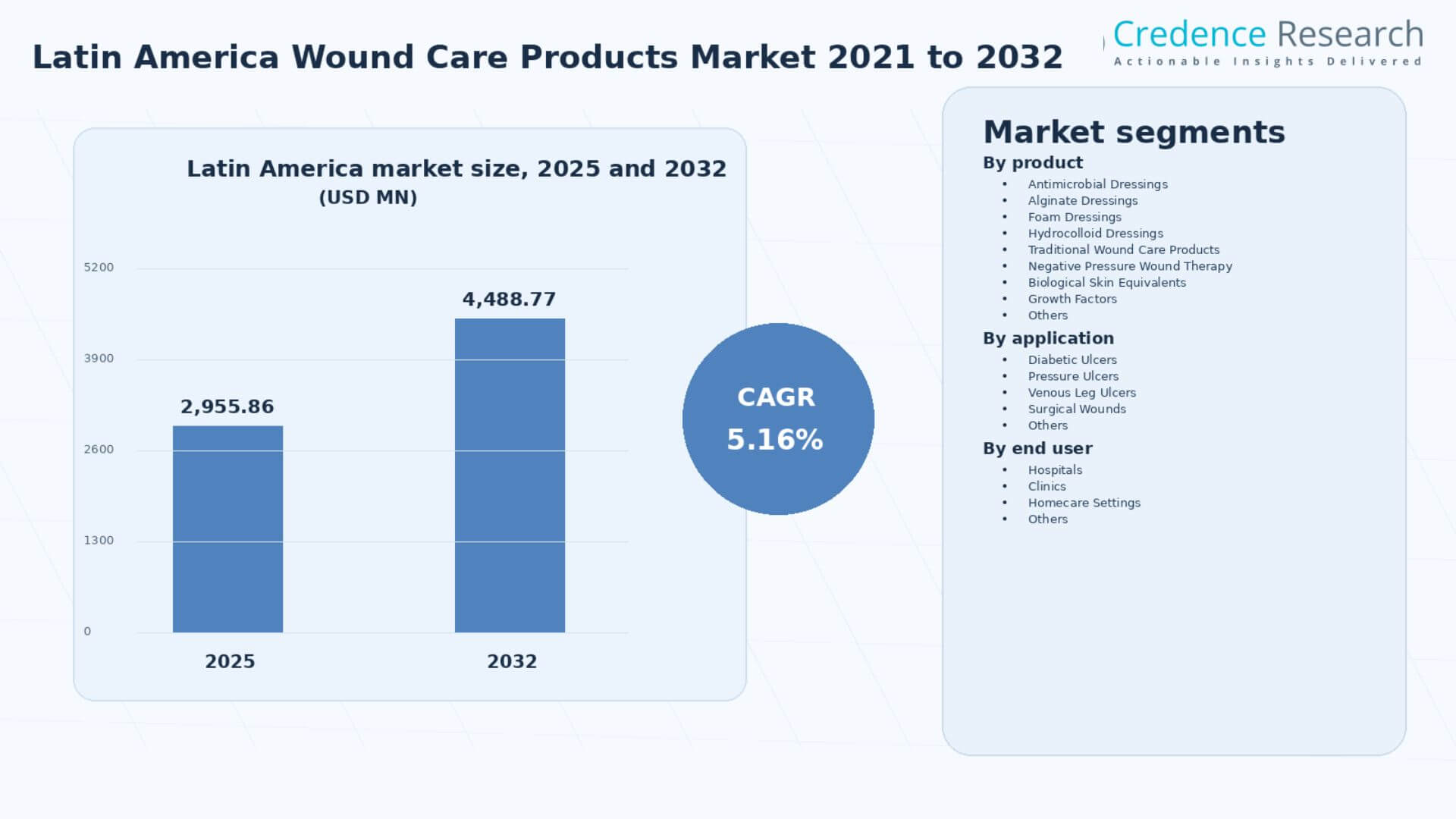
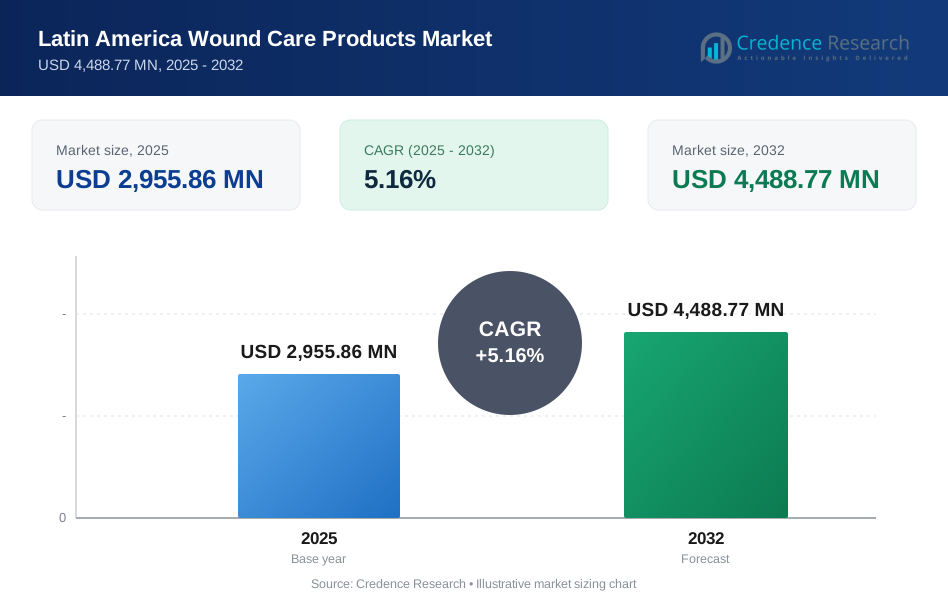
The Latin America Wound Care Products Market size was valued at USD 2,366.52 MN in 2021 and reached USD 2,955.86 MN in 2025. It is anticipated to reach USD 4,488.77 MN by 2032, growing at a CAGR of 5.16% during the forecast period.
| REPORT ATTRIBUTE | DETAILS |
|---|---|
| Historical Period | 2021-2024 |
| Base Year | 2025 |
| Forecast Period | 2025-2032 |
| Latin America Wound Care Products Market Size 2025 | USD 2,955.86 million |
| Latin America Wound Care Products Market , CAGR | 5.16% |
| Latin America Wound Care Products Market Size 2032 | USD 4,488.77 million |
Latin America Wound Care Products Market Insights
- Market growth is supported by diabetes-related wound burden, surgical wound management, aging population needs, hospital infection control, chronic wound treatment and adoption of advanced dressings.
- Foam Dressings, Antimicrobial Dressings and Hydrocolloid Dressings hold strong demand because they support exudate control, infection prevention and healing across diabetic ulcers, pressure ulcers and surgical wounds.
- Negative Pressure Wound Therapy is gaining momentum because hospitals and specialty clinics use it for complex wounds, postoperative wounds, pressure injuries and selected homecare cases.
- Hospitals remain the leading end-user segment because advanced wound treatment often requires surgical teams, infection control, specialist nurses, debridement, dressing protocols and reimbursement coordination.
Market Segment Insights
By product
By product, Foam Dressings held a strong position in 2025 because they are widely used for moderate-to-heavy exudate wounds, pressure ulcers, venous leg ulcers, surgical wounds and diabetic ulcers. Antimicrobial Dressings are gaining demand due to infection prevention needs and high-risk chronic wounds. Alginate Dressings support highly exuding wounds and cavity wounds, while Hydrocolloid Dressings remain important for moist wound healing and low-to-moderate exudate management. Traditional Wound Care Products continue to serve cost-sensitive settings and first-line wound management. Negative Pressure Wound Therapy is expanding in hospitals and clinics for complex wounds. Biological Skin Equivalents and Growth Factors represent premium categories for hard-to-heal wounds. Others include films, hydrogel dressings, collagen dressings and specialty wound care accessories.
By application
By application, Diabetic Ulcers held a strong position in 2025 because diabetes-related neuropathy and poor blood flow increase the risk of foot ulcers, infection and amputation. PAHO reported that 112 million adults in the Region of the Americas lived with diabetes in 2022, equal to an age-standardized prevalence of 13.1%. PAHO also states that neuropathy and reduced blood flow increase the chance of foot ulcers, infection and limb amputation. Pressure Ulcers support demand across hospitals, long-term care and homecare settings. Venous Leg Ulcers are linked to vascular disease, obesity and aging. Surgical Wounds generate steady demand for dressings, antimicrobial products and negative pressure therapy. Others include burns, traumatic wounds and oncology-related wounds.
By end user
By end user, Hospitals held the strongest position in 2025 because hospitals manage surgical wounds, infected wounds, diabetic foot complications, pressure ulcers, burns and complex trauma wounds. Clinics support outpatient dressing changes, diabetic foot checks, venous ulcer management and follow-up care. Homecare Settings are expanding as patients with chronic wounds, pressure injuries, surgical wounds and diabetic ulcers receive dressing changes and monitoring outside hospitals. Others include long-term care facilities, wound care centers, rehabilitation facilities and community health providers. Growth will depend on nurse training, product affordability, reimbursement, infection control protocols and distribution reliability.
Key Market Drivers
Diabetes burden and diabetic foot complications
Diabetes burden and diabetic foot complications represent major growth drivers for the Latin America Wound Care Products Market. Chronic hyperglycemia, neuropathy and impaired blood flow increase the risk of diabetic ulcers, infection and amputation, creating recurring demand for antimicrobial dressings, foam dressings, alginate dressings, hydrocolloid dressings, negative pressure wound therapy and biological skin equivalents. PAHO’s diabetes guidance states that neuropathy and reduced blood flow in the feet increase the chance of foot ulcers, infection and eventual limb amputation. PAHO’s Panorama of Diabetes in the Americas also cites Latin American evidence showing diabetic foot complications in Brazil and amputation burden in Chile, underlining the clinical relevance of advanced wound care across regional markets.
Aging population and long-term care demand
Aging population and long-term care demand support wound care product consumption because older adults are more exposed to pressure ulcers, venous leg ulcers, impaired mobility, chronic disease and post-surgical recovery needs. PAHO reported in 2026 that 14.4% of people aged 65 and older in Latin America and the Caribbean, or about 8 million people, require long-term care, and the figure is projected to rise to 16% by 2050. This driver supports Pressure Ulcers, Venous Leg Ulcers, Homecare Settings, Clinics, Hydrocolloid Dressings, Foam Dressings and Traditional Wound Care Products.
Hospital infection control and surgical wound care
Hospital infection control and surgical wound care strengthen demand for antimicrobial dressings, negative pressure wound therapy, foam dressings and traditional wound care products. Surgical wounds require sterile dressing protocols, postoperative infection prevention, drainage control and timely follow-up. Hospitals remain the main setting for complex surgical wounds, traumatic wounds and infected wounds because they can provide debridement, operating room support, antibiotics, imaging and multidisciplinary care. Smith+Nephew reported 2025 Advanced Wound Management revenue of USD 1,793 million, with Advanced Wound Devices growth supported by PICO negative pressure wound therapy and RENASYS negative pressure wound therapy.
Advanced wound care portfolio investment
Advanced wound care portfolio investment is accelerating product availability and clinical adoption. Convatec reported 2025 group revenue of USD 2,439 million and noted leading positions in Advanced Wound Care, Ostomy Care, Continence Care and Infusion Care. Solventum reported that its MedSurg segment represented 57.9% of 2025 total sales and included negative pressure wound therapy, advanced wound dressings, advanced skin care, synthetic tissue matrices and sterilization assurance. These investments support Antimicrobial Dressings, Foam Dressings, Negative Pressure Wound Therapy, Biological Skin Equivalents, Hospitals, Clinics and Homecare Settings.
Key Trends and Opportunities
Negative pressure wound therapy expands across complex wounds
Negative Pressure Wound Therapy is expanding across complex wounds, surgical wounds, diabetic ulcers and pressure ulcers because it helps manage exudate and supports wound closure in selected clinical settings. Smith+Nephew reported strong growth in Advanced Wound Devices, with performance driven by PICO single-use negative pressure wound therapy, RENASYS negative pressure wound therapy and LEAF patient monitoring. This trend supports Hospitals, Clinics and Homecare Settings. Single-use NPWT systems are especially relevant where hospitals seek shorter stays, standardized postoperative wound protocols and outpatient follow-up.
Biological skin equivalents and growth factors target hard-to-heal wounds
Biological Skin Equivalents and Growth Factors are gaining attention for hard-to-heal wounds, especially diabetic ulcers and chronic wounds that do not respond to traditional dressings. Organogenesis reported that 2025 net product revenue from Advanced Wound Care products increased by USD 77.6 million, or 17%, compared with 2024. These premium categories require specialist evaluation, reimbursement support and clinical evidence. Adoption in Latin America will remain concentrated in larger hospitals, advanced clinics and private care settings, but long-term opportunity is strong as chronic wound programs expand.
Homecare wound management gains relevance
Homecare wound management is gaining relevance as health systems and families manage chronic wounds outside hospitals. Aging populations, diabetes, pressure injury risk and post-surgical recovery create demand for dressings, antimicrobial products, negative pressure systems and nurse-led homecare protocols. PAHO’s long-term care policy guidance for Latin America and the Caribbean highlights rapid population aging and growing care needs, supporting the long-term shift toward home-based and community-based care. This trend supports Homecare Settings, Foam Dressings, Hydrocolloid Dressings, Traditional Wound Care Products and Negative Pressure Wound Therapy.
Advanced dressings replace basic gauze in higher-acuity care
Advanced dressings are replacing basic gauze in higher-acuity care because clinicians need better exudate control, infection prevention, moisture balance and fewer dressing changes. Smith+Nephew reported that Advanced Wound Care revenue reached USD 766 million in 2025 and included good growth in foam dressings and films. Convatec also reported sustained demand in Advanced Wound Care, supported by its chronic care and wound care portfolio. This trend supports Antimicrobial Dressings, Alginate Dressings, Foam Dressings and Hydrocolloid Dressings.
Key Market Challenges
Affordability and reimbursement limitations
Affordability and reimbursement limitations remain major challenges for the Latin America Wound Care Products Market. Advanced dressings, negative pressure wound therapy, biological skin equivalents and growth factors are more expensive than traditional wound care products. Public hospitals and smaller clinics often prioritize basic dressings when reimbursement is limited or procurement budgets are constrained. Patients treated in Homecare Settings may face high out-of-pocket spending for repeated dressing changes and advanced products. Vendors must support value-based evidence, tiered portfolios, public tender access and clinician training to improve adoption.
Uneven wound care access across public and private systems
Uneven wound care access across public and private systems restricts market growth. Large urban hospitals and private clinics can adopt NPWT, advanced dressings and biologics more quickly, while rural and underfunded public facilities often rely on traditional products. PAHO’s NCDs at a Glance 2025 report showed that NCD deaths in the Americas reached 6 million in 2021 and that diabetes prevalence reached 13.1%, underlining a major care burden that can overwhelm fragmented health systems. Better referral pathways, diabetic foot programs, community nursing and product access are required to close the treatment gap.
Clinical training and wound assessment gaps
Clinical training and wound assessment gaps affect product use because advanced wound care depends on correct wound classification, infection assessment, exudate control, offloading, debridement and dressing selection. Poor training can lead to underuse, overuse or inappropriate product choice. Diabetic ulcers, venous leg ulcers and pressure ulcers require multidisciplinary care involving physicians, nurses, podiatrists, vascular specialists and nutrition support. Suppliers that provide clinical education, wound protocols and outcome tracking will improve adoption and patient results.
Supply chain and product availability risk
Supply chain and product availability risk can affect hospitals, clinics and homecare providers. Advanced wound care requires reliable availability of dressings, NPWT canisters, tubing, foam kits, antimicrobial products and sterile accessories. Import dependence, currency volatility, tender delays and distributor gaps can limit continuity of care. Biological Skin Equivalents and Growth Factors face additional complexity due to cold chain, storage, documentation and specialist application requirements. Local warehousing, distributor training and inventory planning will remain important competitive differentiators.
Regional Analysis
Brazil
Brazil leads the Latin America Wound Care Products Market due to its large population, diabetes burden, hospital network, private clinic base and expanding chronic wound management needs. PAHO’s diabetes evidence identifies Brazil as one of the countries where diabetic foot complications are clinically significant, supporting demand for Diabetic Ulcers treatment and advanced dressings. Hospitals remain the leading end users, while Clinics and Homecare Settings are gaining relevance through outpatient wound care, dressing changes and diabetic foot follow-up. Growth will depend on reimbursement, public procurement, private hospital investment, distributor strength and clinician training.
Mexico
Mexico represents a major market supported by diabetes burden, surgical wound care demand, private hospital networks and growing outpatient care. Diabetic Ulcers, Surgical Wounds and Pressure Ulcers are key applications. Foam Dressings, Antimicrobial Dressings, Traditional Wound Care Products and Negative Pressure Wound Therapy are expected to gain demand as hospitals and clinics expand wound protocols. Homecare Settings will grow gradually as chronic wounds require frequent dressing changes and monitoring. Growth will depend on payer coverage, clinic networks, availability of advanced wound products and patient affordability.
Argentina
Argentina offers steady wound care demand supported by hospitals, private clinics, chronic disease management and aging-related wound care needs. Hospitals manage complex wounds, surgery-related wounds and infected ulcers, while Clinics support outpatient follow-up. Foam Dressings, Hydrocolloid Dressings and Traditional Wound Care Products are important in cost-sensitive settings. Advanced options such as NPWT, Biological Skin Equivalents and Growth Factors will remain concentrated in larger hospitals and private centers. Growth will depend on macroeconomic stability, reimbursement, import access, hospital budgets and distribution reliability.
Colombia
Colombia is an expanding market due to public-private health care participation, growing outpatient treatment and rising chronic wound needs. Diabetic Ulcers, Pressure Ulcers and Surgical Wounds support recurring dressing demand. Clinics and Homecare Settings are gaining relevance as wound management moves beyond hospitals. Antimicrobial Dressings, Foam Dressings and Alginate Dressings will benefit from infection control and exudate management needs. Growth will depend on reimbursement, care coordination, hospital procurement, nurse training and product availability in secondary cities.
Chile
Chile represents a relatively mature wound care market within Latin America, supported by structured health care access, private clinics and chronic disease management. PAHO’s Panorama of Diabetes in the Americas referenced Chile’s diabetic foot amputation burden, underscoring the need for stronger diabetic foot prevention and wound treatment. Hospitals and Clinics remain key end users, while Homecare Settings will grow with aging and long-term care needs. Advanced dressings and NPWT adoption will depend on reimbursement, specialist access and clinical evidence.
Rest of Latin America
Rest of Latin America includes markets with varied health infrastructure, public procurement capacity and advanced wound care access. Countries with larger private hospital networks will adopt Negative Pressure Wound Therapy, Biological Skin Equivalents and advanced dressings faster, while lower-resource systems will rely more heavily on Traditional Wound Care Products. PAHO’s long-term care guidance for Latin America and the Caribbean highlights growing care needs among older adults, supporting long-term demand for chronic wound management products. Growth will depend on distributor networks, reimbursement, wound care training, diabetic foot programs and affordability.
Report Attribute Details
| Report Attribute | Details |
| Historical Period | 2021–2024 |
| Base Year | 2025 |
| Forecast Period | 2025–2032 |
| Market Size in 2021 | USD 2,366.52 MN |
| Market Size in 2025 | USD 2,955.86 MN |
| Market Size in 2032 | USD 4,488.77 MN |
| CAGR | 5.16% |
| Segments Covered | Product, Application, End User and Geography |
| Key Companies Covered | Medtronic, Smith+Nephew, Convatec Group PLC, Strategic initiatives, Mölnlycke Health Care AB, Baxter, DeRoyal Industries, Inc., Coloplast Corp., Solventum Corporation, Integra Lifesciences, Medline Industries, LP, Johnson & Johnson Services, Inc., B. Braun SE, Cardinal Health and Organogenesis Inc. |
Latin America Wound Care Products Market segmentations
By Product
- Antimicrobial Dressings
- Alginate Dressings
- Foam Dressings
- Hydrocolloid Dressings
- Traditional Wound Care Products
- Negative Pressure Wound Therapy
- Biological Skin Equivalents
- Growth Factors
- Others
By Application
- Diabetic Ulcers
- Pressure Ulcers
- Venous Leg Ulcers
- Surgical Wounds
- Others
By End User
- Hospitals
- Clinics
- Homecare Settings
- Others
Key Players
- Medtronic
- Smith+Nephew
- Convatec Group PLC
- Strategic initiatives
- Mölnlycke Health Care AB
- Baxter
- DeRoyal Industries, Inc.
- Coloplast Corp.
- Solventum Corporation
- Integra Lifesciences
- Medline Industries, LP
- Johnson & Johnson Services, Inc.
- B. Braun SE
- Cardinal Health
- Organogenesis Inc.
Recent Developments
- In 2025, Smith+Nephew reported Advanced Wound Management revenue of USD 1,793 million, with Advanced Wound Care, Advanced Wound Bioactives and Advanced Wound Devices all contributing to the business.
- In 2025, Smith+Nephew reported that Advanced Wound Devices growth was driven by PICO single-use negative pressure wound therapy, RENASYS negative pressure wound therapy and LEAF patient monitoring.
- In 2025, Convatec reported group revenue of USD 2,439 million and said it held leading positions in Advanced Wound Care, Ostomy Care, Continence Care and Infusion Care.
- In 2025, Solventum reported that its MedSurg segment included negative pressure wound therapy, advanced wound dressings, advanced skin care, synthetic tissue matrices, I.V. site management and sterilization assurance.
- In 2025, Organogenesis reported that net product revenue from Advanced Wound Care products increased by USD 77.6 million, or 17%, compared with 2024.
Report Coverage
The research report offers an in-depth analysis based on product, application, end user and geography. It details leading market players, providing an overview of their business positioning, wound care product portfolios, antimicrobial dressings, alginate dressings, foam dressings, hydrocolloid dressings, traditional wound care products, negative pressure wound therapy, biological skin equivalents, growth factors and strategic relevance in the Latin America Wound Care Products Market. The report includes insights into the competitive environment, market trends, growth drivers, restraints and opportunities. It also examines diabetic ulcer burden, pressure ulcer care, venous leg ulcer treatment, surgical wound management, aging-related care needs, outpatient wound care, homecare adoption and advanced dressing innovation as major factors shaping market development. The report assesses the impact of affordability constraints, reimbursement limitations, uneven access, clinical training gaps and supply chain risk on market growth. It provides strategic recommendations for wound care product manufacturers, hospitals, clinics, homecare providers, distributors, payers, investors and new entrants seeking to navigate Latin America’s wound care products ecosystem.
Future Outlook
- Demand for wound care products will continue to rise as Latin America addresses diabetic ulcers, pressure ulcers, venous leg ulcers and surgical wound management.
- Antimicrobial Dressings will gain demand due to infection prevention needs in diabetic ulcers, surgical wounds and complex chronic wounds.
- Foam Dressings will remain a major product category because they support exudate management across pressure ulcers, diabetic ulcers and postoperative wounds.
- Hydrocolloid Dressings will continue to support moist wound healing in lower-to-moderate exudate wounds.
- Negative Pressure Wound Therapy will expand in hospitals, clinics and selected homecare cases.
- Biological Skin Equivalents and Growth Factors will gain selective adoption for hard-to-heal wounds in advanced clinical settings.
- Diabetic Ulcers will remain a leading application due to diabetes prevalence and diabetic foot complication risk.
- Hospitals will remain the leading end-user segment due to complex wound management, infection control and surgical wound care.
- Homecare Settings will gain relevance as chronic wound treatment shifts closer to patients.
- Competition will increase as companies compete on clinical evidence, dressing performance, NPWT access, reimbursement support, affordability, training and distributor reach.
Request a Free Sample
Fill in your details and we'll send you a free sample report.
- Sample data tables & charts
- Research methodology
Need a Custom Version of This Report?
Tailor the scope, geography, or segments to your exact requirements.
- Custom geography or segment scope
- Direct access to our analyst team
Frequently Asked Questions
What is the current market size for the Latin America Wound Care Products Market and what is its projected size in 2032?
At what CAGR is the Latin America Wound Care Products Market projected to grow?
Which product segment is expected to hold strong demand?
Which application segment leads the market?
Which end-user segment leads the market?
Who are the leading companies in the market?
Which countries are important in the Latin America market?
Table of Content
Chapter 1. Report Introduction
- 1.1 Report Description & Purpose
- 1.1.1 Report Title & Market Definition
- 1.1.2 Unique Selling Propositions (USP) & Key Differentiators
- 1.1.3 Value Proposition for Stakeholders
- 1.2 Research Objectives
- 1.2.1 Market Sizing Objectives (Volume & Revenue) (Volume Where Applicable)
- 1.2.2 Segmentation Objectives
- 1.2.3 Competitive Intelligence Objectives
- 1.2.4 Forecast & Scenario Objectives
- 1.3 Report Scope
- 1.3.1 Latin America Wound Care Products Scope – Segments & Subsegments Covered
- 1.3.2 Geographic Scope – Regions & Countries Covered
- 1.3.3 Historical Period, Base Year & Forecast Period (2025; forecast to 2032)
- 1.3.4 Inclusions & Exclusions
- 1.4 Industry Classification & Applicable Codes
- 1.5 Currency, Measurement Units & Valuation Basis
- 1.6 Target Stakeholders
- 1.7 Limitations & Assumptions
Chapter 2. Executive Summary
- 2.1 Global Latin America Wound Care Products Market Snapshot
- 2.1.1 Market Size – Historical (2025) & Forecast (2025-2032) (2025: USD 2,955.86 MN → 2032: USD 4,488.77 MN)
- 2.1.2 Volume & Revenue – Global Totals (Volume Where Applicable)
- 2.1.3 Key Market Highlights – Top Five Facts
- 2.2 Latin America Wound Care Products Market Segmentation Snapshot
- 2.2.1 Market Split by Region – 2025 vs. 2032
- 2.3 Competitive Snapshot
- 2.3.1 Top 10 Players by Revenue Share – 2025
- 2.3.2 Top 10 Players by Volume Share – 2025 (Volume Where Applicable)
- 2.3.3 Recent Strategic Developments (18-Month Summary)
- 2.4 Key Investment Highlights & Strategic Conclusions
Chapter 3. Latin America Wound Care Products Market Dynamics & Industry Analysis
- 3.1 Market Overview & Context
- 3.1.1 Latin America Wound Care Products Market Position in the Broader Industry Value Chain
- 3.1.2 Demand Structure & Purchasing Dynamics
- 3.1.3 Market Maturity & Development Stage by Region
- 3.2 Latin America Wound Care Products Market Drivers
- 3.3 Latin America Wound Care Products Market Restraints & Challenges
- 3.4 Latin America Wound Care Products Market Opportunities
- 3.5 Porter's Five Forces Analysis
- 3.5.1 Threat of New Entrants
- 3.5.2 Bargaining Power of Suppliers
- 3.5.3 Bargaining Power of Buyers
- 3.5.4 Threat of Substitutes
- 3.5.5 Competitive Rivalry – Intensity Assessment
- 3.6 Latin America Wound Care Products Value Chain Analysis
- 3.6.1 Upstream – Key Inputs, Resources & Suppliers
- 3.6.1.1 Key Input/Resource 1
- 3.6.1.2 Key Input/Resource 2
- 3.6.1.3 Key Input/Resource 3
- 3.6.2 Midstream – Core Operations & Value Creation
- 3.6.2.1 Operating Model & Process Overview
- 3.6.2.2 Key Operating Locations & Capabilities by Company
- 3.6.3 Downstream – Market Channels & End Users
- 3.6.3.1 Direct Sales & Customer Engagement Channels
- 3.6.3.2 Indirect Sales, Intermediaries & Partner Channels
- 3.6.4 Value Chain Profitability Analysis
- 3.6.1 Upstream – Key Inputs, Resources & Suppliers
- 3.7 PESTEL Analysis
- 3.7.1 Political Factors
- 3.7.2 Economic Factors
- 3.7.3 Social Factors
- 3.7.4 Technological Factors
- 3.7.5 Environmental Factors
- 3.7.6 Legal Factors
- 3.8 Latin America Wound Care Products Supply Chain Analysis
- 3.8.1 Critical Input & Resource Availability Risk Assessment
- 3.8.2 Supplier & Operational Concentration Risk (Geographic Exposure)
- 3.8.3 Supply & Service Disruption Impact Analysis
- 3.9 Regulatory & Policy Landscape
Note: The regulatory and policy landscape section covers regulations based on their applicability to the market, Latin America Wound Care Products category, geography, and scope of the study. Only regulatory frameworks with a material impact on operations, compliance, trade, sustainability, or market access are analyzed in detail.
Chapter 4. Key Investment Pockets & Opportunity Analysis
- 4.1 Latin America Wound Care Products Market Attractiveness Analysis
- 4.1.1 By Region – Investment Attractiveness Matrix (Market Size × CAGR)
- 4.2 Absolute Revenue Growth Opportunity
- 4.2.1 By Region – Absolute Revenue Growth Through 2032
- 4.3 Incremental Demand Opportunity
- 4.3.1 By Region – Incremental Demand Through 2032
- 4.3.2 Segment – Incremental Demand
- 4.4 Emerging Submarket Opportunity Deep Dive (Subject to Applicability)
- 4.5 Priority Market Opportunity Scorecards
- 4.5.1 United States
- 4.5.2 Europe
- 4.5.3 Asia
- 4.5.4 Middle East & Africa
Note: Priority market opportunity scorecards reflect the geographic scope and strategic relevance of the study. Listed markets are indicative and may be adapted to the industry.
Chapter 5. Latin America Wound Care Products Cross-Border Trade & Market Access Analysis
- 5.1 International Trade & Cross-Border Activity Overview
- 5.1.1 Global Export Value by Country (2025)
- 5.1.2 Global Export Volume by Country (2025) (Volume Where Applicable)
- 5.1.3 Global Import Value by Country (2025)
- 5.1.4 Global Import Volume by Country (2025) (Volume Where Applicable)
- 5.1.5 Net Trade Balance by Country (2025)
- 5.2 Export Analysis – Segment
- 5.2.1 Category 1 (Applicable Classification Code)
- 5.2.2 Category 2 (Applicable Classification Code)
- 5.2.3 Category 3 (Applicable Classification Code)
- 5.2.4 Category 4 (Applicable Classification Code)
- 5.2.5 Category 5 (Applicable Classification Code)
- 5.3 Import Analysis – Segment
- 5.3.1 Category 1 (Applicable Classification Code)
- 5.3.2 Category 2 (Applicable Classification Code)
- 5.3.3 Category 3 (Applicable Classification Code)
- 5.3.4 Category 4 (Applicable Classification Code)
- 5.3.5 Category 5 (Applicable Classification Code)
- 5.4 Cross-Border Pricing & Transaction Benchmarks
- 5.4.1 Export Pricing – Segment & Country
- 5.4.2 Import Pricing – Segment & Source Country
- 5.4.3 Price Trends (2025)
- 5.5 Key Cross-Border Trade & Delivery Routes
- 5.5.1 Cross-Border Trade/Delivery Route 1
- 5.5.2 Cross-Border Trade/Delivery Route 2
- 5.5.3 Cross-Border Trade/Delivery Route 3
- 5.5.4 Cross-Border Trade/Delivery Route 4
- 5.5.5 Cross-Border Trade/Delivery Route 5
- 5.6 Trade Policy & Market Access Impact Assessment
- 5.6.1 Tariff & Non-Tariff Barriers
- 5.6.2 Regional Trade & Economic Integration Frameworks
- 5.6.3 Bilateral & Multilateral Trade Agreements
- 5.6.4 Cross-Border Operating, Licensing & Localization Requirements
Note: This chapter applies where cross-border trade or delivery is relevant to Latin America Wound Care Products. Goods, services, and digital offerings are assessed using applicable classifications and transaction measures. Import-export volumes, trade balances, and route analyses are included only where meaningful to the market.
Chapter 6. Competitive Landscape & Company Benchmarking
- 6.1 Latin America Wound Care Products Market Concentration & Structure
- 6.1.1 Herfindahl-Hirschman Index (HHI) – vs. 2025
- 6.1.2 Leading, Mid-Sized & Emerging Player Structure
- 6.1.3 Global, Regional & Local Player Dynamics
- 6.2 Latin America Wound Care Products Market Share Analysis – 2025
- 6.2.1 Global Revenue Share by Company
- 6.2.2 Global Volume Share by Company (Volume Where Applicable)
- 6.2.3 Regional Revenue Share
- 6.2.4 Market Share Evolution ( vs. 2025)
- 6.2.5 Company Market Share by Key Segment
- 6.2.6 Company Market Share by Customer Group
- 6.3 Operating Scale, Capacity & Infrastructure Analysis
- 6.3.1 Global Operating Scale & Supply Capacity
- 6.3.2 Resource Utilization & Operating Efficiency
- 6.3.3 Output, Service Delivery & Activity Metrics
- 6.3.4 Operating Footprint & Infrastructure Map
- 6.3.5 Planned Operational & Capacity Expansion
- 6.4 Latin America Wound Care Products Competitive Benchmarking Matrix
- 6.4.1 Revenue, Growth, Profitability & Operating Metric Comparison
- 6.4.2 Channel Revenue Mix
- 6.4.3 Geographic Revenue Exposure
- 6.4.4 R&D Intensity
- 6.4.5 Sustainability Maturity
- 6.5 Strategic Developments in Latin America Wound Care Products (Last 24 Months)
- 6.5.1 Mergers, Acquisitions & Divestments
- 6.5.2 New Products, Services & Solutions in Latin America Wound Care Products
- 6.5.3 Operational & Infrastructure Expansions
- 6.5.4 Strategic Alliances, Joint Ventures & Partnerships
- 6.5.5 Distribution Expansion & Market Entry
- 6.5.6 Sustainability & ESG Initiatives
- 6.6 Competitive Strategy Mapping
- 6.6.1 Leader, Challenger, Follower & Niche Classification
- 6.6.2 Pricing Strategy Comparison
- 6.6.3 Channel Strategy Matrix
Note: Strategic developments are included based on their materiality and the availability of reliable information.
Chapter 7. Global Latin America Wound Care Products Market – By Sales & Delivery Channel
- 7.1 Segment Overview
- 7.1.1 Volume & Revenue Split by Channel (2025 & 2032) (Volume Where Applicable)
- 7.1.2 Channel Mix Evolution (2025-2032)
Chapter 8. Regional Market Analysis – Global Overview
- 8.1 Global Regional Overview
- 8.1.1 Regional Volume Share (Volume Where Applicable)
- 8.1.2 Regional Revenue Share
- 8.1.3 Regional Volume by Region (Volume Where Applicable)
- 8.1.4 Regional Revenue by Region
- 8.1.5 Regional Forecast Through 2032
- 8.2 Cross-Regional Segment Analysis
- 8.2.1 By Sales & Delivery Channel
- 8.2.2 By Competitive Positioning & Price Tier
Chapter 9. North America Latin America Wound Care Products Market
- 9.1 United States
- 9.2 Canada
- 9.3 Mexico
Chapter 10. Europe Latin America Wound Care Products Market
- 10.1 Germany
- 10.2 France
- 10.3 Italy
- 10.4 United Kingdom
- 10.5 Spain
- 10.6 Poland
- 10.7 Russia
- 10.8 Netherlands
- 10.9 Belgium
- 10.10 Sweden
- 10.11 Denmark
- 10.12 Norway
- 10.13 Rest of Europe
Chapter 11. Asia Pacific Latin America Wound Care Products Market
- 11.1 China
- 11.2 India
- 11.3 Japan
- 11.4 South Korea
- 11.5 Thailand
- 11.6 Indonesia
- 11.7 Vietnam
- 11.8 Malaysia
- 11.9 Australia
- 11.10 Rest of Asia Pacific
Chapter 12. Latin America Latin America Wound Care Products Market
- 12.1 Brazil
- 12.2 Argentina
- 12.3 Colombia
- 12.4 Chile
- 12.5 Rest of Latin America
Chapter 13. Middle East Latin America Wound Care Products Market
- 13.1 Saudi Arabia
- 13.2 United Arab Emirates
- 13.3 Turkey
- 13.4 Israel
- 13.5 Iran
- 13.6 Rest of the Middle East
Chapter 14. Africa Latin America Wound Care Products Market
- 14.1 South Africa
- 14.2 Egypt
- 14.3 Nigeria
- 14.4 Morocco
- 14.5 Rest of Africa
Chapter 15. Latin America Wound Care Products Company Profiles
- 15.1 [Company 01]
- 15.1.1 Company Overview
- 15.1.2 Key Management Personnel
- 15.1.3 Products & Services Portfolio
- 15.1.4 Financial Performance
- 15.1.5 Key Market Focus & Geographic Presence
- 15.1.6 Recent Developments & Strategic Initiatives
Note: The company profile list is preliminary and may change based on research findings, market developments, data availability, and client requirements.
Chapter 16. Appendices
- Appendix A – List of Abbreviations & Acronyms
- Appendix B – Industry Classification Code Reference – Full Series
- Appendix C – Supply, Output & Operating Capacity Data Tables
- Appendix D – End-Use & Demand Base Tables
- Appendix E – Demand, Adoption & Usage Assumptions
- Appendix F – Pricing & Revenue Metric Reference Tables
- Appendix G – Company Operations & Infrastructure Database
- Appendix H – Cross-Border Trade & Activity Data Tables (Where Applicable)
- Appendix I – Regulatory Summary Tables
- Appendix J – Primary Research Participant List (Anonymized)
- Appendix K – Primary Research Questionnaire Framework
- Appendix L – Data Sources & Bibliography
- Appendix M – Market Size Divergence & Source Comparison
Chapter 17. Research Methodology
- 17.1 Research Framework & Philosophy
- 17.2 Secondary Research – Sources, Hierarchy & Data Extraction
- 17.3 Data Modeling – Bottom-Up & Top-Down Market Sizing
- 17.4 Primary Research – Stakeholder Framework, LOI & Sample Sizes
- 17.5 Forecast Methodology – Regression, Scenario & Sensitivity Analysis
- 17.6 Quality Control – Four-Layer Validation Framework
- 17.7 Limitations & Standard Assumptions
- 17.8 Disclaimer
