
| REPORT ATTRIBUTE | DETAILS |
|---|---|
| Historical Period | 2020-2023 |
| Base Year | 2024 |
| Forecast Period | 2025-2032 |
| Agricultural Seed Processing Apparatus Market Size 2024 | USD 3557.13 million |
| Agricultural Seed Processing Apparatus Market, CAGR | 8.24% |
| Agricultural Seed Processing Apparatus Market Size 2032 | USD 6701.96 million |
Market Overview:
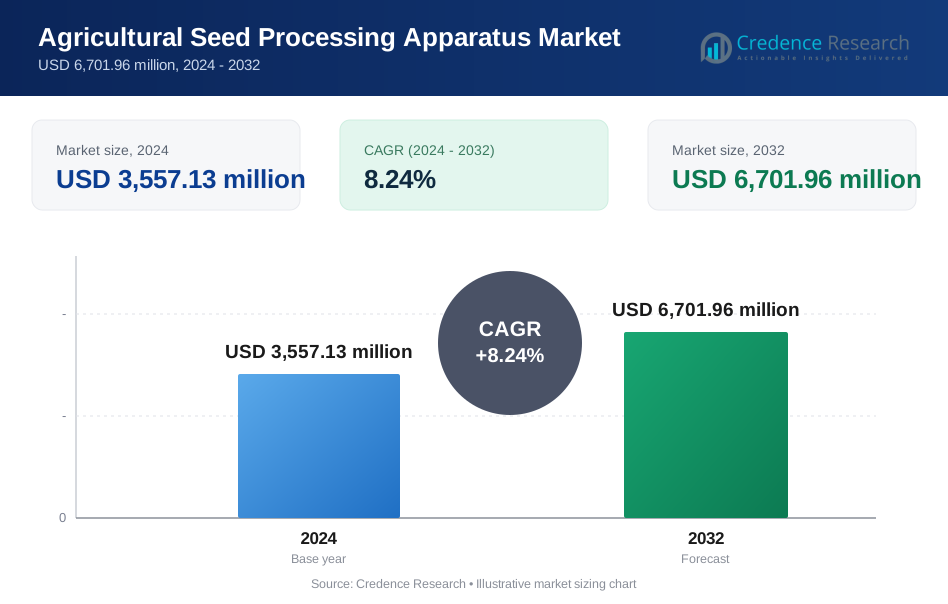
Agricultural Seed Processing Apparatus Market size was valued at USD 3557.13 million in 2024 and is anticipated to reach USD 6701.96 million by 2032, at a CAGR of 8.24% during the forecast period (2024-2032).
The key drivers of the agricultural seed processing apparatus market include the rising global demand for food and the growing focus on food security, leading to higher investments in advanced farming technologies. The need for efficient seed sorting, cleaning, coating, and treatment systems is increasing to reduce seed wastage and improve overall farm productivity. Additionally, technological advancements in seed processing, such as automation, machine learning, and AI, are driving demand for more sophisticated and precise equipment. These innovations help enhance seed quality, reduce labor costs, and streamline processing times, providing a competitive edge to farmers and agricultural companies. Moreover, the increasing adoption of environmentally friendly seed treatments is further propelling the demand for advanced processing systems. As farming techniques evolve, there is also a greater emphasis on integrating sustainable practices in seed processing to reduce environmental impact.
Regionally, the market is dominated by North America, which holds the largest share due to the presence of advanced agricultural practices, technological innovations, and a strong demand for high-quality seeds. The region also benefits from substantial investments in research and development to improve seed processing efficiency. Europe follows closely, with significant demand driven by the growing focus on sustainable farming practices and government initiatives supporting precision agriculture. The increasing adoption of organic farming practices in Europe further boosts the demand for quality seed processing equipment. The Asia-Pacific region is expected to witness the highest growth during the forecast period, driven by increasing agricultural activities, a rising population, and the growing adoption of mechanized farming techniques in countries like India and China. Government subsidies and support in the region are encouraging farmers to invest in advanced technologies. The Latin American and Middle Eastern markets are also expanding, supported by increasing agricultural investments and advancements in seed processing technologies, which are helping improve crop yields and food security.
Market Insights:
- The Agricultural Seed Processing Apparatus Market was valued at USD 3,557.13 million in 2024 and is expected to reach USD 6,701.96 million by 2032, growing at a CAGR of 8.24% during the forecast period (2024-2032).
- Key drivers of market growth include the increasing global demand for food and a greater focus on food security, which leads to higher investments in advanced farming technologies for improved crop yields and quality.
- Technological advancements, such as automation, AI, and machine learning, are driving demand for sophisticated seed processing equipment, enhancing seed quality, reducing labor costs, and streamlining processing times.
- The adoption of environmentally friendly seed treatments is becoming more widespread, promoting the demand for advanced processing systems that reduce environmental impact while maintaining seed quality.
- North America holds the largest market share (32%), benefiting from advanced agricultural practices, substantial investments in research and development, and high demand for high-quality seeds.
- Europe accounts for 27% of the market share, with growing demand driven by sustainable farming practices, government support for precision agriculture, and the adoption of organic farming techniques.
- The Asia-Pacific region is experiencing the highest growth (25%), driven by increased agricultural activities, population growth, and the adoption of mechanized farming in countries like India and China.
Market Drivers:
Increasing Global Food Demand:
The rising global demand for food is a significant driver of the agricultural seed processing apparatus market. With the global population projected to surpass 9 billion by 2050, there is an urgent need to enhance agricultural productivity to meet the growing food requirements. Efficient seed processing plays a critical role in improving crop yields and quality, ensuring that farmers can meet this rising demand. By utilizing advanced seed sorting, cleaning, and coating technologies, farmers can enhance seed viability and germination rates, directly contributing to higher crop production. These developments are essential to supporting the global food supply, as crop failure and suboptimal yields are major contributors to food insecurity.
Technological Advancements in Seed Processing:
Technological innovation is driving the demand for more sophisticated agricultural seed processing apparatus. For instance, Saiwa’s AI-powered seed quality systems use machine learning and computer vision to automate seed analysis, enabling automated counting, sizing, and defect detection, which significantly increases the speed and accuracy of seed testing while reducing human error and operational costs. The integration of automation, artificial intelligence (AI), and machine learning in seed processing systems enables more precise and efficient operations. Automation reduces human intervention and ensures higher accuracy in seed treatment, cleaning, and sorting. AI-driven systems help in detecting defects in seeds, allowing for better-quality control and more efficient processing cycles. These advancements help in reducing operational costs, increasing processing speed, and ensuring better seed quality. With the need for faster, more accurate processing systems, farmers and agribusinesses are increasingly turning to these advanced technologies to stay competitive and meet market demands.
Focus on Sustainability and Environmental Impact:
The growing emphasis on sustainability and environmental responsibility in agriculture is another critical driver of the agricultural seed processing apparatus market. For instance, seed companies such as GAUTIER Semences and SAKATA Vegetables Europe S.A.S. are actively promoting precision agriculture and integrated pest management through their support of the International Seed Federation’s sustainability initiatives, thereby reducing the use of chemicals and minimizing waste in farming operations. As climate change and environmental degradation become more pressing issues, the agricultural industry is adopting more sustainable farming practices. Seed processing systems that use fewer chemicals and minimize environmental impact are becoming highly sought after. The shift toward organic farming practices, combined with the increasing consumer demand for sustainably sourced food, is creating an opportunity for seed processing equipment that supports eco-friendly practices. This trend is encouraging manufacturers to develop machinery that reduces waste, uses fewer resources, and helps farmers produce healthier, more sustainable crops.
Government Support and Investment in Agriculture:
Governments worldwide are increasingly recognizing the importance of agricultural advancements and are investing heavily in the sector. Public sector funding is fostering innovation in seed processing technology, improving processing efficiency and crop yield. Several government initiatives are focused on providing subsidies and grants for the adoption of modern agricultural machinery, including seed processing equipment. These initiatives aim to improve food security and enhance farm productivity, which is crucial to ensuring national food supplies. In addition, agricultural policies in various regions are driving farmers to adopt more advanced machinery, including seed processing apparatus, to remain competitive in the global agricultural market. The availability of financial support for purchasing such machinery is accelerating the adoption of modern seed processing systems across various regions.
Market Trends:
Integration of Automation and AI:
The agricultural seed processing apparatus market is experiencing a significant shift towards automation and artificial intelligence (AI). Advanced machinery integrated with AI algorithms is enhancing seed sorting, grading, and treatment processes, providing higher precision and efficiency. Automation reduces human error, minimizes seed damage, and speeds up processing times, which increases overall productivity. This trend is enabling seed processing companies to maintain competitiveness and optimize operational workflows, while also ensuring that seeds meet the highest quality standards.
Focus on Sustainability and Organic Practices:
Sustainability and organic farming practices are also becoming key trends in the agricultural seed processing market. As consumers become more aware of environmental issues and demand cleaner food sources, the focus on sustainable seed production methods is increasing. This trend is driving the demand for seed processing equipment that supports organic farming standards, such as reducing chemical usage during processing. For instance, the Indian government's Paramparagat Krishi Vikas Yojana (PKVY) initiative has successfully promoted organic farming by providing farmers with access to eco-friendly seed processing equipment that minimizes chemical usage and aligns with organic farming standards. Manufacturers are developing eco-friendly machinery that minimizes waste and energy consumption, aligning with the industry's broader push towards sustainability.
Adoption of Multifunctional Machinery:
Another significant trend is the adoption of multifunctional machinery in seed processing. These machines combine multiple processing functions such as cleaning, grading, and treatment into a single unit. This consolidation of tasks reduces the need for multiple machines, saving both space and operational costs. For instance, Cimbria's Delta Super Cleaner integrates cleaning and grading functions, streamlining the processing workflow and increasing efficiency. Additionally, multifunctional equipment streamlines the processing workflow, increasing efficiency and providing seed producers with a cost-effective solution to meet their operational needs.
Expansion in Emerging Markets:
The expansion of agricultural technology adoption in emerging markets, particularly in the Asia-Pacific region, is driving growth in the seed processing apparatus market. Countries like India and China are making significant investments to modernize their agricultural infrastructure, including the adoption of advanced seed processing technologies. Government incentives and subsidies are also helping facilitate this transition, leading to greater demand for state-of-the-art seed processing equipment in these rapidly growing markets.
Market Challenges Analysis:
High Initial Investment Costs:
One of the major challenges facing the agricultural seed processing apparatus market is the high initial investment cost associated with advanced seed processing machinery. For instance, government surveys indicate that investment costs on civil works and plant machinery constitute a significant portion of total expenditures, often limiting access for small and medium-sized farmers. The acquisition and installation of state-of-the-art equipment, particularly automated and AI-driven systems, can be prohibitively expensive for small and medium-sized farmers. This financial barrier often limits the adoption of modern technology, particularly in regions where access to capital and financing options is limited. As a result, many farmers continue to rely on outdated, less efficient equipment, which impacts productivity and crop yields. The high cost of these systems can also make it difficult for manufacturers to penetrate price-sensitive markets, where the demand for affordable solutions is higher. Additionally, the return on investment may take several years, making it a risky proposition for farmers operating with tight margins. These financial challenges can hinder the widespread adoption of cutting-edge seed processing technologies in certain regions.
Complexity of Integration and Maintenance:
Another key challenge is the complexity of integrating advanced seed processing machinery with existing systems on farms. Many agricultural operations, especially those in emerging markets, rely on a mix of legacy equipment that may not be compatible with new technologies. The integration process can be time-consuming, requiring skilled personnel and significant financial resources to ensure that the systems function seamlessly together. Furthermore, maintaining sophisticated machinery can be challenging, as it often requires specialized knowledge and regular servicing. This can lead to downtime and additional costs for farmers who may not have access to trained technicians or spare parts. The need for continuous maintenance and updates to keep the machinery operating efficiently adds to the overall operational costs, which may deter potential buyers from investing in these advanced systems. Additionally, the lack of skilled labor in rural areas further complicates the successful implementation and upkeep of modern seed processing technology.
Market Opportunities:
The agricultural seed processing apparatus market presents several opportunities for growth driven by technological advancements and increased demand for high-quality seeds. The integration of automation, artificial intelligence (AI), and machine learning into seed processing equipment is revolutionizing the industry. These technologies offer opportunities for the development of highly efficient, precision-focused machinery that can improve seed sorting, grading, and treatment processes. As farmers seek to boost productivity and meet the growing global demand for food, there is an increasing need for advanced processing systems that ensure better seed viability, germination rates, and overall crop yield. Manufacturers who can innovate and deliver cost-effective, technologically advanced solutions stand to gain significant market share.
Additionally, the global trend toward sustainability in agriculture presents a major opportunity for seed processing apparatus manufacturers. With consumers increasingly demanding organic and environmentally friendly products, there is a growing market for equipment that supports sustainable farming practices. This includes systems that reduce chemical usage, minimize waste, and improve energy efficiency. As more farmers adopt eco-friendly farming methods, the demand for seed processing machines that align with these practices will continue to rise. Emerging markets, particularly in Asia-Pacific and Latin America, also offer significant growth potential, as increasing agricultural investments and government support drive the adoption of modern seed processing technologies. As these regions transition to more mechanized farming, there will be an expanding need for efficient, advanced seed processing systems.
Market Segmentation Analysis:
By Product Type
The Agricultural Seed Processing Apparatus Market is segmented by product type into seed cleaners, seed separators, seed coating machines, and others. Seed cleaners hold a dominant share due to their crucial role in removing impurities, stones, and other foreign materials from seeds, ensuring better quality. Seed separators, which sort seeds based on size, weight, or shape, are also experiencing significant growth, driven by the increasing demand for precision sorting. Seed coating machines are gaining traction as farmers seek to enhance seed performance through treatments that improve germination and protect against pests and diseases.
By Application
The market is segmented by application into agricultural, horticultural, and others. The agricultural segment holds the largest share, driven by the rising global demand for high-quality seeds in crops such as cereals, vegetables, and legumes. As farming practices modernize and mechanization increases, there is a growing need for seed processing systems to ensure higher crop yields and reduce wastage. The horticultural segment is also witnessing growth, particularly in regions focusing on organic farming and specialty crops, where quality seed processing is crucial.
By Operation
The market is also divided by operation type into manual, semi-automatic, and automatic systems. Automatic systems are gaining significant momentum, driven by the need for efficiency and precision in seed processing. These systems reduce labor costs, minimize human error, and ensure faster processing times. Semi-automatic and manual systems remain popular in small-scale farming, where cost considerations are more critical. However, automation is expected to dominate in the long term due to its ability to increase productivity and lower operational costs.
Segmentations:
By Product Type
- Seed Cleaners
- Seed Separators
- Seed Coating Machines
- Others
By Application
- Agricultural
- Horticultural
- Others
By Operation
- Manual
- Semi-Automatic
- Automatic
By End-User
- Farmers
- Seed Processing Companies
- Agricultural Cooperatives
- Government Bodies
- Research Institutions
By Region
- North America
- U.S.
- Canada
- Mexico
- Europe
- UK
- France
- Germany
- Italy
- Spain
- Russia
- Belgium
- Netherlands
- Austria
- Sweden
- Poland
- Denmark
- Switzerland
- Rest of Europe
- Asia Pacific
- China
- Japan
- South Korea
- India
- Australia
- Thailand
- Indonesia
- Vietnam
- Malaysia
- Philippines
- Taiwan
- Rest of Asia Pacific
- Latin America
- Brazil
- Argentina
- Peru
- Chile
- Colombia
- Rest of Latin America
- Middle East
- UAE
- KSA
- Israel
- Turkey
- Iran
- Rest of Middle East
- Africa
- Egypt
- Nigeria
- Algeria
- Morocco
- Rest of Africa
Regional Analysis:
North America
North America holds the largest market share at 32%, primarily due to the region’s advanced farming practices, technological innovations, and strong focus on improving agricultural productivity. The U.S. is the major contributor to this market share, where the adoption of automated seed processing systems is widespread. The market in North America benefits from high investments in research and development, which supports the continuous improvement of seed processing equipment. Additionally, government initiatives to enhance food security and sustainability further fuel the growth of the market in this region. The integration of AI, automation, and robotics in seed processing is enhancing the efficiency and precision of operations, making North America a dominant player in the global market. Furthermore, the focus on sustainable farming and eco-friendly production methods is expected to keep driving the demand for modern seed processing technologies.
Europe
Europe accounts for 27% of the Agricultural Seed Processing Apparatus Market share, driven by its emphasis on sustainable farming practices and eco-friendly seed production methods. The region's strong regulations regarding organic farming, combined with an increasing consumer demand for sustainably sourced food, is contributing to the growth of seed processing equipment that meets organic standards. Key markets in Europe, including Germany, France, and the UK, are focusing on improving seed quality and efficiency by adopting advanced technologies in seed treatment and sorting. Europe’s market is also supported by ongoing government initiatives and subsidies aimed at promoting precision agriculture, which further boosts the demand for high-quality seed processing systems. The growing trend of using less chemical-intensive farming methods is expected to increase the need for equipment that aligns with these environmental goals.
Asia-Pacific
The Asia-Pacific region is witnessing the highest growth rate, with a market share of 25%. The rapid adoption of mechanized farming in countries such as India, China, and Japan is driving demand for modern seed processing equipment. The growing population and the need to ensure food security are major factors fueling agricultural investments in the region. Governments in these countries are providing financial support and incentives to encourage the adoption of advanced technologies, including seed processing systems. Additionally, the increasing focus on improving crop yields and reducing wastage through efficient seed processing is creating a favorable environment for market growth in the Asia-Pacific region. As agriculture becomes more industrialized in emerging markets, there is a growing need for advanced machinery to enhance productivity and meet the challenges of feeding large populations.
Key Player Analysis:
- Buhler Group
- AGCO Corporation
- SYNMEC International Trading Ltd.
- Crippen Manufacturing Company
- ArrowCorp Inc.
- Alvan Blanch Development Company Ltd
- PETKUS Technologie GmbH
- Seedburo Equipment Company
- Oliver Manufacturing Co., Inc.
- Lewis M. Carter Manufacturing, LLC
- Westrup A/S
- Akyurek Technology
- Spectrum Industries
- Cimbria Heid GmbH
- Kice Industries, Inc.
Competitive Analysis:
The Agricultural Seed Processing Apparatus Market is highly competitive, with several key players driving innovation and growth. Companies such as Buhler AG, AGCO Corporation, and Cimbria are leading the market by offering advanced seed processing solutions that integrate automation, AI, and robotics to improve efficiency and precision. These players focus on developing multifunctional equipment that can perform a range of tasks, including cleaning, sorting, and coating, while ensuring higher seed quality and yield. Additionally, companies are increasingly investing in research and development to enhance seed treatment technologies and address the growing demand for sustainable farming practices. New entrants in the market are focusing on offering cost-effective and energy-efficient solutions to cater to emerging markets in Asia-Pacific and Latin America, where mechanization adoption is rapidly increasing. Strategic partnerships, acquisitions, and product innovations are expected to remain key competitive strategies for market players to maintain and expand their market share.
Recent Developments:
- In September 2023, Westrup A/S entered a strategic partnership with Oliver Manufacturing to enhance agricultural processing capabilities in South America, aiming to deliver high-capacity, high-quality seed cleaning and sorting solutions for the region’s growing market.
Market Concentration & Characteristics:
The Agricultural Seed Processing Apparatus Market is moderately concentrated, with a few key players dominating the landscape, such as Buhler AG, AGCO Corporation, and Cimbria. These companies hold a significant share due to their extensive product portfolios, strong research and development capabilities, and established brand reputation. However, the market also includes several smaller players and new entrants that focus on offering cost-effective, niche solutions, catering to emerging markets and regional demands. The competitive dynamics are driven by continuous innovation, with major companies investing heavily in automation, AI, and sustainable seed processing technologies. The market is characterized by a high level of technological advancement, as players strive to offer multifunctional equipment that enhances efficiency and seed quality. Additionally, partnerships, collaborations, and acquisitions are common strategies used by leading companies to strengthen their market position and expand their global reach. Overall, the market remains dynamic with evolving competitive pressures.
Report Coverage:
The research report offers an in-depth analysis based on Product Type, Application, Operation, End-User and Region. It details leading market players, providing an overview of their business, product offerings, investments, revenue streams, and key applications. Additionally, the report includes insights into the competitive environment, SWOT analysis, current market trends, as well as the primary drivers and constraints. Furthermore, it discusses various factors that have driven market expansion in recent years. The report also explores market dynamics, regulatory scenarios, and technological advancements that are shaping the industry. It assesses the impact of external factors and global economic changes on market growth. Lastly, it provides strategic recommendations for new entrants and established companies to navigate the complexities of the market.
Future Outlook:
- The Agricultural Seed Processing Apparatus Market is expected to experience significant growth, driven by the increasing demand for high-quality seeds and advancements in agricultural technologies.
- Technological innovations, including automation, artificial intelligence, and machine learning, are enhancing seed sorting, grading, and treatment processes, leading to improved efficiency and precision.
- The rising adoption of precision agriculture techniques is fueling the demand for sophisticated seed processing equipment that ensures optimal planting and germination.
- Sustainability concerns are driving the development of eco-friendly seed processing technologies that reduce chemical usage and minimize environmental impact.
- The growing global population and the need to ensure food security are prompting increased investments in seed processing infrastructure, particularly in emerging markets.
- Asia-Pacific is anticipated to witness the fastest growth in the seed processing apparatus market, with countries like India and China leading the adoption of modern agricultural practices.
- North America remains a dominant market, supported by advanced agricultural practices and substantial investments in research and development.
- Europe's stringent regulations on seed quality and emphasis on sustainable farming practices are driving the demand for advanced seed processing equipment.
- The market is witnessing increased consolidation, with mergers and acquisitions enabling companies to expand their product portfolios and enhance technological capabilities.
- Government subsidies and financial support are facilitating the adoption of modern seed processing technologies, especially among small and medium-sized farmers in developing regions.
Request a Free Sample
Fill in your details and we'll send you a free sample report.
- Sample data tables & charts
- Research methodology
Need a Custom Version of This Report?
Tailor the scope, geography, or segments to your exact requirements.
- Custom geography or segment scope
- Direct access to our analyst team
Frequently Asked Questions
What is the projected market size of the Agricultural Seed Processing Apparatus Market?
What are the key drivers of the agricultural seed processing apparatus market?
How is sustainability influencing the seed processing apparatus market?
Which region is expected to witness the highest growth in the market?
Table of Content
Chapter 1. Report Introduction
- 1.1 Report Description & Purpose
- 1.1.1 Report Title & Market Definition
- 1.1.2 Unique Selling Propositions (USP) & Key Differentiators
- 1.1.3 Value Proposition for Stakeholders
- 1.2 Research Objectives
- 1.2.1 Market Sizing Objectives (Volume & Revenue)
- 1.2.2 Segmentation Objectives
- 1.2.3 Competitive Intelligence Objectives
- 1.2.4 Forecast & Scenario Objectives
- 1.3 Report Scope
- 1.3.1 Agricultural Seed Processing Apparatus Scope – Types & Subtypes Covered
- 1.3.2 Geographic Scope – Regions & Countries Covered
- 1.3.3 Historical Period, Base Year & Forecast Period (2024; forecast to 2032)
- 1.3.4 Inclusions & Exclusions
- 1.4 HS Code & Classification Framework
- 1.5 Currency, Units & Pricing Basis
- 1.6 Target Stakeholders
- 1.7 Limitations & Assumptions
Chapter 2. Executive Summary
- 2.1 Global Agricultural Seed Processing Apparatus Market Snapshot
- 2.1.1 Market Size – Historical (2024) & Forecast (2024-2032) (2024: USD 3,557.13 million → 2032: USD 6,701.96 million)
- 2.1.2 Volume & Revenue – Global Totals
- 2.1.3 Key Market Highlights – Top Five Facts
- 2.2 Agricultural Seed Processing Apparatus Market Segmentation Snapshot
- 2.2.1 Market Split by Region – 2024 vs. 2032
- 2.3 Competitive Snapshot
- 2.3.1 Top 10 Players by Revenue Share – 2024
- 2.3.2 Top 10 Players by Volume Share – 2024
- 2.3.3 Recent Strategic Developments (18-Month Summary)
- 2.4 Key Investment Highlights & Strategic Conclusions
Chapter 3. Agricultural Seed Processing Apparatus Market Dynamics & Industry Analysis
- 3.1 Market Overview & Context
- 3.1.1 Agricultural Seed Processing Apparatus Market Position in the Broader Automotive Value Chain
- 3.1.2 OEM vs. Replacement Market Dynamics
- 3.1.3 Market Maturity & Development Stage by Region
- 3.2 Agricultural Seed Processing Apparatus Market Drivers
- 3.3 Agricultural Seed Processing Apparatus Market Restraints & Challenges
- 3.4 Agricultural Seed Processing Apparatus Market Opportunities
- 3.5 Porter's Five Forces Analysis
- 3.5.1 Threat of New Entrants
- 3.5.2 Bargaining Power of Suppliers
- 3.5.3 Bargaining Power of Buyers
- 3.5.4 Threat of Substitutes
- 3.5.5 Competitive Rivalry – Intensity Assessment
- 3.6 Agricultural Seed Processing Apparatus Value Chain Analysis
- 3.6.1 Upstream – Raw Material/Input Suppliers
- 3.6.1.1 Raw Material/Input 1
- 3.6.1.2 Raw Material/Input 2
- 3.6.1.3 Raw Material/Input 3
- 3.6.2 Midstream – Production/Manufacturing/Service Delivery
- 3.6.2.1 Production/Process Overview
- 3.6.2.2 Key Facility Locations & Capacity by Manufacturer
- 3.6.3 Downstream – Distribution & End Consumer
- 3.6.3.1 Primary Channel – B2B/OEM
- 3.6.3.2 Secondary Channels – Dealer, Retail, Online, Direct
- 3.6.4 Value Chain Profitability Analysis
- 3.6.1 Upstream – Raw Material/Input Suppliers
- 3.7 PESTEL Analysis
- 3.7.1 Political Factors
- 3.7.2 Economic Factors
- 3.7.3 Social Factors
- 3.7.4 Technological Factors
- 3.7.5 Environmental Factors
- 3.7.6 Legal Factors
- 3.8 Agricultural Seed Processing Apparatus Supply Chain Analysis
- 3.8.1 Raw Material/Input Supply Risk Assessment
- 3.8.2 Manufacturing Concentration Risk (Geographic Exposure)
- 3.8.3 Trade Disruption Impact Analysis
- 3.9 Regulatory & Policy Landscape
Note: The regulatory and policy landscape section covers regulations based on their applicability to the market, Agricultural Seed Processing Apparatus category, geography, and scope of the study. Only regulatory frameworks with a material impact on operations, compliance, trade, sustainability, or market access are analyzed in detail.
Chapter 4. Key Investment Pockets & Opportunity Analysis
- 4.1 Agricultural Seed Processing Apparatus Market Attractiveness Analysis
- 4.1.1 By Region – Investment Attractiveness Matrix (Volume × CAGR)
- 4.2 Absolute Revenue Growth Opportunity
- 4.2.1 By Region – Absolute USD Growth Through 2032
- 4.3 Incremental Volume Opportunity
- 4.3.1 By Region – Incremental Volume Through 2032
- 4.3.2 Segment – Incremental Volume
- 4.4 Emerging Submarket Opportunity Deep Dive (Subject to Applicability)
- 4.5 Emerging Market Opportunity Scorecards
- 4.5.1 United States
- 4.5.2 Europe
- 4.5.3 Asia
- 4.5.4 Middle East & Africa
Note: Emerging Market Opportunity Scorecards will be included based on relevance and strategic importance. Regions listed are indicative and may vary depending on data availability and market dynamics.
Chapter 5. Agricultural Seed Processing Apparatus Import-Export Analysis & Trade Flows
- 5.1 Global Trade Overview
- 5.1.1 Global Export Value by Country (2024)
- 5.1.2 Global Export Volume by Country (2024)
- 5.1.3 Global Import Value by Country (2024)
- 5.1.4 Global Import Volume by Country (2024)
- 5.1.5 Net Trade Balance by Country (2024)
- 5.2 Export Analysis – Segment
- 5.2.1 Type 1 (HS Code)
- 5.2.2 Type 2 (HS Code)
- 5.2.3 Type 3 (HS Code)
- 5.2.4 Type 4 (HS Code)
- 5.2.5 Type 5 (HS Code)
- 5.3 Import Analysis – Segment
- 5.3.1 Type 1 (HS Code)
- 5.3.2 Type 2 (HS Code)
- 5.3.3 Type 3 (HS Code)
- 5.3.4 Type 4 (HS Code)
- 5.3.5 Type 5 (HS Code)
- 5.4 Average Unit Trade Prices
- 5.4.1 Average Export Price – Segment & Country
- 5.4.2 Average Import Price – Segment & Source Country
- 5.4.3 Price Trends (2024)
- 5.5 Key Trade Route Analysis
- 5.5.1 Trade Route 1
- 5.5.2 Trade Route 2
- 5.5.3 Trade Route 3
- 5.5.4 Trade Route 4
- 5.5.5 Trade Route 5
- 5.6 Trade Policy Impact Assessment
- 5.6.1 US Anti-Dumping & Section 301 Tariffs
- 5.6.2 EU Customs Union Impact
- 5.6.3 Major Free Trade Agreements
- 5.6.4 USMCA Rules of Origin
Note: Trade policy analysis will be included only where relevant to the Agricultural Seed Processing Apparatus market.
Chapter 6. Competitive Landscape & Company Benchmarking
- 6.1 Agricultural Seed Processing Apparatus Market Concentration & Structure
- 6.1.1 Herfindahl-Hirschman Index (HHI) – vs. 2024
- 6.1.2 Tier 1, Tier 2 & Tier 3 Market Structure
- 6.1.3 Global, Regional & Local Player Dynamics
- 6.2 Agricultural Seed Processing Apparatus Market Share Analysis – 2024
- 6.2.1 Global Revenue Share by Company
- 6.2.2 Global Volume Share by Company
- 6.2.3 Regional Revenue Share
- 6.2.4 Market Share Evolution ( vs. 2024)
- 6.2.5 OEM Segment Share by Company
- 6.2.6 Replacement Segment Share by Company
- 6.3 Production/Delivery Capacity & Facility Analysis
- 6.3.1 Global Installed Capacity
- 6.3.2 Capacity Utilization Rates
- 6.3.3 Production/Output Volume
- 6.3.4 Facility Locations & Capacity Map
- 6.3.5 Planned Capacity Additions
- 6.4 Agricultural Seed Processing Apparatus Competitive Benchmarking Matrix
- 6.4.1 Revenue, Volume, CAGR & Profitability Comparison
- 6.4.2 Channel Revenue Mix
- 6.4.3 Geographic Revenue Exposure
- 6.4.4 R&D Intensity
- 6.4.5 Sustainability Maturity
- 6.5 Strategic Developments in Agricultural Seed Processing Apparatus (Last 24 Months)
- 6.5.1 Mergers, Acquisitions & Divestments
- 6.5.2 New Agricultural Seed Processing Apparatus Launches
- 6.5.3 Facility Expansions
- 6.5.4 Strategic Alliances, Joint Ventures & Partnerships
- 6.5.5 Distribution Expansion & Market Entry
- 6.5.6 Sustainability & ESG Initiatives
- 6.6 Competitive Strategy Mapping
- 6.6.1 Leader, Challenger, Follower & Niche Classification
- 6.6.2 Pricing Strategy Comparison
- 6.6.3 Channel Strategy Matrix
Note: Strategic developments are included based on their materiality and the availability of reliable information.
Chapter 7. Global Agricultural Seed Processing Apparatus Market – By Distribution Channel
- 7.1 Segment Overview
- 7.1.1 Volume & Revenue Split by Channel (2024 & 2032)
- 7.1.2 Channel Mix Evolution (2024-2032)
Chapter 8. Regional Market Analysis – Global Overview
- 8.1 Global Regional Overview
- 8.1.1 Regional Volume Share
- 8.1.2 Regional Revenue Share
- 8.1.3 Regional Volume by Region
- 8.1.4 Regional Revenue by Region
- 8.1.5 Regional Forecast Through 2032
- 8.2 Cross-Regional Segment Analysis
- 8.2.1 By Distribution Channel
- 8.2.2 By Brand/Price Tier
Chapter 9. North America Agricultural Seed Processing Apparatus Market
- 9.1 United States
- 9.2 Canada
- 9.3 Mexico
Chapter 10. Europe Agricultural Seed Processing Apparatus Market
- 10.1 Germany
- 10.2 France
- 10.3 Italy
- 10.4 United Kingdom
- 10.5 Spain
- 10.6 Poland
- 10.7 Russia
- 10.8 Netherlands
- 10.9 Belgium
- 10.10 Sweden
- 10.11 Denmark
- 10.12 Norway
- 10.13 Rest of Europe
Chapter 11. Asia Pacific Agricultural Seed Processing Apparatus Market
- 11.1 China
- 11.2 India
- 11.3 Japan
- 11.4 South Korea
- 11.5 Thailand
- 11.6 Indonesia
- 11.7 Vietnam
- 11.8 Malaysia
- 11.9 Australia
- 11.10 Rest of Asia Pacific
Chapter 12. Latin America Agricultural Seed Processing Apparatus Market
- 12.1 Brazil
- 12.2 Argentina
- 12.3 Colombia
- 12.4 Chile
- 12.5 Rest of Latin America
Chapter 13. Middle East Agricultural Seed Processing Apparatus Market
- 13.1 Saudi Arabia
- 13.2 United Arab Emirates
- 13.3 Turkey
- 13.4 Israel
- 13.5 Iran
- 13.6 Rest of the Middle East
Chapter 14. Africa Agricultural Seed Processing Apparatus Market
- 14.1 South Africa
- 14.2 Egypt
- 14.3 Nigeria
- 14.4 Morocco
- 14.5 Rest of Africa
Chapter 15. Agricultural Seed Processing Apparatus Company Profiles
- 15.1 [Company 01]
- 15.1.1 Company Overview
- 15.1.2 Key Management Personnel
- 15.1.3 Products & Services Portfolio
- 15.1.4 Financial Performance
- 15.1.5 Key Market Focus & Geographic Presence
- 15.1.6 Recent Developments & Strategic Initiatives
Note: The company profile list is preliminary and may change based on research findings, market developments, data availability, and client requirements.
Chapter 16. Appendices
- Appendix A – List of Abbreviations & Acronyms
- Appendix B – Industry Classification Code Reference – Full Series
- Appendix C – Production & Capacity Data Tables
- Appendix D – End-Use & Demand Base Tables
- Appendix E – Consumption & Replacement Rate Assumptions
- Appendix F – ASP Reference Tables
- Appendix G – Manufacturing & Facility Database
- Appendix H – Import-Export Data Tables
- Appendix I – Regulatory Summary Tables
- Appendix J – Primary Research Participant List (Anonymized)
- Appendix K – Primary Research Questionnaire Framework
- Appendix L – Data Sources & Bibliography
- Appendix M – Market Size Divergence & Source Comparison
Chapter 17. Research Methodology
- 17.1 Research Framework & Philosophy
- 17.2 Secondary Research – Sources, Hierarchy & Data Extraction
- 17.3 Data Modeling – Bottom-Up & Top-Down Market Sizing
- 17.4 Primary Research – Stakeholder Framework, LOI & Sample Sizes
- 17.5 Forecast Methodology – Regression, Scenario & Sensitivity Analysis
- 17.6 Quality Control – Four-Layer Validation Framework
- 17.7 Limitations & Standard Assumptions
- 17.8 Disclaimer
