
Landscaping and Gardening Service Market Overview:
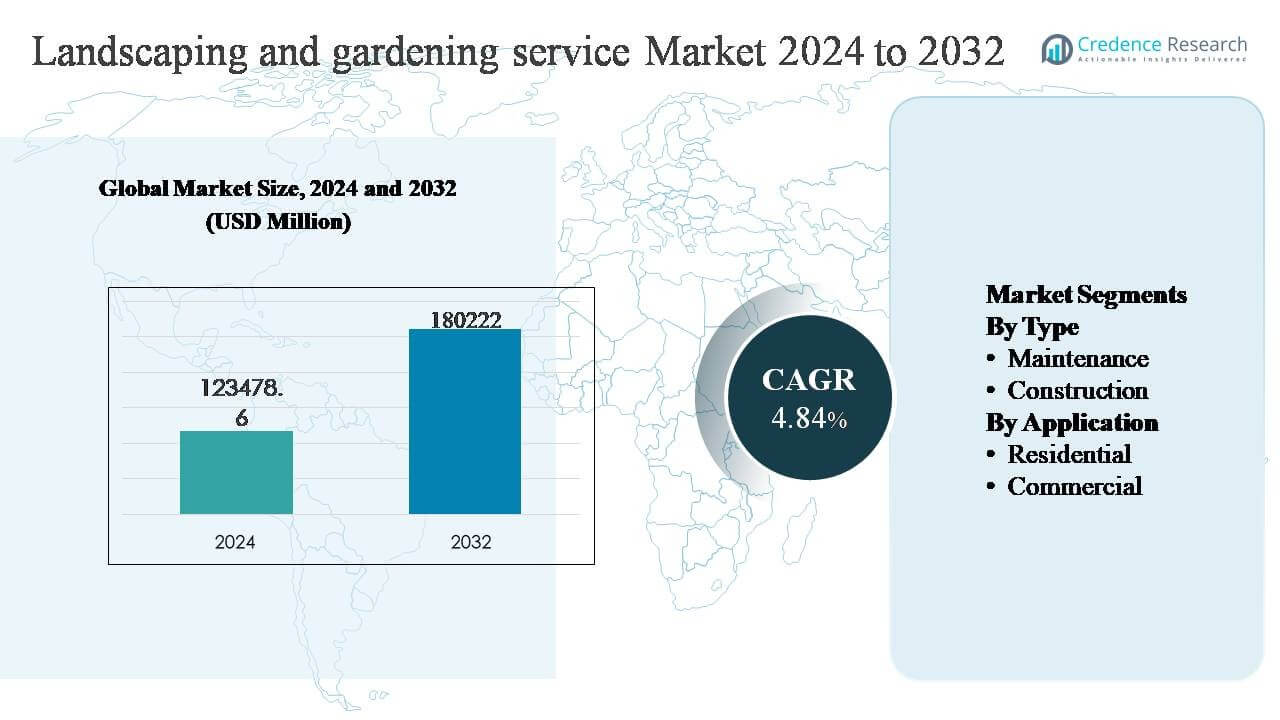
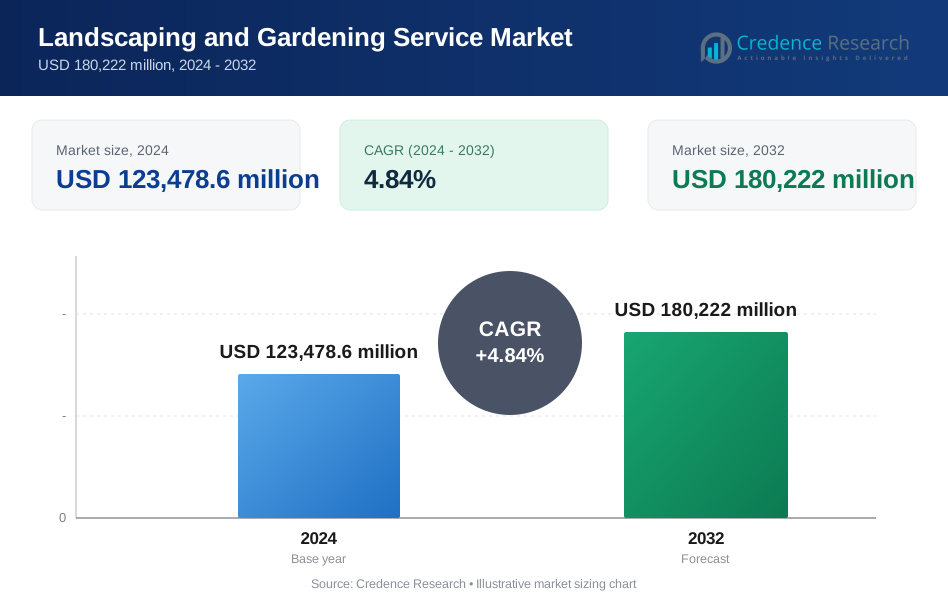
The landscaping and gardening services market was valued at USD 123,478.6 million in 2024 and is projected to reach USD 180,222 million by 2032, expanding at a CAGR of 4.84% over the forecast period.
| REPORT ATTRIBUTE | DETAILS |
|---|---|
| Historical Period | 2020-2023 |
| Base Year | 2024 |
| Forecast Period | 2025-2032 |
| Landscaping and Gardening Service Market Size 2024 | USD 123,478.6 million |
| Landscaping and Gardening Service Market, CAGR | 4.84% |
| Landscaping and Gardening Service Market Size 2032 | USD 180,222 million |
Landscaping and Gardening Service Market Insights
- Market growth is driven by rising outsourcing of landscape maintenance, expansion of residential and commercial real estate, and increasing investments in urban green spaces, with maintenance services dominating the type segment due to recurring demand.
- Key trends include adoption of sustainable landscaping practices, water-efficient irrigation systems, and technology-enabled maintenance, while residential applications hold the leading segment share, supported by housing developments and homeowner preference for professional services.
- The competitive landscape remains moderately fragmented, with national and regional players focusing on long-term service contracts, integrated offerings, and operational efficiency to strengthen market positioning.
- Regionally, North America leads with ~38% market share, followed by Europe at ~29%, Asia-Pacific at ~23%, while Latin America (~6%) and the Middle East & Africa (~4%) show steady growth potential.
Landscaping and Gardening Service Market Segmentation Analysis:
By Type:
The landscaping and gardening services market by type is dominated by maintenance services, which account for the largest market share due to their recurring nature and essential role in sustaining outdoor aesthetics and functionality. Maintenance services benefit from steady demand across residential communities, commercial properties, and public spaces, driven by regular requirements such as lawn care, pruning, irrigation management, and seasonal upkeep. Property owners increasingly outsource maintenance to professional providers to ensure consistent quality, regulatory compliance, and cost efficiency. In contrast, construction services grow steadily, supported by new real estate developments and landscape redesign projects.
- For instance, BrightView Holdings operates the largest landscape maintenance platform in North America, serving thousands of commercial properties. The company had a total workforce of approximately 18,600 employees as of September 30, 2025. BrightView actively deploys smart irrigation controllers with predictive weather capability and soil-moisture monitoring systems to optimize water usage and scheduling for its clients.
By Application:
By application, the residential segment represents the dominant sub-segment, holding the highest market share as homeowners prioritize well-maintained gardens, lawns, and outdoor living spaces. Rising urban housing development, increased disposable income, and growing interest in aesthetic and recreational home environments drive demand for residential landscaping services. Regular lawn maintenance, garden care, and small-scale landscaping projects contribute to repeat service contracts. The commercial segment also shows strong growth, supported by offices, retail centers, hospitality facilities, and institutional campuses seeking professional landscaping to enhance brand image and property value.
- For instance, TruGreen, one of the largest residential lawn care providers, services more than 2.3 million households annually across the United States, operating over 270 branch locations and applying data-driven soil testing and treatment programs supported by proprietary agronomic software to manage millions of individual lawn treatment visits each year.
Key Growth Drivers
Expansion of Residential and Commercial Real Estate
The continued expansion of residential housing, commercial complexes, and mixed-use developments is a primary growth driver for landscaping and gardening services. New housing communities increasingly incorporate landscaped common areas, private gardens, and recreational green zones as standard amenities, creating long-term service demand beyond initial installation. In parallel, commercial properties such as office parks, retail centers, hotels, hospitals, and educational campuses rely on professional landscaping to enhance visual appeal, tenant satisfaction, and asset value. Developers and property managers increasingly view landscaping as a strategic investment rather than a discretionary expense, driving sustained spending on both design and ongoing maintenance services.
- For instance, Lennar Corporation reported delivering more than 82,000 homes in its most recent fiscal year (ended November 30, 2025), with master-planned communities typically integrating multiple landscaped parks, retention ponds, and trail systems that require year-round professional maintenance across hundreds of acres per development, while CBRE Group manages over 7 billion square feet of commercial real estate globally, coordinating standardized landscaping and grounds-maintenance programs across thousands of office, retail, healthcare, and education assets using centralized property-management platforms and digital vendor coordination systems.
Rising Outsourcing of Landscape Maintenance Services
The growing preference for outsourcing landscaping and gardening activities is significantly accelerating market growth. Property owners, facility managers, and housing associations favor professional service providers to reduce labor management complexity, ensure consistent quality, and meet regulatory or sustainability requirements. Outsourcing allows clients to access specialized equipment, trained horticultural staff, and structured service schedules without maintaining in-house teams. This trend is especially strong in urban residential communities and commercial facilities, where regular maintenance contracts provide predictable revenue streams for service providers and long-term cost control for clients.
- For instance, Lawn Doctor, Inc. operates a franchise network exceeding 600 locations across the United States and relies on proprietary soil analysis protocols and calibrated fertilizer application systems to perform millions of scheduled lawn treatment visits annually.
Increasing Focus on Urban Green Spaces and Sustainability
Governments and municipalities worldwide are prioritizing urban green infrastructure to improve environmental quality, public health, and climate resilience. Investments in parks, green belts, roadside landscaping, and community gardens are driving demand for professional landscaping and gardening services. Sustainability initiatives emphasizing water-efficient irrigation, native plant species, soil health, and biodiversity management further reinforce the need for skilled service providers. As cities adopt greener development frameworks, landscaping services play a central role in implementing and maintaining eco-friendly outdoor environments.
Key Trends & Opportunities
Adoption of Sustainable and Eco-Friendly Landscaping Practices
Sustainable landscaping is emerging as a major trend and growth opportunity within the market. Clients increasingly demand environmentally responsible solutions such as drought-resistant plantings, organic soil treatments, rainwater harvesting systems, and efficient irrigation technologies. Landscaping service providers that integrate sustainability into their offerings differentiate themselves and secure premium contracts, particularly in residential communities and commercial developments aligned with green building standards. This shift creates opportunities for service providers to expand advisory, design, and long-term maintenance services focused on resource efficiency and environmental stewardship.
- For instance, Landscape Development, Inc. (LDI) has documented large-scale sustainable landscape programs across California master-planned communities, managing landscaped environments spanning thousands of acres and deploying weather-based smart irrigation controllers, pressure-regulated drip systems, and reclaimed-water infrastructure to support long-term water-conservation mandates.
Growth of Smart Landscaping and Technology Integration
The integration of digital tools and smart technologies is reshaping landscaping service delivery. Automated irrigation systems, remote soil moisture monitoring, GPS-enabled maintenance equipment, and digital scheduling platforms improve efficiency, reduce water usage, and enhance service transparency. Property managers increasingly value data-driven landscaping solutions that optimize maintenance cycles and lower operating costs. Service providers that invest in technology-enabled operations gain competitive advantages through improved productivity, measurable performance outcomes, and stronger client retention.
- For instance, The Davey Tree Expert Company, through its Davey Resource Group, applies LiDAR-enabled tree inventories and GIS-based asset management systems to manage vegetation and landscape assets across tens of thousands of sites, generating millions of individual data points used to schedule pruning, assess canopy health, and plan long-term maintenance.
Key Challenges
Labor Availability and Skilled Workforce Constraints
The landscaping and gardening services market faces persistent challenges related to labor availability and skill development. The industry relies heavily on manual labor for maintenance and installation activities, making it vulnerable to workforce shortages, rising wage costs, and seasonal labor fluctuations. Recruiting and retaining skilled horticultural professionals, equipment operators, and supervisors remains difficult, particularly in urban markets with competing employment opportunities. These constraints can limit service capacity, increase operational costs, and affect service consistency, especially for providers managing large-scale or multi-site contracts.
Cost Pressures and Margin Management
Rising input costs present a significant challenge for landscaping service providers. Expenses related to labor, fuel, equipment maintenance, plant materials, and water usage continue to increase, while clients often seek cost-competitive service contracts. Balancing service quality with pricing pressures requires careful margin management and operational efficiency. Smaller service providers may face difficulties absorbing cost increases or investing in modern equipment and technology, potentially limiting scalability and long-term competitiveness in an increasingly professionalized market.
Regional Analysis
North America
North America holds the largest share of the global landscaping and gardening services market at approximately 38%, supported by high outsourcing rates, mature residential housing stock, and strong commercial property maintenance demand. The United States dominates regional activity due to widespread use of professional lawn care, landscape maintenance contracts, and municipal green space management. Commercial facilities, homeowners’ associations, and public infrastructure projects drive recurring service revenues. The region also benefits from early adoption of smart irrigation systems and sustainable landscaping practices, reinforcing demand for specialized and technology-enabled service providers.
Europe
Europe accounts for around 29% of the global market share, driven by strong emphasis on urban planning, sustainability, and public green infrastructure. Countries such as Germany, the United Kingdom, France, and the Nordics invest consistently in parks, heritage landscapes, and municipal green maintenance. Strict environmental regulations encourage eco-friendly landscaping practices, increasing demand for skilled service providers. Residential gardening services remain prominent, particularly in suburban and semi-urban areas, while commercial landscaping benefits from tourism, hospitality, and institutional properties seeking high-quality outdoor environments.
Asia-Pacific
Asia-Pacific represents approximately 23% of the global landscaping and gardening services market, supported by rapid urbanization, expanding residential construction, and growing commercial infrastructure. Countries such as China, Japan, Australia, and India drive regional demand through large-scale urban development, smart city initiatives, and rising middle-class housing projects. While in-house maintenance remains common in some markets, outsourcing is steadily increasing, particularly in premium residential complexes and commercial properties. Government investments in urban green spaces and public landscaping further strengthen long-term service demand across the region.
Latin America
Latin America holds an estimated 6% market share, with growth driven by urban development, hospitality projects, and expanding residential communities. Brazil and Mexico lead regional demand due to large urban populations and increasing investments in commercial real estate and tourism infrastructure. Landscaping services are increasingly used to enhance property value, particularly in gated communities, resorts, and public spaces. However, market fragmentation and price sensitivity remain notable, with a mix of organized service providers and local contractors shaping competitive dynamics across the region.
Middle East & Africa
The Middle East & Africa region accounts for roughly 4% of the global market share, supported by commercial landscaping demand and government-led urban beautification projects. Gulf Cooperation Council countries drive regional activity through large-scale commercial developments, hospitality projects, and public landscaping initiatives. Water-efficient landscaping and desert-adapted designs are critical drivers due to climatic conditions. In Africa, demand is emerging gradually, led by urban centers and institutional developments. Despite a smaller share, long-term opportunities exist through infrastructure expansion and smart city investments.
Landscaping and Gardening Service Market Segmentations:
By Type
- Maintenance
- Construction
By Application
- Residential
- Commercial
By Geography
- North America
- U.S.
- Canada
- Mexico
- Europe
- Germany
- France
- U.K.
- Italy
- Spain
- Rest of Europe
- Asia Pacific
- China
- Japan
- India
- South Korea
- South-east Asia
- Rest of Asia Pacific
- Latin America
- Brazil
- Argentina
- Rest of Latin America
- Middle East & Africa
- GCC Countries
- South Africa
- Rest of the Middle East and Africa
Competitive Landscape
The competitive landscape of the landscaping and gardening services market is moderately fragmented, characterized by the presence of large national service providers, regional operators, and numerous local contractors. Leading companies compete through comprehensive service portfolios that combine landscape design, construction, and recurring maintenance contracts to secure long-term client relationships. Market participants increasingly differentiate through sustainability-focused offerings, technology-enabled maintenance solutions, and specialized services such as water-efficient irrigation and seasonal landscape management. Strategic partnerships with real estate developers, municipalities, and commercial property managers strengthen market positioning. Larger players leverage scale advantages, standardized processes, and workforce training programs to maintain service quality across multiple locations, while smaller firms compete on localized expertise, customer responsiveness, and flexible pricing structures, sustaining competitive intensity across residential and commercial segments.
Key Player Analysis
- TruGreen, Inc.
- BrightView Holdings, Inc.
- The Davey Tree Expert Company
- Idverde
- Lawn Doctor, Inc.
- Landscape Development, Inc.
- Clintar Commercial Outdoor Services
- Chapel Valley Landscape Company
- Denison Landscaping, Inc.
Recent Developments
- In September 4, 2025 , Davey Resource Group (DRG) the environmental consulting and engineered services subsidiary of The Davey Tree Expert Company acquired LandStudies of Lititz, Pennsylvania, strengthening its technical service portfolio in ecology, wetlands, and environmental planning as part of Davey’s broader landscape and environmental solutions offerings.
- In February 25, 2025, TruGreen became the title sponsor of Full Swing Season 3, a Netflix Sports series that launched this season, extending its brand reach beyond traditional lawn care audiences and reinforcing its partnership as the Official Lawn Care Treatment Provider of the PGA TOUR. TruGreen’s network of more than 290 U.S. and Canada locations and field operations of over 14,000 employees support this sponsorship, aiming to connect the company’s science-driven lawn treatment expertise with viewers interested in high-performance turf quality.
Report Coverage
The research report offers an in-depth analysis based on Type, Application and Geography. It details leading market players, providing an overview of their business, product offerings, investments, revenue streams, and key applications. Additionally, the report includes insights into the competitive environment, SWOT analysis, current market trends, as well as the primary drivers and constraints. Furthermore, it discusses various factors that have driven market expansion in recent years. The report also explores market dynamics, regulatory scenarios, and technological advancements that are shaping the industry. It assesses the impact of external factors and global economic changes on market growth. Lastly, it provides strategic recommendations for new entrants and established companies to navigate the complexities of the market.
Future Outlook
- Demand for professional landscaping and gardening services will continue to rise as urbanization expands and green spaces become integral to residential and commercial developments.
- Maintenance services will remain the dominant revenue contributor due to recurring service requirements and long-term contracts.
- Residential landscaping will sustain strong demand, supported by housing growth and increased focus on outdoor living and property aesthetics.
- Commercial and municipal landscaping will gain importance as organizations invest in green infrastructure and public space enhancement.
- Sustainable landscaping practices will see wider adoption, including water-efficient irrigation and native plant usage.
- Technology integration will improve service efficiency through smart irrigation, digital scheduling, and performance monitoring.
- Outsourcing of landscaping services will increase as property owners prioritize cost control and service consistency.
- Skilled workforce development will become a critical focus to address labor availability and service quality challenges.
- Market consolidation will gradually increase as larger players acquire regional providers to expand geographic reach.
- Emerging markets will offer long-term growth opportunities driven by infrastructure development and urban green initiatives.
Request a Free Sample
Fill in your details and we'll send you a free sample report.
- Sample data tables & charts
- Research methodology
Need a Custom Version of This Report?
Tailor the scope, geography, or segments to your exact requirements.
- Custom geography or segment scope
- Direct access to our analyst team
Frequently Asked Questions
What is the current market size for Landscaping and gardening service, and what is its projected size in 2032?
At what Compound Annual Growth Rate is the Landscaping and gardening service projected to grow between 2024 and 2032?
Which Landscaping and gardening service segment held the largest share in 2024?
What are the primary factors fueling the growth of the Landscaping and gardening service?
Who are the leading companies in the Landscaping and gardening service?
Which region commanded the largest share of the Landscaping and gardening service in 2024?
Table of Content
Chapter 1. Report Introduction
- 1.1 Report Description & Purpose
- 1.1.1 Report Title & Market Definition
- 1.1.2 Unique Selling Propositions (USP) & Key Differentiators
- 1.1.3 Value Proposition for Stakeholders
- 1.2 Research Objectives
- 1.2.1 Market Sizing Objectives (Volume & Revenue)
- 1.2.2 Segmentation Objectives
- 1.2.3 Competitive Intelligence Objectives
- 1.2.4 Forecast & Scenario Objectives
- 1.3 Report Scope
- 1.3.1 Landscaping and Gardening Service Scope – Types & Subtypes Covered
- 1.3.2 Geographic Scope – Regions & Countries Covered
- 1.3.3 Historical Period, Base Year & Forecast Period (2024; forecast to 2032)
- 1.3.4 Inclusions & Exclusions
- 1.4 HS Code & Classification Framework
- 1.5 Currency, Units & Pricing Basis
- 1.6 Target Stakeholders
- 1.7 Limitations & Assumptions
Chapter 2. Executive Summary
- 2.1 Global Landscaping and Gardening Service Market Snapshot
- 2.1.1 Market Size – Historical (2024) & Forecast (2024-2032) (2024: USD 123,478.6 million → 2032: USD 180,222 million)
- 2.1.2 Volume & Revenue – Global Totals
- 2.1.3 Key Market Highlights – Top Five Facts
- 2.2 Landscaping and Gardening Service Market Segmentation Snapshot
- 2.2.1 Market Split by Region – 2024 vs. 2032
- 2.3 Competitive Snapshot
- 2.3.1 Top 10 Players by Revenue Share – 2024
- 2.3.2 Top 10 Players by Volume Share – 2024
- 2.3.3 Recent Strategic Developments (18-Month Summary)
- 2.4 Key Investment Highlights & Strategic Conclusions
Chapter 3. Landscaping and Gardening Service Market Dynamics & Industry Analysis
- 3.1 Market Overview & Context
- 3.1.1 Landscaping and Gardening Service Market Position in the Broader Automotive Value Chain
- 3.1.2 OEM vs. Replacement Market Dynamics
- 3.1.3 Market Maturity & Development Stage by Region
- 3.2 Landscaping and Gardening Service Market Drivers
- 3.3 Landscaping and Gardening Service Market Restraints & Challenges
- 3.4 Landscaping and Gardening Service Market Opportunities
- 3.5 Porter's Five Forces Analysis
- 3.5.1 Threat of New Entrants
- 3.5.2 Bargaining Power of Suppliers
- 3.5.3 Bargaining Power of Buyers
- 3.5.4 Threat of Substitutes
- 3.5.5 Competitive Rivalry – Intensity Assessment
- 3.6 Landscaping and Gardening Service Value Chain Analysis
- 3.6.1 Upstream – Raw Material/Input Suppliers
- 3.6.1.1 Raw Material/Input 1
- 3.6.1.2 Raw Material/Input 2
- 3.6.1.3 Raw Material/Input 3
- 3.6.2 Midstream – Production/Manufacturing/Service Delivery
- 3.6.2.1 Production/Process Overview
- 3.6.2.2 Key Facility Locations & Capacity by Manufacturer
- 3.6.3 Downstream – Distribution & End Consumer
- 3.6.3.1 Primary Channel – B2B/OEM
- 3.6.3.2 Secondary Channels – Dealer, Retail, Online, Direct
- 3.6.4 Value Chain Profitability Analysis
- 3.6.1 Upstream – Raw Material/Input Suppliers
- 3.7 PESTEL Analysis
- 3.7.1 Political Factors
- 3.7.2 Economic Factors
- 3.7.3 Social Factors
- 3.7.4 Technological Factors
- 3.7.5 Environmental Factors
- 3.7.6 Legal Factors
- 3.8 Landscaping and Gardening Service Supply Chain Analysis
- 3.8.1 Raw Material/Input Supply Risk Assessment
- 3.8.2 Manufacturing Concentration Risk (Geographic Exposure)
- 3.8.3 Trade Disruption Impact Analysis
- 3.9 Regulatory & Policy Landscape
Note: The regulatory and policy landscape section covers regulations based on their applicability to the market, Landscaping and Gardening Service category, geography, and scope of the study. Only regulatory frameworks with a material impact on operations, compliance, trade, sustainability, or market access are analyzed in detail.
Chapter 4. Key Investment Pockets & Opportunity Analysis
- 4.1 Landscaping and Gardening Service Market Attractiveness Analysis
- 4.1.1 By Region – Investment Attractiveness Matrix (Volume × CAGR)
- 4.2 Absolute Revenue Growth Opportunity
- 4.2.1 By Region – Absolute USD Growth Through 2032
- 4.3 Incremental Volume Opportunity
- 4.3.1 By Region – Incremental Volume Through 2032
- 4.3.2 Segment – Incremental Volume
- 4.4 Emerging Submarket Opportunity Deep Dive (Subject to Applicability)
- 4.5 Emerging Market Opportunity Scorecards
- 4.5.1 United States
- 4.5.2 Europe
- 4.5.3 Asia
- 4.5.4 Middle East & Africa
Note: Emerging Market Opportunity Scorecards will be included based on relevance and strategic importance. Regions listed are indicative and may vary depending on data availability and market dynamics.
Chapter 5. Landscaping and Gardening Service Import-Export Analysis & Trade Flows
- 5.1 Global Trade Overview
- 5.1.1 Global Export Value by Country (2024)
- 5.1.2 Global Export Volume by Country (2024)
- 5.1.3 Global Import Value by Country (2024)
- 5.1.4 Global Import Volume by Country (2024)
- 5.1.5 Net Trade Balance by Country (2024)
- 5.2 Export Analysis – Segment
- 5.2.1 Type 1 (HS Code)
- 5.2.2 Type 2 (HS Code)
- 5.2.3 Type 3 (HS Code)
- 5.2.4 Type 4 (HS Code)
- 5.2.5 Type 5 (HS Code)
- 5.3 Import Analysis – Segment
- 5.3.1 Type 1 (HS Code)
- 5.3.2 Type 2 (HS Code)
- 5.3.3 Type 3 (HS Code)
- 5.3.4 Type 4 (HS Code)
- 5.3.5 Type 5 (HS Code)
- 5.4 Average Unit Trade Prices
- 5.4.1 Average Export Price – Segment & Country
- 5.4.2 Average Import Price – Segment & Source Country
- 5.4.3 Price Trends (2024)
- 5.5 Key Trade Route Analysis
- 5.5.1 Trade Route 1
- 5.5.2 Trade Route 2
- 5.5.3 Trade Route 3
- 5.5.4 Trade Route 4
- 5.5.5 Trade Route 5
- 5.6 Trade Policy Impact Assessment
- 5.6.1 US Anti-Dumping & Section 301 Tariffs
- 5.6.2 EU Customs Union Impact
- 5.6.3 Major Free Trade Agreements
- 5.6.4 USMCA Rules of Origin
Note: Trade policy analysis will be included only where relevant to the Landscaping and Gardening Service market.
Chapter 6. Competitive Landscape & Company Benchmarking
- 6.1 Landscaping and Gardening Service Market Concentration & Structure
- 6.1.1 Herfindahl-Hirschman Index (HHI) – vs. 2024
- 6.1.2 Tier 1, Tier 2 & Tier 3 Market Structure
- 6.1.3 Global, Regional & Local Player Dynamics
- 6.2 Landscaping and Gardening Service Market Share Analysis – 2024
- 6.2.1 Global Revenue Share by Company
- 6.2.2 Global Volume Share by Company
- 6.2.3 Regional Revenue Share
- 6.2.4 Market Share Evolution ( vs. 2024)
- 6.2.5 OEM Segment Share by Company
- 6.2.6 Replacement Segment Share by Company
- 6.3 Production/Delivery Capacity & Facility Analysis
- 6.3.1 Global Installed Capacity
- 6.3.2 Capacity Utilization Rates
- 6.3.3 Production/Output Volume
- 6.3.4 Facility Locations & Capacity Map
- 6.3.5 Planned Capacity Additions
- 6.4 Landscaping and Gardening Service Competitive Benchmarking Matrix
- 6.4.1 Revenue, Volume, CAGR & Profitability Comparison
- 6.4.2 Channel Revenue Mix
- 6.4.3 Geographic Revenue Exposure
- 6.4.4 R&D Intensity
- 6.4.5 Sustainability Maturity
- 6.5 Strategic Developments in Landscaping and Gardening Service (Last 24 Months)
- 6.5.1 Mergers, Acquisitions & Divestments
- 6.5.2 New Landscaping and Gardening Service Launches
- 6.5.3 Facility Expansions
- 6.5.4 Strategic Alliances, Joint Ventures & Partnerships
- 6.5.5 Distribution Expansion & Market Entry
- 6.5.6 Sustainability & ESG Initiatives
- 6.6 Competitive Strategy Mapping
- 6.6.1 Leader, Challenger, Follower & Niche Classification
- 6.6.2 Pricing Strategy Comparison
- 6.6.3 Channel Strategy Matrix
Note: Strategic developments are included based on their materiality and the availability of reliable information.
Chapter 7. Global Landscaping and Gardening Service Market – By Distribution Channel
- 7.1 Segment Overview
- 7.1.1 Volume & Revenue Split by Channel (2024 & 2032)
- 7.1.2 Channel Mix Evolution (2024-2032)
Chapter 8. Regional Market Analysis – Global Overview
- 8.1 Global Regional Overview
- 8.1.1 Regional Volume Share
- 8.1.2 Regional Revenue Share
- 8.1.3 Regional Volume by Region
- 8.1.4 Regional Revenue by Region
- 8.1.5 Regional Forecast Through 2032
- 8.2 Cross-Regional Segment Analysis
- 8.2.1 By Distribution Channel
- 8.2.2 By Brand/Price Tier
Chapter 9. North America Landscaping and Gardening Service Market
- 9.1 United States
- 9.2 Canada
- 9.3 Mexico
Chapter 10. Europe Landscaping and Gardening Service Market
- 10.1 Germany
- 10.2 France
- 10.3 Italy
- 10.4 United Kingdom
- 10.5 Spain
- 10.6 Poland
- 10.7 Russia
- 10.8 Netherlands
- 10.9 Belgium
- 10.10 Sweden
- 10.11 Denmark
- 10.12 Norway
- 10.13 Rest of Europe
Chapter 11. Asia Pacific Landscaping and Gardening Service Market
- 11.1 China
- 11.2 India
- 11.3 Japan
- 11.4 South Korea
- 11.5 Thailand
- 11.6 Indonesia
- 11.7 Vietnam
- 11.8 Malaysia
- 11.9 Australia
- 11.10 Rest of Asia Pacific
Chapter 12. Latin America Landscaping and Gardening Service Market
- 12.1 Brazil
- 12.2 Argentina
- 12.3 Colombia
- 12.4 Chile
- 12.5 Rest of Latin America
Chapter 13. Middle East Landscaping and Gardening Service Market
- 13.1 Saudi Arabia
- 13.2 United Arab Emirates
- 13.3 Turkey
- 13.4 Israel
- 13.5 Iran
- 13.6 Rest of the Middle East
Chapter 14. Africa Landscaping and Gardening Service Market
- 14.1 South Africa
- 14.2 Egypt
- 14.3 Nigeria
- 14.4 Morocco
- 14.5 Rest of Africa
Chapter 15. Landscaping and Gardening Service Company Profiles
- 15.1 [Company 01]
- 15.1.1 Company Overview
- 15.1.2 Key Management Personnel
- 15.1.3 Products & Services Portfolio
- 15.1.4 Financial Performance
- 15.1.5 Key Market Focus & Geographic Presence
- 15.1.6 Recent Developments & Strategic Initiatives
Note: The company profile list is preliminary and may change based on research findings, market developments, data availability, and client requirements.
Chapter 16. Appendices
- Appendix A – List of Abbreviations & Acronyms
- Appendix B – Industry Classification Code Reference – Full Series
- Appendix C – Production & Capacity Data Tables
- Appendix D – End-Use & Demand Base Tables
- Appendix E – Consumption & Replacement Rate Assumptions
- Appendix F – ASP Reference Tables
- Appendix G – Manufacturing & Facility Database
- Appendix H – Import-Export Data Tables
- Appendix I – Regulatory Summary Tables
- Appendix J – Primary Research Participant List (Anonymized)
- Appendix K – Primary Research Questionnaire Framework
- Appendix L – Data Sources & Bibliography
- Appendix M – Market Size Divergence & Source Comparison
Chapter 17. Research Methodology
- 17.1 Research Framework & Philosophy
- 17.2 Secondary Research – Sources, Hierarchy & Data Extraction
- 17.3 Data Modeling – Bottom-Up & Top-Down Market Sizing
- 17.4 Primary Research – Stakeholder Framework, LOI & Sample Sizes
- 17.5 Forecast Methodology – Regression, Scenario & Sensitivity Analysis
- 17.6 Quality Control – Four-Layer Validation Framework
- 17.7 Limitations & Standard Assumptions
- 17.8 Disclaimer
