
Forage Feed Market Overview:
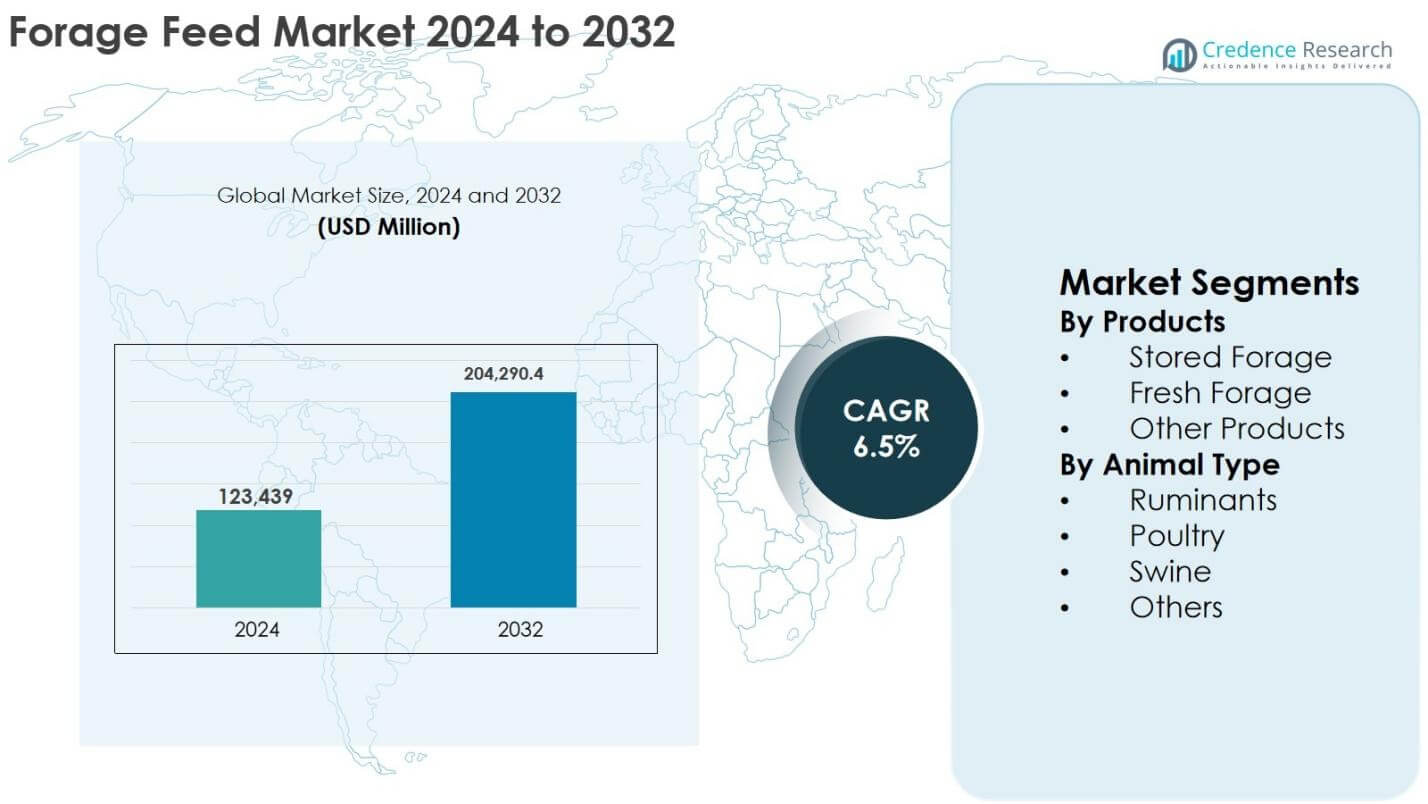
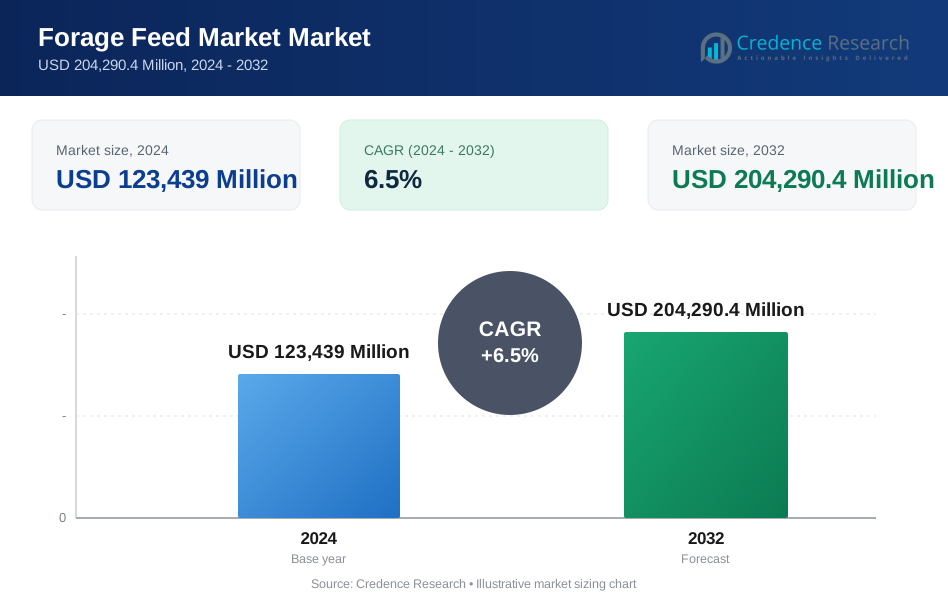
Forage Feed market size was valued USD 123,439 Million in 2024 and is anticipated to reach USD 204,290.4 Million by 2032, at a CAGR of 6.5% during the forecast period.
| REPORT ATTRIBUTE | DETAILS |
|---|---|
| Historical Period | 2020-2023 |
| Base Year | 2024 |
| Forecast Period | 2025-2032 |
| Forage Feed Market Size 2024 | USD 123,439 million |
| Forage Feed Market, CAGR | 6.5% |
| Forage Feed Market Size 2032 | USD 204,290.4 million |
Forage Feed Market Insights
- Strong market growth is driven by rising livestock populations, increasing dairy and beef production, and growing adoption of stored forage and silage to improve feed efficiency and year-round cattle nutrition across commercial farming systems.
- Key trends include increasing demand for nutritionally enriched haylage and alfalfa-based forage, expanding use of mechanized harvesting and storage technologies, and a gradual industry shift toward sustainable and natural livestock feeding practices.
- The market features active participation from players such as ADM Alliance Nutrition, Standlee Premium Products LLC, Triple Crown Nutrition, Wilbur-Ellis Holdings Inc., Al Dahra ACX Global Inc., Lucerne Farms, Riverina Australia Pty Ltd., NWF Agriculture, Chaffhaye, and Baileys Horse Feeds.
- Asia-Pacific leads the market with 34.6% share, followed by North America at 27.8% and Europe at 23.1%, while Stored Forage remains the dominant product segment with 57.3% share in 2024.
Forage Feed Market Segmentation Analysis:
By Products
The Forage Feed market by products is dominated by Stored Forage, which accounted for 57.3% share in 2024, driven by its longer shelf life, better nutrient retention, and suitability for year-round livestock feeding in dairy and beef production systems. Fresh Forage continues to gain traction due to increasing adoption of pasture-based livestock farming and sustainability-focused feed practices, while Other Products serve niche requirements across regional and specialty livestock segments. Growth in this category is supported by expanding herd populations, improved feed storage technologies, and rising emphasis on optimizing livestock productivity.
- For instance, large U.S. dairies routinely rely on corn silage and alfalfa haylage stored in bunker silos or bags to maintain consistent rations during winter, a practice documented in USDA and university extension feeding guides.
By Animal Type
In the Forage Feed market by animal type, Ruminants emerged as the dominant sub-segment with 64.8% market share in 2024, supported by their high forage dependency and expanding global cattle, sheep, and goat production. Poultry and Swine represent a smaller yet growing share as producers adopt forage-based fiber blends to enhance digestion, support organic farming, and reduce reliance on synthetic feed additives. Market expansion is further driven by rising livestock populations, increasing focus on feed cost efficiency, and government initiatives promoting sustainable and natural livestock feeding systems.
- For instance, Fonterra’s pasture-centric model in New Zealand relies heavily on grazed forage for dairy herds, underpinning the cooperative’s low-cost, grass-fed milk production approach.
Key Growth Drivers
Rising Livestock Population and Increasing Demand for Animal Protein
The Forage Feed market is experiencing strong growth due to the expanding global livestock population and the rising demand for dairy, meat, and animal-derived protein products. As populations grow and urbanization accelerates, consumption of beef, milk, and poultry is increasing, particularly in emerging economies across Asia-Pacific, Africa, and Latin America. This trend intensifies the need for high-quality forage to support cattle and ruminant nutrition, ensuring optimal growth, milk yield, and reproductive efficiency. Governments and industry stakeholders increasingly promote livestock productivity improvement programs, driving farmer adoption of nutritionally enriched forage feed over conventional grazing-only systems. Additionally, the shift from subsistence to commercialized livestock farming strengthens demand for silage, haylage, and stored forage products. The growing emphasis on improving feed conversion efficiency, herd health, and sustainable feeding practices further reinforces market expansion, positioning forage feed as a critical component in modern livestock nutrition systems worldwide.
- For instance, the FAO has documented steady increases in global milk and meat output over the past decade, with major contributions from emerging economies that are scaling up dairy and beef production.
Technological Advancements in Forage Processing, Storage, and Feed Quality Enhancement
Technological innovation plays a pivotal role in strengthening the Forage Feed market, particularly through advancements in harvesting, processing, storage, and nutritional formulation. Modern silage compaction systems, precision forage harvesters, moisture-control technologies, and nutrient-preserving storage solutions help farmers retain higher dry-matter content and improve feed stability throughout the year. The adoption of balers, automated wrapping systems, and climate-resistant storage infrastructure reduces post-harvest spoilage and ensures consistent forage availability, especially for large-scale dairy and beef farms. Feed manufacturers increasingly integrate nutritional additives, probiotics, and fiber-optimized blends to enhance digestibility and improve rumen function, thereby increasing herd productivity. Digital agriculture, farm mechanization, and smart feeding systems also enable better monitoring of forage intake and nutrient balance. Together, these advancements improve operational efficiency, reduce wastage, and support premium forage product demand, accelerating market penetration in both developed and developing livestock sectors.
- For instance, John Deere’s self-propelled forage harvesters with HarvestLab 3000 sensor technology allow real-time measurement of dry matter and nutrients, enabling more precise silage harvesting and better ration planning.
Shift Toward Sustainable and Natural Livestock Feeding Practices
A growing shift toward sustainable, natural, and eco-friendly livestock nutrition is significantly boosting demand for forage-based feeding systems. Increasing consumer preference for organic dairy and grass-fed meat, coupled with stricter regulations on synthetic feed additives and antibiotic use, encourages producers to adopt forage-rich diets. Forage feed supports regenerative agriculture practices, enhances soil fertility, promotes pasture biodiversity, and reduces dependence on grain-intensive feeding models, aligning with climate-resilient farming objectives. Governments and sustainability programs actively promote forage cultivation and fodder self-sufficiency to improve rural livelihoods and reduce feed import dependency. The increasing adoption of rotational grazing systems, on-farm forage production, and integrated livestock-crop systems further strengthens forage utilization. As environmental accountability and animal welfare standards continue to gain prominence, forage feed emerges as a critical enabler of sustainable livestock production, driving long-term structural growth opportunities across global agricultural economies.
Key Trends & Opportunities
Growing Adoption of Value-Added and Nutritionally Enriched Forage Products
A major trend shaping the Forage Feed market is the increasing adoption of value-added, nutritionally enhanced, and specialty forage products tailored to animal health and performance needs. Producers are shifting from conventional raw forage toward premium silage blends, fortified hay products, dehydrated forage cubes, and protein-rich alfalfa-based formulations. These products offer improved digestibility, higher fiber balance, and consistent nutritional profiles, supporting higher milk output, weight gain, and reproductive efficiency in livestock. Additionally, demand is rising for functional forage containing probiotics, fermentation enhancers, and natural fiber supplements that optimize rumen health and immunity. The growth of commercial dairy farms, feed mills, and integrated livestock enterprises accelerates the adoption of standardized feed solutions over traditional pasture feeding. This trend creates strong opportunities for forage feed manufacturers to expand product portfolios, develop performance-focused formulations, and cater to specialized livestock nutrition segments globally.
- For instance, Purina Animal Nutrition (Land O’Lakes) offers alfalfa-based and performance-focused forages as part of its dairy and beef feeding programs, designed to support milk components and growth.
Expansion of Forage Cultivation and Commercial Fodder Production Initiatives
Expanding commercial forage cultivation presents a significant opportunity for market players, driven by increasing government support, contract farming initiatives, and investments in fodder value chains. Countries facing feed shortages and climate-induced grazing constraints are promoting structured forage production through subsidized seeds, irrigation support, and farmer training programs. Large agricultural enterprises and dairy cooperatives are increasingly investing in dedicated forage farms, silage production units, and integrated feed processing facilities to ensure stable year-round supply. The rise of forage export markets, particularly alfalfa and compressed hay, further enhances revenue opportunities for producers in North America, the Middle East, Australia, and Europe. Partnerships between feed manufacturers, agri-tech companies, and farmer groups enable efficient supply networks and quality assurance systems. This transition from fragmented small-scale fodder sourcing to organized forage production strengthens supply reliability and expands the commercialization potential of the global Forage Feed market.
- For instance, India’s National Dairy Development Board (NDDB) and various state governments run fodder development schemes that promote high-yield fodder crops, silage-making, and community fodder banks to secure year-round supply for dairy farmers.
Key Challenges
Climate Variability, Water Scarcity, and Crop Yield Uncertainty
Climate change and environmental uncertainties present one of the most significant challenges for the Forage Feed market. Irregular rainfall patterns, prolonged droughts, increasing temperatures, and extreme weather events negatively impact forage crop yields, quality, and availability across major livestock-producing regions. Water scarcity and competition for arable land further restrict large-scale forage cultivation, particularly in dryland and semi-arid regions. Seasonal fluctuations in production also lead to price volatility, affecting feed cost stability for farmers. Inadequate irrigation infrastructure, soil degradation, and limited resilience of traditional forage varieties increase vulnerability to climate shocks. These challenges intensify dependence on expensive imported forage in deficit regions, creating supply-chain disruptions. Addressing climate-related risks requires investments in drought-resistant forage species, climate-smart agriculture practices, water-efficient irrigation systems, and regional fodder security programs to stabilize long-term market sustainability.
High Production, Processing, and Logistics Costs in Forage Supply Chains
The Forage Feed market faces structural challenges related to high production, storage, and transportation costs, which limit affordability and adoption among small and medium-scale livestock farmers. Forage harvesting, baling, compaction, drying, and silage processing require capital-intensive equipment and specialized handling methods that increase operational expenses. Long-distance transportation of bulky forage materials also raises logistics and freight costs, especially in regions lacking efficient cold-chain or fodder storage infrastructure. Price sensitivity among livestock producers further constrains demand for premium and value-added forage products. Additionally, post-harvest losses due to improper storage, spoilage, and nutrient degradation affect profitability for producers and distributors. Overcoming these challenges requires investments in mechanization support, cooperative-based forage processing models, improved rural logistics networks, and scalable storage solutions to enhance cost efficiency across the forage feed value chain.
Regional Analysis
North America
North America accounted for 27.8% share of the Forage Feed market in 2024, supported by its large commercial dairy and beef farming industry, strong mechanization in forage harvesting, and widespread adoption of silage and haylage systems. The United States leads the region due to high ruminant feed demand, organized fodder supply chains, and growing preference for alfalfa-based premium forage. Canada contributes significantly through pasture-based livestock systems and expanding forage exports. Continuous investment in feed quality enhancement, sustainable livestock nutrition programs, and advanced storage infrastructure further strengthens market growth across the region during the forecast period.
Europe
Europe held 23.1% market share in 2024, driven by its strong livestock production base, well-regulated animal nutrition standards, and growing focus on environmentally sustainable forage feeding systems. Countries such as Germany, France, the United Kingdom, and Ireland remain major contributors due to extensive dairy and cattle farming activities. The region benefits from advanced forage processing technologies and structured silage manufacturing facilities. Increasing demand for grass-fed dairy products, organic livestock farming, and performance-oriented forage blends continues to support market expansion, while supportive agricultural policies and farmer cooperatives further enhance forage availability and distribution efficiency.
Asia-Pacific
Asia-Pacific emerged as the largest and fastest-growing region with 34.6% share in 2024, driven by rapid livestock population growth, rising milk and meat consumption, and expansion of commercial dairy farms across China, India, Australia, and Southeast Asia. Governments increasingly promote fodder self-sufficiency programs, forage cultivation initiatives, and silage adoption to reduce feed shortages and seasonal pasture dependency. The region also witnesses strong uptake of stored forage products to support year-round cattle feeding in tropical and semi-arid environments. Rising investments in feed processing facilities, mechanized harvesting equipment, and large-scale livestock enterprises further accelerate market development across Asia-Pacific.
Latin America
Latin America represented 9.6% share of the Forage Feed market in 2024, supported by expanding cattle ranching and beef export industries in Brazil, Argentina, and Mexico. The region benefits from abundant pasture resources but increasingly adopts silage and hay-based feeding systems to improve productivity in commercial dairy and feedlot operations. Growing demand for high-fiber forage blends, coupled with modernization of livestock management practices, strengthens product uptake. Continued investment in forage storage infrastructure, rural mechanization programs, and integrated livestock-crop systems contributes to market growth, while emerging alfalfa cultivation and regional fodder trade enhance long-term opportunities.
Middle East & Africa
The Middle East & Africa accounted for 4.9% market share in 2024, driven primarily by rising demand for fodder imports, particularly alfalfa and dehydrated hay, to support dairy and camel farming industries in the Gulf countries. Water scarcity and limited pasture availability encourage reliance on commercial forage feed products and controlled feeding systems. In Africa, growing cattle and small-ruminant populations, coupled with increasing adoption of silage solutions in emerging dairy clusters, support gradual market expansion. Government initiatives promoting fodder cultivation, pasture improvement, and livestock productivity enhancement programs further strengthen the region’s long-term growth potential.
Forage Feed Market Segmentations:
By Products
- Stored Forage
- Fresh Forage
- Other Products
By Animal Type
- Ruminants
- Poultry
- Swine
- Others
By Geography
- North America
- U.S.
- Canada
- Mexico
- Europe
- Germany
- France
- U.K.
- Italy
- Spain
- Rest of Europe
- Asia Pacific
- China
- Japan
- India
- South Korea
- South-east Asia
- Rest of Asia Pacific
- Latin America
- Brazil
- Argentina
- Rest of Latin America
- Middle East & Africa
- GCC Countries
- South Africa
- Rest of the Middle East and Africa
Competitive Landscape
The Forage Feed market features a diverse and moderately consolidated competitive landscape, characterized by the presence of regional forage producers, integrated feed manufacturers, and large-scale agricultural enterprises expanding specialized forage product portfolios. Key players focus on improving feed quality, enhancing storage stability, and developing nutritionally enriched silage, haylage, and dehydrated forage solutions tailored for dairy, beef, and ruminant livestock systems. Companies such as ADM Alliance Nutrition, Triple Crown Nutrition, Standlee Premium Products LLC, Wilbur-Ellis Holdings Inc., Lucerne Farms, Al Dahra ACX Global Inc., Riverina Australia Pty Ltd., NWF Agriculture, Chaffhaye, and Baileys Horse Feeds strengthen their market presence through contract farming networks, forage processing facilities, and distribution partnerships with commercial livestock operators. Product innovation, investments in mechanized harvesting and baling technologies, and expansion into export-oriented forage segments such as alfalfa and compressed hay remain key strategic priorities. Competition increasingly centers on supply reliability, nutritional consistency, and value-added premium forage offerings for performance-focused livestock production.
Key Player Analysis
- Riverina Australia Pty Ltd.
- Baileys Horse Feeds
- Wilbur-Ellis Holdings Inc.
- Chaffhaye
- ADM Alliance Nutrition
- Al Dahra ACX Global Inc.
- Standlee Premium Products, LLC
- Lucerne Farms
- NWF Agriculture
- Triple Crown Nutrition
Recent Developments
- In October 2024, Renovo Seed announced the launch of its new forage blend, OptiHarv, which combines multiple millet varieties along with peas, beans, barley, and brassicas. The mix is designed to deliver high-volume outputs suitable for baleage, haylage, and grazing applications.
- In March 2023, PGG Wrightson Seeds introduced the GT07 phalaris variety, developed through CSIRO’s breeding program. The GT07 cultivar is recognized by customers for reflecting the company’s continued commitment to innovation and sustainability in agricultural seed development.
- In September 2023, MAS Seeds unveiled a new portfolio of forage mixtures and tailored blends, including its “MAS4 NUTRI” formulation enriched with a high proportion of legumes to improve livestock nutrition. These launches support the company’s strategy to expand its agronomic solutions for farmers.
Report Coverage
The research report offers an in-depth analysis based on Products, Animal Type and Geography. It details leading market players, providing an overview of their business, product offerings, investments, revenue streams, and key applications. Additionally, the report includes insights into the competitive environment, SWOT analysis, current market trends, as well as the primary drivers and constraints. Furthermore, it discusses various factors that have driven market expansion in recent years. The report also explores market dynamics, regulatory scenarios, and technological advancements that are shaping the industry. It assesses the impact of external factors and global economic changes on market growth. Lastly, it provides strategic recommendations for new entrants and established companies to navigate the complexities of the market.
Future Outlook
- The market will continue to expand as livestock producers increasingly adopt forage-based feeding systems to improve animal health and productivity.
- Demand for high-quality silage, haylage, and stored forage will rise as commercial dairy and beef farms focus on year-round feed supply stability.
- Manufacturers will develop more nutritionally enriched and performance-oriented forage blends to support higher milk yield and weight gain in ruminants.
- Technological advancements in harvesting, baling, and storage processes will enhance feed preservation efficiency and reduce post-harvest losses.
- Sustainability-driven farming practices and the shift toward natural livestock nutrition will strengthen the adoption of forage-rich diets.
- Expansion of organized livestock farming and feed processing facilities in emerging economies will create new market opportunities.
- Growth in contract forage farming and integrated fodder value chains will improve supply reliability and distribution networks.
- Climate-resilient forage varieties and improved irrigation support will gain importance in regions facing weather-related fodder shortages.
- Premium forage products targeted at specialized livestock segments such as equine and high-performance dairy herds will see increasing demand.
- Strategic partnerships among feed manufacturers, agricultural cooperatives, and commercial livestock enterprises will shape long-term market development.
Request a Free Sample
Fill in your details and we'll send you a free sample report.
- Sample data tables & charts
- Research methodology
Need a Custom Version of This Report?
Tailor the scope, geography, or segments to your exact requirements.
- Custom geography or segment scope
- Direct access to our analyst team
Frequently Asked Questions
What is the current market size for Forage Feed market, and what is its projected size in 2032?
At what Compound Annual Growth Rate is the Forage Feed market projected to grow between 2024 and 2032?
Which Forage Feed market segment held the largest share in 2024?
What are the primary factors fueling the growth of the Forage Feed market?
Who are the leading companies in the Forage Feed market?
Which region commanded the largest share of the Forage Feed market in 2024?
Table of Content
Chapter 1. Report Introduction
- 1.1 Report Description & Purpose
- 1.1.1 Report Title & Market Definition
- 1.1.2 Unique Selling Propositions (USP) & Key Differentiators
- 1.1.3 Value Proposition for Stakeholders
- 1.2 Research Objectives
- 1.2.1 Market Sizing Objectives (Volume & Revenue)
- 1.2.2 Segmentation Objectives
- 1.2.3 Competitive Intelligence Objectives
- 1.2.4 Forecast & Scenario Objectives
- 1.3 Report Scope
- 1.3.1 Forage Feed Market Scope – Types & Subtypes Covered
- 1.3.2 Geographic Scope – Regions & Countries Covered
- 1.3.3 Historical Period, Base Year & Forecast Period (2024; forecast to 2032)
- 1.3.4 Inclusions & Exclusions
- 1.4 HS Code & Classification Framework
- 1.5 Currency, Units & Pricing Basis
- 1.6 Target Stakeholders
- 1.7 Limitations & Assumptions
Chapter 2. Executive Summary
- 2.1 Global Forage Feed Market Market Snapshot
- 2.1.1 Market Size – Historical (2024) & Forecast (2024-2032) (2024: USD 123,439 Million → 2032: USD 204,290.4 Million)
- 2.1.2 Volume & Revenue – Global Totals
- 2.1.3 Key Market Highlights – Top Five Facts
- 2.2 Forage Feed Market Market Segmentation Snapshot
- 2.2.1 Market Split by Region – 2024 vs. 2032
- 2.3 Competitive Snapshot
- 2.3.1 Top 10 Players by Revenue Share – 2024
- 2.3.2 Top 10 Players by Volume Share – 2024
- 2.3.3 Recent Strategic Developments (18-Month Summary)
- 2.4 Key Investment Highlights & Strategic Conclusions
Chapter 3. Forage Feed Market Market Dynamics & Industry Analysis
- 3.1 Market Overview & Context
- 3.1.1 Forage Feed Market Market Position in the Broader Automotive Value Chain
- 3.1.2 OEM vs. Replacement Market Dynamics
- 3.1.3 Market Maturity & Development Stage by Region
- 3.2 Forage Feed Market Market Drivers
- 3.3 Forage Feed Market Market Restraints & Challenges
- 3.4 Forage Feed Market Market Opportunities
- 3.5 Porter's Five Forces Analysis
- 3.5.1 Threat of New Entrants
- 3.5.2 Bargaining Power of Suppliers
- 3.5.3 Bargaining Power of Buyers
- 3.5.4 Threat of Substitutes
- 3.5.5 Competitive Rivalry – Intensity Assessment
- 3.6 Forage Feed Market Value Chain Analysis
- 3.6.1 Upstream – Raw Material/Input Suppliers
- 3.6.1.1 Raw Material/Input 1
- 3.6.1.2 Raw Material/Input 2
- 3.6.1.3 Raw Material/Input 3
- 3.6.2 Midstream – Production/Manufacturing/Service Delivery
- 3.6.2.1 Production/Process Overview
- 3.6.2.2 Key Facility Locations & Capacity by Manufacturer
- 3.6.3 Downstream – Distribution & End Consumer
- 3.6.3.1 Primary Channel – B2B/OEM
- 3.6.3.2 Secondary Channels – Dealer, Retail, Online, Direct
- 3.6.4 Value Chain Profitability Analysis
- 3.6.1 Upstream – Raw Material/Input Suppliers
- 3.7 PESTEL Analysis
- 3.7.1 Political Factors
- 3.7.2 Economic Factors
- 3.7.3 Social Factors
- 3.7.4 Technological Factors
- 3.7.5 Environmental Factors
- 3.7.6 Legal Factors
- 3.8 Forage Feed Market Supply Chain Analysis
- 3.8.1 Raw Material/Input Supply Risk Assessment
- 3.8.2 Manufacturing Concentration Risk (Geographic Exposure)
- 3.8.3 Trade Disruption Impact Analysis
- 3.9 Regulatory & Policy Landscape
Note: The regulatory and policy landscape section covers regulations based on their applicability to the market, Forage Feed Market category, geography, and scope of the study. Only regulatory frameworks with a material impact on operations, compliance, trade, sustainability, or market access are analyzed in detail.
Chapter 4. Key Investment Pockets & Opportunity Analysis
- 4.1 Forage Feed Market Market Attractiveness Analysis
- 4.1.1 By Region – Investment Attractiveness Matrix (Volume × CAGR)
- 4.2 Absolute Revenue Growth Opportunity
- 4.2.1 By Region – Absolute USD Growth Through 2032
- 4.3 Incremental Volume Opportunity
- 4.3.1 By Region – Incremental Volume Through 2032
- 4.3.2 Segment – Incremental Volume
- 4.4 Emerging Submarket Opportunity Deep Dive (Subject to Applicability)
- 4.5 Emerging Market Opportunity Scorecards
- 4.5.1 United States
- 4.5.2 Europe
- 4.5.3 Asia
- 4.5.4 Middle East & Africa
Note: Emerging Market Opportunity Scorecards will be included based on relevance and strategic importance. Regions listed are indicative and may vary depending on data availability and market dynamics.
Chapter 5. Forage Feed Market Import-Export Analysis & Trade Flows
- 5.1 Global Trade Overview
- 5.1.1 Global Export Value by Country (2024)
- 5.1.2 Global Export Volume by Country (2024)
- 5.1.3 Global Import Value by Country (2024)
- 5.1.4 Global Import Volume by Country (2024)
- 5.1.5 Net Trade Balance by Country (2024)
- 5.2 Export Analysis – Segment
- 5.2.1 Type 1 (HS Code)
- 5.2.2 Type 2 (HS Code)
- 5.2.3 Type 3 (HS Code)
- 5.2.4 Type 4 (HS Code)
- 5.2.5 Type 5 (HS Code)
- 5.3 Import Analysis – Segment
- 5.3.1 Type 1 (HS Code)
- 5.3.2 Type 2 (HS Code)
- 5.3.3 Type 3 (HS Code)
- 5.3.4 Type 4 (HS Code)
- 5.3.5 Type 5 (HS Code)
- 5.4 Average Unit Trade Prices
- 5.4.1 Average Export Price – Segment & Country
- 5.4.2 Average Import Price – Segment & Source Country
- 5.4.3 Price Trends (2024)
- 5.5 Key Trade Route Analysis
- 5.5.1 Trade Route 1
- 5.5.2 Trade Route 2
- 5.5.3 Trade Route 3
- 5.5.4 Trade Route 4
- 5.5.5 Trade Route 5
- 5.6 Trade Policy Impact Assessment
- 5.6.1 US Anti-Dumping & Section 301 Tariffs
- 5.6.2 EU Customs Union Impact
- 5.6.3 Major Free Trade Agreements
- 5.6.4 USMCA Rules of Origin
Note: Trade policy analysis will be included only where relevant to the Forage Feed Market market.
Chapter 6. Competitive Landscape & Company Benchmarking
- 6.1 Forage Feed Market Market Concentration & Structure
- 6.1.1 Herfindahl-Hirschman Index (HHI) – vs. 2024
- 6.1.2 Tier 1, Tier 2 & Tier 3 Market Structure
- 6.1.3 Global, Regional & Local Player Dynamics
- 6.2 Forage Feed Market Market Share Analysis – 2024
- 6.2.1 Global Revenue Share by Company
- 6.2.2 Global Volume Share by Company
- 6.2.3 Regional Revenue Share
- 6.2.4 Market Share Evolution ( vs. 2024)
- 6.2.5 OEM Segment Share by Company
- 6.2.6 Replacement Segment Share by Company
- 6.3 Production/Delivery Capacity & Facility Analysis
- 6.3.1 Global Installed Capacity
- 6.3.2 Capacity Utilization Rates
- 6.3.3 Production/Output Volume
- 6.3.4 Facility Locations & Capacity Map
- 6.3.5 Planned Capacity Additions
- 6.4 Forage Feed Market Competitive Benchmarking Matrix
- 6.4.1 Revenue, Volume, CAGR & Profitability Comparison
- 6.4.2 Channel Revenue Mix
- 6.4.3 Geographic Revenue Exposure
- 6.4.4 R&D Intensity
- 6.4.5 Sustainability Maturity
- 6.5 Strategic Developments in Forage Feed Market (Last 24 Months)
- 6.5.1 Mergers, Acquisitions & Divestments
- 6.5.2 New Forage Feed Market Launches
- 6.5.3 Facility Expansions
- 6.5.4 Strategic Alliances, Joint Ventures & Partnerships
- 6.5.5 Distribution Expansion & Market Entry
- 6.5.6 Sustainability & ESG Initiatives
- 6.6 Competitive Strategy Mapping
- 6.6.1 Leader, Challenger, Follower & Niche Classification
- 6.6.2 Pricing Strategy Comparison
- 6.6.3 Channel Strategy Matrix
Note: Strategic developments are included based on their materiality and the availability of reliable information.
Chapter 7. Global Forage Feed Market Market – By Distribution Channel
- 7.1 Segment Overview
- 7.1.1 Volume & Revenue Split by Channel (2024 & 2032)
- 7.1.2 Channel Mix Evolution (2024-2032)
Chapter 8. Regional Market Analysis – Global Overview
- 8.1 Global Regional Overview
- 8.1.1 Regional Volume Share
- 8.1.2 Regional Revenue Share
- 8.1.3 Regional Volume by Region
- 8.1.4 Regional Revenue by Region
- 8.1.5 Regional Forecast Through 2032
- 8.2 Cross-Regional Segment Analysis
- 8.2.1 By Distribution Channel
- 8.2.2 By Brand/Price Tier
Chapter 9. North America Forage Feed Market Market
- 9.1 United States
- 9.2 Canada
- 9.3 Mexico
Chapter 10. Europe Forage Feed Market Market
- 10.1 Germany
- 10.2 France
- 10.3 Italy
- 10.4 United Kingdom
- 10.5 Spain
- 10.6 Poland
- 10.7 Russia
- 10.8 Netherlands
- 10.9 Belgium
- 10.10 Sweden
- 10.11 Denmark
- 10.12 Norway
- 10.13 Rest of Europe
Chapter 11. Asia Pacific Forage Feed Market Market
- 11.1 China
- 11.2 India
- 11.3 Japan
- 11.4 South Korea
- 11.5 Thailand
- 11.6 Indonesia
- 11.7 Vietnam
- 11.8 Malaysia
- 11.9 Australia
- 11.10 Rest of Asia Pacific
Chapter 12. Latin America Forage Feed Market Market
- 12.1 Brazil
- 12.2 Argentina
- 12.3 Colombia
- 12.4 Chile
- 12.5 Rest of Latin America
Chapter 13. Middle East Forage Feed Market Market
- 13.1 Saudi Arabia
- 13.2 United Arab Emirates
- 13.3 Turkey
- 13.4 Israel
- 13.5 Iran
- 13.6 Rest of the Middle East
Chapter 14. Africa Forage Feed Market Market
- 14.1 South Africa
- 14.2 Egypt
- 14.3 Nigeria
- 14.4 Morocco
- 14.5 Rest of Africa
Chapter 15. Forage Feed Market Company Profiles
- 15.1 [Company 01]
- 15.1.1 Company Overview
- 15.1.2 Key Management Personnel
- 15.1.3 Products & Services Portfolio
- 15.1.4 Financial Performance
- 15.1.5 Key Market Focus & Geographic Presence
- 15.1.6 Recent Developments & Strategic Initiatives
Note: The company profile list is preliminary and may change based on research findings, market developments, data availability, and client requirements.
Chapter 16. Appendices
- Appendix A – List of Abbreviations & Acronyms
- Appendix B – Industry Classification Code Reference – Full Series
- Appendix C – Production & Capacity Data Tables
- Appendix D – End-Use & Demand Base Tables
- Appendix E – Consumption & Replacement Rate Assumptions
- Appendix F – ASP Reference Tables
- Appendix G – Manufacturing & Facility Database
- Appendix H – Import-Export Data Tables
- Appendix I – Regulatory Summary Tables
- Appendix J – Primary Research Participant List (Anonymized)
- Appendix K – Primary Research Questionnaire Framework
- Appendix L – Data Sources & Bibliography
- Appendix M – Market Size Divergence & Source Comparison
Chapter 17. Research Methodology
- 17.1 Research Framework & Philosophy
- 17.2 Secondary Research – Sources, Hierarchy & Data Extraction
- 17.3 Data Modeling – Bottom-Up & Top-Down Market Sizing
- 17.4 Primary Research – Stakeholder Framework, LOI & Sample Sizes
- 17.5 Forecast Methodology – Regression, Scenario & Sensitivity Analysis
- 17.6 Quality Control – Four-Layer Validation Framework
- 17.7 Limitations & Standard Assumptions
- 17.8 Disclaimer
