
Thresher Market Overview:
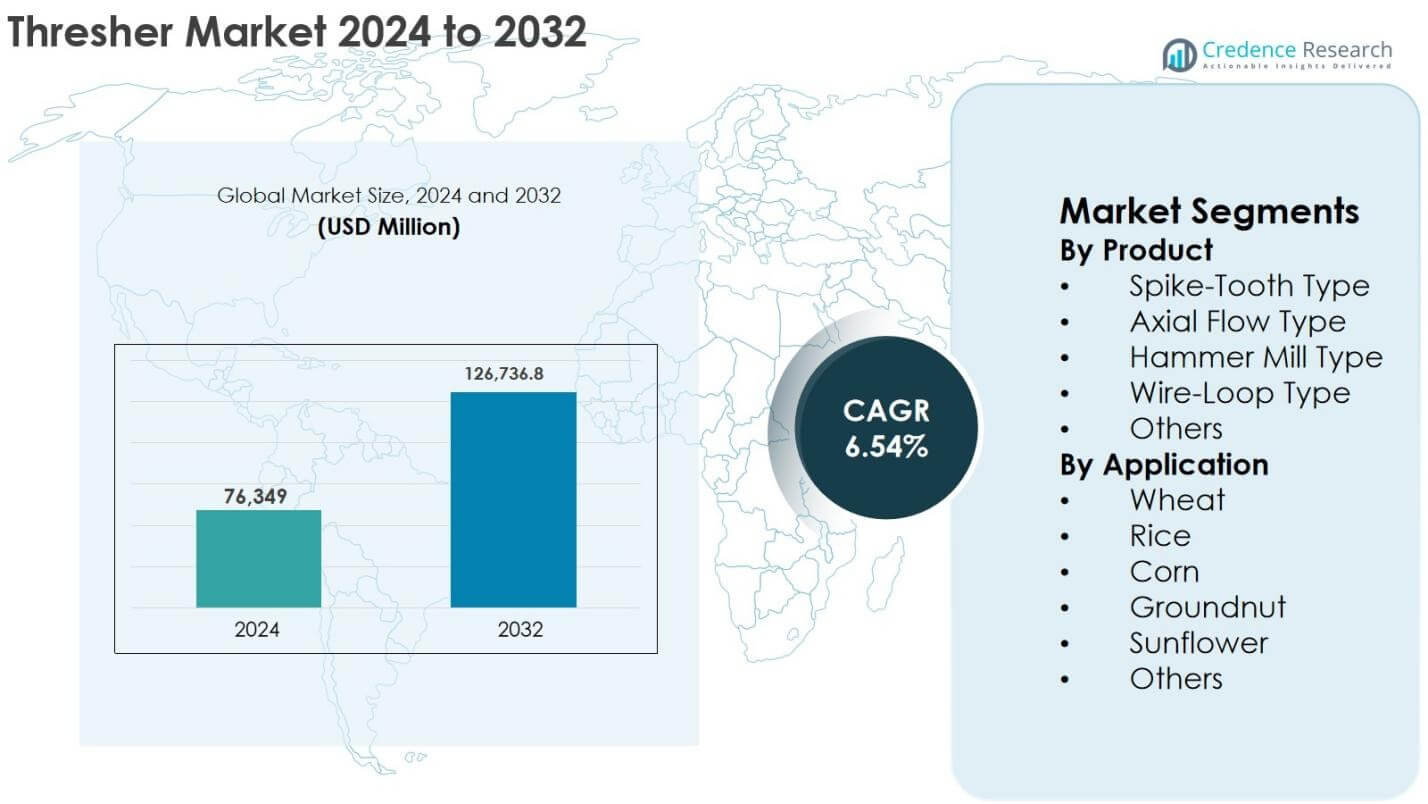
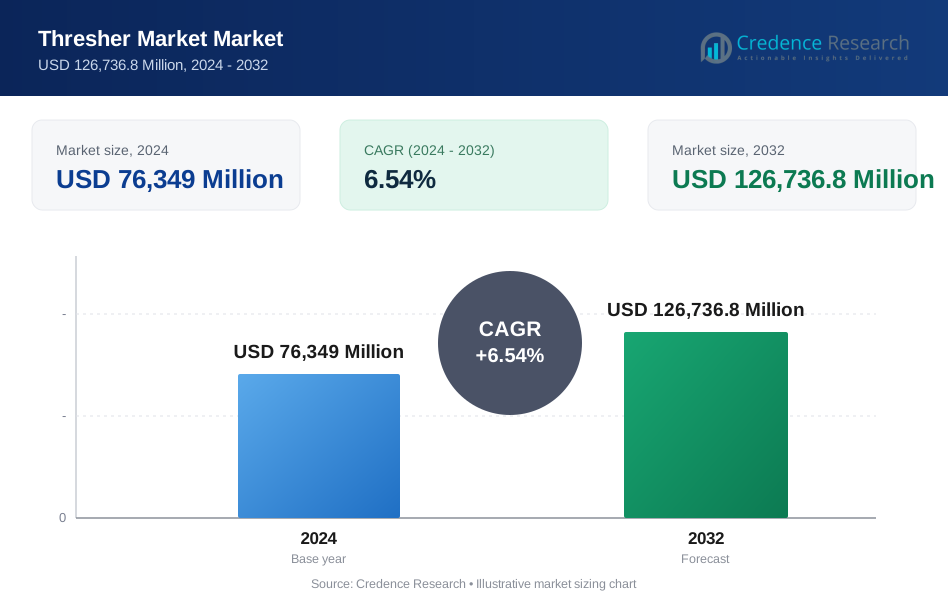
Thresher market size was valued USD 76,349 Million in 2024 and is anticipated to reach USD 126,736.8 Million by 2032, at a CAGR of 6.54% during the forecast period.
| REPORT ATTRIBUTE | DETAILS |
|---|---|
| Historical Period | 2020-2023 |
| Base Year | 2024 |
| Forecast Period | 2025-2032 |
| Thresher Market Size 2024 | USD 76,349 million |
| Thresher Market, CAGR | 6.54% |
| Thresher Market Size 2032 | USD 126,736.8 million |
Thresher Market Insights
- The market is driven by rising agricultural mechanization, labor shortages during peak harvesting seasons, and increasing adoption of multi-crop threshers that enhance productivity, reduce post-harvest losses, and improve grain quality across wheat, rice, corn, and oilseed value chains.
- Growing trends include technological upgrades such as higher-efficiency axial-flow and spike-tooth threshers, improved durability and fuel efficiency, and increasing preference for portable models suited for small and fragmented farmlands in developing regions.
- Market competition is influenced by strong participation from players such as Mahindra & Mahindra, John Deere, Kubota, AGCO, ALMACO, Iseki & Co., Wuhan Acme Agro Tech, and Kovai Classic Industries, with companies focusing on localization, affordability, and after-sales service networks.
- Asia-Pacific leads the market with a 46.8% share, followed by Europe at 18.5% and North America at 15.9%, while the Spike-Tooth Type segment dominates the product category with a 38.6% share due to its versatility and adaptability across multi-crop applications.
Thresher Market Segmentation Analysis:
By Product
The Thresher market by product is led by the Spike-Tooth Type segment, which accounts for 38.6% of the market share in 2024, driven by its high adaptability across multi-crop operations and lower maintenance requirements for small and mid-scale farms. Axial Flow Type threshers follow closely, benefiting from improved grain quality retention and higher throughput efficiency, particularly in mechanized farming regions. Hammer Mill and Wire-Loop Type segments serve niche applications where grain size and husk separation require specific processing characteristics, while the Others category gains traction through compact, portable models suitable for smallholder agricultural ecosystems.
- For instance, the spike-tooth configurations used in the John Deere C-Series and New Holland TC-series combine harvesters are widely adopted in Asia for wheat, paddy, and pulses because they handle mixed crop conditions with relatively simple maintenance.
By Application
Within applications, the Wheat segment dominates the Thresher market with a 34.2% share in 2024, supported by large-scale cultivation, high mechanization adoption, and the need for efficient post-harvest processing to minimize grain losses. Rice threshing remains the second-largest contributor, driven by expanding paddy-growing regions and increasing labor cost pressures encouraging mechanized alternatives. Corn applications continue to grow steadily due to demand from feed and biofuel industries, with farmers preferring multi-crop adaptable threshers that enhance operational productivity and reduce turnaround time during seasonal harvesting cycles.
- For instance, Kubota’s rice-oriented combines such as the DC-70 Plus and DC-93 are extensively used in Southeast Asia for paddy threshing in flooded and soft-field conditions, and Yanmar’s AW- and YH-series machines are adopted in Japan for efficient, low-loss rice threshing and separation.
Key Growth Drivers
Rising Mechanization in Agriculture and Labor Shortages
The Thresher market is experiencing strong growth as farm mechanization accelerates globally, particularly across Asia-Pacific, Latin America, and parts of Africa. Rising labor shortages during peak harvesting seasons, coupled with escalating rural-to-urban migration, are compelling farmers to replace manual threshing with mechanized solutions. Governments are supporting this shift through subsidy programs, agricultural credit facilities, and mechanization missions that reduce equipment acquisition barriers for small and mid-scale farmers. The need to improve productivity, minimize post-harvest grain losses, and ensure faster turnaround between harvesting cycles further strengthens market adoption. In addition, expanding commercial farming and contract cultivation practices encourage investment in high-capacity threshers, enabling farmers to scale operations efficiently. As agriculture modernizes to meet rising food demand and climate-resilient farming needs, mechanized threshers continue to emerge as essential assets improving operational efficiency, crop quality, and overall farm profitability, thereby reinforcing sustained demand growth across global agricultural economies.
- For instance, India’s agricultural machinery sector has expanded under rising mechanization in crops like wheat and rice, where companies such as Mahindra & Mahindra and John Deere India supply tractor-driven threshers and combine-based threshing solutions to small and mid-scale farmers.
Expansion of Multi-Crop Farming and Demand for Efficient Post-Harvest Processing
The growing adoption of multi-crop farming systems and diversified cultivation patterns significantly drives the Thresher market, as farmers increasingly rely on versatile threshers capable of handling wheat, rice, corn, groundnuts, pulses, and oilseeds. This shift is driven by the need to optimize land productivity, enhance seasonal crop cycles, and mitigate climate-related risks through crop rotation strategies. Multi-crop threshers reduce dependency on crop-specific equipment and deliver higher economic value by supporting year-round utilization. At the same time, the increasing emphasis on post-harvest efficiency particularly in developing agricultural markets encourages investment in advanced threshing technologies that minimize grain breakage and preserve output quality. Growing integration of processing chains for storage, milling, and food value-addition further strengthens demand for reliable threshing systems. As agricultural value chains modernize, farmers prioritize equipment that enhances throughput, reduces wastage, and aligns with scalable commercial farming operations, making multi-crop threshers a strategic investment driver in the market.
- For instance, Mahindra & Mahindra and Sonalika market multi-crop tractor-powered threshers in India that are designed to handle cereals and pulses on the same platform, improving year-round equipment utilization for small and medium farms.
Technological Advancements and Transition Toward High-Efficiency Threshing Systems
Technological innovation remains a major growth catalyst in the Thresher market, with manufacturers increasingly introducing high-efficiency, durable, and performance-optimized machines tailored for varying farm scales and crop types. Advancements such as improved power transmission systems, enhanced grain-separation mechanisms, lower vibration operation, and fuel-efficient engines contribute to superior productivity and reduced operating costs. The market is also witnessing the emergence of semi-automatic and tractor-mounted threshers suitable for mechanized as well as smallholder farming environments. Integration of safety enhancements, easier maintenance features, and ergonomic designs increases equipment usability and operational life. Additionally, sustainability-focused innovations including energy-efficient models and reduced-emission power units align with modern agricultural and environmental standards. As digital agriculture evolves, select manufacturers are exploring telematics-enabled monitoring, performance diagnostics, and predictive maintenance capabilities. These advancements collectively strengthen user confidence, lower lifecycle costs, and encourage broader market adoption, reinforcing technology-driven growth momentum across global thresher demand segments.
Key Trends & Opportunities
Growing Adoption of Customizable and Region-Specific Thresher Designs
A key trend shaping the Thresher market is the increasing demand for customizable equipment tailored to regional crop characteristics, farm sizes, and operational conditions. Farmers in emerging markets favor compact, portable, and cost-efficient models for small and fragmented landholdings, while large commercial farms prefer high-capacity axial-flow and multi-crop threshers to support intensive agriculture. Manufacturers are responding by developing modular and adaptable configurations that enable crop-specific settings, interchangeable components, and flexible operating speeds. This trend creates strong opportunities for localized manufacturing partnerships, dealer-network expansion, and after-sales service ecosystems. The growing focus on rural mechanization clusters and farm equipment rental services further enhances accessibility for small farmers. As governments promote region-aligned mechanization policies and training programs, demand for customized threshing solutions is expected to accelerate, enabling manufacturers to strengthen market penetration while supporting inclusive and scalable agricultural modernization initiatives across diverse farming communities.
- For instance, John Deere S- and X-series and Case IH Axial-Flow combines allow operators to change concaves, sieves, and rotor settings to match crops like wheat, corn, and soybeans, giving practical customization within a single machine platform.
Rising Opportunities in Developing Economies and Contract Farming Models
Developing economies present significant growth opportunities for the Thresher market as agricultural modernization initiatives continue gaining momentum. Expanding contract farming, agri-business partnerships, and farmer-producer organizations are increasing access to financing, shared equipment ownership, and mechanization-as-a-service models. These frameworks enable smallholder farmers to benefit from high-capacity threshers without bearing full capital investment burdens. Increasing adoption of rural entrepreneurship models-such as custom hiring centers and cooperative equipment pools-further stimulates thresher deployment across underserved regions. Rapid infrastructure development in grain storage, food processing, and logistics enhances the relevance of efficient post-harvest systems. In parallel, international development programs supporting productivity improvement, climate-resilient agriculture, and food security initiatives create additional procurement and funding opportunities. As developing regions transition toward structured and commercially oriented farming systems, the market stands well-positioned to capitalize on rising equipment demand, supported by policy incentives, collaborative value-chain initiatives, and expanding mechanization ecosystems.
- For instance, Farmer Producer Organizations (FPOs) supported by the Small Farmers’ Agribusiness Consortium (SFAC) in India facilitate group purchase and shared use of machinery including threshers and combine harvesters.
Key Challenges
High Initial Investment Costs and Limited Access to Financing
Despite strong growth prospects, high upfront equipment costs remain a major challenge in the Thresher market, particularly for small and marginal farmers with limited capital resources. In many regions, lack of access to formal credit, high interest rates, and insufficient subsidy coverage hinder equipment adoption. Farmers operating on fragmented landholdings may find investment in large or specialized threshers economically unviable, leading to continued reliance on manual or traditional threshing methods. Inadequate financing awareness, weak leasing infrastructure, and limited penetration of rental or cooperative ownership models further restrict market potential. Additionally, fluctuating farm income due to weather variability and commodity price pressures reduces farmers’ capacity to commit to long-term capital expenditures. Addressing this challenge requires integrated financial support mechanisms, inclusive mechanization programs, and scalable ownership solutions that improve affordability and encourage wider adoption across emerging agricultural economies.
Operational Limitations, Maintenance Constraints, and Skill Gaps
Another key challenge affecting the Thresher market arises from operational and maintenance constraints, particularly in rural and resource-limited farming environments. Many farmers face difficulties related to improper handling, lack of technical training, and inadequate maintenance practices, which can lead to machine downtime, reduced efficiency, and shorter equipment life cycles. Limited availability of spare parts, weak service networks, and dependence on informal repair channels further complicate equipment upkeep, especially in remote agricultural areas. Crop variability, uneven harvesting conditions, and residue management complexities may also impact thresher performance when machines are not appropriately configured. Additionally, safety risks associated with improper operation pose concerns in small-farm settings. Overcoming these challenges requires stronger service infrastructure, operator training programs, localized technical support, and design innovations that emphasize reliability, user safety, and ease of maintenance to ensure sustained and efficient thresher utilization across diverse agricultural markets.
Regional Analysis
Asia-Pacific
Asia-Pacific dominates the Thresher market with a 46.8% share in 2024, driven by large agricultural economies such as India, China, Indonesia, and Vietnam, where farm mechanization programs and smallholder farming modernization strongly support equipment adoption. Rising labor shortages, government subsidies, and expanding paddy, wheat, and multi-crop cultivation further enhance demand for tractor-mounted and multi-crop threshers. The region also benefits from strong domestic manufacturing ecosystems and rural financing initiatives that improve affordability and accessibility. Growing contract farming, increasing agricultural exports, and scaling post-harvest processing infrastructure continue to reinforce Asia-Pacific’s leadership position throughout the forecast period.
Europe
Europe accounts for 18.5% of the Thresher market in 2024, supported by highly mechanized farming systems, strong adoption of advanced axial-flow threshers, and emphasis on precision and sustainable agriculture. Countries such as Germany, France, Italy, and Poland remain key demand contributors, particularly in large-scale cereal and oilseed production. Ongoing technological upgrades, increasing productivity optimization, and strict crop-quality standards encourage investment in efficient, low-loss threshing solutions. The region also benefits from innovation-driven equipment manufacturers and modernization of farm fleets, while EU rural development funds and sustainability-focused machinery programs continue to enhance replacement demand and operational efficiency across farms.
North America
North America holds a 15.9% market share in 2024, driven by large commercial farming operations across the United States and Canada, where advanced harvesting equipment and high-capacity threshers support large-scale cereal, corn, and oilseed production. Strong focus on productivity, grain quality preservation, and reduced operational downtime fuels demand for technologically advanced, durable threshing systems. The region benefits from robust dealer networks, farm equipment leasing models, and growing integration of automation and telematics in agricultural machinery. Increasing investments in post-harvest efficiency and modernization of agricultural fleets further strengthen market adoption, particularly within highly consolidated and industrialized farming environments.
Latin America
Latin America represents 10.2% of the Thresher market in 2024, supported by expanding mechanization across Brazil, Argentina, Mexico, and Colombia, where rising grain cultivation and export-oriented agriculture drive demand. The shift from manual and semi-mechanized operations to tractor-mounted and multi-crop threshers strengthens market penetration among mid-scale farms. Government-backed financing programs, rural credit schemes, and cooperative equipment-sharing models enhance affordability for small farmers. Increasing adoption in corn, soybean, and cereal value chains, coupled with growing investments in post-harvest processing and agri-business infrastructure, continues to create growth opportunities across emerging agricultural regions within Latin America.
Middle East & Africa
The Middle East & Africa region accounts for 8.6% of the Thresher market in 2024, with growth led by improving agricultural mechanization in countries such as South Africa, Nigeria, Kenya, Egypt, and Turkey. Rising food security initiatives, expanding cereal and pulse cultivation, and development-sector support programs promote thresher deployment among smallholder and semi-commercial farms. Increasing efforts to reduce post-harvest losses and strengthen rural productivity further stimulate market demand. Although affordability and service accessibility remain challenges in remote areas, expanding farm equipment rental networks and localized manufacturing initiatives continue to improve adoption across diverse farming landscapes.
Thresher Market Segmentations:
By Product
- Spike-Tooth Type
- Axial Flow Type
- Hammer Mill Type
- Wire-Loop Type
- Others
By Application
- Wheat
- Rice
- Corn
- Groundnut
- Sunflower
- Others
By Geography
- North America
- U.S.
- Canada
- Mexico
- Europe
- Germany
- France
- U.K.
- Italy
- Spain
- Rest of Europe
- Asia Pacific
- China
- Japan
- India
- South Korea
- South-east Asia
- Rest of Asia Pacific
- Latin America
- Brazil
- Argentina
- Rest of Latin America
- Middle East & Africa
- GCC Countries
- South Africa
- Rest of the Middle East and Africa
Competitive Landscape
The Thresher market features a diverse and well-established competitive landscape characterized by the presence of global agricultural machinery leaders and strong regional manufacturers focusing on cost-efficient and crop-specific solutions. Key players include Mahindra & Mahindra, John Deere, Kubota, AGCO, ALMACO, Iseki & Co., Wuhan Acme Agro Tech, Kovai Classic Industries, Unnati Threshers, Shandong Guangzhong Machinery, and Rizhao Peakrising International, among others. Leading companies prioritize product reliability, multi-crop adaptability, higher throughput efficiency, and durability to meet the mechanization needs of smallholder as well as commercial farms. Strategic initiatives such as localized manufacturing, dealer-network expansion, technology upgrades, and subsidy-aligned product portfolios strengthen their market positioning. Manufacturers are increasingly investing in ergonomic designs, safety features, and fuel-efficient systems to enhance operational performance and reduce lifecycle costs. Partnerships with rural financing programs, custom-hiring centers, and agri-service providers further support market penetration, while competition continues to intensify around innovation, after-sales support, and region-specific equipment customization.
Key Player Analysis
- Kovai Classic Industries
- Wuhan Acme Agro Tech
- Iseki & Co
- Shandong Guangzhong Machinery
- Unnati Threshers
- ALMACO
- Rizhao Peakrising International
- Bharat Industries
- Kubota
- Hunan Sunfield Agricultural Machinery
Recent Developments
- In November 2025 John Deere debuted new agricultural machines and integrated data systems at European agricultural events, highlighting enhanced equipment including advanced harvest and threshing-related technology for optimized field performance.
- In October 2025 Mahindra & Mahindra launched a new Groundnut Thresher designed for farmers in Gujarat, Rajasthan, Madhya Pradesh, and Uttar Pradesh, offering tractor-powered threshing that improves output, reduces wastage, and monitors grain quality in real-time
Report Coverage
The research report offers an in-depth analysis based on Product, Application, and Geography. It details leading market players, providing an overview of their business, product offerings, investments, revenue streams, and key applications. Additionally, the report includes insights into the competitive environment, SWOT analysis, current market trends, as well as the primary drivers and constraints. Furthermore, it discusses various factors that have driven market expansion in recent years. The report also explores market dynamics, regulatory scenarios, and technological advancements that are shaping the industry. It assesses the impact of external factors and global economic changes on market growth. Lastly, it provides strategic recommendations for new entrants and established companies to navigate the complexities of the market.
Future Outlook
- The Thresher market will continue to expand as farm mechanization accelerates across developing and emerging agricultural economies.
- Demand will rise for multi-crop threshers that support diversified farming systems and improve year-round equipment utilization.
- Manufacturers will increasingly focus on energy-efficient, durable, and low-maintenance designs to reduce operating costs for farmers.
- Technological enhancements such as improved grain-separation mechanisms and higher throughput efficiency will strengthen product performance.
- Rental, cooperative ownership, and custom-hiring models will play a larger role in enabling access for small and marginal farmers.
- Localized manufacturing, regional product customization, and stronger dealer networks will drive deeper market penetration.
- Government mechanization subsidies and rural financing programs will remain key catalysts supporting equipment adoption.
- Growth opportunities will expand in contract farming, agri-service businesses, and organized post-harvest value chains.
- Sustainability initiatives will encourage the development of safer, eco-friendly, and operator-friendly thresher systems.
- Competition will intensify around innovation, after-sales service capability, and crop-specific equipment specialization.
Request a Free Sample
Fill in your details and we'll send you a free sample report.
- Sample data tables & charts
- Research methodology
Need a Custom Version of This Report?
Tailor the scope, geography, or segments to your exact requirements.
- Custom geography or segment scope
- Direct access to our analyst team
Frequently Asked Questions
What is the current market size for the Thresher Market, and what is its projected size in 2032?
At what Compound Annual Growth Rate is the Thresher Market projected to grow between 2024 and 2032?
Which Thresher Market segment held the largest share in 2024?
What are the primary factors fueling the growth of the Thresher Market?
Who are the leading companies in the Thresher Market?
Which region commanded the largest share of the Thresher Market in 2024?
Table of Content
Chapter 1. Report Introduction
- 1.1 Report Description & Purpose
- 1.1.1 Report Title & Market Definition
- 1.1.2 Unique Selling Propositions (USP) & Key Differentiators
- 1.1.3 Value Proposition for Stakeholders
- 1.2 Research Objectives
- 1.2.1 Market Sizing Objectives (Volume & Revenue)
- 1.2.2 Segmentation Objectives
- 1.2.3 Competitive Intelligence Objectives
- 1.2.4 Forecast & Scenario Objectives
- 1.3 Report Scope
- 1.3.1 Thresher Market Scope – Types & Subtypes Covered
- 1.3.2 Geographic Scope – Regions & Countries Covered
- 1.3.3 Historical Period, Base Year & Forecast Period (2024; forecast to 2032)
- 1.3.4 Inclusions & Exclusions
- 1.4 HS Code & Classification Framework
- 1.5 Currency, Units & Pricing Basis
- 1.6 Target Stakeholders
- 1.7 Limitations & Assumptions
Chapter 2. Executive Summary
- 2.1 Global Thresher Market Market Snapshot
- 2.1.1 Market Size – Historical (2024) & Forecast (2024-2032) (2024: USD 76,349 Million → 2032: USD 126,736.8 Million)
- 2.1.2 Volume & Revenue – Global Totals
- 2.1.3 Key Market Highlights – Top Five Facts
- 2.2 Thresher Market Market Segmentation Snapshot
- 2.2.1 Market Split by Region – 2024 vs. 2032
- 2.3 Competitive Snapshot
- 2.3.1 Top 10 Players by Revenue Share – 2024
- 2.3.2 Top 10 Players by Volume Share – 2024
- 2.3.3 Recent Strategic Developments (18-Month Summary)
- 2.4 Key Investment Highlights & Strategic Conclusions
Chapter 3. Thresher Market Market Dynamics & Industry Analysis
- 3.1 Market Overview & Context
- 3.1.1 Thresher Market Market Position in the Broader Automotive Value Chain
- 3.1.2 OEM vs. Replacement Market Dynamics
- 3.1.3 Market Maturity & Development Stage by Region
- 3.2 Thresher Market Market Drivers
- 3.3 Thresher Market Market Restraints & Challenges
- 3.4 Thresher Market Market Opportunities
- 3.5 Porter's Five Forces Analysis
- 3.5.1 Threat of New Entrants
- 3.5.2 Bargaining Power of Suppliers
- 3.5.3 Bargaining Power of Buyers
- 3.5.4 Threat of Substitutes
- 3.5.5 Competitive Rivalry – Intensity Assessment
- 3.6 Thresher Market Value Chain Analysis
- 3.6.1 Upstream – Raw Material/Input Suppliers
- 3.6.1.1 Raw Material/Input 1
- 3.6.1.2 Raw Material/Input 2
- 3.6.1.3 Raw Material/Input 3
- 3.6.2 Midstream – Production/Manufacturing/Service Delivery
- 3.6.2.1 Production/Process Overview
- 3.6.2.2 Key Facility Locations & Capacity by Manufacturer
- 3.6.3 Downstream – Distribution & End Consumer
- 3.6.3.1 Primary Channel – B2B/OEM
- 3.6.3.2 Secondary Channels – Dealer, Retail, Online, Direct
- 3.6.4 Value Chain Profitability Analysis
- 3.6.1 Upstream – Raw Material/Input Suppliers
- 3.7 PESTEL Analysis
- 3.7.1 Political Factors
- 3.7.2 Economic Factors
- 3.7.3 Social Factors
- 3.7.4 Technological Factors
- 3.7.5 Environmental Factors
- 3.7.6 Legal Factors
- 3.8 Thresher Market Supply Chain Analysis
- 3.8.1 Raw Material/Input Supply Risk Assessment
- 3.8.2 Manufacturing Concentration Risk (Geographic Exposure)
- 3.8.3 Trade Disruption Impact Analysis
- 3.9 Regulatory & Policy Landscape
Note: The regulatory and policy landscape section covers regulations based on their applicability to the market, Thresher Market category, geography, and scope of the study. Only regulatory frameworks with a material impact on operations, compliance, trade, sustainability, or market access are analyzed in detail.
Chapter 4. Key Investment Pockets & Opportunity Analysis
- 4.1 Thresher Market Market Attractiveness Analysis
- 4.1.1 By Region – Investment Attractiveness Matrix (Volume × CAGR)
- 4.2 Absolute Revenue Growth Opportunity
- 4.2.1 By Region – Absolute USD Growth Through 2032
- 4.3 Incremental Volume Opportunity
- 4.3.1 By Region – Incremental Volume Through 2032
- 4.3.2 Segment – Incremental Volume
- 4.4 Emerging Submarket Opportunity Deep Dive (Subject to Applicability)
- 4.5 Emerging Market Opportunity Scorecards
- 4.5.1 United States
- 4.5.2 Europe
- 4.5.3 Asia
- 4.5.4 Middle East & Africa
Note: Emerging Market Opportunity Scorecards will be included based on relevance and strategic importance. Regions listed are indicative and may vary depending on data availability and market dynamics.
Chapter 5. Thresher Market Import-Export Analysis & Trade Flows
- 5.1 Global Trade Overview
- 5.1.1 Global Export Value by Country (2024)
- 5.1.2 Global Export Volume by Country (2024)
- 5.1.3 Global Import Value by Country (2024)
- 5.1.4 Global Import Volume by Country (2024)
- 5.1.5 Net Trade Balance by Country (2024)
- 5.2 Export Analysis – Segment
- 5.2.1 Type 1 (HS Code)
- 5.2.2 Type 2 (HS Code)
- 5.2.3 Type 3 (HS Code)
- 5.2.4 Type 4 (HS Code)
- 5.2.5 Type 5 (HS Code)
- 5.3 Import Analysis – Segment
- 5.3.1 Type 1 (HS Code)
- 5.3.2 Type 2 (HS Code)
- 5.3.3 Type 3 (HS Code)
- 5.3.4 Type 4 (HS Code)
- 5.3.5 Type 5 (HS Code)
- 5.4 Average Unit Trade Prices
- 5.4.1 Average Export Price – Segment & Country
- 5.4.2 Average Import Price – Segment & Source Country
- 5.4.3 Price Trends (2024)
- 5.5 Key Trade Route Analysis
- 5.5.1 Trade Route 1
- 5.5.2 Trade Route 2
- 5.5.3 Trade Route 3
- 5.5.4 Trade Route 4
- 5.5.5 Trade Route 5
- 5.6 Trade Policy Impact Assessment
- 5.6.1 US Anti-Dumping & Section 301 Tariffs
- 5.6.2 EU Customs Union Impact
- 5.6.3 Major Free Trade Agreements
- 5.6.4 USMCA Rules of Origin
Note: Trade policy analysis will be included only where relevant to the Thresher Market market.
Chapter 6. Competitive Landscape & Company Benchmarking
- 6.1 Thresher Market Market Concentration & Structure
- 6.1.1 Herfindahl-Hirschman Index (HHI) – vs. 2024
- 6.1.2 Tier 1, Tier 2 & Tier 3 Market Structure
- 6.1.3 Global, Regional & Local Player Dynamics
- 6.2 Thresher Market Market Share Analysis – 2024
- 6.2.1 Global Revenue Share by Company
- 6.2.2 Global Volume Share by Company
- 6.2.3 Regional Revenue Share
- 6.2.4 Market Share Evolution ( vs. 2024)
- 6.2.5 OEM Segment Share by Company
- 6.2.6 Replacement Segment Share by Company
- 6.3 Production/Delivery Capacity & Facility Analysis
- 6.3.1 Global Installed Capacity
- 6.3.2 Capacity Utilization Rates
- 6.3.3 Production/Output Volume
- 6.3.4 Facility Locations & Capacity Map
- 6.3.5 Planned Capacity Additions
- 6.4 Thresher Market Competitive Benchmarking Matrix
- 6.4.1 Revenue, Volume, CAGR & Profitability Comparison
- 6.4.2 Channel Revenue Mix
- 6.4.3 Geographic Revenue Exposure
- 6.4.4 R&D Intensity
- 6.4.5 Sustainability Maturity
- 6.5 Strategic Developments in Thresher Market (Last 24 Months)
- 6.5.1 Mergers, Acquisitions & Divestments
- 6.5.2 New Thresher Market Launches
- 6.5.3 Facility Expansions
- 6.5.4 Strategic Alliances, Joint Ventures & Partnerships
- 6.5.5 Distribution Expansion & Market Entry
- 6.5.6 Sustainability & ESG Initiatives
- 6.6 Competitive Strategy Mapping
- 6.6.1 Leader, Challenger, Follower & Niche Classification
- 6.6.2 Pricing Strategy Comparison
- 6.6.3 Channel Strategy Matrix
Note: Strategic developments are included based on their materiality and the availability of reliable information.
Chapter 7. Global Thresher Market Market – By Distribution Channel
- 7.1 Segment Overview
- 7.1.1 Volume & Revenue Split by Channel (2024 & 2032)
- 7.1.2 Channel Mix Evolution (2024-2032)
Chapter 8. Regional Market Analysis – Global Overview
- 8.1 Global Regional Overview
- 8.1.1 Regional Volume Share
- 8.1.2 Regional Revenue Share
- 8.1.3 Regional Volume by Region
- 8.1.4 Regional Revenue by Region
- 8.1.5 Regional Forecast Through 2032
- 8.2 Cross-Regional Segment Analysis
- 8.2.1 By Distribution Channel
- 8.2.2 By Brand/Price Tier
Chapter 9. North America Thresher Market Market
- 9.1 United States
- 9.2 Canada
- 9.3 Mexico
Chapter 10. Europe Thresher Market Market
- 10.1 Germany
- 10.2 France
- 10.3 Italy
- 10.4 United Kingdom
- 10.5 Spain
- 10.6 Poland
- 10.7 Russia
- 10.8 Netherlands
- 10.9 Belgium
- 10.10 Sweden
- 10.11 Denmark
- 10.12 Norway
- 10.13 Rest of Europe
Chapter 11. Asia Pacific Thresher Market Market
- 11.1 China
- 11.2 India
- 11.3 Japan
- 11.4 South Korea
- 11.5 Thailand
- 11.6 Indonesia
- 11.7 Vietnam
- 11.8 Malaysia
- 11.9 Australia
- 11.10 Rest of Asia Pacific
Chapter 12. Latin America Thresher Market Market
- 12.1 Brazil
- 12.2 Argentina
- 12.3 Colombia
- 12.4 Chile
- 12.5 Rest of Latin America
Chapter 13. Middle East Thresher Market Market
- 13.1 Saudi Arabia
- 13.2 United Arab Emirates
- 13.3 Turkey
- 13.4 Israel
- 13.5 Iran
- 13.6 Rest of the Middle East
Chapter 14. Africa Thresher Market Market
- 14.1 South Africa
- 14.2 Egypt
- 14.3 Nigeria
- 14.4 Morocco
- 14.5 Rest of Africa
Chapter 15. Thresher Market Company Profiles
- 15.1 [Company 01]
- 15.1.1 Company Overview
- 15.1.2 Key Management Personnel
- 15.1.3 Products & Services Portfolio
- 15.1.4 Financial Performance
- 15.1.5 Key Market Focus & Geographic Presence
- 15.1.6 Recent Developments & Strategic Initiatives
Note: The company profile list is preliminary and may change based on research findings, market developments, data availability, and client requirements.
Chapter 16. Appendices
- Appendix A – List of Abbreviations & Acronyms
- Appendix B – Industry Classification Code Reference – Full Series
- Appendix C – Production & Capacity Data Tables
- Appendix D – End-Use & Demand Base Tables
- Appendix E – Consumption & Replacement Rate Assumptions
- Appendix F – ASP Reference Tables
- Appendix G – Manufacturing & Facility Database
- Appendix H – Import-Export Data Tables
- Appendix I – Regulatory Summary Tables
- Appendix J – Primary Research Participant List (Anonymized)
- Appendix K – Primary Research Questionnaire Framework
- Appendix L – Data Sources & Bibliography
- Appendix M – Market Size Divergence & Source Comparison
Chapter 17. Research Methodology
- 17.1 Research Framework & Philosophy
- 17.2 Secondary Research – Sources, Hierarchy & Data Extraction
- 17.3 Data Modeling – Bottom-Up & Top-Down Market Sizing
- 17.4 Primary Research – Stakeholder Framework, LOI & Sample Sizes
- 17.5 Forecast Methodology – Regression, Scenario & Sensitivity Analysis
- 17.6 Quality Control – Four-Layer Validation Framework
- 17.7 Limitations & Standard Assumptions
- 17.8 Disclaimer
