
Lawn And Garden Consumables Market Overview:
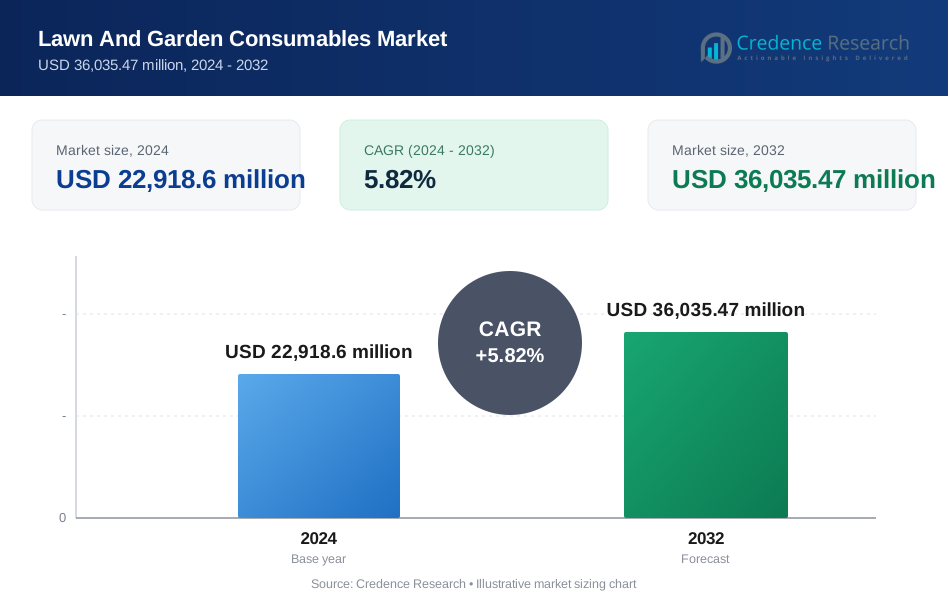
Lawn And Garden Consumables Market size was valued USD 22918.6 million in 2024 and is anticipated to reach USD 36035.47 million by 2032, at a CAGR of 5.82% during the forecast period.
| REPORT ATTRIBUTE | DETAILS |
|---|---|
| Historical Period | 2020-2023 |
| Base Year | 2024 |
| Forecast Period | 2025-2032 |
| Lawn And Garden Consumables Market Size 2024 | USD 22918.6 million |
| Lawn And Garden Consumables Market, CAGR | 5.82% |
| Lawn And Garden Consumables Market Size 2032 | USD 36035.47 million |
Lawn And Garden Consumables Market Insights
- Market growth is primarily driven by rising household participation in gardening, increased spending on landscaping services, and higher adoption of fertilizers, seeds, and soil conditioners in residential and commercial applications.
- Key market trends include growing demand for sustainable and organic consumables, wider use of controlled-release fertilizers, and increased preference for climate-resilient and low-maintenance seed varieties.
- Competitive dynamics remain intense as manufacturers focus on R&D, private-label expansion, eco-compliant formulations, and stronger retail partnerships to improve shelf presence and customer reach.
- Regionally, North America leads with an exact 41% share, while Europe shows stable eco-friendly demand and Asia-Pacific records faster growth; by segment, fertilizers dominate with around 48% share, followed by seeds at approximately 32%.
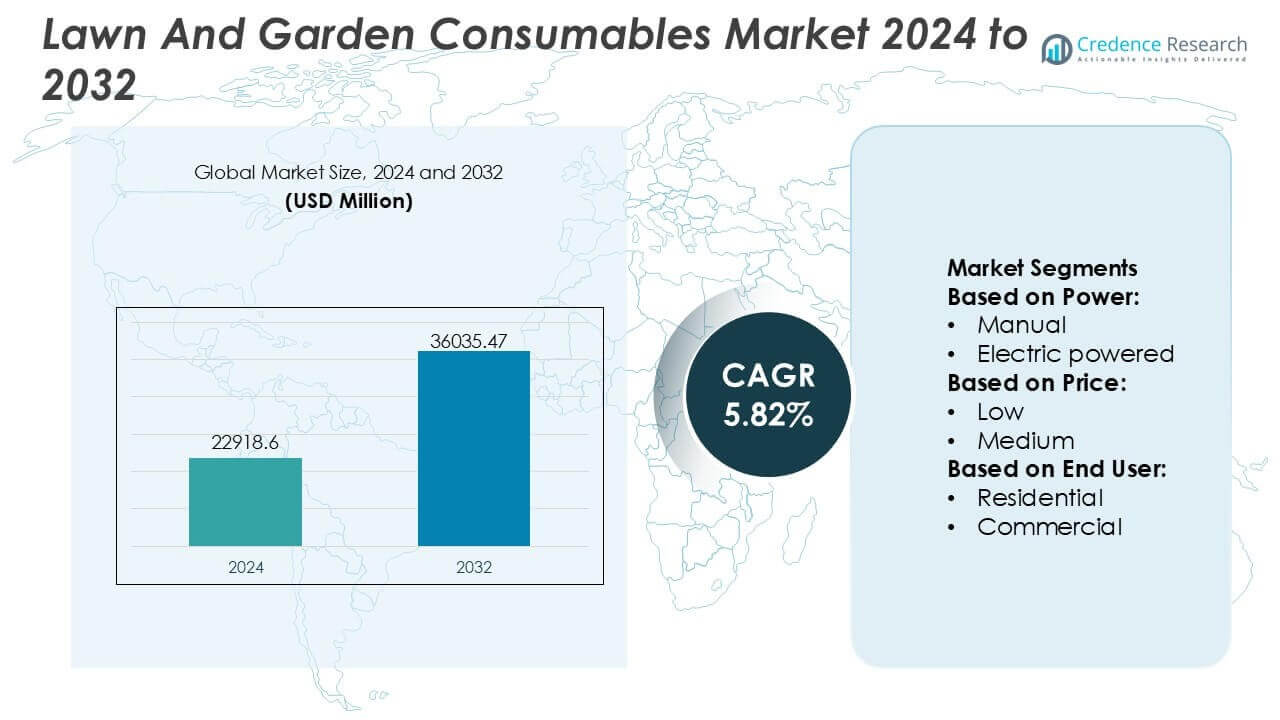
Lawn And Garden Consumables Market Segmentation Analysis:
By Power
By power, electric-powered equipment emerges as the dominant sub-segment in the lawn and garden consumables market, accounting for an estimated 46% market share. Growth is driven by rising adoption of cordless and corded electric tools that offer lower noise levels, reduced maintenance requirements, and zero direct emissions compared to gas-powered alternatives. Advances in lithium-ion battery energy density, faster charging cycles, and improved motor efficiency have significantly enhanced runtime and cutting performance. Manual tools maintain relevance among small garden owners due to affordability, while gas-powered products retain demand in heavy-duty applications requiring higher torque and extended operating duration.
- For instance, H.B. Fuller has commercialized high-performance water-based acrylic dispersions, such as those in its Swift®tak and Gel-Tac® portfolios, engineered for sustainable packaging and labeling. These adhesives deliver excellent peel adhesion values often exceeding 10 N/25 mm on paperboard and maintain high shear resistance for permanent applications, all while operating with VOC levels below 3 g/L to meet stringent global environmental and food-safety regulations.
By Price
By price, the medium-priced segment dominates with approximately 42% market share, supported by its balance of durability, performance, and affordability. Consumers increasingly prefer products that integrate reliable materials, ergonomic design, and moderate technological features without the premium cost associated with high-end offerings. This segment benefits from strong replacement demand and broad availability across retail and online channels. Low-priced consumables attract cost-sensitive buyers and first-time users but face durability limitations, while high-priced products cater to professionals seeking advanced features, longer lifespan, and superior build quality, resulting in comparatively lower volume uptake.
- For instance, Dow Inc. has advanced its RHOBARR™ 320 Polyolefin Dispersion, an aqueous functionalized dispersion engineered for barrier coatings in paperboard applications, capable of forming liquid water barriers with heat seal strength tailored for hot and cold liquids as measured by industry standards documented in product literature.
By End User
By end user, the residential segment leads with nearly 55% market share, driven by widespread home gardening, lawn maintenance, and landscaping activities. Urbanization trends combined with rising interest in home aesthetics and do-it-yourself gardening continue to stimulate consistent demand from households. Residential users favor easy-to-use, lightweight, and low-maintenance consumables suited for routine upkeep. The commercial segment follows, supported by landscaping services, golf courses, and public green spaces requiring frequent replacement of consumables, while other end users, including institutional buyers, contribute a smaller but stable share.
Key Growth Drivers
Rising Residential Landscaping and Home Gardening Activities
Growing interest in home improvement, outdoor aesthetics, and self-sufficiency strongly drives demand for lawn and garden consumables. Homeowners increasingly invest in seeds, fertilizers, soil conditioners, mulches, and pest control products to maintain visually appealing and functional outdoor spaces. Urbanization and smaller living spaces also encourage container gardening and lawn maintenance solutions that rely heavily on consumables. Additionally, post-pandemic lifestyle shifts have reinforced gardening as a recreational and wellness activity, sustaining repeat purchases and seasonal demand across residential user segments.
- For instance, 3M has developed water-based acrylic adhesive technologies used in its industrial tapes and bonding solutions that achieve 180-degree peel adhesion above 8 N/cm on stainless steel and maintain shear holding power exceeding 10,000 minutes at 23 °C under 1 kg load, as documented in 3M technical data sheets.
Expansion of Commercial Landscaping and Green Infrastructure
The steady expansion of commercial landscaping across public parks, sports fields, hospitality properties, and institutional campuses significantly accelerates consumables consumption. Municipal investments in green infrastructure, urban beautification, and climate-resilient landscaping boost demand for turf care products, fertilizers, and soil enhancers. Commercial users prioritize performance consistency, large-volume availability, and fast-acting formulations, which drives higher per-site consumption compared to residential use. Growth in real estate development and infrastructure projects further supports long-term demand for lawn and garden consumables.
- For instance, Arkema’s Bostik R&D teams have developed acrylic and hybrid dispersion adhesives delivering peel strengths exceeding 6 N/mm on paper-to-film laminations while maintaining open times above 8 minutes to support high-speed packaging lines.
Product Innovation and Performance-Driven Formulations
Continuous innovation in lawn and garden consumables strengthens market growth by improving efficiency, ease of use, and results. Advanced slow-release fertilizers, bio-stimulants, moisture-retention soils, and targeted pest control solutions reduce labor intensity and improve outcomes for both residential and professional users. Manufacturers increasingly focus on formulations that enhance nutrient uptake, soil health, and plant resilience under varying climatic conditions. These performance-driven improvements encourage brand loyalty and premium product adoption across price-sensitive and value-focused customer segments.
Key Trends & Opportunities
Shift Toward Sustainable and Eco-Friendly Consumables
Sustainability has emerged as a critical trend shaping product development and purchasing decisions. Consumers increasingly favor organic fertilizers, bio-based pesticides, compostable soil amendments, and low-toxicity solutions that minimize environmental impact. Regulatory pressure and growing environmental awareness further accelerate adoption of eco-friendly consumables. This trend creates strong opportunities for manufacturers to differentiate through certified organic products, recyclable packaging, and reduced chemical runoff, particularly in developed and environmentally regulated markets.
- For instance, PPG’s recent dispersion platforms for packaging and industrial bonding incorporate bio-based raw material content above 30% by mass, verified through mass-balance certification, while achieving VOC levels below 5 g/L in finished adhesive systems.
Growth of Smart Gardening and Precision Application
The integration of smart gardening tools and precision application methods creates new opportunities for consumables optimized for targeted use. Products designed for compatibility with automated spreaders, irrigation systems, and sensor-based nutrient management gain traction among tech-savvy users and commercial landscapers. Precision-focused consumables reduce waste, improve cost efficiency, and enhance plant health outcomes. This trend supports premiumization and encourages recurring purchases aligned with data-driven lawn and garden maintenance practices.
- For instance, Henkel’s latest polyurethane and hybrid dispersion systems for automotive interior laminations demonstrate heat resistance up to 120 °C under continuous load and elongation at break exceeding 300%, supporting flexible substrates such as PU foams and lightweight fabrics.
Expanding Distribution Through E-Commerce and DIY Channels
The rapid expansion of e-commerce and organized DIY retail channels reshapes how consumers access lawn and garden consumables. Online platforms offer wider product visibility, subscription-based replenishment, and detailed usage guidance, improving customer engagement. DIY retail chains enhance in-store education and bundled offerings, supporting cross-selling of consumables. These channels create opportunities for brands to strengthen direct-to-consumer strategies, improve margins, and capture impulse and seasonal demand more effectively.
Key Challenges
Seasonality and Weather-Dependent Demand Volatility
Demand for lawn and garden consumables remains highly seasonal and sensitive to weather conditions. Unpredictable rainfall patterns, droughts, or extended winters directly impact planting cycles and lawn maintenance activities. This volatility complicates inventory planning, production scheduling, and revenue predictability for manufacturers and distributors. Companies must balance stock availability with demand uncertainty, increasing operational complexity and potential margin pressure, particularly in regions experiencing climate variability.
Regulatory Constraints and Rising Input Costs
Stringent regulations governing chemical usage, labeling, and environmental safety pose ongoing challenges for the market. Compliance requirements increase product development timelines and costs, especially for fertilizers and pest control solutions. At the same time, rising raw material, packaging, and transportation costs exert pressure on pricing strategies. Manufacturers must continuously reformulate products and optimize supply chains to maintain compliance while preserving profitability in a competitive and price-sensitive market.
Regional Analysis
North America
North America dominates the Lawn and Garden Consumables Market, accounting for approximately 38% of the global market share. Strong demand is driven by high residential lawn ownership, well-established gardening culture, and consistent spending on turf care, fertilizers, and pest control products. The region also benefits from a mature commercial landscaping sector, including sports fields, golf courses, and municipal green spaces. Advanced retail infrastructure, widespread DIY adoption, and rapid uptake of premium and eco-friendly consumables further support market leadership. Seasonal replacement demand and product innovation continue to reinforce North America’s strong position.
Europe
Europe holds an estimated 27% share of the global Lawn and Garden Consumables Market, supported by strong emphasis on sustainability, urban landscaping, and home gardening. Demand is particularly strong in Western Europe, where consumers prioritize organic fertilizers, soil enhancers, and low-toxicity pest control solutions. Stringent environmental regulations encourage the adoption of eco-friendly consumables, shaping product portfolios across the region. Commercial landscaping linked to public parks and urban green initiatives also supports steady consumption. Although growth is more regulated compared to other regions, premiumization and sustainability-driven purchasing sustain Europe’s market presence.
Asia-Pacific
Asia-Pacific accounts for around 22% of the global market share and represents the fastest-growing regional market. Rising urbanization, increasing disposable income, and expanding interest in home gardening and ornamental plants drive demand for consumables. Countries such as China, Japan, Australia, and India contribute significantly through residential lawn care, nursery expansion, and public landscaping projects. Growing awareness of soil health, lawn aesthetics, and pest management supports increased product adoption. While price sensitivity remains in some markets, improving distribution networks and product accessibility continue to accelerate regional growth.
Latin America
Latin America captures approximately 8% of the Lawn and Garden Consumables Market, supported by favorable climatic conditions and expanding landscaping activities. Demand is driven by residential gardening, agricultural-adjacent lawn care, and commercial landscaping in hospitality and tourism-focused areas. Brazil and Mexico lead regional consumption due to rising urban housing developments and increasing awareness of lawn maintenance solutions. However, market growth remains moderated by economic volatility and uneven access to premium consumables. Gradual modernization of retail channels and increasing focus on aesthetic landscaping continue to support steady demand growth.
Middle East & Africa
The Middle East & Africa region accounts for about 5% of the global market share, with demand concentrated in urban and commercial landscaping projects. Water-efficient fertilizers, soil conditioners, and turf maintenance products are particularly important due to arid climates. Growth is supported by investments in smart cities, hospitality infrastructure, and public green spaces, especially in the Middle East. In Africa, market development remains gradual, driven by urban expansion and improving access to gardening inputs. Overall, demand is niche but steadily expanding, supported by climate-adapted consumable solutions.
Lawn And Garden Consumables Market Segmentations:
By Power:
- Manual
- Electric powered
By Price:
- Low
- Medium
By End User:
- Residential
- Commercial
By Geography
- North America
- U.S.
- Canada
- Mexico
- Europe
- Germany
- France
- U.K.
- Italy
- Spain
- Rest of Europe
- Asia Pacific
- China
- Japan
- India
- South Korea
- South-east Asia
- Rest of Asia Pacific
- Latin America
- Brazil
- Argentina
- Rest of Latin America
- Middle East & Africa
- GCC Countries
- South Africa
- Rest of the Middle East and Africa
Competitive Landscape
The lawn and garden consumables market players such as Griffin Industries Inc.; Bayer AG; Ferry-Morse; APEX Nursery Fertilizer; Barenbrug; Dow; Pennington Seed, Inc.; Ace Hardware; DuPont; BASF. The lawn and garden consumables market demonstrates a competitive structure driven by product performance, innovation, and broad distribution reach rather than reliance on a few dominant brands. Manufacturers and suppliers compete by expanding portfolios of fertilizers, seeds, soil conditioners, and plant protection products that address diverse climatic conditions and usage patterns.
Differentiation increasingly depends on advanced formulations, controlled-release nutrients, and improved seed genetics that enhance yield consistency and turf durability. Sustainability has become a central competitive lever, with growing emphasis on organic inputs, eco-friendly packaging, and compliance with evolving environmental regulations. Retail presence and omnichannel distribution play a critical role, as strong shelf visibility, private-label offerings, and direct-to-consumer models improve market penetration. In parallel, pricing strategies, agronomic advisory support, and region-specific product customization continue to shape competitive positioning across residential, commercial, and professional landscaping segments.
Key Player Analysis
- Griffin Industries Inc.
- Bayer AG
- Ferry-Morse
- APEX Nursery Fertilizer
- Barenbrug
- Dow
- Pennington Seed, Inc.
- Ace Hardware
- DuPont
- BASF
Recent Developments
- In August 2024, Eli Lilly and Company confirmed that single-dose vials of Zepbound (tirzepatide) in 2.5 mg and 5 mg doses are available for self-pay patients with an on-label prescription. This initiative aims to significantly expand the supply of Zepbound and increase access for patients amid high demand.
- In August 2024, Amneal Pharmaceuticals, Inc. announced that it has received approval from the U.S. Food and Drug Administration (FDA) for its Abbreviated New Drug Application (ANDA) for Propofol Injectable Emulsion USP. The approved formulations include 200 mg/20 mL (10 mg/mL), 500 mg/50 mL (10 mg/mL), and 1,000 mg/100 mL (10 mg/mL) in single-dose vials.
- In May 2024, Hamilton's advanced CO-RE II (Compressed O-Ring Expansion) technology with groundbreaking air displacement pipetting technology to ensure high accuracy and precision liquid handling.
Report Coverage
The research report offers an in-depth analysis based on Power, Price, End-User and Geography. It details leading market players, providing an overview of their business, product offerings, investments, revenue streams, and key applications. Additionally, the report includes insights into the competitive environment, SWOT analysis, current market trends, as well as the primary drivers and constraints. Furthermore, it discusses various factors that have driven market expansion in recent years. The report also explores market dynamics, regulatory scenarios, and technological advancements that are shaping the industry. It assesses the impact of external factors and global economic changes on market growth. Lastly, it provides strategic recommendations for new entrants and established companies to navigate the complexities of the market.
Future Outlook
- Demand for lawn and garden consumables will rise steadily with increasing home gardening, landscaping, and urban green-space development.
- Sustainable and organic inputs will gain stronger adoption as consumers prioritize soil health and environmental safety.
- Advanced fertilizer formulations with controlled-release and nutrient-efficiency features will see wider use.
- Seed innovation focused on climate-resilient and low-maintenance varieties will accelerate product differentiation.
- Digital tools and data-driven gardening solutions will increasingly support product selection and application accuracy.
- Retail and e-commerce integration will expand, improving accessibility and consumer engagement across channels.
- Professional landscaping and commercial end-use demand will grow alongside infrastructure and real-estate development.
- Private-label products will strengthen their presence through competitive pricing and improved quality.
- Regulatory pressure will continue to shape product composition, labeling, and compliance strategies.
- Strategic partnerships and portfolio diversification will remain central to long-term competitive positioning.
Request a Free Sample
Fill in your details and we'll send you a free sample report.
- Sample data tables & charts
- Research methodology
Need a Custom Version of This Report?
Tailor the scope, geography, or segments to your exact requirements.
- Custom geography or segment scope
- Direct access to our analyst team
Frequently Asked Questions
What is the current market size for the Lawn And Garden Consumables Market, and what is its projected size in 2032?
At what Compound Annual Growth Rate is the Lawn And Garden Consumables Market projected to grow between 2024 and 2032?
Which Lawn And Garden Consumables Market segment held the largest share in 2024?
What are the primary factors fueling the growth of the Lawn And Garden Consumables Market?
Who are the leading companies in the Lawn And Garden Consumables Market?
Which region commanded the largest share of the Lawn And Garden Consumables Market in 2024?
Table of Content
Chapter 1. Report Introduction
- 1.1 Report Description & Purpose
- 1.1.1 Report Title & Market Definition
- 1.1.2 Unique Selling Propositions (USP) & Key Differentiators
- 1.1.3 Value Proposition for Stakeholders
- 1.2 Research Objectives
- 1.2.1 Market Sizing Objectives (Volume & Revenue) (Volume Where Applicable)
- 1.2.2 Segmentation Objectives
- 1.2.3 Competitive Intelligence Objectives
- 1.2.4 Forecast & Scenario Objectives
- 1.3 Report Scope
- 1.3.1 Lawn And Garden Consumables Scope – Segments & Subsegments Covered
- 1.3.2 Geographic Scope – Regions & Countries Covered
- 1.3.3 Historical Period, Base Year & Forecast Period (2024; forecast to 2032)
- 1.3.4 Inclusions & Exclusions
- 1.4 Industry Classification & Applicable Codes
- 1.5 Currency, Measurement Units & Valuation Basis
- 1.6 Target Stakeholders
- 1.7 Limitations & Assumptions
Chapter 2. Executive Summary
- 2.1 Global Lawn And Garden Consumables Market Snapshot
- 2.1.1 Market Size – Historical (2024) & Forecast (2024-2032) (2024: USD 22,918.6 million → 2032: USD 36,035.47 million)
- 2.1.2 Volume & Revenue – Global Totals (Volume Where Applicable)
- 2.1.3 Key Market Highlights – Top Five Facts
- 2.2 Lawn And Garden Consumables Market Segmentation Snapshot
- 2.2.1 Market Split by Region – 2024 vs. 2032
- 2.3 Competitive Snapshot
- 2.3.1 Top 10 Players by Revenue Share – 2024
- 2.3.2 Top 10 Players by Volume Share – 2024 (Volume Where Applicable)
- 2.3.3 Recent Strategic Developments (18-Month Summary)
- 2.4 Key Investment Highlights & Strategic Conclusions
Chapter 3. Lawn And Garden Consumables Market Dynamics & Industry Analysis
- 3.1 Market Overview & Context
- 3.1.1 Lawn And Garden Consumables Market Position in the Broader Industry Value Chain
- 3.1.2 Demand Structure & Purchasing Dynamics
- 3.1.3 Market Maturity & Development Stage by Region
- 3.2 Lawn And Garden Consumables Market Drivers
- 3.3 Lawn And Garden Consumables Market Restraints & Challenges
- 3.4 Lawn And Garden Consumables Market Opportunities
- 3.5 Porter's Five Forces Analysis
- 3.5.1 Threat of New Entrants
- 3.5.2 Bargaining Power of Suppliers
- 3.5.3 Bargaining Power of Buyers
- 3.5.4 Threat of Substitutes
- 3.5.5 Competitive Rivalry – Intensity Assessment
- 3.6 Lawn And Garden Consumables Value Chain Analysis
- 3.6.1 Upstream – Key Inputs, Resources & Suppliers
- 3.6.1.1 Key Input/Resource 1
- 3.6.1.2 Key Input/Resource 2
- 3.6.1.3 Key Input/Resource 3
- 3.6.2 Midstream – Core Operations & Value Creation
- 3.6.2.1 Operating Model & Process Overview
- 3.6.2.2 Key Operating Locations & Capabilities by Company
- 3.6.3 Downstream – Market Channels & End Users
- 3.6.3.1 Direct Sales & Customer Engagement Channels
- 3.6.3.2 Indirect Sales, Intermediaries & Partner Channels
- 3.6.4 Value Chain Profitability Analysis
- 3.6.1 Upstream – Key Inputs, Resources & Suppliers
- 3.7 PESTEL Analysis
- 3.7.1 Political Factors
- 3.7.2 Economic Factors
- 3.7.3 Social Factors
- 3.7.4 Technological Factors
- 3.7.5 Environmental Factors
- 3.7.6 Legal Factors
- 3.8 Lawn And Garden Consumables Supply Chain Analysis
- 3.8.1 Critical Input & Resource Availability Risk Assessment
- 3.8.2 Supplier & Operational Concentration Risk (Geographic Exposure)
- 3.8.3 Supply & Service Disruption Impact Analysis
- 3.9 Regulatory & Policy Landscape
Note: The regulatory and policy landscape section covers regulations based on their applicability to the market, Lawn And Garden Consumables category, geography, and scope of the study. Only regulatory frameworks with a material impact on operations, compliance, trade, sustainability, or market access are analyzed in detail.
Chapter 4. Key Investment Pockets & Opportunity Analysis
- 4.1 Lawn And Garden Consumables Market Attractiveness Analysis
- 4.1.1 By Region – Investment Attractiveness Matrix (Market Size × CAGR)
- 4.2 Absolute Revenue Growth Opportunity
- 4.2.1 By Region – Absolute Revenue Growth Through 2032
- 4.3 Incremental Demand Opportunity
- 4.3.1 By Region – Incremental Demand Through 2032
- 4.3.2 Segment – Incremental Demand
- 4.4 Emerging Submarket Opportunity Deep Dive (Subject to Applicability)
- 4.5 Priority Market Opportunity Scorecards
- 4.5.1 United States
- 4.5.2 Europe
- 4.5.3 Asia
- 4.5.4 Middle East & Africa
Note: Priority market opportunity scorecards reflect the geographic scope and strategic relevance of the study. Listed markets are indicative and may be adapted to the industry.
Chapter 5. Lawn And Garden Consumables Cross-Border Trade & Market Access Analysis
- 5.1 International Trade & Cross-Border Activity Overview
- 5.1.1 Global Export Value by Country (2024)
- 5.1.2 Global Export Volume by Country (2024) (Volume Where Applicable)
- 5.1.3 Global Import Value by Country (2024)
- 5.1.4 Global Import Volume by Country (2024) (Volume Where Applicable)
- 5.1.5 Net Trade Balance by Country (2024)
- 5.2 Export Analysis – Segment
- 5.2.1 Category 1 (Applicable Classification Code)
- 5.2.2 Category 2 (Applicable Classification Code)
- 5.2.3 Category 3 (Applicable Classification Code)
- 5.2.4 Category 4 (Applicable Classification Code)
- 5.2.5 Category 5 (Applicable Classification Code)
- 5.3 Import Analysis – Segment
- 5.3.1 Category 1 (Applicable Classification Code)
- 5.3.2 Category 2 (Applicable Classification Code)
- 5.3.3 Category 3 (Applicable Classification Code)
- 5.3.4 Category 4 (Applicable Classification Code)
- 5.3.5 Category 5 (Applicable Classification Code)
- 5.4 Cross-Border Pricing & Transaction Benchmarks
- 5.4.1 Export Pricing – Segment & Country
- 5.4.2 Import Pricing – Segment & Source Country
- 5.4.3 Price Trends (2024)
- 5.5 Key Cross-Border Trade & Delivery Routes
- 5.5.1 Cross-Border Trade/Delivery Route 1
- 5.5.2 Cross-Border Trade/Delivery Route 2
- 5.5.3 Cross-Border Trade/Delivery Route 3
- 5.5.4 Cross-Border Trade/Delivery Route 4
- 5.5.5 Cross-Border Trade/Delivery Route 5
- 5.6 Trade Policy & Market Access Impact Assessment
- 5.6.1 Tariff & Non-Tariff Barriers
- 5.6.2 Regional Trade & Economic Integration Frameworks
- 5.6.3 Bilateral & Multilateral Trade Agreements
- 5.6.4 Cross-Border Operating, Licensing & Localization Requirements
Note: This chapter applies where cross-border trade or delivery is relevant to Lawn And Garden Consumables. Goods, services, and digital offerings are assessed using applicable classifications and transaction measures. Import-export volumes, trade balances, and route analyses are included only where meaningful to the market.
Chapter 6. Competitive Landscape & Company Benchmarking
- 6.1 Lawn And Garden Consumables Market Concentration & Structure
- 6.1.1 Herfindahl-Hirschman Index (HHI) – vs. 2024
- 6.1.2 Leading, Mid-Sized & Emerging Player Structure
- 6.1.3 Global, Regional & Local Player Dynamics
- 6.2 Lawn And Garden Consumables Market Share Analysis – 2024
- 6.2.1 Global Revenue Share by Company
- 6.2.2 Global Volume Share by Company (Volume Where Applicable)
- 6.2.3 Regional Revenue Share
- 6.2.4 Market Share Evolution ( vs. 2024)
- 6.2.5 Company Market Share by Key Segment
- 6.2.6 Company Market Share by Customer Group
- 6.3 Operating Scale, Capacity & Infrastructure Analysis
- 6.3.1 Global Operating Scale & Supply Capacity
- 6.3.2 Resource Utilization & Operating Efficiency
- 6.3.3 Output, Service Delivery & Activity Metrics
- 6.3.4 Operating Footprint & Infrastructure Map
- 6.3.5 Planned Operational & Capacity Expansion
- 6.4 Lawn And Garden Consumables Competitive Benchmarking Matrix
- 6.4.1 Revenue, Growth, Profitability & Operating Metric Comparison
- 6.4.2 Channel Revenue Mix
- 6.4.3 Geographic Revenue Exposure
- 6.4.4 R&D Intensity
- 6.4.5 Sustainability Maturity
- 6.5 Strategic Developments in Lawn And Garden Consumables (Last 24 Months)
- 6.5.1 Mergers, Acquisitions & Divestments
- 6.5.2 New Products, Services & Solutions in Lawn And Garden Consumables
- 6.5.3 Operational & Infrastructure Expansions
- 6.5.4 Strategic Alliances, Joint Ventures & Partnerships
- 6.5.5 Distribution Expansion & Market Entry
- 6.5.6 Sustainability & ESG Initiatives
- 6.6 Competitive Strategy Mapping
- 6.6.1 Leader, Challenger, Follower & Niche Classification
- 6.6.2 Pricing Strategy Comparison
- 6.6.3 Channel Strategy Matrix
Note: Strategic developments are included based on their materiality and the availability of reliable information.
Chapter 7. Global Lawn And Garden Consumables Market – By Sales & Delivery Channel
- 7.1 Segment Overview
- 7.1.1 Volume & Revenue Split by Channel (2024 & 2032) (Volume Where Applicable)
- 7.1.2 Channel Mix Evolution (2024-2032)
Chapter 8. Regional Market Analysis – Global Overview
- 8.1 Global Regional Overview
- 8.1.1 Regional Volume Share (Volume Where Applicable)
- 8.1.2 Regional Revenue Share
- 8.1.3 Regional Volume by Region (Volume Where Applicable)
- 8.1.4 Regional Revenue by Region
- 8.1.5 Regional Forecast Through 2032
- 8.2 Cross-Regional Segment Analysis
- 8.2.1 By Sales & Delivery Channel
- 8.2.2 By Competitive Positioning & Price Tier
Chapter 9. North America Lawn And Garden Consumables Market
- 9.1 United States
- 9.2 Canada
- 9.3 Mexico
Chapter 10. Europe Lawn And Garden Consumables Market
- 10.1 Germany
- 10.2 France
- 10.3 Italy
- 10.4 United Kingdom
- 10.5 Spain
- 10.6 Poland
- 10.7 Russia
- 10.8 Netherlands
- 10.9 Belgium
- 10.10 Sweden
- 10.11 Denmark
- 10.12 Norway
- 10.13 Rest of Europe
Chapter 11. Asia Pacific Lawn And Garden Consumables Market
- 11.1 China
- 11.2 India
- 11.3 Japan
- 11.4 South Korea
- 11.5 Thailand
- 11.6 Indonesia
- 11.7 Vietnam
- 11.8 Malaysia
- 11.9 Australia
- 11.10 Rest of Asia Pacific
Chapter 12. Latin America Lawn And Garden Consumables Market
- 12.1 Brazil
- 12.2 Argentina
- 12.3 Colombia
- 12.4 Chile
- 12.5 Rest of Latin America
Chapter 13. Middle East Lawn And Garden Consumables Market
- 13.1 Saudi Arabia
- 13.2 United Arab Emirates
- 13.3 Turkey
- 13.4 Israel
- 13.5 Iran
- 13.6 Rest of the Middle East
Chapter 14. Africa Lawn And Garden Consumables Market
- 14.1 South Africa
- 14.2 Egypt
- 14.3 Nigeria
- 14.4 Morocco
- 14.5 Rest of Africa
Chapter 15. Lawn And Garden Consumables Company Profiles
- 15.1 [Company 01]
- 15.1.1 Company Overview
- 15.1.2 Key Management Personnel
- 15.1.3 Products & Services Portfolio
- 15.1.4 Financial Performance
- 15.1.5 Key Market Focus & Geographic Presence
- 15.1.6 Recent Developments & Strategic Initiatives
Note: The company profile list is preliminary and may change based on research findings, market developments, data availability, and client requirements.
Chapter 16. Appendices
- Appendix A – List of Abbreviations & Acronyms
- Appendix B – Industry Classification Code Reference – Full Series
- Appendix C – Supply, Output & Operating Capacity Data Tables
- Appendix D – End-Use & Demand Base Tables
- Appendix E – Demand, Adoption & Usage Assumptions
- Appendix F – Pricing & Revenue Metric Reference Tables
- Appendix G – Company Operations & Infrastructure Database
- Appendix H – Cross-Border Trade & Activity Data Tables (Where Applicable)
- Appendix I – Regulatory Summary Tables
- Appendix J – Primary Research Participant List (Anonymized)
- Appendix K – Primary Research Questionnaire Framework
- Appendix L – Data Sources & Bibliography
- Appendix M – Market Size Divergence & Source Comparison
Chapter 17. Research Methodology
- 17.1 Research Framework & Philosophy
- 17.2 Secondary Research – Sources, Hierarchy & Data Extraction
- 17.3 Data Modeling – Bottom-Up & Top-Down Market Sizing
- 17.4 Primary Research – Stakeholder Framework, LOI & Sample Sizes
- 17.5 Forecast Methodology – Regression, Scenario & Sensitivity Analysis
- 17.6 Quality Control – Four-Layer Validation Framework
- 17.7 Limitations & Standard Assumptions
- 17.8 Disclaimer
