
Soil Monitoring Market Overview:
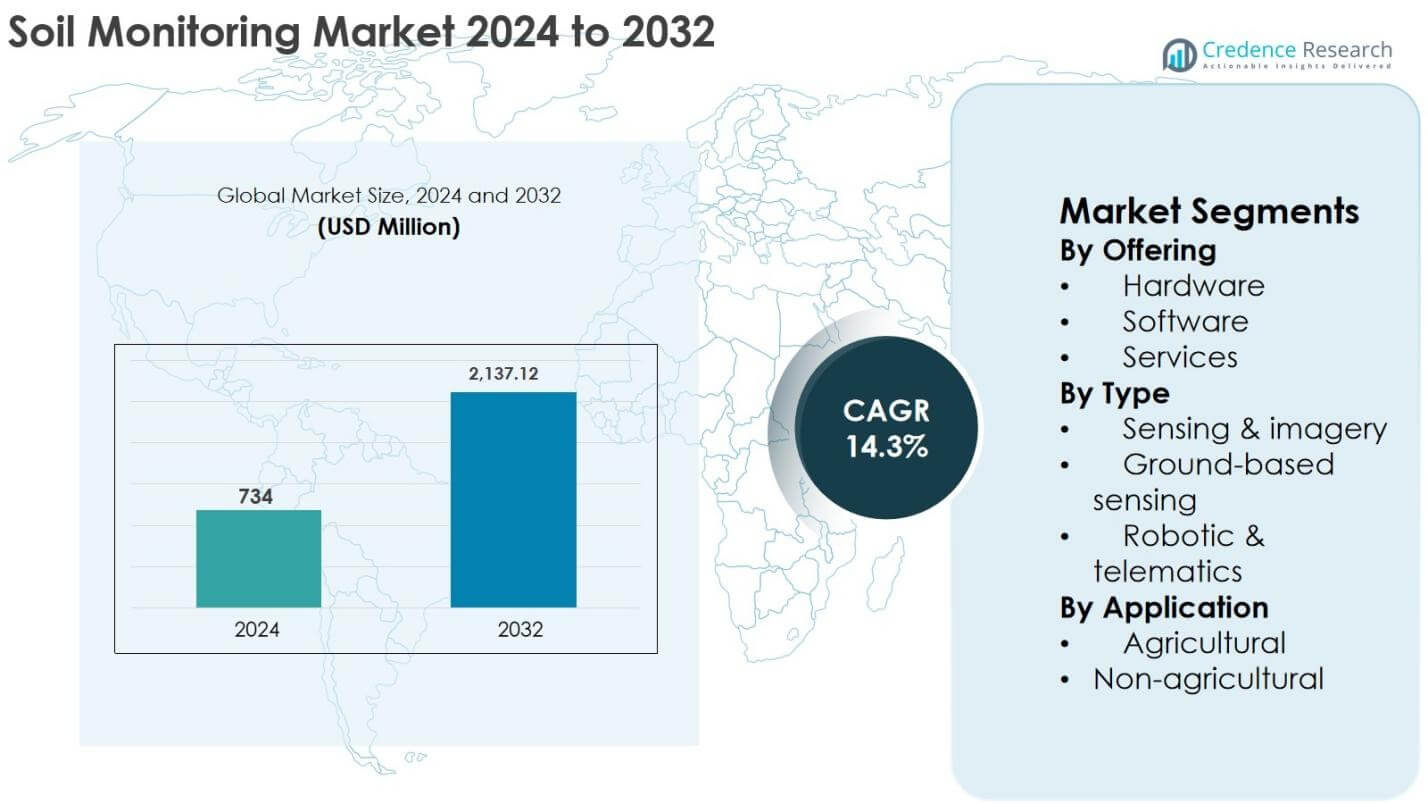
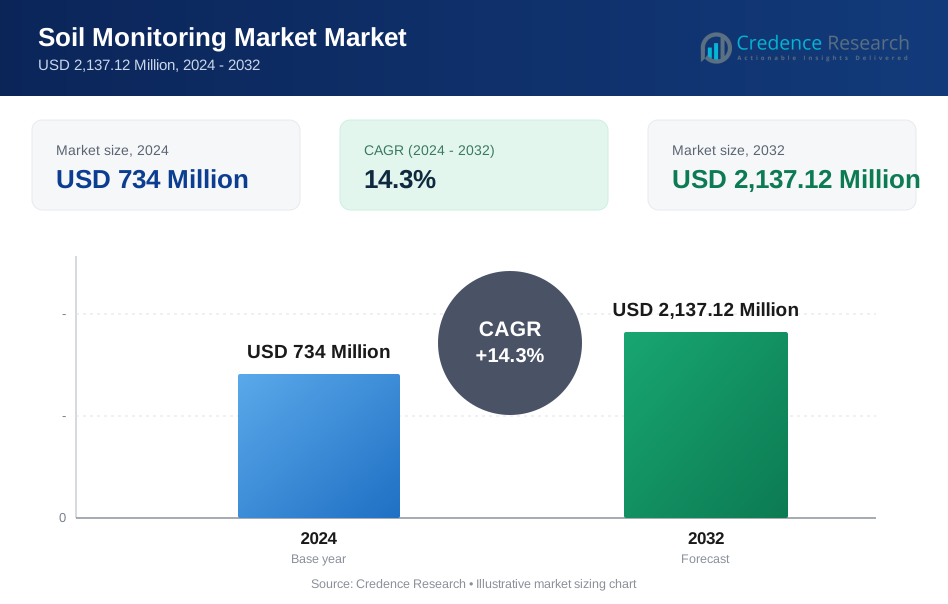
Soil Monitoring market size was valued at USD 734 Million in 2024 and is anticipated to reach USD 2,137.12 Million by 2032, at a CAGR of 14.3% during the forecast period.
| REPORT ATTRIBUTE | DETAILS |
|---|---|
| Historical Period | 2020-2023 |
| Base Year | 2024 |
| Forecast Period | 2025-2032 |
| Soil Monitoring Market Size 2024 | USD 734 million |
| Soil Monitoring Market, CAGR | 14.3% |
| Soil Monitoring Market Size 2032 | USD 2,137.12 million |
Soil Monitoring Market Insights
- Market growth is driven by increasing adoption of precision agriculture, smart irrigation systems, and soil health management initiatives that help farmers optimize water usage, improve crop yield, and enhance resource efficiency across large and mid-scale farming operations.
- A key trend in the market is the integration of IoT-enabled sensors, cloud platforms, AI-based analytics, and drone or satellite imagery to enable real-time monitoring, predictive insights, and automated decision-support for sustainable farming practices.
- Major players focus on product innovation, partnerships, and digital platform expansion to strengthen market presence, while high hardware costs and limited technology accessibility among small farmers act as key restraints in developing regions.
- North America leads the market with 34.6% share, followed by Europe at 28.1% and Asia-Pacific at 24.7%, while the Hardware segment remains dominant with 62.4% share due to strong demand for ground-based soil sensing devices.
Soil Monitoring Market Segmentation Analysis:
By Offering
The Soil Monitoring market is led by the Hardware segment, which accounted for 62.4% share in 2024, driven by the widespread adoption of in-field moisture sensors, probes, data loggers, and wireless telemetry systems that enable real-time soil condition measurement across large farm areas. Farmers and agronomists prefer robust hardware solutions to improve irrigation efficiency, crop yield, and resource optimization, which strengthens demand in precision agriculture programs. The Software segment gains traction as data analytics and AI-based platforms enhance decision-making, while Services expand through installation, calibration, and maintenance support across commercial farms and research facilities.
- For instance, John Deere integrates soil moisture and nutrient data from in-field sensors into its Operations Center platform to help farmers fine-tune variable-rate irrigation and fertilization decisions.
By Type
The Ground-based sensing segment dominated the Soil Monitoring market with a 58.7% share in 2024, as fixed and portable soil sensors deliver accurate measurements of moisture, temperature, salinity, and nutrient levels directly from the field, supporting sustainable farming practices and optimized input utilization. Sensing and imagery solutions, including satellite and drone-based platforms, are growing due to their ability to provide large-area crop and soil insights for mapping and predictive analysis. Robotic and telematics technologies are emerging in automated monitoring, enhancing connectivity, remote diagnostics, and autonomous farm operations.
- For instance, Sentek’s Drill & Drop soil probes provide multi-depth moisture and salinity readings in crops such as almonds and wine grapes, helping growers fine-tune irrigation scheduling
By Application
The Agricultural segment held the dominant position in the Soil Monitoring market with a 71.5% share in 2024, driven by rising adoption of precision farming, smart irrigation, and crop health optimization across row crops, horticulture, and greenhouse farming systems. Farmers increasingly deploy soil monitoring solutions to improve productivity, reduce water consumption, and manage soil fertility under climate-responsive farming initiatives. The Non-agricultural segment, which includes environmental monitoring, construction, landscaping, and land restoration projects, is expanding as governments and industries focus on soil conservation, land quality assessment, and sustainable land-use management.
Key Growth Drivers
Rising Adoption of Precision Agriculture and Smart Irrigation
The Soil Monitoring market grows significantly due to the increasing adoption of precision agriculture and smart irrigation practices across large and mid-scale farms. Farmers rely on soil moisture, salinity, and nutrient monitoring systems to optimize input usage, enhance crop yield, and reduce water wastage, which strengthens the demand for sensor-based field intelligence solutions. Government programs promoting sustainable agriculture, climate-resilient farming, and digital agriculture technologies further accelerate adoption in developed and emerging economies. Integration of IoT-enabled monitoring platforms with automated irrigation systems enables real-time decision-making, lowering operational costs and improving productivity outcomes. The rapid expansion of greenhouse farming, horticulture, and controlled environment agriculture also contributes to market growth by increasing the need for continuous soil condition assessment and data-driven farm management.
- For instance, Netafim integrates soil moisture sensors with its drip irrigation systems to automate irrigation scheduling and reduce water consumption in orchards, vineyards, and field crops.
Expansion of Climate-Smart Farming and Soil Health Management Programs
The shift toward climate-smart farming and regenerative agriculture drives strong demand for advanced soil monitoring technologies. Farmers, research institutions, and environmental agencies increasingly prioritize soil health assessment to mitigate risks related to drought, erosion, nutrient depletion, and climate variability. Monitoring systems support sustainable land-use planning, carbon sequestration initiatives, and conservation agriculture practices, enabling stakeholders to maintain soil fertility and ecological balance. Increasing investments in agricultural modernization, national soil testing missions, and sustainability-linked funding programs further encourage technology deployment. The capability of monitoring platforms to provide long-term soil performance insights helps optimize fertilizer application, prevent crop stress, and improve resource efficiency, reinforcing their importance in environmental stewardship and modern farm management strategies.
- For instance, the USDA’s Conservation Stewardship Program and Climate-Smart Commodities initiatives encourage practices such as cover cropping and reduced tillage, which rely on soil organic matter, moisture, and nutrient monitoring to track improvements in soil health.
Technological Advancements in IoT, AI Analytics, and Remote Sensing
Technology innovation plays a major role in accelerating the growth of the Soil Monitoring market, with advancements in IoT sensors, wireless telemetry, AI-driven analytics, and cloud-based data platforms enabling high-accuracy soil diagnostics and predictive insights. Modern systems integrate drone imagery, satellite mapping, and ground-based sensors to create comprehensive soil intelligence networks that support precision crop modeling and early risk detection. The development of low-power, cost-efficient, and rugged sensor devices enhances field operability, making adoption feasible for small and medium-scale farmers. Increasing collaborations among ag-tech companies, equipment manufacturers, and analytics providers foster ecosystem-based solutions that improve interoperability and scalability. Continuous innovation in automation, robotics, and digital farm management platforms strengthens market penetration across commercial agriculture, research, and environmental monitoring applications.
Key Trends & Opportunities
Growing Integration of Data Platforms, Farm Automation, and AI-Driven Decision Systems
A major trend in the Soil Monitoring market is the integration of data intelligence platforms with automated farming systems, enabling centralized monitoring and precision-based decision workflows. AI-powered analytics convert raw soil data into actionable insights, supporting yield forecasting, irrigation scheduling, and stress detection at field and zone levels. Cloud-connected dashboards enable remote monitoring across large farm networks, research plantations, and smart agriculture projects. Opportunities emerge as vendors develop interoperable platforms that integrate soil data with weather analytics, crop modeling, and farm machinery telematics, enhancing operational efficiency and end-user value. This convergence of automation and analytics creates strong growth potential in digital agriculture ecosystems.
- For instance, Climate FieldView by Bayer combines soil, weather, and machine data in a single platform to generate field-level insights that support seeding, input, and management decisions.
Rising Adoption in Non-Agricultural Applications and Environmental Monitoring Projects
Another key trend shaping the market is the expanding adoption of soil monitoring technologies beyond agriculture, particularly in construction, mining rehabilitation, land restoration, landscaping, and ecological conservation projects. Governments and environmental agencies increasingly deploy monitoring systems for land stability assessment, contamination detection, erosion prevention, and watershed management initiatives. Opportunities arise in smart city planning, infrastructure development, and sustainability-driven industrial applications where soil quality, compaction, and moisture conditions must be continuously evaluated. Growing emphasis on environmental compliance, climate-risk evaluation, and responsible land-use development further strengthens the role of advanced soil monitoring solutions across multidisciplinary applications.
- For instance, the U.S. Geological Survey (USGS) uses soil moisture and related sensors in landslide early warning and watershed monitoring projects to assess slope stability and runoff risk
Key Challenges
High Deployment Costs and Limited Technology Accessibility for Small Farmers
One of the major challenges in the Soil Monitoring market is the high cost associated with sensor hardware, installation, calibration, data connectivity, and analytics subscriptions, which restricts adoption among small and marginal farmers, particularly in developing regions. Limited awareness of technology benefits, lack of digital literacy, and insufficient financial support mechanisms further slow market penetration. Infrastructure limitations such as weak network coverage in rural areas also hinder real-time data transmission and remote monitoring capabilities. Addressing these constraints requires cost-effective product models, government subsidy programs, farmer training initiatives, and scalable technology frameworks designed to support inclusive and widespread adoption.
Data Accuracy, Standardization Issues, and Integration Complexity
Another critical challenge involves ensuring accurate, standardized, and reliable soil data across diverse geographies, soil types, and climatic conditions. Variations in calibration methods, sensor performance, and data interpretation can affect decision-making outcomes, especially in large-scale farming environments. Integration complexity between soil monitoring devices, farm management software, and automation systems also creates technical barriers for users. Concerns related to data ownership, privacy, and interoperability further complicate large-scale digital adoption. Overcoming these challenges requires improved testing frameworks, stronger device standardization protocols, robust data governance practices, and collaborative ecosystem development among technology providers, research bodies, and agricultural institutions.
Regional Analysis
North America
North America accounted for 34.6% share of the Soil Monitoring market in 2024, driven by the strong penetration of precision agriculture technologies, advanced irrigation systems, and large-scale commercial farming operations in the United States and Canada. Farmers increasingly adopt ground-based sensors, moisture probes, and wireless monitoring platforms to optimize crop yield, reduce input costs, and improve water-use efficiency. Government-backed sustainability programs and ag-tech investments further accelerate adoption across row crops and horticulture. The region also benefits from the presence of leading technology providers, research institutions, and digital agriculture startups that continue to expand field-level monitoring and data-driven farm management practices.
Europe
Europe held 28.1% share of the Soil Monitoring market in 2024, supported by strong emphasis on sustainable agriculture, environmental conservation, and soil quality management under EU-funded smart farming initiatives. Countries such as Germany, France, the Netherlands, and Italy actively deploy soil monitoring systems to support climate-resilient farming, organic cultivation, and precision fertilization programs. Adoption is also rising across vineyards, greenhouse farming, and horticulture clusters, where real-time soil analytics improve productivity and resource efficiency. Ongoing investments in digital agriculture, carbon-farming projects, and regenerative land management policies continue to strengthen technology deployment across both commercial and research-driven agricultural ecosystems.
Asia-Pacific
Asia-Pacific emerged as the fastest-growing region with 24.7% market share in 2024, driven by rapid agricultural modernization in China, India, Japan, and Australia. Governments increasingly promote smart irrigation, soil health monitoring, and sensor-based farming solutions to address water scarcity, soil degradation, and productivity gaps in large crop-producing economies. Expanding greenhouse cultivation, horticulture clusters, and high-value crop farming fuel technology uptake across small and mid-scale farms. Local manufacturing of cost-efficient sensors and growing ag-tech startup ecosystems further support regional adoption. Rising awareness of climate-smart agriculture and input optimization strengthens long-term demand for connected soil monitoring platforms.
Latin America
Latin America accounted for 7.6% share of the Soil Monitoring market in 2024, with adoption primarily concentrated in Brazil, Argentina, and Chile, where large-scale commercial farming and export-oriented crop production drive technology demand. Farmers increasingly implement soil moisture and nutrient monitoring solutions to improve yield reliability in soybeans, sugarcane, coffee, and horticulture sectors. Expansion of precision agriculture programs, coupled with partnerships between ag-tech providers and agribusiness enterprises, supports gradual market growth. However, cost sensitivity, uneven digital infrastructure, and limited awareness among smallholder farmers continue to restrict broader adoption, creating opportunities for affordable and scalable monitoring solutions.
Middle East & Africa
The Middle East & Africa region represented 5.0% share of the Soil Monitoring market in 2024, with adoption driven largely by smart irrigation, desert farming, and water-resource optimization initiatives in Gulf countries and select African economies. Soil monitoring systems play a critical role in greenhouse agriculture, hydroponics, and climate-resilient farming projects designed to address water scarcity and soil salinity challenges. Governments and development agencies increasingly support sustainable land-use and crop productivity programs, encouraging gradual deployment of sensing technologies. Market expansion remains moderate due to budget constraints and infrastructure limitations but is expected to strengthen as digital agriculture investments increase.
Soil Monitoring Market Segmentations:
By Offering
- Hardware
- Software
- Services
By Type
- Sensing & imagery
- Ground-based sensing
- Robotic & telematics
By Application
- Agricultural
- Non-agricultural
By Geography
- North America
- U.S.
- Canada
- Mexico
- Europe
- Germany
- France
- U.K.
- Italy
- Spain
- Rest of Europe
- Asia Pacific
- China
- Japan
- India
- South Korea
- South-east Asia
- Rest of Asia Pacific
- Latin America
- Brazil
- Argentina
- Rest of Latin America
- Middle East & Africa
- GCC Countries
- South Africa
- Rest of the Middle East and Africa
Competitive Landscape
The Soil Monitoring market features a diverse and increasingly technology-driven competitive landscape, with companies focusing on sensor innovation, data analytics integration, and precision agriculture solutions to strengthen their market presence. Key players include Campbell Scientific, CropX Technologies, Spectrum Technologies, METER Group, The Toro Company, SGS Group, Stevens Water Monitoring Systems, Sontok Technologies, Irromotor, and Element Material Technology, all of which actively expand product portfolios through advanced soil moisture sensors, telemetry systems, and IoT-enabled monitoring platforms. Market participants emphasize partnerships with agritech firms, research institutions, and farm equipment manufacturers to enhance interoperability and deliver end-to-end farm intelligence solutions. Companies are also investing in AI-based analytics, satellite imagery integration, and remote diagnostics capabilities to support scalable deployments across commercial farming, horticulture, environmental monitoring, and smart irrigation applications. As competition intensifies, vendors increasingly differentiate through cost-efficient devices, cloud-based data platforms, and tailored service offerings designed to address regional farming needs and sustainability-focused agricultural practices.
Key Player Analysis
- Spectrum Technologies
- Campbell Scientific
- The Toro Company
- METER Group
- Stevens Water Monitoring Systems
- SGS Group
- CropX Technologies
- Irromotor
- Sontok Technologies
- Element Material Technology
Recent Developments
- In February 2025, The Toro Company, in partnership with TerraRad, introduced a new software solution to enhance irrigation management. The product, called Spatial Adjust, is designed for the Toro Lynx Central Control platform and integrates with TerraRad’s turfRad smart sensors installed on Toro equipment. As the mower operates, the system monitors soil moisture levels to support more accurate and efficient irrigation decisions.
- In May 2024, Stevens Water Monitoring Systems, Inc. acquired the weather instrument product line from Dyacon. This acquisition expanded Stevens’ portfolio of meteorological solutions, enabling the company to better serve applications such as climate monitoring, agriculture, soil analysis, research, sports turf management, fire weather monitoring, and emerging small-airport environments.
- In February 2024, CropX Technologies entered into a collaboration with Syngenta to support improved sustainability and yield performance among Syngenta’s seed suppliers in the U.S. Midwest. The initiative leverages data generated from CropX’s agronomic platform, which combines insights from soil sensors and in-field agricultural machinery.
Report Coverage
The research report offers an in-depth analysis based on Offering, Type, Application, and Geography. It details leading market players, providing an overview of their business, product offerings, investments, revenue streams, and key applications. Additionally, the report includes insights into the competitive environment, SWOT analysis, current market trends, as well as the primary drivers and constraints. Furthermore, it discusses various factors that have driven market expansion in recent years. The report also explores market dynamics, regulatory scenarios, and technological advancements that are shaping the industry. It assesses the impact of external factors and global economic changes on market growth. Lastly, it provides strategic recommendations for new entrants and established companies to navigate the complexities of the market.
Future Outlook
- The market will experience strong growth as precision agriculture and data-driven farm management become central to sustainable crop production.
- Adoption of IoT-enabled soil sensors and wireless telemetry systems will increase across large farms, greenhouses, and horticulture operations.
- AI-based analytics and predictive modeling will play a greater role in irrigation scheduling, nutrient planning, and crop health optimization.
- Integration of soil monitoring platforms with farm automation, drones, and satellite imagery will enhance real-time decision support capabilities.
- Demand for affordable and compact sensor solutions will rise among small and mid-scale farmers in emerging economies.
- Government initiatives promoting climate-smart agriculture and soil health improvement will accelerate technology deployment.
- Non-agricultural applications such as environmental restoration, construction, and land-stability monitoring will expand adoption opportunities.
- Vendors will focus on interoperability, cloud connectivity, and scalable platform architecture to support multi-field monitoring.
- Partnerships between ag-tech firms, research bodies, and irrigation equipment manufacturers will intensify.
- Increasing emphasis on sustainability, water-use efficiency, and carbon-farming practices will continue to strengthen long-term market demand.
Request a Free Sample
Fill in your details and we'll send you a free sample report.
- Sample data tables & charts
- Research methodology
Need a Custom Version of This Report?
Tailor the scope, geography, or segments to your exact requirements.
- Custom geography or segment scope
- Direct access to our analyst team
Frequently Asked Questions
What is the current market size for the Soil Monitoring Market, and what is its projected size in 2032?
At what Compound Annual Growth Rate is the Soil Monitoring Market projected to grow between 2024 and 2032?
Which Soil Monitoring Market segment held the largest share in 2024?
What are the primary factors fueling the growth of the Soil Monitoring Market?
Who are the leading companies in the Soil Monitoring Market?
Which region commanded the largest share of the Soil Monitoring Market in 2024?
Table of Content
Chapter 1. Report Introduction
- 1.1 Report Description & Purpose
- 1.1.1 Report Title & Market Definition
- 1.1.2 Unique Selling Propositions (USP) & Key Differentiators
- 1.1.3 Value Proposition for Stakeholders
- 1.2 Research Objectives
- 1.2.1 Market Sizing Objectives (Volume & Revenue)
- 1.2.2 Segmentation Objectives
- 1.2.3 Competitive Intelligence Objectives
- 1.2.4 Forecast & Scenario Objectives
- 1.3 Report Scope
- 1.3.1 Soil Monitoring Market Scope – Types & Subtypes Covered
- 1.3.2 Geographic Scope – Regions & Countries Covered
- 1.3.3 Historical Period, Base Year & Forecast Period (2024; forecast to 2032)
- 1.3.4 Inclusions & Exclusions
- 1.4 HS Code & Classification Framework
- 1.5 Currency, Units & Pricing Basis
- 1.6 Target Stakeholders
- 1.7 Limitations & Assumptions
Chapter 2. Executive Summary
- 2.1 Global Soil Monitoring Market Market Snapshot
- 2.1.1 Market Size – Historical (2024) & Forecast (2024-2032) (2024: USD 734 Million → 2032: USD 2,137.12 Million)
- 2.1.2 Volume & Revenue – Global Totals
- 2.1.3 Key Market Highlights – Top Five Facts
- 2.2 Soil Monitoring Market Market Segmentation Snapshot
- 2.2.1 Market Split by Region – 2024 vs. 2032
- 2.3 Competitive Snapshot
- 2.3.1 Top 10 Players by Revenue Share – 2024
- 2.3.2 Top 10 Players by Volume Share – 2024
- 2.3.3 Recent Strategic Developments (18-Month Summary)
- 2.4 Key Investment Highlights & Strategic Conclusions
Chapter 3. Soil Monitoring Market Market Dynamics & Industry Analysis
- 3.1 Market Overview & Context
- 3.1.1 Soil Monitoring Market Market Position in the Broader Automotive Value Chain
- 3.1.2 OEM vs. Replacement Market Dynamics
- 3.1.3 Market Maturity & Development Stage by Region
- 3.2 Soil Monitoring Market Market Drivers
- 3.3 Soil Monitoring Market Market Restraints & Challenges
- 3.4 Soil Monitoring Market Market Opportunities
- 3.5 Porter's Five Forces Analysis
- 3.5.1 Threat of New Entrants
- 3.5.2 Bargaining Power of Suppliers
- 3.5.3 Bargaining Power of Buyers
- 3.5.4 Threat of Substitutes
- 3.5.5 Competitive Rivalry – Intensity Assessment
- 3.6 Soil Monitoring Market Value Chain Analysis
- 3.6.1 Upstream – Raw Material/Input Suppliers
- 3.6.1.1 Raw Material/Input 1
- 3.6.1.2 Raw Material/Input 2
- 3.6.1.3 Raw Material/Input 3
- 3.6.2 Midstream – Production/Manufacturing/Service Delivery
- 3.6.2.1 Production/Process Overview
- 3.6.2.2 Key Facility Locations & Capacity by Manufacturer
- 3.6.3 Downstream – Distribution & End Consumer
- 3.6.3.1 Primary Channel – B2B/OEM
- 3.6.3.2 Secondary Channels – Dealer, Retail, Online, Direct
- 3.6.4 Value Chain Profitability Analysis
- 3.6.1 Upstream – Raw Material/Input Suppliers
- 3.7 PESTEL Analysis
- 3.7.1 Political Factors
- 3.7.2 Economic Factors
- 3.7.3 Social Factors
- 3.7.4 Technological Factors
- 3.7.5 Environmental Factors
- 3.7.6 Legal Factors
- 3.8 Soil Monitoring Market Supply Chain Analysis
- 3.8.1 Raw Material/Input Supply Risk Assessment
- 3.8.2 Manufacturing Concentration Risk (Geographic Exposure)
- 3.8.3 Trade Disruption Impact Analysis
- 3.9 Regulatory & Policy Landscape
Note: The regulatory and policy landscape section covers regulations based on their applicability to the market, Soil Monitoring Market category, geography, and scope of the study. Only regulatory frameworks with a material impact on operations, compliance, trade, sustainability, or market access are analyzed in detail.
Chapter 4. Key Investment Pockets & Opportunity Analysis
- 4.1 Soil Monitoring Market Market Attractiveness Analysis
- 4.1.1 By Region – Investment Attractiveness Matrix (Volume × CAGR)
- 4.2 Absolute Revenue Growth Opportunity
- 4.2.1 By Region – Absolute USD Growth Through 2032
- 4.3 Incremental Volume Opportunity
- 4.3.1 By Region – Incremental Volume Through 2032
- 4.3.2 Segment – Incremental Volume
- 4.4 Emerging Submarket Opportunity Deep Dive (Subject to Applicability)
- 4.5 Emerging Market Opportunity Scorecards
- 4.5.1 United States
- 4.5.2 Europe
- 4.5.3 Asia
- 4.5.4 Middle East & Africa
Note: Emerging Market Opportunity Scorecards will be included based on relevance and strategic importance. Regions listed are indicative and may vary depending on data availability and market dynamics.
Chapter 5. Soil Monitoring Market Import-Export Analysis & Trade Flows
- 5.1 Global Trade Overview
- 5.1.1 Global Export Value by Country (2024)
- 5.1.2 Global Export Volume by Country (2024)
- 5.1.3 Global Import Value by Country (2024)
- 5.1.4 Global Import Volume by Country (2024)
- 5.1.5 Net Trade Balance by Country (2024)
- 5.2 Export Analysis – Segment
- 5.2.1 Type 1 (HS Code)
- 5.2.2 Type 2 (HS Code)
- 5.2.3 Type 3 (HS Code)
- 5.2.4 Type 4 (HS Code)
- 5.2.5 Type 5 (HS Code)
- 5.3 Import Analysis – Segment
- 5.3.1 Type 1 (HS Code)
- 5.3.2 Type 2 (HS Code)
- 5.3.3 Type 3 (HS Code)
- 5.3.4 Type 4 (HS Code)
- 5.3.5 Type 5 (HS Code)
- 5.4 Average Unit Trade Prices
- 5.4.1 Average Export Price – Segment & Country
- 5.4.2 Average Import Price – Segment & Source Country
- 5.4.3 Price Trends (2024)
- 5.5 Key Trade Route Analysis
- 5.5.1 Trade Route 1
- 5.5.2 Trade Route 2
- 5.5.3 Trade Route 3
- 5.5.4 Trade Route 4
- 5.5.5 Trade Route 5
- 5.6 Trade Policy Impact Assessment
- 5.6.1 US Anti-Dumping & Section 301 Tariffs
- 5.6.2 EU Customs Union Impact
- 5.6.3 Major Free Trade Agreements
- 5.6.4 USMCA Rules of Origin
Note: Trade policy analysis will be included only where relevant to the Soil Monitoring Market market.
Chapter 6. Competitive Landscape & Company Benchmarking
- 6.1 Soil Monitoring Market Market Concentration & Structure
- 6.1.1 Herfindahl-Hirschman Index (HHI) – vs. 2024
- 6.1.2 Tier 1, Tier 2 & Tier 3 Market Structure
- 6.1.3 Global, Regional & Local Player Dynamics
- 6.2 Soil Monitoring Market Market Share Analysis – 2024
- 6.2.1 Global Revenue Share by Company
- 6.2.2 Global Volume Share by Company
- 6.2.3 Regional Revenue Share
- 6.2.4 Market Share Evolution ( vs. 2024)
- 6.2.5 OEM Segment Share by Company
- 6.2.6 Replacement Segment Share by Company
- 6.3 Production/Delivery Capacity & Facility Analysis
- 6.3.1 Global Installed Capacity
- 6.3.2 Capacity Utilization Rates
- 6.3.3 Production/Output Volume
- 6.3.4 Facility Locations & Capacity Map
- 6.3.5 Planned Capacity Additions
- 6.4 Soil Monitoring Market Competitive Benchmarking Matrix
- 6.4.1 Revenue, Volume, CAGR & Profitability Comparison
- 6.4.2 Channel Revenue Mix
- 6.4.3 Geographic Revenue Exposure
- 6.4.4 R&D Intensity
- 6.4.5 Sustainability Maturity
- 6.5 Strategic Developments in Soil Monitoring Market (Last 24 Months)
- 6.5.1 Mergers, Acquisitions & Divestments
- 6.5.2 New Soil Monitoring Market Launches
- 6.5.3 Facility Expansions
- 6.5.4 Strategic Alliances, Joint Ventures & Partnerships
- 6.5.5 Distribution Expansion & Market Entry
- 6.5.6 Sustainability & ESG Initiatives
- 6.6 Competitive Strategy Mapping
- 6.6.1 Leader, Challenger, Follower & Niche Classification
- 6.6.2 Pricing Strategy Comparison
- 6.6.3 Channel Strategy Matrix
Note: Strategic developments are included based on their materiality and the availability of reliable information.
Chapter 7. Global Soil Monitoring Market Market – By Distribution Channel
- 7.1 Segment Overview
- 7.1.1 Volume & Revenue Split by Channel (2024 & 2032)
- 7.1.2 Channel Mix Evolution (2024-2032)
Chapter 8. Regional Market Analysis – Global Overview
- 8.1 Global Regional Overview
- 8.1.1 Regional Volume Share
- 8.1.2 Regional Revenue Share
- 8.1.3 Regional Volume by Region
- 8.1.4 Regional Revenue by Region
- 8.1.5 Regional Forecast Through 2032
- 8.2 Cross-Regional Segment Analysis
- 8.2.1 By Distribution Channel
- 8.2.2 By Brand/Price Tier
Chapter 9. North America Soil Monitoring Market Market
- 9.1 United States
- 9.2 Canada
- 9.3 Mexico
Chapter 10. Europe Soil Monitoring Market Market
- 10.1 Germany
- 10.2 France
- 10.3 Italy
- 10.4 United Kingdom
- 10.5 Spain
- 10.6 Poland
- 10.7 Russia
- 10.8 Netherlands
- 10.9 Belgium
- 10.10 Sweden
- 10.11 Denmark
- 10.12 Norway
- 10.13 Rest of Europe
Chapter 11. Asia Pacific Soil Monitoring Market Market
- 11.1 China
- 11.2 India
- 11.3 Japan
- 11.4 South Korea
- 11.5 Thailand
- 11.6 Indonesia
- 11.7 Vietnam
- 11.8 Malaysia
- 11.9 Australia
- 11.10 Rest of Asia Pacific
Chapter 12. Latin America Soil Monitoring Market Market
- 12.1 Brazil
- 12.2 Argentina
- 12.3 Colombia
- 12.4 Chile
- 12.5 Rest of Latin America
Chapter 13. Middle East Soil Monitoring Market Market
- 13.1 Saudi Arabia
- 13.2 United Arab Emirates
- 13.3 Turkey
- 13.4 Israel
- 13.5 Iran
- 13.6 Rest of the Middle East
Chapter 14. Africa Soil Monitoring Market Market
- 14.1 South Africa
- 14.2 Egypt
- 14.3 Nigeria
- 14.4 Morocco
- 14.5 Rest of Africa
Chapter 15. Soil Monitoring Market Company Profiles
- 15.1 [Company 01]
- 15.1.1 Company Overview
- 15.1.2 Key Management Personnel
- 15.1.3 Products & Services Portfolio
- 15.1.4 Financial Performance
- 15.1.5 Key Market Focus & Geographic Presence
- 15.1.6 Recent Developments & Strategic Initiatives
Note: The company profile list is preliminary and may change based on research findings, market developments, data availability, and client requirements.
Chapter 16. Appendices
- Appendix A – List of Abbreviations & Acronyms
- Appendix B – Industry Classification Code Reference – Full Series
- Appendix C – Production & Capacity Data Tables
- Appendix D – End-Use & Demand Base Tables
- Appendix E – Consumption & Replacement Rate Assumptions
- Appendix F – ASP Reference Tables
- Appendix G – Manufacturing & Facility Database
- Appendix H – Import-Export Data Tables
- Appendix I – Regulatory Summary Tables
- Appendix J – Primary Research Participant List (Anonymized)
- Appendix K – Primary Research Questionnaire Framework
- Appendix L – Data Sources & Bibliography
- Appendix M – Market Size Divergence & Source Comparison
Chapter 17. Research Methodology
- 17.1 Research Framework & Philosophy
- 17.2 Secondary Research – Sources, Hierarchy & Data Extraction
- 17.3 Data Modeling – Bottom-Up & Top-Down Market Sizing
- 17.4 Primary Research – Stakeholder Framework, LOI & Sample Sizes
- 17.5 Forecast Methodology – Regression, Scenario & Sensitivity Analysis
- 17.6 Quality Control – Four-Layer Validation Framework
- 17.7 Limitations & Standard Assumptions
- 17.8 Disclaimer
