
Market Overview:
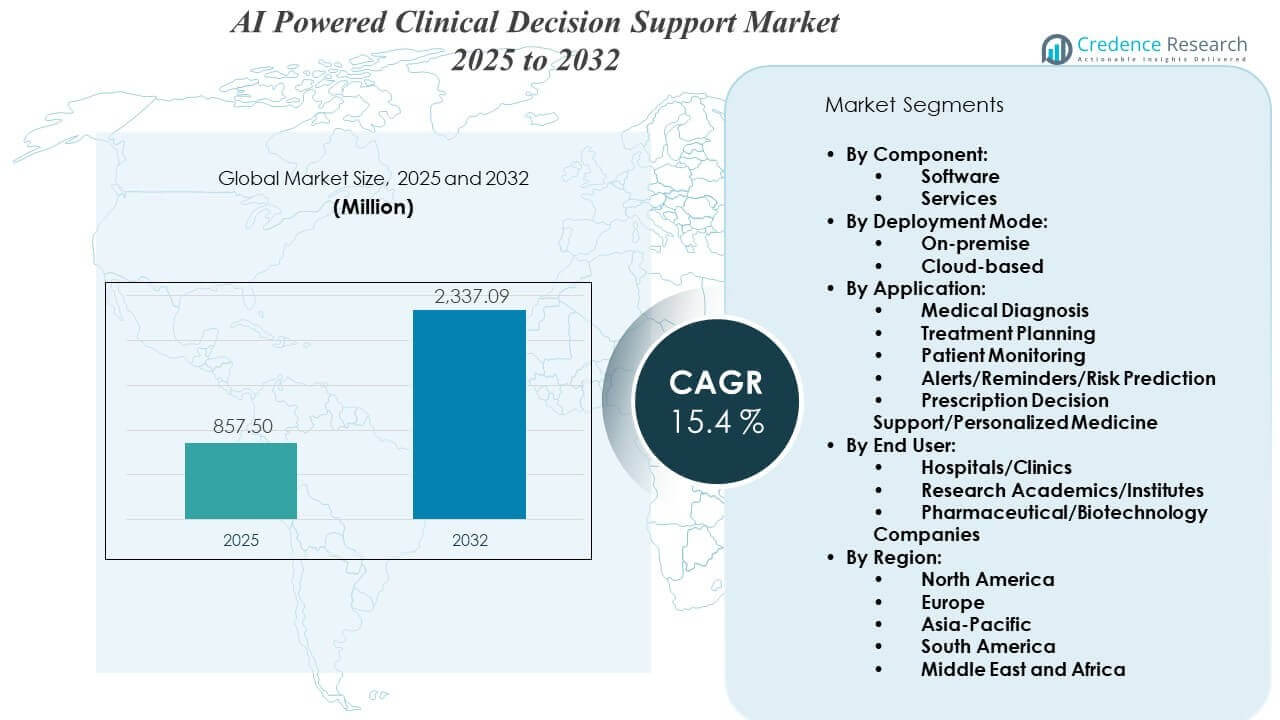
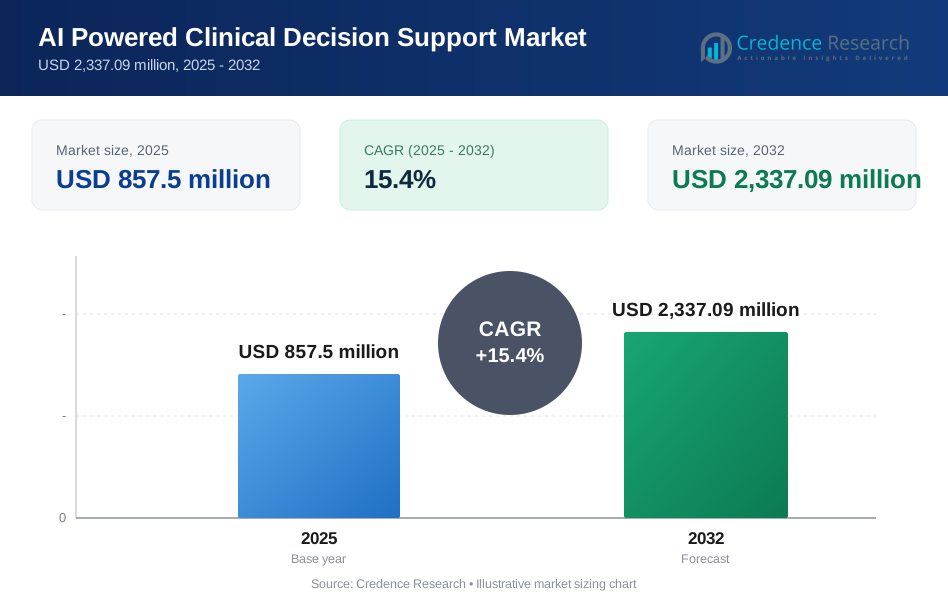
The AI Powered Clinical Decision Support Market is projected to grow from USD 857.5 million in 2025 to an estimated USD 2,337.09 million by 2032, with a compound annual growth rate (CAGR) of 15.4% from 2025 to 2032.
| REPORT ATTRIBUTE | DETAILS |
|---|---|
| Historical Period | 2020-2023 |
| Base Year | 2024 |
| Forecast Period | 2025-2032 |
| AI Powered Clinical Decision Support Market Size 2025 | USD 857.5 million |
| AI Powered Clinical Decision Support Market, CAGR | 5.7% |
| AI Powered Clinical Decision Support Market Size 2032 | USD 2,337.09 million |
This market is gaining traction due to the rising need for accurate, data-driven, and real-time clinical support tools. Healthcare providers are increasingly adopting AI-powered systems to enhance diagnostic accuracy, reduce medical errors, and improve patient outcomes. Integration with electronic health records (EHRs) and advancements in natural language processing and predictive analytics further support adoption. Hospitals, clinics, and research institutions are investing in decision support tools to handle large volumes of medical data. The demand is also driven by the push for value-based care and increasing regulatory support for AI in clinical workflows.
North America leads the AI-powered clinical decision support market due to strong digital health infrastructure, favorable regulations, and early adoption by major health systems. Europe follows closely, especially in countries like Germany, the UK, and France, which are modernizing healthcare through AI integration. Asia-Pacific is emerging as a high-growth region, driven by expanding healthcare access, government digitization programs, and increasing investment in AI healthcare start-ups across China, India, and Japan. Latin America and the Middle East are gradually adopting these systems, though limited by infrastructure and skilled workforce availability.
Market Insights:
- The AI Powered Clinical Decision Support Market was valued at USD 857.5 million in 2025 and is projected to reach USD 2,337.09 million by 2032, growing at a CAGR of 15.4% during the forecast period.
- North America (41%), Europe (26%), and Asia-Pacific (20%) lead the market due to strong healthcare IT infrastructure, regulatory support, and investment in digital health transformation.
- Asia-Pacific, with a 20% share, is the fastest-growing region driven by expanding healthcare access, government funding, and adoption in emerging economies like China and India.
- The software segment accounted for the largest share at over 60%, driven by high demand for real-time analytics and seamless integration with EHR systems.
- Hospitals and clinics held nearly 55% of the end-user market due to their need for scalable, AI-driven decision tools in high-volume care environments.
Market Drivers:
Rising Demand for Real-Time Decision Support to Reduce Diagnostic Errors
Healthcare providers seek tools that offer immediate insights at the point of care. The growing need to reduce misdiagnosis and improve clinical decisions supports AI adoption. Clinical decision support systems integrated with AI can process diverse data from labs, imaging, and EHRs. These systems enhance diagnostic precision and reduce delays in treatment planning. The AI Powered Clinical Decision Support Market benefits from increasing investments in intelligent alert systems. Hospitals now rely on predictive risk scoring to guide interventions. This demand continues to rise due to the focus on patient safety. Government agencies and accreditation bodies support the shift toward smarter decision systems.
- For instance, AI algorithms like Johns Hopkins’ Targeted Real‑Time Early Warning System (TREWS) detected sepsis up to 6 hours earlier and reduced mortality risk by about 20% in multi‑hospital settings.
Integration with Electronic Health Records Drives Institutional Adoption
EHR platforms now include AI-powered decision support modules to enhance usability. AI integration enables clinicians to extract patient insights from unstructured notes and structured data. These tools reduce cognitive load on practitioners by offering context-aware alerts and care suggestions. The AI Powered Clinical Decision Support Market gains traction through such streamlined integration. Vendors design solutions that align with existing hospital IT ecosystems. This alignment reduces training burden and accelerates deployment. Health systems are now choosing AI platforms with seamless interoperability. It helps providers reduce alert fatigue and focus on actionable outcomes.
- For instance, OpenEvidence, a clinical search and decision assistant, reported over 430,000 registered physicians and more than 8.5 million consultations per month using its AI insights to support clinical questions, demonstrating real user engagement with AI data synthesis.
Need for Cost-Effective Healthcare Delivery Across High-Burden Systems
Hospitals aim to optimize resource allocation while maintaining quality outcomes. AI-supported systems help prioritize cases, reduce unnecessary tests, and automate documentation. These capabilities support efficiency in overburdened care settings. The AI Powered Clinical Decision Support Market reflects this shift toward automation-led savings. Governments in emerging markets now invest in digital tools that support underserved areas. Clinical decision systems reduce the need for specialist intervention in routine cases. It empowers nurses and general physicians with real-time decision aid. These systems help lower the cost per patient encounter.
Supportive Regulatory Frameworks and Clinical Validation of AI Systems
Regulatory bodies have issued frameworks that support the clinical use of AI. FDA and EMA continue to approve AI-enabled diagnostic support tools. Validated models with high sensitivity and specificity now receive widespread use. It improves confidence among providers to adopt such technologies. The AI Powered Clinical Decision Support Market benefits from growing trust in AI-backed tools. Medical institutions seek evidence-based systems with proven outcomes. Clinical trials and peer-reviewed studies drive product acceptance. The market sees faster commercialization for solutions with validated clinical impact.
Market Trends:
Growing Use of Natural Language Processing in Clinical Note Interpretation
Hospitals generate a large volume of unstructured clinical data daily. Natural Language Processing (NLP) tools now extract insights from physician notes and discharge summaries. NLP models trained on medical terminology help detect care gaps or flag complications. It supports automated clinical coding and real-time audit checks. The AI Powered Clinical Decision Support Market expands with such capabilities in demand. NLP tools also assist in extracting social determinants of health from patient history. It improves personalized risk assessments and care planning. Providers adopt these tools to enrich clinical workflows and reduce manual review. The technology enhances information retrieval and decision speed.
- For instance, large language models in EMRs assist with summarization and categorization of clinical text, helping reduce physician workload and streamline documentation tasks.
Emergence of Federated Learning to Protect Patient Data Privacy
Healthcare institutions prioritize data privacy and compliance with regional laws. Federated learning allows AI models to train on local data without transferring it. Hospitals can benefit from collaborative AI model development while preserving privacy. This trend supports decentralized model training across different care settings. The AI Powered Clinical Decision Support Market evolves to support privacy-first innovations. Federated systems adapt to regional datasets, enhancing local accuracy. Vendors now promote secure deployment of models in on-premise and cloud environments. Institutions favor these frameworks to meet GDPR and HIPAA standards. The trend improves trust in AI tools among compliance teams.
Adoption of Specialty-Focused AI Modules in Subclinical Disciplines
Health systems now explore AI modules tailored for specialties like oncology, cardiology, and radiology. These tools offer precision guidance for diagnosis, treatment, and monitoring. Subspecialty AI supports detection of anomalies often missed in general models. The AI Powered Clinical Decision Support Market benefits from this segmentation trend. Vendors target niche clinical areas with specialized algorithms. Specialty-focused AI gains faster traction in academic and tertiary centers. It enhances decision accuracy for complex patient profiles. Hospitals demand clinical decision systems aligned with their top volume departments. The trend supports market expansion across both developed and developing regions.
- For instance, Viz.ai reported that its AI-based stroke detection platform helped reduce time to treatment by over 50 minutes in several U.S. hospital networks by rapidly identifying large vessel occlusions on CT scans.
Shift Toward Voice-Based Clinical Interfaces and Smart Assistants
Clinicians increasingly use voice-enabled tools to access patient data or receive decision prompts. Smart assistants embedded in EHRs allow hands-free operation during procedures or ward rounds. Voice AI enhances accessibility and reduces documentation delays. The AI Powered Clinical Decision Support Market responds to this shift in user interaction. Voice recognition tools improve real-time engagement with support systems. Hospitals deploy voice AI in emergency rooms and surgical suites for instant queries. These interfaces improve workflow efficiency and reduce screen dependency. Vendors integrate voice UX to support fast adoption and boost productivity in care settings.
Market Challenges Analysis:
Data Quality Issues and Fragmented Health Information Systems
Healthcare datasets remain inconsistent across institutions and geographies. AI models struggle to perform well when inputs lack completeness or standardization. Hospitals use varied formats and coding practices in documentation. The AI Powered Clinical Decision Support Market faces resistance due to data fragmentation. Inaccurate or incomplete data reduces the reliability of AI predictions. Institutions require robust data governance and standard mapping tools. Interoperability challenges also limit cross-institutional deployments. Models trained in one region may not generalize elsewhere without adaptation. These constraints slow down large-scale integration in low-resource and mid-tier hospitals.
Clinical Acceptance Barriers and Trust Gaps in AI Recommendations
Many clinicians remain cautious about relying on machine-generated decisions. Concerns arise around model transparency, explainability, and accountability. The AI Powered Clinical Decision Support Market must address trust deficits through model auditability. Physicians seek clear rationale behind suggestions, especially in critical care settings. Unexplained alerts or recommendations often lead to system disengagement. Vendors work to embed explainable AI and feedback loops into product design. Regulatory uncertainty over autonomous decision-making also contributes to hesitation. Without clear clinical ownership, systems risk being ignored. Successful adoption requires confidence in clinical relevance and ethical safeguards.
Market Opportunities:
Expansion into Ambulatory and Remote Care Settings for Broader Reach
Care is moving beyond hospitals into outpatient and remote care environments. AI tools can support decision-making in clinics, home care, and virtual consultations. The AI Powered Clinical Decision Support Market finds new users in primary and community care. It enables frontline workers to make timely and informed decisions. Cloud-based AI systems support remote access and decentralized monitoring. Governments promote telehealth expansion and see AI as a force multiplier. This shift opens new opportunities across rural and low-infrastructure zones.
Collaborations Between Tech Companies and Healthcare Providers for Innovation
Tech giants and med-tech start-ups collaborate with hospital chains to co-develop AI solutions. These partnerships accelerate the testing, validation, and scaling of decision tools. The AI Powered Clinical Decision Support Market gains from multi-stakeholder ecosystems. Joint ventures improve data access, model refinement, and user training. Hospitals benefit from tailor-made tools that fit their practice patterns. Such alliances fast-track commercialization and enhance global product pipelines.
Market Segmentation Analysis:
By Component
The software segment holds a dominant position due to its central role in decision automation, data analytics, and system integration. It enables fast deployment, user-friendly interfaces, and algorithm-based insights. Services are gaining importance with growing demand for training, support, and system optimization. Hospitals and research centers often require managed services to maximize system performance and compliance.
- For instance, AI platforms such as OpenEvidence’s DeepConsult feature reasoning systems that synthesize evidence across clinical literature to aid diagnostic decisions, contributing to large‑scale clinician adoption.
By Deployment Mode
Cloud-based deployment leads due to its scalability, remote access, and lower upfront cost. Healthcare providers prefer cloud platforms for easier updates and interoperability. On-premise deployment still holds relevance in large institutions needing full data control and security compliance. The AI Powered Clinical Decision Support Market supports both models depending on regulatory and infrastructure needs.
- For instance, ambient scribe solutions from vendors like Tandem Health process clinician speech into structured notes while complying with regional data privacy standards.
By Application
Medical diagnosis and treatment planning segments drive the highest adoption. These applications improve clinical accuracy and reduce diagnostic delays. Patient monitoring and alerts/reminders assist in proactive care and risk mitigation. Prescription decision support plays a key role in personalized medicine strategies. Hospitals use it to align treatment with genetic, behavioral, and historical patient data.
By End User
Hospitals and clinics remain the largest users due to high patient volumes and complex care demands. Research institutes adopt these systems to support clinical trials and evidence generation. Pharmaceutical and biotech firms use them to refine trial protocols and improve drug targeting. Each segment demands tailored AI models aligned with operational goals.
Segmentation:
By Component:
- Software
- Services
By Deployment Mode:
- On-premise
- Cloud-based
By Application:
- Medical Diagnosis
- Treatment Planning
- Patient Monitoring
- Alerts/Reminders/Risk Prediction
- Prescription Decision Support/Personalized Medicine
By End User:
- Hospitals/Clinics
- Research Academics/Institutes
- Pharmaceutical/Biotechnology Companies
By Region:
- North America
- U.S.
- Canada
- Mexico
- Europe
- Germany
- France
- U.K.
- Italy
- Spain
- Rest of Europe
- Asia Pacific
- China
- Japan
- India
- South Korea
- South-east Asia
- Rest of Asia Pacific
- Latin America
- Brazil
- Argentina
- Rest of Latin America
- Middle East & Africa
- GCC Countries
- South Africa
- Rest of the Middle East and Africa
Regional Analysis:
North America Leads with Strong Technological Base and High Adoption Rate
North America dominates the AI Powered Clinical Decision Support Market with a market share of over 41%. The region benefits from a well-established healthcare IT ecosystem, strong government support, and early integration of AI technologies. Major U.S.-based vendors, such as Epic Systems and Oracle, continue to expand AI modules within clinical systems. High per capita healthcare spending and regulatory encouragement for digital health innovation drive growth. Hospitals and academic institutions actively partner with AI companies to co-develop and test clinical tools. Canada also shows significant interest through national health digitization programs, contributing to steady regional growth.
Europe Maintains Steady Growth Backed by Compliance and Research Investment
Europe holds the second-largest share at around 26% of the global market. Strong emphasis on compliance with data protection laws like GDPR influences the adoption of secure AI systems. Countries such as Germany, the UK, and the Netherlands lead in hospital digitization and clinical research adoption. It sees broad interest in AI tools that support personalized treatment, patient monitoring, and drug development. EU-backed initiatives fund AI pilots across university hospitals and national health systems. The AI Powered Clinical Decision Support Market in Europe continues to mature through cross-border collaborations and innovation-focused regulations.
Asia-Pacific Emerges as a High-Growth Market with Expanding Healthcare Access
Asia-Pacific accounts for nearly 20% of the global market and is expected to register the fastest CAGR. China, India, and Japan lead the region due to investments in digital health, rising patient loads, and growing medical infrastructure. Governments fund AI-based clinical systems to manage resource constraints and improve rural care delivery. Local startups and global vendors expand offerings tailored to regional healthcare needs. South Korea and Singapore serve as test beds for smart hospital models powered by AI. The AI Powered Clinical Decision Support Market in Asia-Pacific grows rapidly due to rising demand for scalable and cost-efficient clinical solutions.
Key Player Analysis:
- Epic Systems Corporation (U.S.)
- Oracle (U.S.)
- Wolters Kluwer N.V. (Netherlands)
- Merative (U.S.)
- Change Healthcare (U.S.)
- Veradigm Inc. (U.S.)
- athenahealth (U.S.)
- Elsevier B.V. (Netherlands)
- IQVIA
Competitive Analysis:
The AI Powered Clinical Decision Support Market remains highly competitive, driven by a mix of established health IT vendors and specialized AI solution providers. Large players focus on embedding AI into existing EHR and clinical workflow platforms to strengthen customer retention. Mid-sized firms compete through niche clinical expertise, such as oncology or radiology-focused decision tools. Competition centers on model accuracy, explainability, regulatory readiness, and interoperability. Companies invest heavily in clinical validation and real-world evidence to build physician trust. Strategic partnerships with hospitals and research institutions support faster product refinement. It also sees rising competition from cloud and data analytics firms entering healthcare AI.
Recent Developments:
- In February 2026, Oracle Health added order creation capabilities to its Clinical AI Agent through ambient listening, enabling it to draft clinical orders and reduce administrative burdens while enhancing patient care in clinical decision support.
- In September 2025, Wolters Kluwer Health launched UpToDate Expert AI, a generative AI-powered clinical decision support solution that provides evidence-based answers to medical questions at the point of care using clinical intelligence from 7,600 experts.
- In May 2025, Oracle announced a strategic partnership with Cleveland Clinic and G42 to launch a global AI-powered healthcare platform integrating Oracle Health applications for intelligent clinical decision support and precision medicine.
Report Coverage:
The research report offers an in-depth analysis based on Component, Deployment Mode, Application, End User, and Region. It details leading market players, providing an overview of their business, product offerings, investments, revenue streams, and key applications. Additionally, the report includes insights into the competitive environment, SWOT analysis, current market trends, as well as the primary drivers and constraints. Furthermore, it discusses various factors that have driven market expansion in recent years. The report also explores market dynamics, regulatory scenarios, and technological advancements that are shaping the industry. It assesses the impact of external factors and global economic changes on market growth. Lastly, it provides strategic recommendations for new entrants and established companies to navigate the complexities of the market.
Future Outlook:
- Hospitals will expand AI integration across diagnostic imaging, treatment decision support, and patient risk scoring to improve clinical efficiency and accuracy at scale.
- Vendors will prioritize the development of explainable AI models to meet increasing demands for transparency, traceability, and clinician trust in automated decision systems.
- Cloud-based platforms will steadily replace traditional on-premise deployments, especially in mid-sized hospitals and emerging healthcare systems aiming for cost-effective scalability.
- AI-based prescription support tools will enhance personalized medicine, especially in oncology and chronic disease management, by aligning treatments with genetic and behavioral data.
- Real-time alerts and predictive analytics will become vital in emergency departments, critical care units, and surgical centers to support time-sensitive interventions.
- Localization of AI models will grow in importance, with companies customizing tools to regional languages, disease profiles, and clinical protocols to boost relevance.
- Full interoperability with national and regional electronic health records will become a key differentiator in vendor selection, especially across Europe and Asia-Pacific.
- Voice-enabled AI interfaces and virtual clinical assistants will gain traction to streamline data entry, reduce screen time, and support multitasking clinicians.
- Partnerships between AI developers, academic medical centers, and government-backed health programs will increase, enabling faster validation and real-world testing.
- Regulatory bodies will accelerate approvals for clinically validated AI tools, while offering updated frameworks to support continuous learning systems and post-market monitoring.
Request a Free Sample
Fill in your details and we'll send you a free sample report.
- Sample data tables & charts
- Research methodology
Need a Custom Version of This Report?
Tailor the scope, geography, or segments to your exact requirements.
- Custom geography or segment scope
- Direct access to our analyst team
Frequently Asked Questions
What is the current market size for AI Powered Clinical Decision Support Market, and what is its projected size in 2032?
At what Compound Annual Growth Rate is the AI Powered Clinical Decision Support Market projected to grow between 2025 and 2032?
Which AI Powered Clinical Decision Support Market segment held the largest share in 2025?
What are the primary factors fueling the growth of the AI Powered Clinical Decision Support Market?
Who are the leading companies in the AI Powered Clinical Decision Support Market?
Which region commanded the largest share of the AI Powered Clinical Decision Support Market in 2025?
Table of Content
Chapter 1 Market Segmentation
- 1.1 Segmentation Framework
- 1.1.1 Product and Service Classification
- 1.1.2 Application and End-Use Classification
- 1.1.3 Technology and Solution Classification
- 1.1.4 Customer and Distribution Channel Classification
- 1.1.5 Geographic Segmentation
- 1.1.6 Market Segment Definitions and Boundaries
Chapter 2 Introduction
- 2.1 Report Objectives and Scope
- 2.2 Product Definition and Industry Terminology
- 2.3 Market Inclusions and Exclusions
- 2.4 Research Process
- 2.4.1 Primary Research and Expert Interviews
- 2.4.2 Secondary Research and Source Review
- 2.4.3 Top-Down and Bottom-Up Estimation
- 2.4.4 Data Triangulation and Verification
- 2.5 Market Size Measurement Basis
- 2.5.1 2025: USD 857.5 million → 2032: USD 2,337.09 million
- 2.6 Historical and Forecast Reference Periods
- 2.6.1 Base Year: 2025
- 2.6.2 Forecast Period: 2025-2032
- 2.7 Research Assumptions and Limitations
Chapter 3 Executive Summary
- 3.1 Market Snapshot and Key Findings
- 3.2 Base-Year Market Size, 2025
- 3.3 Forecast Market Size, 2032
- 3.4 Revenue and Volume Growth Outlook
- 3.5 Key Demand and Supply Indicators
- 3.6 Leading Market Segments
- 3.7 Fastest-Growing Market Opportunities
- 3.8 Regional Performance Highlights
- 3.9 Technology and Industry Transformation
- 3.10 Competitive Landscape Summary
- 3.11 Analyst View and Strategic Implications
Chapter 4 Global AI Powered Clinical Decision Support Market Trends and Developments
- 4.1 Historical Industry Development
- 4.2 Recent Market Trends and Developments
- 4.3 Demand and Customer Behavior Trends
- 4.4 Technology and Product Innovation
- 4.5 Artificial Intelligence, Automation and Digitalization
- 4.6 Local Manufacturing and Supply Chain Realignment
- 4.7 Industry Partnerships, Mergers and Acquisitions
- 4.8 Sustainability and Circular Economy Developments
- 4.9 Government and Private Sector Investment Trends
- 4.10 Emerging Business Models and Commercialization
- 4.11 Industry Developments and Announcements
Chapter 5 Global AI Powered Clinical Decision Support Market Production, Supply and Demand Analysis
- 5.1 Demand Trend and Consumption Analysis
- 5.2 Demand Forecast, 2025-2032
- 5.3 Production and Output Trend
- 5.4 Production and Output Forecast, 2025-2032
- 5.5 Installed Capacity and Capacity Utilization
- 5.6 Company-Wise Production Plants and Statistics
- 5.6.1 Installed Production Capacity
- 5.6.2 Actual Production
- 5.6.3 Planned Capacity and Expansion Targets
- 5.7 Supply Chain Structure and Procurement Trends
- 5.8 Supply-Demand Gap and Bottlenecks
- 5.9 Import Dependence and Sourcing Structure
- 5.10 Contract Manufacturing and Outsourcing
- 5.11 Regional Supply and Demand Concentration
Chapter 6 Global AI Powered Clinical Decision Support Market Pricing Analysis
- 6.1 Pricing Structure and Measurement
- 6.2 Historical Pricing Trends
- 6.3 Pricing Outlook, 2025-2032
- 6.4 Average Selling Price and Unit Economics
- 6.5 Pricing by Product and Market Segment
- 6.6 Geographic Pricing Differences
- 6.7 Key Input, Energy, Labor and Logistics Costs
- 6.8 Contract Pricing and Purchasing Models
- 6.9 Pricing Sensitivity and Competitive Positioning
- 6.10 Price, Margin and Profitability Implications
Chapter 7 Global AI Powered Clinical Decision Support Market Dynamics
- 7.1 Market Growth Drivers
- 7.1.1 Demand-Side Drivers
- 7.1.2 Technology and Innovation Drivers
- 7.1.3 Infrastructure and Investment Drivers
- 7.1.4 Regulatory and Policy Drivers
- 7.2 Market Restraints
- 7.2.1 Cost and Affordability Constraints
- 7.2.2 Technology and Adoption Barriers
- 7.2.3 Supply Chain and Operational Constraints
- 7.3 Market Challenges
- 7.3.1 Competitive Pressure and Margin Erosion
- 7.3.2 Skills, Infrastructure and Implementation Gaps
- 7.4 Emerging Market Opportunities
- 7.5 Market Dynamics Impact and Time-Horizon Assessment
Chapter 8 Global AI Powered Clinical Decision Support Value Chain Analysis
- 8.1 Industry Value Chain Overview
- 8.2 Upstream Suppliers and Critical Inputs
- 8.3 Technology and Component Providers
- 8.4 Manufacturing or Service Delivery
- 8.5 Distribution, Channel Partners and Integrators
- 8.6 Downstream Applications and End Users
- 8.7 Value Addition and Profit Pools
- 8.8 Vertical Integration and Outsourcing
- 8.9 Supplier Concentration and Risk
- 8.10 Supply Chain Localization and Resilience
Chapter 9 Global AI Powered Clinical Decision Support Market Regulations and Policies
- 9.1 Relevant Laws, Standards and Compliance Frameworks
- 9.2 Product, Service, Safety and Quality Requirements
- 9.3 Government Policies, Incentives and Subsidies
- 9.4 Imports, Exports and Trade Barriers
- 9.5 Public Procurement and Local Content Requirements
- 9.6 Environmental and Sustainability Compliance
- 9.7 Upcoming Policy Changes and Market Implications
Chapter 10 Global AI Powered Clinical Decision Support Market Hotspots and Opportunities
- 10.1 Market Opportunity Mapping and Growth Hotspots
- 10.2 High-Growth Applications and Customer Groups
- 10.3 Underserved Markets and White-Space Opportunities
- 10.4 Emerging Technology and Product Opportunities
- 10.5 New Capacity and Investment Hotspots
- 10.6 Market Entry and Expansion Opportunities
- 10.7 Distribution and Partnership Opportunities
- 10.8 Near-Term and Long-Term Commercial Potential
- 10.9 Opportunity Attractiveness and Execution Risks
Chapter 11 Global AI Powered Clinical Decision Support Market Outlook, 2025-2032
- 11.1 Market Size and Analysis
- 11.1.1 Revenue (Market Measurement: 2025: USD 857.5 million → 2032: USD 2,337.09 million)
- 11.1.2 Market Volume and Quantity Sold
- 11.1.3 Historical Market Size
- 11.1.4 Base-Year Market Size, 2025
- 11.2 Market Forecast, 2025-2032
- 11.2.1 Revenue Forecast to 2032
- 11.2.2 Volume Forecast to 2032
- 11.2.3 CAGR and Year-on-Year Growth
- 11.2.4 Incremental Revenue Opportunity
- 11.3 Forecast Assumptions and Scenario Analysis
- 11.3.1 Base-Case Forecast
- 11.3.2 Optimistic and Conservative Scenarios
- 11.3.3 Technology, Pricing and Policy Sensitivities
- 11.4 Market Attractiveness and Growth Outlook
Chapter 12 Global AI Powered Clinical Decision Support Market Segmentation and Outlook
- 12.1 Segmentation Summary and Market Shares, 2025
- 12.2 Largest and Fastest-Growing Segments
- 12.3 Segment Growth Comparison
- 12.4 Segment Attractiveness and Priority Matrix
Chapter 13 Global AI Powered Clinical Decision Support Geographic Market Outlook, 2025-2032
- 13.1 Regional Market Size and Share, 2025
- 13.2 Regional Market Forecast, 2025-2032
- 13.3 Regional Pricing, Production and Demand Differences
- 13.4 North America
- 13.4.1 United States
- 13.4.2 Canada
- 13.4.3 Mexico
- 13.5 Europe
- 13.5.1 Germany
- 13.5.2 France
- 13.5.3 Italy
- 13.5.4 United Kingdom
- 13.5.5 Spain
- 13.5.6 Poland
- 13.5.7 Russia
- 13.5.8 Netherlands
- 13.5.9 Belgium
- 13.5.10 Sweden
- 13.5.11 Denmark
- 13.5.12 Norway
- 13.5.13 Rest of Europe
- 13.6 Asia Pacific
- 13.6.1 China
- 13.6.2 India
- 13.6.3 Japan
- 13.6.4 South Korea
- 13.6.5 Thailand
- 13.6.6 Indonesia
- 13.6.7 Vietnam
- 13.6.8 Malaysia
- 13.6.9 Australia
- 13.6.10 Rest of Asia Pacific
- 13.7 Latin America
- 13.7.1 Brazil
- 13.7.2 Argentina
- 13.7.3 Colombia
- 13.7.4 Chile
- 13.7.5 Rest of Latin America
- 13.8 Middle East
- 13.8.1 Saudi Arabia
- 13.8.2 United Arab Emirates
- 13.8.3 Turkey
- 13.8.4 Israel
- 13.8.5 Iran
- 13.8.6 Rest of the Middle East
- 13.9 Africa
- 13.9.1 South Africa
- 13.9.2 Egypt
- 13.9.3 Nigeria
- 13.9.4 Morocco
- 13.9.5 Rest of Africa
- 13.10 Regional Investment, Policy and Supply Chain Differences
- 13.11 Regional Competitive Landscape
- 13.12 Geographic Growth Hotspots
Chapter 14 Global AI Powered Clinical Decision Support Technology, Innovation and Sustainability Outlook
- 14.1 Technology Landscape and Maturity
- 14.2 Product, Process and Service Innovation
- 14.3 AI, Automation and Digital Tools in the Industry
- 14.4 Technology Adoption and Performance Benchmarking
- 14.5 Innovation Pipeline and R&D Investment
- 14.6 Patent and Intellectual Property Trends
- 14.7 Energy Efficiency and Resource Management
- 14.8 Sustainability, Recycling and Circularity
- 14.9 Technology Roadmap, 2025-2032
- 14.10 Risks of Obsolescence and Technology Substitution
Chapter 15 Global AI Powered Clinical Decision Support Market Key Strategic Imperatives
- 15.1 Growth and Market Entry Priorities
- 15.2 High-Return Products and Segments
- 15.3 Pricing, Profitability and Cost Optimization
- 15.4 Technology Investment and Product Differentiation
- 15.5 Supply Chain Localization and Resilience
- 15.6 Distribution and Customer Acquisition
- 15.7 Partnership, Acquisition and Capacity Strategy
- 15.8 Regional Expansion Priorities
- 15.9 Short-, Medium- and Long-Term Actions
Chapter 16 Competition Outlook
- 16.1 Industry Competition Characteristics
- 16.2 Market Structure and Concentration
- 16.3 Market Share and Competitive Positioning, 2025
- 16.4 Company-Wise Revenue and Product Benchmarking
- 16.5 Production and Service Capacity Benchmarking
- 16.6 Technology, Pricing and Differentiation
- 16.7 Regional Footprint and Distribution Strength
- 16.8 Mergers, Acquisitions and Strategic Alliances
- 16.9 New Entrants and Competitive Threats
- 16.10 Porter's Five Forces and Industry Attractiveness
- 16.11 Competitive Outlook, 2025-2032
Chapter 17 Company Profiles
- 17.1 Company Coverage and Selection Criteria
- 17.2 Leading Market Participants – Standard Profile Structure
- 17.2.1 Business Description
- 17.2.2 Company Ownership and Geographic Presence
- 17.2.3 Product and Service Portfolio
- 17.2.4 Manufacturing and Operating Footprint
- 17.2.5 Production Capacity and Expansion Plans
- 17.2.6 Financial Performance and Investment
- 17.2.7 Market Share and Competitive Position
- 17.2.8 Technology and Innovation Capabilities
- 17.2.9 Strategic Alliances or Partnerships
- 17.2.10 Recent Developments
- 17.2.11 Growth Strategy and Outlook
- 17.3 Other Relevant Market Participants
Note: Every listed company is profiled on the structure shown under the first company. The company list is preliminary and may change based on research findings, market developments, data availability and client requirements.
Chapter 18 Disclaimer
- 18.1 Research and Forecast Disclaimer
- 18.2 Data Source and Estimation Limitations
Note: The depth of individual sections depends on data availability for this market. Volume, capacity, trade and other unit-based metrics are included where applicable.
