
| REPORT ATTRIBUTE | DETAILS |
|---|---|
| Historical Period | 2020-2023 |
| Base Year | 2024 |
| Forecast Period | 2025-2032 |
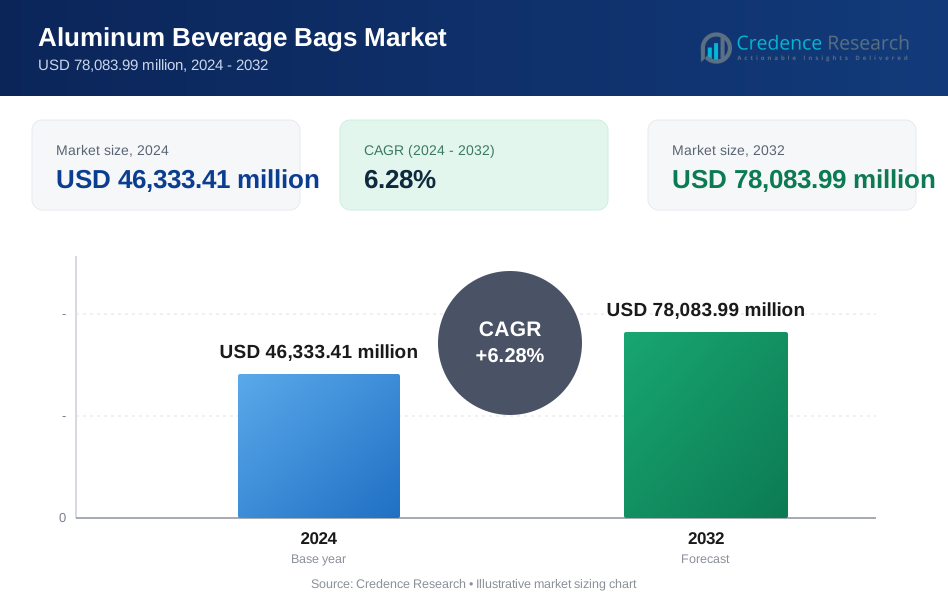
| Aluminum Beverage Bags Market Size 2024 | USD 46,333.41 million |
| Aluminum Beverage Bags Market, CAGR | 6.28% |
| Aluminum Beverage Bags Market Size 2032 | USD 78,083.99 million |
Market Overview:
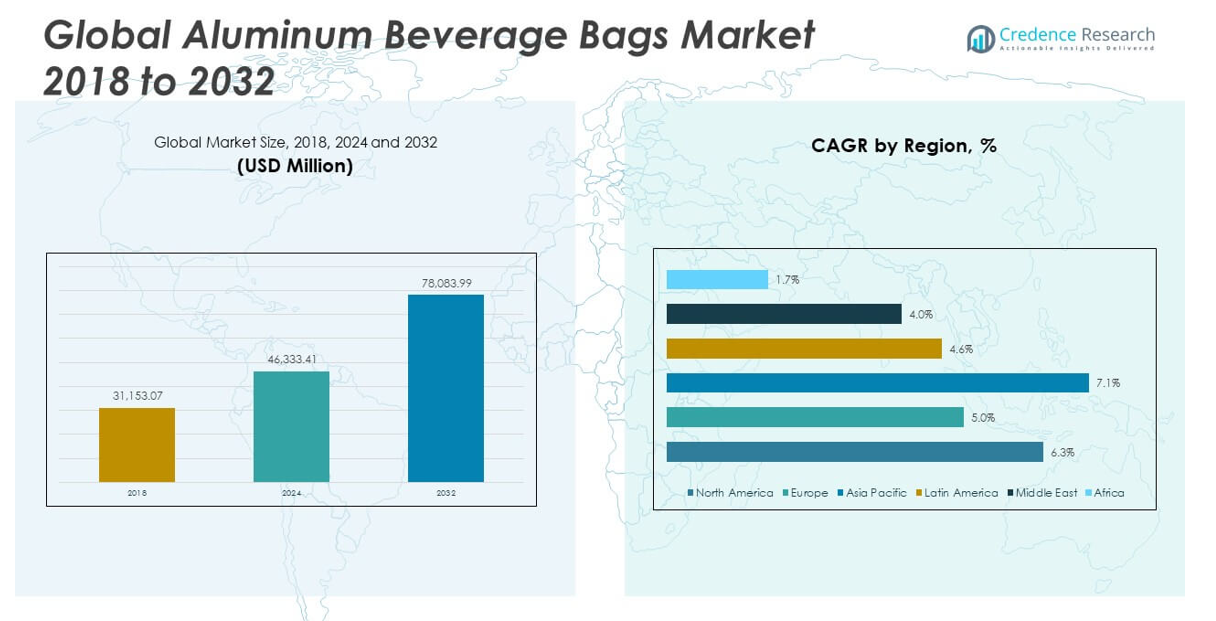
The Global Aluminum Beverage Bags Market size was valued at USD 31,153.07 million in 2018 to USD 46,333.41 million in 2024 and is anticipated to reach USD 78,083.99 million by 2032, at a CAGR of 6.28% during the forecast period.
The aluminum beverage bags market is primarily driven by the convergence of sustainability, convenience, and evolving consumer preferences. As governments and environmental organizations intensify efforts to reduce plastic waste, aluminum packaging has emerged as a viable eco-friendly solution due to its high recyclability and low carbon footprint. Consumer demand for convenience is another critical factor, with modern lifestyles favoring resealable, lightweight, and portable packaging formats that aluminum bags provide. These bags are particularly well-suited for single-serve beverages, functional drinks, and health-based formulations that require extended shelf life and effective barrier protection. Additionally, the rise of e-commerce and home delivery services has further amplified demand for packaging that ensures product integrity during transit, a role aluminum beverage bags fulfill efficiently. Innovations such as spouted pouches and multi-layered laminates continue to enhance functionality, aesthetics, and user convenience.
Regionally, North America leads the global aluminum beverage bags market, driven by robust demand for sustainable packaging, a strong recycling infrastructure, and high adoption in the functional beverage segment. The U.S. and Canada prioritize eco-conscious products, making aluminum bags a preferred alternative to plastic. Europe follows closely, with countries like Germany, France, and the UK enforcing strict packaging waste regulations and promoting aluminum usage due to its circular economy benefits. The region also has a high concentration of beverage producers investing in sustainable packaging formats. Asia Pacific is the fastest-growing region, supported by rapid urbanization, rising disposable income, and expanding beverage consumption in markets such as China, India, Japan, and Southeast Asia. Local manufacturers are scaling production to meet demand for on-the-go, shelf-stable beverages. Meanwhile, Latin America and the Middle East & Africa show steady growth potential, driven by improving retail infrastructure, expanding food and beverage industries, and increased environmental awareness.
Market Insights:
- The market reached USD 46,333.41 million in 2024 and is projected to hit USD 78,083.99 million by 2032, growing at a CAGR of 6.28%.
- Eco-conscious regulations and consumer preference for recyclable materials are pushing brands to adopt aluminum beverage bags over plastic.
- Stand-up pouches dominate due to their balance of aesthetics, portability, and functionality, especially for single-serve and functional drinks.
- Rapid growth in e-commerce and mobile retail is increasing demand for tamper-resistant, lightweight, and durable packaging formats.
- Material innovations like multi-layer laminates, smart closures, and digital printing enhance both product shelf life and branding potential.
- Recycling challenges related to multilayer bag composition and limited infrastructure remain key barriers to large-scale adoption.
- North America leads the market with strong recycling systems, while Asia Pacific emerges as the fastest-growing region due to urbanization and rising beverage consumption.
Market Drivers:
Growing Demand for Sustainable and Recyclable Packaging Solutions is Driving Market Expansion
The Global Aluminum Beverage Bags Market is witnessing strong momentum due to rising demand for eco-friendly packaging across the beverage sector. Governments and regulatory bodies worldwide are implementing strict bans on single-use plastics and encouraging the adoption of recyclable materials. Aluminum bags offer high recyclability, lower carbon footprint, and excellent preservation capabilities, aligning well with circular economy goals. Brands are under increasing pressure to adopt packaging that meets both regulatory and consumer expectations. This shift is especially evident in the packaged beverage segment, where sustainability now influences purchasing decisions. The aluminum beverage bag format provides a practical solution, supporting the transition to low-impact packaging systems.
- For example, Ball Corporation, the world’s largest producer of aluminum packaging, has set a target to increase the recycled material content in its aluminum cans to 85% by 2030
Rise in Single-Serve and Functional Beverages Supports Market Growth
The increasing popularity of single-serve beverages, energy drinks, and functional beverages has elevated the need for compact, high-barrier packaging formats. The Global Aluminum Beverage Bags Market benefits from this trend by offering lightweight and space-efficient alternatives to cans and bottles. These bags maintain product freshness and extend shelf life without the use of preservatives. It is particularly favored by beverage companies launching health-focused and ready-to-consume drinks targeting mobile consumers. With consumer behavior shifting toward convenience and on-the-go consumption, aluminum bags present a practical and hygienic packaging format. The growing penetration of fitness, nutraceutical, and organic beverage categories supports this rising demand.
Advancements in Material Engineering Enhance Product Performance and Versatility
Technological progress in aluminum-based laminates and pouch manufacturing is expanding the functional range of beverage bags. It includes improvements in puncture resistance, thermal stability, and resealable closures, all of which support wider beverage applications. The Global Aluminum Beverage Bags Market is benefiting from these innovations by enabling producers to deliver a superior consumer experience while reducing material usage. High-barrier materials now allow beverage companies to offer products in shelf-stable formats without refrigeration. With the integration of smart printing and product authentication features, packaging has evolved into a key brand engagement tool. The enhancements in structural design and user-friendliness further position aluminum beverage bags as an optimal solution.
- For instance, industrial aluminum foil bags now achieve puncture resistance values up to 50N, compared to the typical market range of 15–30N6. This is accomplished by optimizing multi-layer laminate structures: an outer PET layer for printability and gloss, a middle NY or AL layer for puncture and gas barrier performance, and an inner CPP or PE layer for heat sealing.
Growth of E-Commerce and Mobile Consumption Boosts Packaging Requirements
The rise of e-commerce and mobile retail channels is fueling demand for packaging solutions that ensure durability, lightweight shipping, and product integrity. It aligns with the capabilities of aluminum beverage bags, which protect contents from oxygen, light, and moisture throughout the supply chain. The Global Aluminum Beverage Bags Market is capitalizing on this shift by serving both direct-to-consumer and wholesale beverage formats. Online beverage sales require tamper-proof, resilient packaging that minimizes leakage and breakage risks. It supports these requirements while reducing logistic costs due to its lightweight and collapsible nature. With online platforms becoming key retail channels for beverages, the demand for efficient aluminum packaging continues to grow.
Market Trends:
Shift Toward Premiumization in Beverage Packaging is Creating New Opportunities
Premiumization in the beverage industry is influencing packaging innovation, with brands increasingly adopting upscale, visually distinct packaging formats. The Global Aluminum Beverage Bags Market is witnessing increased demand for aesthetically appealing designs that reflect product quality and brand identity. Luxury beverages, craft cocktails, and gourmet juices are moving toward packaging that offers a premium look while maintaining functionality. Aluminum bags with matte finishes, metallic accents, and custom print options appeal to a consumer base willing to pay more for perceived value. It provides brands the flexibility to experiment with design while maintaining product safety. The combination of high-end appearance and efficient material performance makes aluminum bags a preferred choice in premium segments.
Rising Influence of Digital Printing and Customization on Branding Strategies
Digital printing technology is playing a pivotal role in transforming packaging into a tool for real-time marketing and brand engagement. The Global Aluminum Beverage Bags Market is adopting high-resolution digital printing to support short-run customization, seasonal promotions, and targeted campaigns. Beverage brands are using this capability to respond quickly to market trends and changing consumer preferences. It enables greater personalization, supports regional marketing, and reduces lead time and inventory waste. Enhanced visual clarity and color accuracy improve shelf impact, making products more noticeable in retail environments. The ability to integrate variable data, QR codes, and AR elements is also creating interactive packaging experiences.
Integration of Smart Packaging Technologies is Enhancing Consumer Engagement
Smart packaging features are emerging as a value-added component across beverage categories. The Global Aluminum Beverage Bags Market is increasingly incorporating elements such as NFC tags, freshness indicators, and tamper-evident closures to deliver more than just containment. It supports product authentication, supply chain transparency, and consumer engagement through digital interactions. Beverage brands are using these technologies to provide origin traceability, usage instructions, and loyalty program access. Smart packaging adds an experiential dimension to the purchase, reinforcing brand trust and promoting repeat sales. The adoption of connected packaging reflects the growing alignment of packaging design with digital transformation trends.
- GAO RFID’s NFC tags, for example, provide real-time temperature and freshness tracking, accessible via NFC-enabled devices throughout the supply chain.
Expansion of Alcoholic Beverage Formats is Fueling Demand for Specialized Pouches
The alcohol industry is diversifying its product formats to cater to outdoor events, travel, and convenience-driven consumption. The Global Aluminum Beverage Bags Market is responding to this shift by offering flexible pouches for wine, cocktails, and low-alcohol beverages. It delivers packaging solutions that are lightweight, unbreakable, and easy to dispose of, addressing needs in festivals, picnics, and hospitality sectors. These formats also reduce transportation costs and align with sustainability goals. With regulatory acceptance expanding in many regions, alcohol brands are increasingly trialing aluminum pouch formats. It supports their strategy to differentiate offerings and improve consumer convenience in emerging retail channels.
- For instance, manufacturers like BOWE PACK now offer custom aluminum foil stand-up pouches for alcoholic beverages, with volumes ranging from 100ml to 5L and minimum order quantities as low as 10,000 units. These pouches use PET/AL/PE laminates with thicknesses of 100 microns, providing a perfect barrier against oxygen and moisture, and are available with features like spouts, resealable zippers, and windows for enhanced functionality
Market Challenges Analysis:
Recycling Infrastructure Limitations and Material Separation Issues Are Slowing Market Scalability
The Global Aluminum Beverage Bags Market faces significant challenges related to recycling infrastructure and multilayer material separation. While aluminum is fully recyclable, most beverage bags consist of composite structures combining aluminum foil with plastic or polymer layers. This complex design complicates the recycling process, requiring specialized facilities that are not widely available in many regions. It limits end-of-life recyclability and restricts widespread acceptance by municipal waste systems. Brands adopting aluminum pouches must often rely on take-back programs or niche recyclers, which adds logistical costs and lowers scalability. Consumer confusion about how to properly dispose of these bags further impedes the effectiveness of circular economy goals.
High Production Costs and Supply Chain Pressures Are Affecting Price Competitiveness
The cost of producing aluminum-based beverage bags remains higher than that of traditional plastic packaging, especially when incorporating advanced features such as resealable spouts or custom printing. The Global Aluminum Beverage Bags Market continues to struggle with raw material price fluctuations, particularly in aluminum and specialty adhesives. It also faces disruptions from global supply chain volatility, affecting material sourcing and delivery timelines. These factors impact pricing strategies for both packaging manufacturers and beverage brands, making it harder to compete with lower-cost alternatives in price-sensitive markets. Small and medium beverage producers often hesitate to adopt aluminum bags due to upfront investment requirements. This pricing barrier slows mass-market adoption, particularly in developing economies where cost efficiency remains a top priority.
Market Opportunities:
Expansion of Sustainable Packaging Mandates Across Emerging Markets Opens Growth Avenues
Regulatory shifts across emerging economies are creating new demand for recyclable and low-impact packaging formats. The Global Aluminum Beverage Bags Market stands to benefit as governments implement plastic reduction policies and promote alternative materials. Beverage brands in regions like Asia Pacific, Latin America, and Africa are beginning to align with global sustainability standards, driving interest in aluminum-based solutions. It can offer manufacturers a competitive edge by meeting compliance while supporting brand reputation. Early adoption in these markets presents opportunities for establishing strong regional supply chains and localized production. The push toward extended producer responsibility (EPR) frameworks further strengthens the business case for recyclable formats.
Rising Demand for Travel-Friendly and Outdoor Beverage Formats Presents Untapped Segments
Changes in consumer behavior are expanding the demand for portable, lightweight beverage packaging suited for outdoor activities, tourism, and e-commerce delivery. The Global Aluminum Beverage Bags Market can address this need by offering flexible pouches that reduce breakage risks and simplify transport. It provides convenience without sacrificing product safety or freshness. Markets for ready-to-drink cocktails, infused waters, and specialty beverages remain underpenetrated in this format. Brands targeting niche audiences such as hikers, campers, and festival-goers can use aluminum bags to differentiate and gain loyalty. These untapped segments offer profitable opportunities for both established players and new entrants.
Market Segmentation Analysis:
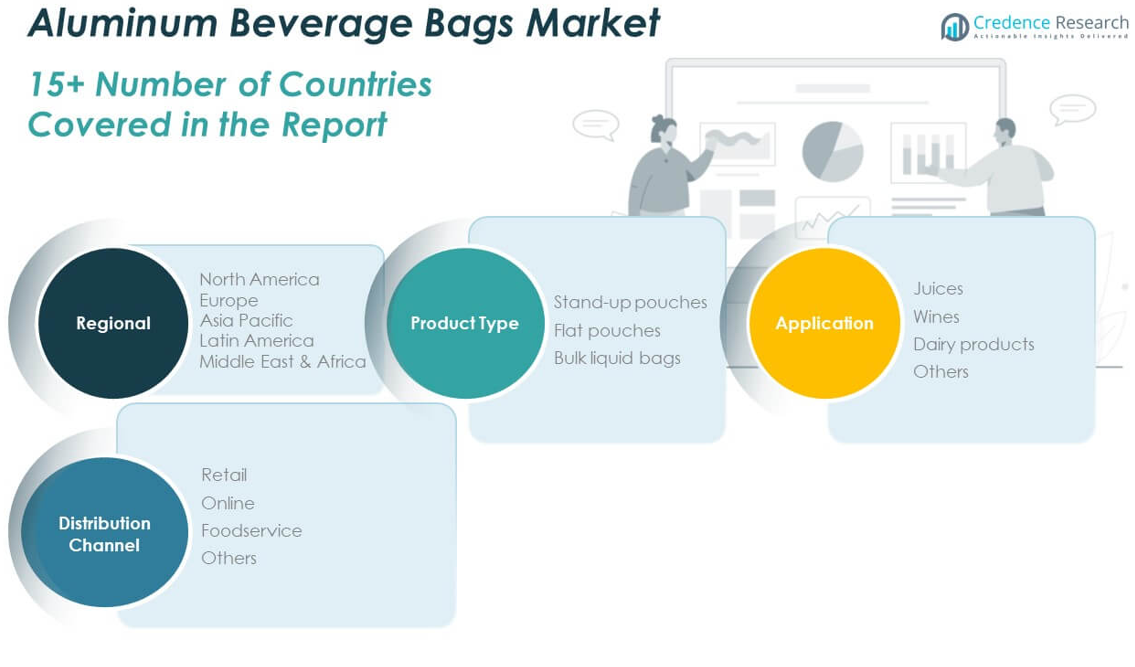
The Global Aluminum Beverage Bags Market is segmented by product type, application, and distribution channel, reflecting a diverse range of end-user needs and packaging formats.
By product type, stand-up pouches dominate the segment due to their superior shelf appeal, stability, and consumer convenience. Flat pouches serve as compact, cost-effective solutions for single-use packaging, while bulk liquid bags cater to industrial and foodservice applications requiring high-volume storage and transport.
- For example, Amcor produces flat pouches designed for compact, cost-effective single-use packaging. These are commonly used for single-serve beverages and health supplements, as highlighted in Amcor’s product brochures and innovation reports.
By application, juices lead the segment, driven by demand for lightweight, portable packaging in the health and wellness beverage space. Wines are increasingly shifting toward aluminum bags, especially for outdoor and travel-friendly formats. Dairy products use these bags for extended shelf life and hygiene, while the "others" category includes energy drinks, flavored waters, and alcoholic ready-to-drink products.
- For example, SIG Combibloc supplies aluminum-based aseptic beverage bags for dairy products, offering extended shelf life and hygiene through advanced barrier protection, as detailed in their product information and aseptic packaging reports.
By distribution channel, retail remains the largest segment due to its broad consumer reach. Online sales are growing rapidly, supported by e-commerce expansion and direct-to-consumer beverage brands. Foodservice utilizes bulk and portion-controlled pouches to streamline operations. It meets varying channel needs with flexible, efficient packaging.
Segmentation:
By Product Type
- Stand-up Pouches
- Flat Pouches
- Bulk Liquid Bags
By Application
- Juices
- Wines
- Dairy Products
- Others
By Distribution Channel
- Retail
- Online
- Foodservice
- Others
By Region
- North America
- U.S.
- Canada
- Mexico
- Europe
- Germany
- France
- U.K.
- Italy
- Spain
- Rest of Europe
- Asia Pacific
- China
- Japan
- India
- South Korea
- South-east Asia
- Rest of Asia Pacific
- Latin America
- Brazil
- Argentina
- Rest of Latin America
- Middle East & Africa
- GCC Countries
- South Africa
- Rest of the Middle East and Africa
Regional Analysis:
The North America Aluminum Beverage Bags Market size was valued at USD 9,854.96 million in 2018 to USD 14,446.99 million in 2024 and is anticipated to reach USD 24,440.68 million by 2032, at a CAGR of 6.3% during the forecast period. North America holds a 27% share of the Global Aluminum Beverage Bags Market and leads in terms of innovation, consumer awareness, and sustainability adoption. It benefits from a well-developed recycling infrastructure and high demand for eco-conscious beverage packaging. Beverage producers in the U.S. and Canada are actively shifting to aluminum pouches to align with evolving environmental regulations and consumer expectations. It supports demand from functional beverage, ready-to-drink, and alcohol segments with durable, lightweight formats. Growth is also supported by private label expansion and advanced customization in digital packaging. Market players are leveraging innovation in closures and formats to meet diverse retail and e-commerce requirements.
The Europe Aluminum Beverage Bags Market size was valued at USD 5,742.76 million in 2018 to USD 8,067.23 million in 2024 and is anticipated to reach USD 12,346.07 million by 2032, at a CAGR of 5.0% during the forecast period. Europe accounts for 15% of the Global Aluminum Beverage Bags Market and maintains a strong position due to stringent packaging waste regulations and increasing demand for recyclable solutions. Countries like Germany, France, and the UK continue to promote aluminum as a sustainable packaging alternative. It aligns with the European Green Deal and Extended Producer Responsibility directives aimed at reducing plastic waste. Beverage companies are adopting aluminum pouches to meet carbon reduction goals and circular economy targets. Growth is supported by consumer preference for portable, resealable formats in health and wellness beverage categories. Regional manufacturers are investing in local production capabilities to meet rising demand and reduce dependency on imports.
The Asia Pacific Aluminum Beverage Bags Market size was valued at USD 12,939.12 million in 2018 to USD 19,991.71 million in 2024 and is anticipated to reach USD 35,849.53 million by 2032, at a CAGR of 7.1% during the forecast period. Asia Pacific holds the largest share in the Global Aluminum Beverage Bags Market at 38% and represents the fastest-growing region. Urbanization, rising disposable incomes, and increased consumption of packaged beverages are driving strong market demand. China, India, and Japan are leading markets for both domestic consumption and export-oriented production. It benefits from government-led initiatives to reduce plastic dependency and encourage sustainable packaging solutions. Local beverage brands are rapidly adopting aluminum bags in both premium and value segments. The expansion of online retail and food delivery services further supports the shift toward lightweight, flexible packaging.
The Latin America Aluminum Beverage Bags Market size was valued at USD 1,443.63 million in 2018 to USD 2,119.88 million in 2024 and is anticipated to reach USD 3,154.03 million by 2032, at a CAGR of 4.6% during the forecast period. Latin America represents 4% of the Global Aluminum Beverage Bags Market and is gradually expanding as sustainability awareness rises across the region. Brazil, Mexico, and Argentina are the primary markets adopting aluminum pouches in juice, flavored water, and alcoholic beverages. It supports outdoor consumption trends and is gaining popularity in convenience stores and travel retail. Rising investment in food and beverage processing infrastructure is improving the regional supply chain. Brands are exploring resealable, low-leakage pouch formats to meet regional distribution challenges. Market adoption remains price-sensitive but shows strong potential with continued policy support and packaging innovation.
The Middle East Aluminum Beverage Bags Market size was valued at USD 851.72 million in 2018 to USD 1,155.25 million in 2024 and is anticipated to reach USD 1,634.57 million by 2032, at a CAGR of 4.0% during the forecast period. The Middle East holds 3% of the Global Aluminum Beverage Bags Market, supported by growing demand for premium beverages and sustainable packaging alternatives. The UAE and Saudi Arabia lead the region in modern retail development and consumer engagement with eco-conscious products. It is gaining traction in the health drink and hydration categories as brands seek flexible solutions for arid climates. Beverage manufacturers are also adopting aluminum bags for tourism-driven product lines and on-the-go offerings. Rising imports of premium beverage products are influencing local packaging standards. Regional players are beginning to adopt automated pouching systems to improve production efficiency.
The Africa Aluminum Beverage Bags Market size was valued at USD 320.88 million in 2018 to USD 552.34 million in 2024 and is anticipated to reach USD 659.11 million by 2032, at a CAGR of 1.7% during the forecast period. Africa holds 1% of the Global Aluminum Beverage Bags Market and remains in the early stages of adoption. The market is concentrated in South Africa, Kenya, and Nigeria, where modern trade formats and middle-class expansion are gaining ground. It sees growing use in locally produced fruit juices, energy drinks, and dairy-based beverages. Limited recycling infrastructure and high packaging costs continue to challenge widespread adoption. However, rising awareness of plastic waste and international brand presence are influencing positive shifts in packaging preferences. Small-scale beverage producers are exploring aluminum bags for urban markets due to their lightweight and tamper-resistant features.
Key Player Analysis:
- Amcor
- Mondi Group
- Tetra Pak
- Ball Corporation
- Crown Holdings
- Berry Global Inc.
- BlueTriton Brands Inc.
- Scholle IPN
- Smurfit Kappa
- Sealed Air
- Clondalkin Group
- Flex Pack
Competitive Analysis:
The Global Aluminum Beverage Bags Market features a moderately fragmented competitive landscape, with key players focusing on innovation, sustainability, and regional expansion. Leading companies are investing in advanced laminates, resealable closures, and digital printing technologies to enhance product performance and visual appeal. It continues to attract new entrants offering niche solutions for premium, functional, and ready-to-drink beverages. Established players are forming strategic partnerships with beverage brands to secure long-term supply contracts and expand their footprint in emerging markets. Competition is intensifying as demand for lightweight, recyclable packaging grows across both developed and developing regions. Price sensitivity in some markets encourages manufacturers to streamline operations and explore local sourcing strategies. The market favors companies that can offer custom packaging formats, rapid turnaround, and regulatory compliance, making innovation and agility critical success factors.
Recent Developments:
- In June 2025, Amcorhas been highly active. it launched a first-of-its-kind, more sustainable shrink bag for Butterball, LLC, marking a significant step towards responsible packaging solutions.
- In June 2025, Tetra Pak showcased its Tetra Prisma® Aseptic, Tetra Recart®, and Tetra Fino® Aseptic packaging solutions at the NaturalTech 2025 event.
- In July 2025, Mondi launched the re/cycle PaperPlus Bag Advanced, a sustainable paper bag with a high-performance barrier film designed to protect moisture-sensitive products while reducing plastic content by up to 60% compared to traditional bags.
Market Concentration & Characteristics:
The Global Aluminum Beverage Bags Market exhibits moderate concentration, with a mix of global packaging giants and specialized regional players. It is characterized by a strong emphasis on innovation, sustainability, and customization. Companies differentiate through proprietary laminates, closure technologies, and design capabilities that cater to evolving beverage trends. The market shows high demand elasticity in emerging economies, where pricing and material availability influence adoption. It supports diverse end-use segments, including health drinks, alcoholic beverages, and energy drinks, which require flexible, lightweight, and tamper-resistant packaging. Regulatory compliance and recyclability standards shape product development and influence purchasing decisions.
Report Coverage:
The research report offers an in-depth analysis based on product type, application, and distribution channel. It details leading market players, providing an overview of their business, product offerings, investments, revenue streams, and key applications. Additionally, the report includes insights into the competitive environment, SWOT analysis, current market trends, as well as the primary drivers and constraints. Furthermore, it discusses various factors that have driven market expansion in recent years. The report also explores market dynamics, regulatory scenarios, and technological advancements that are shaping the industry. It assesses the impact of external factors and global economic changes on market growth. Lastly, it provides strategic recommendations for new entrants and established companies to navigate the complexities of the market.
Future Outlook:
- Demand for recyclable and lightweight beverage packaging will accelerate due to stricter environmental regulations.
- Single-serve and ready-to-drink beverage categories will continue to drive adoption across global markets.
- Advances in digital printing and customization will enhance brand visibility and consumer engagement.
- E-commerce growth will increase the need for durable, tamper-resistant packaging solutions.
- Asia Pacific will maintain its lead in volume growth, supported by urbanization and rising disposable incomes.
- Innovations in mono-material laminates will improve recyclability and regulatory compliance.
- Strategic partnerships between packaging firms and beverage brands will shape competitive dynamics.
- Alcoholic and functional beverage segments will expand use of aluminum bags for portability and safety.
- Automation and localized production will reduce costs and improve supply chain efficiency.
- Consumer preference for sustainable and premium packaging formats will influence long-term product development.
Request a Free Sample
Fill in your details and we'll send you a free sample report.
- Sample data tables & charts
- Research methodology
Need a Custom Version of This Report?
Tailor the scope, geography, or segments to your exact requirements.
- Custom geography or segment scope
- Direct access to our analyst team
Frequently Asked Questions
What is the current size of the Global Aluminum Beverage Bags Market?
What are the key segments within the Global Aluminum Beverage Bags Market?
What are some challenges faced by the Global Aluminum Beverage Bags Market?
Who are the major players in the Global Aluminum Beverage Bags Market?
Table of Content
Chapter 1. Report Introduction
- 1.1 Report Description & Purpose
- 1.1.1 Report Title & Market Definition
- 1.1.2 Unique Selling Propositions (USP) & Key Differentiators
- 1.1.3 Value Proposition for Stakeholders
- 1.2 Research Objectives
- 1.2.1 Market Sizing Objectives (Volume & Revenue)
- 1.2.2 Segmentation Objectives
- 1.2.3 Competitive Intelligence Objectives
- 1.2.4 Forecast & Scenario Objectives
- 1.3 Report Scope
- 1.3.1 Aluminum Beverage Bags Scope – Types & Subtypes Covered
- 1.3.2 Geographic Scope – Regions & Countries Covered
- 1.3.3 Historical Period, Base Year & Forecast Period (2024; forecast to 2032)
- 1.3.4 Inclusions & Exclusions
- 1.4 HS Code & Classification Framework
- 1.5 Currency, Units & Pricing Basis
- 1.6 Target Stakeholders
- 1.7 Limitations & Assumptions
Chapter 2. Executive Summary
- 2.1 Global Aluminum Beverage Bags Market Snapshot
- 2.1.1 Market Size – Historical (2024) & Forecast (2024-2032) (2024: USD 46,333.41 million → 2032: USD 78,083.99 million)
- 2.1.2 Volume & Revenue – Global Totals
- 2.1.3 Key Market Highlights – Top Five Facts
- 2.2 Aluminum Beverage Bags Market Segmentation Snapshot
- 2.2.1 Market Split by Region – 2024 vs. 2032
- 2.3 Competitive Snapshot
- 2.3.1 Top 10 Players by Revenue Share – 2024
- 2.3.2 Top 10 Players by Volume Share – 2024
- 2.3.3 Recent Strategic Developments (18-Month Summary)
- 2.4 Key Investment Highlights & Strategic Conclusions
Chapter 3. Aluminum Beverage Bags Market Dynamics & Industry Analysis
- 3.1 Market Overview & Context
- 3.1.1 Aluminum Beverage Bags Market Position in the Broader Automotive Value Chain
- 3.1.2 OEM vs. Replacement Market Dynamics
- 3.1.3 Market Maturity & Development Stage by Region
- 3.2 Aluminum Beverage Bags Market Drivers
- 3.3 Aluminum Beverage Bags Market Restraints & Challenges
- 3.4 Aluminum Beverage Bags Market Opportunities
- 3.5 Porter's Five Forces Analysis
- 3.5.1 Threat of New Entrants
- 3.5.2 Bargaining Power of Suppliers
- 3.5.3 Bargaining Power of Buyers
- 3.5.4 Threat of Substitutes
- 3.5.5 Competitive Rivalry – Intensity Assessment
- 3.6 Aluminum Beverage Bags Value Chain Analysis
- 3.6.1 Upstream – Raw Material/Input Suppliers
- 3.6.1.1 Raw Material/Input 1
- 3.6.1.2 Raw Material/Input 2
- 3.6.1.3 Raw Material/Input 3
- 3.6.2 Midstream – Production/Manufacturing/Service Delivery
- 3.6.2.1 Production/Process Overview
- 3.6.2.2 Key Facility Locations & Capacity by Manufacturer
- 3.6.3 Downstream – Distribution & End Consumer
- 3.6.3.1 Primary Channel – B2B/OEM
- 3.6.3.2 Secondary Channels – Dealer, Retail, Online, Direct
- 3.6.4 Value Chain Profitability Analysis
- 3.6.1 Upstream – Raw Material/Input Suppliers
- 3.7 PESTEL Analysis
- 3.7.1 Political Factors
- 3.7.2 Economic Factors
- 3.7.3 Social Factors
- 3.7.4 Technological Factors
- 3.7.5 Environmental Factors
- 3.7.6 Legal Factors
- 3.8 Aluminum Beverage Bags Supply Chain Analysis
- 3.8.1 Raw Material/Input Supply Risk Assessment
- 3.8.2 Manufacturing Concentration Risk (Geographic Exposure)
- 3.8.3 Trade Disruption Impact Analysis
- 3.9 Regulatory & Policy Landscape
Note: The regulatory and policy landscape section covers regulations based on their applicability to the market, Aluminum Beverage Bags category, geography, and scope of the study. Only regulatory frameworks with a material impact on operations, compliance, trade, sustainability, or market access are analyzed in detail.
Chapter 4. Key Investment Pockets & Opportunity Analysis
- 4.1 Aluminum Beverage Bags Market Attractiveness Analysis
- 4.1.1 By Region – Investment Attractiveness Matrix (Volume × CAGR)
- 4.2 Absolute Revenue Growth Opportunity
- 4.2.1 By Region – Absolute USD Growth Through 2032
- 4.3 Incremental Volume Opportunity
- 4.3.1 By Region – Incremental Volume Through 2032
- 4.3.2 Segment – Incremental Volume
- 4.4 Emerging Submarket Opportunity Deep Dive (Subject to Applicability)
- 4.5 Emerging Market Opportunity Scorecards
- 4.5.1 United States
- 4.5.2 Europe
- 4.5.3 Asia
- 4.5.4 Middle East & Africa
Note: Emerging Market Opportunity Scorecards will be included based on relevance and strategic importance. Regions listed are indicative and may vary depending on data availability and market dynamics.
Chapter 5. Aluminum Beverage Bags Import-Export Analysis & Trade Flows
- 5.1 Global Trade Overview
- 5.1.1 Global Export Value by Country (2024)
- 5.1.2 Global Export Volume by Country (2024)
- 5.1.3 Global Import Value by Country (2024)
- 5.1.4 Global Import Volume by Country (2024)
- 5.1.5 Net Trade Balance by Country (2024)
- 5.2 Export Analysis – Segment
- 5.2.1 Type 1 (HS Code)
- 5.2.2 Type 2 (HS Code)
- 5.2.3 Type 3 (HS Code)
- 5.2.4 Type 4 (HS Code)
- 5.2.5 Type 5 (HS Code)
- 5.3 Import Analysis – Segment
- 5.3.1 Type 1 (HS Code)
- 5.3.2 Type 2 (HS Code)
- 5.3.3 Type 3 (HS Code)
- 5.3.4 Type 4 (HS Code)
- 5.3.5 Type 5 (HS Code)
- 5.4 Average Unit Trade Prices
- 5.4.1 Average Export Price – Segment & Country
- 5.4.2 Average Import Price – Segment & Source Country
- 5.4.3 Price Trends (2024)
- 5.5 Key Trade Route Analysis
- 5.5.1 Trade Route 1
- 5.5.2 Trade Route 2
- 5.5.3 Trade Route 3
- 5.5.4 Trade Route 4
- 5.5.5 Trade Route 5
- 5.6 Trade Policy Impact Assessment
- 5.6.1 US Anti-Dumping & Section 301 Tariffs
- 5.6.2 EU Customs Union Impact
- 5.6.3 Major Free Trade Agreements
- 5.6.4 USMCA Rules of Origin
Note: Trade policy analysis will be included only where relevant to the Aluminum Beverage Bags market.
Chapter 6. Competitive Landscape & Company Benchmarking
- 6.1 Aluminum Beverage Bags Market Concentration & Structure
- 6.1.1 Herfindahl-Hirschman Index (HHI) – vs. 2024
- 6.1.2 Tier 1, Tier 2 & Tier 3 Market Structure
- 6.1.3 Global, Regional & Local Player Dynamics
- 6.2 Aluminum Beverage Bags Market Share Analysis – 2024
- 6.2.1 Global Revenue Share by Company
- 6.2.2 Global Volume Share by Company
- 6.2.3 Regional Revenue Share
- 6.2.4 Market Share Evolution ( vs. 2024)
- 6.2.5 OEM Segment Share by Company
- 6.2.6 Replacement Segment Share by Company
- 6.3 Production/Delivery Capacity & Facility Analysis
- 6.3.1 Global Installed Capacity
- 6.3.2 Capacity Utilization Rates
- 6.3.3 Production/Output Volume
- 6.3.4 Facility Locations & Capacity Map
- 6.3.5 Planned Capacity Additions
- 6.4 Aluminum Beverage Bags Competitive Benchmarking Matrix
- 6.4.1 Revenue, Volume, CAGR & Profitability Comparison
- 6.4.2 Channel Revenue Mix
- 6.4.3 Geographic Revenue Exposure
- 6.4.4 R&D Intensity
- 6.4.5 Sustainability Maturity
- 6.5 Strategic Developments in Aluminum Beverage Bags (Last 24 Months)
- 6.5.1 Mergers, Acquisitions & Divestments
- 6.5.2 New Aluminum Beverage Bags Launches
- 6.5.3 Facility Expansions
- 6.5.4 Strategic Alliances, Joint Ventures & Partnerships
- 6.5.5 Distribution Expansion & Market Entry
- 6.5.6 Sustainability & ESG Initiatives
- 6.6 Competitive Strategy Mapping
- 6.6.1 Leader, Challenger, Follower & Niche Classification
- 6.6.2 Pricing Strategy Comparison
- 6.6.3 Channel Strategy Matrix
Note: Strategic developments are included based on their materiality and the availability of reliable information.
Chapter 7. Global Aluminum Beverage Bags Market – By Distribution Channel
- 7.1 Segment Overview
- 7.1.1 Volume & Revenue Split by Channel (2024 & 2032)
- 7.1.2 Channel Mix Evolution (2024-2032)
Chapter 8. Regional Market Analysis – Global Overview
- 8.1 Global Regional Overview
- 8.1.1 Regional Volume Share
- 8.1.2 Regional Revenue Share
- 8.1.3 Regional Volume by Region
- 8.1.4 Regional Revenue by Region
- 8.1.5 Regional Forecast Through 2032
- 8.2 Cross-Regional Segment Analysis
- 8.2.1 By Distribution Channel
- 8.2.2 By Brand/Price Tier
Chapter 9. North America Aluminum Beverage Bags Market
- 9.1 United States
- 9.2 Canada
- 9.3 Mexico
Chapter 10. Europe Aluminum Beverage Bags Market
- 10.1 Germany
- 10.2 France
- 10.3 Italy
- 10.4 United Kingdom
- 10.5 Spain
- 10.6 Poland
- 10.7 Russia
- 10.8 Netherlands
- 10.9 Belgium
- 10.10 Sweden
- 10.11 Denmark
- 10.12 Norway
- 10.13 Rest of Europe
Chapter 11. Asia Pacific Aluminum Beverage Bags Market
- 11.1 China
- 11.2 India
- 11.3 Japan
- 11.4 South Korea
- 11.5 Thailand
- 11.6 Indonesia
- 11.7 Vietnam
- 11.8 Malaysia
- 11.9 Australia
- 11.10 Rest of Asia Pacific
Chapter 12. Latin America Aluminum Beverage Bags Market
- 12.1 Brazil
- 12.2 Argentina
- 12.3 Colombia
- 12.4 Chile
- 12.5 Rest of Latin America
Chapter 13. Middle East Aluminum Beverage Bags Market
- 13.1 Saudi Arabia
- 13.2 United Arab Emirates
- 13.3 Turkey
- 13.4 Israel
- 13.5 Iran
- 13.6 Rest of the Middle East
Chapter 14. Africa Aluminum Beverage Bags Market
- 14.1 South Africa
- 14.2 Egypt
- 14.3 Nigeria
- 14.4 Morocco
- 14.5 Rest of Africa
Chapter 15. Aluminum Beverage Bags Company Profiles
- 15.1 [Company 01]
- 15.1.1 Company Overview
- 15.1.2 Key Management Personnel
- 15.1.3 Products & Services Portfolio
- 15.1.4 Financial Performance
- 15.1.5 Key Market Focus & Geographic Presence
- 15.1.6 Recent Developments & Strategic Initiatives
Note: The company profile list is preliminary and may change based on research findings, market developments, data availability, and client requirements.
Chapter 16. Appendices
- Appendix A – List of Abbreviations & Acronyms
- Appendix B – Industry Classification Code Reference – Full Series
- Appendix C – Production & Capacity Data Tables
- Appendix D – End-Use & Demand Base Tables
- Appendix E – Consumption & Replacement Rate Assumptions
- Appendix F – ASP Reference Tables
- Appendix G – Manufacturing & Facility Database
- Appendix H – Import-Export Data Tables
- Appendix I – Regulatory Summary Tables
- Appendix J – Primary Research Participant List (Anonymized)
- Appendix K – Primary Research Questionnaire Framework
- Appendix L – Data Sources & Bibliography
- Appendix M – Market Size Divergence & Source Comparison
Chapter 17. Research Methodology
- 17.1 Research Framework & Philosophy
- 17.2 Secondary Research – Sources, Hierarchy & Data Extraction
- 17.3 Data Modeling – Bottom-Up & Top-Down Market Sizing
- 17.4 Primary Research – Stakeholder Framework, LOI & Sample Sizes
- 17.5 Forecast Methodology – Regression, Scenario & Sensitivity Analysis
- 17.6 Quality Control – Four-Layer Validation Framework
- 17.7 Limitations & Standard Assumptions
- 17.8 Disclaimer
