
K-character Market Overview:
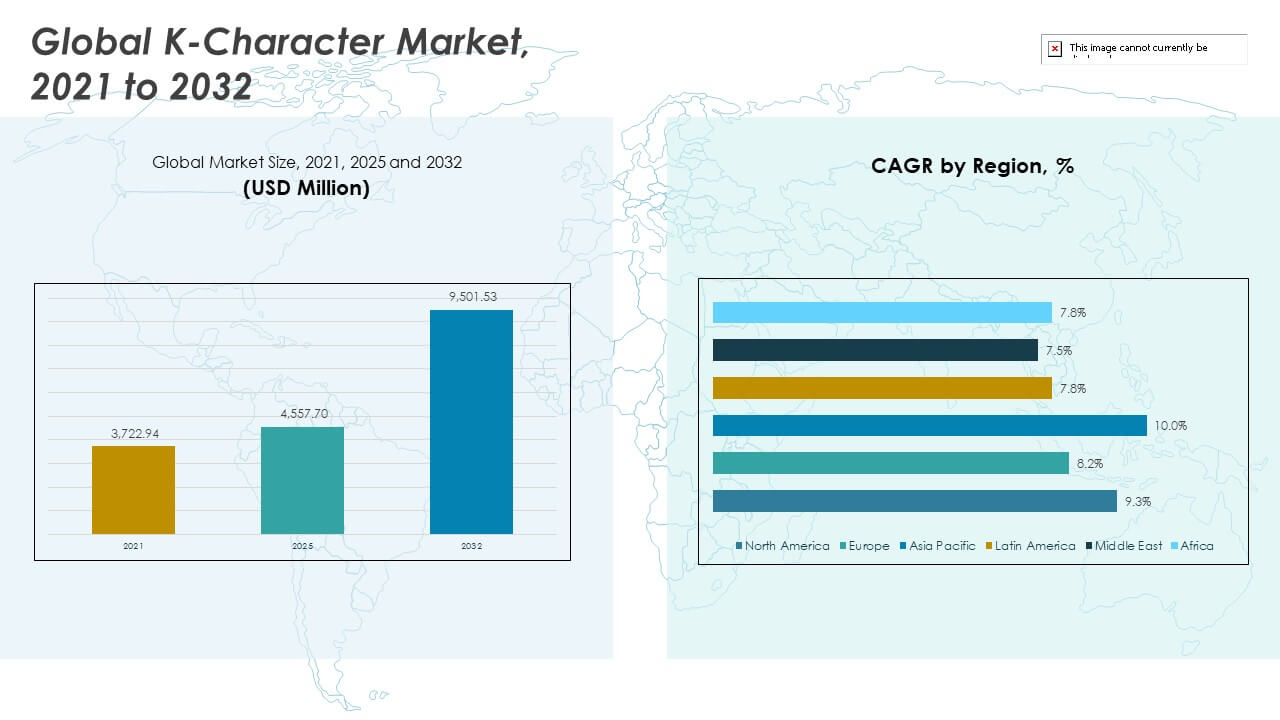
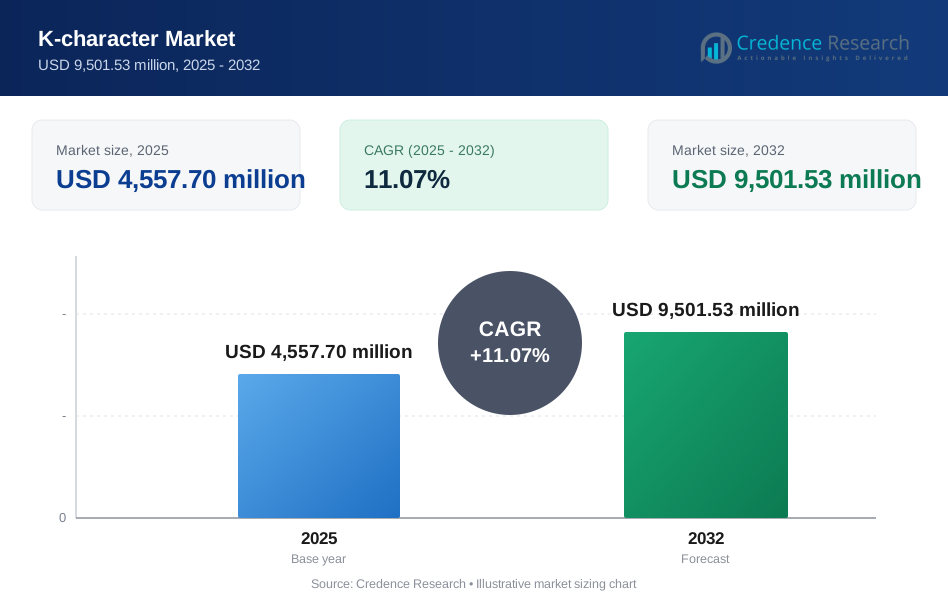
The global K-character market size was valued at USD 3,722.94 million in 2021 and reached USD 4,557.70 million in 2025. According to Credence Research it is anticipated to reach USD 9,501.53 million by 2032, growing at a CAGR of 11.07% from 2025 to 2032. This growth is supported by the expanding commercialization of Korean character intellectual property across digital emoticons, social media, gaming, consumer merchandise, retail, and licensing partnerships. In particular, digital platforms are creating new channels for character discovery and monetization; the Korea Creative Content Agency (KOCCA) identifies the Korean emoticon market as a new distribution and expansion route for the K-character industry.
| REPORT ATTRIBUTE | DETAILS |
|---|---|
| Historical Period | 2021-2024 |
| Base Year | 2025 |
| Forecast Period | 2025-2032 |
| K-character Market Size 2025 | USD 4,557.70 million |
| K-character Market, CAGR | 11.07% |
| K-character Market Size 2032 | USD 9,501.53 million |
K-character Market Insights
- Market growth is supported by global expansion of Korean character intellectual property, webtoon-led storytelling, animation exports, mobile character use, gaming IP and merchandise licensing.
- Animation Characters hold a strong position because Korean studios continue to build children’s franchises, digital series and licensed character ecosystems across toys, apparel and digital content.
- Online Retail is gaining strong traction as global fans buy toys, collectibles, apparel, stationery and lifestyle products through cross-border e-commerce platforms.
- Asia Pacific is projected to record the fastest regional CAGR at 10.0%, supported by strong Korean Wave influence, mature character retail networks, mobile culture and licensing activity.
K-character Market Segment Insights
By character origin
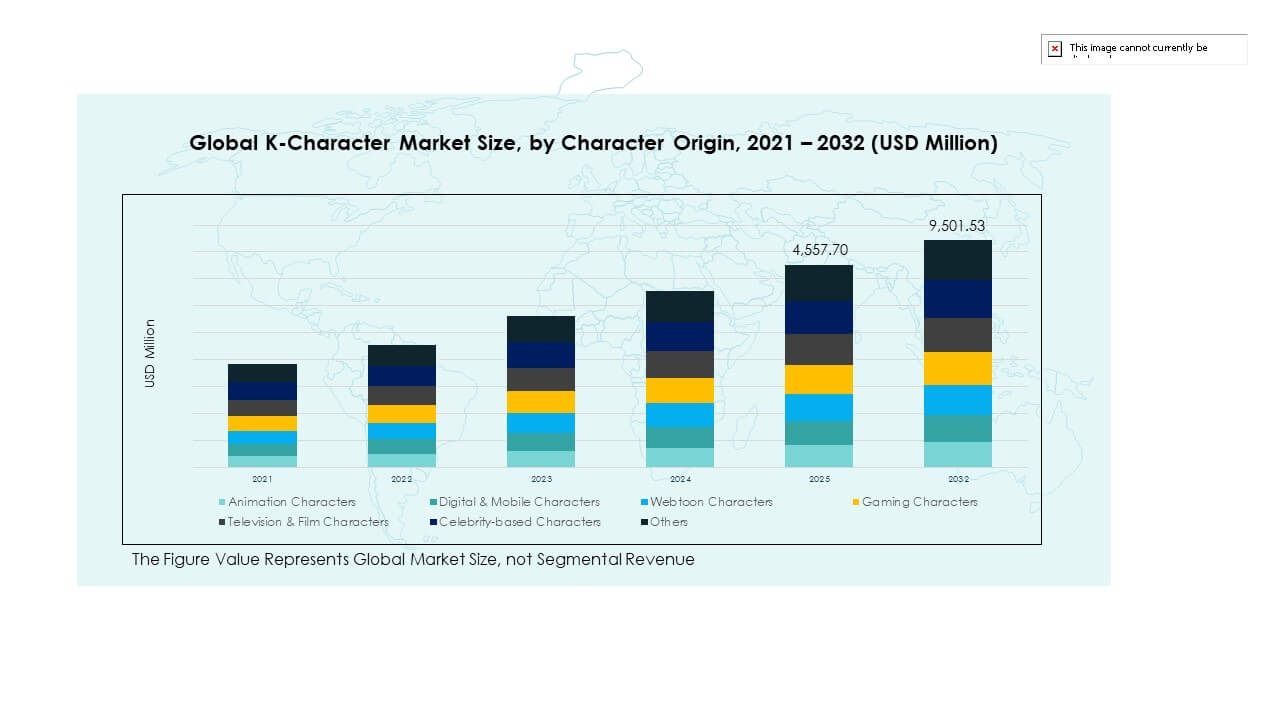
By character origin, Animation Characters held a strong position in 2025, supported by children’s entertainment franchises, preschool content, streaming distribution and licensing across toys and consumer products. Digital and Mobile Characters also gained strong traction because messaging platforms, stickers, avatars and mobile-first communities make character engagement part of daily communication. Webtoon Characters are becoming more valuable as webtoon IP moves into dramas, games, merchandise and digital collectibles. Gaming Characters support strong monetization through in-game items, collaborations, apparel and collectibles. Television and Film Characters, Celebrity-Based Characters and Others add diversification as entertainment companies convert popular content and talent-linked IP into wider commercial products.
By product application
By product application, Toys and Collectibles held a strong position in 2025 because K-character brands appeal to children, collectors and global fandom communities. Apparel and Accessories represent a major application area as character IP supports fashion collaborations, casualwear, bags, footwear and fan merchandise. Stationery remains relevant in school, office and gifting channels, particularly across Asia Pacific markets. Home and Lifestyle Products are gaining demand as character brands move into home décor, kitchenware, bedding and wellness-linked products. Digital Content is expected to grow quickly as characters expand into apps, games, virtual items, digital stickers and online fan engagement. Others include food collaborations, event products and themed experiences.
By distribution channel
By distribution channel, Online Retail held a strong position in 2025 because it allows character IP owners and licensed merchants to reach global fans without depending only on physical stores. Character Specialty Stores remain important for immersive brand experience, exclusive products and fan engagement. Brand-Owned Stores support stronger margin control and deeper customer relationships for leading IP owners. Pop-Up Stores are becoming a major promotional tool because they create scarcity, social media visibility and event-based purchases. Other channels include department stores, bookstores, toy stores, convenience stores and entertainment venues. Channel growth will depend on IP strength, product variety, logistics reach and local fandom density.
Key market drivers
Korean Wave-driven Character IP Exports
The Korean Wave is accelerating the global reach of K-character intellectual property by linking familiar characters with music, dramas, animation, games, webtoons, films and social platforms. As international audiences develop stronger affinity for Korean storytelling and celebrity culture, they increasingly seek licensed collectibles, apparel, digital stickers, lifestyle goods and immersive brand experiences connected to those narratives. This cultural connection enables character owners to extend a single identity across content, merchandise, retail partnerships and online fan communities, creating durable monetization opportunities beyond initial media consumption.
Export success will depend on localized licensing, culturally relevant product design, reliable rights management and partnerships with overseas retailers and digital platforms. Government-backed export activity demonstrates tangible commercial demand: ten Korean character IP companies participating in the Shenzhen International Licensing Expo completed 148 export consultations and secured 16.71 million US dollars in sales opportunities. Consequently, Korean Wave visibility is likely to remain an essential channel for taking domestic character franchises into international consumer markets through 2032.
Webtoon and Digital-native IP Expansion
Webtoons and other digital-native formats are expanding the K-character market by establishing audience attachment to stories and personalities before physical merchandise enters stores. Mobile-first storytelling lets creators test characters rapidly, observe reader engagement and develop communities that can later support animation, live-action productions, games, collectibles, apparel and branded digital assets. This route lowers reliance on conventional television distribution while allowing intellectual-property owners to introduce franchises internationally through accessible apps and social media.
Character stickers, avatars and short-form content further maintain daily interaction, helping individual characters remain visible between major content releases. The commercial depth of this ecosystem is evidenced by the Korean webtoon industry generating 2.2856 trillion won in 2024, according to the Ministry of Culture, Sports and Tourism and the Korea Creative Content Agency. For K-character companies, digital discovery can therefore serve as an early-stage licensing engine, turning engaged readers into purchasers and allowing successful properties to move efficiently across multiple entertainment and consumer-product categories.
Merchandise and Licensing Ecosystem Growth
Merchandise and licensing are strengthening the K-character market by allowing intellectual-property owners to extend popular identities into toys, collectibles, apparel, accessories, stationery, homewares, food collaborations and digital products. Rather than relying only on content-viewing revenue, owners can work with specialist manufacturers, retailers and regional distributors to build broader consumer touchpoints while retaining control over brand standards and approvals. This approach is particularly effective as younger fans treat character goods as personal lifestyle signals, supporting premium collaborations, limited editions and products designed for adult collectors as well as children.
Stronger rights management, product development capabilities and retail data will determine which companies capture the greatest long-term value from each franchise. Retail evidence shows the scale of this opportunity: CU expanded its character product range from about 50 items in 2021 to roughly 370 items, while its Ganadi series surpassed 4 million units sold. As brands build coordinated licensing portfolios, K-character merchandise can become a recurring revenue stream that sustains relevance long after a show, game or webtoon release.
Pop-up Retail and Fan Experience Demand
Pop-up stores, exhibitions and temporary themed activations are becoming important growth channels for K-character brands because they combine limited-edition buying with community participation and social-media visibility. These formats help IP owners test demand in new locations, collect direct feedback, build anticipation for launches and convert online fandom into physical retail traffic. Interactive displays, exclusive merchandise, photo zones and event programming can make specialty stores and brand-owned outlets feel like extensions of a character universe rather than conventional sales spaces. This is especially valuable for digital-native, virtual-idol and entertainment-linked properties whose audiences respond strongly to scarcity, collectability and shareable experiences.
The Hyundai Seoul illustrates the commercial potential, with pop-ups featuring Isegye Idol, StelLive and PLAVE attracting more than 100,000 visitors and generating sales above 7 billion won. As consumer attention becomes more fragmented, experiential retail will help K-character companies create urgency, stimulate higher spending per visit and deepen loyalty across both local and overseas fan communities.
Key Trends and Opportunities
Cross-media character franchises expand
Cross-media character franchises are becoming a major opportunity as animation, webtoons, games, films and television properties expand into consumer products and digital services. A character that starts in animation can move into toys, apparel, mobile games, books, live shows and online content. Webtoon and game characters can also become merchandise franchises when they develop strong fan identity. This model increases revenue durability and reduces dependence on one product category. IP owners that control storytelling, licensing, retail and digital engagement will gain stronger margins. The opportunity is especially strong across Asia Pacific, North America and Europe where Korean content visibility continues to rise.
Online retail strengthens global access
Online retail is strengthening global access by allowing fans to buy K-character products across borders. E-commerce platforms help IP owners reach consumers in markets where physical stores remain limited. Online launches also support limited-edition drops, preorders, fan bundles and direct customer data collection. This improves demand forecasting and helps brands identify where to open pop-up stores or specialty retail locations. Online channels also support smaller IP owners that cannot immediately invest in large retail networks. Growth will remain strong as logistics, payments and social commerce improve.
Celebrity-based and fandom-linked characters gain value
Celebrity-based and fandom-linked characters are gaining value as K-pop, influencers and entertainment brands create character IP that reflects artist identity and fan culture. These characters support merchandise, digital stickers, apparel, collectibles and pop-up retail. They also create collaboration opportunities with fashion, food, beauty and lifestyle brands. Fandom-linked IP can scale quickly because fan communities already have strong emotional attachment and social media reach. However, long-term value depends on consistent storytelling and product quality beyond celebrity association. Companies that combine artist-linked IP with durable character worlds will capture stronger growth.
Key Market Challenges
Short character lifecycle and trend volatility
Short character lifecycle and trend volatility remain key challenges for the global K-character market. Character demand can rise quickly through social media, streaming or fandom activity, but consumer interest may fade if companies do not maintain storytelling, product freshness and community engagement. Fast product cycles increase pressure on licensing partners, retailers and inventory planning teams. Trend volatility can also raise the risk of unsold merchandise and discounting. IP owners must balance speed with brand consistency and product quality. Companies with strong content pipelines and direct fan data will manage this challenge more effectively.
Licensing control and counterfeit risk
Licensing control and counterfeit risk can weaken market value as character IP expands across international markets. Popular K-character brands can face unauthorized products, poor-quality copies and weak rights enforcement. Counterfeit goods reduce brand trust and affect revenue for licensed partners. Fragmented distribution across online marketplaces and small retailers increases monitoring complexity. IP owners need clear licensing contracts, trademark protection, supply chain controls and enforcement partnerships. Strong brand-owned stores, verified online channels and official pop-up stores can help protect consumers and preserve IP value.
High retail and product development cost
High retail and product development cost can limit profitability, particularly for smaller character IP owners. Physical stores, pop-up activations, product design, packaging, licensing management and inventory all require upfront investment. Retail expansion can become risky when demand is uncertain or market awareness remains early-stage. Product development also requires careful coordination across age groups, regions and price points. Poor product-market fit can reduce sell-through and weaken licensing partner confidence. IP owners need disciplined market testing, flexible manufacturing and strong online demand signals to manage cost risk.
Regional Analysis
Asia Pacific
Asia Pacific is projected to grow at a CAGR of 10.0% from 2025 to 2032, supported by strong Korean Wave influence, high digital engagement and established demand for character merchandise. Japan, China, South Korea and Southeast Asia remain important markets for animation characters, mobile characters, webtoon characters and celebrity-linked IP. Character Specialty Stores, Brand-Owned Stores, Online Retail and Pop-Up Stores support strong monetization. The region also benefits from proximity to Korean content production and licensing networks. Asia Pacific will remain the largest and fastest-growing regional opportunity because consumers actively engage with K-content, games, webtoons and character retail.
Africa
Africa is projected to grow at a CAGR of 9.3% from 2025 to 2032, supported by young demographics, mobile-first media use and rising exposure to Korean entertainment through streaming and social platforms. Market size remains smaller than Asia Pacific, North America and Europe, but growth potential is meaningful as digital content and online retail expand. Character adoption is likely to begin through animation, music-linked characters, mobile content and affordable merchandise. Price sensitivity will shape product mix, making digital content, stationery and value-oriented collectibles important. Growth will depend on distribution access, local partnerships and payment infrastructure. Africa represents an emerging long-term opportunity for K-character brands.
Europe
Europe is projected to grow at a CAGR of 8.2% from 2025 to 2032, supported by rising K-pop fandom, streaming exposure, webtoon awareness and demand for licensed lifestyle products. Character demand varies across countries, but online retail and pop-up stores help brands reach fragmented audiences. Apparel, collectibles, stationery and digital content are expected to support adoption among younger consumers. European buyers also value quality, design and official licensing, which supports premium character merchandise. Growth will depend on localization, retail partnerships and event-based engagement. Europe will remain an attractive expansion market for established Korean character IP owners.
North America
North America is projected to grow at a CAGR of 7.8% from 2025 to 2032, supported by strong fandom culture, premium collectibles, pop-up retail and e-commerce reach. Korean character IP benefits from K-pop, webtoon, gaming and animation visibility across the U.S. and Canada. Online Retail and Brand-Owned Stores can support direct fan engagement, while Pop-Up Stores create event-driven demand in major cities. Toys and Collectibles and Apparel and Accessories are expected to remain important product applications. Competition is intense because North America has mature character and entertainment licensing markets. Growth will depend on strong IP differentiation and official distribution.
Latin America
Latin America is projected to grow at a CAGR of 7.8% from 2025 to 2032, supported by young fans, rising K-content consumption and active social media communities. K-character demand is likely to grow through online retail, pop-up events, apparel, stationery and affordable collectibles. Price sensitivity may limit premium product adoption, but licensed merchandise can expand through regional partnerships and targeted launches. Music-linked and digital-native characters can gain traction among fandom groups. Localization in Spanish and Portuguese will support better market reach. Latin America offers steady growth potential as Korean entertainment brands deepen consumer engagement.
Middle East
The Middle East is projected to grow at a CAGR of 7.5% from 2025 to 2032, supported by young consumers, high digital engagement, mall culture and rising interest in Korean entertainment. Premium retail environments and pop-up activations can support character merchandise in key Gulf markets. Online Retail will remain important for broader access across markets with limited specialty stores. Character IP linked to animation, K-pop and webtoon culture can gain visibility through digital platforms and events. Cultural fit, local partnerships and product selection will shape adoption. The region offers selective but attractive growth opportunities for official K-character retail and licensing.
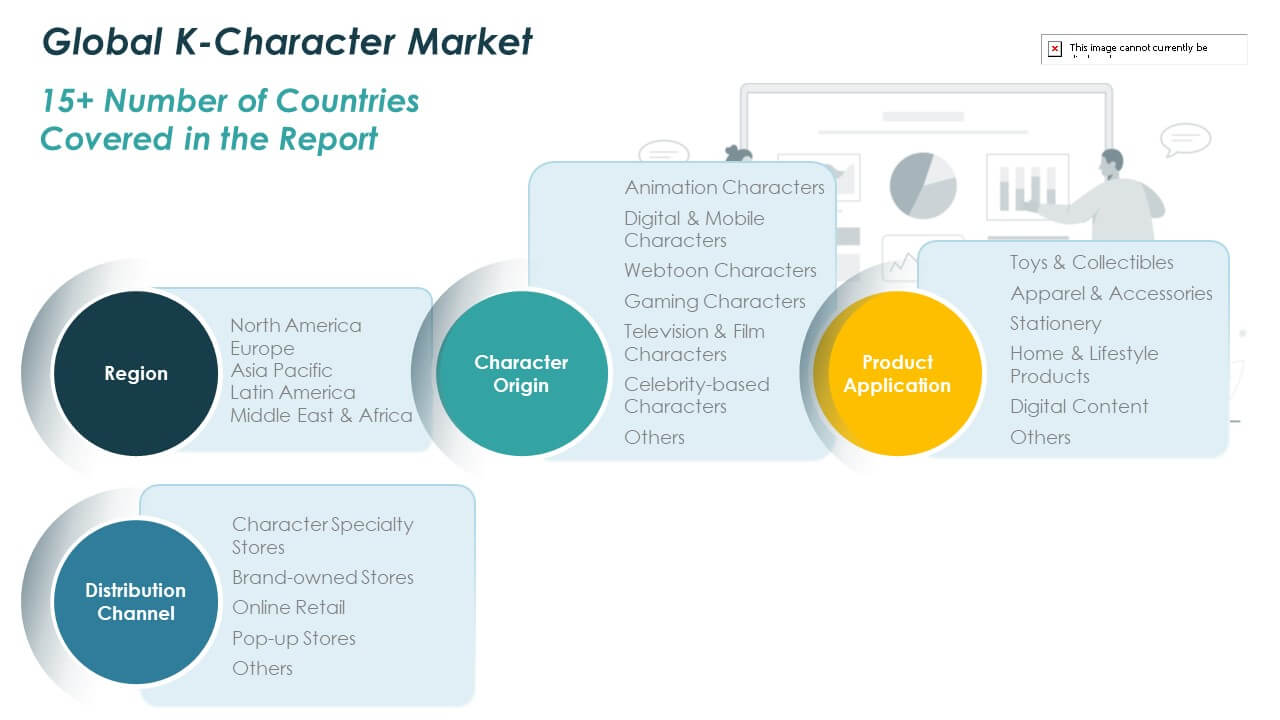
K-character Market Segmentations
By Character Origin
- Animation Characters
- Digital and Mobile Characters
- Webtoon Characters
- Gaming Characters
- Television and Film Characters
- Celebrity-Based Characters
- Others
By Product Application
- Toys and Collectibles • Apparel and Accessories • Stationery • Home and Lifestyle Products • Digital Content • Others
By Distribution Channel
- Character Specialty Stores
- Brand-Owned Stores
- Online Retail
- Pop-Up Stores
- Others
By Region
- North America
- U.S.
- Canada
- Mexico
- Europe
- Germany
- France
- U.K.
- Italy
- Spain
- Rest of Europe
- Asia Pacific
- China
- Japan
- India
- South Korea
- South-east Asia
- Rest of Asia Pacific
- Latin America
- Brazil
- Argentina
- Rest of Latin America
- Middle East & Africa
- GCC Countries
- South Africa
- Rest of the Middle East and Africa
Key Players
- Kakao Corporation
- IPX Corporation
- SAMG Entertainment Co., Ltd.
- Iconix Entertainment Co., Ltd.
- The Pinkfong Company, Inc.
- Young Toys, Inc.
- Aurora World Corporation
- ROI Visual Co., Ltd.
- TUBAn Co., Ltd.
- Others
Recent Developments
- In May 2025, LINE FRIENDS partnered with UK character-driven brand Ketnipz to expand the brand’s footprint in North America and Asia through character IP collaboration.
- In 2025, SAMG Entertainment and SM Entertainment signed an MOU to combine K-pop fandom and character IP across integrated content projects.
- In May 2026, The Pinkfong Company announced its participation in Licensing Expo 2026, where it planned to showcase Pinkfong, Baby Shark, Bebefinn and SEALOOK.
- In January 2026, 8 Lions Entertainment signed a YouTube distribution services agreement with SAMG Entertainment to manage and monetize flagship animated franchises including Catch! Teenieping, Miniforce and Metal Cardbot.
Report Coverage
The research report offers an in-depth analysis based on character origin, product application, distribution channel and region. It details leading market players, providing an overview of their business positioning, character IP portfolios, licensing capabilities, retail strategies and strategic relevance in the global K-character ecosystem. The report includes insights into the competitive environment, market trends, growth drivers, restraints and opportunities. It also examines Korean Wave exports, animation IP, mobile characters, webtoon characters, gaming characters, pop-up retail, online retail and merchandise licensing as major factors shaping market development. The report assesses the impact of fandom culture, digital platforms, regional retail development, counterfeit risk and cross-media franchise expansion on market growth. It provides strategic recommendations for IP owners, animation studios, licensing agencies, retailers, e-commerce platforms, toy manufacturers, investors and new entrants seeking to navigate the global K-character market.
Future Outlook
- Demand for K-character IP will continue to rise as Korean entertainment, animation, webtoons, games and mobile platforms expand global reach.
- Animation Characters will remain important because children’s franchises support toys, collectibles, apparel, stationery and lifestyle licensing.
- Digital and Mobile Characters will gain traction as messaging, avatars, stickers and social platforms increase daily character engagement.
- Webtoon Characters will become more valuable as webtoon IP moves into dramas, animation, games and merchandise.
- Toys and Collectibles will remain a leading product application due to strong demand from children, fans and collectors.
- Apparel and Accessories will grow as character collaborations gain visibility across fashion and fandom communities.
- Online Retail will gain share because it supports cross-border sales, limited-edition drops and direct fan engagement.
- Pop-Up Stores will remain a major promotional channel because they create scarcity, social visibility and immersive fan experiences.
- Asia Pacific will remain the fastest-growing region, while Africa will offer emerging growth potential from mobile-first audiences.
- Competitive intensity will increase as Korean IP owners compete on storytelling, licensing control, product quality, global retail access and fan engagement.
Request a Free Sample
Fill in your details and we'll send you a free sample report.
- Sample data tables & charts
- Research methodology
Need a Custom Version of This Report?
Tailor the scope, geography, or segments to your exact requirements.
- Custom geography or segment scope
- Direct access to our analyst team
Frequently Asked Questions
What is the current market size for the global K-character market and what is its projected size in 2032?
At what CAGR is the global K-character market projected to grow?
Which character origin segment is expected to lead the global K-character market?
Which product application holds the strongest position in the market?
Which distribution channel supports strong market demand?
Who are the leading companies in the global K-character market?
Which region is projected to grow fastest?
Table of Content
Chapter 1. Report Introduction
- 1.1 Report Description & Purpose
- 1.1.1 Report Title & Market Definition
- 1.1.2 Unique Selling Propositions (USP) & Key Differentiators
- 1.1.3 Value Proposition for Stakeholders
- 1.2 Research Objectives
- 1.2.1 Market Sizing Objectives (Volume & Revenue) (Volume Where Applicable)
- 1.2.2 Segmentation Objectives
- 1.2.3 Competitive Intelligence Objectives
- 1.2.4 Forecast & Scenario Objectives
- 1.3 Report Scope
- 1.3.1 K-character Scope – Segments & Subsegments Covered
- 1.3.2 Geographic Scope – Regions & Countries Covered
- 1.3.3 Historical Period, Base Year & Forecast Period (2025; forecast to 2032)
- 1.3.4 Inclusions & Exclusions
- 1.4 Industry Classification & Applicable Codes
- 1.5 Currency, Measurement Units & Valuation Basis
- 1.6 Target Stakeholders
- 1.7 Limitations & Assumptions
Chapter 2. Executive Summary
- 2.1 Global K-character Market Snapshot
- 2.1.1 Market Size – Historical (2025) & Forecast (2025-2032) (2025: USD 4,557.70 million → 2032: USD 9,501.53 million)
- 2.1.2 Volume & Revenue – Global Totals (Volume Where Applicable)
- 2.1.3 Key Market Highlights – Top Five Facts
- 2.2 K-character Market Segmentation Snapshot
- 2.2.1 Market Split by Region – 2025 vs. 2032
- 2.3 Competitive Snapshot
- 2.3.1 Top 10 Players by Revenue Share – 2025
- 2.3.2 Top 10 Players by Volume Share – 2025 (Volume Where Applicable)
- 2.3.3 Recent Strategic Developments (18-Month Summary)
- 2.4 Key Investment Highlights & Strategic Conclusions
Chapter 3. K-character Market Dynamics & Industry Analysis
- 3.1 Market Overview & Context
- 3.1.1 K-character Market Position in the Broader Industry Value Chain
- 3.1.2 Demand Structure & Purchasing Dynamics
- 3.1.3 Market Maturity & Development Stage by Region
- 3.2 K-character Market Drivers
- 3.3 K-character Market Restraints & Challenges
- 3.4 K-character Market Opportunities
- 3.5 Porter's Five Forces Analysis
- 3.5.1 Threat of New Entrants
- 3.5.2 Bargaining Power of Suppliers
- 3.5.3 Bargaining Power of Buyers
- 3.5.4 Threat of Substitutes
- 3.5.5 Competitive Rivalry – Intensity Assessment
- 3.6 K-character Value Chain Analysis
- 3.6.1 Upstream – Key Inputs, Resources & Suppliers
- 3.6.1.1 Key Input/Resource 1
- 3.6.1.2 Key Input/Resource 2
- 3.6.1.3 Key Input/Resource 3
- 3.6.2 Midstream – Core Operations & Value Creation
- 3.6.2.1 Operating Model & Process Overview
- 3.6.2.2 Key Operating Locations & Capabilities by Company
- 3.6.3 Downstream – Market Channels & End Users
- 3.6.3.1 Direct Sales & Customer Engagement Channels
- 3.6.3.2 Indirect Sales, Intermediaries & Partner Channels
- 3.6.4 Value Chain Profitability Analysis
- 3.6.1 Upstream – Key Inputs, Resources & Suppliers
- 3.7 PESTEL Analysis
- 3.7.1 Political Factors
- 3.7.2 Economic Factors
- 3.7.3 Social Factors
- 3.7.4 Technological Factors
- 3.7.5 Environmental Factors
- 3.7.6 Legal Factors
- 3.8 K-character Supply Chain Analysis
- 3.8.1 Critical Input & Resource Availability Risk Assessment
- 3.8.2 Supplier & Operational Concentration Risk (Geographic Exposure)
- 3.8.3 Supply & Service Disruption Impact Analysis
- 3.9 Regulatory & Policy Landscape
Note: The regulatory and policy landscape section covers regulations based on their applicability to the market, K-character category, geography, and scope of the study. Only regulatory frameworks with a material impact on operations, compliance, trade, sustainability, or market access are analyzed in detail.
Chapter 4. Key Investment Pockets & Opportunity Analysis
- 4.1 K-character Market Attractiveness Analysis
- 4.1.1 By Region – Investment Attractiveness Matrix (Market Size × CAGR)
- 4.2 Absolute Revenue Growth Opportunity
- 4.2.1 By Region – Absolute Revenue Growth Through 2032
- 4.3 Incremental Demand Opportunity
- 4.3.1 By Region – Incremental Demand Through 2032
- 4.3.2 Segment – Incremental Demand
- 4.4 Emerging Submarket Opportunity Deep Dive (Subject to Applicability)
- 4.5 Priority Market Opportunity Scorecards
- 4.5.1 United States
- 4.5.2 Europe
- 4.5.3 Asia
- 4.5.4 Middle East & Africa
Note: Priority market opportunity scorecards reflect the geographic scope and strategic relevance of the study. Listed markets are indicative and may be adapted to the industry.
Chapter 5. K-character Cross-Border Trade & Market Access Analysis
- 5.1 International Trade & Cross-Border Activity Overview
- 5.1.1 Global Export Value by Country (2025)
- 5.1.2 Global Export Volume by Country (2025) (Volume Where Applicable)
- 5.1.3 Global Import Value by Country (2025)
- 5.1.4 Global Import Volume by Country (2025) (Volume Where Applicable)
- 5.1.5 Net Trade Balance by Country (2025)
- 5.2 Export Analysis – Segment
- 5.2.1 Category 1 (Applicable Classification Code)
- 5.2.2 Category 2 (Applicable Classification Code)
- 5.2.3 Category 3 (Applicable Classification Code)
- 5.2.4 Category 4 (Applicable Classification Code)
- 5.2.5 Category 5 (Applicable Classification Code)
- 5.3 Import Analysis – Segment
- 5.3.1 Category 1 (Applicable Classification Code)
- 5.3.2 Category 2 (Applicable Classification Code)
- 5.3.3 Category 3 (Applicable Classification Code)
- 5.3.4 Category 4 (Applicable Classification Code)
- 5.3.5 Category 5 (Applicable Classification Code)
- 5.4 Cross-Border Pricing & Transaction Benchmarks
- 5.4.1 Export Pricing – Segment & Country
- 5.4.2 Import Pricing – Segment & Source Country
- 5.4.3 Price Trends (2025)
- 5.5 Key Cross-Border Trade & Delivery Routes
- 5.5.1 Cross-Border Trade/Delivery Route 1
- 5.5.2 Cross-Border Trade/Delivery Route 2
- 5.5.3 Cross-Border Trade/Delivery Route 3
- 5.5.4 Cross-Border Trade/Delivery Route 4
- 5.5.5 Cross-Border Trade/Delivery Route 5
- 5.6 Trade Policy & Market Access Impact Assessment
- 5.6.1 Tariff & Non-Tariff Barriers
- 5.6.2 Regional Trade & Economic Integration Frameworks
- 5.6.3 Bilateral & Multilateral Trade Agreements
- 5.6.4 Cross-Border Operating, Licensing & Localization Requirements
Note: This chapter applies where cross-border trade or delivery is relevant to K-character. Goods, services, and digital offerings are assessed using applicable classifications and transaction measures. Import-export volumes, trade balances, and route analyses are included only where meaningful to the market.
Chapter 6. Competitive Landscape & Company Benchmarking
- 6.1 K-character Market Concentration & Structure
- 6.1.1 Herfindahl-Hirschman Index (HHI) – the historical period vs. 2025
- 6.1.2 Leading, Mid-Sized & Emerging Player Structure
- 6.1.3 Global, Regional & Local Player Dynamics
- 6.2 K-character Market Share Analysis – 2025
- 6.2.1 Global Revenue Share by Company
- 6.2.2 Global Volume Share by Company (Volume Where Applicable)
- 6.2.3 Regional Revenue Share
- 6.2.4 Market Share Evolution (the historical period vs. 2025)
- 6.2.5 Company Market Share by Key Segment
- 6.2.6 Company Market Share by Customer Group
- 6.3 Operating Scale, Capacity & Infrastructure Analysis
- 6.3.1 Global Operating Scale & Supply Capacity
- 6.3.2 Resource Utilization & Operating Efficiency
- 6.3.3 Output, Service Delivery & Activity Metrics
- 6.3.4 Operating Footprint & Infrastructure Map
- 6.3.5 Planned Operational & Capacity Expansion
- 6.4 K-character Competitive Benchmarking Matrix
- 6.4.1 Revenue, Growth, Profitability & Operating Metric Comparison
- 6.4.2 Channel Revenue Mix
- 6.4.3 Geographic Revenue Exposure
- 6.4.4 R&D Intensity
- 6.4.5 Sustainability Maturity
- 6.5 Strategic Developments in K-character (Last 24 Months)
- 6.5.1 Mergers, Acquisitions & Divestments
- 6.5.2 New Products, Services & Solutions in K-character
- 6.5.3 Operational & Infrastructure Expansions
- 6.5.4 Strategic Alliances, Joint Ventures & Partnerships
- 6.5.5 Distribution Expansion & Market Entry
- 6.5.6 Sustainability & ESG Initiatives
- 6.6 Competitive Strategy Mapping
- 6.6.1 Leader, Challenger, Follower & Niche Classification
- 6.6.2 Pricing Strategy Comparison
- 6.6.3 Channel Strategy Matrix
Note: Strategic developments are included based on their materiality and the availability of reliable information.
Chapter 7. Global K-character Market – By Sales & Delivery Channel
- 7.1 Segment Overview
- 7.1.1 Volume & Revenue Split by Channel (2025 & 2032) (Volume Where Applicable)
- 7.1.2 Channel Mix Evolution (2025-2032)
Chapter 8. Regional Market Analysis – Global Overview
- 8.1 Global Regional Overview
- 8.1.1 Regional Volume Share (Volume Where Applicable)
- 8.1.2 Regional Revenue Share
- 8.1.3 Regional Volume by Region (Volume Where Applicable)
- 8.1.4 Regional Revenue by Region
- 8.1.5 Regional Forecast Through 2032
- 8.2 Cross-Regional Segment Analysis
- 8.2.1 By Sales & Delivery Channel
- 8.2.2 By Competitive Positioning & Price Tier
Chapter 9. North America K-character Market
- 9.1 United States
- 9.2 Canada
- 9.3 Mexico
Chapter 10. Europe K-character Market
- 10.1 Germany
- 10.2 France
- 10.3 Italy
- 10.4 United Kingdom
- 10.5 Spain
- 10.6 Poland
- 10.7 Russia
- 10.8 Netherlands
- 10.9 Belgium
- 10.10 Sweden
- 10.11 Denmark
- 10.12 Norway
- 10.13 Rest of Europe
Chapter 11. Asia Pacific K-character Market
- 11.1 China
- 11.2 India
- 11.3 Japan
- 11.4 South Korea
- 11.5 Thailand
- 11.6 Indonesia
- 11.7 Vietnam
- 11.8 Malaysia
- 11.9 Australia
- 11.10 Rest of Asia Pacific
Chapter 12. Latin America K-character Market
- 12.1 Brazil
- 12.2 Argentina
- 12.3 Colombia
- 12.4 Chile
- 12.5 Rest of Latin America
Chapter 13. Middle East K-character Market
- 13.1 Saudi Arabia
- 13.2 United Arab Emirates
- 13.3 Turkey
- 13.4 Israel
- 13.5 Iran
- 13.6 Rest of the Middle East
Chapter 14. Africa K-character Market
- 14.1 South Africa
- 14.2 Egypt
- 14.3 Nigeria
- 14.4 Morocco
- 14.5 Rest of Africa
Chapter 15. K-character Company Profiles
- 15.1 [Company 01]
- 15.1.1 Company Overview
- 15.1.2 Key Management Personnel
- 15.1.3 Products & Services Portfolio
- 15.1.4 Financial Performance
- 15.1.5 Key Market Focus & Geographic Presence
- 15.1.6 Recent Developments & Strategic Initiatives
Note: The company profile list is preliminary and may change based on research findings, market developments, data availability, and client requirements.
Chapter 16. Appendices
- Appendix A – List of Abbreviations & Acronyms
- Appendix B – Industry Classification Code Reference – Full Series
- Appendix C – Supply, Output & Operating Capacity Data Tables
- Appendix D – End-Use & Demand Base Tables
- Appendix E – Demand, Adoption & Usage Assumptions
- Appendix F – Pricing & Revenue Metric Reference Tables
- Appendix G – Company Operations & Infrastructure Database
- Appendix H – Cross-Border Trade & Activity Data Tables (Where Applicable)
- Appendix I – Regulatory Summary Tables
- Appendix J – Primary Research Participant List (Anonymized)
- Appendix K – Primary Research Questionnaire Framework
- Appendix L – Data Sources & Bibliography
- Appendix M – Market Size Divergence & Source Comparison
Chapter 17. Research Methodology
- 17.1 Research Framework & Philosophy
- 17.2 Secondary Research – Sources, Hierarchy & Data Extraction
- 17.3 Data Modeling – Bottom-Up & Top-Down Market Sizing
- 17.4 Primary Research – Stakeholder Framework, LOI & Sample Sizes
- 17.5 Forecast Methodology – Regression, Scenario & Sensitivity Analysis
- 17.6 Quality Control – Four-Layer Validation Framework
- 17.7 Limitations & Standard Assumptions
- 17.8 Disclaimer
