
K-fashion Market Overview:
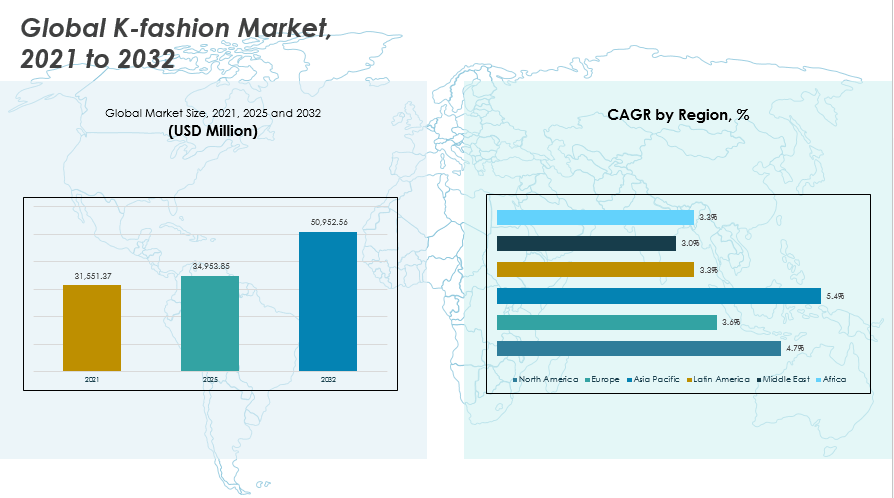
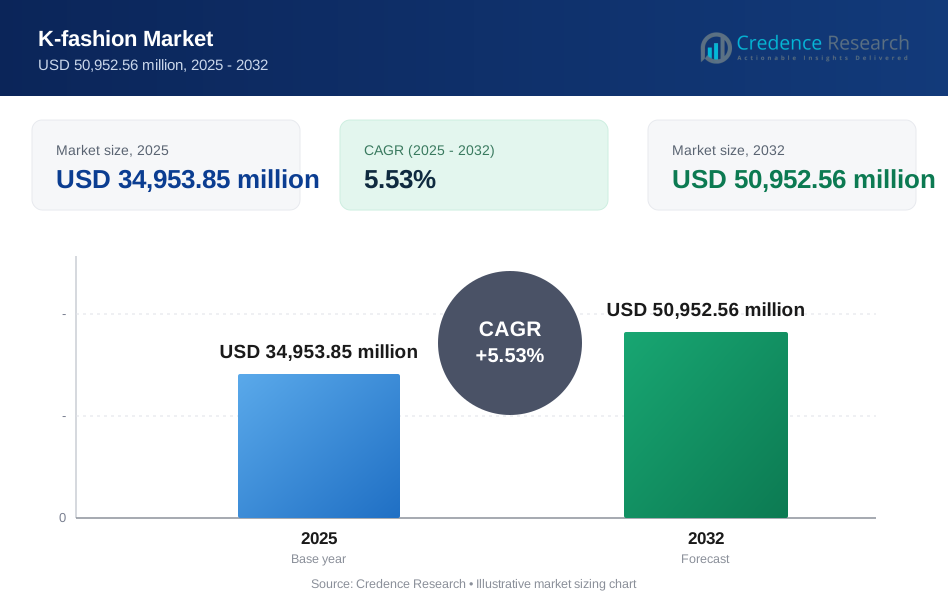
The global K-fashion market size was valued at USD 31,551.37 million in 2021 and reached USD 34,953.85 million in 2025. It is anticipated to reach USD 50,952.56 million by 2032, growing at a CAGR of 5.53% from 2025 to 2032. This growth is supported by the expansion of cross-border e-commerce and digital fashion platforms, which allow Korean brands to reach overseas consumers directly and scale beyond conventional retail channels.
| REPORT ATTRIBUTE | DETAILS |
|---|---|
| Historical Period | 2021-2024 |
| Base Year | 2025 |
| Forecast Period | 2025-2032 |
| K-fashion Market Size 2025 | USD 34,953.85 million |
| K-fashion Market, CAGR | 5.53% |
| K-fashion Market Size 2032 | USD 50,952.56 million |
Invest Korea notes that K-fashion is expected to access new international markets through cross-border e-commerce, while online and mobile fashion sales have expanded as brands strengthen their digital sales strategies. Additionally, public-sector export and logistics support is improving the ability of Korean designer-fashion brands to serve global buyers. In 2025, KOTRA launched a program providing eligible fashion companies with logistics infrastructure, fulfillment support, overseas-market access, and platform-based viral marketing across key international markets.
K-fashion Market Insights
- Market growth is supported by the global Korean Wave, online fashion marketplaces, creator-led styling trends, brand-owned retail expansion and rising demand for Korean apparel, footwear and accessories.
- Apparel holds the strongest product position because Korean fashion brands gain global visibility through streetwear, casualwear, contemporary womenswear, K-pop styling and digital-first merchandising.
- Affordable Premium is gaining traction as consumers seek Korean fashion brands that offer trend-focused design, better quality perception and accessible pricing compared with luxury labels.
- Asia Pacific is projected to record the fastest regional CAGR at 5.4%, supported by cultural proximity, strong digital commerce, cross-border shopping and rapid adoption of Korean style trends.
K-fashion Market Segment Insights
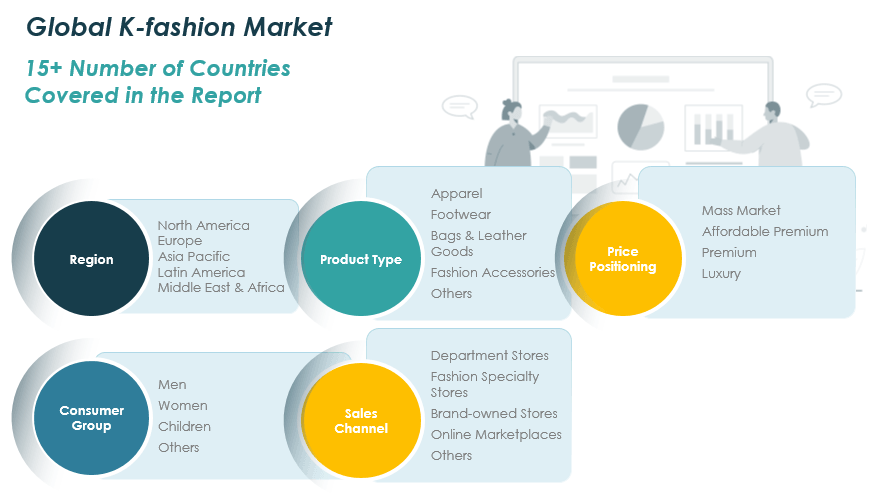
By Product Type
- Apparel
- Footwear
- Bags and Leather Goods
- Fashion Accessories
By product type, Apparel held the strongest position in 2025, supported by strong demand for Korean streetwear, casualwear, womenswear, menswear and seasonal fashion drops. K-fashion apparel benefits from strong visual appeal across social media, celebrity styling, music videos, dramas and influencer-led content. Footwear is gaining momentum as Korean brands expand into sneakers, casual shoes and lifestyle footwear that appeal to young consumers. Bags and Leather Goods support premium and affordable premium demand through minimalist design, functional styling and fashion-forward positioning. Fashion Accessories continue to gain traction across jewelry, eyewear, scarves, hats and small lifestyle products. Others include niche lifestyle products and collaboration-led fashion categories.
By price positioning
- Mass Market
- Affordable Premium
- Premium
- Luxury
By price positioning, Mass Market held a strong position in 2025 because Korean fashion remains accessible through online marketplaces, department stores and fashion specialty platforms. Affordable Premium is expected to gain strong momentum as consumers seek better design, brand identity and quality without paying luxury prices. Premium K-fashion brands are building stronger global recognition through curated stores, international pop-ups, fashion weeks and influencer partnerships. Luxury remains smaller but strategically important as Korean designers expand into global fashion capitals and collaborate with celebrities and cultural figures. Growth across price tiers reflects the ability of K-fashion brands to serve both trend-driven value buyers and higher-spending style-conscious consumers.
By consumer group
- Men
- Women
- Children
- Others
By consumer group, Women held the strongest position in 2025 because Korean fashion platforms and brands have deep strength in womenswear, beauty-linked styling and trend-driven apparel. Women’s demand is supported by dresses, outerwear, knitwear, casualwear, accessories, bags and footwear. Men represent a growing consumer group as Korean menswear, streetwear and gender-fluid styling gain international attention. Children’s fashion remains smaller but relevant through family-oriented brands, character collaborations and lifestyle products. Others include unisex, gender-neutral and youth-focused fashion categories that align with Korean street style and digital culture. Demand across consumer groups will grow as K-fashion broadens from niche fandom shopping into mainstream global fashion consumption.
By Sales Channel
- Department Stores
- Fashion Specialty Stores
- Brand-Owned Stores
- Online Marketplaces
By sales channel, Online Marketplaces held a strong position in 2025 because they help Korean brands reach global consumers without relying only on physical retail. Platforms support product discovery, cross-border transactions, influencer campaigns, reviews and curated brand storytelling. Department Stores remain important for premium positioning, brand credibility and offline customer experience. Fashion Specialty Stores support curated discovery and help emerging Korean designers build awareness. Brand-Owned Stores are gaining importance as leading companies seek better margins, customer data and direct fan engagement. Other channels include pop-up stores, social commerce, multi-brand boutiques and event-linked retail formats.
Key market drivers
Korean Wave and Global Style Influence
The Korean Wave is strengthening global demand for K-fashion by making Korean streetwear, clean tailoring, layered outfits, contemporary accessories and youth-led styling instantly recognizable across entertainment and social channels. K-pop performers, drama casts, creators and beauty-led content increasingly influence how international shoppers discover silhouettes, brands and seasonal looks, giving Korean labels a cultural connection that can reduce the effort required to build awareness abroad.
This influence extends from apparel into bags, footwear, jewelry and lifestyle accessories, particularly when brands translate celebrity visibility into distinctive product design and consistent storytelling. The opportunity is not confined to a single region, as K-fashion increasingly reaches consumers in Asia Pacific, North America, Europe, Latin America, the Middle East and Africa through digitally amplified fandoms. A notable retail example came when Nordstrom introduced eight Korean designers through its KFashion Pop-In, with products ranging from 45 to 640 US dollars across stores in the United States and Canada. Continued Korean cultural visibility should therefore support international consideration and strengthen the global commercial relevance of K-fashion through 2032.
Online Marketplaces and Cross-border Commerce
Online marketplaces and cross-border commerce are broadening K-fashion’s international reach by enabling Korean brands to sell directly to overseas consumers without first building costly wholesale or store networks. Mobile-led platforms combine product discovery, influencer referrals, targeted merchandising and real-time customer feedback, allowing emerging designers to assess demand and refine assortments by country. These capabilities are especially important for mass-market and affordable-premium labels, which can use localized languages, payment options, delivery services and return processes to make Korean fashion more accessible to global buyers.
Digital storefronts also give brands greater control over visual presentation, pricing, customer data and campaign timing than conventional multibrand distribution. The scale of platform-led brand development is evident in Coor, which generated more than 10 billion won in sales on Musinsa before expanding into physical outlets at Hyundai Department Store locations. As marketplaces continue to improve fulfillment and customer-service infrastructure, they will remain a practical export route for K-fashion companies seeking international reach while preserving agile merchandising and direct consumer engagement.
Affordable Premium and Designer Brand Expansion
Affordable-premium and designer K-fashion brands are gaining momentum as consumers seek distinctive design, flexible styling and stronger perceived quality without moving into traditional luxury price levels. Korean labels can compete effectively by introducing fast design refreshes, recognizable visual identities and products that move comfortably between streetwear, casualwear and occasion dressing. This creates a broad value ladder encompassing accessible fashion, affordable premium offerings and high-end designer collections, enabling companies to serve varied spending profiles while sustaining aspirational brand appeal. International fashion weeks, celebrity placements, retail pop-ups and collaborations can further accelerate recognition, but durable growth will depend on fit consistency, fabric quality, reliable fulfilment and locally relevant brand storytelling.
Matin Kim’s Japan strategy demonstrates the scale of ambition possible for a successful affordable-premium label: its five-year distribution partnership with Musinsa Global through 2029 carries a Japan sales target of 250 billion won. Brands that combine accessible prices with disciplined product quality and selective global retail partnerships should be best positioned to build repeat purchasing and long-term value.
Retail Experience and Pop-up-led Discovery
Retail experience and pop-up-led discovery are essential to K-fashion expansion because physical settings allow consumers to assess fit, fabric, finish and styling in ways that digital channels cannot fully replicate. Short-term stores also create urgency around exclusive drops, bring online communities into branded spaces and generate highly shareable content that can extend campaigns beyond the host location. Department stores provide credibility and established customer traffic for emerging labels, while specialty and brand-owned stores enable deeper storytelling, higher-margin selling and richer customer relationships.
The most effective model combines digital audience building with targeted offline placements in culturally relevant shopping districts, then uses shopper feedback to guide market-entry decisions. Hyundai Department Store’s The Hyundai Global initiative shows the operational advantage of this approach, stating that it can reduce the cost of opening overseas stores by more than 30 percent while managing customs, logistics and inventory for participating Korean brands. As K-fashion brands enter new cities, pop-ups and carefully chosen retail partners will remain pivotal tools for building trust, visibility and localized demand.
Key Trends and Opportunities
Global expansion of Korean designer platforms
Global expansion of Korean designer platforms is becoming a major opportunity as marketplaces and curated retailers introduce more Korean brands to international consumers. Platforms can aggregate small and midsize labels, reduce discovery friction and provide integrated logistics support. This model helps K-fashion brands enter markets such as Japan, China, Southeast Asia, North America, Europe and the Middle East without building full local infrastructure immediately. Designers benefit from data-driven merchandising, localized campaigns and cross-border fulfillment. Consumers gain access to wider assortments across Apparel, Footwear, Bags and Leather Goods and Fashion Accessories. This opportunity will remain strong as online retail becomes the main gateway for global K-fashion discovery.
K-pop, influencer and social commerce strengthen demand
K-pop, influencer and social commerce are strengthening demand by converting cultural attention into fashion purchases. Consumers often seek looks inspired by artists, actors, creators and Korean street-style influencers. Social media shortens the path from discovery to purchase, especially for Apparel, Fashion Accessories and Bags and Leather Goods. Live commerce, creator storefronts and style content help brands promote new collections and limited drops. This trend supports fast product cycles and higher engagement among Gen Z and millennial consumers. Brands that align merchandising with social content and influencer credibility will be better positioned to scale globally.
Sustainable and gender-fluid fashion gains relevance
Sustainable and gender-fluid fashion is gaining relevance as younger consumers seek values-driven and flexible styling. Korean brands are increasingly using minimalist silhouettes, unisex fits, recycled materials, lower-waste production and durable wardrobe staples to support differentiated positioning. Gender-neutral styling fits K-fashion’s broader appeal because many Korean streetwear and designer labels already emphasize oversized cuts, layering and fluid silhouettes. Sustainability can also help brands compete in Europe and North America where consumer scrutiny and retail requirements are stronger. The opportunity remains early but important for Premium, Affordable Premium and Luxury positioning. Brands with transparent sourcing, clear product quality and authentic storytelling will gain stronger long-term trust.
Key Market Challenges
Short trend cycles and inventory risk
Short trend cycles and inventory risk remain key challenges for the global K-fashion market. K-fashion demand often moves quickly across social media, celebrity looks and seasonal drops. Fast-moving trends can create overstock risk when brands scale production before demand is confirmed. Smaller designers may struggle to balance product freshness with inventory discipline. Online marketplaces also face pressure to keep assortments updated while avoiding excessive discounting. Brands need better demand forecasting, flexible sourcing and controlled drop strategies to manage this challenge. Companies with strong data systems and agile merchandising will hold an advantage.
Global competition and brand differentiation
Global competition and brand differentiation create pressure across all price tiers. K-fashion brands compete with Japanese, Chinese, European, U.S. and local fashion labels in every target market. Many brands use similar streetwear, minimalist or contemporary design cues, which can make differentiation harder. International consumers may also know K-culture but not individual Korean fashion labels. Brands must invest in storytelling, fit consistency, quality, styling content and reliable customer service to build loyalty. Companies that depend only on trend visibility may struggle to sustain repeat purchases. Distinct brand identity will become critical as K-fashion moves into more crowded global retail channels.
Cross-border logistics and localization barriers
Cross-border logistics and localization barriers can slow international growth. Fashion products require accurate sizing, reliable fulfillment, return handling, customs management and localized customer support. Differences in body fit, climate, style preferences and shopping behavior can affect sell-through across regions. Shipping costs and return complexity can reduce margins for online marketplaces and brand-owned stores. Smaller Korean brands may lack resources to manage localized marketing, translations and compliance. Platforms and retailers that provide integrated logistics, local merchandising and customer support will help reduce these barriers.
Regional Analysis
Asia Pacific
Asia Pacific is projected to grow at a CAGR of 5.4% from 2025 to 2032, supported by cultural proximity, strong Korean Wave influence and high digital commerce adoption. Japan, China, Southeast Asia and South Korea remain important markets for Apparel, Footwear, Bags and Leather Goods and Fashion Accessories. Consumers in the region respond strongly to Korean celebrity styling, social commerce, online marketplaces and pop-up stores. Department Stores, Fashion Specialty Stores and Brand-Owned Stores also support offline discovery in major cities. Asia Pacific will remain the fastest-growing region because K-fashion has strong cultural recognition and platform-led distribution in the region.
North America
North America is projected to grow at a CAGR of 4.7% from 2025 to 2032, supported by K-pop fandom, digital shopping, streetwear culture and growing awareness of Korean designer brands. The U.S. and Canada offer strong opportunities for online marketplaces, brand-owned e-commerce and selective pop-up retail. Apparel, accessories and footwear are expected to benefit from social media discovery and celebrity-led styling. Affordable Premium and Premium brands can gain traction among consumers seeking differentiated design outside mainstream fashion labels. Growth will depend on localized sizing, returns, shipping reliability and brand storytelling. North America will remain a high-value expansion market for Korean fashion platforms and designer labels.
Europe
Europe is projected to grow at a CAGR of 3.6% from 2025 to 2032, supported by rising interest in Korean design, fashion week exposure, K-pop fandom and online retail access. European consumers are style-conscious and often value quality, sustainability and brand identity, which supports Premium and Affordable Premium positioning. Growth varies by country because fashion preferences, retail channels and purchasing power differ across the region. Online marketplaces and specialty stores can help Korean brands enter fragmented markets without heavy physical retail investment. Sustainability and product quality will be important for long-term acceptance. Europe offers steady growth but requires stronger localization and brand differentiation.
Africa
Africa is projected to grow at a CAGR of 3.3% from 2025 to 2032, supported by young consumers, mobile-first retail behavior and rising exposure to Korean entertainment. Market scale remains smaller than Asia Pacific, North America and Europe, but long-term potential is emerging through online retail and social commerce. Apparel and accessories are likely to serve as entry categories because they align with youth fashion and digital trend adoption. Price sensitivity will shape demand, making Mass Market and Affordable Premium products more relevant. Growth will depend on logistics, payment access and local retail partnerships. Africa represents an early-stage opportunity for K-fashion expansion.
Latin America
Latin America is projected to grow at a CAGR of 3.2% from 2025 to 2032, supported by active K-pop fandoms, social media engagement and rising demand for Korean lifestyle products. Apparel, accessories and bags can gain traction through online marketplaces, influencer campaigns and localized product drops. Price sensitivity and import logistics remain important constraints. Spanish and Portuguese localization will help brands improve customer engagement and conversion. Pop-up stores and event-linked retail can create awareness in major cities. Latin America offers steady growth potential as Korean entertainment and youth fashion culture continue to expand.
Middle East
The Middle East is projected to grow at a CAGR of 3.0% from 2025 to 2032, supported by young consumers, premium mall retail, social media influence and rising interest in Korean culture. Gulf markets offer opportunities for Premium and Affordable Premium brands, especially through pop-up stores, department stores and online marketplaces. Apparel, bags and accessories can gain demand where Korean style aligns with modest, layered or contemporary fashion preferences. Brand localization and cultural fit will be important for product selection. Online retail will support broader access outside major retail hubs. The region offers selective but attractive opportunities for K-fashion brands with strong positioning.
Company
- Samsung C&T Corporation, Fashion Group
- LF Corporation
- Handsome Corporation
- F&F Co., Ltd.
- E-Land World Limited
- Shinsegae International Inc.
- Kolon Industries FnC
- MUSINSA Co., Ltd.
- W Concept Korea Co., Ltd.
- Others
Recent Developments
- In April 2025, MUSINSA reported that its Global Store transactions in Japan rose 114% year over year in the first quarter, supported by user growth and stronger demand for K-fashion brands.
- In July 2025, MUSINSA was designated as an official trade company for K-fashion and outlined plans to accelerate global expansion across Japan, China, Thailand and Southeast Asia through online and offline channels.
- In October 2025, W Concept expanded its overseas push by strengthening a dedicated global team and revamping its global business strategy.
- In July 2024, F&F Co., Ltd. announced plans to expand Discovery Expedition across China, Japan and Southeast Asia, with a plan to grow its China store network by the end of 2025.
Report Coverage
The research report offers an in-depth analysis based on product type, price positioning, consumer group, sales channel and region. It details leading market players, providing an overview of their business positioning, fashion portfolios, retail channels, digital platforms and strategic relevance in the global K-fashion ecosystem. The report includes insights into the competitive environment, market trends, growth drivers, restraints and opportunities.
It also examines Korean Wave influence, online marketplaces, affordable premium positioning, designer brand expansion, pop-up retail, social commerce and cross-border fashion demand as major factors shaping market development. The report assesses the impact of regional demand patterns, brand localization, product differentiation, inventory risk and logistics complexity on market growth. It provides strategic recommendations for fashion brands, retailers, online marketplaces, department stores, investors, licensing partners and new entrants seeking to navigate the global K-fashion market.
Future Outlook
- Demand for K-fashion will continue to rise as Korean culture, celebrity styling and digital fashion platforms influence global consumers.
- Apparel will remain the leading product type because it anchors Korean streetwear, casualwear, womenswear, menswear and designer fashion demand.
- Footwear and Fashion Accessories will gain traction as brands expand lifestyle collections and cross-category styling.
- Affordable Premium will grow as consumers seek differentiated Korean design at accessible price points.
- Women will remain the leading consumer group, while men and unisex fashion categories will gain momentum through streetwear and gender-fluid styling.
- Online Marketplaces will remain a leading sales channel because they support cross-border discovery and scalable brand access.
- Brand-Owned Stores and pop-up formats will become more important for customer experience, exclusive drops and premium positioning.
- Asia Pacific will remain the fastest-growing region, while North America will remain a high-value expansion market.
- Sustainability and product quality will become more important as Korean brands expand into Europe and premium global channels.
- Competitive intensity will increase as K-fashion brands compete on design identity, fit, digital marketing, logistics, localization and retail partnerships.
Request a Free Sample
Fill in your details and we'll send you a free sample report.
- Sample data tables & charts
- Research methodology
Need a Custom Version of This Report?
Tailor the scope, geography, or segments to your exact requirements.
- Custom geography or segment scope
- Direct access to our analyst team
Frequently Asked Questions
What is the current market size for the global K-fashion market and what is its projected size in 2032?
At what CAGR is the global K-fashion market projected to grow?
Which product type segment is expected to lead the global K-fashion market?
Which price positioning segment supports strong market demand?
Which sales channel holds a strong position in the market?
Who are the leading companies in the global K-fashion market?
Which region is projected to grow fastest?
Table of Content
Chapter 1 Market Segmentation
- 1.1 Segmentation Framework
- 1.1.1 Product and Service Classification
- 1.1.2 Application and End-Use Classification
- 1.1.3 Technology and Solution Classification
- 1.1.4 Customer and Distribution Channel Classification
- 1.1.5 Geographic Segmentation
- 1.1.6 Market Segment Definitions and Boundaries
Chapter 2 Introduction
- 2.1 Report Objectives and Scope
- 2.2 Product Definition and Industry Terminology
- 2.3 Market Inclusions and Exclusions
- 2.4 Research Process
- 2.4.1 Primary Research and Expert Interviews
- 2.4.2 Secondary Research and Source Review
- 2.4.3 Top-Down and Bottom-Up Estimation
- 2.4.4 Data Triangulation and Verification
- 2.5 Market Size Measurement Basis
- 2.5.1 2025: USD 34,953.85 million → 2032: USD 50,952.56 million
- 2.6 Historical and Forecast Reference Periods
- 2.6.1 Base Year: 2025
- 2.6.2 Forecast Period: 2025-2032
- 2.7 Research Assumptions and Limitations
Chapter 3 Executive Summary
- 3.1 Market Snapshot and Key Findings
- 3.2 Base-Year Market Size, 2025
- 3.3 Forecast Market Size, 2032
- 3.4 Revenue and Volume Growth Outlook
- 3.5 Key Demand and Supply Indicators
- 3.6 Leading Market Segments
- 3.7 Fastest-Growing Market Opportunities
- 3.8 Regional Performance Highlights
- 3.9 Technology and Industry Transformation
- 3.10 Competitive Landscape Summary
- 3.11 Analyst View and Strategic Implications
Chapter 4 Global K-fashion Market Trends and Developments
- 4.1 Historical Industry Development
- 4.2 Recent Market Trends and Developments
- 4.3 Demand and Customer Behavior Trends
- 4.4 Technology and Product Innovation
- 4.5 Artificial Intelligence, Automation and Digitalization
- 4.6 Local Manufacturing and Supply Chain Realignment
- 4.7 Industry Partnerships, Mergers and Acquisitions
- 4.8 Sustainability and Circular Economy Developments
- 4.9 Government and Private Sector Investment Trends
- 4.10 Emerging Business Models and Commercialization
- 4.11 Industry Developments and Announcements
Chapter 5 Global K-fashion Market Production, Supply and Demand Analysis
- 5.1 Demand Trend and Consumption Analysis
- 5.2 Demand Forecast, 2025-2032
- 5.3 Production and Output Trend
- 5.4 Production and Output Forecast, 2025-2032
- 5.5 Installed Capacity and Capacity Utilization
- 5.6 Company-Wise Production Plants and Statistics
- 5.6.1 Installed Production Capacity
- 5.6.2 Actual Production
- 5.6.3 Planned Capacity and Expansion Targets
- 5.7 Supply Chain Structure and Procurement Trends
- 5.8 Supply-Demand Gap and Bottlenecks
- 5.9 Import Dependence and Sourcing Structure
- 5.10 Contract Manufacturing and Outsourcing
- 5.11 Regional Supply and Demand Concentration
Chapter 6 Global K-fashion Market Pricing Analysis
- 6.1 Pricing Structure and Measurement
- 6.2 Historical Pricing Trends
- 6.3 Pricing Outlook, 2025-2032
- 6.4 Average Selling Price and Unit Economics
- 6.5 Pricing by Product and Market Segment
- 6.6 Geographic Pricing Differences
- 6.7 Key Input, Energy, Labor and Logistics Costs
- 6.8 Contract Pricing and Purchasing Models
- 6.9 Pricing Sensitivity and Competitive Positioning
- 6.10 Price, Margin and Profitability Implications
Chapter 7 Global K-fashion Market Dynamics
- 7.1 Market Growth Drivers
- 7.1.1 Demand-Side Drivers
- 7.1.2 Technology and Innovation Drivers
- 7.1.3 Infrastructure and Investment Drivers
- 7.1.4 Regulatory and Policy Drivers
- 7.2 Market Restraints
- 7.2.1 Cost and Affordability Constraints
- 7.2.2 Technology and Adoption Barriers
- 7.2.3 Supply Chain and Operational Constraints
- 7.3 Market Challenges
- 7.3.1 Competitive Pressure and Margin Erosion
- 7.3.2 Skills, Infrastructure and Implementation Gaps
- 7.4 Emerging Market Opportunities
- 7.5 Market Dynamics Impact and Time-Horizon Assessment
Chapter 8 Global K-fashion Value Chain Analysis
- 8.1 Industry Value Chain Overview
- 8.2 Upstream Suppliers and Critical Inputs
- 8.3 Technology and Component Providers
- 8.4 Manufacturing or Service Delivery
- 8.5 Distribution, Channel Partners and Integrators
- 8.6 Downstream Applications and End Users
- 8.7 Value Addition and Profit Pools
- 8.8 Vertical Integration and Outsourcing
- 8.9 Supplier Concentration and Risk
- 8.10 Supply Chain Localization and Resilience
Chapter 9 Global K-fashion Market Regulations and Policies
- 9.1 Relevant Laws, Standards and Compliance Frameworks
- 9.2 Product, Service, Safety and Quality Requirements
- 9.3 Government Policies, Incentives and Subsidies
- 9.4 Imports, Exports and Trade Barriers
- 9.5 Public Procurement and Local Content Requirements
- 9.6 Environmental and Sustainability Compliance
- 9.7 Upcoming Policy Changes and Market Implications
Chapter 10 Global K-fashion Market Hotspots and Opportunities
- 10.1 Market Opportunity Mapping and Growth Hotspots
- 10.2 High-Growth Applications and Customer Groups
- 10.3 Underserved Markets and White-Space Opportunities
- 10.4 Emerging Technology and Product Opportunities
- 10.5 New Capacity and Investment Hotspots
- 10.6 Market Entry and Expansion Opportunities
- 10.7 Distribution and Partnership Opportunities
- 10.8 Near-Term and Long-Term Commercial Potential
- 10.9 Opportunity Attractiveness and Execution Risks
Chapter 11 Global K-fashion Market Outlook, 2025-2032
- 11.1 Market Size and Analysis
- 11.1.1 Revenue (Market Measurement: 2025: USD 34,953.85 million → 2032: USD 50,952.56 million)
- 11.1.2 Market Volume and Quantity Sold
- 11.1.3 Historical Market Size
- 11.1.4 Base-Year Market Size, 2025
- 11.2 Market Forecast, 2025-2032
- 11.2.1 Revenue Forecast to 2032
- 11.2.2 Volume Forecast to 2032
- 11.2.3 CAGR and Year-on-Year Growth
- 11.2.4 Incremental Revenue Opportunity
- 11.3 Forecast Assumptions and Scenario Analysis
- 11.3.1 Base-Case Forecast
- 11.3.2 Optimistic and Conservative Scenarios
- 11.3.3 Technology, Pricing and Policy Sensitivities
- 11.4 Market Attractiveness and Growth Outlook
Chapter 12 Global K-fashion Market Segmentation and Outlook
- 12.1 Segmentation Summary and Market Shares, 2025
- 12.2 Largest and Fastest-Growing Segments
- 12.3 Segment Growth Comparison
- 12.4 Segment Attractiveness and Priority Matrix
Chapter 13 Global K-fashion Geographic Market Outlook, 2025-2032
- 13.1 Regional Market Size and Share, 2025
- 13.2 Regional Market Forecast, 2025-2032
- 13.3 Regional Pricing, Production and Demand Differences
- 13.4 North America
- 13.4.1 United States
- 13.4.2 Canada
- 13.4.3 Mexico
- 13.5 Europe
- 13.5.1 Germany
- 13.5.2 France
- 13.5.3 Italy
- 13.5.4 United Kingdom
- 13.5.5 Spain
- 13.5.6 Poland
- 13.5.7 Russia
- 13.5.8 Netherlands
- 13.5.9 Belgium
- 13.5.10 Sweden
- 13.5.11 Denmark
- 13.5.12 Norway
- 13.5.13 Rest of Europe
- 13.6 Asia Pacific
- 13.6.1 China
- 13.6.2 India
- 13.6.3 Japan
- 13.6.4 South Korea
- 13.6.5 Thailand
- 13.6.6 Indonesia
- 13.6.7 Vietnam
- 13.6.8 Malaysia
- 13.6.9 Australia
- 13.6.10 Rest of Asia Pacific
- 13.7 Latin America
- 13.7.1 Brazil
- 13.7.2 Argentina
- 13.7.3 Colombia
- 13.7.4 Chile
- 13.7.5 Rest of Latin America
- 13.8 Middle East
- 13.8.1 Saudi Arabia
- 13.8.2 United Arab Emirates
- 13.8.3 Turkey
- 13.8.4 Israel
- 13.8.5 Iran
- 13.8.6 Rest of the Middle East
- 13.9 Africa
- 13.9.1 South Africa
- 13.9.2 Egypt
- 13.9.3 Nigeria
- 13.9.4 Morocco
- 13.9.5 Rest of Africa
- 13.10 Regional Investment, Policy and Supply Chain Differences
- 13.11 Regional Competitive Landscape
- 13.12 Geographic Growth Hotspots
Chapter 14 Global K-fashion Technology, Innovation and Sustainability Outlook
- 14.1 Technology Landscape and Maturity
- 14.2 Product, Process and Service Innovation
- 14.3 AI, Automation and Digital Tools in the Industry
- 14.4 Technology Adoption and Performance Benchmarking
- 14.5 Innovation Pipeline and R&D Investment
- 14.6 Patent and Intellectual Property Trends
- 14.7 Energy Efficiency and Resource Management
- 14.8 Sustainability, Recycling and Circularity
- 14.9 Technology Roadmap, 2025-2032
- 14.10 Risks of Obsolescence and Technology Substitution
Chapter 15 Global K-fashion Market Key Strategic Imperatives
- 15.1 Growth and Market Entry Priorities
- 15.2 High-Return Products and Segments
- 15.3 Pricing, Profitability and Cost Optimization
- 15.4 Technology Investment and Product Differentiation
- 15.5 Supply Chain Localization and Resilience
- 15.6 Distribution and Customer Acquisition
- 15.7 Partnership, Acquisition and Capacity Strategy
- 15.8 Regional Expansion Priorities
- 15.9 Short-, Medium- and Long-Term Actions
Chapter 16 Competition Outlook
- 16.1 Industry Competition Characteristics
- 16.2 Market Structure and Concentration
- 16.3 Market Share and Competitive Positioning, 2025
- 16.4 Company-Wise Revenue and Product Benchmarking
- 16.5 Production and Service Capacity Benchmarking
- 16.6 Technology, Pricing and Differentiation
- 16.7 Regional Footprint and Distribution Strength
- 16.8 Mergers, Acquisitions and Strategic Alliances
- 16.9 New Entrants and Competitive Threats
- 16.10 Porter's Five Forces and Industry Attractiveness
- 16.11 Competitive Outlook, 2025-2032
Chapter 17 Company Profiles
- 17.1 Company Coverage and Selection Criteria
- 17.2 Leading Market Participants – Standard Profile Structure
- 17.2.1 Business Description
- 17.2.2 Company Ownership and Geographic Presence
- 17.2.3 Product and Service Portfolio
- 17.2.4 Manufacturing and Operating Footprint
- 17.2.5 Production Capacity and Expansion Plans
- 17.2.6 Financial Performance and Investment
- 17.2.7 Market Share and Competitive Position
- 17.2.8 Technology and Innovation Capabilities
- 17.2.9 Strategic Alliances or Partnerships
- 17.2.10 Recent Developments
- 17.2.11 Growth Strategy and Outlook
- 17.3 Other Relevant Market Participants
Note: Every listed company is profiled on the structure shown under the first company. The company list is preliminary and may change based on research findings, market developments, data availability and client requirements.
Chapter 18 Disclaimer
- 18.1 Research and Forecast Disclaimer
- 18.2 Data Source and Estimation Limitations
Note: The depth of individual sections depends on data availability for this market. Volume, capacity, trade and other unit-based metrics are included where applicable.
