
K-content Market Overview
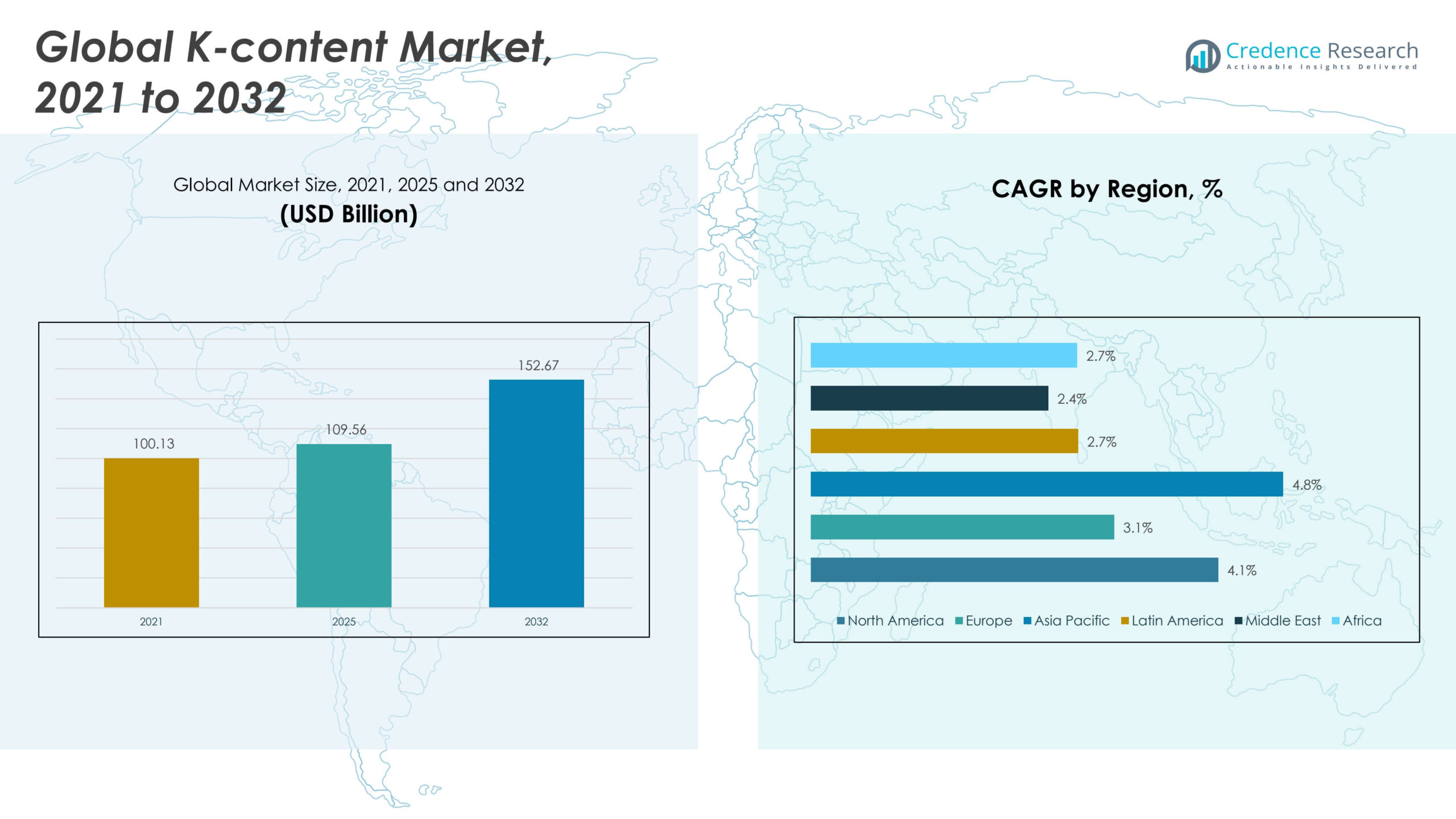
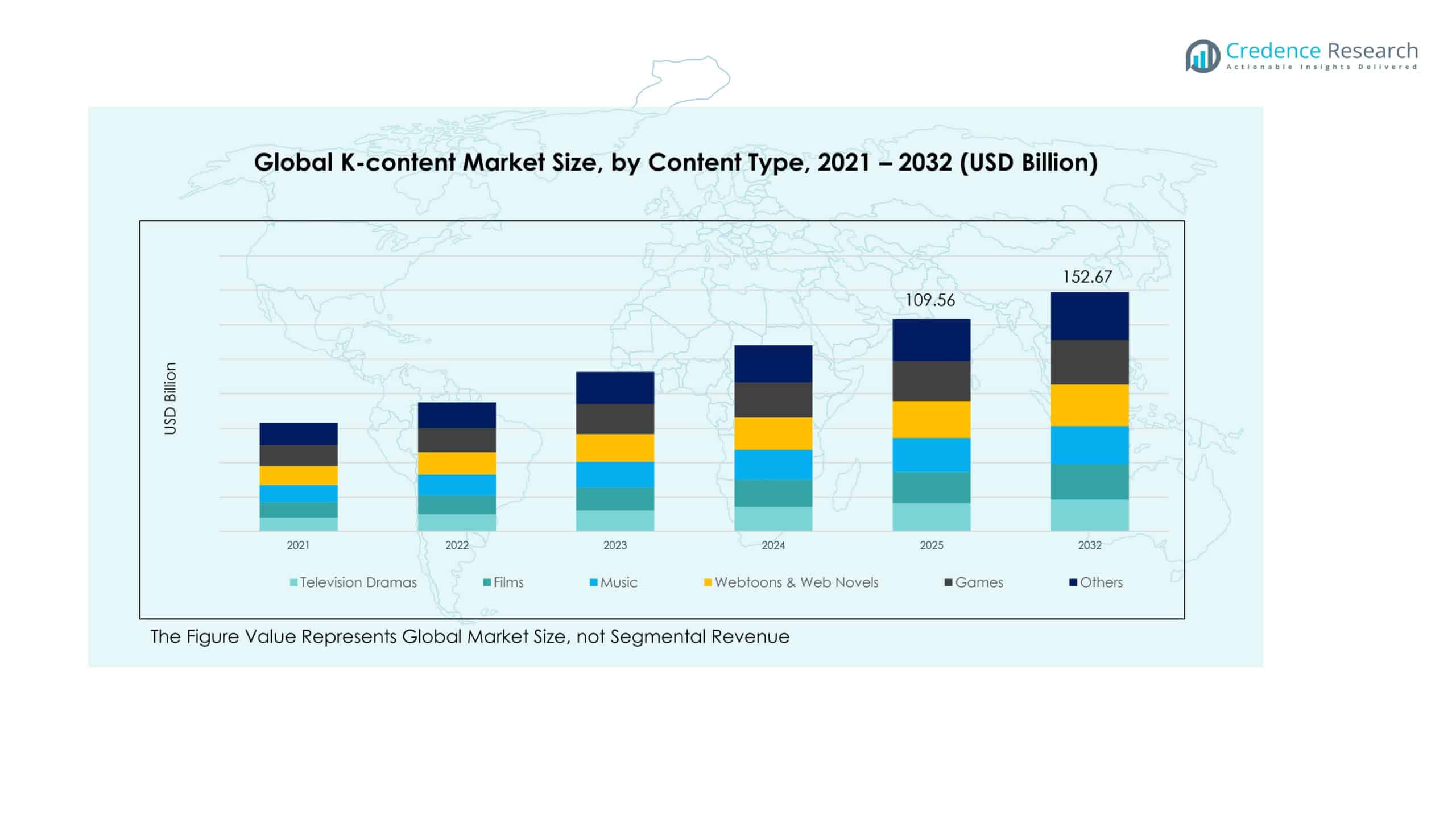
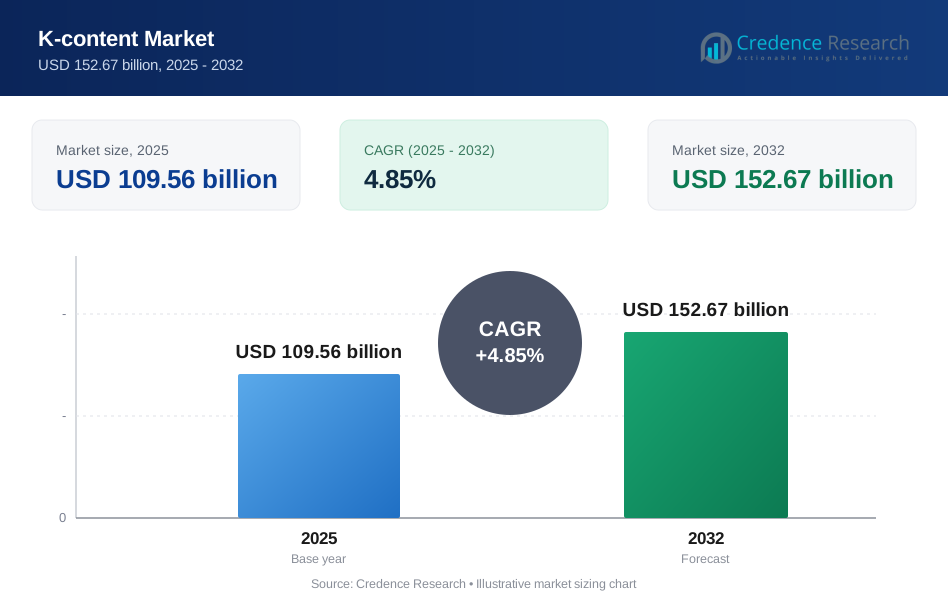
The global K-content market size was valued at USD 100.13 billion in 2021 and reached USD 109.56 billion in 2025. It is anticipated to reach USD 152.67 billion by 2032 according to Credence Research, growing at a CAGR of 4.85% from 2025 to 2032. The global expansion of digital streaming platforms, which has widened international access to Korean dramas, music, games, and other Korean cultural content. The Korea Development Institute identifies improved content quality, a maturing digital ecosystem, and increasingly interconnected business networks as major factors supporting the sector’s growth.
| REPORT ATTRIBUTE | DETAILS |
|---|---|
| Historical Period | 2021-2024 |
| Base Year | 2025 |
| Forecast Period | 2025-2032 |
| K-content Market Size 2025 | USD 109.56 Billion |
| K-content Market, CAGR | 4.85% |
| K-content Market Size 2032 | USD 152.67 Billion |
K-content Market Insights
- Market growth is supported by global demand for Korean dramas, music, games, webtoons and films across OTT platforms, music streaming services, gaming platforms and licensing channels.
- Television dramas hold a strong position in the market because international OTT platforms, regional broadcasters and content licensing partners continue to expand Korean scripted content distribution.
- Subscription remains a leading revenue model, supported by paid OTT platforms, music streaming services, gaming memberships and digital content bundles.
- Asia Pacific is projected to record the fastest regional CAGR at 4.8%, supported by strong cultural proximity, high digital media consumption, fandom activity and cross-border OTT distribution.
K-content Market Segment Insights
By content type
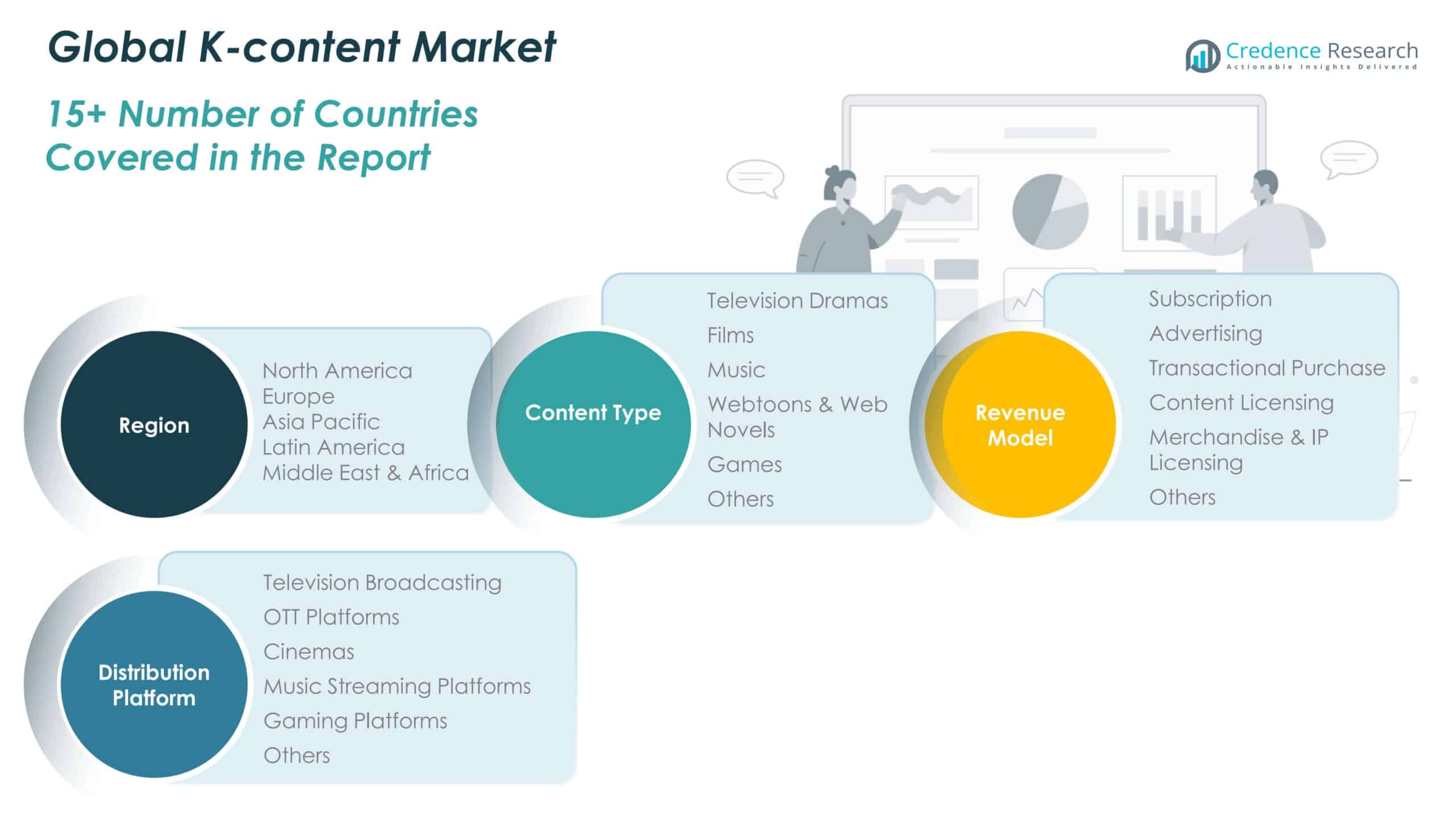
By content type, television dramas held a strong position in 2025, supported by global OTT distribution, subtitle and dubbing investment and strong international fan communities. Korean drama series continue to drive audience engagement across Asia Pacific, North America, Europe and Latin America because they combine strong storytelling, high production quality and cross-genre appeal. Music also remains a major content category due to the global reach of K-pop, live events, fan platforms, streaming and merchandise-linked intellectual property. Webtoons and web novels are gaining importance because they create scalable story IP that can be adapted into dramas, films, games and animation. Games represent a major digital revenue base, while films and others support diversified monetization through cinemas, streaming and licensing.
By revenue model
By revenue model, subscription held a strong position in 2025 because OTT platforms, music streaming services, gaming platforms and digital reading apps use recurring payment models to monetize K-content globally. Advertising remains important for free streaming, video platforms, social media promotion, webtoon platforms and music discovery. Transactional purchase supports cinema tickets, digital rentals, downloads, premium episodes, game items and event-linked purchases. Content licensing is a strategic revenue model as broadcasters, OTT platforms and regional distributors compete for Korean dramas, films and music programming. Merchandise and intellectual property licensing are expanding through fan goods, character products, concerts, games, brand collaborations and webtoon-based adaptations. Other revenue models include live events, creator subscriptions and platform-linked fan services.
By distribution platform
By distribution platform, OTT platforms held a strong position in 2025 because they provide global reach, multilingual access and large-scale discovery for television dramas, films, unscripted shows and documentaries. Television broadcasting remains relevant in domestic and regional markets where linear channels still support mass audience reach and advertising revenue. Cinemas continue to support film monetization, but their role is more selective compared with streaming-first distribution. Music streaming platforms drive K-pop discovery and long-tail catalog monetization across global markets. Gaming platforms support in-game purchases, subscriptions and cross-IP collaborations. Other platforms, including webtoon apps, social media, fan communities and live-event platforms, play an increasing role in audience development and intellectual property expansion.
Key Market Drivers
Global OTT demand and Korean drama exports
Global OTT demand and Korean drama exports represent a major growth driver for the global K-content market. Streaming platforms have expanded the reach of Korean dramas, films, unscripted shows and documentaries by lowering language and distribution barriers. Subtitles, dubbing, recommendation algorithms and localized promotion help Korean content reach new audiences across Asia Pacific, North America, Europe, Latin America, Africa and the Middle East. Production companies benefit from wider licensing opportunities and stronger international commissioning demand. Korean dramas also create downstream value by supporting music, tourism, webtoon adaptations, merchandise and brand partnerships. This driver will remain important through 2032 as OTT platforms compete for differentiated non-English content.
K-pop fandom and music streaming expansion
K-pop fandom and music streaming expansion support market growth by creating recurring digital engagement across platforms, concerts, merchandise and fan communities. K-pop acts generate revenue through streaming, albums, live tours, fan platforms, brand collaborations and intellectual property licensing. Global fandoms also strengthen social media visibility, which helps new releases move quickly across markets. Music streaming platforms support long-tail monetization and make Korean music accessible to international listeners. K-pop’s influence also strengthens demand for related television appearances, documentaries, games and merchandise. This driver supports strong cross-segment value because music acts often function as global cultural brands rather than single-format entertainment products.
Webtoon and game IP monetization
Webtoon and game IP monetization is strengthening the global K-content market as Korean companies convert digital-native intellectual property into broader entertainment franchises. Webtoons and web novels provide low-cost story testing and audience validation before adaptation into dramas, films, animation and games. Games support large digital revenue pools through in-game purchases, live services and global publishing. This IP cycle improves monetization because successful stories can move across distribution platforms and revenue models. Content owners benefit when they control characters, stories and fan communities across multiple formats. This driver will become more important as studios, publishers and platforms invest in adaptable IP pipelines.
Government support and cultural export strategy
Government support and cultural export strategy continue to strengthen the global K-content market. South Korea has treated cultural content as a strategic service export, supported by policy financing, talent development, overseas expansion initiatives and digital media infrastructure. This support helps smaller studios, creators, production houses and content platforms compete in international markets. Policy focus also supports content localization, intellectual property protection, overseas promotion and venture growth. Public support complements private investment from OTT platforms, entertainment agencies, game publishers and webtoon companies. This driver will remain relevant as South Korea seeks to expand its cultural influence and diversify export growth beyond manufacturing.
Key Trends and Opportunities
Cross-platform IP expansion accelerates
Cross-platform IP expansion is becoming a major opportunity as content owners turn successful dramas, webtoons, games and music acts into broader franchises. A webtoon can become a drama, a drama can support merchandise and tourism, and a music act can drive streaming, concerts, documentaries and fan platform engagement. This model improves lifecycle value and reduces dependence on single-release performance. Global platforms increasingly prefer IP with proven audiences and adaptation potential. Content owners with integrated production, publishing, licensing and talent management capabilities will gain a stronger position. The opportunity will remain strongest in television dramas, webtoons, web novels, games and merchandise licensing.
Regional localization expands audience reach
Regional localization is expanding audience reach as Korean content companies adapt distribution, marketing and partnerships for different markets. Asia Pacific remains the core region, but North America, Europe, Latin America, Africa and the Middle East offer growth opportunities through localized subtitles, dubbing, fan events, social media and platform partnerships. K-pop and K-dramas are also gaining traction in markets with young digital audiences and strong mobile media use. Localization helps reduce cultural barriers and improves repeat engagement. Content licensing partners can use regional audience data to select genres, release windows and marketing formats. This trend supports steady growth across OTT platforms, music streaming and gaming platforms.
Merchandise and intellectual property licensing gains value
Merchandise and intellectual property licensing are gaining value as K-content brands build global fandoms. Successful dramas, music acts, webtoons and games can generate revenue through albums, fan goods, character products, apparel, beauty collaborations, food partnerships and live events. Licensing helps content owners extend revenue beyond viewing or streaming. It also allows brands to monetize loyal fans across markets without relying only on advertising or subscription revenue. Intellectual property owners that manage rights carefully can build recurring revenue streams from franchises and character ecosystems. This opportunity will gain importance as competition for streaming revenue intensifies.
Key Market Challenges
Rising production cost and margin pressure
Rising production cost and margin pressure remain key challenges for the global K-content market. Global demand has increased expectations for production quality, star talent, visual effects, marketing and international distribution. Higher budgets can improve global competitiveness, but they also raise financial risk for studios and platforms. Smaller producers may struggle to compete for talent, financing and overseas promotion. Margin pressure can increase when licensing fees, advertising revenue or box-office returns do not keep pace with cost inflation. Content companies need stronger IP ownership, diversified monetization and disciplined project selection to manage this challenge.
Platform dependence and bargaining risk
Platform dependence and bargaining risk can limit long-term value capture for content owners. OTT platforms and global digital distributors provide scale, but they can also control audience data, commissioning terms, release timing and international promotion. Content producers may face weaker bargaining power if they depend heavily on a small number of platforms. Music, webtoon and game companies also face platform fees, algorithm changes and discoverability challenges. This risk can reduce revenue visibility and weaken direct fan relationships. Companies that build owned channels, fan communities and multi-platform licensing strategies will be better positioned.
Content fatigue and audience fragmentation
Content fatigue and audience fragmentation create challenges as global viewers face more entertainment choices across streaming, social media, gaming and short-form video. Korean content must compete not only with domestic entertainment in each market but also with other non-English content categories. Audience preferences vary by region, age group, genre and platform. A successful format in one market may not perform equally well elsewhere. Marketing costs can rise as platforms and studios work harder to capture attention. Companies that use data, localization and diversified content portfolios will manage this challenge more effectively.
Regional Analysis
Asia Pacific
Asia Pacific is projected to grow at a CAGR of 4.8% from 2025 to 2032 according to Credence Research, supported by strong cultural proximity, high digital media use and established demand for Korean dramas, music, games and webtoons. Japan, China, Southeast Asia and South Asia remain important markets for K-content consumption and licensing. OTT platforms, music streaming services and gaming platforms continue to expand access to Korean entertainment across mobile-first audiences. Regional fandom activity also supports merchandise, concerts and social media engagement. Asia Pacific will remain the largest and fastest-growing regional opportunity because Korean content already holds strong visibility across multiple formats.
North America
North America is projected to grow at a CAGR of 4.1% from 2025 to 2032 according to Credence Research, supported by wider acceptance of non-English content, strong streaming penetration and growing K-pop fandoms. OTT platforms play a central role in introducing Korean dramas, films and unscripted content to mainstream audiences. Music streaming and live events support K-pop monetization across the U.S. and Canada. Webtoons and games also benefit from digital-native consumers and strong app usage. Growth will depend on localization, genre diversity and platform investment. North America will remain a high-value region because it combines subscription revenue, merchandise demand and strong cultural visibility.
Europe
Europe is projected to grow at a CAGR of 3.1% from 2025 to 2032, supported by streaming adoption, film festival exposure, music fandoms and growing interest in Asian entertainment. Demand varies across countries, with stronger consumption in markets where OTT platforms, cultural events and K-pop communities have built awareness. Korean dramas and films benefit from subtitle availability and platform curation. Music streaming supports K-pop discovery, while webtoons and games expand among younger users. Europe offers steady growth but remains more fragmented due to language diversity, local content quotas and varied consumer behavior. Licensing and localized promotion will remain important for regional expansion.
Latin America
Latin America is projected to grow at a CAGR of 2.7% from 2025 to 2032, supported by young digital audiences, active fandom communities and rising OTT access. K-dramas and K-pop have built strong cultural awareness across several markets through streaming, social media and fan engagement. Music streaming platforms and live events support monetization, while dramas and webtoons create long-term IP opportunities. Pricing sensitivity can limit subscription growth, but ad-supported models and content licensing can expand reach. Localized Spanish and Portuguese subtitles and dubbing will remain important. Latin America offers meaningful upside as Korean entertainment companies deepen market-specific partnerships.
Africa
Africa is projected to grow at a CAGR of 2.7% from 2025 to 2032, supported by mobile-first media use, young demographics and expanding streaming access. K-content demand remains smaller than in Asia Pacific, North America and Europe, but awareness is rising through music, short-form video, social media and OTT platforms. Advertising-supported models and mobile-friendly distribution can help expand access in price-sensitive markets. Music and dramas are expected to be key entry points, while games can gain traction through mobile platforms. Growth will depend on affordability, internet access, payment systems and localization. Africa remains an emerging but long-term opportunity for K-content distribution.
Middle East
The Middle East is projected to grow at a CAGR of 2.4% from 2025 to 2032, supported by young audiences, high digital engagement and rising interest in Korean music, dramas and lifestyle-linked content. OTT platforms and regional streaming partnerships are improving access to Korean dramas and films. K-pop fandoms also support merchandise, events and social media visibility. Content localization, cultural fit and platform partnerships will shape adoption. The region offers selective growth in premium digital entertainment, especially in Gulf markets with stronger purchasing power. Long-term expansion will depend on localized distribution and partnerships with regional media platforms.
Company
- CJ ENM Co., Ltd.
- Studio Dragon Corporation
- SLL JoongAng Co., Ltd.
- Kakao Entertainment Corp.
- NAVER Corporation
- HYBE Co., Ltd.
- Krafton, Inc.
- NCSoft Corporation
- Netmarble Corporation
- Others
K-content Market Segmentations
By Content Type
- Television Dramas
- Films
- Music
- Webtoons and Web Novels
- Games
- Others
By Revenue Model
- Subscription
- Advertising
- Transactional Purchase
- Content Licensing
- Merchandise and Intellectual Property Licensing
- Others
By Distribution Platform
- Television Broadcasting
- OTT Platforms
- Cinemas
- Music Streaming Platforms
- Gaming Platforms
- Others
Recent Developments
- In February 2025, Netflix announced its 2025 Korea slate, covering new Korean series, films, unscripted programs and returning titles for global streaming audiences.
- In 2025, South Korea continued to position cultural exports as a growth engine, with industry and policy focus on music, dramas, webtoons, food and beauty-linked cultural influence.
- In 2025, Kakao Entertainment highlighted global performance across several scripted titles and reinforced its strategy of adapting webtoon and story IP into dramas and streaming content.
- In 2025, Korean entertainment companies continued to expand into Latin America, the Middle East and India through partnerships, localized production strategies and cross-market fan engagement.
Report Coverage
The research report offers an in-depth analysis based on content type, revenue model, distribution platform and region. It details market positioning across television dramas, films, music, webtoons and web novels, games and other content categories. The report includes insights into the competitive environment, market trends, growth drivers, restraints and opportunities. It also examines OTT distribution, K-pop fandom, webtoon and game IP monetization, content licensing, merchandise and intellectual property licensing and regional demand patterns as major factors shaping market development. The report assesses the impact of platform investment, cultural export policy, localization, digital media adoption and production cost pressure on market growth. It provides strategic recommendations for content producers, streaming platforms, music labels, webtoon publishers, game companies, licensors, investors and new entrants seeking to navigate the global K-content ecosystem.
Future Outlook
- Demand for K-content will continue to rise as global audiences consume more Korean dramas, music, games, webtoons and films across digital platforms.
- Television dramas will remain a leading content type because OTT platforms and broadcasters continue to license Korean scripted content.
- Music will remain a major revenue contributor through streaming, live events, fandom platforms, merchandise and intellectual property licensing.
- Webtoons and web novels will gain strategic importance because they create adaptable IP pipelines for dramas, films, animation and games.
- Games will remain a major digital content category because platform-based monetization supports recurring revenue.
- Subscription will remain a leading revenue model, supported by OTT platforms, music streaming services, gaming platforms and digital reading apps.
- Content licensing and merchandise and intellectual property licensing will become more important as owners seek stronger lifecycle value.
- OTT platforms will remain the leading distribution platform for global reach and multilingual accessibility.
- Asia Pacific will remain the fastest-growing region, while North America will remain a high-value market for streaming, music and merchandise.
- Competitive intensity will increase as content owners, platforms and licensors compete on IP ownership, production quality, localization, fan engagement and cross-platform monetization.
Request a Free Sample
Fill in your details and we'll send you a free sample report.
- Sample data tables & charts
- Research methodology
Need a Custom Version of This Report?
Tailor the scope, geography, or segments to your exact requirements.
- Custom geography or segment scope
- Direct access to our analyst team
Frequently Asked Questions
What is the current market size for the global K-content market and what is its projected size in 2032?
At what CAGR is the global K-content market projected to grow?
Which content type segment is expected to lead the global K-content market?
Which revenue model holds the strongest position in the market?
Which distribution platform supports strong market demand?
Which region is projected to grow fastest?
Table of Content
Chapter 1. Report Introduction
- 1.1 Report Description & Purpose
- 1.1.1 Report Title & Market Definition
- 1.1.2 Unique Selling Propositions (USP) & Key Differentiators
- 1.1.3 Value Proposition for Stakeholders
- 1.2 Research Objectives
- 1.2.1 Market Sizing Objectives (Volume & Revenue) (Volume Where Applicable)
- 1.2.2 Segmentation Objectives
- 1.2.3 Competitive Intelligence Objectives
- 1.2.4 Forecast & Scenario Objectives
- 1.3 Report Scope
- 1.3.1 K-content Scope – Segments & Subsegments Covered
- 1.3.2 Geographic Scope – Regions & Countries Covered
- 1.3.3 Historical Period, Base Year & Forecast Period (2025; forecast to 2032)
- 1.3.4 Inclusions & Exclusions
- 1.4 Industry Classification & Applicable Codes
- 1.5 Currency, Measurement Units & Valuation Basis
- 1.6 Target Stakeholders
- 1.7 Limitations & Assumptions
Chapter 2. Executive Summary
- 2.1 Global K-content Market Snapshot
- 2.1.1 Market Size – Historical (2025) & Forecast (2025-2032) (2025: USD 109.56 billion → 2032: USD 152.67 billion)
- 2.1.2 Volume & Revenue – Global Totals (Volume Where Applicable)
- 2.1.3 Key Market Highlights – Top Five Facts
- 2.2 K-content Market Segmentation Snapshot
- 2.2.1 Market Split by Region – 2025 vs. 2032
- 2.3 Competitive Snapshot
- 2.3.1 Top 10 Players by Revenue Share – 2025
- 2.3.2 Top 10 Players by Volume Share – 2025 (Volume Where Applicable)
- 2.3.3 Recent Strategic Developments (18-Month Summary)
- 2.4 Key Investment Highlights & Strategic Conclusions
Chapter 3. K-content Market Dynamics & Industry Analysis
- 3.1 Market Overview & Context
- 3.1.1 K-content Market Position in the Broader Industry Value Chain
- 3.1.2 Demand Structure & Purchasing Dynamics
- 3.1.3 Market Maturity & Development Stage by Region
- 3.2 K-content Market Drivers
- 3.3 K-content Market Restraints & Challenges
- 3.4 K-content Market Opportunities
- 3.5 Porter's Five Forces Analysis
- 3.5.1 Threat of New Entrants
- 3.5.2 Bargaining Power of Suppliers
- 3.5.3 Bargaining Power of Buyers
- 3.5.4 Threat of Substitutes
- 3.5.5 Competitive Rivalry – Intensity Assessment
- 3.6 K-content Value Chain Analysis
- 3.6.1 Upstream – Key Inputs, Resources & Suppliers
- 3.6.1.1 Key Input/Resource 1
- 3.6.1.2 Key Input/Resource 2
- 3.6.1.3 Key Input/Resource 3
- 3.6.2 Midstream – Core Operations & Value Creation
- 3.6.2.1 Operating Model & Process Overview
- 3.6.2.2 Key Operating Locations & Capabilities by Company
- 3.6.3 Downstream – Market Channels & End Users
- 3.6.3.1 Direct Sales & Customer Engagement Channels
- 3.6.3.2 Indirect Sales, Intermediaries & Partner Channels
- 3.6.4 Value Chain Profitability Analysis
- 3.6.1 Upstream – Key Inputs, Resources & Suppliers
- 3.7 PESTEL Analysis
- 3.7.1 Political Factors
- 3.7.2 Economic Factors
- 3.7.3 Social Factors
- 3.7.4 Technological Factors
- 3.7.5 Environmental Factors
- 3.7.6 Legal Factors
- 3.8 K-content Supply Chain Analysis
- 3.8.1 Critical Input & Resource Availability Risk Assessment
- 3.8.2 Supplier & Operational Concentration Risk (Geographic Exposure)
- 3.8.3 Supply & Service Disruption Impact Analysis
- 3.9 Regulatory & Policy Landscape
Note: The regulatory and policy landscape section covers regulations based on their applicability to the market, K-content category, geography, and scope of the study. Only regulatory frameworks with a material impact on operations, compliance, trade, sustainability, or market access are analyzed in detail.
Chapter 4. Key Investment Pockets & Opportunity Analysis
- 4.1 K-content Market Attractiveness Analysis
- 4.1.1 By Region – Investment Attractiveness Matrix (Market Size × CAGR)
- 4.2 Absolute Revenue Growth Opportunity
- 4.2.1 By Region – Absolute Revenue Growth Through 2032
- 4.3 Incremental Demand Opportunity
- 4.3.1 By Region – Incremental Demand Through 2032
- 4.3.2 Segment – Incremental Demand
- 4.4 Emerging Submarket Opportunity Deep Dive (Subject to Applicability)
- 4.5 Priority Market Opportunity Scorecards
- 4.5.1 United States
- 4.5.2 Europe
- 4.5.3 Asia
- 4.5.4 Middle East & Africa
Note: Priority market opportunity scorecards reflect the geographic scope and strategic relevance of the study. Listed markets are indicative and may be adapted to the industry.
Chapter 5. K-content Cross-Border Trade & Market Access Analysis
- 5.1 International Trade & Cross-Border Activity Overview
- 5.1.1 Global Export Value by Country (2025)
- 5.1.2 Global Export Volume by Country (2025) (Volume Where Applicable)
- 5.1.3 Global Import Value by Country (2025)
- 5.1.4 Global Import Volume by Country (2025) (Volume Where Applicable)
- 5.1.5 Net Trade Balance by Country (2025)
- 5.2 Export Analysis – Segment
- 5.2.1 Category 1 (Applicable Classification Code)
- 5.2.2 Category 2 (Applicable Classification Code)
- 5.2.3 Category 3 (Applicable Classification Code)
- 5.2.4 Category 4 (Applicable Classification Code)
- 5.2.5 Category 5 (Applicable Classification Code)
- 5.3 Import Analysis – Segment
- 5.3.1 Category 1 (Applicable Classification Code)
- 5.3.2 Category 2 (Applicable Classification Code)
- 5.3.3 Category 3 (Applicable Classification Code)
- 5.3.4 Category 4 (Applicable Classification Code)
- 5.3.5 Category 5 (Applicable Classification Code)
- 5.4 Cross-Border Pricing & Transaction Benchmarks
- 5.4.1 Export Pricing – Segment & Country
- 5.4.2 Import Pricing – Segment & Source Country
- 5.4.3 Price Trends (2025)
- 5.5 Key Cross-Border Trade & Delivery Routes
- 5.5.1 Cross-Border Trade/Delivery Route 1
- 5.5.2 Cross-Border Trade/Delivery Route 2
- 5.5.3 Cross-Border Trade/Delivery Route 3
- 5.5.4 Cross-Border Trade/Delivery Route 4
- 5.5.5 Cross-Border Trade/Delivery Route 5
- 5.6 Trade Policy & Market Access Impact Assessment
- 5.6.1 Tariff & Non-Tariff Barriers
- 5.6.2 Regional Trade & Economic Integration Frameworks
- 5.6.3 Bilateral & Multilateral Trade Agreements
- 5.6.4 Cross-Border Operating, Licensing & Localization Requirements
Note: This chapter applies where cross-border trade or delivery is relevant to K-content. Goods, services, and digital offerings are assessed using applicable classifications and transaction measures. Import-export volumes, trade balances, and route analyses are included only where meaningful to the market.
Chapter 6. Competitive Landscape & Company Benchmarking
- 6.1 K-content Market Concentration & Structure
- 6.1.1 Herfindahl-Hirschman Index (HHI) – the historical period vs. 2025
- 6.1.2 Leading, Mid-Sized & Emerging Player Structure
- 6.1.3 Global, Regional & Local Player Dynamics
- 6.2 K-content Market Share Analysis – 2025
- 6.2.1 Global Revenue Share by Company
- 6.2.2 Global Volume Share by Company (Volume Where Applicable)
- 6.2.3 Regional Revenue Share
- 6.2.4 Market Share Evolution (the historical period vs. 2025)
- 6.2.5 Company Market Share by Key Segment
- 6.2.6 Company Market Share by Customer Group
- 6.3 Operating Scale, Capacity & Infrastructure Analysis
- 6.3.1 Global Operating Scale & Supply Capacity
- 6.3.2 Resource Utilization & Operating Efficiency
- 6.3.3 Output, Service Delivery & Activity Metrics
- 6.3.4 Operating Footprint & Infrastructure Map
- 6.3.5 Planned Operational & Capacity Expansion
- 6.4 K-content Competitive Benchmarking Matrix
- 6.4.1 Revenue, Growth, Profitability & Operating Metric Comparison
- 6.4.2 Channel Revenue Mix
- 6.4.3 Geographic Revenue Exposure
- 6.4.4 R&D Intensity
- 6.4.5 Sustainability Maturity
- 6.5 Strategic Developments in K-content (Last 24 Months)
- 6.5.1 Mergers, Acquisitions & Divestments
- 6.5.2 New Products, Services & Solutions in K-content
- 6.5.3 Operational & Infrastructure Expansions
- 6.5.4 Strategic Alliances, Joint Ventures & Partnerships
- 6.5.5 Distribution Expansion & Market Entry
- 6.5.6 Sustainability & ESG Initiatives
- 6.6 Competitive Strategy Mapping
- 6.6.1 Leader, Challenger, Follower & Niche Classification
- 6.6.2 Pricing Strategy Comparison
- 6.6.3 Channel Strategy Matrix
Note: Strategic developments are included based on their materiality and the availability of reliable information.
Chapter 7. Global K-content Market – By Sales & Delivery Channel
- 7.1 Segment Overview
- 7.1.1 Volume & Revenue Split by Channel (2025 & 2032) (Volume Where Applicable)
- 7.1.2 Channel Mix Evolution (2025-2032)
Chapter 8. Regional Market Analysis – Global Overview
- 8.1 Global Regional Overview
- 8.1.1 Regional Volume Share (Volume Where Applicable)
- 8.1.2 Regional Revenue Share
- 8.1.3 Regional Volume by Region (Volume Where Applicable)
- 8.1.4 Regional Revenue by Region
- 8.1.5 Regional Forecast Through 2032
- 8.2 Cross-Regional Segment Analysis
- 8.2.1 By Sales & Delivery Channel
- 8.2.2 By Competitive Positioning & Price Tier
Chapter 9. North America K-content Market
- 9.1 United States
- 9.2 Canada
- 9.3 Mexico
Chapter 10. Europe K-content Market
- 10.1 Germany
- 10.2 France
- 10.3 Italy
- 10.4 United Kingdom
- 10.5 Spain
- 10.6 Poland
- 10.7 Russia
- 10.8 Netherlands
- 10.9 Belgium
- 10.10 Sweden
- 10.11 Denmark
- 10.12 Norway
- 10.13 Rest of Europe
Chapter 11. Asia Pacific K-content Market
- 11.1 China
- 11.2 India
- 11.3 Japan
- 11.4 South Korea
- 11.5 Thailand
- 11.6 Indonesia
- 11.7 Vietnam
- 11.8 Malaysia
- 11.9 Australia
- 11.10 Rest of Asia Pacific
Chapter 12. Latin America K-content Market
- 12.1 Brazil
- 12.2 Argentina
- 12.3 Colombia
- 12.4 Chile
- 12.5 Rest of Latin America
Chapter 13. Middle East K-content Market
- 13.1 Saudi Arabia
- 13.2 United Arab Emirates
- 13.3 Turkey
- 13.4 Israel
- 13.5 Iran
- 13.6 Rest of the Middle East
Chapter 14. Africa K-content Market
- 14.1 South Africa
- 14.2 Egypt
- 14.3 Nigeria
- 14.4 Morocco
- 14.5 Rest of Africa
Chapter 15. K-content Company Profiles
- 15.1 [Company 01]
- 15.1.1 Company Overview
- 15.1.2 Key Management Personnel
- 15.1.3 Products & Services Portfolio
- 15.1.4 Financial Performance
- 15.1.5 Key Market Focus & Geographic Presence
- 15.1.6 Recent Developments & Strategic Initiatives
Note: The company profile list is preliminary and may change based on research findings, market developments, data availability, and client requirements.
Chapter 16. Appendices
- Appendix A – List of Abbreviations & Acronyms
- Appendix B – Industry Classification Code Reference – Full Series
- Appendix C – Supply, Output & Operating Capacity Data Tables
- Appendix D – End-Use & Demand Base Tables
- Appendix E – Demand, Adoption & Usage Assumptions
- Appendix F – Pricing & Revenue Metric Reference Tables
- Appendix G – Company Operations & Infrastructure Database
- Appendix H – Cross-Border Trade & Activity Data Tables (Where Applicable)
- Appendix I – Regulatory Summary Tables
- Appendix J – Primary Research Participant List (Anonymized)
- Appendix K – Primary Research Questionnaire Framework
- Appendix L – Data Sources & Bibliography
- Appendix M – Market Size Divergence & Source Comparison
Chapter 17. Research Methodology
- 17.1 Research Framework & Philosophy
- 17.2 Secondary Research – Sources, Hierarchy & Data Extraction
- 17.3 Data Modeling – Bottom-Up & Top-Down Market Sizing
- 17.4 Primary Research – Stakeholder Framework, LOI & Sample Sizes
- 17.5 Forecast Methodology – Regression, Scenario & Sensitivity Analysis
- 17.6 Quality Control – Four-Layer Validation Framework
- 17.7 Limitations & Standard Assumptions
- 17.8 Disclaimer
