
Market Overview:
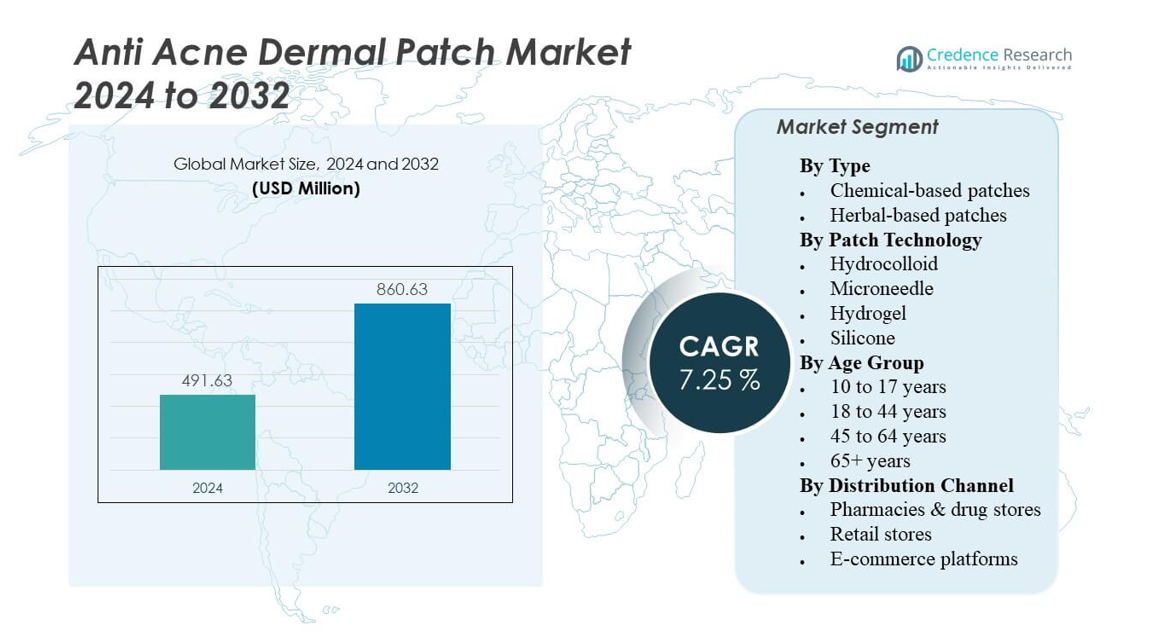
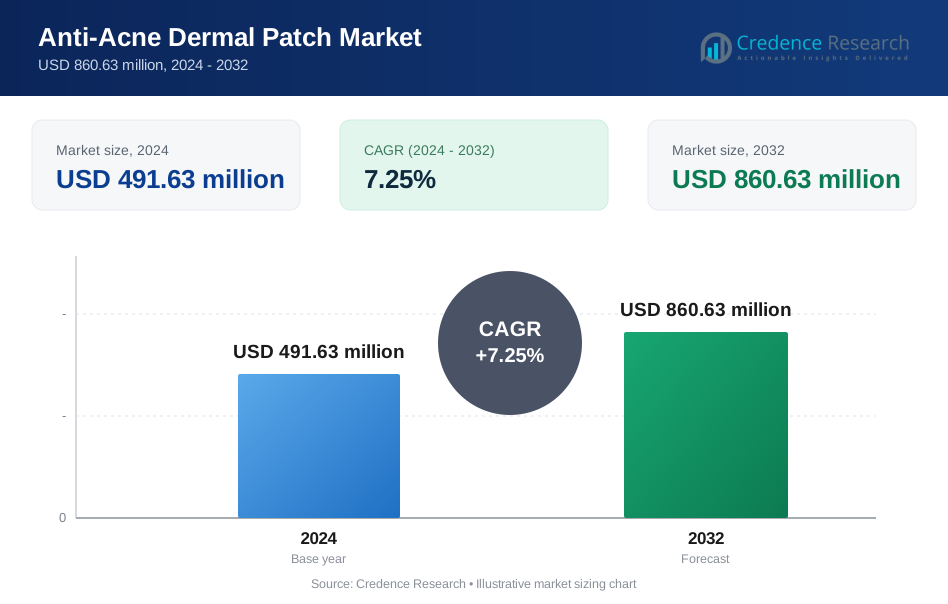
The Anti Acne Dermal Patch Market is projected to grow from USD 491.63 million in 2024 to an estimated USD 860.63 million by 2032, with a compound annual growth rate (CAGR) of 7.25% from 2024 to 2032.
| REPORT ATTRIBUTE | DETAILS |
|---|---|
| Historical Period | 2020-2023 |
| Base Year | 2024 |
| Forecast Period | 2025-2032 |
| Anti-Acne Dermal Patch Market Size 2024 | USD 491.63 million |
| Anti-Acne Dermal Patch Market, CAGR | 7.25% |
| Anti-Acne Dermal Patch Market Size 2032 | USD 860.63 million |
Rising acne prevalence among both adolescents and adults is driving market expansion. Growing awareness of skincare routines, increasing disposable incomes, and the shift toward convenient, non-invasive treatments strengthen demand. It benefits from product innovations such as hydrocolloid, herbal, and micro-needle patches that deliver faster healing and reduced inflammation. Influencer marketing and expanding e-commerce channels continue to support brand reach and consumer adoption globally.
North America leads due to high skincare awareness, strong retail networks, and advanced product innovation. Europe follows closely with sustainable and dermatologically tested formulations gaining preference. Asia-Pacific is an emerging growth hub, fueled by large youth populations, social media-driven beauty trends, and the rapid expansion of online skincare retail across countries like South Korea, Japan, and China.
Market Insights:
- The Anti Acne Dermal Patch Market is valued at USD 491.63 million in 2024 and projected to reach USD 860.63 million by 2032, growing at a CAGR of 7.25%.
- Rising acne prevalence across teenage and adult populations is fueling consistent product demand worldwide.
- Consumers prefer convenient, non-invasive, and quick-acting acne treatments over traditional topical creams.
- Increasing product innovation, such as hydrocolloid and micro-needle patches, enhances healing effectiveness.
- High production costs and limited awareness in developing regions slightly restrain market penetration.
- North America leads the market due to high skincare awareness and advanced dermatological products.
- Asia-Pacific is emerging as a key growth region, supported by youth-driven skincare trends and expanding e-commerce platforms.
Market Drivers
Rising Acne Prevalence and Growing Demand for Convenient Skincare Solutions
The increasing prevalence of acne among adolescents and adults drives the Anti Acne Dermal Patch Market forward. Lifestyle factors, pollution, and hormonal imbalance contribute to acne breakouts, creating demand for quick and effective remedies. Consumers prefer patches due to their convenience, invisibility, and mess-free application. It appeals to individuals seeking discreet treatments compatible with daily routines. The fast-paced lifestyle and desire for non-invasive skincare options further strengthen adoption. Growing awareness of skincare hygiene supports higher acceptance of patches. Dermatologists also recommend patches for mild acne, supporting their credibility.
Advancements in Patch Technology and Formulation Innovation
Continuous product innovation fuels market expansion. Manufacturers integrate hydrocolloid materials with active ingredients like salicylic acid, tea tree oil, and niacinamide. It improves healing, reduces inflammation, and promotes faster recovery. Transparent and breathable patch designs enhance comfort and usability. Companies are also introducing micro-needle and dissolving patches to improve ingredient delivery. Such innovations attract a tech-driven skincare audience seeking visible results. New product launches and R&D investments increase competition and consumer interest. Innovation in texture, adherence, and skin compatibility continues to boost consumer trust.
- For instance, ZitSticka’s KILLA patch features 24 self-dissolving microdarts per patch, as officially confirmed on ZitSticka’s website and retail pages; in a consumer study, 85% of panelists agreed KILLA helped reduce pimple color and size,
Influence of Social Media and Growing Beauty Awareness
ocial media platforms significantly drive the market, promoting visual skincare transformations. Influencers highlight patch effectiveness, increasing curiosity and acceptance among young consumers. It creates aspirational purchasing behavior linked to visible skin improvement. The rise of self-care trends has transformed acne patches from treatment products into lifestyle essentials. Marketing through digital channels and short video platforms builds brand visibility. Consumers perceive patches as fashionable skincare tools rather than clinical aids. Global cosmetic brands capitalize on this trend by expanding influencer partnerships. Growing engagement across digital channels enhances global product recognition.
- For instance, COSRX’s Acne Pimple Master Patch remains one of the most recognized K-beauty products globally, frequently cited in industry reports and social media marketing case studies for its viral online presence and strong consumer engagement across Instagram and TikTok platforms.
E-commerce Growth and Expanding Accessibility of Dermatological Products
Online retailing enhances accessibility and visibility for acne patch products. Consumers can explore diverse brands and formulations with transparent reviews and pricing. It benefits small and emerging skincare companies seeking global reach. E-commerce platforms enable quick adoption of niche dermatological innovations. Subscription models and discounts increase repeat purchases. Retail chains also collaborate with online stores to maintain visibility. Growing consumer comfort with digital purchases strengthens product penetration in urban and semi-urban regions. Online engagement channels provide valuable insights for product refinement and marketing precision.
Market Trends
Adoption of Sustainable and Biodegradable Skincare Materials
The growing shift toward eco-friendly skincare influences product development trends. Brands use biodegradable polymers, natural adhesives, and recyclable packaging to appeal to conscious consumers. It aligns with global sustainability standards in cosmetic production. Manufacturers highlight cruelty-free testing and clean formulations to strengthen consumer loyalty. Demand for environment-safe acne patches is rising among younger users. Companies emphasize transparency in sourcing and product labeling to maintain trust. This trend encourages consistent innovation toward greener skincare manufacturing. Sustainability now represents both a value and a differentiator in this market.
Integration of Smart Patches and Advanced Ingredient Delivery Systems
Technological advancements are transforming the functional design of acne patches. Brands introduce micro-needle and nano-layered patches capable of controlled ingredient release. It enhances absorption efficiency and therapeutic outcomes. These systems combine comfort with precision, providing measurable benefits for active acne treatment. The integration of AI-driven skincare assessments further personalizes recommendations. Consumers value smart solutions that combine medical accuracy with cosmetic appeal. Research collaborations between cosmetic firms and biotech companies accelerate these developments. The focus on skin-compatible technology marks a defining evolution in product sophistication.
Rising Male Grooming Awareness and Expanding Target Demographics
The growing focus on men’s skincare significantly broadens market scope. Male consumers now seek products that address acne while preserving natural appearance. It creates fresh demand for gender-neutral and minimalist designs. Companies introduce acne patches with neutral tones and matte finishes to appeal to male users. Marketing strategies are shifting toward inclusivity, reflecting broader grooming awareness. Dermatologists promote patches suitable for sensitive or oily male skin types. Increasing social acceptance of skincare among men strengthens this evolving segment. Expanding product visibility in men’s care aisles enhances overall market reach.
- For instance, Starface has sold more than one billion individual Hydro-Stars since its 2019 launch and generated roughly $90 million in revenue in 2024, according to reports by CNBC Make It and Yahoo Finance. These figures highlight the brand’s strong global market presence in acne patch products.
Customization and Personalized Skincare Preferences Among Consumers
Personalized skincare is shaping the evolution of the acne patch industry. Brands offer customized formulations that address specific acne types and skin sensitivities. It allows users to choose between patches with anti-inflammatory, antibacterial, or healing properties. The availability of trial kits and subscription boxes supports personalized treatment routines. AI-powered diagnostic tools and mobile apps help consumers identify suitable products. Retailers leverage data insights to recommend targeted skincare solutions. Such tailored approaches improve satisfaction and retention rates. Personalized offerings elevate consumer engagement and strengthen brand differentiation.
- For instance, Hero Cosmetics reported a 21% increase in purchase conversions within the first 100 days of launching its Hero Skin Squad Community in partnership with TrueLoyal, as confirmed by the TrueLoyal case study. This result highlights the measurable impact of personalized consumer engagement initiatives.
Market Challenges Analysis
Low Awareness in Developing Regions and Limited Dermatological Education
The Anti Acne Dermal Patch Market faces obstacles in countries with low dermatological awareness. Consumers often rely on traditional remedies or over-the-counter creams instead of advanced patch solutions. It limits demand potential in rural and semi-urban markets. High prices and limited retail availability also restrict adoption. Distribution gaps and inconsistent product education create misinformation about patch efficacy. Manufacturers must invest in awareness campaigns and dermatologist-led outreach to overcome barriers. The absence of standardized product labeling across emerging regions adds to consumer hesitation. Expanding education initiatives is vital to increasing penetration and credibility.
Product Duplication, Pricing Pressure, and Regulatory Compliance Issues
Counterfeit and low-quality products create trust issues among consumers. It weakens brand reputation and affects revenue growth for legitimate companies. The influx of unregulated products on online platforms increases the risk of skin irritation cases. Maintaining compliance with regional cosmetic standards remains a complex task. Price competition among local brands pressures established players to reduce margins. Fluctuating import duties and ingredient costs affect profitability in some regions. Stronger regulation and authentication mechanisms are needed to preserve market integrity. Collaboration between regulators and manufacturers can ensure safe, consistent product quality.
Market Opportunities
Expansion in Asia-Pacific and Growing Urban Skincare Consciousness
Rising disposable incomes and increasing skincare awareness create vast opportunities in Asia-Pacific. Urban consumers seek quick, effective, and visually appealing acne solutions. It supports local manufacturing and private-label collaborations. Korean and Japanese brands lead innovations in hydrogel and micro-needle technologies. Cross-border e-commerce strengthens access to regional skincare innovations. The influence of K-beauty trends boosts market exposure across Southeast Asia and India. Partnerships with local dermatologists can enhance trust and adoption. The evolving beauty ecosystem in these regions offers immense growth potential.
Innovation in Active Ingredients and Functional Patch Development
The growing demand for multi-functional skincare drives ingredient innovation. Companies are exploring anti-inflammatory botanicals, peptides, and ceramides for targeted acne management. It helps enhance healing speed and post-acne care efficiency. The introduction of dual-action patches combining hydration and treatment attracts premium consumers. Pharmaceutical firms are also entering collaborations to co-develop clinically proven patches. Investment in clinical testing enhances brand credibility and consumer trust. Enhanced delivery systems and advanced polymers ensure better adherence and comfort. Innovation remains the most significant growth catalyst shaping the industry’s future direction.
Market Segmentation Analysis:
By Type
The Anti Acne Dermal Patch Market is segmented into chemical-based and herbal-based patches. Chemical-based patches dominate due to their proven efficiency in treating active acne using active ingredients like salicylic acid and niacinamide. It offers quick results and consistent performance for both mild and moderate acne cases. Herbal-based patches are gaining traction among consumers seeking natural, skin-friendly alternatives. These patches use plant extracts such as tea tree oil and centella asiatica, which reduce irritation and promote gentle healing. Growing awareness of clean-label skincare supports this segment’s expansion. The balance between efficacy and natural safety defines consumer preference in this category.
By Patch Technology
Based on technology, the market includes hydrocolloid, microneedle, hydrogel, and silicone patches. Hydrocolloid technology holds the largest share due to its strong moisture retention and absorption ability, accelerating healing and reducing inflammation. It is widely available across both premium and mass-market brands. Microneedle patches are emerging for their advanced delivery of active ingredients deep into the skin. Hydrogel patches provide enhanced comfort and cooling effects for sensitive users. Silicone-based patches appeal to consumers targeting scar prevention and long-term acne recovery. Each technology addresses specific skin needs, strengthening product diversification and adoption.
- For instance, hydrocolloid patches from leading brands such as Mighty Patch and COSRX have been independently reviewed to reduce the size and redness of acne lesions in 24 hours, as verified by dermatologist-run product test panels.
By Age Group
The market serves diverse age groups ranging from teenagers to older adults. The 18 to 44 years segment leads due to higher acne prevalence among adults and increased skincare spending. It reflects the growing influence of lifestyle stress and pollution-related breakouts. Teenagers aged 10 to 17 also represent a key segment, driven by hormonal fluctuations and social media awareness. The 45 to 64 and 65+ groups show growing adoption for post-acne care and scar management. It highlights expanding demand beyond adolescent skincare. Rising awareness across all age categories ensures broader consumer penetration for brands.
- For instance, Neutrogena’s Ultra-Thin Blemish Patches are clinically tested and reported by the company to deliver visible results, with over 90% of users noticing flatter pimples by the next day, according to data published on Neutrogena’s official product page.
By Distribution Channel
The distribution landscape includes pharmacies and drug stores, retail stores, and e-commerce platforms. Pharmacies and drug stores dominate due to consumer trust in medically recommended products. It ensures availability of dermatologist-endorsed patches with verified formulations. Retail stores provide visibility for mass-market brands and promote impulse purchases. E-commerce platforms show the fastest growth due to convenience and digital marketing influence. It enables direct-to-consumer models with broader reach and easy product comparison. Online reviews and influencer endorsements further drive sales. The omnichannel presence of brands strengthens accessibility and consumer confidence across regions.
Segmentation:
By Type
- Chemical-based patches
- Herbal-based patches
By Patch Technology
- Hydrocolloid
- Microneedle
- Hydrogel
- Silicone
By Age Group
- 10 to 17 years
- 18 to 44 years
- 45 to 64 years
- 65+ years
By Distribution Channel
- Pharmacies & drug stores
- Retail stores
- E-commerce platforms
By Region
- North America
- U.S.
- Canada
- Mexico
- Europe
- Germany
- France
- U.K.
- Italy
- Spain
- Rest of Europe
- Asia Pacific
- China
- Japan
- India
- South Korea
- South-east Asia
- Rest of Asia Pacific
- Latin America
- Brazil
- Argentina
- Rest of Latin America
- Middle East & Africa
- GCC Countries
- South Africa
- Rest of the Middle East and Africa
Regional Analysis:
North America
North America leads the Anti Acne Dermal Patch Market with a market share of 37%. The region’s dominance is supported by high consumer awareness, advanced dermatological infrastructure, and the strong presence of premium skincare brands. It benefits from early adoption of innovative acne treatment solutions and high expenditure on personal care products. The United States accounts for the largest share within the region, driven by frequent product launches and celebrity-endorsed campaigns. Canada contributes steadily due to rising demand for natural and eco-friendly skincare options. Favorable retail distribution across pharmacies, online channels, and beauty stores ensures continuous market growth and accessibility.
Europe
Europe holds a market share of 28%, driven by increasing focus on dermatological health and sustainable skincare solutions. Consumers prefer clean-label, vegan, and cruelty-free acne patches that align with regional sustainability standards. It shows strong product penetration across markets such as Germany, the United Kingdom, and France. Major cosmetic and pharmaceutical brands continue to expand their acne-care portfolios to serve growing consumer interest. Online retailing and organized beauty chains strengthen visibility for innovative patch-based products. The region’s strict regulatory framework promotes product quality, enhancing trust and repeat purchases. Continuous innovation in bioactive and transparent patches supports long-term market expansion.
Asia-Pacific, Latin America, and Middle East & Africa
Asia-Pacific accounts for 25% of the market share and exhibits the fastest growth rate. South Korea, Japan, and China dominate regional demand through innovation in hydrocolloid and micro-needle patches. It benefits from beauty-conscious consumers, K-beauty influence, and expanding e-commerce networks. Latin America captures 6% of the share, with Brazil and Mexico showing rising skincare awareness among younger demographics. The Middle East & Africa holds 4% of the market share, supported by growing urbanization and improving access to dermatological care. These emerging regions represent untapped potential for international brands seeking localized expansion. Increasing affordability and wider distribution are likely to strengthen their market position.
Key Player Analysis:
- Hero Cosmetics (Mighty Patch)
- COSRX
- Peace Out Skincare
- ZitSticka
- 3M
- Peter Thomas Roth Labs LLC
- Rael
- Starface
- DermaAngel
- Sephora USA, Inc.
- Urban Outfitters
- Peach & Lily
- Alba Botanica
Competitive Analysis:
The Anti Acne Dermal Patch Market features strong competition among established skincare brands and emerging dermatological companies. Key players include Hero Cosmetics, 3M, COSRX, ZitSticka, Rael, Peace Out Skincare, and Nexcare. It emphasizes innovation in hydrocolloid, micro-needle, and herbal formulations to enhance performance and comfort. Companies focus on ingredient transparency, eco-friendly packaging, and dermatological testing to build consumer trust. Strategic collaborations, product diversification, and regional expansion drive brand positioning in global markets. Digital marketing and influencer campaigns play a critical role in customer engagement and brand visibility. The entry of pharmaceutical and cosmetic hybrid brands is intensifying price and innovation competition. Growing investment in research and clinical validation is strengthening credibility and market differentiation.
Recent Developments:
- In August 2025, PanOxyl (by Revance) launched its new Daytime Invisible Patches, infused with salicylic acid and designed for all-day wear under makeup. The product aims to enhance the Anti Acne Dermal Patch Market by offering a discreet, treatment-level patch option along with its Acne Gel Wash, reinforcing its position in the acne-care segment.
- In July 2024, Starface introduced the Hydro-Star Clear pimple patch, an invisible hydrocolloid option built on its signature playful style. The launch expanded the Anti Acne Dermal Patch Market’s appeal to users seeking both efficacy and aesthetics in acne treatment accessories.
- In May 2024, The Inkey List expanded its acne product portfolio by launching Hydrocolloid Invisible Pimple Patches, which became available on Sephora’s app on June 3 and on Sephora’s website the following day. This launch reinforces the company's commitment to affordable, efficient acne solutions and follows their recent innovation in digital acne analysis tools.
Report Coverage:
The research report offers an in-depth analysis based on Type, Patch Technology, Age Group and Distribution Channel. It details leading market players, providing an overview of their business, product offerings, investments, revenue streams, and key applications. Additionally, the report includes insights into the competitive environment, SWOT analysis, current market trends, as well as the primary drivers and constraints. Furthermore, it discusses various factors that have driven market expansion in recent years. The report also explores market dynamics, regulatory scenarios, and technological advancements that are shaping the industry. It assesses the impact of external factors and global economic changes on market growth. Lastly, it provides strategic recommendations for new entrants and established companies to navigate the complexities of the market.
Future Outlook:
- Rising consumer awareness of skin health will continue to drive consistent product adoption.
- Technological advances in micro-needle and hydrocolloid formulations will enhance treatment outcomes.
- Expanding e-commerce networks will strengthen accessibility across developed and emerging regions.
- Eco-friendly and biodegradable patch materials will attract environmentally conscious consumers.
- Collaboration between skincare and pharmaceutical companies will lead to clinically proven formulations.
- Personalized acne patch solutions will grow through AI-based skin diagnostics and data-driven insights.
- Premium brands will focus on transparency, ingredient safety, and sustainable sourcing practices.
- Social media and influencer marketing will remain vital in shaping consumer perception and brand loyalty.
- The inclusion of men’s skincare and gender-neutral branding will expand the target audience base.
- Increasing dermatological awareness in developing economies will open new market opportunities.
Request a Free Sample
Fill in your details and we'll send you a free sample report.
- Sample data tables & charts
- Research methodology
Need a Custom Version of This Report?
Tailor the scope, geography, or segments to your exact requirements.
- Custom geography or segment scope
- Direct access to our analyst team
Frequently Asked Questions
What is the current market size for Anti Acne Dermal Patch Market, and what is its projected size in 2032?
At what Compound Annual Growth Rate is the Anti Acne Dermal Patch Market projected to grow between 2024 and 2032?
Which Anti Acne Dermal Patch Market segment held the largest share in 2024?
What are the primary factors fueling the growth of the Anti Acne Dermal Patch Market?
Who are the leading companies in the Anti Acne Dermal Patch Market?
Table of Content
Chapter 1. Report Introduction
- 1.1 Report Description & Purpose
- 1.1.1 Report Title & Market Definition
- 1.1.2 Unique Selling Propositions (USP) & Key Differentiators
- 1.1.3 Value Proposition for Stakeholders
- 1.2 Research Objectives
- 1.2.1 Market Sizing Objectives (Volume & Revenue)
- 1.2.2 Segmentation Objectives
- 1.2.3 Competitive Intelligence Objectives
- 1.2.4 Forecast & Scenario Objectives
- 1.3 Report Scope
- 1.3.1 Anti-Acne Dermal Patch Scope – Types & Subtypes Covered
- 1.3.2 Geographic Scope – Regions & Countries Covered
- 1.3.3 Historical Period, Base Year & Forecast Period (2024; forecast to 2032)
- 1.3.4 Inclusions & Exclusions
- 1.4 HS Code & Classification Framework
- 1.5 Currency, Units & Pricing Basis
- 1.6 Target Stakeholders
- 1.7 Limitations & Assumptions
Chapter 2. Executive Summary
- 2.1 Global Anti-Acne Dermal Patch Market Snapshot
- 2.1.1 Market Size – Historical (2024) & Forecast (2024-2032) (2024: USD 491.63 million → 2032: USD 860.63 million)
- 2.1.2 Volume & Revenue – Global Totals
- 2.1.3 Key Market Highlights – Top Five Facts
- 2.2 Anti-Acne Dermal Patch Market Segmentation Snapshot
- 2.2.1 Market Split by Region – 2024 vs. 2032
- 2.3 Competitive Snapshot
- 2.3.1 Top 10 Players by Revenue Share – 2024
- 2.3.2 Top 10 Players by Volume Share – 2024
- 2.3.3 Recent Strategic Developments (18-Month Summary)
- 2.4 Key Investment Highlights & Strategic Conclusions
Chapter 3. Anti-Acne Dermal Patch Market Dynamics & Industry Analysis
- 3.1 Market Overview & Context
- 3.1.1 Anti-Acne Dermal Patch Market Position in the Broader Automotive Value Chain
- 3.1.2 OEM vs. Replacement Market Dynamics
- 3.1.3 Market Maturity & Development Stage by Region
- 3.2 Anti-Acne Dermal Patch Market Drivers
- 3.3 Anti-Acne Dermal Patch Market Restraints & Challenges
- 3.4 Anti-Acne Dermal Patch Market Opportunities
- 3.5 Porter's Five Forces Analysis
- 3.5.1 Threat of New Entrants
- 3.5.2 Bargaining Power of Suppliers
- 3.5.3 Bargaining Power of Buyers
- 3.5.4 Threat of Substitutes
- 3.5.5 Competitive Rivalry – Intensity Assessment
- 3.6 Anti-Acne Dermal Patch Value Chain Analysis
- 3.6.1 Upstream – Raw Material/Input Suppliers
- 3.6.1.1 Raw Material/Input 1
- 3.6.1.2 Raw Material/Input 2
- 3.6.1.3 Raw Material/Input 3
- 3.6.2 Midstream – Production/Manufacturing/Service Delivery
- 3.6.2.1 Production/Process Overview
- 3.6.2.2 Key Facility Locations & Capacity by Manufacturer
- 3.6.3 Downstream – Distribution & End Consumer
- 3.6.3.1 Primary Channel – B2B/OEM
- 3.6.3.2 Secondary Channels – Dealer, Retail, Online, Direct
- 3.6.4 Value Chain Profitability Analysis
- 3.6.1 Upstream – Raw Material/Input Suppliers
- 3.7 PESTEL Analysis
- 3.7.1 Political Factors
- 3.7.2 Economic Factors
- 3.7.3 Social Factors
- 3.7.4 Technological Factors
- 3.7.5 Environmental Factors
- 3.7.6 Legal Factors
- 3.8 Anti-Acne Dermal Patch Supply Chain Analysis
- 3.8.1 Raw Material/Input Supply Risk Assessment
- 3.8.2 Manufacturing Concentration Risk (Geographic Exposure)
- 3.8.3 Trade Disruption Impact Analysis
- 3.9 Regulatory & Policy Landscape
Note: The regulatory and policy landscape section covers regulations based on their applicability to the market, Anti-Acne Dermal Patch category, geography, and scope of the study. Only regulatory frameworks with a material impact on operations, compliance, trade, sustainability, or market access are analyzed in detail.
Chapter 4. Key Investment Pockets & Opportunity Analysis
- 4.1 Anti-Acne Dermal Patch Market Attractiveness Analysis
- 4.1.1 By Region – Investment Attractiveness Matrix (Volume × CAGR)
- 4.2 Absolute Revenue Growth Opportunity
- 4.2.1 By Region – Absolute USD Growth Through 2032
- 4.3 Incremental Volume Opportunity
- 4.3.1 By Region – Incremental Volume Through 2032
- 4.3.2 Segment – Incremental Volume
- 4.4 Emerging Submarket Opportunity Deep Dive (Subject to Applicability)
- 4.5 Emerging Market Opportunity Scorecards
- 4.5.1 United States
- 4.5.2 Europe
- 4.5.3 Asia
- 4.5.4 Middle East & Africa
Note: Emerging Market Opportunity Scorecards will be included based on relevance and strategic importance. Regions listed are indicative and may vary depending on data availability and market dynamics.
Chapter 5. Anti-Acne Dermal Patch Import-Export Analysis & Trade Flows
- 5.1 Global Trade Overview
- 5.1.1 Global Export Value by Country (2024)
- 5.1.2 Global Export Volume by Country (2024)
- 5.1.3 Global Import Value by Country (2024)
- 5.1.4 Global Import Volume by Country (2024)
- 5.1.5 Net Trade Balance by Country (2024)
- 5.2 Export Analysis – Segment
- 5.2.1 Type 1 (HS Code)
- 5.2.2 Type 2 (HS Code)
- 5.2.3 Type 3 (HS Code)
- 5.2.4 Type 4 (HS Code)
- 5.2.5 Type 5 (HS Code)
- 5.3 Import Analysis – Segment
- 5.3.1 Type 1 (HS Code)
- 5.3.2 Type 2 (HS Code)
- 5.3.3 Type 3 (HS Code)
- 5.3.4 Type 4 (HS Code)
- 5.3.5 Type 5 (HS Code)
- 5.4 Average Unit Trade Prices
- 5.4.1 Average Export Price – Segment & Country
- 5.4.2 Average Import Price – Segment & Source Country
- 5.4.3 Price Trends (2024)
- 5.5 Key Trade Route Analysis
- 5.5.1 Trade Route 1
- 5.5.2 Trade Route 2
- 5.5.3 Trade Route 3
- 5.5.4 Trade Route 4
- 5.5.5 Trade Route 5
- 5.6 Trade Policy Impact Assessment
- 5.6.1 US Anti-Dumping & Section 301 Tariffs
- 5.6.2 EU Customs Union Impact
- 5.6.3 Major Free Trade Agreements
- 5.6.4 USMCA Rules of Origin
Note: Trade policy analysis will be included only where relevant to the Anti-Acne Dermal Patch market.
Chapter 6. Competitive Landscape & Company Benchmarking
- 6.1 Anti-Acne Dermal Patch Market Concentration & Structure
- 6.1.1 Herfindahl-Hirschman Index (HHI) – vs. 2024
- 6.1.2 Tier 1, Tier 2 & Tier 3 Market Structure
- 6.1.3 Global, Regional & Local Player Dynamics
- 6.2 Anti-Acne Dermal Patch Market Share Analysis – 2024
- 6.2.1 Global Revenue Share by Company
- 6.2.2 Global Volume Share by Company
- 6.2.3 Regional Revenue Share
- 6.2.4 Market Share Evolution ( vs. 2024)
- 6.2.5 OEM Segment Share by Company
- 6.2.6 Replacement Segment Share by Company
- 6.3 Production/Delivery Capacity & Facility Analysis
- 6.3.1 Global Installed Capacity
- 6.3.2 Capacity Utilization Rates
- 6.3.3 Production/Output Volume
- 6.3.4 Facility Locations & Capacity Map
- 6.3.5 Planned Capacity Additions
- 6.4 Anti-Acne Dermal Patch Competitive Benchmarking Matrix
- 6.4.1 Revenue, Volume, CAGR & Profitability Comparison
- 6.4.2 Channel Revenue Mix
- 6.4.3 Geographic Revenue Exposure
- 6.4.4 R&D Intensity
- 6.4.5 Sustainability Maturity
- 6.5 Strategic Developments in Anti-Acne Dermal Patch (Last 24 Months)
- 6.5.1 Mergers, Acquisitions & Divestments
- 6.5.2 New Anti-Acne Dermal Patch Launches
- 6.5.3 Facility Expansions
- 6.5.4 Strategic Alliances, Joint Ventures & Partnerships
- 6.5.5 Distribution Expansion & Market Entry
- 6.5.6 Sustainability & ESG Initiatives
- 6.6 Competitive Strategy Mapping
- 6.6.1 Leader, Challenger, Follower & Niche Classification
- 6.6.2 Pricing Strategy Comparison
- 6.6.3 Channel Strategy Matrix
Note: Strategic developments are included based on their materiality and the availability of reliable information.
Chapter 7. Global Anti-Acne Dermal Patch Market – By Distribution Channel
- 7.1 Segment Overview
- 7.1.1 Volume & Revenue Split by Channel (2024 & 2032)
- 7.1.2 Channel Mix Evolution (2024-2032)
Chapter 8. Regional Market Analysis – Global Overview
- 8.1 Global Regional Overview
- 8.1.1 Regional Volume Share
- 8.1.2 Regional Revenue Share
- 8.1.3 Regional Volume by Region
- 8.1.4 Regional Revenue by Region
- 8.1.5 Regional Forecast Through 2032
- 8.2 Cross-Regional Segment Analysis
- 8.2.1 By Distribution Channel
- 8.2.2 By Brand/Price Tier
Chapter 9. North America Anti-Acne Dermal Patch Market
- 9.1 United States
- 9.2 Canada
- 9.3 Mexico
Chapter 10. Europe Anti-Acne Dermal Patch Market
- 10.1 Germany
- 10.2 France
- 10.3 Italy
- 10.4 United Kingdom
- 10.5 Spain
- 10.6 Poland
- 10.7 Russia
- 10.8 Netherlands
- 10.9 Belgium
- 10.10 Sweden
- 10.11 Denmark
- 10.12 Norway
- 10.13 Rest of Europe
Chapter 11. Asia Pacific Anti-Acne Dermal Patch Market
- 11.1 China
- 11.2 India
- 11.3 Japan
- 11.4 South Korea
- 11.5 Thailand
- 11.6 Indonesia
- 11.7 Vietnam
- 11.8 Malaysia
- 11.9 Australia
- 11.10 Rest of Asia Pacific
Chapter 12. Latin America Anti-Acne Dermal Patch Market
- 12.1 Brazil
- 12.2 Argentina
- 12.3 Colombia
- 12.4 Chile
- 12.5 Rest of Latin America
Chapter 13. Middle East Anti-Acne Dermal Patch Market
- 13.1 Saudi Arabia
- 13.2 United Arab Emirates
- 13.3 Turkey
- 13.4 Israel
- 13.5 Iran
- 13.6 Rest of the Middle East
Chapter 14. Africa Anti-Acne Dermal Patch Market
- 14.1 South Africa
- 14.2 Egypt
- 14.3 Nigeria
- 14.4 Morocco
- 14.5 Rest of Africa
Chapter 15. Anti-Acne Dermal Patch Company Profiles
- 15.1 [Company 01]
- 15.1.1 Company Overview
- 15.1.2 Key Management Personnel
- 15.1.3 Products & Services Portfolio
- 15.1.4 Financial Performance
- 15.1.5 Key Market Focus & Geographic Presence
- 15.1.6 Recent Developments & Strategic Initiatives
Note: The company profile list is preliminary and may change based on research findings, market developments, data availability, and client requirements.
Chapter 16. Appendices
- Appendix A – List of Abbreviations & Acronyms
- Appendix B – Industry Classification Code Reference – Full Series
- Appendix C – Production & Capacity Data Tables
- Appendix D – End-Use & Demand Base Tables
- Appendix E – Consumption & Replacement Rate Assumptions
- Appendix F – ASP Reference Tables
- Appendix G – Manufacturing & Facility Database
- Appendix H – Import-Export Data Tables
- Appendix I – Regulatory Summary Tables
- Appendix J – Primary Research Participant List (Anonymized)
- Appendix K – Primary Research Questionnaire Framework
- Appendix L – Data Sources & Bibliography
- Appendix M – Market Size Divergence & Source Comparison
Chapter 17. Research Methodology
- 17.1 Research Framework & Philosophy
- 17.2 Secondary Research – Sources, Hierarchy & Data Extraction
- 17.3 Data Modeling – Bottom-Up & Top-Down Market Sizing
- 17.4 Primary Research – Stakeholder Framework, LOI & Sample Sizes
- 17.5 Forecast Methodology – Regression, Scenario & Sensitivity Analysis
- 17.6 Quality Control – Four-Layer Validation Framework
- 17.7 Limitations & Standard Assumptions
- 17.8 Disclaimer
