
Asia Pacific Biologics Market Overview:
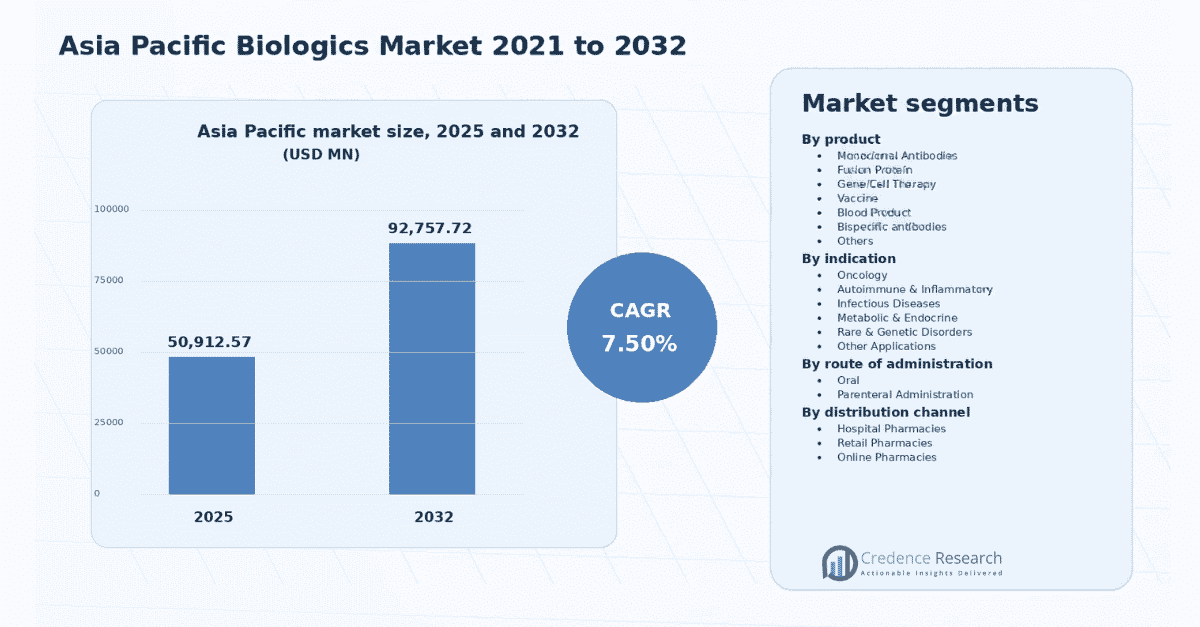
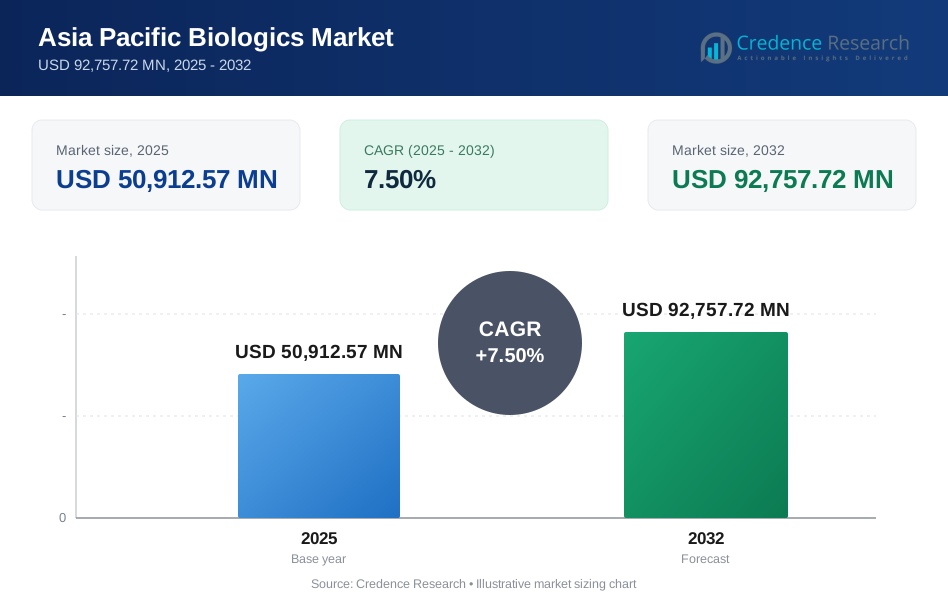
The Asia Pacific Biologics Market size was valued at USD 36,980.76 MN in 2021 and reached USD 50,912.57 MN in 2025. It is anticipated to reach USD 92,757.72 MN by 2032, growing at a CAGR of 7.50% during the forecast period.
| REPORT ATTRIBUTE | DETAILS |
|---|---|
| Historical Period | 2021-2024 |
| Base Year | 2025 |
| Forecast Period | 2026-2032 |
| Asia Pacific Biologics Market Size 2025 | USD 50,912.57 million |
| Asia Pacific Biologics Market, CAGR | 7.50% |
| Asia Pacific Biologics Market Size 2032 | USD 92,757.72 million |
Asia Pacific Biologics Market Insights
- Market growth is supported by oncology biologic demand, autoimmune and inflammatory disease treatment, vaccine access, GLP-1 biologic expansion, biosimilar adoption and stronger hospital pharmacy infrastructure.
- Monoclonal Antibodies hold a strong position because oncology, autoimmune disease and inflammatory disease treatment increasingly depend on targeted biologic therapy.
- Oncology remains a leading indication because cancer immunotherapies, antibody-drug conjugates, bispecific antibodies and cell therapies continue to expand across major Asia Pacific markets.
- Parenteral Administration remains the leading route because most biologics are administered through injection, infusion or hospital-supervised delivery.
Asia Pacific Biologics MarketSegment Insights
By product
By product, Monoclonal Antibodies held the strongest position in 2025 because targeted antibodies are widely used across oncology, autoimmune disease, inflammatory disease and rare disease treatment. Vaccines remain a major product category due to national immunization programs, infectious disease prevention and recurring public health procurement. Gene/Cell Therapy is gaining momentum as China, Japan, South Korea and Australia expand advanced therapy approvals and clinical development. Fusion Protein supports demand across autoimmune and metabolic indications, while Blood Product remains important in hematology, immunology and plasma-derived treatment. Bispecific antibodies are emerging in oncology and rare disease care. Others include recombinant proteins, enzymes, hormones and next-generation biologic formats.
By indication
By indication, Oncology held the strongest position in 2025 because cancer treatment increasingly uses monoclonal antibodies, antibody-drug conjugates, bispecific antibodies and cell therapies. Autoimmune & Inflammatory remains a major indication due to biologic use in psoriasis, rheumatoid arthritis, inflammatory bowel disease and related immune-mediated conditions. Infectious Diseases support demand for vaccines, monoclonal antibodies and selected immune therapies. Metabolic & Endocrine is expanding through injectable biologics, including GLP-1 therapies and insulin-based products. Rare & Genetic Disorders support premium demand for gene therapies, enzyme replacement therapies and orphan biologics. Other Applications include hematology, ophthalmology, neurology and transplant-related immune management.
By route of administration
By route of administration, Parenteral Administration held the strongest position in 2025 because most biologics require injection, infusion or subcutaneous administration. Hospital Pharmacies manage complex biologics, infusion therapy, oncology regimens, cell therapies and cold-chain handling. Retail Pharmacies support selected subcutaneous biologics, insulin products, vaccines and chronic maintenance therapies. Oral remains limited but strategically important as oral peptide and biologic-like delivery technologies evolve. Route growth will depend on formulation innovation, device convenience, safety monitoring, reimbursement and patient preference. Parenteral Administration will continue to dominate, but self-injection and long-acting formats will shift more therapy into outpatient settings.
By distribution channel
By distribution channel, Hospital Pharmacies held the strongest position in 2025 because biologics often require cold-chain storage, infusion capacity, clinical monitoring and specialist oversight. Oncology biologics, gene/cell therapies, bispecific antibodies and many autoimmune therapies are concentrated in hospital settings. Retail Pharmacies are gaining relevance as self-administered biologics, vaccines and chronic metabolic therapies expand. Online Pharmacies are emerging gradually where regulations allow prescription fulfillment, cold-chain logistics and digital refill coordination. Growth will favor channels that provide safe handling, payer documentation, patient education and therapy continuity. Specialty distribution models will gain value as biologic complexity increases.
Key Market Drivers
Rising oncology biologic demand
Rising oncology biologic demand represents a major growth driver for the Asia Pacific Biologics Market. Cancer treatment increasingly depends on Monoclonal Antibodies, Bispecific antibodies, Gene/Cell Therapy and other targeted biologics.
WHO estimates that the Western Pacific Region recorded close to 6.8 million new cancer cases in 2022, while WHO South-East Asia reported 2.37 million new cancer cases and 1.53 million cancer deaths in 2022. Supporting statement from key company data: Merck’s 2025 Form 10-K cited Japan approval of Keytruda with trastuzumab and chemotherapy for first-line HER2-positive gastric or gastroesophageal junction adenocarcinoma and China approval of Keytruda plus Lenvima with transarterial chemoembolization for unresectable, non-metastatic hepatocellular carcinoma. These approvals support sustained oncology biologic adoption across Japan, China and broader Asia Pacific.
Autoimmune and inflammatory biologic expansion
Autoimmune and inflammatory biologic expansion supports strong demand across Monoclonal Antibodies, Fusion Protein and parenteral therapies. Patients with psoriasis, inflammatory bowel disease, rheumatoid arthritis and related disorders increasingly use biologics after inadequate response to conventional drugs.
AbbVie reported full-year 2025 global immunology portfolio net revenues of USD 30.406 billion, including Skyrizi net revenues of USD 17.562 billion, Rinvoq net revenues of USD 8.304 billion and Humira net revenues of USD 4.540 billion. Johnson & Johnson also said Tremfya received Japan approvals in 2025 for moderate to severe ulcerative colitis and Crohn’s disease and later gained approval for subcutaneous ulcerative colitis induction therapy in 2026. This driver supports higher biologic use across specialist hospitals and retail-linked chronic therapy pathways.
Vaccine access and infectious disease prevention
Vaccine access and infectious disease prevention strengthen the Asia Pacific Biologics Market because vaccines remain central to public health programs and recurring procurement cycles. Infectious Diseases support demand for Vaccine, monoclonal antibody prevention products and cold-chain biologics.
WHO’s Western Pacific vaccines and immunization page reported that nearly a million children in the region missed out on basic vaccines through routine immunization services in 2023, while WHO’s immunization data portal shows 2025 Western Pacific vaccine-preventable disease and coverage trends. This gap supports ongoing vaccination catch-up, public procurement and biologics distribution investment. Growth will depend on national immunization budgets, cold-chain capacity, regional manufacturing and public confidence in vaccination programs.
Metabolic and endocrine biologic growth
Metabolic and endocrine biologic growth supports market expansion as diabetes, obesity and related endocrine disorders increase demand for injectable biologics and peptide-based therapies. GLP-1 products, insulin analogs and long-acting biologic therapies are reshaping chronic metabolic care.
Novo Nordisk’s 2025 annual report said sales of GLP-1-based products for type 2 diabetes increased by 6% at constant exchange rates to DKK 152,202 million, while obesity care sales rose from DKK 6 billion in 2019 to DKK 82 billion in 2025. These trends support Parenteral Administration, Retail Pharmacies and chronic therapy distribution. Asia Pacific demand will grow as diagnosis, affordability, specialist access and country-specific reimbursement improve.
Key Trends and Opportunities
Cell and gene therapy adoption accelerates
Cell and gene therapy adoption is accelerating as China, Japan and other Asia Pacific markets expand advanced therapy regulation, approvals and manufacturing capacity. China’s NMPA approved Ciltacabtagene Autoleucel Injection with conditions in 2025 for adults with relapsed or refractory multiple myeloma after three or more prior therapy lines, describing it as an autologous cellular immunotherapy involving CAR gene integration into a patient’s T cells. China also approved Amimestrocel Injection with conditions through priority review in 2025 for steroid-refractory acute graft-versus-host disease. This trend supports Gene/Cell Therapy, Oncology, Rare & Genetic Disorders and Hospital Pharmacies.
Biosimilars improve affordability and access
Biosimilars are improving affordability and access across Asia Pacific biologics markets. Several countries are encouraging biosimilar competition to reduce treatment cost and expand access to oncology, autoimmune and metabolic biologics. Biosimilar adoption can reduce payer burden and improve therapy availability, especially where out-of-pocket spending limits patient access. It also pressures originator brands to compete through device convenience, patient support, clinical differentiation and local access programs. The trend supports Retail Pharmacies and Hospital Pharmacies as biosimilar distribution expands beyond large tertiary hospitals. Companies with localized pricing, regulatory expertise and strong physician education will gain share.
Regional biologics manufacturing gains strategic value
Regional biologics manufacturing is gaining strategic value as countries seek supply security, lower import dependence and faster access to advanced therapies. Vaccine production, monoclonal antibody manufacturing, fill-finish capacity, cell therapy facilities and cold-chain logistics are becoming strategic health care assets. AstraZeneca said in 2026 that it would build a cell therapy facility in Shanghai to make and supply CAR-T cell therapies for China and other Asian markets, and Reuters reported that it planned a radioconjugate drug production and supply base in Guangzhou to provide cancer treatments in China and Asia Pacific. This opportunity supports Gene/Cell Therapy, Oncology and hospital-linked biologics distribution.
Key Market Challenges
High treatment cost and reimbursement gaps
High treatment cost and reimbursement gaps remain key challenges for the Asia Pacific Biologics Market. Monoclonal antibodies, cell therapies, bispecific antibodies and rare disease biologics can carry high upfront costs. Many Asia Pacific markets still have uneven insurance coverage, fragmented reimbursement and significant patient out-of-pocket spending. Hospitals and payers may restrict use to severe disease or post-failure settings. These barriers can delay adoption despite strong clinical need. Manufacturers must support value evidence, patient access programs, local pricing and reimbursement submissions to expand uptake.
Cold-chain and specialty distribution complexity
Cold-chain and specialty distribution complexity can slow market growth. Biologics often require temperature-controlled storage, validated logistics, trained pharmacy staff and careful administration. Gene/Cell Therapy adds greater complexity because personalized products require chain-of-identity controls, specialized facilities and coordinated hospital workflows. Rural and smaller markets may lack reliable cold-chain infrastructure. Product wastage, temperature excursions and inventory planning add cost. Companies and distributors must invest in cold-chain monitoring, specialty pharmacy partnerships and hospital training to improve access.
Regulatory variation across Asia Pacific
Regulatory variation across Asia Pacific creates complexity for companies seeking regional launches. Approval pathways, biosimilar rules, pharmacovigilance requirements, clinical evidence expectations and post-market obligations differ by country. Advanced therapies face additional complexity because regulators must assess manufacturing controls, long-term safety and specialized clinical infrastructure. This can extend launch timelines and increase compliance cost. Companies must tailor evidence packages, regulatory strategy and local partnerships by country. Harmonization efforts can help, but market entry will remain highly country-specific through 2032.
Regional Analysis
China
China represents a major opportunity within the Asia Pacific Biologics Market due to its large patient base, growing oncology burden, rapid biologics approvals and expanding local manufacturing. Oncology, Autoimmune & Inflammatory, Metabolic & Endocrine and Infectious Diseases support strong demand for monoclonal antibodies, vaccines, GLP-1 therapies, cell therapies and biosimilars. Hospital Pharmacies dominate advanced biologics use, while Retail Pharmacies are gaining relevance for chronic injectable therapies and vaccines. Domestic biotech companies are increasing competition in antibodies, cell therapy and biosimilars. Growth will depend on reimbursement, volume-based procurement, hospital access and local manufacturing capacity.
Japan
Japan supports strong biologics demand due to mature health care infrastructure, specialist care access, oncology innovation and advanced therapy regulation. Monoclonal Antibodies remain central across oncology and autoimmune disease, while Gene/Cell Therapy is gaining attention through Japan’s regenerative medicine framework. Hospital Pharmacies play a critical role in infusion therapy, oncology biologics and advanced therapies. Retail Pharmacies support chronic biologics and metabolic therapies where self-injection models apply. Japan remains an important launch market for multinational companies because of its regulatory sophistication, reimbursement structure and high clinical adoption in specialist settings.
India
India is an expanding market supported by rising biologic and biosimilar use, strong domestic pharmaceutical manufacturing and increasing demand for oncology, metabolic and autoimmune therapies. Vaccines and biosimilars remain particularly important because affordability influences adoption. Hospital Pharmacies dominate advanced biologics, while Retail Pharmacies support insulin, vaccines and selected chronic therapies. Indian companies are expected to strengthen biosimilar competition and expand access across urban and semi-urban markets. Growth will depend on price sensitivity, insurance expansion, local manufacturing, physician confidence and government procurement programs.
South Korea
South Korea represents a high-value biologics market supported by advanced health systems, strong biomanufacturing, biosimilar leadership and rapid clinical adoption. Oncology, Autoimmune & Inflammatory and Rare & Genetic Disorders are key demand areas. Hospital Pharmacies remain central for advanced biologics and infusion products, while Retail Pharmacies support maintenance therapy. South Korea also serves as a biologics manufacturing and biosimilar export hub, which strengthens its strategic role in Asia Pacific. Growth will depend on innovation, reimbursement, global partnerships and continued investment in bioprocessing capacity.
Australia and New Zealand
Australia and New Zealand represent mature biologics markets supported by structured reimbursement, strong specialist care and evidence-based treatment pathways. Monoclonal Antibodies, vaccines, metabolic biologics and autoimmune therapies see steady use across hospitals and outpatient settings. Hospital Pharmacies remain important for oncology and infusion therapies, while Retail Pharmacies support vaccines and self-administered biologics. Biosimilars create access opportunities where national funding systems support substitution or preferred products. Growth will remain steady as advanced therapies gain reimbursement and clinical confidence.
Southeast Asia
Southeast Asia offers high long-term growth potential due to expanding health care investment, rising chronic disease burden, vaccine demand and increasing access to biologics in private hospitals. Singapore supports advanced biologics adoption and regional specialty care, while Thailand, Malaysia, Indonesia, Vietnam and the Philippines are expanding access at different speeds. Hospital Pharmacies remain the main channel for high-cost biologics, while Retail Pharmacies and Online Pharmacies are gaining value for vaccines and chronic therapies. Growth will depend on affordability, reimbursement, cold-chain logistics, private insurance and local regulatory capacity.
Report Attribute Details
| Report Attribute | Details |
| Historical Period | 2021–2024 |
| Base Year | 2025 |
| Forecast Period | 2025–2032 |
| Market Size in 2021 | USD 36,980.76 MN |
| Market Size in 2025 | USD 50,912.57 MN |
| Market Size in 2032 | USD 92,757.72 MN |
| CAGR | 7.50% |
| Segments Covered | Product, Indication, Route Of Administration, Distribution Channel and Geography |
| Key Companies Covered | AbbVie, Bristol-Myers Squibb, Johnson & Johnson, Novo Nordisk, Pfizer, Merck & Co., Amgen, Eli Lilly, AstraZeneca, Roche and Sanofi |
Asia Pacific Biologics Market Segmentations
By Product
- Monoclonal Antibodies
- Fusion Protein
- Gene/Cell Therapy
- Vaccine
- Blood Product
- Bispecific antibodies
- Others
By Indication
- Oncology
- Autoimmune & Inflammatory
- Infectious Diseases
- Metabolic & Endocrine
- Rare & Genetic Disorders
- Other Applications
By Route Of Administration
- Oral
- Parenteral Administration
By Distribution Channel
- Hospital Pharmacies
- Retail Pharmacies
- Online Pharmacies
Key Players
- AbbVie
- Bristol-Myers Squibb
- Johnson & Johnson
- Novo Nordisk
- Pfizer
- Merck & Co.
- Amgen
- Eli Lilly
- AstraZeneca
- Roche
- Sanofi
Recent Developments
- In February 2025, China’s NMPA approved Ciltacabtagene Autoleucel Injection with conditions for adults with relapsed or refractory multiple myeloma after three or more prior therapy lines.
- In June 2025, China’s NMPA approved Amimestrocel Injection with conditions through priority review for steroid-refractory acute graft-versus-host disease.
- In February 2026, Johnson & Johnson said Japan approved a partial change for Tremfya subcutaneous formulation for induction therapy in moderate to severe ulcerative colitis after inadequate response to existing treatment.
- In March 2026, AstraZeneca said it would build a cell therapy facility in Shanghai to manufacture and supply CAR-T therapies for China and other Asian markets.
Report Coverage
The research report offers an in-depth analysis based on product, indication, route of administration, distribution channel and geography. It details leading market players, providing an overview of their business positioning, biologics portfolios, oncology antibodies, autoimmune therapies, vaccines, metabolic biologics, cell therapy exposure, biosimilar strategies and strategic relevance in the Asia Pacific Biologics Market. The report includes insights into the competitive environment, market trends, growth drivers, restraints and opportunities. It also examines oncology demand, autoimmune biologic expansion, vaccine access, metabolic and endocrine biologic growth, biosimilar adoption, regional manufacturing and specialty pharmacy infrastructure as major factors shaping market development. The report assesses the impact of high treatment cost, reimbursement gaps, cold-chain complexity, specialty distribution requirements and regulatory variation on market growth. It provides strategic recommendations for pharmaceutical companies, hospital systems, retail pharmacy networks, online pharmacies, biologics manufacturers, distributors, investors and new entrants seeking to navigate Asia Pacific’s biologics ecosystem.
Future Outlook
- Demand for biologics will continue to rise as oncology, autoimmune disease, infectious disease and metabolic care expand across Asia Pacific.
- Monoclonal Antibodies will remain a leading product category because targeted biologics are central to cancer and immune-mediated disease treatment.
- Gene/Cell Therapy will gain momentum as advanced therapy approvals and manufacturing capacity expand in China, Japan and South Korea.
- Vaccines will remain important due to immunization programs, infectious disease prevention and public procurement.
- Metabolic & Endocrine will grow as GLP-1 therapies, insulin products and long-acting injectables expand.
- Parenteral Administration will remain dominant because most biologics require injection, infusion or subcutaneous delivery.
- Hospital Pharmacies will remain the leading distribution channel for oncology biologics, cell therapies and complex infusion products.
- Retail Pharmacies will gain share through self-administered biologics, vaccines and chronic metabolic therapies.
- Biosimilars will improve access and intensify price competition across oncology and autoimmune biologics.
- Competition will increase as companies compete on clinical efficacy, biosimilar pricing, local manufacturing, access programs, cold-chain reliability and regulatory speed.
Request a Free Sample
Fill in your details and we'll send you a free sample report.
- Sample data tables & charts
- Research methodology
Need a Custom Version of This Report?
Tailor the scope, geography, or segments to your exact requirements.
- Custom geography or segment scope
- Direct access to our analyst team
Frequently Asked Questions
What is the current market size for the Asia Pacific Biologics Market and what is its projected size in 2032?
At what CAGR is the Asia Pacific Biologics Market projected to grow?
Which product segment is expected to lead the market?
Which indication supports strong market demand?
Which route of administration holds the strongest position?
Who are the leading companies in the market?
Which countries are important in the Asia Pacific market?
Table of Content
Chapter 1. Report Introduction
- 1.1 Report Description & Purpose
- 1.1.1 Report Title & Market Definition
- 1.1.2 Unique Selling Propositions (USP) & Key Differentiators
- 1.1.3 Value Proposition for Stakeholders
- 1.2 Research Objectives
- 1.2.1 Market Sizing Objectives (Volume & Revenue)
- 1.2.2 Segmentation Objectives
- 1.2.3 Competitive Intelligence Objectives
- 1.2.4 Forecast & Scenario Objectives
- 1.3 Report Scope
- 1.3.1 Asia Pacific Biologics Scope – Types & Subtypes Covered
- 1.3.2 Geographic Scope – Regions & Countries Covered
- 1.3.3 Historical Period, Base Year & Forecast Period (2025; forecast to 2032)
- 1.3.4 Inclusions & Exclusions
- 1.4 HS Code & Classification Framework
- 1.5 Currency, Units & Pricing Basis
- 1.6 Target Stakeholders
- 1.7 Limitations & Assumptions
Chapter 2. Executive Summary
- 2.1 Global Asia Pacific Biologics Market Snapshot
- 2.1.1 Market Size – Historical (2025) & Forecast (2025-2032) (2025: USD 50,912.57 MN → 2032: USD 92,757.72 MN)
- 2.1.2 Volume & Revenue – Global Totals
- 2.1.3 Key Market Highlights – Top Five Facts
- 2.2 Asia Pacific Biologics Market Segmentation Snapshot
- 2.2.1 Market Split by Region – 2025 vs. 2032
- 2.3 Competitive Snapshot
- 2.3.1 Top 10 Players by Revenue Share – 2025
- 2.3.2 Top 10 Players by Volume Share – 2025
- 2.3.3 Recent Strategic Developments (18-Month Summary)
- 2.4 Key Investment Highlights & Strategic Conclusions
Chapter 3. Asia Pacific Biologics Market Dynamics & Industry Analysis
- 3.1 Market Overview & Context
- 3.1.1 Asia Pacific Biologics Market Position in the Broader Automotive Value Chain
- 3.1.2 OEM vs. Replacement Market Dynamics
- 3.1.3 Market Maturity & Development Stage by Region
- 3.2 Asia Pacific Biologics Market Drivers
- 3.3 Asia Pacific Biologics Market Restraints & Challenges
- 3.4 Asia Pacific Biologics Market Opportunities
- 3.5 Porter's Five Forces Analysis
- 3.5.1 Threat of New Entrants
- 3.5.2 Bargaining Power of Suppliers
- 3.5.3 Bargaining Power of Buyers
- 3.5.4 Threat of Substitutes
- 3.5.5 Competitive Rivalry – Intensity Assessment
- 3.6 Asia Pacific Biologics Value Chain Analysis
- 3.6.1 Upstream – Raw Material/Input Suppliers
- 3.6.1.1 Raw Material/Input 1
- 3.6.1.2 Raw Material/Input 2
- 3.6.1.3 Raw Material/Input 3
- 3.6.2 Midstream – Production/Manufacturing/Service Delivery
- 3.6.2.1 Production/Process Overview
- 3.6.2.2 Key Facility Locations & Capacity by Manufacturer
- 3.6.3 Downstream – Distribution & End Consumer
- 3.6.3.1 Primary Channel – B2B/OEM
- 3.6.3.2 Secondary Channels – Dealer, Retail, Online, Direct
- 3.6.4 Value Chain Profitability Analysis
- 3.6.1 Upstream – Raw Material/Input Suppliers
- 3.7 PESTEL Analysis
- 3.7.1 Political Factors
- 3.7.2 Economic Factors
- 3.7.3 Social Factors
- 3.7.4 Technological Factors
- 3.7.5 Environmental Factors
- 3.7.6 Legal Factors
- 3.8 Asia Pacific Biologics Supply Chain Analysis
- 3.8.1 Raw Material/Input Supply Risk Assessment
- 3.8.2 Manufacturing Concentration Risk (Geographic Exposure)
- 3.8.3 Trade Disruption Impact Analysis
- 3.9 Regulatory & Policy Landscape
Note: The regulatory and policy landscape section covers regulations based on their applicability to the market, Asia Pacific Biologics category, geography, and scope of the study. Only regulatory frameworks with a material impact on operations, compliance, trade, sustainability, or market access are analyzed in detail.
Chapter 4. Key Investment Pockets & Opportunity Analysis
- 4.1 Asia Pacific Biologics Market Attractiveness Analysis
- 4.1.1 By Region – Investment Attractiveness Matrix (Volume × CAGR)
- 4.2 Absolute Revenue Growth Opportunity
- 4.2.1 By Region – Absolute USD Growth Through 2032
- 4.3 Incremental Volume Opportunity
- 4.3.1 By Region – Incremental Volume Through 2032
- 4.3.2 Segment – Incremental Volume
- 4.4 Emerging Submarket Opportunity Deep Dive (Subject to Applicability)
- 4.5 Emerging Market Opportunity Scorecards
- 4.5.1 United States
- 4.5.2 Europe
- 4.5.3 Asia
- 4.5.4 Middle East & Africa
Note: Emerging Market Opportunity Scorecards will be included based on relevance and strategic importance. Regions listed are indicative and may vary depending on data availability and market dynamics.
Chapter 5. Asia Pacific Biologics Import-Export Analysis & Trade Flows
- 5.1 Global Trade Overview
- 5.1.1 Global Export Value by Country (2025)
- 5.1.2 Global Export Volume by Country (2025)
- 5.1.3 Global Import Value by Country (2025)
- 5.1.4 Global Import Volume by Country (2025)
- 5.1.5 Net Trade Balance by Country (2025)
- 5.2 Export Analysis – Segment
- 5.2.1 Type 1 (HS Code)
- 5.2.2 Type 2 (HS Code)
- 5.2.3 Type 3 (HS Code)
- 5.2.4 Type 4 (HS Code)
- 5.2.5 Type 5 (HS Code)
- 5.3 Import Analysis – Segment
- 5.3.1 Type 1 (HS Code)
- 5.3.2 Type 2 (HS Code)
- 5.3.3 Type 3 (HS Code)
- 5.3.4 Type 4 (HS Code)
- 5.3.5 Type 5 (HS Code)
- 5.4 Average Unit Trade Prices
- 5.4.1 Average Export Price – Segment & Country
- 5.4.2 Average Import Price – Segment & Source Country
- 5.4.3 Price Trends (2025)
- 5.5 Key Trade Route Analysis
- 5.5.1 Trade Route 1
- 5.5.2 Trade Route 2
- 5.5.3 Trade Route 3
- 5.5.4 Trade Route 4
- 5.5.5 Trade Route 5
- 5.6 Trade Policy Impact Assessment
- 5.6.1 US Anti-Dumping & Section 301 Tariffs
- 5.6.2 EU Customs Union Impact
- 5.6.3 Major Free Trade Agreements
- 5.6.4 USMCA Rules of Origin
Note: Trade policy analysis will be included only where relevant to the Asia Pacific Biologics market.
Chapter 6. Competitive Landscape & Company Benchmarking
- 6.1 Asia Pacific Biologics Market Concentration & Structure
- 6.1.1 Herfindahl-Hirschman Index (HHI) – vs. 2025
- 6.1.2 Tier 1, Tier 2 & Tier 3 Market Structure
- 6.1.3 Global, Regional & Local Player Dynamics
- 6.2 Asia Pacific Biologics Market Share Analysis – 2025
- 6.2.1 Global Revenue Share by Company
- 6.2.2 Global Volume Share by Company
- 6.2.3 Regional Revenue Share
- 6.2.4 Market Share Evolution ( vs. 2025)
- 6.2.5 OEM Segment Share by Company
- 6.2.6 Replacement Segment Share by Company
- 6.3 Production/Delivery Capacity & Facility Analysis
- 6.3.1 Global Installed Capacity
- 6.3.2 Capacity Utilization Rates
- 6.3.3 Production/Output Volume
- 6.3.4 Facility Locations & Capacity Map
- 6.3.5 Planned Capacity Additions
- 6.4 Asia Pacific Biologics Competitive Benchmarking Matrix
- 6.4.1 Revenue, Volume, CAGR & Profitability Comparison
- 6.4.2 Channel Revenue Mix
- 6.4.3 Geographic Revenue Exposure
- 6.4.4 R&D Intensity
- 6.4.5 Sustainability Maturity
- 6.5 Strategic Developments in Asia Pacific Biologics (Last 24 Months)
- 6.5.1 Mergers, Acquisitions & Divestments
- 6.5.2 New Asia Pacific Biologics Launches
- 6.5.3 Facility Expansions
- 6.5.4 Strategic Alliances, Joint Ventures & Partnerships
- 6.5.5 Distribution Expansion & Market Entry
- 6.5.6 Sustainability & ESG Initiatives
- 6.6 Competitive Strategy Mapping
- 6.6.1 Leader, Challenger, Follower & Niche Classification
- 6.6.2 Pricing Strategy Comparison
- 6.6.3 Channel Strategy Matrix
Note: Strategic developments are included based on their materiality and the availability of reliable information.
Chapter 7. Global Asia Pacific Biologics Market – By Distribution Channel
- 7.1 Segment Overview
- 7.1.1 Volume & Revenue Split by Channel (2025 & 2032)
- 7.1.2 Channel Mix Evolution (2025-2032)
Chapter 8. Regional Market Analysis – Global Overview
- 8.1 Global Regional Overview
- 8.1.1 Regional Volume Share
- 8.1.2 Regional Revenue Share
- 8.1.3 Regional Volume by Region
- 8.1.4 Regional Revenue by Region
- 8.1.5 Regional Forecast Through 2032
- 8.2 Cross-Regional Segment Analysis
- 8.2.1 By Distribution Channel
- 8.2.2 By Brand/Price Tier
Chapter 9. North America Asia Pacific Biologics Market
- 9.1 United States
- 9.2 Canada
- 9.3 Mexico
Chapter 10. Europe Asia Pacific Biologics Market
- 10.1 Germany
- 10.2 France
- 10.3 Italy
- 10.4 United Kingdom
- 10.5 Spain
- 10.6 Poland
- 10.7 Russia
- 10.8 Netherlands
- 10.9 Belgium
- 10.10 Sweden
- 10.11 Denmark
- 10.12 Norway
- 10.13 Rest of Europe
Chapter 11. Asia Pacific Asia Pacific Biologics Market
- 11.1 China
- 11.2 India
- 11.3 Japan
- 11.4 South Korea
- 11.5 Thailand
- 11.6 Indonesia
- 11.7 Vietnam
- 11.8 Malaysia
- 11.9 Australia
- 11.10 Rest of Asia Pacific
Chapter 12. Latin America Asia Pacific Biologics Market
- 12.1 Brazil
- 12.2 Argentina
- 12.3 Colombia
- 12.4 Chile
- 12.5 Rest of Latin America
Chapter 13. Middle East Asia Pacific Biologics Market
- 13.1 Saudi Arabia
- 13.2 United Arab Emirates
- 13.3 Turkey
- 13.4 Israel
- 13.5 Iran
- 13.6 Rest of the Middle East
Chapter 14. Africa Asia Pacific Biologics Market
- 14.1 South Africa
- 14.2 Egypt
- 14.3 Nigeria
- 14.4 Morocco
- 14.5 Rest of Africa
Chapter 15. Asia Pacific Biologics Company Profiles
- 15.1 [Company 01]
- 15.1.1 Company Overview
- 15.1.2 Key Management Personnel
- 15.1.3 Products & Services Portfolio
- 15.1.4 Financial Performance
- 15.1.5 Key Market Focus & Geographic Presence
- 15.1.6 Recent Developments & Strategic Initiatives
Note: The company profile list is preliminary and may change based on research findings, market developments, data availability, and client requirements.
Chapter 16. Appendices
- Appendix A – List of Abbreviations & Acronyms
- Appendix B – Industry Classification Code Reference – Full Series
- Appendix C – Production & Capacity Data Tables
- Appendix D – End-Use & Demand Base Tables
- Appendix E – Consumption & Replacement Rate Assumptions
- Appendix F – ASP Reference Tables
- Appendix G – Manufacturing & Facility Database
- Appendix H – Import-Export Data Tables
- Appendix I – Regulatory Summary Tables
- Appendix J – Primary Research Participant List (Anonymized)
- Appendix K – Primary Research Questionnaire Framework
- Appendix L – Data Sources & Bibliography
- Appendix M – Market Size Divergence & Source Comparison
Chapter 17. Research Methodology
- 17.1 Research Framework & Philosophy
- 17.2 Secondary Research – Sources, Hierarchy & Data Extraction
- 17.3 Data Modeling – Bottom-Up & Top-Down Market Sizing
- 17.4 Primary Research – Stakeholder Framework, LOI & Sample Sizes
- 17.5 Forecast Methodology – Regression, Scenario & Sensitivity Analysis
- 17.6 Quality Control – Four-Layer Validation Framework
- 17.7 Limitations & Standard Assumptions
- 17.8 Disclaimer
