
Asia Pacific Cancer Biopsy Market Overview:
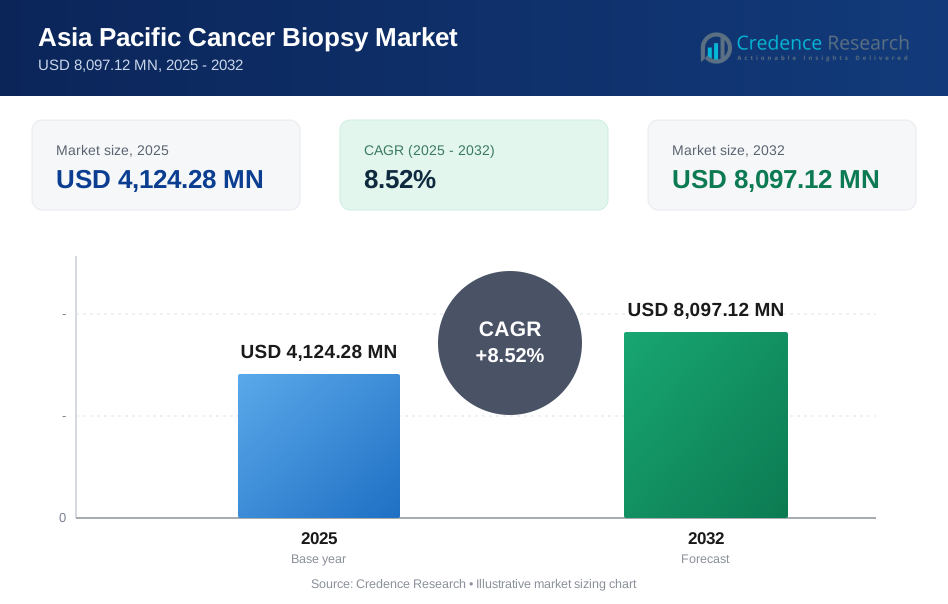
The Asia Pacific Cancer Biopsy Market size was valued at USD 2,917.45 MN in 2021 and reached USD 4,124.28 MN in 2025. It is anticipated to reach USD 8,097.12 MN by 2032, growing at a CAGR of 8.52% during the forecast period.
| REPORT ATTRIBUTE | DETAILS |
|---|---|
| Historical Period | 2021-2024 |
| Base Year | 2025 |
| Forecast Period | 2025-2032 |
| Asia Pacific Cancer Biopsy Market Size 2025 | USD 4,124.28 million |
| Asia Pacific Cancer Biopsy Market, CAGR | 8.52% |
| Asia Pacific Cancer Biopsy Market Size 2032 | USD 8,097.12 million |
Asia Pacific Cancer Biopsy Market Insights
- Market growth is supported by rising cancer diagnosis volume, broader pathology access, liquid biopsy adoption, molecular profiling demand and expanding oncology infrastructure across major Asia Pacific countries.
- Consumables hold a strong position because biopsy workflows require recurring use of needles, reagents, slides, sample containers, preservation media, cartridges and molecular testing materials.
- Tissue Biopsies remain the leading type because they are widely used for histopathology confirmation, tumor grading, staging and biomarker testing across major cancer indications.
- Hospitals remain the leading end users because complex biopsy procedures, imaging guidance, pathology departments and oncology treatment pathways are concentrated in hospital-based networks.
Market Segment Insights
By product
By product, Consumables held a strong position in 2025 because cancer biopsy testing depends on recurring use of sample collection, preservation, processing and molecular testing materials. Hospitals and Diagnostic Centres require biopsy needles, reagents, slides, stains, sample containers, cartridges, extraction materials and testing consumables across tissue and liquid biopsy workflows. Kits are gaining demand as laboratories standardize biopsy processing, molecular profiling and liquid biopsy testing. Instrument demand is supported by imaging-guided biopsy systems, pathology platforms, automated sample processors, sequencing systems and molecular analyzers. Services remain important because hospitals, laboratories and research institutes rely on outsourced testing, sample logistics, pathology interpretation and genomic analysis.
By type
By type, Tissue Biopsies led the Asia Pacific Cancer Biopsy Market in 2025 because tissue-based diagnosis remains the clinical standard for confirming malignancy, identifying tumor subtype and supporting treatment planning. Tissue biopsies are widely used across Lung Cancer, Breast Cancer, Colorectal Cancer, Stomach Cancer, Prostate Cancer and other cancers. Liquid Biopsies are gaining momentum because blood-based testing can support minimally invasive genomic profiling, therapy selection, resistance monitoring and recurrence assessment. Adoption of liquid biopsy is strongest in advanced oncology centers, private hospital networks and molecular diagnostic laboratories. Tissue and liquid biopsies are expected to remain complementary because tissue confirms diagnosis while liquid biopsy improves access to molecular information when tissue is limited or difficult to obtain.
By application
By application, Lung Cancer held a strong position in 2025 because treatment selection increasingly depends on tissue diagnosis and biomarker testing. Stomach Cancer, Colorectal Cancer, Breast Cancer, Prostate Cancer and Liver Cancer also support strong biopsy demand due to high diagnostic volume and growing use of molecular testing. Cervical Cancer remains important in Asia Pacific because screening and pathology confirmation are central to disease management. Kidney Cancer, Bladder Cancer, Esophagus Cancer and Other Cancers create additional demand for biopsy instruments, kits, consumables and services. Growth across applications will depend on screening coverage, physician referral patterns, molecular testing access, reimbursement and oncology infrastructure expansion.
By end user
By end user, Hospitals held the strongest position in 2025 because they conduct complex biopsy procedures, imaging-guided sampling, surgical biopsies, pathology testing and oncology treatment planning. Hospitals also coordinate multidisciplinary cancer care, which increases biopsy use for diagnosis, staging and therapy selection. Diagnostic Centres are gaining share as private laboratory networks expand histopathology, cytology, immunohistochemistry and molecular oncology testing. Research Institutes support demand through clinical trials, biomarker discovery, translational oncology and validation of liquid biopsy methods. Growth across end users will favor organizations that improve sample quality, turnaround time, molecular testing capacity and integration with oncologist workflows.
Key market drivers
Rising cancer burden and diagnostic demand
Rising cancer burden and diagnostic demand represent a major growth driver for the Asia Pacific Cancer Biopsy Market. Higher cancer diagnosis volumes increase demand for Instrument, Kits, Consumables and Services across hospitals and Diagnostic Centres. Biopsy remains essential for confirming malignancy, identifying tumor type and guiding treatment decisions across Lung Cancer, Breast Cancer, Colorectal Cancer, Stomach Cancer, Cervical Cancer and other cancers. WHO reported that the Western Pacific Region recorded close to 6.8 million new cancer cases in 2022 and nearly 3.5 million cancer deaths each year, while the WHO South-East Asia Region estimated 2.37 million new cancer cases and 1.53 million deaths in 2022. This disease burden supports sustained demand for biopsy testing and pathology infrastructure across Asia Pacific.
Precision oncology and biomarker testing
Precision oncology and biomarker testing support market growth as treatment decisions increasingly depend on tumor genetics, receptor status, actionable mutations and companion diagnostics. Tissue and liquid biopsy samples are critical for molecular profiling, immunohistochemistry, next-generation sequencing and targeted therapy selection. Hospitals and Diagnostic Centres are expanding capabilities to support biomarker testing for Lung Cancer, Breast Cancer, Colorectal Cancer, Prostate Cancer and other cancers.
Guardant Health introduced new Smart Liquid Biopsy applications for Guardant360 Liquid in 2025, expanding biomarker identification and cancer subtyping capabilities to help oncologists identify appropriate treatment plans. This driver will strengthen demand for kits, instruments, molecular testing consumables and diagnostic services.
Liquid biopsy adoption
Liquid biopsy adoption is strengthening the market because blood-based testing can support genomic profiling, therapy selection and treatment monitoring with less invasive sampling. It is especially useful when tissue is insufficient, unsafe to collect or difficult to access. Liquid biopsy also supports repeated testing during disease progression, which is important for advanced cancers.
Lucence announced ASCO 2025 data showing that combined circulating tumor DNA and circulating tumor RNA liquid biopsy improved detection of actionable mutations and fusions in metastatic non-small cell lung cancer. Adoption will expand first in advanced oncology centers, private hospitals and molecular diagnostic laboratories, then broaden as reimbursement and physician familiarity improve.
Expansion of molecular diagnostic services
Expansion of molecular diagnostic services is improving biopsy testing access across Asia Pacific. Private diagnostic networks, hospital laboratories and specialized testing providers are investing in molecular oncology, sample logistics, companion diagnostics and genomic interpretation services. This trend supports demand for Consumables, Kits, Instruments and outsourced Services.
QIAGEN expanded its oncology diagnostics portfolio in 2025 through strategic partnerships for minimal residual disease testing in clinical trials and companion diagnostic development, while Roche’s Foundation Medicine moved in 2026 to strengthen its monitoring portfolio with SAGA Diagnostics’ tumor-informed molecular residual disease platform. These developments reflect broader industry investment in advanced cancer testing infrastructure and monitoring workflows.
Key Trends and Opportunities
Liquid biopsy and noninvasive testing expand
Liquid biopsy and noninvasive testing are becoming major opportunities because they can reduce dependence on invasive tissue collection in selected cases. Blood-based testing supports therapy selection, resistance mutation detection, treatment response tracking and recurrence monitoring. This is valuable in Lung Cancer, Colorectal Cancer, Breast Cancer and Prostate Cancer where repeated molecular testing may be required. Liquid biopsy also creates opportunities for sample collection tubes, extraction kits, sequencing services, bioinformatics and companion diagnostics. Adoption will expand first in advanced cancer centers, private hospitals and specialized laboratories. Broader use will depend on clinical validation, affordability, reimbursement and clinician confidence.
Companion diagnostics gain clinical relevance
Companion diagnostics are gaining clinical relevance as oncology care becomes more biomarker-driven. Drug approvals increasingly rely on tests that identify patients eligible for targeted therapies or immunotherapy combinations. This increases demand for high-quality tissue and liquid biopsy samples across major cancer indications. Hospitals and Diagnostic Centres need validated workflows, standardized kits and reliable instruments to support clinical decisions. Pharmaceutical companies may partner with diagnostic firms to expand access to companion testing in Asia Pacific. The opportunity is strongest in Lung Cancer, Breast Cancer, Colorectal Cancer and Prostate Cancer, where biomarker-defined treatment pathways are expanding.
Outsourced biopsy testing services grow
Outsourced biopsy testing services are growing as hospitals and smaller laboratories refer complex genomic or molecular oncology tests to specialized providers. This model helps health systems access advanced testing without immediately investing in expensive instruments, sequencing platforms and bioinformatics teams. Outsourced services also support research institutes, clinical trials and pharmaceutical partnerships. Service providers can differentiate through faster turnaround, quality accreditation, broad test menus and strong sample logistics. Demand will rise as oncology care requires more biomarker data and treatment monitoring. Companies that connect local collection networks with regional or global testing infrastructure will gain stronger market access.
Key Market Challenges
Affordability and reimbursement constraints
Affordability and reimbursement constraints remain key challenges for the Asia Pacific Cancer Biopsy Market. Advanced molecular tests, broad genomic panels and liquid biopsy assays can be expensive for patients and health systems. Public reimbursement coverage varies widely by country and may not fully support newer genomic tests. Private insurance can improve access, but coverage remains uneven across markets. Cost sensitivity can delay adoption of liquid biopsy and comprehensive molecular profiling. Suppliers and laboratories must demonstrate clinical value, cost-effectiveness and treatment relevance to improve adoption.
Laboratory infrastructure gaps
Laboratory infrastructure gaps can slow market expansion across emerging Asia Pacific countries. Many regions still face shortages of trained pathologists, molecular laboratory specialists, sequencing infrastructure and quality-controlled sample logistics. Rural and underserved areas may depend on centralized laboratories, which can increase turnaround time and affect sample quality. Liquid biopsy and companion diagnostics require validated workflows, bioinformatics and quality assurance systems. Smaller laboratories may struggle to invest in advanced instruments and technical staff. Capacity-building, training and public-private partnerships will be important to address this challenge.
Sample quality and workflow standardization
Sample quality and workflow standardization create challenges across tissue and liquid biopsy testing. Poor specimen handling, delayed fixation, insufficient tumor content and inconsistent processing can affect diagnostic accuracy. Liquid biopsy testing also requires careful blood collection, stabilization, storage and transport to preserve circulating tumor DNA or RNA. Workflow variation across hospitals, Diagnostic Centres and countries can reduce confidence in results. Standardized kits, training, accreditation and quality-control systems are essential for reliable testing. Companies that support end-to-end workflows will have an advantage.
Regional Analysis
China
China represents a major opportunity within the Asia Pacific Cancer Biopsy Market due to its large cancer patient base, expanding hospital networks and growing molecular diagnostics sector. Demand is supported by Lung Cancer, Stomach Cancer, Colorectal Cancer, Liver Cancer and Breast Cancer diagnosis. Hospitals remain central because complex biopsy procedures and oncology treatment pathways are concentrated in large medical centers. Diagnostic Centres and specialized laboratories are expanding genomic testing, liquid biopsy and companion diagnostic capabilities. Growth will depend on reimbursement, regulatory approvals, domestic test development and access across lower-tier cities. China is expected to remain one of the most important regional demand centers through 2032.
Japan
Japan supports strong demand for cancer biopsy products and services due to advanced oncology infrastructure, aging demographics and mature diagnostic systems. Tissue Biopsies remain central for diagnosis and treatment planning, while Liquid Biopsies are gaining use in precision oncology and advanced cancer monitoring. Hospitals and research institutes support strong demand for biomarker testing, next-generation sequencing and clinical trial-linked diagnostics. Breast Cancer, Lung Cancer, Colorectal Cancer, Prostate Cancer and Stomach Cancer remain important applications. Japan’s market growth will depend on reimbursement policy, diagnostic innovation and adoption of minimally invasive testing. It remains a premium market for advanced biopsy technologies.
India
India is an expanding market supported by rising cancer diagnosis volume, private hospital growth, diagnostic chain expansion and increasing physician awareness of molecular oncology. Tissue Biopsies remain dominant because histopathology is essential for cancer confirmation across hospitals and Diagnostic Centres. Liquid Biopsies are growing in large urban centers, especially for Lung Cancer and advanced solid tumors. Cost sensitivity remains a major constraint, but private laboratories and oncology hospitals are increasing access to biomarker testing. Demand for Consumables and Services is expected to rise as biopsy volume expands. India offers long-term growth potential as cancer care infrastructure and diagnostic access improve.
South Korea
South Korea represents a technologically advanced biopsy market supported by strong hospital systems, cancer screening programs, molecular diagnostics and clinical research. Hospitals and research institutes support adoption of biopsy instruments, kits, consumables and advanced testing services. The country has strong demand for Lung Cancer, Breast Cancer, Colorectal Cancer, Stomach Cancer and Liver Cancer testing. Liquid biopsy adoption is gaining momentum through precision oncology programs and private diagnostic innovation. Fast clinical adoption of advanced diagnostics supports premium product demand. South Korea will remain an attractive market for molecular biopsy platforms and oncology testing services.
Australia and New Zealand
Australia and New Zealand represent mature markets supported by structured cancer care pathways, strong pathology networks and high clinical awareness. Tissue Biopsies remain central, while Liquid Biopsies are gaining relevance in advanced cancer management and treatment monitoring. Hospitals, Diagnostic Centres and research institutes support strong demand for molecular profiling and companion diagnostics. Breast Cancer, Colorectal Cancer, Prostate Cancer and Lung Cancer are major application areas. Reimbursement and evidence requirements shape adoption of advanced tests. These markets are expected to remain important for premium biopsy technologies and research-linked diagnostic services.
Southeast Asia
Southeast Asia represents a high-potential market with varied diagnostic capacity across Singapore, Thailand, Malaysia, Indonesia, Vietnam and the Philippines. Singapore supports advanced molecular diagnostics and liquid biopsy adoption, while larger emerging markets are expanding pathology and oncology infrastructure. Hospitals remain the leading end users, but Diagnostic Centres are growing through private health care investment. Lung Cancer, Breast Cancer, Colorectal Cancer, Liver Cancer and Cervical Cancer support strong diagnostic demand. Affordability, sample logistics and laboratory capacity remain important constraints. The region offers long-term growth as private diagnostics, insurance coverage and precision oncology adoption expand.
Report Attribute Details
| Report Attribute | Details |
| Historical Period | 2021–2024 |
| Base Year | 2025 |
| Forecast Period | 2025–2032 |
| Market Size in 2021 | USD 2,917.45 MN |
| Market Size in 2025 | USD 4,124.28 MN |
| Market Size in 2032 | USD 8,097.12 MN |
| CAGR | 8.52% |
| Segments Covered | Product, Type, Application, End User and Geography |
| Key Companies Covered | QIAGEN, Illumina, Inc., Thermo Fisher Scientific, BD, Biodesix, Lucence Health Inc., Myriad Genetics, Inc., Hologic, Inc., Oncimmune Holdings PLC, F. Hoffmann-La Roche Ltd., Guardant Health Inc. and Epigenomics AG |
Asia Pacific Cancer Biopsy Market Segmentations
By Product
- Instrument
- Kits
- Consumables
- Services
By Type
- Tissue Biopsies
- Liquid Biopsies
By Application
- Lung Cancer
- Stomach Cancer
- Colorectal Cancer
- Breast Cancer
- Prostate Cancer
- Liver Cancer
- Esophagus Cancer
- Cervical Cancer
- Kidney Cancer
- Bladder Cancer
- Other Cancers
By End User
- Hospitals
- Diagnostic Centres
- Research Institutes
Key Players
- QIAGEN
- Illumina, Inc.
- Thermo Fisher Scientific
- BD
- Biodesix
- Lucence Health Inc.
- Myriad Genetics, Inc.
- Hologic, Inc.
- Oncimmune Holdings PLC
- F. Hoffmann-La Roche Ltd.
- Guardant Health Inc.
- Epigenomics AG
Recent Developments
- In February 2025, Hologic obtained CE Mark for Affirm Contrast Biopsy Software, which combines contrast-enhanced diagnostic capabilities with lesion targeting to support breast biopsy workflows.
- In May 2025, Guardant Health introduced new Smart Liquid Biopsy applications for Guardant360 Liquid, expanding biomarker identification and cancer subtyping capabilities.
- In May 2025, Lucence announced ASCO 2025 data showing that combined ctDNA and ctRNA liquid biopsy improved diagnostic yield in metastatic non-small cell lung cancer.
- In June 2025, QIAGEN expanded its oncology diagnostics portfolio through strategic partnerships focused on minimal residual disease testing in clinical trials and companion diagnostic development.
Report Coverage
The research report offers an in-depth analysis based on product, type, application, end user and geography. It details leading market players, providing an overview of their business positioning, biopsy product portfolios, molecular diagnostic capabilities, laboratory services and strategic relevance in the Asia Pacific Cancer Biopsy Market. The report includes insights into the competitive environment, market trends, growth drivers, restraints and opportunities. It also examines cancer diagnosis volume, tissue biopsy use, liquid biopsy adoption, molecular profiling, companion diagnostics and expansion of diagnostic services as major factors shaping market development. The report assesses the impact of affordability, reimbursement, laboratory infrastructure, sample quality and workflow standardization on market growth. It provides strategic recommendations for diagnostic companies, hospitals, Diagnostic Centres, research institutes, laboratory service providers, investors and new entrants seeking to navigate Asia Pacific’s cancer biopsy ecosystem.
Future Outlook
- Demand for cancer biopsy products will continue to rise as Asia Pacific health systems expand cancer diagnosis and precision oncology capabilities.
- Consumables will remain a major product category due to recurring use across tissue processing, sample preparation and molecular testing workflows.
- Kits will gain demand as laboratories standardize tissue and liquid biopsy workflows.
- Tissue Biopsies will remain the leading type because they are essential for diagnosis, histology, grading and biomarker confirmation.
- Liquid Biopsies will grow quickly as blood-based genomic profiling and treatment monitoring gain clinical acceptance.
- Lung Cancer, Breast Cancer, Colorectal Cancer, Stomach Cancer and Liver Cancer will remain key application areas.
- Hospitals will remain the leading end users because complex biopsy procedures and oncology treatment pathways are concentrated in hospital networks.
- Diagnostic Centres will gain share as private laboratories expand histopathology, cytology and molecular testing services.
- China, Japan, India, South Korea and Southeast Asia will remain major demand centers.
- Competition will increase as global diagnostics companies compete on test accuracy, sample workflow, laboratory partnerships, service reach and affordability.
Request a Free Sample
Fill in your details and we'll send you a free sample report.
- Sample data tables & charts
- Research methodology
Need a Custom Version of This Report?
Tailor the scope, geography, or segments to your exact requirements.
- Custom geography or segment scope
- Direct access to our analyst team
Frequently Asked Questions
What is the current market size for the Asia Pacific Cancer Biopsy Market and what is its projected size in 2032?
At what CAGR is the Asia Pacific Cancer Biopsy Market projected to grow?
Which product segment is expected to lead the market?
Which type segment leads the market?
Which end user holds the strongest position?
Who are the leading companies in the market?
Which countries are important in the Asia Pacific Cancer Biopsy Market?
Table of Content
Chapter 1. Report Introduction
- 1.1 Report Description & Purpose
- 1.1.1 Report Title & Market Definition
- 1.1.2 Unique Selling Propositions (USP) & Key Differentiators
- 1.1.3 Value Proposition for Stakeholders
- 1.2 Research Objectives
- 1.2.1 Market Sizing Objectives (Volume & Revenue)
- 1.2.2 Segmentation Objectives
- 1.2.3 Competitive Intelligence Objectives
- 1.2.4 Forecast & Scenario Objectives
- 1.3 Report Scope
- 1.3.1 Asia Pacific Cancer Biopsy Scope – Types & Subtypes Covered
- 1.3.2 Geographic Scope – Regions & Countries Covered
- 1.3.3 Historical Period, Base Year & Forecast Period (2025; forecast to 2032)
- 1.3.4 Inclusions & Exclusions
- 1.4 HS Code & Classification Framework
- 1.5 Currency, Units & Pricing Basis
- 1.6 Target Stakeholders
- 1.7 Limitations & Assumptions
Chapter 2. Executive Summary
- 2.1 Global Asia Pacific Cancer Biopsy Market Snapshot
- 2.1.1 Market Size – Historical (2025) & Forecast (2025-2032) (2025: USD 4,124.28 MN → 2032: USD 8,097.12 MN)
- 2.1.2 Volume & Revenue – Global Totals
- 2.1.3 Key Market Highlights – Top Five Facts
- 2.2 Asia Pacific Cancer Biopsy Market Segmentation Snapshot
- 2.2.1 Market Split by Region – 2025 vs. 2032
- 2.3 Competitive Snapshot
- 2.3.1 Top 10 Players by Revenue Share – 2025
- 2.3.2 Top 10 Players by Volume Share – 2025
- 2.3.3 Recent Strategic Developments (18-Month Summary)
- 2.4 Key Investment Highlights & Strategic Conclusions
Chapter 3. Asia Pacific Cancer Biopsy Market Dynamics & Industry Analysis
- 3.1 Market Overview & Context
- 3.1.1 Asia Pacific Cancer Biopsy Market Position in the Broader Automotive Value Chain
- 3.1.2 OEM vs. Replacement Market Dynamics
- 3.1.3 Market Maturity & Development Stage by Region
- 3.2 Asia Pacific Cancer Biopsy Market Drivers
- 3.3 Asia Pacific Cancer Biopsy Market Restraints & Challenges
- 3.4 Asia Pacific Cancer Biopsy Market Opportunities
- 3.5 Porter's Five Forces Analysis
- 3.5.1 Threat of New Entrants
- 3.5.2 Bargaining Power of Suppliers
- 3.5.3 Bargaining Power of Buyers
- 3.5.4 Threat of Substitutes
- 3.5.5 Competitive Rivalry – Intensity Assessment
- 3.6 Asia Pacific Cancer Biopsy Value Chain Analysis
- 3.6.1 Upstream – Raw Material/Input Suppliers
- 3.6.1.1 Raw Material/Input 1
- 3.6.1.2 Raw Material/Input 2
- 3.6.1.3 Raw Material/Input 3
- 3.6.2 Midstream – Production/Manufacturing/Service Delivery
- 3.6.2.1 Production/Process Overview
- 3.6.2.2 Key Facility Locations & Capacity by Manufacturer
- 3.6.3 Downstream – Distribution & End Consumer
- 3.6.3.1 Primary Channel – B2B/OEM
- 3.6.3.2 Secondary Channels – Dealer, Retail, Online, Direct
- 3.6.4 Value Chain Profitability Analysis
- 3.6.1 Upstream – Raw Material/Input Suppliers
- 3.7 PESTEL Analysis
- 3.7.1 Political Factors
- 3.7.2 Economic Factors
- 3.7.3 Social Factors
- 3.7.4 Technological Factors
- 3.7.5 Environmental Factors
- 3.7.6 Legal Factors
- 3.8 Asia Pacific Cancer Biopsy Supply Chain Analysis
- 3.8.1 Raw Material/Input Supply Risk Assessment
- 3.8.2 Manufacturing Concentration Risk (Geographic Exposure)
- 3.8.3 Trade Disruption Impact Analysis
- 3.9 Regulatory & Policy Landscape
Note: The regulatory and policy landscape section covers regulations based on their applicability to the market, Asia Pacific Cancer Biopsy category, geography, and scope of the study. Only regulatory frameworks with a material impact on operations, compliance, trade, sustainability, or market access are analyzed in detail.
Chapter 4. Key Investment Pockets & Opportunity Analysis
- 4.1 Asia Pacific Cancer Biopsy Market Attractiveness Analysis
- 4.1.1 By Region – Investment Attractiveness Matrix (Volume × CAGR)
- 4.2 Absolute Revenue Growth Opportunity
- 4.2.1 By Region – Absolute USD Growth Through 2032
- 4.3 Incremental Volume Opportunity
- 4.3.1 By Region – Incremental Volume Through 2032
- 4.3.2 Segment – Incremental Volume
- 4.4 Emerging Submarket Opportunity Deep Dive (Subject to Applicability)
- 4.5 Emerging Market Opportunity Scorecards
- 4.5.1 United States
- 4.5.2 Europe
- 4.5.3 Asia
- 4.5.4 Middle East & Africa
Note: Emerging Market Opportunity Scorecards will be included based on relevance and strategic importance. Regions listed are indicative and may vary depending on data availability and market dynamics.
Chapter 5. Asia Pacific Cancer Biopsy Import-Export Analysis & Trade Flows
- 5.1 Global Trade Overview
- 5.1.1 Global Export Value by Country (2025)
- 5.1.2 Global Export Volume by Country (2025)
- 5.1.3 Global Import Value by Country (2025)
- 5.1.4 Global Import Volume by Country (2025)
- 5.1.5 Net Trade Balance by Country (2025)
- 5.2 Export Analysis – Segment
- 5.2.1 Type 1 (HS Code)
- 5.2.2 Type 2 (HS Code)
- 5.2.3 Type 3 (HS Code)
- 5.2.4 Type 4 (HS Code)
- 5.2.5 Type 5 (HS Code)
- 5.3 Import Analysis – Segment
- 5.3.1 Type 1 (HS Code)
- 5.3.2 Type 2 (HS Code)
- 5.3.3 Type 3 (HS Code)
- 5.3.4 Type 4 (HS Code)
- 5.3.5 Type 5 (HS Code)
- 5.4 Average Unit Trade Prices
- 5.4.1 Average Export Price – Segment & Country
- 5.4.2 Average Import Price – Segment & Source Country
- 5.4.3 Price Trends (2025)
- 5.5 Key Trade Route Analysis
- 5.5.1 Trade Route 1
- 5.5.2 Trade Route 2
- 5.5.3 Trade Route 3
- 5.5.4 Trade Route 4
- 5.5.5 Trade Route 5
- 5.6 Trade Policy Impact Assessment
- 5.6.1 US Anti-Dumping & Section 301 Tariffs
- 5.6.2 EU Customs Union Impact
- 5.6.3 Major Free Trade Agreements
- 5.6.4 USMCA Rules of Origin
Note: Trade policy analysis will be included only where relevant to the Asia Pacific Cancer Biopsy market.
Chapter 6. Competitive Landscape & Company Benchmarking
- 6.1 Asia Pacific Cancer Biopsy Market Concentration & Structure
- 6.1.1 Herfindahl-Hirschman Index (HHI) – vs. 2025
- 6.1.2 Tier 1, Tier 2 & Tier 3 Market Structure
- 6.1.3 Global, Regional & Local Player Dynamics
- 6.2 Asia Pacific Cancer Biopsy Market Share Analysis – 2025
- 6.2.1 Global Revenue Share by Company
- 6.2.2 Global Volume Share by Company
- 6.2.3 Regional Revenue Share
- 6.2.4 Market Share Evolution ( vs. 2025)
- 6.2.5 OEM Segment Share by Company
- 6.2.6 Replacement Segment Share by Company
- 6.3 Production/Delivery Capacity & Facility Analysis
- 6.3.1 Global Installed Capacity
- 6.3.2 Capacity Utilization Rates
- 6.3.3 Production/Output Volume
- 6.3.4 Facility Locations & Capacity Map
- 6.3.5 Planned Capacity Additions
- 6.4 Asia Pacific Cancer Biopsy Competitive Benchmarking Matrix
- 6.4.1 Revenue, Volume, CAGR & Profitability Comparison
- 6.4.2 Channel Revenue Mix
- 6.4.3 Geographic Revenue Exposure
- 6.4.4 R&D Intensity
- 6.4.5 Sustainability Maturity
- 6.5 Strategic Developments in Asia Pacific Cancer Biopsy (Last 24 Months)
- 6.5.1 Mergers, Acquisitions & Divestments
- 6.5.2 New Asia Pacific Cancer Biopsy Launches
- 6.5.3 Facility Expansions
- 6.5.4 Strategic Alliances, Joint Ventures & Partnerships
- 6.5.5 Distribution Expansion & Market Entry
- 6.5.6 Sustainability & ESG Initiatives
- 6.6 Competitive Strategy Mapping
- 6.6.1 Leader, Challenger, Follower & Niche Classification
- 6.6.2 Pricing Strategy Comparison
- 6.6.3 Channel Strategy Matrix
Note: Strategic developments are included based on their materiality and the availability of reliable information.
Chapter 7. Global Asia Pacific Cancer Biopsy Market – By Distribution Channel
- 7.1 Segment Overview
- 7.1.1 Volume & Revenue Split by Channel (2025 & 2032)
- 7.1.2 Channel Mix Evolution (2025-2032)
Chapter 8. Regional Market Analysis – Global Overview
- 8.1 Global Regional Overview
- 8.1.1 Regional Volume Share
- 8.1.2 Regional Revenue Share
- 8.1.3 Regional Volume by Region
- 8.1.4 Regional Revenue by Region
- 8.1.5 Regional Forecast Through 2032
- 8.2 Cross-Regional Segment Analysis
- 8.2.1 By Distribution Channel
- 8.2.2 By Brand/Price Tier
Chapter 9. North America Asia Pacific Cancer Biopsy Market
- 9.1 United States
- 9.2 Canada
- 9.3 Mexico
Chapter 10. Europe Asia Pacific Cancer Biopsy Market
- 10.1 Germany
- 10.2 France
- 10.3 Italy
- 10.4 United Kingdom
- 10.5 Spain
- 10.6 Poland
- 10.7 Russia
- 10.8 Netherlands
- 10.9 Belgium
- 10.10 Sweden
- 10.11 Denmark
- 10.12 Norway
- 10.13 Rest of Europe
Chapter 11. Asia Pacific Asia Pacific Cancer Biopsy Market
- 11.1 China
- 11.2 India
- 11.3 Japan
- 11.4 South Korea
- 11.5 Thailand
- 11.6 Indonesia
- 11.7 Vietnam
- 11.8 Malaysia
- 11.9 Australia
- 11.10 Rest of Asia Pacific
Chapter 12. Latin America Asia Pacific Cancer Biopsy Market
- 12.1 Brazil
- 12.2 Argentina
- 12.3 Colombia
- 12.4 Chile
- 12.5 Rest of Latin America
Chapter 13. Middle East Asia Pacific Cancer Biopsy Market
- 13.1 Saudi Arabia
- 13.2 United Arab Emirates
- 13.3 Turkey
- 13.4 Israel
- 13.5 Iran
- 13.6 Rest of the Middle East
Chapter 14. Africa Asia Pacific Cancer Biopsy Market
- 14.1 South Africa
- 14.2 Egypt
- 14.3 Nigeria
- 14.4 Morocco
- 14.5 Rest of Africa
Chapter 15. Asia Pacific Cancer Biopsy Company Profiles
- 15.1 [Company 01]
- 15.1.1 Company Overview
- 15.1.2 Key Management Personnel
- 15.1.3 Products & Services Portfolio
- 15.1.4 Financial Performance
- 15.1.5 Key Market Focus & Geographic Presence
- 15.1.6 Recent Developments & Strategic Initiatives
Note: The company profile list is preliminary and may change based on research findings, market developments, data availability, and client requirements.
Chapter 16. Appendices
- Appendix A – List of Abbreviations & Acronyms
- Appendix B – Industry Classification Code Reference – Full Series
- Appendix C – Production & Capacity Data Tables
- Appendix D – End-Use & Demand Base Tables
- Appendix E – Consumption & Replacement Rate Assumptions
- Appendix F – ASP Reference Tables
- Appendix G – Manufacturing & Facility Database
- Appendix H – Import-Export Data Tables
- Appendix I – Regulatory Summary Tables
- Appendix J – Primary Research Participant List (Anonymized)
- Appendix K – Primary Research Questionnaire Framework
- Appendix L – Data Sources & Bibliography
- Appendix M – Market Size Divergence & Source Comparison
Chapter 17. Research Methodology
- 17.1 Research Framework & Philosophy
- 17.2 Secondary Research – Sources, Hierarchy & Data Extraction
- 17.3 Data Modeling – Bottom-Up & Top-Down Market Sizing
- 17.4 Primary Research – Stakeholder Framework, LOI & Sample Sizes
- 17.5 Forecast Methodology – Regression, Scenario & Sensitivity Analysis
- 17.6 Quality Control – Four-Layer Validation Framework
- 17.7 Limitations & Standard Assumptions
- 17.8 Disclaimer
