
Asia Pacific Dental Equipment Market Overview:
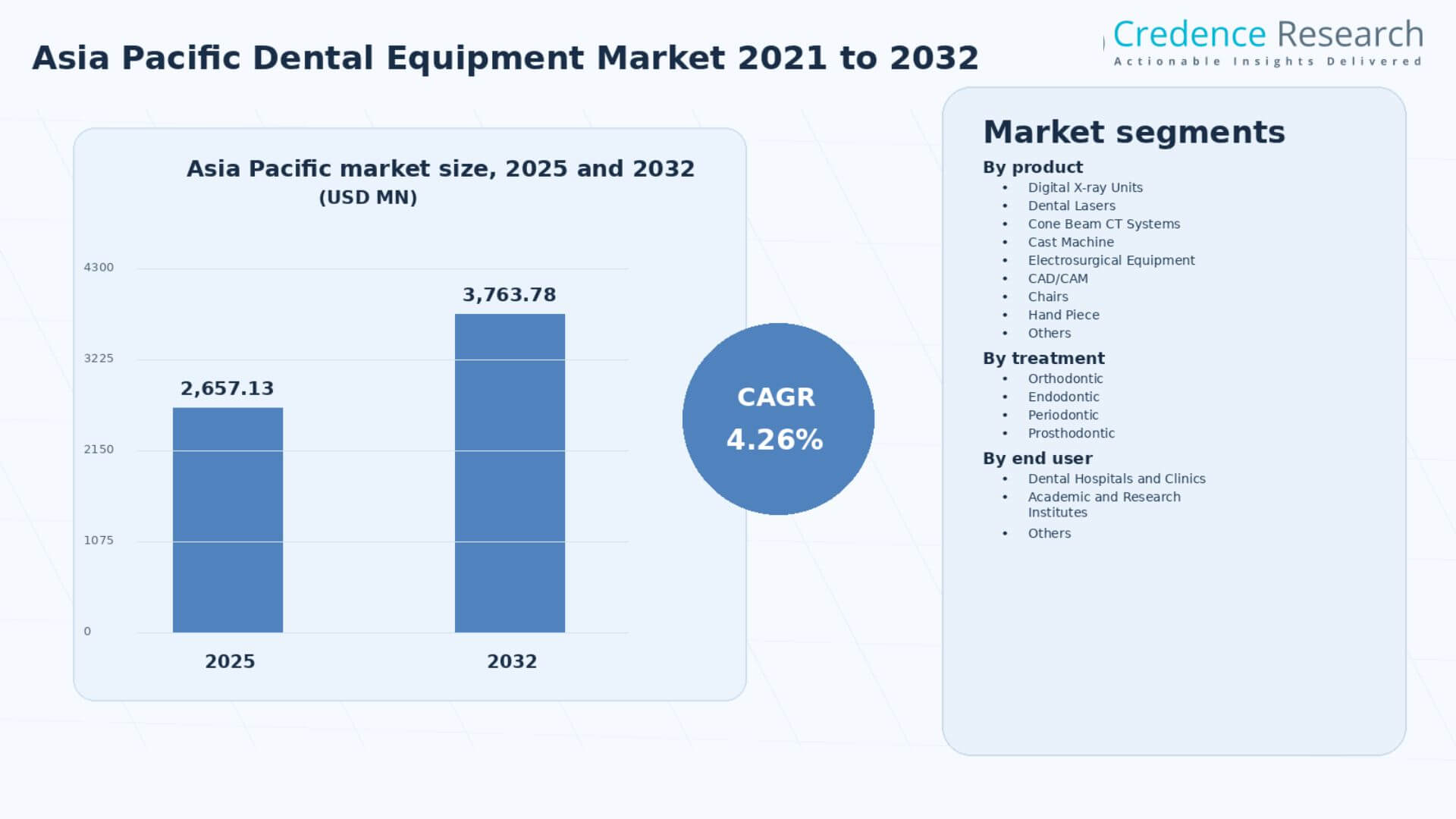
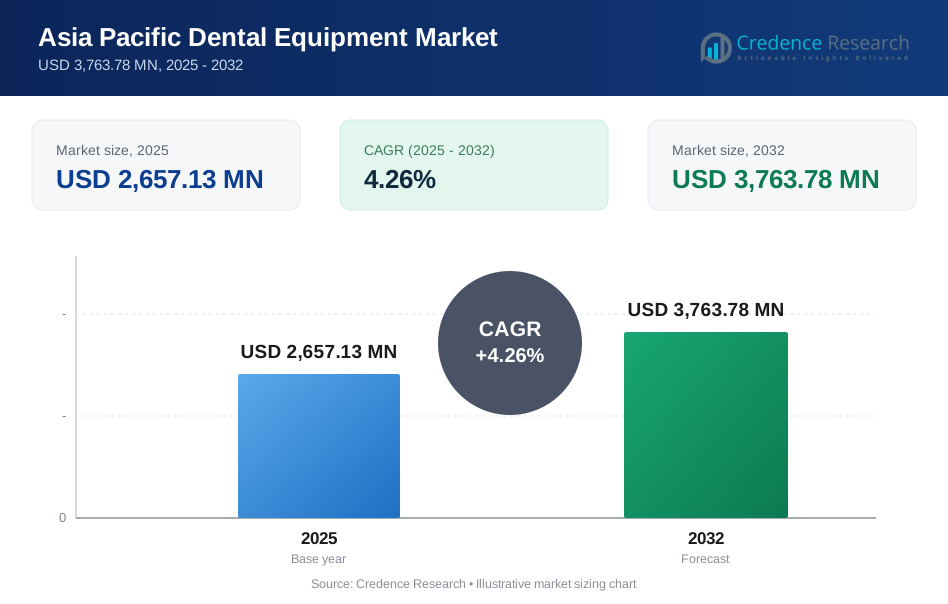
The Asia Pacific Dental Equipment Market size was valued at USD 3,361.43 MN in 2021 and reached USD 2,657.13 MN in 2025. It is anticipated to reach USD 3,763.78 MN by 2032, growing at a CAGR of 4.26% during the forecast period.
| REPORT ATTRIBUTE | DETAILS |
|---|---|
| Historical Period | 2021-2024 |
| Base Year | 2025 |
| Forecast Period | 2025-2032 |
| Asia Pacific Dental Equipment Market Size 2025 | USD 2,657.13 million |
| Asia Pacific Dental Equipment Market, CAGR | 4.26% |
| Asia Pacific Dental Equipment Market Size 2032 | USD 3,763.78 million |
Asia Pacific Dental Equipment Market Insights
- Market recovery is supported by oral disease burden, dental clinic modernization, cone beam CT adoption, digital X-ray conversion, CAD/CAM workflows, orthodontic treatment demand and replacement of conventional dental chairs and hand pieces.
- Digital X-ray Units and Cone Beam CT Systems hold strong demand because dental hospitals and clinics increasingly use imaging for diagnosis, implant planning, orthodontics, endodontics and prosthodontic workflows.
- CAD/CAM is gaining momentum because dental practices and laboratories are moving toward chairside restoration, digital impressions, milling and integrated treatment planning.
- Dental Hospitals and Clinics remain the leading end-user segment because most diagnostic, restorative, orthodontic and surgical dental procedures require chairside equipment, imaging systems, hand pieces and trained dentists.
Asia Pacific Dental Equipment Market Segment Insights
By product
By product, Digital X-ray Units held a strong position in 2025 because dental clinics use radiography for caries detection, periodontal assessment, endodontic planning, orthodontic evaluation and surgical diagnosis. Cone Beam CT Systems are gaining demand because CBCT supports three-dimensional imaging for implants, impacted teeth, root canal assessment, orthodontic planning and oral surgery. CAD/CAM is expanding as dentists adopt digital impressions, scanning, milling and prosthodontic workflows. Chairs and Hand Piece categories remain essential because they support daily clinical procedures across dental hospitals and clinics. Dental Lasers and Electrosurgical Equipment are gaining selective use in soft tissue treatment, periodontics and minimally invasive care. Cast Machine and Others support dental laboratory and restoration workflows.
By treatment
By treatment, Prosthodontic held a strong position in 2025 because crowns, bridges, dentures, implants and restorations require imaging, CAD/CAM, casting and chairside equipment. Orthodontic demand is supported by malocclusion correction, digital treatment planning, CBCT, intraoral imaging and aligner-related diagnostics. Endodontic treatment supports demand for digital X-ray units, CBCT, hand pieces and precision instruments used in root canal procedures. Periodontic treatment supports dental lasers, electrosurgical equipment, imaging and chairside devices used for gum disease management. Treatment demand will depend on oral disease burden, affordability, dental insurance, private clinic investment and patient awareness across Asia Pacific.
By end user
By end user, Dental Hospitals and Clinics held the strongest position in 2025 because most dental diagnosis, treatment planning, restorative care, orthodontics, endodontics and prosthodontics are delivered in clinical settings. These facilities require chairs, hand pieces, digital X-ray units, CBCT systems, CAD/CAM tools and sterilization-linked equipment. Academic and Research Institutes support dental training, equipment evaluation, clinical research, digital dentistry adoption and new workflow validation. Others include dental laboratories, mobile dental care providers and specialty centers. Growth will favor end users that can invest in digital workflows, service contracts, staff training and patient throughput.
Key Market Drivers
High oral disease burden across Asia Pacific
High oral disease burden represents a major growth driver for the Asia Pacific Dental Equipment Market. WHO states that oral diseases affect nearly 3.7 billion people globally, while untreated dental caries in permanent teeth is the most common health condition in the Global Burden of Disease 2021. WHO also estimates that severe periodontal diseases affect more than 1 billion cases worldwide. This burden supports demand for Digital X-ray Units, Cone Beam CT Systems, Hand Piece, Chairs, Endodontic treatment, Periodontic treatment and Dental Hospitals and Clinics. As countries expand early diagnosis, restorative care and preventive dental programs, demand for dental imaging and chairside equipment is expected to improve through 2032.
Western Pacific oral health policy momentum
Western Pacific oral health policy momentum supports dental equipment adoption in key Asia Pacific markets. WHO reported that oral diseases are the most common noncommunicable diseases in the Western Pacific Region and affected an estimated 960 million people, or more than 40% of the population, in 2021. WHO also supports member states in integrating essential oral health services into primary health care and universal health coverage benefit packages. This driver supports Dental Hospitals and Clinics, Digital X-ray Units, Chairs, Hand Piece and basic diagnostic equipment. Policy focus on oral health can strengthen clinic networks, public dental programs and demand for affordable equipment.
South-East Asia treatment access gap
South-East Asia treatment access gap creates strong long-term demand for dental infrastructure and equipment. WHO’s South-East Asia oral health action plan reported more than 900 million cases of untreated dental caries, severe periodontal disease and edentulism in the region in 2019. It also estimated 526 million cases of untreated caries in permanent teeth and 307 million cases of severe periodontal disease. These disease levels support demand for Digital X-ray Units, Hand Piece, Chairs, Dental Lasers, Periodontic treatment and Prosthodontic treatment. Market expansion will depend on affordability, dental workforce, public programs, insurance coverage and clinic modernization.
Digital dentistry and CAD/CAM adoption
Digital dentistry and CAD/CAM adoption are reshaping dental equipment investment. Dentsply Sirona reported that its Connected Technology Solutions segment includes dental technology and equipment products, including Equipment & Instruments and CAD/CAM product categories. The company also said it provides technologically advanced dental equipment supported by cloud-enabled software solutions. This supports demand for CAD/CAM, Digital X-ray Units, Cone Beam CT Systems, Dental Hospitals and Clinics and Academic and Research Institutes. Digital workflows help dentists improve planning, reduce turnaround time and integrate imaging with restorative and prosthodontic treatment.
Dental imaging and orthodontic platform expansion
Dental imaging and orthodontic platform expansion is supporting equipment demand as clinics upgrade diagnostic and treatment planning tools. Envista reported 2025 total sales of USD 2.7 billion and said its portfolio includes dental implants, orthodontics and digital imaging technologies. Its Equipment & Consumables segment generated USD 966.7 million in 2025 and included digital imaging systems, software and visualization systems used in dental offices. This driver supports Digital X-ray Units, Cone Beam CT Systems, Orthodontic treatment, Prosthodontic treatment and Dental Hospitals and Clinics. Vendors with integrated imaging, software and treatment planning ecosystems are expected to gain stronger adoption.
Key Trends and Opportunities
Cone beam CT moves deeper into treatment planning
Cone Beam CT Systems are moving deeper into treatment planning as dentists use 3D imaging for implant placement, orthodontics, endodontics, oral surgery and complex prosthodontic cases. Carestream Dental reported in July 2025 that its CS 9600 and CS 8200 3D Family CBCT systems earned Digital Dentistry Society certification, while its March 2025 IDS coverage highlighted next-generation CBCT imaging and AI-driven software. This trend supports Cone Beam CT Systems, CAD/CAM, Prosthodontic, Orthodontic and Dental Hospitals and Clinics. Growth will depend on affordability, training, radiation safety, diagnostic value and software integration.
CAD/CAM supports chairside restoration and digital prosthodontics
CAD/CAM is gaining importance as dental clinics and laboratories adopt digital impressions, milling, design software and integrated restorative workflows. Dentsply Sirona’s Connected Technology Solutions segment covers CAD/CAM and equipment categories, reinforcing the role of digital dentistry in equipment portfolios. Prosthodontic treatment will benefit as clinics reduce external laboratory turnaround time and improve restoration consistency. CAD/CAM adoption will be faster in private dental chains, premium clinics, academic institutions and urban dental hospitals where procedure volumes support equipment investment.
Academic institutes support digital dentistry training
Academic and Research Institutes are becoming important growth enablers because dentists require training on CBCT, CAD/CAM, lasers, electrosurgical systems and digital X-ray interpretation. WHO’s South-East Asia action plan identifies oral health workforce development, oral health research, digital innovation and emerging issues as strategic action areas. This creates opportunities for equipment vendors to partner with dental schools, training centers and research institutions. Vendors that provide education, clinical protocols and student exposure can improve long-term adoption across regional dental practice networks.
Emerging market clinics demand value-tier equipment
Emerging market clinics are demanding value-tier dental equipment as Asia Pacific dental providers balance affordability with quality. Envista reported that emerging markets represented 22% of its total sales in 2025 and that the company has dedicated product management, operations, regulatory, sales and customer service resources focused on those markets. This trend supports Chairs, Hand Piece, Digital X-ray Units, Cast Machine and basic CAD/CAM systems. Vendors that offer financing, compact formats, local service, training and modular upgrades will gain stronger traction in India, Southeast Asia and other price-sensitive markets.
Key Market Challenges
Historical market decline and recovery pressure
Historical market decline and recovery pressure remain key challenges for the Asia Pacific Dental Equipment Market. The market declined from USD 3,361.43 MN in 2021 to USD 2,657.13 MN in 2025 based on the supplied values, creating pressure for vendors to regain lost value through product upgrades, clinic investment and digital adoption. Dental equipment purchases are capital-intensive and often delayed when clinics face weaker patient volumes, higher financing costs or lower discretionary procedure demand. Vendors must support financing models, training, maintenance and clinic productivity improvement to accelerate recovery.
High equipment cost and affordability barriers
High equipment cost and affordability barriers restrict adoption of CBCT, CAD/CAM, dental lasers and premium chairs across emerging Asia Pacific markets. Advanced dental equipment requires upfront capital, installation, maintenance, software subscriptions, upgrades and operator training. Smaller clinics may prioritize basic chairs, hand pieces and X-ray units over premium systems. Cost barriers are stronger in markets with limited dental insurance and high out-of-pocket spending. Manufacturers must offer value-tier systems, leasing, distributor financing and service packages to improve adoption.
Training and workflow integration constraints
Training and workflow integration constraints affect utilization of advanced dental equipment. CBCT, CAD/CAM, dental lasers and electrosurgical equipment require dentists and staff to understand imaging protocols, software workflows, radiation safety, digital design and case planning. Clinics may underuse installed systems without proper training and service support. Academic and Research Institutes can reduce this gap by integrating digital dentistry into training. Vendors with strong education programs, chairside workflow support and remote assistance will be better positioned.
Service, maintenance and distributor dependence
Service, maintenance and distributor dependence remain structural challenges. Dental equipment requires reliable installation, calibration, spare parts, software updates and local technical support. Downtime directly affects clinic revenue and patient scheduling. In Asia Pacific, service quality can vary widely across urban and rural markets. Dentsply Sirona’s 2026 plan included investment in clinical education and sales team education focused on connected dentistry, showing the importance of customer experience and post-sale support in dental equipment markets. Vendors with strong distributor networks and responsive service teams will gain advantage.
Regional Analysis
China
China represents a major market within the Asia Pacific Dental Equipment Market due to its large dental patient base, expanding private dental chains, domestic equipment manufacturing and rising demand for digital dentistry. Digital X-ray Units, Cone Beam CT Systems, CAD/CAM, Chairs and Hand Piece products are important across dental hospitals and clinics. Orthodontic and Prosthodontic treatments are supported by urban middle-class demand, implant dentistry and cosmetic dentistry. Domestic suppliers compete strongly in value-tier segments, while premium clinics continue to adopt international imaging and CAD/CAM systems. Growth will depend on clinic expansion, equipment financing, distributor strength and digital workflow adoption.
Japan
Japan is a mature dental equipment market supported by advanced clinics, aging population, established dental insurance and high demand for prosthodontic and restorative care. Chairs, Hand Piece, Digital X-ray Units, CAD/CAM and Cone Beam CT Systems remain key categories. Japan’s high standards for clinical quality and equipment reliability support demand for premium systems and replacement purchases. Dental Hospitals and Clinics dominate demand, while Academic and Research Institutes support technology validation and digital training. Growth will be moderate but steady due to replacement cycles, elderly patient needs, prosthodontic care and continued digital workflow adoption.
India
India is an expanding market supported by a large untreated oral disease burden, private dental clinic growth, dental education capacity and increasing demand for affordable digital equipment. WHO’s South-East Asia data showing high untreated caries and periodontal disease burden supports long-term need for dental diagnosis and treatment infrastructure. Digital X-ray Units, Chairs, Hand Piece and value-tier CBCT systems are expected to gain demand as clinics modernize. Orthodontic and Prosthodontic treatments are expanding in urban centers. Growth will depend on affordability, dental insurance penetration, distributor reach, financing and local service support.
South Korea
South Korea represents a high-value dental equipment market due to advanced dental clinics, strong implant dentistry, domestic dental technology companies and high consumer interest in cosmetic and restorative procedures. Osstem supports the country’s dental ecosystem through dental implants and medical equipment, with company information highlighting dental implant and medical equipment production and dental chair development. CAD/CAM, Cone Beam CT Systems, Digital X-ray Units, Chairs and Hand Piece products are important across premium clinics. Growth will depend on technology upgrades, export-oriented dental innovation, private clinic demand and digital treatment workflows.
Australia and New Zealand
Australia and New Zealand represent mature markets supported by private dental practices, established oral health awareness, high equipment standards and steady replacement demand. Dental Hospitals and Clinics use Digital X-ray Units, CBCT, Chairs, Hand Piece and CAD/CAM to support preventive, restorative, orthodontic and prosthodontic care. Premium equipment adoption is stronger in urban clinics and specialist practices. Growth will depend on private practice investment, reimbursement, patient affordability, aging population needs and demand for faster restorative workflows. Service reliability and regulatory compliance will remain important vendor differentiators.
Southeast Asia
Southeast Asia offers long-term growth potential due to large populations, rising dental clinic investment, dental tourism, growing urban middle-class demand and high untreated oral disease burden. Thailand, Malaysia, Indonesia, Vietnam, the Philippines and Singapore show different adoption levels. Singapore and Thailand support premium digital dentistry and dental tourism, while Indonesia, Vietnam and the Philippines offer volume growth for chairs, hand pieces, digital X-ray units and value-tier systems. WHO’s Western Pacific and South-East Asia oral health data indicate strong need for oral disease prevention and treatment access across these markets. Growth will depend on affordability, dental workforce, service networks and clinic financing.
Report Attribute Details
| Report Attribute | Details |
| Historical Period | 2021–2024 |
| Base Year | 2025 |
| Forecast Period | 2025–2032 |
| Market Size in 2021 | USD 3,361.43 MN |
| Market Size in 2025 | USD 2,657.13 MN |
| Market Size in 2032 | USD 3,763.78 MN |
| CAGR | 4.26% |
| Segments Covered | Product, Treatment, End User and Geography |
| Key Companies Covered | 3M, Canon, Carestream Health, GE Healthcare, Dentsply Sirona, Philips Healthcare, Danaher Corporation, Osstem, Siemens Healthineers, Kavo Dental, Envista Holdings, BioHorizons and DENTAURUM GmbH |
Market Segmentations
By Product
- Digital X-ray Units
- Dental Lasers
- Cone Beam CT Systems
- Cast Machine
- Electrosurgical Equipment
- CAD/CAM
- Chairs
- Hand Piece
- Others
By Treatment
- Orthodontic
- Endodontic
- Periodontic
- Prosthodontic
By End User
- Dental Hospitals and Clinics
- Academic and Research Institutes
- Others
Key players
- 3M
- Canon
- Carestream Health
- GE Healthcare
- Dentsply Sirona
- Philips Healthcare
- Danaher Corporation
- Osstem
- Siemens Healthineers
- Kavo Dental
- Envista Holdings
- BioHorizons
- DENTAURUM GmbH
Recent Developments
- In February 2026, Dentsply Sirona reported fourth-quarter 2025 net sales of USD 961 million and announced a restructuring initiative expected to redirect about USD 120 million annually into return-to-growth initiatives focused on innovation, clinical education and connected dentistry.
- In 2025, Dentsply Sirona reported that its Connected Technology Solutions segment included equipment, instruments and CAD/CAM product categories, reinforcing the company’s focus on connected dental technology.
- In 2025, Envista reported total sales of USD 2.7 billion and Equipment & Consumables sales of USD 966.7 million, with the segment including digital imaging systems, software and visualization systems used in dental offices.
- In July 2025, Carestream Dental reported that its CS 9600 and CS 8200 3D Family CBCT systems earned Digital Dentistry Society certification.
- In March 2025, Carestream Dental highlighted next-generation CBCT imaging, AI-driven software and a planned collaboration with Straumann at IDS 2025 to support more connected dental workflows.
Report Coverage
The research report offers an in-depth analysis based on product, treatment, end user and geography. It details leading market players, providing an overview of their business positioning, dental equipment portfolios, digital X-ray systems, cone beam CT systems, CAD/CAM solutions, dental lasers, chairs, hand pieces, orthodontic equipment, endodontic equipment, prosthodontic workflows and strategic relevance in the Asia Pacific Dental Equipment Market. The report includes insights into the competitive environment, market trends, growth drivers, restraints and opportunities. It also examines oral disease burden, clinic modernization, dental imaging adoption, CAD/CAM expansion, dental training needs, value-tier equipment demand and distributor-led service models as major factors shaping market development. The report assesses the impact of equipment cost, historical market decline, affordability barriers, workflow integration challenges, training needs and service limitations on market growth. It provides strategic recommendations for dental equipment manufacturers, dental hospitals, clinics, academic institutes, distributors, investors and new entrants seeking to navigate Asia Pacific’s dental equipment ecosystem.
Future Outlook
- Demand for dental equipment will recover as dental hospitals and clinics invest in modernization, imaging upgrades and digital workflows.
- Digital X-ray Units will remain a major product category due to routine use in diagnosis, endodontics, orthodontics and periodontal assessment.
- Cone Beam CT Systems will gain demand through implant planning, orthodontic workflows, endodontic assessment and oral surgery.
- CAD/CAM will expand as clinics and laboratories adopt chairside restoration, digital scanning and prosthodontic workflows.
- Chairs and Hand Piece products will remain essential because they support daily procedure volume across dental hospitals and clinics.
- Orthodontic treatment will grow through digital imaging, treatment planning and rising aesthetic dental demand.
- Endodontic treatment will support demand for imaging systems, hand pieces and precision chairside equipment.
- Prosthodontic treatment will remain a key revenue area due to crowns, bridges, dentures, implants and restoration workflows.
- Academic and Research Institutes will support adoption through dental training, equipment evaluation and digital dentistry education.
- Competition will increase as companies compete on affordability, software integration, imaging quality, financing, service uptime, training and distributor reach.
Request a Free Sample
Fill in your details and we'll send you a free sample report.
- Sample data tables & charts
- Research methodology
Need a Custom Version of This Report?
Tailor the scope, geography, or segments to your exact requirements.
- Custom geography or segment scope
- Direct access to our analyst team
Frequently Asked Questions
What is the current market size for the Asia Pacific Dental Equipment Market and what is its projected size in 2032?
At what CAGR is the Asia Pacific Dental Equipment Market projected to grow?
Which product segment is expected to hold strong demand?
Which treatment segment supports strong market demand?
Which end-user segment leads the market?
Who are the leading companies in the market?
Which countries are important in the Asia Pacific market?
Table of Content
Chapter 1. Report Introduction
- 1.1 Report Description & Purpose
- 1.1.1 Report Title & Market Definition
- 1.1.2 Unique Selling Propositions (USP) & Key Differentiators
- 1.1.3 Value Proposition for Stakeholders
- 1.2 Research Objectives
- 1.2.1 Market Sizing Objectives (Volume & Revenue)
- 1.2.2 Segmentation Objectives
- 1.2.3 Competitive Intelligence Objectives
- 1.2.4 Forecast & Scenario Objectives
- 1.3 Report Scope
- 1.3.1 Asia Pacific Dental Equipment Scope – Types & Subtypes Covered
- 1.3.2 Geographic Scope – Regions & Countries Covered
- 1.3.3 Historical Period, Base Year & Forecast Period (2025; forecast to 2032)
- 1.3.4 Inclusions & Exclusions
- 1.4 HS Code & Classification Framework
- 1.5 Currency, Units & Pricing Basis
- 1.6 Target Stakeholders
- 1.7 Limitations & Assumptions
Chapter 2. Executive Summary
- 2.1 Global Asia Pacific Dental Equipment Market Snapshot
- 2.1.1 Market Size – Historical (2025) & Forecast (2025-2032) (2025: USD 2,657.13 MN → 2032: USD 3,763.78 MN)
- 2.1.2 Volume & Revenue – Global Totals
- 2.1.3 Key Market Highlights – Top Five Facts
- 2.2 Asia Pacific Dental Equipment Market Segmentation Snapshot
- 2.2.1 Market Split by Region – 2025 vs. 2032
- 2.3 Competitive Snapshot
- 2.3.1 Top 10 Players by Revenue Share – 2025
- 2.3.2 Top 10 Players by Volume Share – 2025
- 2.3.3 Recent Strategic Developments (18-Month Summary)
- 2.4 Key Investment Highlights & Strategic Conclusions
Chapter 3. Asia Pacific Dental Equipment Market Dynamics & Industry Analysis
- 3.1 Market Overview & Context
- 3.1.1 Asia Pacific Dental Equipment Market Position in the Broader Automotive Value Chain
- 3.1.2 OEM vs. Replacement Market Dynamics
- 3.1.3 Market Maturity & Development Stage by Region
- 3.2 Asia Pacific Dental Equipment Market Drivers
- 3.3 Asia Pacific Dental Equipment Market Restraints & Challenges
- 3.4 Asia Pacific Dental Equipment Market Opportunities
- 3.5 Porter's Five Forces Analysis
- 3.5.1 Threat of New Entrants
- 3.5.2 Bargaining Power of Suppliers
- 3.5.3 Bargaining Power of Buyers
- 3.5.4 Threat of Substitutes
- 3.5.5 Competitive Rivalry – Intensity Assessment
- 3.6 Asia Pacific Dental Equipment Value Chain Analysis
- 3.6.1 Upstream – Raw Material/Input Suppliers
- 3.6.1.1 Raw Material/Input 1
- 3.6.1.2 Raw Material/Input 2
- 3.6.1.3 Raw Material/Input 3
- 3.6.2 Midstream – Production/Manufacturing/Service Delivery
- 3.6.2.1 Production/Process Overview
- 3.6.2.2 Key Facility Locations & Capacity by Manufacturer
- 3.6.3 Downstream – Distribution & End Consumer
- 3.6.3.1 Primary Channel – B2B/OEM
- 3.6.3.2 Secondary Channels – Dealer, Retail, Online, Direct
- 3.6.4 Value Chain Profitability Analysis
- 3.6.1 Upstream – Raw Material/Input Suppliers
- 3.7 PESTEL Analysis
- 3.7.1 Political Factors
- 3.7.2 Economic Factors
- 3.7.3 Social Factors
- 3.7.4 Technological Factors
- 3.7.5 Environmental Factors
- 3.7.6 Legal Factors
- 3.8 Asia Pacific Dental Equipment Supply Chain Analysis
- 3.8.1 Raw Material/Input Supply Risk Assessment
- 3.8.2 Manufacturing Concentration Risk (Geographic Exposure)
- 3.8.3 Trade Disruption Impact Analysis
- 3.9 Regulatory & Policy Landscape
Note: The regulatory and policy landscape section covers regulations based on their applicability to the market, Asia Pacific Dental Equipment category, geography, and scope of the study. Only regulatory frameworks with a material impact on operations, compliance, trade, sustainability, or market access are analyzed in detail.
Chapter 4. Key Investment Pockets & Opportunity Analysis
- 4.1 Asia Pacific Dental Equipment Market Attractiveness Analysis
- 4.1.1 By Region – Investment Attractiveness Matrix (Volume × CAGR)
- 4.2 Absolute Revenue Growth Opportunity
- 4.2.1 By Region – Absolute USD Growth Through 2032
- 4.3 Incremental Volume Opportunity
- 4.3.1 By Region – Incremental Volume Through 2032
- 4.3.2 Segment – Incremental Volume
- 4.4 Emerging Submarket Opportunity Deep Dive (Subject to Applicability)
- 4.5 Emerging Market Opportunity Scorecards
- 4.5.1 United States
- 4.5.2 Europe
- 4.5.3 Asia
- 4.5.4 Middle East & Africa
Note: Emerging Market Opportunity Scorecards will be included based on relevance and strategic importance. Regions listed are indicative and may vary depending on data availability and market dynamics.
Chapter 5. Asia Pacific Dental Equipment Import-Export Analysis & Trade Flows
- 5.1 Global Trade Overview
- 5.1.1 Global Export Value by Country (2025)
- 5.1.2 Global Export Volume by Country (2025)
- 5.1.3 Global Import Value by Country (2025)
- 5.1.4 Global Import Volume by Country (2025)
- 5.1.5 Net Trade Balance by Country (2025)
- 5.2 Export Analysis – Segment
- 5.2.1 Type 1 (HS Code)
- 5.2.2 Type 2 (HS Code)
- 5.2.3 Type 3 (HS Code)
- 5.2.4 Type 4 (HS Code)
- 5.2.5 Type 5 (HS Code)
- 5.3 Import Analysis – Segment
- 5.3.1 Type 1 (HS Code)
- 5.3.2 Type 2 (HS Code)
- 5.3.3 Type 3 (HS Code)
- 5.3.4 Type 4 (HS Code)
- 5.3.5 Type 5 (HS Code)
- 5.4 Average Unit Trade Prices
- 5.4.1 Average Export Price – Segment & Country
- 5.4.2 Average Import Price – Segment & Source Country
- 5.4.3 Price Trends (2025)
- 5.5 Key Trade Route Analysis
- 5.5.1 Trade Route 1
- 5.5.2 Trade Route 2
- 5.5.3 Trade Route 3
- 5.5.4 Trade Route 4
- 5.5.5 Trade Route 5
- 5.6 Trade Policy Impact Assessment
- 5.6.1 US Anti-Dumping & Section 301 Tariffs
- 5.6.2 EU Customs Union Impact
- 5.6.3 Major Free Trade Agreements
- 5.6.4 USMCA Rules of Origin
Note: Trade policy analysis will be included only where relevant to the Asia Pacific Dental Equipment market.
Chapter 6. Competitive Landscape & Company Benchmarking
- 6.1 Asia Pacific Dental Equipment Market Concentration & Structure
- 6.1.1 Herfindahl-Hirschman Index (HHI) – vs. 2025
- 6.1.2 Tier 1, Tier 2 & Tier 3 Market Structure
- 6.1.3 Global, Regional & Local Player Dynamics
- 6.2 Asia Pacific Dental Equipment Market Share Analysis – 2025
- 6.2.1 Global Revenue Share by Company
- 6.2.2 Global Volume Share by Company
- 6.2.3 Regional Revenue Share
- 6.2.4 Market Share Evolution ( vs. 2025)
- 6.2.5 OEM Segment Share by Company
- 6.2.6 Replacement Segment Share by Company
- 6.3 Production/Delivery Capacity & Facility Analysis
- 6.3.1 Global Installed Capacity
- 6.3.2 Capacity Utilization Rates
- 6.3.3 Production/Output Volume
- 6.3.4 Facility Locations & Capacity Map
- 6.3.5 Planned Capacity Additions
- 6.4 Asia Pacific Dental Equipment Competitive Benchmarking Matrix
- 6.4.1 Revenue, Volume, CAGR & Profitability Comparison
- 6.4.2 Channel Revenue Mix
- 6.4.3 Geographic Revenue Exposure
- 6.4.4 R&D Intensity
- 6.4.5 Sustainability Maturity
- 6.5 Strategic Developments in Asia Pacific Dental Equipment (Last 24 Months)
- 6.5.1 Mergers, Acquisitions & Divestments
- 6.5.2 New Asia Pacific Dental Equipment Launches
- 6.5.3 Facility Expansions
- 6.5.4 Strategic Alliances, Joint Ventures & Partnerships
- 6.5.5 Distribution Expansion & Market Entry
- 6.5.6 Sustainability & ESG Initiatives
- 6.6 Competitive Strategy Mapping
- 6.6.1 Leader, Challenger, Follower & Niche Classification
- 6.6.2 Pricing Strategy Comparison
- 6.6.3 Channel Strategy Matrix
Note: Strategic developments are included based on their materiality and the availability of reliable information.
Chapter 7. Global Asia Pacific Dental Equipment Market – By Distribution Channel
- 7.1 Segment Overview
- 7.1.1 Volume & Revenue Split by Channel (2025 & 2032)
- 7.1.2 Channel Mix Evolution (2025-2032)
Chapter 8. Regional Market Analysis – Global Overview
- 8.1 Global Regional Overview
- 8.1.1 Regional Volume Share
- 8.1.2 Regional Revenue Share
- 8.1.3 Regional Volume by Region
- 8.1.4 Regional Revenue by Region
- 8.1.5 Regional Forecast Through 2032
- 8.2 Cross-Regional Segment Analysis
- 8.2.1 By Distribution Channel
- 8.2.2 By Brand/Price Tier
Chapter 9. North America Asia Pacific Dental Equipment Market
- 9.1 United States
- 9.2 Canada
- 9.3 Mexico
Chapter 10. Europe Asia Pacific Dental Equipment Market
- 10.1 Germany
- 10.2 France
- 10.3 Italy
- 10.4 United Kingdom
- 10.5 Spain
- 10.6 Poland
- 10.7 Russia
- 10.8 Netherlands
- 10.9 Belgium
- 10.10 Sweden
- 10.11 Denmark
- 10.12 Norway
- 10.13 Rest of Europe
Chapter 11. Asia Pacific Asia Pacific Dental Equipment Market
- 11.1 China
- 11.2 India
- 11.3 Japan
- 11.4 South Korea
- 11.5 Thailand
- 11.6 Indonesia
- 11.7 Vietnam
- 11.8 Malaysia
- 11.9 Australia
- 11.10 Rest of Asia Pacific
Chapter 12. Latin America Asia Pacific Dental Equipment Market
- 12.1 Brazil
- 12.2 Argentina
- 12.3 Colombia
- 12.4 Chile
- 12.5 Rest of Latin America
Chapter 13. Middle East Asia Pacific Dental Equipment Market
- 13.1 Saudi Arabia
- 13.2 United Arab Emirates
- 13.3 Turkey
- 13.4 Israel
- 13.5 Iran
- 13.6 Rest of the Middle East
Chapter 14. Africa Asia Pacific Dental Equipment Market
- 14.1 South Africa
- 14.2 Egypt
- 14.3 Nigeria
- 14.4 Morocco
- 14.5 Rest of Africa
Chapter 15. Asia Pacific Dental Equipment Company Profiles
- 15.1 [Company 01]
- 15.1.1 Company Overview
- 15.1.2 Key Management Personnel
- 15.1.3 Products & Services Portfolio
- 15.1.4 Financial Performance
- 15.1.5 Key Market Focus & Geographic Presence
- 15.1.6 Recent Developments & Strategic Initiatives
Note: The company profile list is preliminary and may change based on research findings, market developments, data availability, and client requirements.
Chapter 16. Appendices
- Appendix A – List of Abbreviations & Acronyms
- Appendix B – Industry Classification Code Reference – Full Series
- Appendix C – Production & Capacity Data Tables
- Appendix D – End-Use & Demand Base Tables
- Appendix E – Consumption & Replacement Rate Assumptions
- Appendix F – ASP Reference Tables
- Appendix G – Manufacturing & Facility Database
- Appendix H – Import-Export Data Tables
- Appendix I – Regulatory Summary Tables
- Appendix J – Primary Research Participant List (Anonymized)
- Appendix K – Primary Research Questionnaire Framework
- Appendix L – Data Sources & Bibliography
- Appendix M – Market Size Divergence & Source Comparison
Chapter 17. Research Methodology
- 17.1 Research Framework & Philosophy
- 17.2 Secondary Research – Sources, Hierarchy & Data Extraction
- 17.3 Data Modeling – Bottom-Up & Top-Down Market Sizing
- 17.4 Primary Research – Stakeholder Framework, LOI & Sample Sizes
- 17.5 Forecast Methodology – Regression, Scenario & Sensitivity Analysis
- 17.6 Quality Control – Four-Layer Validation Framework
- 17.7 Limitations & Standard Assumptions
- 17.8 Disclaimer
