
Asia Pacific RNA-based Therapeutics Market Overview:
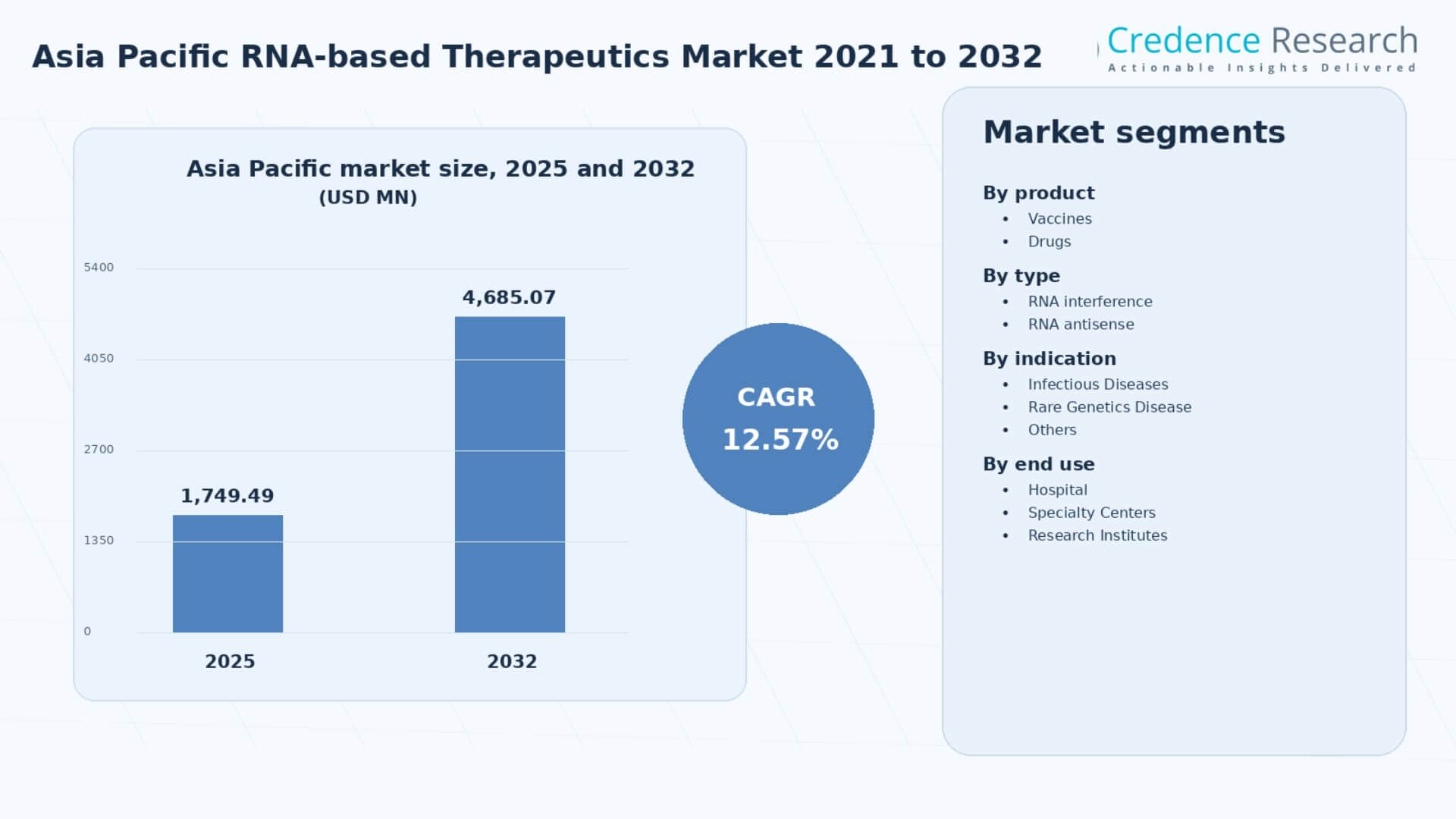
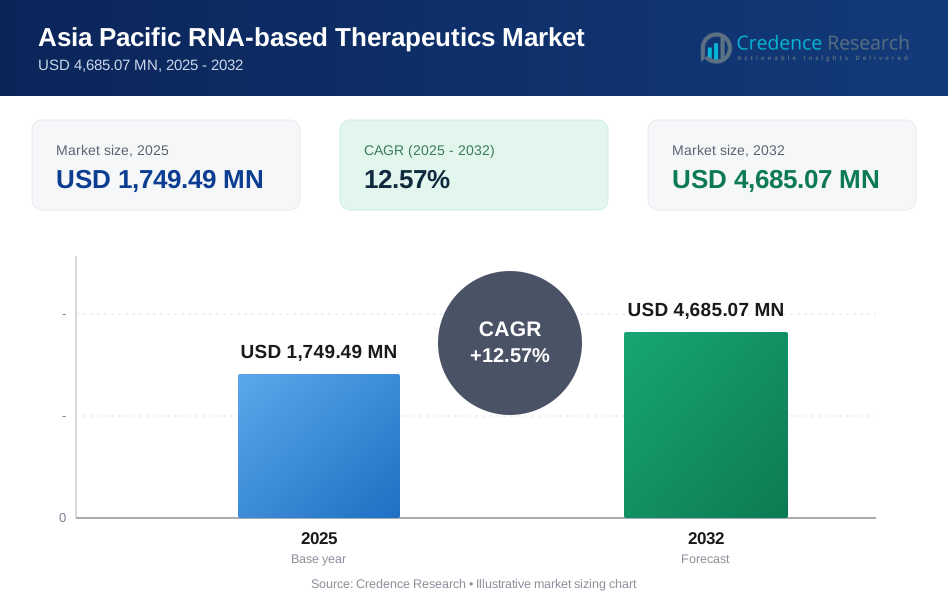
The Asia Pacific RNA-based Therapeutics Market size was valued at USD 1,025.76 MN in 2021 and reached USD 1,749.49 MN in 2025. It is anticipated to reach USD 4,685.07 MN by 2032, growing at a CAGR of 12.57% during the forecast period.
| REPORT ATTRIBUTE | DETAILS |
|---|---|
| Historical Period | 2021-2024 |
| Base Year | 2025 |
| Forecast Period | 2025-2032 |
| Asia Pacific RNA-based Therapeutics Market Size 2025 | USD 1,749.49 million |
| Asia Pacific RNA-based Therapeutics Market, CAGR | 12.57% |
| Asia Pacific RNA-based Therapeutics Market Size 2032 | USD 4,685.07 million |
Asia Pacific RNA-based Therapeutics Market Insights
- Market growth is supported by mRNA vaccine adoption, RNA interference drug commercialization, RNA antisense innovation, rare genetic disease treatment demand and expanding clinical research infrastructure.
- Vaccines hold a strong position because mRNA vaccines remain relevant for COVID-19, RSV, influenza pipeline development and broader infectious disease preparedness.
- RNA interference is gaining momentum as approved RNAi therapies expand commercial performance and create stronger confidence in gene-silencing platforms.
- Hospitals remain the leading end-use segment because RNA-based therapeutics often require specialist prescribing, cold-chain handling, clinical monitoring and reimbursement documentation.
Asia Pacific RNA-based Therapeutics Market segment Insights
By product
By product, Vaccines held the strongest position in 2025 because mRNA vaccine platforms gained broad acceptance through COVID-19 prevention and are expanding into RSV, influenza and other infectious disease areas. Vaccines benefit from public-sector procurement, seasonal update models, pandemic preparedness and rapid antigen redesign capability. Drugs are gaining momentum as RNA interference and RNA antisense therapies move deeper into rare genetic disease, cardiometabolic disease, neurology and specialty medicine. Drug growth will depend on target validation, delivery technology, safety profile, payer access and physician confidence. Vaccines will remain important, but Drugs are expected to gain higher long-term value as more RNA-based therapeutics secure approvals.
By type
By type, RNA interference held a strong position in 2025 because RNAi medicines have demonstrated commercial relevance across rare disease and cardiometabolic treatment pathways. RNA interference drugs can silence disease-causing genes and support durable therapeutic effects through targeted delivery. RNA antisense remains a major technology category due to its use in rare genetic disorders, neurology, cardiometabolic disease and protein modulation. Antisense oligonucleotides support flexible drug design and can target RNA transcripts that are difficult to address through conventional small molecules. Growth across both types will depend on delivery systems, dosing convenience, safety monitoring, clinical evidence and disease-specific regulatory pathways.
By indication
By indication, Infectious Diseases held the strongest position in 2025 because RNA vaccine platforms remain highly relevant for COVID-19 updates, RSV prevention, influenza development and emerging pathogen preparedness. Rare Genetics Disease is gaining strong value because RNA interference and RNA antisense therapies can address genetically defined disease mechanisms. This segment benefits from orphan drug pathways, specialist diagnosis and high unmet need. Others include cardiometabolic diseases, neurology, oncology, immunology and liver-targeted conditions. Indication growth will depend on diagnosis rates, genetic testing, clinical trial access, reimbursement policy and launch readiness across Japan, China, South Korea, Australia, India and Southeast Asia.
By end use
By end use, Hospital held the strongest position in 2025 because RNA-based therapeutics frequently require physician-led diagnosis, monitoring, parenteral delivery, adverse event management and payer documentation. Specialty Centers are gaining demand as rare disease clinics, genetic medicine centers, infectious disease centers and specialty infusion networks expand. Research Institutes remain important because RNA therapeutics depend on platform innovation, target discovery, delivery systems, preclinical validation and translational research. Hospital adoption will remain strongest for approved therapies, while Research Institutes will drive pipeline expansion. Specialty Centers will grow as care shifts toward targeted outpatient treatment and rare disease management.
Key Market Drivers
mRNA vaccine adoption and infectious disease preparedness
mRNA vaccine adoption and infectious disease preparedness represent major growth drivers for the Asia Pacific RNA-based Therapeutics Market. RNA vaccines remain relevant because infectious disease programs require rapid variant adaptation, scalable manufacturing and recurring seasonal updates.
WHO’s Western Pacific Region describes the newest mRNA vaccines as part of modern immunization progress and says its 2021-2030 immunization framework aims to expand the scope of immunization, maximize vaccine benefits and accelerate control of vaccine-preventable diseases. Moderna Japan also received marketing authorization in May 2025 for mRESVIA, an RSV mRNA vaccine for adults aged 60 and older, based on a Phase 3 trial that included about 37,000 adults across 22 countries, including Japan. This driver supports Vaccines, Infectious Diseases, Hospitals and Specialty Centers.
Regulatory and commercial momentum for updated RNA vaccines
Regulatory and commercial momentum for updated RNA vaccines supports sustained regional demand. Japan and Australia continue to review and approve updated RNA vaccine products for respiratory infection prevention, which supports platform continuity beyond the initial pandemic cycle.
Pfizer and BioNTech received Japan manufacturing and marketing approval in August 2025 for LP.8.1-adapted Comirnaty COVID-19 vaccine formulations across age groups, including adults, children and young children. Australia’s Therapeutic Goods Administration also approved Moderna’s mNEXSPIKE XBB.1.5 COVID-19 mRNA vaccine for active immunization in individuals aged 12 years and older. This activity supports Vaccines, Infectious Diseases and hospital-led or public-sector vaccination pathways.
RNA interference commercialization
RNA interference commercialization is strengthening confidence in RNA-based drugs. RNAi therapies are expanding beyond early niche use and are generating significant product revenue, which supports investment in platform research, delivery systems and regional launches.
Alnylam reported that AMVUTTRA and ONPATTRO generated full-year 2025 revenues of USD 2.314 billion and USD 173 million, respectively, representing 103% total TTR growth compared with full-year 2024. Alnylam also described RNA interference as a new class of gene-silencing medicines capable of transforming human health. This driver supports RNA interference, Drugs, Rare Genetics Disease, Hospitals and Specialty Centers.
RNA antisense innovation in rare disease care
RNA antisense innovation supports market growth as antisense therapies move into rare genetic disease, neurology and cardiometabolic indications. These therapies can modulate RNA expression and address disease pathways that are difficult for conventional drugs.
Ionis reported that WAINUA generated USD 212 million in sales in 2025, producing USD 49 million in royalty revenue for the company. Sarepta also reported full-year 2025 PMO net product revenue of USD 965.6 million, reflecting continued commercial relevance for exon-skipping RNA therapies in rare disease care. This driver supports RNA antisense, Drugs, Rare Genetics Disease and specialty treatment settings.
Key Trends and Opportunities
RNA drug pipelines shift beyond vaccines
RNA drug pipelines are shifting beyond vaccines as developers expand RNA interference, antisense, circular RNA and mRNA therapeutics into rare disease, cardiometabolic disease, neurology and oncology-adjacent applications. Moderna’s 2025 Form 10-K said the company continues to build commercial subsidiaries in key markets across North America, Europe and the Asia-Pacific region, while its vaccine and broader mRNA platform strategy remains active. This trend supports Drugs, RNA interference, RNA antisense and Research Institutes. Growth will favor companies that can solve delivery challenges, demonstrate durable clinical benefit and secure specialty reimbursement.
Rare genetic disease treatment creates premium opportunities
Rare genetic disease treatment creates premium opportunities because RNA-based therapeutics can directly target inherited disease mechanisms. RNA interference and RNA antisense platforms can reduce disease-causing proteins, alter splicing or modify transcript behavior. Specialty Centers and Hospitals will remain important because rare disease patients require diagnosis, genetic testing, monitoring and long-term treatment coordination. This trend supports Rare Genetics Disease, Drugs, RNA interference and RNA antisense. Adoption will depend on local genetic testing access, orphan drug policy, pricing, registries and patient assistance programs.
Research institutes drive platform innovation
Research Institutes are becoming more important as RNA-based therapeutics require advances in delivery chemistry, lipid nanoparticles, GalNAc conjugates, RNA stability, immune modulation and manufacturing. GSK and CureVac have worked together since 2020 on mRNA vaccines for infectious diseases, and GSK restructured the collaboration into a licensing agreement for mRNA vaccine candidates in 2024. Merck and Orna Therapeutics also formed a collaboration to advance circular RNA technology across vaccine and therapeutic programs. These activities support Research Institutes, Vaccines, Drugs and future RNA platform expansion across Asia Pacific.
Key Market Challenges
Delivery and stability limitations
Delivery and stability limitations remain key challenges for the Asia Pacific RNA-based Therapeutics Market. RNA medicines require protection from degradation and efficient delivery to target cells or tissues. Vaccines often depend on lipid nanoparticle systems and cold-chain management, while RNA interference and antisense drugs need tissue-specific uptake, repeat dosing and careful safety monitoring. Delivery limitations can restrict indication expansion beyond liver-targeted diseases and injectable vaccines. Companies must improve formulation stability, targeting technology, storage conditions and tolerability to support broader adoption.
High therapy cost and reimbursement barriers
High therapy cost and reimbursement barriers limit access to RNA-based drugs. RNA interference and antisense products often serve specialty or rare disease populations and may carry premium prices. Hospitals and payers require strong evidence of clinical benefit, durability and long-term safety before adoption. Emerging Asia Pacific markets may face delayed access due to affordability constraints, limited insurance coverage and fragmented reimbursement pathways. Vaccines benefit from public procurement, but specialty RNA drugs depend more on country-specific reimbursement and patient support programs. Pricing strategy will remain critical through 2032.
Regulatory and manufacturing complexity
Regulatory and manufacturing complexity can slow market growth. RNA-based therapeutics require robust chemistry, manufacturing and controls documentation, impurity testing, delivery-system validation and post-market monitoring. Products may also require variant updates, batch consistency controls and cold-chain verification. Country-level regulatory variation across Asia Pacific can extend launch timelines and increase compliance cost. Manufacturers need scalable production, specialized raw materials, quality systems and regional regulatory expertise. Research Institutes and companies must also address intellectual property complexity across delivery systems and RNA chemistry.
Regional Analysis
China
China represents a major opportunity within the Asia Pacific RNA-based Therapeutics Market due to its large patient population, expanding biotech industry, growing clinical trial base and government interest in advanced therapies. Vaccines and Drugs both offer growth opportunities, with infectious disease preparedness, rare genetic disease care and oncology-adjacent research supporting pipeline activity. Hospitals dominate commercial use, while Research Institutes drive translational work in delivery technologies, synthetic biology and gene-silencing platforms. Local biotech companies are expected to increase competition in RNA interference, mRNA vaccines and nucleic acid delivery. Growth will depend on regulatory approval speed, reimbursement, manufacturing scale and clinical evidence.
Japan
Japan supports strong RNA-based therapeutics demand due to advanced regulation, mature hospitals, specialist care and early adoption of innovative medicines. The country continues to approve updated mRNA vaccines and has become an important launch market for respiratory RNA vaccine products. Moderna Japan’s 2025 approval of mRESVIA and Pfizer-BioNTech’s 2025 approval for LP.8.1-adapted Comirnaty formulations reinforce Japan’s role in RNA vaccine adoption. Specialty Centers and Hospitals are expected to support RNAi and antisense drug adoption as rare disease diagnosis improves. Growth will depend on reimbursement, clinical guidelines, physician confidence and safety monitoring.
India
India is an expanding market supported by a large infectious disease burden, vaccine manufacturing strength, rising genomic medicine interest and growing private hospital networks. Vaccines remain the primary near-term opportunity due to public health programs and potential technology transfer. Drugs will grow more gradually as RNA interference and antisense therapies become available through tertiary hospitals and specialty centers. Research Institutes will play an important role in local RNA platform development, delivery science and cost-efficient manufacturing models. Growth will depend on affordability, regulatory clarity, domestic partnerships, clinical trials and public-private investment.
South Korea
South Korea represents a high-value RNA therapeutics market supported by advanced biomanufacturing, hospital infrastructure, clinical trial capacity and digital health integration. Vaccines, RNA interference and RNA antisense therapies can benefit from strong specialist care and government support for biotechnology innovation. Hospitals and Specialty Centers are well positioned to adopt rare disease and infectious disease products as evidence expands. Research Institutes and domestic biotechnology firms are expected to strengthen platform development. Growth will depend on reimbursement, clinical validation, regional partnerships, manufacturing capacity and export-oriented RNA technology investment.
Australia and New Zealand
Australia and New Zealand represent mature markets supported by strong regulatory systems, advanced clinical research and structured reimbursement pathways. Australia’s approval of Moderna’s mNEXSPIKE XBB.1.5 mRNA vaccine highlights continued regulatory activity for RNA vaccine products. Hospitals and Specialty Centers will remain important for RNA-based Drugs, especially in rare genetic disease treatment. Research Institutes support platform development, clinical trials and translational medicine. Growth will remain steady as reimbursement decisions, safety data and clinical guidelines determine access to premium RNA therapies.
Southeast Asia
Southeast Asia offers long-term growth potential as public health systems, private hospitals, clinical research networks and specialty care access expand. Singapore is likely to lead early adoption due to stronger regulatory and research infrastructure, while Thailand, Malaysia, Indonesia, Vietnam and the Philippines will adopt RNA-based therapeutics at different speeds. Vaccines will remain the strongest near-term opportunity due to infectious disease prevention and preparedness. Drugs will expand gradually through specialty hospitals and rare disease programs. Growth will depend on affordability, cold-chain systems, payer coverage, physician awareness and regional procurement.
Report Attribute Details
| Report Attribute | Details |
| Historical Period | 2021–2024 |
| Base Year | 2025 |
| Forecast Period | 2025–2032 |
| Market Size in 2021 | USD 1,025.76 MN |
| Market Size in 2025 | USD 1,749.49 MN |
| Market Size in 2032 | USD 4,685.07 MN |
| CAGR | 12.57% |
| Segments Covered | Product, Type, Indication, End Use and Geography |
| Key Companies Covered | Moderna, Inc., Pfizer, Inc., Alnylam Pharmaceuticals, Inc., Novartis AG, Ionis Pharmaceuticals, Inc., Sanofi, Sarepta Therapeutics, Inc., Orna Therapeutics, Curevac SE and Sirnaomics |
Asia Pacific RNA-based Therapeutics Market Segmentations
By Product
- Vaccines
- Drugs
By Type
- RNA interference
- RNA antisense
By Indication
- Infectious Diseases
- Rare Genetics Disease
- Others
By End Use
- Hospital
- Specialty Centers
- Research Institutes
Key Players
- Moderna, Inc.
- Pfizer, Inc.
- Alnylam Pharmaceuticals, Inc.
- Novartis AG
- Ionis Pharmaceuticals, Inc.
- Sanofi
- Sarepta Therapeutics, Inc.
- Orna Therapeutics
- Curevac SE
- Sirnaomics
Recent Developments
- In May 2025, Moderna Japan received marketing authorization for mRESVIA, an RSV mRNA vaccine for adults aged 60 and older in Japan.
- In August 2025, Pfizer and BioNTech received Japan approval for LP.8.1-adapted Comirnaty COVID-19 RNA vaccine formulations for the 2025-2026 season.
- In December 2025, Australia’s TGA approved Moderna’s mNEXSPIKE XBB.1.5 mRNA COVID-19 vaccine for active immunization in individuals aged 12 years and older.
- In 2025, Alnylam reported full-year AMVUTTRA revenue of USD 2.314 billion and ONPATTRO revenue of USD 173 million, reflecting strong commercial growth for RNA interference therapeutics.
Report Coverage
The research report offers an in-depth analysis based on product, type, indication, end use and geography. It details leading market players, providing an overview of their business positioning, RNA vaccine platforms, RNA interference drugs, RNA antisense therapies, rare genetic disease portfolios, infectious disease programs, clinical research activity and strategic relevance in the Asia Pacific RNA-based Therapeutics Market. The report includes insights into the competitive environment, market trends, growth drivers, restraints and opportunities. It also examines mRNA vaccine adoption, updated respiratory vaccine approvals, RNAi commercialization, antisense innovation, rare disease treatment, research institute activity and hospital-led specialty access as major factors shaping market development. The report assesses the impact of delivery limitations, high therapy cost, reimbursement barriers, regulatory complexity, cold-chain requirements and manufacturing constraints on market growth. It provides strategic recommendations for RNA therapeutics companies, vaccine developers, hospitals, specialty centers, research institutes, payers, investors and new entrants seeking to navigate Asia Pacific’s RNA-based therapeutics ecosystem.
Future Outlook
- Demand for RNA-based therapeutics will continue to rise as infectious disease preparedness and rare genetic disease treatment expand across Asia Pacific.
- Vaccines will remain a leading product segment due to recurring COVID-19 updates, RSV prevention and future respiratory vaccine development.
- Drugs will gain share as RNA interference and RNA antisense therapies expand in rare disease and specialty medicine.
- RNA interference will gain momentum through stronger commercial performance and broader gene-silencing pipelines.
- RNA antisense will remain important for rare genetic disease, neurology and transcript-modifying treatment strategies.
- Infectious Diseases will remain the largest near-term indication due to vaccine demand and respiratory disease preparedness.
- Rare Genetics Disease will grow as genetic testing, orphan drug access and specialty care networks improve.
- Hospitals will remain the leading end-use segment because RNA therapies require specialist prescribing and monitoring.
- Research Institutes will strengthen platform innovation in RNA chemistry, delivery systems and translational development.
- Competition will increase as companies compete on delivery technology, clinical evidence, regulatory speed, manufacturing scalability, pricing and regional partnerships.
Request a Free Sample
Fill in your details and we'll send you a free sample report.
- Sample data tables & charts
- Research methodology
Need a Custom Version of This Report?
Tailor the scope, geography, or segments to your exact requirements.
- Custom geography or segment scope
- Direct access to our analyst team
Frequently Asked Questions
What is the current market size for the Asia Pacific RNA-based Therapeutics Market and what is its projected size in 2032?
At what CAGR is the Asia Pacific RNA-based Therapeutics Market projected to grow?
Which product segment is expected to lead the market?
Which type segment supports strong market demand?
Which indication leads the market?
Who are the leading companies in the market?
Which countries are important in the Asia Pacific market?
Table of Content
Chapter 1. Report Introduction
- 1.1 Report Description & Purpose
- 1.1.1 Report Title & Market Definition
- 1.1.2 Unique Selling Propositions (USP) & Key Differentiators
- 1.1.3 Value Proposition for Stakeholders
- 1.2 Research Objectives
- 1.2.1 Market Sizing Objectives (Volume & Revenue)
- 1.2.2 Segmentation Objectives
- 1.2.3 Competitive Intelligence Objectives
- 1.2.4 Forecast & Scenario Objectives
- 1.3 Report Scope
- 1.3.1 Asia Pacific RNA-based Therapeutics Scope – Types & Subtypes Covered
- 1.3.2 Geographic Scope – Regions & Countries Covered
- 1.3.3 Historical Period, Base Year & Forecast Period (2025; forecast to 2032)
- 1.3.4 Inclusions & Exclusions
- 1.4 HS Code & Classification Framework
- 1.5 Currency, Units & Pricing Basis
- 1.6 Target Stakeholders
- 1.7 Limitations & Assumptions
Chapter 2. Executive Summary
- 2.1 Global Asia Pacific RNA-based Therapeutics Market Snapshot
- 2.1.1 Market Size – Historical (2025) & Forecast (2025-2032) (2025: USD 1,749.49 MN → 2032: USD 4,685.07 MN)
- 2.1.2 Volume & Revenue – Global Totals
- 2.1.3 Key Market Highlights – Top Five Facts
- 2.2 Asia Pacific RNA-based Therapeutics Market Segmentation Snapshot
- 2.2.1 Market Split by Region – 2025 vs. 2032
- 2.3 Competitive Snapshot
- 2.3.1 Top 10 Players by Revenue Share – 2025
- 2.3.2 Top 10 Players by Volume Share – 2025
- 2.3.3 Recent Strategic Developments (18-Month Summary)
- 2.4 Key Investment Highlights & Strategic Conclusions
Chapter 3. Asia Pacific RNA-based Therapeutics Market Dynamics & Industry Analysis
- 3.1 Market Overview & Context
- 3.1.1 Asia Pacific RNA-based Therapeutics Market Position in the Broader Automotive Value Chain
- 3.1.2 OEM vs. Replacement Market Dynamics
- 3.1.3 Market Maturity & Development Stage by Region
- 3.2 Asia Pacific RNA-based Therapeutics Market Drivers
- 3.3 Asia Pacific RNA-based Therapeutics Market Restraints & Challenges
- 3.4 Asia Pacific RNA-based Therapeutics Market Opportunities
- 3.5 Porter's Five Forces Analysis
- 3.5.1 Threat of New Entrants
- 3.5.2 Bargaining Power of Suppliers
- 3.5.3 Bargaining Power of Buyers
- 3.5.4 Threat of Substitutes
- 3.5.5 Competitive Rivalry – Intensity Assessment
- 3.6 Asia Pacific RNA-based Therapeutics Value Chain Analysis
- 3.6.1 Upstream – Raw Material/Input Suppliers
- 3.6.1.1 Raw Material/Input 1
- 3.6.1.2 Raw Material/Input 2
- 3.6.1.3 Raw Material/Input 3
- 3.6.2 Midstream – Production/Manufacturing/Service Delivery
- 3.6.2.1 Production/Process Overview
- 3.6.2.2 Key Facility Locations & Capacity by Manufacturer
- 3.6.3 Downstream – Distribution & End Consumer
- 3.6.3.1 Primary Channel – B2B/OEM
- 3.6.3.2 Secondary Channels – Dealer, Retail, Online, Direct
- 3.6.4 Value Chain Profitability Analysis
- 3.6.1 Upstream – Raw Material/Input Suppliers
- 3.7 PESTEL Analysis
- 3.7.1 Political Factors
- 3.7.2 Economic Factors
- 3.7.3 Social Factors
- 3.7.4 Technological Factors
- 3.7.5 Environmental Factors
- 3.7.6 Legal Factors
- 3.8 Asia Pacific RNA-based Therapeutics Supply Chain Analysis
- 3.8.1 Raw Material/Input Supply Risk Assessment
- 3.8.2 Manufacturing Concentration Risk (Geographic Exposure)
- 3.8.3 Trade Disruption Impact Analysis
- 3.9 Regulatory & Policy Landscape
Note: The regulatory and policy landscape section covers regulations based on their applicability to the market, Asia Pacific RNA-based Therapeutics category, geography, and scope of the study. Only regulatory frameworks with a material impact on operations, compliance, trade, sustainability, or market access are analyzed in detail.
Chapter 4. Key Investment Pockets & Opportunity Analysis
- 4.1 Asia Pacific RNA-based Therapeutics Market Attractiveness Analysis
- 4.1.1 By Region – Investment Attractiveness Matrix (Volume × CAGR)
- 4.2 Absolute Revenue Growth Opportunity
- 4.2.1 By Region – Absolute USD Growth Through 2032
- 4.3 Incremental Volume Opportunity
- 4.3.1 By Region – Incremental Volume Through 2032
- 4.3.2 Segment – Incremental Volume
- 4.4 Emerging Submarket Opportunity Deep Dive (Subject to Applicability)
- 4.5 Emerging Market Opportunity Scorecards
- 4.5.1 United States
- 4.5.2 Europe
- 4.5.3 Asia
- 4.5.4 Middle East & Africa
Note: Emerging Market Opportunity Scorecards will be included based on relevance and strategic importance. Regions listed are indicative and may vary depending on data availability and market dynamics.
Chapter 5. Asia Pacific RNA-based Therapeutics Import-Export Analysis & Trade Flows
- 5.1 Global Trade Overview
- 5.1.1 Global Export Value by Country (2025)
- 5.1.2 Global Export Volume by Country (2025)
- 5.1.3 Global Import Value by Country (2025)
- 5.1.4 Global Import Volume by Country (2025)
- 5.1.5 Net Trade Balance by Country (2025)
- 5.2 Export Analysis – Segment
- 5.2.1 Type 1 (HS Code)
- 5.2.2 Type 2 (HS Code)
- 5.2.3 Type 3 (HS Code)
- 5.2.4 Type 4 (HS Code)
- 5.2.5 Type 5 (HS Code)
- 5.3 Import Analysis – Segment
- 5.3.1 Type 1 (HS Code)
- 5.3.2 Type 2 (HS Code)
- 5.3.3 Type 3 (HS Code)
- 5.3.4 Type 4 (HS Code)
- 5.3.5 Type 5 (HS Code)
- 5.4 Average Unit Trade Prices
- 5.4.1 Average Export Price – Segment & Country
- 5.4.2 Average Import Price – Segment & Source Country
- 5.4.3 Price Trends (2025)
- 5.5 Key Trade Route Analysis
- 5.5.1 Trade Route 1
- 5.5.2 Trade Route 2
- 5.5.3 Trade Route 3
- 5.5.4 Trade Route 4
- 5.5.5 Trade Route 5
- 5.6 Trade Policy Impact Assessment
- 5.6.1 US Anti-Dumping & Section 301 Tariffs
- 5.6.2 EU Customs Union Impact
- 5.6.3 Major Free Trade Agreements
- 5.6.4 USMCA Rules of Origin
Note: Trade policy analysis will be included only where relevant to the Asia Pacific RNA-based Therapeutics market.
Chapter 6. Competitive Landscape & Company Benchmarking
- 6.1 Asia Pacific RNA-based Therapeutics Market Concentration & Structure
- 6.1.1 Herfindahl-Hirschman Index (HHI) – vs. 2025
- 6.1.2 Tier 1, Tier 2 & Tier 3 Market Structure
- 6.1.3 Global, Regional & Local Player Dynamics
- 6.2 Asia Pacific RNA-based Therapeutics Market Share Analysis – 2025
- 6.2.1 Global Revenue Share by Company
- 6.2.2 Global Volume Share by Company
- 6.2.3 Regional Revenue Share
- 6.2.4 Market Share Evolution ( vs. 2025)
- 6.2.5 OEM Segment Share by Company
- 6.2.6 Replacement Segment Share by Company
- 6.3 Production/Delivery Capacity & Facility Analysis
- 6.3.1 Global Installed Capacity
- 6.3.2 Capacity Utilization Rates
- 6.3.3 Production/Output Volume
- 6.3.4 Facility Locations & Capacity Map
- 6.3.5 Planned Capacity Additions
- 6.4 Asia Pacific RNA-based Therapeutics Competitive Benchmarking Matrix
- 6.4.1 Revenue, Volume, CAGR & Profitability Comparison
- 6.4.2 Channel Revenue Mix
- 6.4.3 Geographic Revenue Exposure
- 6.4.4 R&D Intensity
- 6.4.5 Sustainability Maturity
- 6.5 Strategic Developments in Asia Pacific RNA-based Therapeutics (Last 24 Months)
- 6.5.1 Mergers, Acquisitions & Divestments
- 6.5.2 New Asia Pacific RNA-based Therapeutics Launches
- 6.5.3 Facility Expansions
- 6.5.4 Strategic Alliances, Joint Ventures & Partnerships
- 6.5.5 Distribution Expansion & Market Entry
- 6.5.6 Sustainability & ESG Initiatives
- 6.6 Competitive Strategy Mapping
- 6.6.1 Leader, Challenger, Follower & Niche Classification
- 6.6.2 Pricing Strategy Comparison
- 6.6.3 Channel Strategy Matrix
Note: Strategic developments are included based on their materiality and the availability of reliable information.
Chapter 7. Global Asia Pacific RNA-based Therapeutics Market – By Distribution Channel
- 7.1 Segment Overview
- 7.1.1 Volume & Revenue Split by Channel (2025 & 2032)
- 7.1.2 Channel Mix Evolution (2025-2032)
Chapter 8. Regional Market Analysis – Global Overview
- 8.1 Global Regional Overview
- 8.1.1 Regional Volume Share
- 8.1.2 Regional Revenue Share
- 8.1.3 Regional Volume by Region
- 8.1.4 Regional Revenue by Region
- 8.1.5 Regional Forecast Through 2032
- 8.2 Cross-Regional Segment Analysis
- 8.2.1 By Distribution Channel
- 8.2.2 By Brand/Price Tier
Chapter 9. North America Asia Pacific RNA-based Therapeutics Market
- 9.1 United States
- 9.2 Canada
- 9.3 Mexico
Chapter 10. Europe Asia Pacific RNA-based Therapeutics Market
- 10.1 Germany
- 10.2 France
- 10.3 Italy
- 10.4 United Kingdom
- 10.5 Spain
- 10.6 Poland
- 10.7 Russia
- 10.8 Netherlands
- 10.9 Belgium
- 10.10 Sweden
- 10.11 Denmark
- 10.12 Norway
- 10.13 Rest of Europe
Chapter 11. Asia Pacific Asia Pacific RNA-based Therapeutics Market
- 11.1 China
- 11.2 India
- 11.3 Japan
- 11.4 South Korea
- 11.5 Thailand
- 11.6 Indonesia
- 11.7 Vietnam
- 11.8 Malaysia
- 11.9 Australia
- 11.10 Rest of Asia Pacific
Chapter 12. Latin America Asia Pacific RNA-based Therapeutics Market
- 12.1 Brazil
- 12.2 Argentina
- 12.3 Colombia
- 12.4 Chile
- 12.5 Rest of Latin America
Chapter 13. Middle East Asia Pacific RNA-based Therapeutics Market
- 13.1 Saudi Arabia
- 13.2 United Arab Emirates
- 13.3 Turkey
- 13.4 Israel
- 13.5 Iran
- 13.6 Rest of the Middle East
Chapter 14. Africa Asia Pacific RNA-based Therapeutics Market
- 14.1 South Africa
- 14.2 Egypt
- 14.3 Nigeria
- 14.4 Morocco
- 14.5 Rest of Africa
Chapter 15. Asia Pacific RNA-based Therapeutics Company Profiles
- 15.1 [Company 01]
- 15.1.1 Company Overview
- 15.1.2 Key Management Personnel
- 15.1.3 Products & Services Portfolio
- 15.1.4 Financial Performance
- 15.1.5 Key Market Focus & Geographic Presence
- 15.1.6 Recent Developments & Strategic Initiatives
Note: The company profile list is preliminary and may change based on research findings, market developments, data availability, and client requirements.
Chapter 16. Appendices
- Appendix A – List of Abbreviations & Acronyms
- Appendix B – Industry Classification Code Reference – Full Series
- Appendix C – Production & Capacity Data Tables
- Appendix D – End-Use & Demand Base Tables
- Appendix E – Consumption & Replacement Rate Assumptions
- Appendix F – ASP Reference Tables
- Appendix G – Manufacturing & Facility Database
- Appendix H – Import-Export Data Tables
- Appendix I – Regulatory Summary Tables
- Appendix J – Primary Research Participant List (Anonymized)
- Appendix K – Primary Research Questionnaire Framework
- Appendix L – Data Sources & Bibliography
- Appendix M – Market Size Divergence & Source Comparison
Chapter 17. Research Methodology
- 17.1 Research Framework & Philosophy
- 17.2 Secondary Research – Sources, Hierarchy & Data Extraction
- 17.3 Data Modeling – Bottom-Up & Top-Down Market Sizing
- 17.4 Primary Research – Stakeholder Framework, LOI & Sample Sizes
- 17.5 Forecast Methodology – Regression, Scenario & Sensitivity Analysis
- 17.6 Quality Control – Four-Layer Validation Framework
- 17.7 Limitations & Standard Assumptions
- 17.8 Disclaimer
