Attention Deficit Hyperactivity Disorder Market Overview:
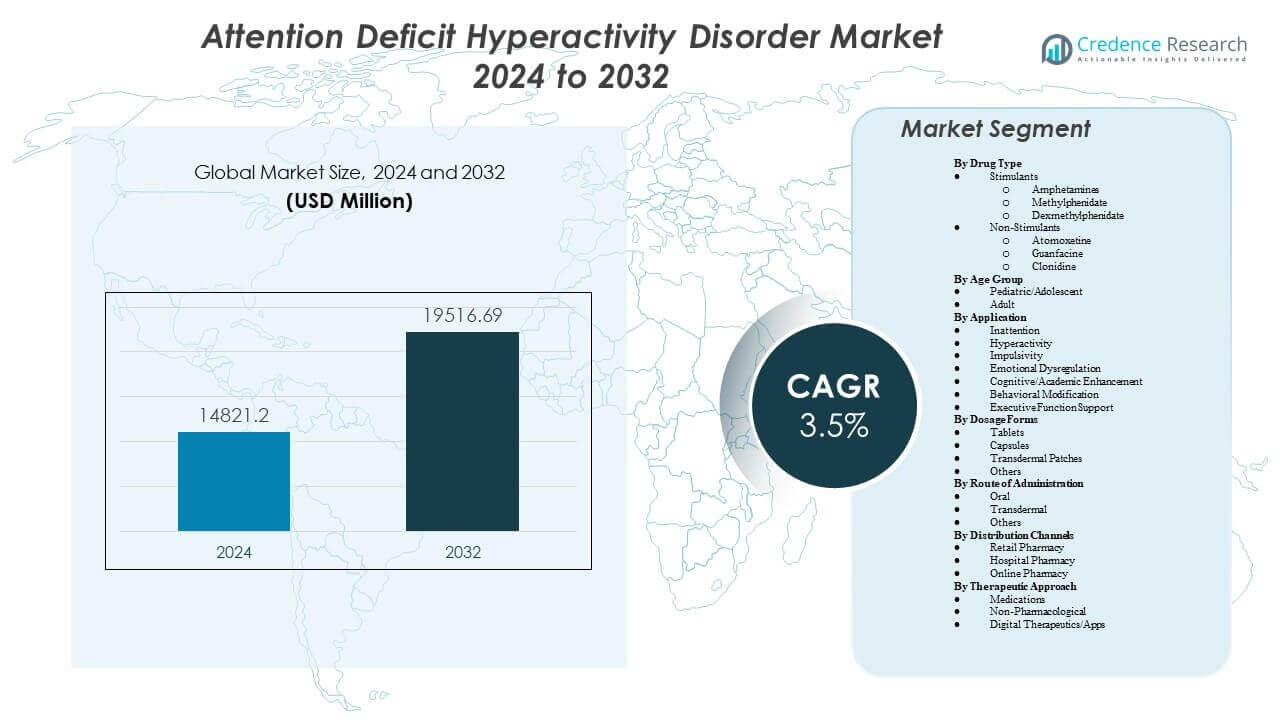
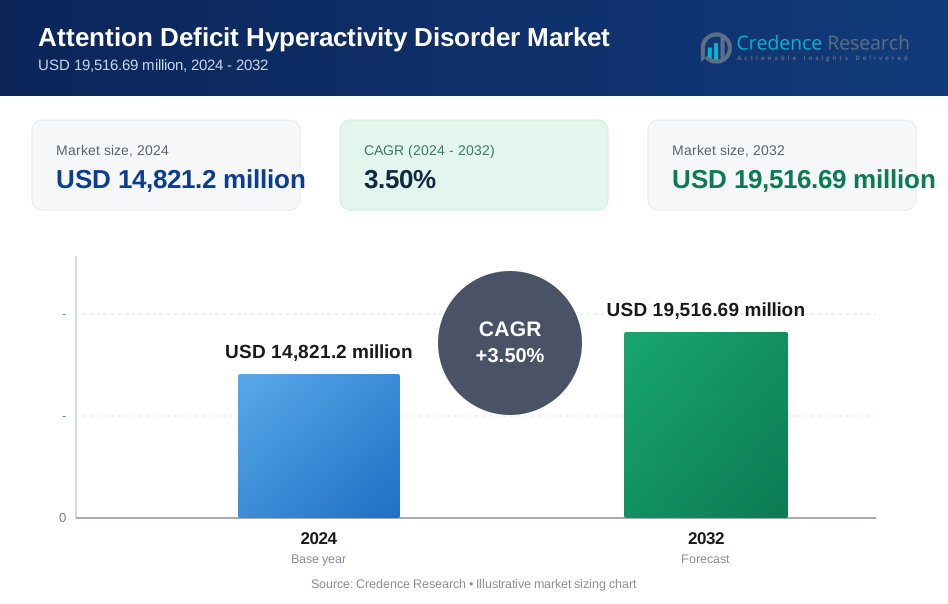
The Attention Deficit Hyperactivity Disorder Market is projected to grow from USD 14,821.2 million in 2024 to an estimated USD 19,516.69 million by 2032, with a CAGR of 3.5% from 2024 to 2032.
| REPORT ATTRIBUTE | DETAILS |
|---|---|
| Historical Period | 2020-2023 |
| Base Year | 2024 |
| Forecast Period | 2025-2032 |
| Attention Deficit Hyperactivity Disorder Market Size 2024 | USD 14,821.2 Million |
| Attention Deficit Hyperactivity Disorder Market, CAGR | 3.5% |
| Attention Deficit Hyperactivity Disorder Market Size 2032 | USD 19,516.69 Million |
Attention Deficit Hyperactivity Disorder Market Insights:
- Growing adoption of long-acting medications, digital therapeutics, and structured behavioral programs supports stronger clinical outcomes across all age groups.
- Limited specialist availability and varying diagnostic standards across regions continue to restrain timely assessment and consistent treatment delivery.
- North America remains the leading region due to advanced clinical infrastructure, while Europe sustains steady growth through integrated mental health frameworks.
- Asia Pacific shows the fastest expansion as awareness increases and developmental healthcare systems strengthen, broadening overall market participation.
Attention Deficit Hyperactivity Disorder Market Drivers
Growing Clinical Focus on Neurodevelopmental Screening and Early Intervention
Growing clinical attention toward early identification strengthens structured care pathways for children and adults. Providers expand routine behavioral assessments to improve timely diagnosis. Awareness programs guide families toward validated clinical support. Schools adopt screening frameworks that promote early referrals to specialists. Broader collaboration among educators and clinicians supports accurate evaluation. New care models reduce diagnostic delays and improve long-term outcomes. The Attention Deficit Hyperactivity Disorder Market benefits from rising acceptance of neurodevelopmental care needs. It also gains steady support from government-led mental health initiatives.
- For instance, Qbtech has implemented the QbTest, a computer-based tool that combines motion-tracking systems with continuous performance tasks, which has been shown to reduce the time to a diagnostic decision by 152 days compared to standard clinical assessments alone.
Expansion of Pharmacological Pipelines and Long-Acting Therapeutic Options
Pharmaceutical innovators introduce long-acting stimulants and non-stimulants that help improve adherence. Extended-release formats reduce frequent dosing challenges for patients. Safer formulations gain preference among prescribers and caregivers. Innovative delivery systems offer controlled symptom management throughout the day. Companies focus on reducing side effects that disrupt treatment continuity. Clinical trials explore next-generation molecules targeting complex symptoms. The Attention Deficit Hyperactivity Disorder Market sees strong demand for therapies that enhance daily functioning. It benefits from continued investment in tailored medication profiles.
- For instance, Aytu BioPharma developed Adzenys XR-ODT, the first orally disintegrating amphetamine tablet, which utilizes the LiquiXR delivery technology to provide a clinical effect that begins within 1.5 hours and maintains a duration of action for up to 12 hours.
Rise of Digital Health Platforms Supporting Remote Monitoring and Patient Outcomes
Digital tools expand access to behavioral support and structured follow-ups. Clinicians monitor progress through real-time dashboards and validated digital assessments. Families use mobile tools to maintain consistent engagement with treatment teams. Remote sessions reduce barriers tied to distance, travel, or scheduling. Data integration enhances personalized symptom management. AI-driven tools support decision-making for therapy adjustments. The Attention Deficit Hyperactivity Disorder Market gains traction from digital ecosystems that increase treatment visibility. It creates new care pathways that improve continuity.
Growing Acceptance of Behavioral Therapy and Multidisciplinary Support Models
Behavioral programs gain strong recognition for improving emotional regulation and learning outcomes. Providers expand cognitive-behavioral models across diverse age groups. Schools integrate structured interventions to support academic performance. Parents adopt home-based strategies recommended by therapists. Clinicians apply combined therapy approaches for complex cases. Cross-functional teams support sustained improvements. The Attention Deficit Hyperactivity Disorder Market benefits from rising confidence in evidence-based interventions. It encourages broader adoption of comprehensive care plans.
Attention Deficit Hyperactivity Disorder Market Trends
Integration of AI-Enhanced Diagnostic Tools and Predictive Behavioral Assessments
AI tools support clinicians with pattern-based interpretation of behavioral indicators. Platforms help reduce errors tied to subjective evaluations. Machine-learning models analyze large datasets to refine diagnostic accuracy. Providers gain clearer insights into symptom progression over time. Predictive tools help guide treatment decisions more effectively. Technology partners design specialized algorithms for neurodevelopmental cases. The Attention Deficit Hyperactivity Disorder Market sees momentum from these innovations. It builds a structured foundation for precision-based care delivery.
- For instance, Cognoa received FDA De Novo authorization for CanvasDx, an AI-based diagnostic aid that demonstrated a "definitive result" in 52% of patients who were previously classified as "indeterminate" by standard clinical assessments, utilizing machine learning to evaluate behavioral videos and caregiver inputs.
Growing Use of Digital Therapeutics and Gamified Cognitive Reinforcement Tools
Digital therapies introduce interactive models that support attention control and executive functioning. Gamified platforms engage children through structured cognitive tasks. Clinicians use progress data to adjust therapy goals. Families gain access to supportive tools beyond clinic visits. Developers design programs targeting focus, planning, and working memory. Strong engagement levels support measurable improvement. The Attention Deficit Hyperactivity Disorder Market benefits from validated digital interventions. It reflects rising consumer interest in non-pharmacological treatment formats.
Expansion of Workplace Support Programs for Adult ADHD Management
Employers introduce policies that support neurodiverse staff members. Training modules help managers understand attention-related challenges. Workplace tools promote task organization and structured routines. Adults receive accommodations that improve daily productivity. Remote work flexibility supports better symptom management. Mental health benefits expand across corporate plans. The Attention Deficit Hyperactivity Disorder Market gains recognition from rising adult diagnosis rates. It reflects a shift toward inclusive employment practices.
Increasing Global Research Focus on Comorbidity Patterns and Holistic Treatment Frameworks
Researchers investigate links among attention disorders, learning conditions, and emotional health. Studies explore integrated approaches that support both cognitive and behavioral needs. Providers adopt combined therapy models to address overlapping symptoms. Families receive clearer guidance on long-term developmental goals. Clinics enhance skill development programs for children and adolescents. Cross-disciplinary collaboration strengthens treatment effectiveness. The Attention Deficit Hyperactivity Disorder Market evolves with deeper scientific insights. It supports better planning for patient-centered care models.
- For instance, Ironshore Pharmaceuticals conducted a study on its HLD200 (Jornay PM) formulation, confirming that its evening-dosing technology reduced the "early morning functional impairment" score by 14.3 points compared to baseline, specifically addressing the comorbid sleep and morning behavioral challenges associated with the disorder.
Attention Deficit Hyperactivity Disorder Market Challenges Analysis
Variability in Diagnostic Accuracy and Uneven Global Access to Trained Specialists
Many regions experience limited access to trained behavioral health professionals. Families face delays that impact early management outcomes. Diagnostic criteria vary across clinical settings, reducing consistency. Limited awareness contributes to missed or late identification. Cultural barriers influence acceptance of mental health conditions. Clinicians encounter difficulty distinguishing overlapping symptoms in complex cases. The Attention Deficit Hyperactivity Disorder Market must address gaps in training and standardized screening. It requires scalable frameworks to improve equitable access.
Concerns Over Long-Term Medication Use and Patient Adherence Gaps
Caregivers focus on safety concerns tied to extended pharmacological treatment. Some patients struggle with maintaining consistent medication schedules. Side effects reduce willingness to continue therapy. Providers must balance dose optimization with patient comfort. Adolescents often shift between medications due to tolerance issues. Regulatory scrutiny creates additional hurdles for product approvals. The Attention Deficit Hyperactivity Disorder Market faces barriers related to sustained adherence. It depends on improved therapeutic designs that reduce treatment fatigue.
Attention Deficit Hyperactivity Disorder Market Opportunities
Growth of Non-Pharmacological Therapies and Scalable Digital Intervention Models
New digital platforms create accessible treatment formats for diverse populations. Evidence-based behavioral programs gain strong acceptance among clinicians. Families prefer flexible options that fit daily routines. Developers focus on modular tools that support personalized therapy goals. Schools adopt digital reinforcement programs for learning improvement. Providers see value in hybrid models that combine in-person and digital support. The Attention Deficit Hyperactivity Disorder Market benefits from broadening therapeutic ecosystems. It opens pathways for global expansion of structured care models.
Increasing Global Policy Support for Neurodevelopmental Health and Inclusive Education Systems
Governments invest in programs that strengthen child mental health services. Public initiatives raise awareness of attention and learning needs. Education systems develop frameworks that support neurodiverse students. Training programs help teachers identify early behavioral signs. Community groups promote acceptance through ongoing outreach. Healthcare networks expand integrated behavioral clinics. The Attention Deficit Hyperactivity Disorder Market gains momentum from these reforms. It aligns with long-term strategies that promote accessible developmental care.
Attention Deficit Hyperactivity Disorder Market Segmentation Analysis:
By Drug Type
Stimulants hold a dominant share in the Attention Deficit Hyperactivity Disorder Market due to strong clinical evidence supporting symptom control. Amphetamines remain widely prescribed because they improve attention and reduce impulsive behavior. Methylphenidate maintains broad acceptance across pediatric and adult groups. Dexmethylphenidate offers a refined profile that supports stable symptom management. Non-stimulants gain steady demand among patients who require alternatives with lower risk of side effects. Atomoxetine supports long-term therapy through once-daily dosing. Guanfacine and Clonidine extend treatment options for patients who need non-stimulant pathways. The segment reflects a balanced shift toward diversified drug classes.
By Age Group
The pediatric and adolescent category forms the core of the Attention Deficit Hyperactivity Disorder Market due to early diagnosis and strong awareness across caregivers and schools. Clinicians prioritize structured therapy plans that support academic performance and behavioral stability. Children gain access to long-acting medications that reduce daily disruptions. Adolescents benefit from flexible care models that support emotional regulation. The adult segment experiences rising diagnosis rates due to improved screening. Adults seek therapies that support workplace productivity and daily functioning. New digital tools help adults track progress with greater accuracy. The segment demonstrates broad adoption across age groups.
- For instance, Takeda Pharmaceutical’s clinical data for Vyvanse in adults showed a mean improvement of 18.6 points on the ADHD Rating Scale IV, addressing the specific functional impairments faced by the over-18 demographic.
By Application
Inattention remains the leading application driving treatment demand in the Attention Deficit Hyperactivity Disorder Market because it widely affects academic and workplace outcomes. Hyperactivity requires integrated behavioral and pharmacological support for sustained improvement. Impulsivity management focuses on strategies that help patients improve decision-making. Emotional dysregulation gains focus through therapies that support mood stability. Cognitive and academic enhancement drives adoption of evidence-based tools. Behavioral modification programs support long-term developmental gains. Executive function support improves planning and organizational skills. The segment highlights the diverse clinical needs managed under ADHD care.
- For instance, Akili Interactive’s EndeavorRx, the first FDA-authorized video game treatment, proved its efficacy in application-specific care by showing that 73% of children reported a significant improvement in their objective attention span after 4 weeks of use.
By Dosage Forms
Tablets remain the preferred dosage form in the Attention Deficit Hyperactivity Disorder Market due to ease of use and broad availability. Capsules provide flexible dosing for patients who require controlled titration. Transdermal patches offer steady absorption and reduce the need for multiple daily doses. Caregivers value patches for children who face difficulty with swallowing. Other dosage formats support patients with specific therapeutic requirements. Prescribers rely on varied delivery systems to match symptom patterns. Each format strengthens adherence across different lifestyles. The segment reflects strong demand for convenience-focused solutions.
By Route of Administration
Oral administration remains the primary route in the Attention Deficit Hyperactivity Disorder Market because it supports consistent dosing and high patient acceptance. Tablets and capsules allow controlled release across the day. Clinicians prefer oral routes for their predictable absorption. Transdermal options strengthen adherence among children who need alternative delivery systems. Patches reduce fluctuations that may occur with multiple oral doses. Other routes support patients who require specialized care formats. Each route enhances treatment flexibility across diverse clinical needs. The segment ensures broad access to tailored administration methods.
By Distribution Channels
Retail pharmacies lead the distribution network in the Attention Deficit Hyperactivity Disorder Market due to strong accessibility for families and adults. Pharmacists guide patients on medication use and therapy continuity. Hospital pharmacies support complex cases that require close clinical oversight. Clinicians use hospital channels for treatment initiation and monitoring. Online pharmacies expand rapidly due to convenience and rising digital adoption. Patients appreciate home delivery services that support adherence. Each channel works together to improve medication availability. The segment demonstrates the importance of accessible supply chains.
By Therapeutic Approach
Medications form the foundation of the Attention Deficit Hyperactivity Disorder Market due to their strong clinical impact on core symptoms. Stimulant and non-stimulant classes remain central to long-term care. Non-pharmacological approaches complement medication therapy through behavioral programs that target emotional and cognitive needs. Cognitive behavioral therapy and parent training support sustainable improvement. Neurofeedback and dietary strategies gain interest among caregivers seeking broader options. Digital therapeutics deliver structured exercises that reinforce attention and executive functions. It benefits from technology-backed engagement tools. The segment highlights the expanding range of multimodal interventions.
Segmentation:
By Drug Type
- Stimulants
- Amphetamines
- Methylphenidate
- Dexmethylphenidate
- Non-Stimulants
- Atomoxetine
- Guanfacine
- Clonidine
By Age Group
- Pediatric/Adolescent
- Adult
By Application
- Inattention
- Hyperactivity
- Impulsivity
- Emotional Dysregulation
- Cognitive/Academic Enhancement
- Behavioral Modification
- Executive Function Support
By Dosage Forms
- Tablets
- Capsules
- Transdermal Patches
- Others
By Route of Administration
- Oral
- Transdermal
- Others
By Distribution Channels
- Retail Pharmacy
- Hospital Pharmacy
- Online Pharmacy
By Therapeutic Approach
- Medications
- Non-Pharmacological
- Digital Therapeutics/Apps
By Region
- North America
- U.S.
- Canada
- Mexico
- Europe
- Germany
- France
- U.K.
- Italy
- Spain
- Rest of Europe
- Asia Pacific
- China
- Japan
- India
- South Korea
- South-east Asia
- Rest of Asia Pacific
- Latin America
- Brazil
- Argentina
- Rest of Latin America
- Middle East & Africa
- GCC Countries
- South Africa
- Rest of the Middle East and Africa
Regional Analysis:
North America holds the largest share of the Attention Deficit Hyperactivity Disorder Market due to strong diagnostic capacity, extensive therapeutic availability, and high awareness across clinicians and caregivers. The region accounts for the leading portion of global market activity, supported by broad insurance coverage and rapid adoption of long-acting medications. Providers use structured care pathways that support consistent outcomes. Schools integrate screening practices that improve early referrals. Digital platforms strengthen access across rural and urban settings. It continues to lead global demand due to advanced clinical infrastructure.
Europe captures the second-largest market share, supported by established mental health frameworks and steady investment in pediatric and adolescent care. Countries promote integrated behavioral support programs that improve treatment continuity. Clinicians rely on a wide portfolio of stimulant and non-stimulant options. Regulatory bodies encourage careful monitoring of therapeutic outcomes. Public health initiatives sustain awareness across families and schools. The region maintains a strong position due to balanced access to pharmacological and behavioral interventions.
Asia Pacific demonstrates the fastest growth and expands its market share through rising awareness and improved access to developmental health services. Urban centers adopt digital assessment tools that support early identification. Families show higher acceptance of combined therapy models. Providers expand behavioral support programs across private and public care settings. Governments strengthen child health initiatives that improve diagnosis rates. The region builds momentum as it aligns clinical capacity with growing population needs in the Attention Deficit Hyperactivity Disorder Market.
Key Player Analysis:
- Eli Lilly and Company
- Takeda Pharmaceutical Company (formerly Shire)
- Johnson & Johnson (Janssen Pharmaceuticals)
- Novartis AG
- Purdue Pharma
- GlaxoSmithKline (GSK)
- Pfizer Inc.
- Amneal Pharmaceuticals
- Mallinckrodt Pharmaceuticals
- Tris Pharma
- Noven Pharmaceuticals
- Neos Therapeutics
Competitive Analysis:
Competition in the Attention Deficit Hyperactivity Disorder Market remains strong due to a diverse mix of multinational pharmaceutical companies and specialized therapy developers. Leading drug manufacturers focus on long-acting stimulant and non-stimulant formulations that improve adherence and safety. Companies invest in research programs targeting next-generation molecules designed to refine symptom control. Behavioral health innovators expand digital tools that support cognitive engagement and remote monitoring. Market participants strengthen portfolios through reformulations, extended-release technologies, and differentiated delivery systems. Partnerships with digital health firms help broaden therapy ecosystems. It continues to attract investment from firms seeking opportunities across both pharmacological and non-pharmacological segments.
Recent Developments:
- In February 2026, Azurity Pharmaceuticals announced that its lisdexamfetamine dimesylate (Arynta) oral solution for ADHD treatment in adults and children aged 6+ will be available mid-2026. The liquid stimulant provides up to 14-hour symptom control and flexible dosing for those struggling with capsules.
- In May 2025, Keys Group completed the acquisition of ADHD 360, a provider of assessment, diagnosis, and treatment services for neurodiverse conditions including ADHD. This move expands Keys Group's specialist clinical services, offering virtual nationwide support for children and adults with ADHD, autism, and related conditions.
Report Coverage:
The research report offers an in-depth analysis based on Drug Type, Age Group, Application, Dosage Forms, Route of Administration, Distribution Channels, Therapeutic Approach and Region. It details leading market players, providing an overview of their business, product offerings, investments, revenue streams, and key applications. Additionally, the report includes insights into the competitive environment, SWOT analysis, current market trends, as well as the primary drivers and constraints. Furthermore, it discusses various factors that have driven market expansion in recent years. The report also explores market dynamics, regulatory scenarios, and technological advancements that are shaping the industry. It assesses the impact of external factors and global economic changes on market growth. Lastly, it provides strategic recommendations for new entrants and established companies to navigate the complexities of the market.
Future Outlook:
- Growing diagnosis rates across age groups are expected to expand treatment adoption in the Attention Deficit Hyperactivity Disorder Market, strengthening long-term demand.
- New long-acting therapies will support better adherence and shape prescribing patterns across global regions.
- Digital therapeutics will gain traction as clinicians integrate technology-backed cognitive tools into care pathways.
- Rising adult diagnosis rates will broaden the market as workplace screening and support programs expand.
- Non-pharmacological therapies will gain visibility due to increasing interest in behavioral and cognitive interventions.
- AI-driven diagnostic platforms will enhance accuracy and reduce delays in early identification.
- Transdermal delivery formats will grow due to improved dosing flexibility for pediatric and adolescent groups.
- Regional healthcare reforms will improve access to behavioral therapy and structured clinical support.
- Pharmaceutical competition will intensify as companies advance next-generation formulations with refined safety profiles.
- Integrated treatment models will influence future care standards by combining medication, behavioral therapy, and digital tools.
Request a Free Sample
Fill in your details and we'll send you a free sample report.
- Sample data tables & charts
- Research methodology
Need a Custom Version of This Report?
Tailor the scope, geography, or segments to your exact requirements.
- Custom geography or segment scope
- Direct access to our analyst team
Frequently Asked Questions
What is the current market size for the Attention Deficit Hyperactivity Disorder Market, and what is its projected size in 2032?
At what Compound Annual Growth Rate is the Attention Deficit Hyperactivity Disorder Market projected to grow between 2024 and 2032?
Which Attention Deficit Hyperactivity Disorder Market segment held the largest share in 2024?
What are the primary factors fueling the growth of the Attention Deficit Hyperactivity Disorder Market?
Who are the leading companies in the Attention Deficit Hyperactivity Disorder Market?
Which region commanded the largest share of the Attention Deficit Hyperactivity Disorder Market in 2024?
Table of Content
Chapter 1 Market Segmentation
- 1.1 Segmentation Framework
- 1.1.1 Product and Service Classification
- 1.1.2 Application and End-Use Classification
- 1.1.3 Technology and Solution Classification
- 1.1.4 Customer and Distribution Channel Classification
- 1.1.5 Geographic Segmentation
- 1.1.6 Market Segment Definitions and Boundaries
Chapter 2 Introduction
- 2.1 Report Objectives and Scope
- 2.2 Product Definition and Industry Terminology
- 2.3 Market Inclusions and Exclusions
- 2.4 Research Process
- 2.4.1 Primary Research and Expert Interviews
- 2.4.2 Secondary Research and Source Review
- 2.4.3 Top-Down and Bottom-Up Estimation
- 2.4.4 Data Triangulation and Verification
- 2.5 Market Size Measurement Basis
- 2.5.1 2024: USD 14,821.2 million → 2032: USD 19,516.69 million
- 2.6 Historical and Forecast Reference Periods
- 2.6.1 Base Year: 2024
- 2.6.2 Forecast Period: 2024-2032
- 2.7 Research Assumptions and Limitations
Chapter 3 Executive Summary
- 3.1 Market Snapshot and Key Findings
- 3.2 Base-Year Market Size, 2024
- 3.3 Forecast Market Size, 2032
- 3.4 Revenue and Volume Growth Outlook
- 3.5 Key Demand and Supply Indicators
- 3.6 Leading Market Segments
- 3.7 Fastest-Growing Market Opportunities
- 3.8 Regional Performance Highlights
- 3.9 Technology and Industry Transformation
- 3.10 Competitive Landscape Summary
- 3.11 Analyst View and Strategic Implications
Chapter 4 Global Attention Deficit Hyperactivity Disorder Market Trends and Developments
- 4.1 Historical Industry Development
- 4.2 Recent Market Trends and Developments
- 4.3 Demand and Customer Behavior Trends
- 4.4 Technology and Product Innovation
- 4.5 Artificial Intelligence, Automation and Digitalization
- 4.6 Local Manufacturing and Supply Chain Realignment
- 4.7 Industry Partnerships, Mergers and Acquisitions
- 4.8 Sustainability and Circular Economy Developments
- 4.9 Government and Private Sector Investment Trends
- 4.10 Emerging Business Models and Commercialization
- 4.11 Industry Developments and Announcements
Chapter 5 Global Attention Deficit Hyperactivity Disorder Market Production, Supply and Demand Analysis
- 5.1 Demand Trend and Consumption Analysis
- 5.2 Demand Forecast, 2024-2032
- 5.3 Production and Output Trend
- 5.4 Production and Output Forecast, 2024-2032
- 5.5 Installed Capacity and Capacity Utilization
- 5.6 Company-Wise Production Plants and Statistics
- 5.6.1 Installed Production Capacity
- 5.6.2 Actual Production
- 5.6.3 Planned Capacity and Expansion Targets
- 5.7 Supply Chain Structure and Procurement Trends
- 5.8 Supply-Demand Gap and Bottlenecks
- 5.9 Import Dependence and Sourcing Structure
- 5.10 Contract Manufacturing and Outsourcing
- 5.11 Regional Supply and Demand Concentration
Chapter 6 Global Attention Deficit Hyperactivity Disorder Market Pricing Analysis
- 6.1 Pricing Structure and Measurement
- 6.2 Historical Pricing Trends
- 6.3 Pricing Outlook, 2024-2032
- 6.4 Average Selling Price and Unit Economics
- 6.5 Pricing by Product and Market Segment
- 6.6 Geographic Pricing Differences
- 6.7 Key Input, Energy, Labor and Logistics Costs
- 6.8 Contract Pricing and Purchasing Models
- 6.9 Pricing Sensitivity and Competitive Positioning
- 6.10 Price, Margin and Profitability Implications
Chapter 7 Global Attention Deficit Hyperactivity Disorder Market Dynamics
- 7.1 Market Growth Drivers
- 7.1.1 Demand-Side Drivers
- 7.1.2 Technology and Innovation Drivers
- 7.1.3 Infrastructure and Investment Drivers
- 7.1.4 Regulatory and Policy Drivers
- 7.2 Market Restraints
- 7.2.1 Cost and Affordability Constraints
- 7.2.2 Technology and Adoption Barriers
- 7.2.3 Supply Chain and Operational Constraints
- 7.3 Market Challenges
- 7.3.1 Competitive Pressure and Margin Erosion
- 7.3.2 Skills, Infrastructure and Implementation Gaps
- 7.4 Emerging Market Opportunities
- 7.5 Market Dynamics Impact and Time-Horizon Assessment
Chapter 8 Global Attention Deficit Hyperactivity Disorder Value Chain Analysis
- 8.1 Industry Value Chain Overview
- 8.2 Upstream Suppliers and Critical Inputs
- 8.3 Technology and Component Providers
- 8.4 Manufacturing or Service Delivery
- 8.5 Distribution, Channel Partners and Integrators
- 8.6 Downstream Applications and End Users
- 8.7 Value Addition and Profit Pools
- 8.8 Vertical Integration and Outsourcing
- 8.9 Supplier Concentration and Risk
- 8.10 Supply Chain Localization and Resilience
Chapter 9 Global Attention Deficit Hyperactivity Disorder Market Regulations and Policies
- 9.1 Relevant Laws, Standards and Compliance Frameworks
- 9.2 Product, Service, Safety and Quality Requirements
- 9.3 Government Policies, Incentives and Subsidies
- 9.4 Imports, Exports and Trade Barriers
- 9.5 Public Procurement and Local Content Requirements
- 9.6 Environmental and Sustainability Compliance
- 9.7 Upcoming Policy Changes and Market Implications
Chapter 10 Global Attention Deficit Hyperactivity Disorder Market Hotspots and Opportunities
- 10.1 Market Opportunity Mapping and Growth Hotspots
- 10.2 High-Growth Applications and Customer Groups
- 10.3 Underserved Markets and White-Space Opportunities
- 10.4 Emerging Technology and Product Opportunities
- 10.5 New Capacity and Investment Hotspots
- 10.6 Market Entry and Expansion Opportunities
- 10.7 Distribution and Partnership Opportunities
- 10.8 Near-Term and Long-Term Commercial Potential
- 10.9 Opportunity Attractiveness and Execution Risks
Chapter 11 Global Attention Deficit Hyperactivity Disorder Market Outlook, 2024-2032
- 11.1 Market Size and Analysis
- 11.1.1 Revenue (Market Measurement: 2024: USD 14,821.2 million → 2032: USD 19,516.69 million)
- 11.1.2 Market Volume and Quantity Sold
- 11.1.3 Historical Market Size
- 11.1.4 Base-Year Market Size, 2024
- 11.2 Market Forecast, 2024-2032
- 11.2.1 Revenue Forecast to 2032
- 11.2.2 Volume Forecast to 2032
- 11.2.3 CAGR and Year-on-Year Growth
- 11.2.4 Incremental Revenue Opportunity
- 11.3 Forecast Assumptions and Scenario Analysis
- 11.3.1 Base-Case Forecast
- 11.3.2 Optimistic and Conservative Scenarios
- 11.3.3 Technology, Pricing and Policy Sensitivities
- 11.4 Market Attractiveness and Growth Outlook
Chapter 12 Global Attention Deficit Hyperactivity Disorder Market Segmentation and Outlook
- 12.1 Segmentation Summary and Market Shares, 2024
- 12.2 Largest and Fastest-Growing Segments
- 12.3 Segment Growth Comparison
- 12.4 Segment Attractiveness and Priority Matrix
Chapter 13 Global Attention Deficit Hyperactivity Disorder Geographic Market Outlook, 2024-2032
- 13.1 Regional Market Size and Share, 2024
- 13.2 Regional Market Forecast, 2024-2032
- 13.3 Regional Pricing, Production and Demand Differences
- 13.4 North America
- 13.4.1 United States
- 13.4.2 Canada
- 13.4.3 Mexico
- 13.5 Europe
- 13.5.1 Germany
- 13.5.2 France
- 13.5.3 Italy
- 13.5.4 United Kingdom
- 13.5.5 Spain
- 13.5.6 Poland
- 13.5.7 Russia
- 13.5.8 Netherlands
- 13.5.9 Belgium
- 13.5.10 Sweden
- 13.5.11 Denmark
- 13.5.12 Norway
- 13.5.13 Rest of Europe
- 13.6 Asia Pacific
- 13.6.1 China
- 13.6.2 India
- 13.6.3 Japan
- 13.6.4 South Korea
- 13.6.5 Thailand
- 13.6.6 Indonesia
- 13.6.7 Vietnam
- 13.6.8 Malaysia
- 13.6.9 Australia
- 13.6.10 Rest of Asia Pacific
- 13.7 Latin America
- 13.7.1 Brazil
- 13.7.2 Argentina
- 13.7.3 Colombia
- 13.7.4 Chile
- 13.7.5 Rest of Latin America
- 13.8 Middle East
- 13.8.1 Saudi Arabia
- 13.8.2 United Arab Emirates
- 13.8.3 Turkey
- 13.8.4 Israel
- 13.8.5 Iran
- 13.8.6 Rest of the Middle East
- 13.9 Africa
- 13.9.1 South Africa
- 13.9.2 Egypt
- 13.9.3 Nigeria
- 13.9.4 Morocco
- 13.9.5 Rest of Africa
- 13.10 Regional Investment, Policy and Supply Chain Differences
- 13.11 Regional Competitive Landscape
- 13.12 Geographic Growth Hotspots
Chapter 14 Global Attention Deficit Hyperactivity Disorder Technology, Innovation and Sustainability Outlook
- 14.1 Technology Landscape and Maturity
- 14.2 Product, Process and Service Innovation
- 14.3 AI, Automation and Digital Tools in the Industry
- 14.4 Technology Adoption and Performance Benchmarking
- 14.5 Innovation Pipeline and R&D Investment
- 14.6 Patent and Intellectual Property Trends
- 14.7 Energy Efficiency and Resource Management
- 14.8 Sustainability, Recycling and Circularity
- 14.9 Technology Roadmap, 2024-2032
- 14.10 Risks of Obsolescence and Technology Substitution
Chapter 15 Global Attention Deficit Hyperactivity Disorder Market Key Strategic Imperatives
- 15.1 Growth and Market Entry Priorities
- 15.2 High-Return Products and Segments
- 15.3 Pricing, Profitability and Cost Optimization
- 15.4 Technology Investment and Product Differentiation
- 15.5 Supply Chain Localization and Resilience
- 15.6 Distribution and Customer Acquisition
- 15.7 Partnership, Acquisition and Capacity Strategy
- 15.8 Regional Expansion Priorities
- 15.9 Short-, Medium- and Long-Term Actions
Chapter 16 Competition Outlook
- 16.1 Industry Competition Characteristics
- 16.2 Market Structure and Concentration
- 16.3 Market Share and Competitive Positioning, 2024
- 16.4 Company-Wise Revenue and Product Benchmarking
- 16.5 Production and Service Capacity Benchmarking
- 16.6 Technology, Pricing and Differentiation
- 16.7 Regional Footprint and Distribution Strength
- 16.8 Mergers, Acquisitions and Strategic Alliances
- 16.9 New Entrants and Competitive Threats
- 16.10 Porter's Five Forces and Industry Attractiveness
- 16.11 Competitive Outlook, 2024-2032
Chapter 17 Company Profiles
- 17.1 Company Coverage and Selection Criteria
- 17.2 Leading Market Participants – Standard Profile Structure
- 17.2.1 Business Description
- 17.2.2 Company Ownership and Geographic Presence
- 17.2.3 Product and Service Portfolio
- 17.2.4 Manufacturing and Operating Footprint
- 17.2.5 Production Capacity and Expansion Plans
- 17.2.6 Financial Performance and Investment
- 17.2.7 Market Share and Competitive Position
- 17.2.8 Technology and Innovation Capabilities
- 17.2.9 Strategic Alliances or Partnerships
- 17.2.10 Recent Developments
- 17.2.11 Growth Strategy and Outlook
- 17.3 Other Relevant Market Participants
Note: Every listed company is profiled on the structure shown under the first company. The company list is preliminary and may change based on research findings, market developments, data availability and client requirements.
Chapter 18 Disclaimer
- 18.1 Research and Forecast Disclaimer
- 18.2 Data Source and Estimation Limitations
Note: The depth of individual sections depends on data availability for this market. Volume, capacity, trade and other unit-based metrics are included where applicable.