
Biologics and vaccines keep temperature control essential
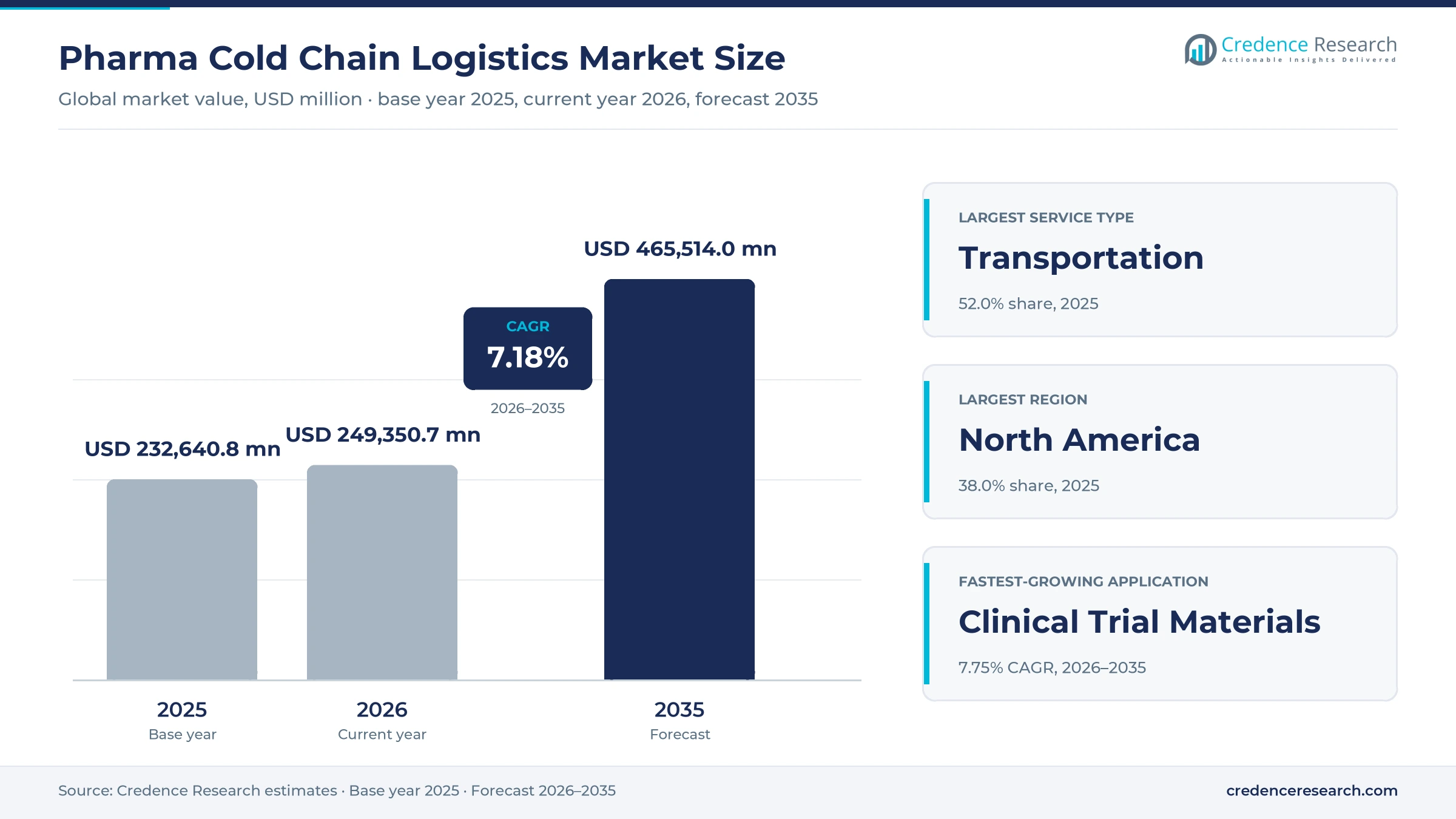
The global pharma cold chain logistics market was valued at USD 232.64 billion in 2025 and is projected to increase from USD 249.35 billion in 2026 to USD 465.51 billion by 2035, registering a CAGR of 7.18% during 2026–2035. Demand comes from vaccines, monoclonal antibodies, insulin, blood products, cell and gene therapies and clinical trial materials that lose potency outside narrow temperature ranges. North America held the largest regional share, 38.0% in 2025, because the United States hosts the largest biologics pipeline and dense networks of specialist couriers and temperature-controlled warehouses. Asia Pacific is the fastest-growing region at 8.41% a year, as India, China and Southeast Asia expand vaccine production and biologics exports. The commercial picture shifted in 2025, when large parcel carriers bought specialist healthcare couriers and packaging makers changed owners. As a result, buyers now choose between integrated carriers and focused thermal packaging suppliers.
Which temperature-controlled services does this analysis cover?
The analysis counts transportation, warehousing and storage, thermal packaging and related services used to move medicines and clinical materials at refrigerated, frozen, cryogenic or controlled room temperatures, valued at service provider prices. Drug manufacturers, clinical research sponsors, distributors and blood services buy these services through annual contracts, lane tenders and per-shipment orders.
Ambient medicine distribution, food cold chain and refrigeration equipment sold to end users sit outside the scope of this analysis. The value chain runs from packaging makers and monitoring device suppliers through freight forwarders, airlines, trucking firms and warehouse operators to wholesalers, hospitals, pharmacies and clinical trial sites.
Pharma Cold Chain Logistics Market Insights
- The pharma cold chain logistics market grows from USD 232.64 billion in 2025 to USD 465.51 billion by 2035, a 7.18% CAGR driven by biologics, vaccines and advanced therapies.
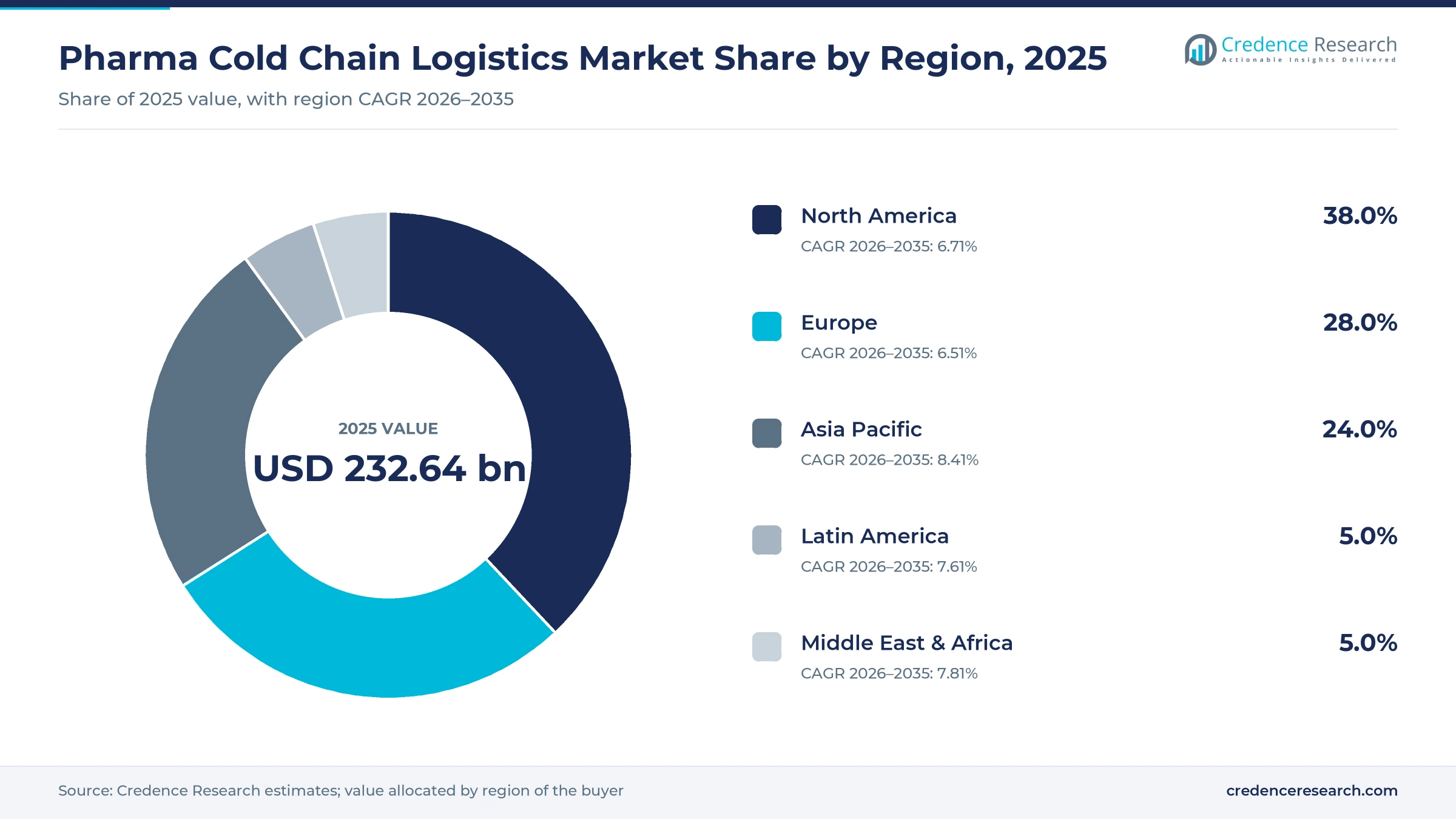
- North America held 38.0% of global pharma cold chain logistics value in 2025, supported by the largest biologics pipeline and dense courier networks.
- Transportation led service types with 52.0% of 2025 value, while packaging solutions grow fastest at 7.78% a year.
- In June 2025, DHL Group completed its acquisition of CRYOPDP, a specialty courier that handles over 600,000 shipments a year.
- In April 2026, CD&R completed its acquisition of SEE, which took the packaging company private and ended its New York listing.
Transportation leads as packaging and trial supply gain
Why does transportation account for most spending?
Based on service type, the market is categorized into transportation, warehousing and storage, packaging solutions and others. Transportation led with a 52.0% share of 2025 value, because every shipment needs a temperature-controlled move by air, road or sea. Packaging Solutions grow fastest at 7.78% a year, as reusable shippers, cryogenic containers and phase change materials replace simple foam boxes. Warehousing adds value through bonded and frozen storage near airports.
Which products drive most temperature-controlled shipments?
Based on application, the market is categorized into vaccines, biologics, clinical trial materials, blood and plasma products and others. Biologics led with a 46.0% share of 2025 value, because monoclonal antibodies, insulin and other biologic medicines need refrigerated handling from plant to patient. Clinical Trial Materials grow fastest at 7.75% a year, as cell and gene therapy trials need frozen and cryogenic shipments to many sites. Vaccines remain a large, steady base through routine immunization programs.
How do shippers choose between air, road and sea?
Based on mode of transport, the market is categorized into air transport, road transport, sea transport and rail transport. Road Transport led with a 48.0% share of 2025 value, because most deliveries to wholesalers, hospitals and pharmacies travel by refrigerated trucks and vans. Sea Transport grows fastest at 7.89% a year, as manufacturers move stable products into reefer containers to cut cost and emissions. Air freight remains essential for urgent, high-value and long-distance biologics shipments.
| Segment Group | Leading Sub-segment | Share, 2025 | Fastest-growing Sub-segment | CAGR, 2026–2035 |
|---|---|---|---|---|
| By Service Type | Transportation | 52.0% | Packaging Solutions | 7.78% |
| By Application | Biologics | 46.0% | Clinical Trial Materials | 7.75% |
| By Mode of Transport | Road Transport | 48.0% | Sea Transport | 7.89% |
Request a Free Sample
Fill in your details and we'll send you a free sample report.
- Sample data tables & charts
- Research methodology
Biologic pipelines and vaccine programs drive shipments
How do biologic medicines raise temperature-control needs?
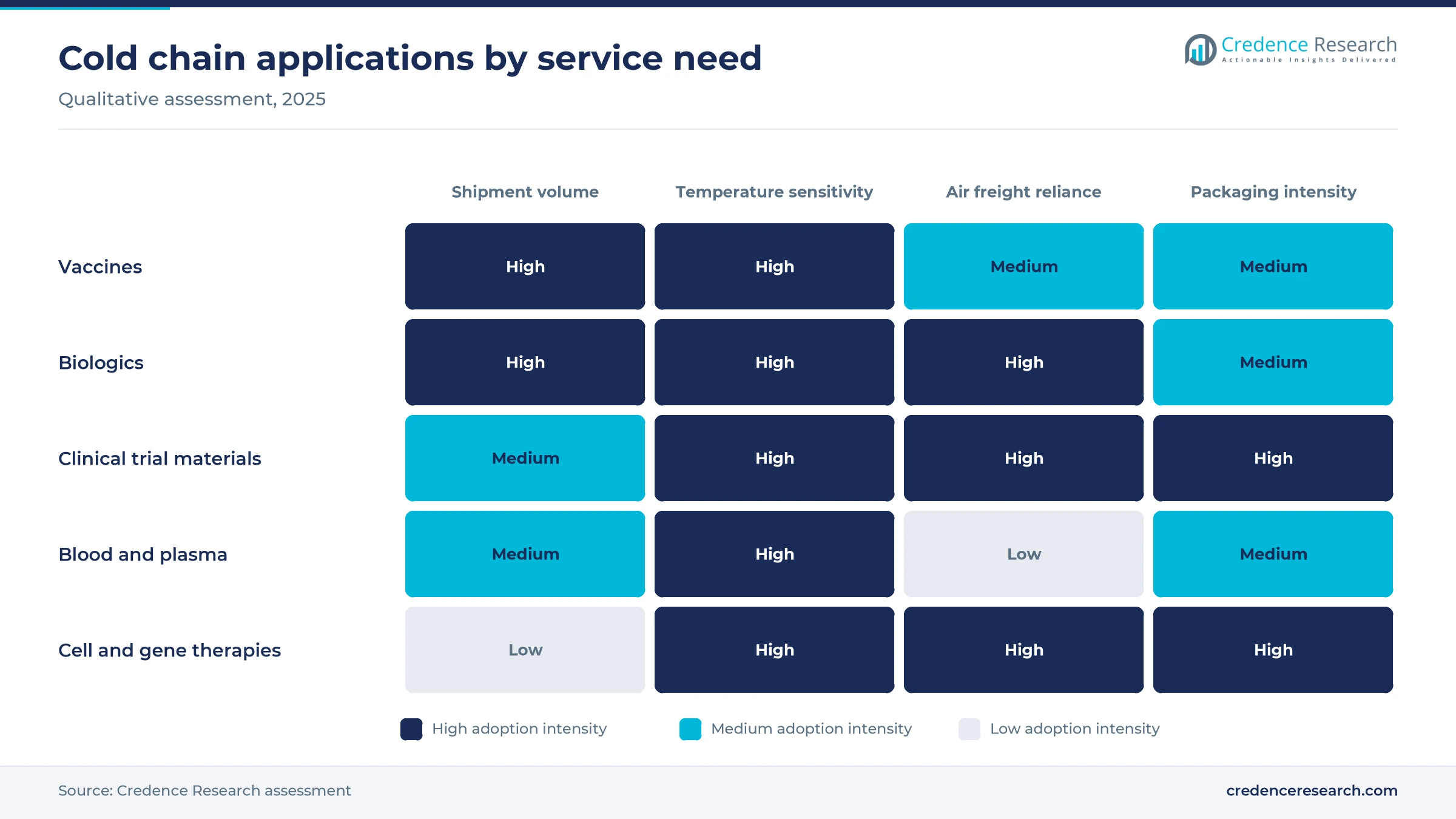
Biologic medicines form the largest source of demand, because proteins and antibodies degrade when they warm or freeze outside labeled ranges. Most of these products travel under refrigeration, and many need monitored storage at every handover between carriers. Insulin, antibody therapies and newer weight-loss injections all reach patients through refrigerated wholesale and pharmacy networks. As a result, each new biologic launch adds a product that needs validated cold handling for its entire life on the market, often across dozens of countries and several transport modes.
Why do routine immunization programs sustain vaccine shipments?
Routine immunization programs create steady demand, because vaccines must stay cold from the factory to the clinic. In July 2025, WHO and UNICEF reported that about 109 million infants, or 85%, received three doses of DTP-containing vaccine in 2024. About 115 million infants, or 89%, received at least one dose. However, 14.3 million infants received no vaccine at all, mostly in hard-to-reach areas. In turn, closing these gaps requires more refrigerated storage and last-mile transport in low- and middle-income countries, where networks remain thin.
How do distribution rules raise service requirements?
Distribution rules raise service requirements, because regulators expect wholesalers and carriers to protect medicine quality at every step. The European Medicines Agency describes good distribution practice as the minimum standards that a wholesale distributor must meet to maintain quality and integrity throughout the supply chain. These standards cover temperature mapping, monitoring, training and deviation handling. As a result, shippers prefer providers with validated lanes and documented quality systems, and they pay more for that assurance.
Why do decentralized trials and advanced therapies add shipments?
Clinical development adds high-value shipments, because sponsors send investigational products and samples to many sites and sometimes to patients' homes. Clinical trial supplies often travel frozen or cryogenic, and each kit needs tracking and return logistics. Cell and gene therapies add round trips, because patient cells travel to a manufacturing site and back. In turn, specialist couriers earn more per shipment than standard refrigerated freight, and demand rises with every new advanced therapy trial.
Specialist couriers and cryogenic shipping reshape supply
How are parcel carriers expanding into specialist healthcare logistics?
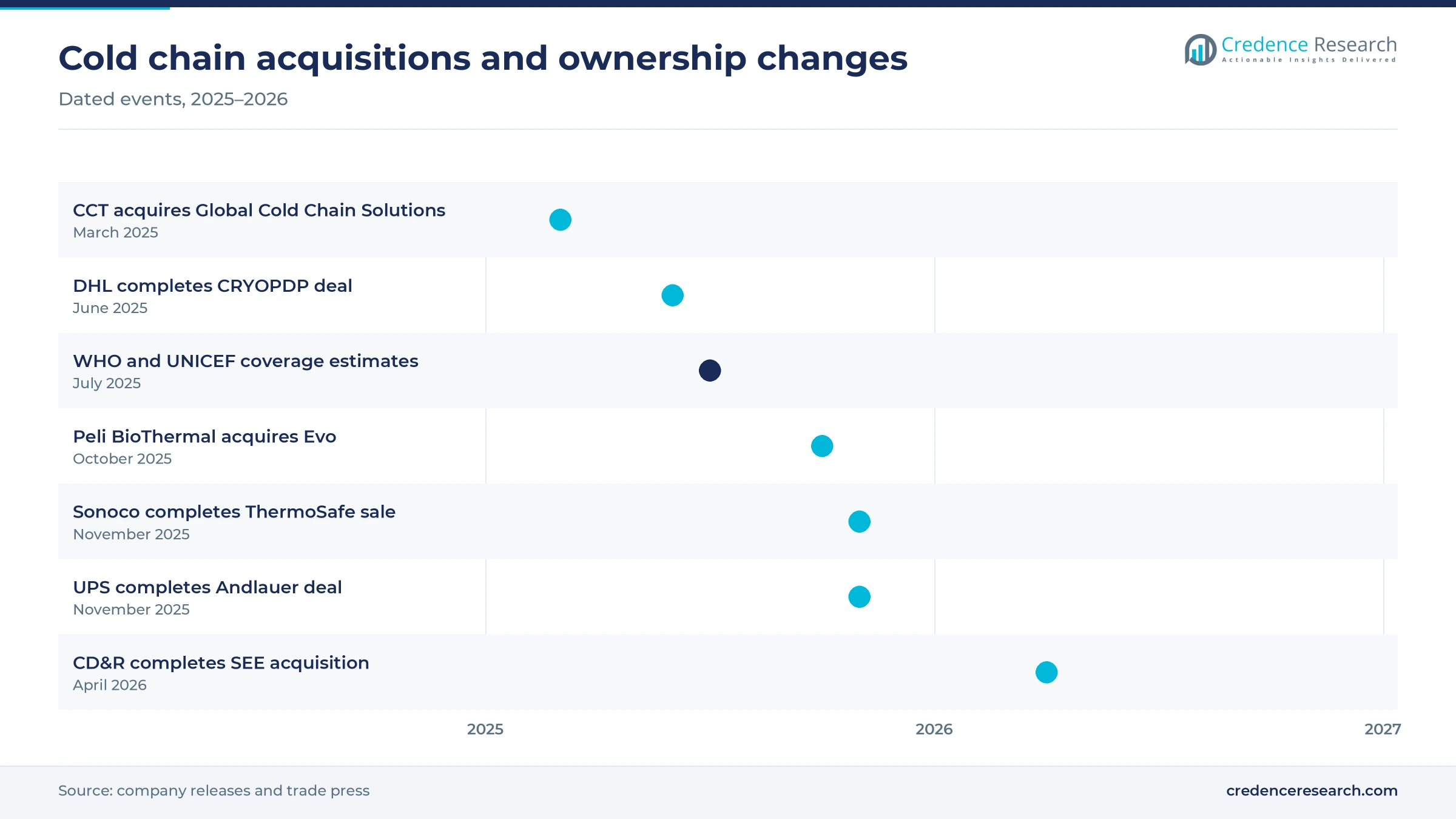
Large parcel carriers are shifting deeper into healthcare logistics, buying specialist couriers that already hold validated cold chain networks. In June 2025, DHL Group completed its acquisition of CRYOPDP, which handles over 600,000 shipments a year for clients in more than 135 countries. In November 2025, UPS completed its USD 1.6 billion acquisition of Andlauer Healthcare Group, a Canadian provider of refrigerated transport for medicines, vaccines and blood products. As a result, integrated carriers now compete directly with specialist couriers for temperature-controlled contracts.
Is cryogenic shipping rising with cell and gene therapies?
Cryogenic shipping is rising, because cell and gene therapies must stay frozen at very low temperatures from collection to infusion. In October 2025, Peli BioThermal acquired the Evo product line from BioLife Solutions, including cryogenic shippers and a tracking platform for this field. The deal widened its range beyond refrigerated and frozen containers. In turn, packaging makers that pair cryogenic hardware with tracking software can serve fast-growing therapy programs and charge higher prices per shipment.
Can certified air cargo lanes open premium revenue?
Certified air cargo lanes are a clear opening, because shippers of high-value biologics prefer airports and handlers with recognized pharmaceutical standards. The IATA CEIV Pharma program certifies that facilities, equipment, operations and staff meet the needs and expectations of drug manufacturers. Airports, airlines and forwarders use the certification to win long-term lane contracts. As a result, certified hubs in Europe, Asia and the Middle East can attract premium transit volumes from global drugmakers.
Where can Asia Pacific capacity win new contracts?
Asia Pacific capacity is an emerging opening, because vaccine makers and biologics exporters in India, China and Southeast Asia need more cold storage and certified transport. In March 2025, Cold Chain Technologies acquired Global Cold Chain Solutions, a passive packaging supplier based in Australia and India. The buyer said the region was seeing rapid investment across life sciences. In turn, providers that build local packaging, testing and warehousing capacity can win contracts as regional production expands.
Excursion risk, compliance cost and weak networks weigh
How do temperature excursions destroy shipment value?
Temperature excursions destroy value, because a single deviation can force a manufacturer to quarantine or discard an entire shipment. Delays at customs, airport tarmacs and transfer points cause many of these failures, especially on long routes with several handovers. Each loss also triggers investigation, documentation and replacement costs for the shipper. As a result, buyers demand temperature monitoring systems and contingency plans, which raise service cost.
Why does compliance raise operating costs?
Compliance raises operating costs, because providers must validate packaging, map warehouses and train staff to meet good distribution practice in every market they serve. Audits by drug manufacturers and regulators add recurring expense and can take months to complete. Smaller carriers often struggle to fund these quality systems across many countries. As a result, contracts concentrate among large providers, while small operators serve local routes under subcontracts.
Why do weak networks limit last-mile reach?
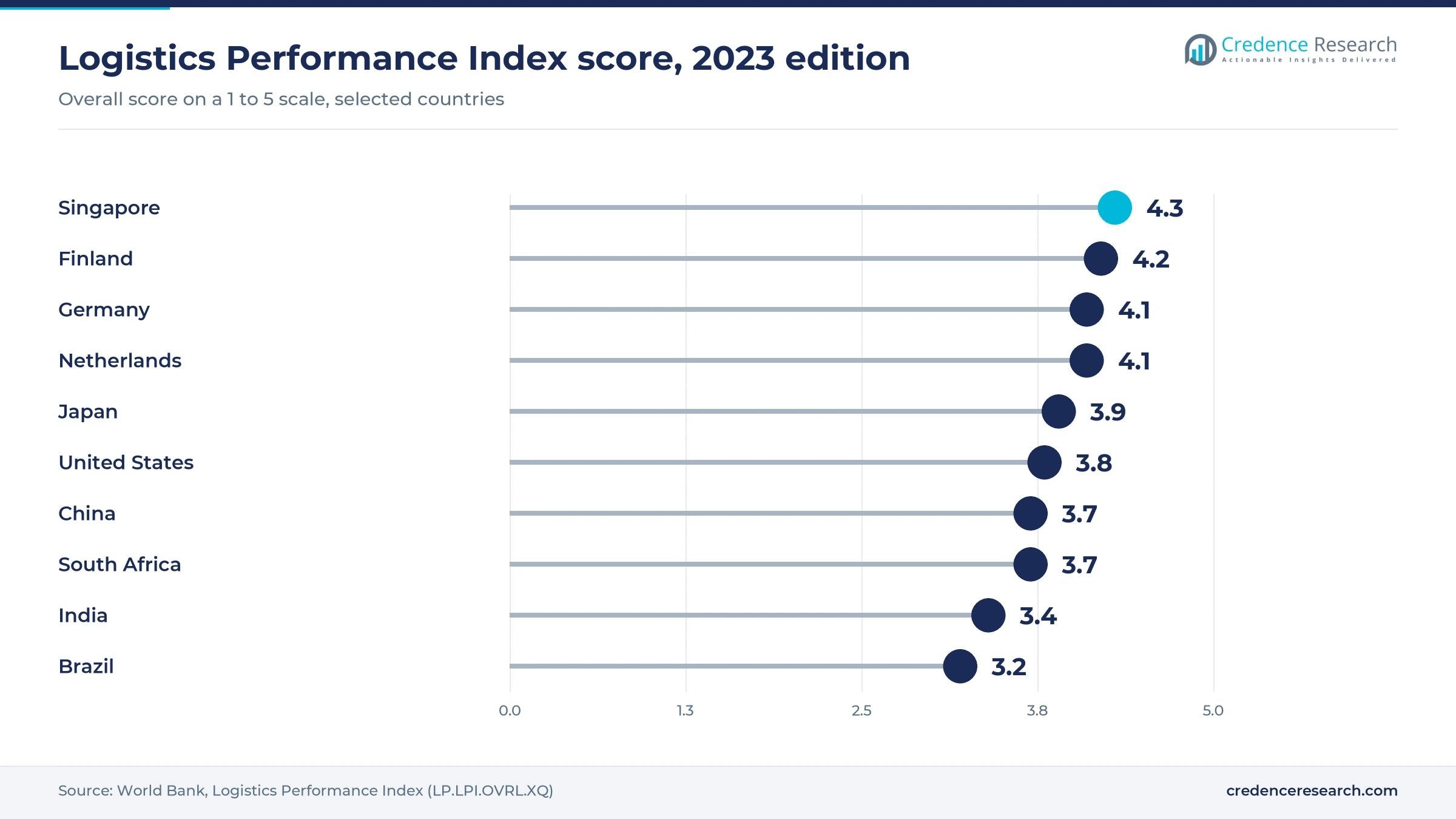
Weak infrastructure limits reach in many low- and middle-income countries, because unreliable power, poor roads and few refrigerated vehicles make last-mile delivery difficult. On the World Bank logistics index, India scored 3.4 and Brazil 3.2, well below the 4.3 for Singapore and 4.1 for Germany. These gaps raise spoilage risk for vaccines and biologics that travel to rural clinics. In turn, programs rely on solar refrigerators, cold boxes and donor funding to fill the shortfall.
How do sustainability goals pressure single-use packaging?
Sustainability goals pressure single-use packaging, because foam shippers and coolants create large volumes of waste after each delivery. Drug manufacturers have set emissions targets that include freight and packaging, so they ask suppliers for reusable and recyclable options. Reusable systems need return logistics, cleaning and tracking, which add cost and complexity. As a result, packaging makers must redesign products while keeping thermal performance and qualification records intact.
North America leads as Asia Pacific builds capacity
| Region | Value, 2025 (USD billion) | Share, 2025 | CAGR, 2026–2035 |
|---|---|---|---|
| North America | 88.40 | 38.0% | 6.71% |
| Europe | 65.14 | 28.0% | 6.51% |
| Asia Pacific | 55.83 | 24.0% | 8.41% |
| Latin America | 11.63 | 5.0% | 7.61% |
| Middle East & Africa | 11.63 | 5.0% | 7.81% |
Why does North America hold the largest regional share?
North America held a 38.0% share of 2025 value and grows at 6.71% a year through 2035. The United States drives this position, because it hosts the largest biologics pipeline, many cell and gene therapy trials and dense specialist courier networks. UPS strengthened its Canadian healthcare network with the Andlauer acquisition in November 2025. However, high labor and fuel costs push shippers to optimize routes and reuse packaging, and the United States scored 3.8 on the World Bank logistics index.
How fast is Asia Pacific building cold chain capacity?
Asia Pacific held a 24.0% share of 2025 value and is the fastest-growing region at 8.41% a year. India and China are expanding vaccine production and biologics exports, which require certified cold storage and air lanes. Singapore scored 4.3 on the World Bank logistics index, the highest among the countries shown, and serves as a regional pharma hub. Packaging makers such as Cold Chain Technologies have added capacity in Australia and India.
What shapes demand across Europe?
Europe held a 28.0% share of 2025 value and grows at 6.51% a year, the slowest pace of the five regions. Germany, Switzerland, Belgium and Ireland host large biologics plants that export worldwide through certified airports. Strict good distribution practice rules raise service standards and cost across the region. However, mature networks and price pressure from national health systems limit growth, while Germany and the Netherlands each scored 4.1 on the World Bank logistics index.
Where is Latin America adding demand?
Latin America held a 5.0% share of 2025 value and grows at 7.61% a year through 2035. Brazil and Mexico lead regional demand through public vaccine programs and growing biologics imports. Brazil scored 3.2 on the World Bank logistics index, which shows the infrastructure gap that providers must close.
What limits growth in the Middle East and Africa?
The Middle East and Africa held a 5.0% share of 2025 value and grows at 7.81% a year through 2035. Gulf airports add transit hubs for pharmaceutical cargo between Europe and Asia. Many countries in sub-Saharan Africa still lack reliable power and refrigerated transport, which limits vaccine and biologics reach.
Acquisitions reshape temperature-controlled supply
| Development | Status and market relevance |
|---|---|
| In March 2025, Cold Chain Technologies acquired Global Cold Chain Solutions, a passive packaging supplier in Australia and India. | Completed; widens Asia Pacific packaging capacity |
| In June 2025, DHL Group completed its acquisition of CRYOPDP, a specialty courier serving more than 135 countries. | Completed; adds specialist clinical and cryogenic courier capability |
| In October 2025, Peli BioThermal acquired the Evo cryogenic shipper line and tracking platform from BioLife Solutions. | Completed; extends packaging into cell and gene therapy shipping |
| In November 2025, UPS completed its acquisition of Andlauer Healthcare Group, a Canadian healthcare logistics provider. | Completed; expands refrigerated ground transport in North America |
| In April 2026, CD&R completed its acquisition of SEE, taking the packaging company private. | Completed; changes ownership of a large protective packaging supplier |
Reusable shippers and live tracking lead innovation
- Reusable passive shippers use vacuum panels and phase change materials to hold temperature for several days, and they return to depots for reuse.
- Cryogenic dry vapor shippers keep cell and gene therapies frozen at very low temperatures, and Peli BioThermal added this capability through the Evo line.
- Connected data loggers report location and temperature in real time, which lets shippers act on delays before a product goes out of range.
- Solid carbon dioxide coolants remain a standard for frozen shipments, and dry ice supply affects lane reliability.
Need a Custom Version of This Report?
Tailor the scope, geography, or segments to your exact requirements.
- Custom geography or segment scope
- Direct access to our analyst team
Packaging specialists compete with integrated carriers
Competition splits between thermal packaging specialists and integrated logistics carriers that move and store medicines. Cold Chain Technologies, CSafe, Peli BioThermal and Sonoco ThermoSafe supply qualified passive and active containers, and Sonoco completed the sale of ThermoSafe to Arsenal Capital Partners in November 2025 for up to USD 725 million. Cryopak, Intelsius, Temperpack and Nordic Cold Chain Solutions serve parcel shippers, clinical trial kits and specialty pharmacy deliveries. In Europe, SOFRIGAM and EMBALL'ISO supply insulated packaging for refrigerated and frozen medicines, while SEE became a private company in April 2026 at an enterprise value of USD 10.3 billion. Integrated carriers such as DHL and UPS bought specialist healthcare couriers in 2025 to offer end-to-end temperature-controlled service. As a result, packaging makers compete on thermal performance, reuse programs and qualification support, while carriers compete on network reach and certified lanes.
Companies profiled and their roles in this market
| Company | Type | Role in the market |
|---|---|---|
| Cold Chain Technologies | Packaging specialist | Passive shippers; acquired Global Cold Chain Solutions in 2025 |
| Cryopak | Packaging specialist | Insulated shippers and coolants |
| CSafe | Packaging specialist | Active and passive temperature-controlled containers |
| EMBALL'ISO | Packaging specialist | Insulated packaging for medicines in Europe |
| Intelsius | Packaging specialist | Packaging for clinical samples and trial materials |
| Nordic Cold Chain Solutions | Packaging specialist | Cold chain packaging and coolants |
| Peli BioThermal | Packaging specialist | Reusable shippers; added Evo cryogenic line in 2025 |
| SEE | Packaging supplier | Protective packaging; taken private by CD&R in 2026 |
| SOFRIGAM | Packaging specialist | Isothermal packaging for medicines in Europe |
| Sonoco Thermosafe | Packaging specialist | Temperature assurance packaging; sold to Arsenal in 2025 |
| Temperpack | Packaging specialist | Recyclable insulated shipping packaging |
Value moves to validated, end-to-end thermal services
Credence Research's view is that value in pharma cold chain logistics will move toward validated, end-to-end thermal services through 2035, because shippers want one provider to manage packaging, transport, storage and monitoring. The overall market grows at 7.18% a year, supported by biologics launches, routine vaccination and advanced therapy trials. The best value opportunities sit in cryogenic shipping, reusable packaging and certified air lanes in Asia Pacific. Providers that pair qualified packaging with live tracking and wide networks will hold value as acquisitions reshape the supplier base.
How Credence Research sized temperature-controlled supply
The report uses 2025 as the base year and 2026 to 2035 as the forecast period. Market values come from the Credence Research model, which builds spending by service type, application, mode of transport and region. Regional and segment splits are Credence Research estimates informed by World Bank logistics data, WHO and UNICEF immunization estimates, European Medicines Agency and IATA guidance, and company press releases. No primary interviews or surveys were used in preparing this edition.
Temperature-controlled medicine supply outlook to 2035
By 2035, the pharma cold chain logistics market is projected to reach USD 465.51 billion, with growth led by biologics, clinical trial materials and thermal packaging. Transportation will remain the largest service type, but packaging and monitoring will take a larger share of each shipment budget. North America keeps the highest value, while Asia Pacific adds the most new capacity. Sea freight will carry more stable products as shippers cut cost and emissions. As a result, advantage will depend on validated networks, cryogenic capability and reuse programs.
Frequently Asked Questions
How big is the global pharma cold chain logistics market?
Which service type leads pharma cold chain logistics spending?
Which region leads pharma cold chain logistics spending?
Which application accounts for the most spending?
What recent deals have reshaped cold chain supply?
Why are good distribution practice rules important?
Who are the leading pharma cold chain packaging companies?
What restrains growth in pharma cold chain logistics?
Table of Content
Chapter 1 Market Segmentation
- 1.1 Segmentation Framework
- 1.1.1 Product and Service Classification
- 1.1.2 Application and End-Use Classification
- 1.1.3 Technology and Solution Classification
- 1.1.4 Customer and Distribution Channel Classification
- 1.1.5 Geographic Segmentation
- 1.1.6 Market Segment Definitions and Boundaries
- 1.2 By Service Type
- 1.2.1 Transportation
- 1.2.2 Warehousing & Storage
- 1.2.3 Packaging Solutions
- 1.2.4 Others
- 1.3 By Application
- 1.3.1 Vaccines
- 1.3.2 Biologics
- 1.3.3 Clinical Trial Materials
- 1.3.4 Blood & Plasma Products
- 1.3.5 Others
- 1.4 By Mode of Transport
- 1.4.1 Air Transport
- 1.4.2 Road Transport
- 1.4.3 Sea Transport
- 1.4.4 Rail Transport
Chapter 2 Introduction
- 2.1 Report Objectives and Scope
- 2.2 Product Definition and Industry Terminology
- 2.3 Market Inclusions and Exclusions
- 2.4 Research Process
- 2.4.1 Primary Research and Expert Interviews
- 2.4.2 Secondary Research and Source Review
- 2.4.3 Top-Down and Bottom-Up Estimation
- 2.4.4 Data Triangulation and Verification
- 2.5 Market Size Measurement Basis
- 2.5.1 2025: USD 232.64 billion → 2035: USD 465.51 billion
- 2.6 Historical and Forecast Reference Periods
- 2.6.1 Historical Period: 2018-2025
- 2.6.2 Base Year: 2025
- 2.6.3 Forecast Period: 2025-2035
- 2.7 Research Assumptions and Limitations
Chapter 3 Executive Summary
- 3.1 Market Snapshot and Key Findings
- 3.2 Base-Year Market Size, 2025
- 3.3 Forecast Market Size, 2035
- 3.4 Revenue and Volume Growth Outlook
- 3.5 Key Demand and Supply Indicators
- 3.6 Leading Market Segments
- 3.7 Fastest-Growing Market Opportunities
- 3.8 Regional Performance Highlights
- 3.9 Technology and Industry Transformation
- 3.10 Competitive Landscape Summary
- 3.11 Analyst View and Strategic Implications
Chapter 4 Global Pharma Cold Chain Logistics Market Trends and Developments
- 4.1 Historical Industry Development, 2018-2025
- 4.2 Recent Market Trends and Developments
- 4.3 Demand and Customer Behavior Trends
- 4.4 Technology and Product Innovation
- 4.5 Artificial Intelligence, Automation and Digitalization
- 4.6 Local Manufacturing and Supply Chain Realignment
- 4.7 Industry Partnerships, Mergers and Acquisitions
- 4.8 Sustainability and Circular Economy Developments
- 4.9 Government and Private Sector Investment Trends
- 4.10 Emerging Business Models and Commercialization
- 4.11 Industry Developments and Announcements
Chapter 5 Global Pharma Cold Chain Logistics Market Production, Supply and Demand Analysis
- 5.1 Demand Trend and Consumption Analysis, 2018-2025
- 5.2 Demand Forecast, 2025-2035
- 5.3 Production and Output Trend, 2018-2025
- 5.4 Production and Output Forecast, 2025-2035
- 5.5 Installed Capacity and Capacity Utilization
- 5.6 Company-Wise Production Plants and Statistics
- 5.6.1 Installed Production Capacity
- 5.6.2 Actual Production
- 5.6.3 Planned Capacity and Expansion Targets
- 5.7 Supply Chain Structure and Procurement Trends
- 5.8 Supply-Demand Gap and Bottlenecks
- 5.9 Import Dependence and Sourcing Structure
- 5.10 Contract Manufacturing and Outsourcing
- 5.11 Regional Supply and Demand Concentration
Chapter 6 Global Pharma Cold Chain Logistics Market Pricing Analysis
- 6.1 Pricing Structure and Measurement
- 6.2 Historical Pricing Trends, 2018-2025
- 6.3 Pricing Outlook, 2025-2035
- 6.4 Average Selling Price and Unit Economics
- 6.5 Pricing by Product and Market Segment
- 6.6 Geographic Pricing Differences
- 6.7 Key Input, Energy, Labor and Logistics Costs
- 6.8 Contract Pricing and Purchasing Models
- 6.9 Pricing Sensitivity and Competitive Positioning
- 6.10 Price, Margin and Profitability Implications
Chapter 7 Global Pharma Cold Chain Logistics Market Dynamics
- 7.1 Market Growth Drivers
- 7.1.1 Demand-Side Drivers
- 7.1.2 Technology and Innovation Drivers
- 7.1.3 Infrastructure and Investment Drivers
- 7.1.4 Regulatory and Policy Drivers
- 7.2 Market Restraints
- 7.2.1 Cost and Affordability Constraints
- 7.2.2 Technology and Adoption Barriers
- 7.2.3 Supply Chain and Operational Constraints
- 7.3 Market Challenges
- 7.3.1 Competitive Pressure and Margin Erosion
- 7.3.2 Skills, Infrastructure and Implementation Gaps
- 7.4 Emerging Market Opportunities
- 7.5 Market Dynamics Impact and Time-Horizon Assessment
Chapter 8 Global Pharma Cold Chain Logistics Value Chain Analysis
- 8.1 Industry Value Chain Overview
- 8.2 Upstream Suppliers and Critical Inputs
- 8.3 Technology and Component Providers
- 8.4 Manufacturing or Service Delivery
- 8.5 Distribution, Channel Partners and Integrators
- 8.6 Downstream Applications and End Users
- 8.7 Value Addition and Profit Pools
- 8.8 Vertical Integration and Outsourcing
- 8.9 Supplier Concentration and Risk
- 8.10 Supply Chain Localization and Resilience
Chapter 9 Global Pharma Cold Chain Logistics Market Regulations and Policies
- 9.1 Relevant Laws, Standards and Compliance Frameworks
- 9.2 Product, Service, Safety and Quality Requirements
- 9.3 Government Policies, Incentives and Subsidies
- 9.4 Imports, Exports and Trade Barriers
- 9.5 Public Procurement and Local Content Requirements
- 9.6 Environmental and Sustainability Compliance
- 9.7 Upcoming Policy Changes and Market Implications
Chapter 10 Global Pharma Cold Chain Logistics Market Hotspots and Opportunities
- 10.1 Market Opportunity Mapping and Growth Hotspots
- 10.2 High-Growth Applications and Customer Groups
- 10.3 Underserved Markets and White-Space Opportunities
- 10.4 Emerging Technology and Product Opportunities
- 10.5 New Capacity and Investment Hotspots
- 10.6 Market Entry and Expansion Opportunities
- 10.7 Distribution and Partnership Opportunities
- 10.8 Near-Term and Long-Term Commercial Potential
- 10.9 Opportunity Attractiveness and Execution Risks
Chapter 11 Global Pharma Cold Chain Logistics Market Outlook, 2025-2035
- 11.1 Market Size and Analysis
- 11.1.1 Revenue (Market Measurement: 2025: USD 232.64 billion → 2035: USD 465.51 billion)
- 11.1.2 Market Volume and Quantity Sold
- 11.1.3 Historical Market Size, 2018-2025
- 11.1.4 Base-Year Market Size, 2025
- 11.2 Market Forecast, 2025-2035
- 11.2.1 Revenue Forecast to 2035
- 11.2.2 Volume Forecast to 2035
- 11.2.3 CAGR and Year-on-Year Growth
- 11.2.4 Incremental Revenue Opportunity
- 11.3 Forecast Assumptions and Scenario Analysis
- 11.3.1 Base-Case Forecast
- 11.3.2 Optimistic and Conservative Scenarios
- 11.3.3 Technology, Pricing and Policy Sensitivities
- 11.4 Market Attractiveness and Growth Outlook
Chapter 12 Global Pharma Cold Chain Logistics Market Segmentation and Outlook
- 12.1 Segmentation Summary and Market Shares, 2025
- 12.2 Largest and Fastest-Growing Segments
- 12.3 By Service Type - Market Size and Forecast, 2025-2035
- 12.3.1 Segment Definition and Scope
- 12.3.2 Historical Market Size, 2018-2025
- 12.3.3 Revenue Forecast, 2025-2035
- 12.3.4 Volume Forecast, 2025-2035
- 12.3.5 Base-Year Market Share, 2025
- 12.3.6 Segment CAGR and Growth Drivers
- 12.3.7 Subsegment Market Size and Forecast
- 12.3.7.1 Transportation
- 12.3.7.2 Warehousing & Storage
- 12.3.7.3 Packaging Solutions
- 12.3.7.4 Others
- 12.3.8 Subsegment Pricing and Adoption Trends
- 12.3.9 Leading Suppliers and Competition
- 12.3.10 Regional Demand and Opportunities
- 12.4 By Application - Market Size and Forecast, 2025-2035
- 12.4.1 Segment Definition and Scope
- 12.4.2 Historical Market Size, 2018-2025
- 12.4.3 Revenue Forecast, 2025-2035
- 12.4.4 Volume Forecast, 2025-2035
- 12.4.5 Base-Year Market Share, 2025
- 12.4.6 Segment CAGR and Growth Drivers
- 12.4.7 Subsegment Market Size and Forecast
- 12.4.7.1 Vaccines
- 12.4.7.2 Biologics
- 12.4.7.3 Clinical Trial Materials
- 12.4.7.4 Blood & Plasma Products
- 12.4.7.5 Others
- 12.4.8 Subsegment Pricing and Adoption Trends
- 12.4.9 Leading Suppliers and Competition
- 12.4.10 Regional Demand and Opportunities
- 12.5 By Mode of Transport - Market Size and Forecast, 2025-2035
- 12.5.1 Segment Definition and Scope
- 12.5.2 Historical Market Size, 2018-2025
- 12.5.3 Revenue Forecast, 2025-2035
- 12.5.4 Volume Forecast, 2025-2035
- 12.5.5 Base-Year Market Share, 2025
- 12.5.6 Segment CAGR and Growth Drivers
- 12.5.7 Subsegment Market Size and Forecast
- 12.5.7.1 Air Transport
- 12.5.7.2 Road Transport
- 12.5.7.3 Sea Transport
- 12.5.7.4 Rail Transport
- 12.5.8 Subsegment Pricing and Adoption Trends
- 12.5.9 Leading Suppliers and Competition
- 12.5.10 Regional Demand and Opportunities
- 12.6 Segment Growth Comparison
- 12.7 Segment Attractiveness and Priority Matrix
Chapter 13 Global Pharma Cold Chain Logistics End-Use and Application Market Outlook
- 13.1 End-Use Industry and Customer Demand Structure
- 13.2 Leading Applications and Customer Groups
- 13.3 End-Use Market Size, Share and Forecast
- 13.4 Major End-Use Industry Deep Dives
- 13.4.1 Customer Requirements and Use Cases
- 13.4.2 Demand and Replacement Cycles
- 13.4.3 Technical and Regulatory Considerations
- 13.4.4 Purchasing and Procurement Models
- 13.4.5 Leading Vendors and Distribution Channels
- 13.4.6 Forecast and Commercial Opportunities
- 13.5 Emerging Applications and Cross-Segment Demand
- 13.6 End-Use Industry Investment Priorities
Chapter 14 Global Pharma Cold Chain Logistics Geographic Market Outlook, 2025-2035
- 14.1 Regional Market Size and Share, 2025
- 14.2 Regional Market Forecast, 2025-2035
- 14.3 Regional Pricing, Production and Demand Differences
- 14.4 North America
- 14.4.1 United States
- 14.4.2 Canada
- 14.4.3 Mexico
- 14.5 Europe
- 14.5.1 Germany
- 14.5.2 France
- 14.5.3 Italy
- 14.5.4 United Kingdom
- 14.5.5 Spain
- 14.5.6 Poland
- 14.5.7 Russia
- 14.5.8 Netherlands
- 14.5.9 Belgium
- 14.5.10 Sweden
- 14.5.11 Denmark
- 14.5.12 Norway
- 14.5.13 Rest of Europe
- 14.6 Asia Pacific
- 14.6.1 China
- 14.6.2 India
- 14.6.3 Japan
- 14.6.4 South Korea
- 14.6.5 Thailand
- 14.6.6 Indonesia
- 14.6.7 Vietnam
- 14.6.8 Malaysia
- 14.6.9 Australia
- 14.6.10 Rest of Asia Pacific
- 14.7 Latin America
- 14.7.1 Brazil
- 14.7.2 Argentina
- 14.7.3 Colombia
- 14.7.4 Chile
- 14.7.5 Rest of Latin America
- 14.8 Middle East
- 14.8.1 Saudi Arabia
- 14.8.2 United Arab Emirates
- 14.8.3 Turkey
- 14.8.4 Israel
- 14.8.5 Iran
- 14.8.6 Rest of the Middle East
- 14.9 Africa
- 14.9.1 South Africa
- 14.9.2 Egypt
- 14.9.3 Nigeria
- 14.9.4 Morocco
- 14.9.5 Rest of Africa
- 14.10 Regional Investment, Policy and Supply Chain Differences
- 14.11 Regional Competitive Landscape
- 14.12 Geographic Growth Hotspots
Chapter 15 Global Pharma Cold Chain Logistics Technology, Innovation and Sustainability Outlook
- 15.1 Technology Landscape and Maturity
- 15.2 Product, Process and Service Innovation
- 15.3 AI, Automation and Digital Tools in the Industry
- 15.4 Technology Adoption and Performance Benchmarking
- 15.5 Innovation Pipeline and R&D Investment
- 15.6 Patent and Intellectual Property Trends
- 15.7 Energy Efficiency and Resource Management
- 15.8 Sustainability, Recycling and Circularity
- 15.9 Technology Roadmap, 2025-2035
- 15.10 Risks of Obsolescence and Technology Substitution
Chapter 16 Global Pharma Cold Chain Logistics Market Key Strategic Imperatives
- 16.1 Growth and Market Entry Priorities
- 16.2 High-Return Products and Segments
- 16.3 Pricing, Profitability and Cost Optimization
- 16.4 Technology Investment and Product Differentiation
- 16.5 Supply Chain Localization and Resilience
- 16.6 Distribution and Customer Acquisition
- 16.7 Partnership, Acquisition and Capacity Strategy
- 16.8 Regional Expansion Priorities
- 16.9 Short-, Medium- and Long-Term Actions
Chapter 17 Competition Outlook
- 17.1 Industry Competition Characteristics
- 17.2 Market Structure and Concentration
- 17.3 Market Share and Competitive Positioning, 2025
- 17.4 Company-Wise Revenue and Product Benchmarking
- 17.5 Production and Service Capacity Benchmarking
- 17.6 Technology, Pricing and Differentiation
- 17.7 Regional Footprint and Distribution Strength
- 17.8 Mergers, Acquisitions and Strategic Alliances
- 17.9 New Entrants and Competitive Threats
- 17.10 Porter's Five Forces and Industry Attractiveness
- 17.11 Competitive Outlook, 2025-2035
Chapter 18 Company Profiles
- 18.1 Company Coverage and Selection Criteria
- 18.2 Cold Chain Technologies
- 18.2.1 Business Description
- 18.2.2 Company Ownership and Geographic Presence
- 18.2.3 Product and Service Portfolio
- 18.2.4 Manufacturing and Operating Footprint
- 18.2.5 Production Capacity and Expansion Plans
- 18.2.6 Financial Performance and Investment
- 18.2.7 Market Share and Competitive Position
- 18.2.8 Technology and Innovation Capabilities
- 18.2.9 Strategic Alliances or Partnerships
- 18.2.10 Recent Developments
- 18.2.11 Growth Strategy and Outlook
- 18.3 Cryopak
- 18.4 CSafe
- 18.5 EMBALL'ISO
- 18.6 Intelsius
- 18.7 Nordic Cold Chain Solutions
- 18.8 Peli BioThermal
- 18.9 SEE
- 18.10 SOFRIGAM
- 18.11 Sonoco Thermosafe
- 18.12 Temperpack
- 18.13 Other Relevant Market Participants
Note: Every listed company is profiled on the structure shown under the first company. The company list is preliminary and may change based on research findings, market developments, data availability and client requirements.
Chapter 19 Disclaimer
- 19.1 Research and Forecast Disclaimer
- 19.2 Data Source and Estimation Limitations
Note: The depth of individual sections depends on data availability for this market. Volume, capacity, trade and other unit-based metrics are included where applicable.

