
| REPORT ATTRIBUTE | DETAILS |
|---|---|
| Historical Period | 2020-2023 |
| Base Year | 2024 |
| Forecast Period | 2025-2032 |
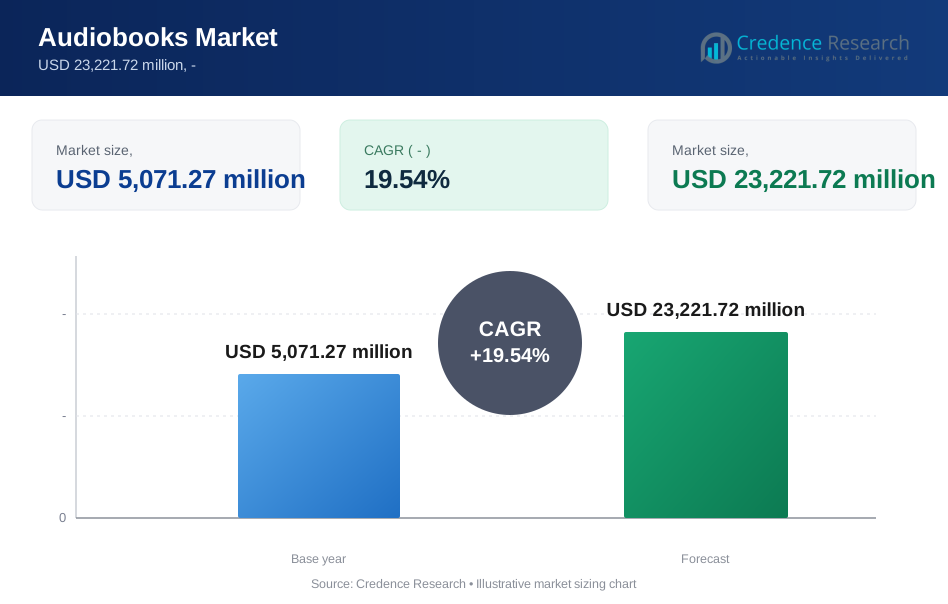
| Audiobooks Market Size 2024 | USD 5,071.27 million |
| Audiobooks Market, CAGR | 19.54% |
| Audiobooks Market Size 2032 | USD 23,221.72 million |
Market Overview
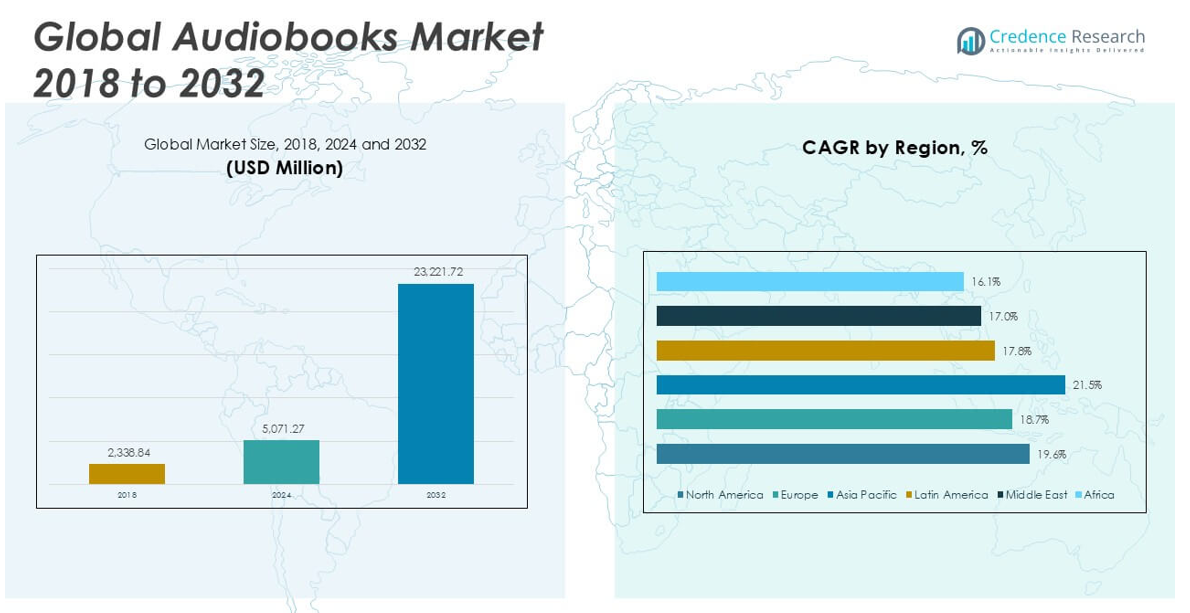
The Audiobooks Market size was valued at USD 2,338.84 million in 2018, increased to USD 5,071.27 million in 2024, and is anticipated to reach USD 23,221.72 million by 2032, at a CAGR of 19.54% during the forecast period.
The audiobooks market is dominated by major players such as Amazon.com, Inc., Google LLC, Apple Inc., Rakuten Group, Inc., Audible, Inc., Storytel AB, PLAYSTER (SOFTONIC INTERNATIONAL S.A.), Barnes & Noble Booksellers, Inc., Downpour.com, and VoiceVerse. These companies actively expand their content libraries, secure exclusive titles, and offer user-centric subscription models to strengthen their market positions. North America leads the global audiobooks market, holding a significant market share of 41.7% in 2024, driven by advanced digital infrastructure, high smartphone penetration, and strong consumer preference for on-demand audio content. Europe follows as another key region with steady growth potential.
Market Insights
- The audiobooks market was valued at USD 2,338.84 million in 2018, reached USD 5,071.27 million in 2024, and is expected to reach USD 23,221.72 million by 2032, growing at a CAGR of 19.54% during the forecast period.
- Rising smartphone adoption and consumer preference for multitasking media are major drivers fueling audiobook consumption globally, with subscription-based services significantly boosting market growth.
- Key trends include the growing popularity of celebrity-narrated audiobooks, exclusive content offerings, and the integration of AI and voice technologies to improve user engagement and content accessibility.
- The market is highly competitive, led by players like Amazon.com, Inc., Google LLC, Apple Inc., and Rakuten Group, Inc., focusing on expanding content libraries, subscription models, and regional language offerings.
- North America leads the market with a 41.7% share in 2024, followed by Europe at 29.3% and Asia Pacific at 19.8%, while the fiction genre holds the largest segment share globally.
Market Segmentation Analysis:
By Genre
In the audiobooks market, the fiction segment holds the dominant share, accounting for approximately 60% of the market in 2024. Fiction audiobooks continue to attract a broad audience due to their engaging storytelling and popularity among younger listeners. The increasing availability of bestsellers and exclusive fiction titles on major platforms drives this dominance. Moreover, the demand for immersive audio experiences and celebrity-narrated fiction books significantly boosts consumer interest, positioning the fiction segment as the leading genre across global markets.
- For instance, Audible, Inc. reported that its exclusive fiction title The Sandman by Neil Gaiman achieved over 2,300,000 downloads within the first five months of release, highlighting the segment’s strong consumer pull.
By Preferred Device
Smartphones dominate the audiobooks market by preferred device, contributing to nearly 55% of total consumption in 2024. The portability, ease of access, and integration with popular audiobook applications make smartphones the most preferred device among users. The widespread adoption of mobile internet and the increasing penetration of smartphones, especially in emerging economies, further accelerate this trend. Enhanced audio quality, offline listening capabilities, and seamless syncing across devices contribute to the growing reliance on smartphones for audiobook consumption.
- For instance, Storytel AB reported that out of 5,500,000 active users in 2023, approximately 4,300,000 accessed audiobooks exclusively through smartphones in India, demonstrating the growing dependence on mobile devices for audio content.
By Distribution Channel
The subscription-based segment leads the audiobooks market, capturing approximately 65% market share in 2024. Consumers increasingly favor subscription models due to cost efficiency, access to vast audiobook libraries, and flexibility in content selection. Key providers offer personalized recommendations and exclusive content under subscription plans, encouraging long-term customer engagement. The growing popularity of unlimited listening packages and the convenience of automated renewals are major drivers supporting the dominance of subscription-based distribution in the global audiobooks market.
Market Overview
Rising Smartphone Penetration
The rapid increase in smartphone usage globally is a significant growth driver for the audiobooks market. Smartphones provide easy access to audiobook platforms, enabling users to listen on the go. With mobile applications offering features like offline downloads and seamless streaming, consumers are increasingly shifting toward mobile-based audiobook consumption. This widespread accessibility, coupled with improved internet connectivity, particularly in emerging regions, continues to expand the consumer base and fuels the demand for audiobooks across diverse demographics.
- For instance, Google Play Books recorded 15,800,000 audiobook app downloads on Android devices worldwide between 2021 and 2023, confirming the influence of growing smartphone penetration on audiobook consumption habits.
Growing Preference for Multitasking Media
Consumers are increasingly valuing formats that allow multitasking, making audiobooks a preferred medium. Unlike traditional reading, audiobooks enable users to consume content while driving, exercising, or performing daily routines. This shift in consumption behavior is particularly evident among working professionals and students seeking to optimize time. The growing demand for time-efficient learning and entertainment solutions strongly supports the rising adoption of audiobooks, positioning them as a versatile alternative to physical books and e-books.
- For instance, Apple Books reported that in the United States, 120,000,000 hours of audiobook content were consumed during commuting times in 2023, reflecting strong multitasking consumption patterns.
Expansion of Subscription-Based Platforms
The surge in subscription-based audiobook services significantly contributes to market growth. Platforms offering unlimited access to vast audiobook libraries through affordable subscription models attract a large consumer base. This model enhances user retention by providing cost-effective options and personalized content recommendations. Major players like Audible and Scribd continue to invest in exclusive content and seamless user experiences, strengthening the subscription ecosystem and driving sustained market expansion.
Key Trends & Opportunities
Celebrity-Narrated and Exclusive Content
The growing trend of celebrity-narrated audiobooks and exclusive content offerings is transforming consumer engagement. Renowned personalities lending their voices to popular titles create a unique listening experience, enhancing the appeal of audiobooks. Publishers and platforms increasingly focus on securing exclusive audio rights to attract loyal subscribers. This trend not only differentiates offerings but also presents significant opportunities for strategic collaborations, thereby enhancing the overall market competitiveness.
- For instance, Spotify’s exclusive release of Michelle Obama’s The Light Podcast series generated over 10,000,000 streams globally within the first two months of launch, underscoring the power of celebrity-driven content to attract and retain users.
Integration of AI and Voice Technologies
The integration of artificial intelligence (AI) and advanced voice technologies is reshaping audiobook production and delivery. AI-driven narration, voice modulation, and language personalization enable faster and cost-effective audiobook creation. Additionally, AI-powered recommendation engines improve user engagement by curating personalized content. These technological advancements present new opportunities for publishers and platforms to enhance scalability, reach diverse audiences, and optimize content discovery.
- For instance, Google introduced AI-generated audiobook narration in 2022, enabling publishers to convert full-length texts into natural-sounding audio in less than 24 hours, significantly reducing traditional production timelines that often required 3 to 4 weeks.
Key Challenges
Copyright and Licensing Complexities
The audiobooks market faces persistent challenges related to copyright and licensing agreements. Navigating the legal landscape for securing audio rights is often complex and time-consuming, especially when dealing with international markets and multi-language content. Disputes over distribution rights and royalty structures can delay releases and limit content availability, posing significant barriers to market expansion and efficient content distribution.
High Production Costs for Quality Audiobooks
Producing high-quality audiobooks, particularly those featuring professional narrators or sound effects, incurs substantial costs. This financial barrier can be challenging for smaller publishers and independent authors aiming to enter the market. Investment in editing, studio recording, and sound engineering further escalates expenses, potentially limiting the diversity of content offerings and constraining new entrants from competing effectively.
Market Saturation in Developed Regions
The audiobooks market in developed regions, such as North America and parts of Europe, is approaching saturation, with major platforms already holding significant market shares. This limits opportunities for new players and reduces the potential for rapid growth in these areas. Companies must increasingly focus on market differentiation, localized content, and expansion into untapped regions to sustain growth amid intensifying competition and consumer fatigue.
Regional Analysis
North America
North America dominates the audiobooks market, accounting for the largest share of approximately 41.7% in 2024. The market was valued at USD 987.28 million in 2018 and grew to USD 2,117.70 million in 2024, with projections reaching USD 9,724.98 million by 2032 at a CAGR of 19.6%. The region’s growth is driven by high smartphone penetration, a mature subscription-based ecosystem, and strong consumer preference for on-the-go entertainment. The presence of key market players and advanced distribution platforms further strengthen North America's leadership position, supported by growing demand for diverse, high-quality audio content.
Europe
Europe holds a significant position in the audiobooks market, with a market share of around 29.3% in 2024. The regional market was valued at USD 709.74 million in 2018, expanding to USD 1,487.04 million in 2024, and is anticipated to reach USD 6,437.73 million by 2032, growing at a CAGR of 18.7%. The increasing popularity of localized and multi-language audiobooks, along with the rise of subscription-based services, supports steady market expansion. Europe’s well-established publishing industry and rising interest in audiobooks among younger demographics significantly contribute to the region’s growth trajectory.
Asia Pacific
Asia Pacific is the fastest-growing region in the audiobooks market, with a market share of approximately 19.8% in 2024. Starting at USD 426.21 million in 2018, the market expanded to USD 1,005.96 million in 2024 and is projected to reach USD 5,248.23 million by 2032, registering a CAGR of 21.5%. Rapid smartphone adoption, improving digital infrastructure, and growing awareness of audiobooks among tech-savvy populations are key drivers. Additionally, regional content development and increasing demand for language-specific audiobooks are fueling accelerated growth across countries like China, India, and Japan.
Latin America
Latin America represents a growing segment in the audiobooks market, with a market share of around 4.8% in 2024. Valued at USD 113.06 million in 2018, the market reached USD 242.17 million in 2024 and is forecast to achieve USD 984.43 million by 2032, growing at a CAGR of 17.8%. The rising adoption of smartphones, expanding internet penetration, and increasing consumption of digital media contribute to regional growth. The demand for Spanish and Portuguese audiobooks and the rising influence of younger audiences offer further opportunities for market players to tap into this emerging landscape.
Middle East
The Middle East holds a market share of approximately 2.6% in 2024 in the global audiobooks market. The regional market was valued at USD 66.54 million in 2018, grew to USD 132.07 million in 2024, and is anticipated to reach USD 511.89 million by 2032, with a CAGR of 17.0%. Increasing smartphone usage, improved digital platforms, and the demand for Arabic language content are driving growth. The Middle East presents emerging opportunities, particularly as educational audiobooks and religious content gain popularity among diverse user groups seeking accessible audio experiences.
Africa
Africa captures a market share of approximately 1.7% in 2024 in the audiobooks market. The market was valued at USD 36.02 million in 2018, expanded to USD 86.32 million in 2024, and is expected to reach USD 314.47 million by 2032, growing at a CAGR of 16.1%. Despite challenges in digital infrastructure, the region is witnessing steady growth supported by rising mobile adoption and increasing awareness of digital learning tools. Localized content development and the growing popularity of educational audiobooks offer potential avenues for market expansion in the coming years.
Market Segmentations:
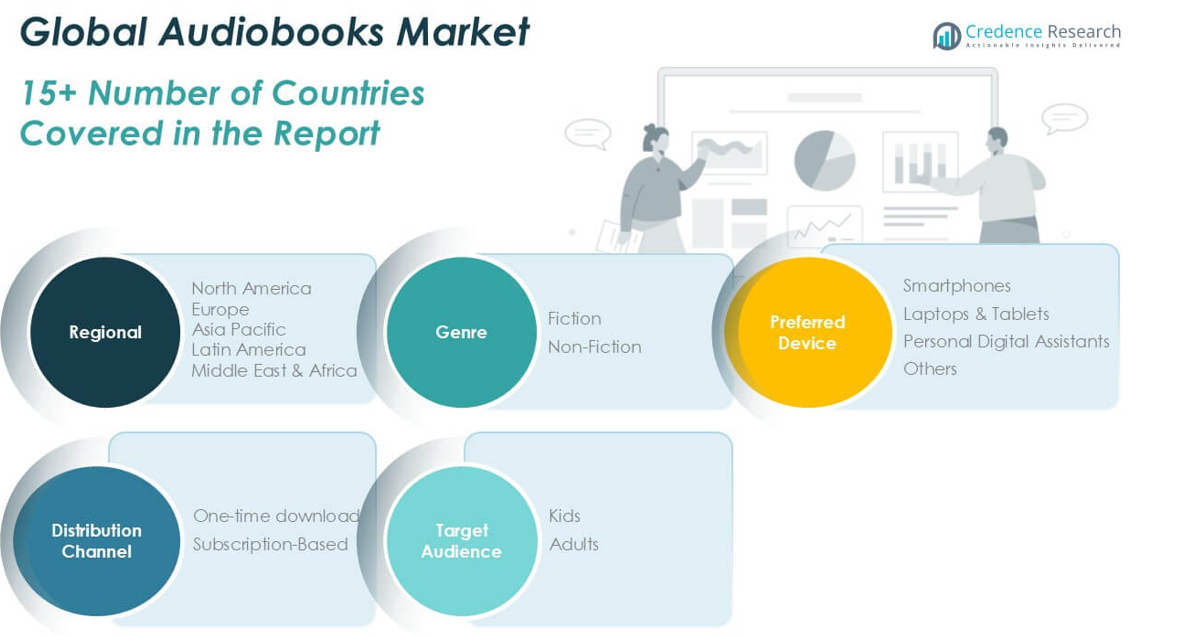
By Genre
- Fiction
- Non-Fiction
By Preferred Device
- Smartphones
- Laptops & Tablets
- Personal Digital Assistants
- Others
By Distribution Channel
- One-time Download
- Subscription-Based
By Target Audience
- Kids
- Adults
By Geography:
- North America
- U.S.
- Canada
- Mexico
- Europe
- Germany
- France
- U.K.
- Italy
- Spain
- Rest of Europe
- Asia Pacific
- China
- Japan
- India
- South Korea
- South-east Asia
- Rest of Asia Pacific
- Latin America
- Brazil
- Argentina
- Rest of Latin America
- Middle East & Africa
- GCC Countries
- South Africa
- Rest of the Middle East and Africa
Competitive Landscape
The audiobooks market is highly competitive, with key players focusing on expanding content libraries, enhancing user experiences, and securing exclusive distribution rights to strengthen their market positions. Major companies such as Amazon.com, Inc. (through Audible), Google LLC, Apple Inc., and Rakuten Group, Inc. lead the industry by offering extensive audiobook collections, subscription-based services, and seamless integration across devices. These players are actively investing in exclusive content, celebrity-narrated titles, and innovative features like AI-driven recommendations to retain subscribers and attract new users. Additionally, regional platforms like Storytel AB are gaining traction by providing localized content and catering to specific language markets. Partnerships with publishers, content creators, and technology providers are shaping the competitive dynamics, enabling companies to deliver differentiated value propositions. The market also witnesses contributions from emerging platforms like VoiceVerse and Downpour.com, which are introducing diverse content formats and pricing strategies, intensifying competition and driving continuous innovation across the global audiobooks landscape.
Key Player Analysis
- Google LLC
- PLAYSTER (SOFTONIC INTERNATIONAL S.A.)
- Rakuten Group, Inc.
- com, Inc.
- Apple Inc.
- Audible, Inc.
- Barnes & Noble Booksellers, Inc.
- com
- VoiceVerse
- Storytel AB
Recent Developments
- In March 2025, Amazon.com, Inc. announced the integration of Audible's extensive audiobook catalog into its Unlimited subscription service, expanding access to audiobooks for subscribers in the U.S., UK, Canada, France, Australia, and New Zealand.
- In October 2024, Spotify AB expanded its Audiobook service to France, Belgium, the Netherlands, and Luxembourg, offering over 200,000 titles to Premium subscribers. The service includes 12 hours of free audiobook listening per month, with additional listening time available for purchase.
- In January 2024, RBmedia expanded its audiobook catalog by acquiring Berrett-Koehler's audiobook publishing company. This acquisition included a diverse range of titles, strengthening RBmedia's position in the educational and professional audiobook segments.
- In July 2022, Spotify paid 117 million euros (about $119 million) for Findaway, a platform that allows users to create distribute, and monetize their own audiobooks, according to a Securities and Exchange Commission (SEC) filing.
- In July 2022, RBmedia made two audiobook acquisitions, one in the United States and one in France. The acquisition, according to RBmedia CEO Tom MacIsaac, follows the company's objective of expanding in the United States and overseas.
Market Concentration & Characteristics
The audiobooks market demonstrates moderate to high market concentration, with a few dominant players holding significant control over global distribution and content supply. Companies such as Amazon.com, Inc. through Audible, Apple Inc., Google LLC, and Rakuten Group, Inc. maintain strong competitive advantages through extensive content libraries, established subscription models, and advanced digital platforms. The market favors companies with significant technological capabilities, cross-platform integration, and strong publisher relationships. It remains highly dynamic, with a continuous influx of exclusive titles and celebrity-narrated content driving user acquisition. Subscription-based platforms have emerged as the preferred distribution channel due to their affordability and expansive access to diverse content. The audiobooks market displays characteristics of rapid digitalization, with increasing consumer demand for convenience and mobility shaping product delivery methods. Smartphone penetration continues to support market growth, with users preferring mobile applications for seamless access. Regional platforms like Storytel AB gain traction by offering localized content, but global players retain a competitive edge through resource depth and diversified language portfolios. The fiction segment holds a major share due to consistent consumer interest and a steady pipeline of new releases. The market shows resilience against competition from other digital media formats because of its suitability for multitasking and ease of content consumption. It faces entry barriers for smaller participants due to high-quality production costs, exclusive licensing complexities, and strong brand loyalty tied to leading platforms. Technological advancements, including AI-powered voice technologies and intelligent recommendation systems, continue to shape consumer experiences and content discovery patterns.
Report Coverage
The research report offers an in-depth analysis based on Genre, Preferred Device, Distribution Channel, Target Audience and Geography. It details leading market players, providing an overview of their business, product offerings, investments, revenue streams, and key applications. Additionally, the report includes insights into the competitive environment, SWOT analysis, current market trends, as well as the primary drivers and constraints. Furthermore, it discusses various factors that have driven market expansion in recent years. The report also explores market dynamics, regulatory scenarios, and technological advancements that are shaping the industry. It assesses the impact of external factors and global economic changes on market growth. Lastly, it provides strategic recommendations for new entrants and established companies to navigate the complexities of the market.
Future Outlook
- The audiobooks market will continue expanding rapidly with increasing global smartphone penetration.
- Subscription-based models will dominate as consumers prefer affordable access to large content libraries.
- Celebrity-narrated audiobooks and exclusive titles will attract new users and strengthen platform loyalty.
- AI-powered narration and advanced voice technologies will improve production efficiency and reduce costs.
- Regional language audiobooks will gain popularity, supporting growth in non-English speaking markets.
- Mobile applications will remain the primary access point for audiobook consumption.
- Partnerships between publishers and technology companies will increase to secure exclusive distribution rights.
- Educational and self-development audiobooks will see rising demand across student and professional segments.
- Content personalization through AI-driven recommendation engines will enhance user engagement.
- The market will see steady growth in emerging economies driven by improving digital infrastructure.
Request a Free Sample
Fill in your details and we'll send you a free sample report.
- Sample data tables & charts
- Research methodology
Need a Custom Version of This Report?
Tailor the scope, geography, or segments to your exact requirements.
- Custom geography or segment scope
- Direct access to our analyst team
Frequently Asked Questions
What is the current size of the Audiobooks Market?
What are the key segments within the Audiobooks Market?
What are some challenges faced by the Audiobooks Market?
Who are the major players in the Audiobooks Market?
Table of Content
Chapter 1. Report Introduction
- 1.1 Report Description & Purpose
- 1.1.1 Report Title & Market Definition
- 1.1.2 Unique Selling Propositions (USP) & Key Differentiators
- 1.1.3 Value Proposition for Stakeholders
- 1.2 Research Objectives
- 1.2.1 Market Sizing Objectives (Volume & Revenue)
- 1.2.2 Segmentation Objectives
- 1.2.3 Competitive Intelligence Objectives
- 1.2.4 Forecast & Scenario Objectives
- 1.3 Report Scope
- 1.3.1 Audiobooks Scope – Types & Subtypes Covered
- 1.3.2 Geographic Scope – Regions & Countries Covered
- 1.3.3 Historical Period, Base Year & Forecast Period (the historical period; forecast to the forecast period)
- 1.3.4 Inclusions & Exclusions
- 1.4 HS Code & Classification Framework
- 1.5 Currency, Units & Pricing Basis
- 1.6 Target Stakeholders
- 1.7 Limitations & Assumptions
Chapter 2. Executive Summary
- 2.1 Global Audiobooks Market Snapshot
- 2.1.1 Market Size – Historical (the historical period) & Forecast (the forecast period) (base year: USD 5,071.27 million → forecast year: USD 23,221.72 million)
- 2.1.2 Volume & Revenue – Global Totals
- 2.1.3 Key Market Highlights – Top Five Facts
- 2.2 Audiobooks Market Segmentation Snapshot
- 2.2.1 Market Split by Region – vs.
- 2.3 Competitive Snapshot
- 2.3.1 Top 10 Players by Revenue Share –
- 2.3.2 Top 10 Players by Volume Share –
- 2.3.3 Recent Strategic Developments (18-Month Summary)
- 2.4 Key Investment Highlights & Strategic Conclusions
Chapter 3. Audiobooks Market Dynamics & Industry Analysis
- 3.1 Market Overview & Context
- 3.1.1 Audiobooks Market Position in the Broader Automotive Value Chain
- 3.1.2 OEM vs. Replacement Market Dynamics
- 3.1.3 Market Maturity & Development Stage by Region
- 3.2 Audiobooks Market Drivers
- 3.3 Audiobooks Market Restraints & Challenges
- 3.4 Audiobooks Market Opportunities
- 3.5 Porter's Five Forces Analysis
- 3.5.1 Threat of New Entrants
- 3.5.2 Bargaining Power of Suppliers
- 3.5.3 Bargaining Power of Buyers
- 3.5.4 Threat of Substitutes
- 3.5.5 Competitive Rivalry – Intensity Assessment
- 3.6 Audiobooks Value Chain Analysis
- 3.6.1 Upstream – Raw Material/Input Suppliers
- 3.6.1.1 Raw Material/Input 1
- 3.6.1.2 Raw Material/Input 2
- 3.6.1.3 Raw Material/Input 3
- 3.6.2 Midstream – Production/Manufacturing/Service Delivery
- 3.6.2.1 Production/Process Overview
- 3.6.2.2 Key Facility Locations & Capacity by Manufacturer
- 3.6.3 Downstream – Distribution & End Consumer
- 3.6.3.1 Primary Channel – B2B/OEM
- 3.6.3.2 Secondary Channels – Dealer, Retail, Online, Direct
- 3.6.4 Value Chain Profitability Analysis
- 3.6.1 Upstream – Raw Material/Input Suppliers
- 3.7 PESTEL Analysis
- 3.7.1 Political Factors
- 3.7.2 Economic Factors
- 3.7.3 Social Factors
- 3.7.4 Technological Factors
- 3.7.5 Environmental Factors
- 3.7.6 Legal Factors
- 3.8 Audiobooks Supply Chain Analysis
- 3.8.1 Raw Material/Input Supply Risk Assessment
- 3.8.2 Manufacturing Concentration Risk (Geographic Exposure)
- 3.8.3 Trade Disruption Impact Analysis
- 3.9 Regulatory & Policy Landscape
Note: The regulatory and policy landscape section covers regulations based on their applicability to the market, Audiobooks category, geography, and scope of the study. Only regulatory frameworks with a material impact on operations, compliance, trade, sustainability, or market access are analyzed in detail.
Chapter 4. Key Investment Pockets & Opportunity Analysis
- 4.1 Audiobooks Market Attractiveness Analysis
- 4.1.1 By Region – Investment Attractiveness Matrix (Volume × CAGR)
- 4.2 Absolute Revenue Growth Opportunity
- 4.2.1 By Region – Absolute USD Growth Through the forecast period
- 4.3 Incremental Volume Opportunity
- 4.3.1 By Region – Incremental Volume Through the forecast period
- 4.3.2 Segment – Incremental Volume
- 4.4 Emerging Submarket Opportunity Deep Dive (Subject to Applicability)
- 4.5 Emerging Market Opportunity Scorecards
- 4.5.1 United States
- 4.5.2 Europe
- 4.5.3 Asia
- 4.5.4 Middle East & Africa
Note: Emerging Market Opportunity Scorecards will be included based on relevance and strategic importance. Regions listed are indicative and may vary depending on data availability and market dynamics.
Chapter 5. Audiobooks Import-Export Analysis & Trade Flows
- 5.1 Global Trade Overview
- 5.1.1 Global Export Value by Country (the historical period)
- 5.1.2 Global Export Volume by Country (the historical period)
- 5.1.3 Global Import Value by Country (the historical period)
- 5.1.4 Global Import Volume by Country (the historical period)
- 5.1.5 Net Trade Balance by Country (the historical period)
- 5.2 Export Analysis – Segment
- 5.2.1 Type 1 (HS Code)
- 5.2.2 Type 2 (HS Code)
- 5.2.3 Type 3 (HS Code)
- 5.2.4 Type 4 (HS Code)
- 5.2.5 Type 5 (HS Code)
- 5.3 Import Analysis – Segment
- 5.3.1 Type 1 (HS Code)
- 5.3.2 Type 2 (HS Code)
- 5.3.3 Type 3 (HS Code)
- 5.3.4 Type 4 (HS Code)
- 5.3.5 Type 5 (HS Code)
- 5.4 Average Unit Trade Prices
- 5.4.1 Average Export Price – Segment & Country
- 5.4.2 Average Import Price – Segment & Source Country
- 5.4.3 Price Trends (the historical period)
- 5.5 Key Trade Route Analysis
- 5.5.1 Trade Route 1
- 5.5.2 Trade Route 2
- 5.5.3 Trade Route 3
- 5.5.4 Trade Route 4
- 5.5.5 Trade Route 5
- 5.6 Trade Policy Impact Assessment
- 5.6.1 US Anti-Dumping & Section 301 Tariffs
- 5.6.2 EU Customs Union Impact
- 5.6.3 Major Free Trade Agreements
- 5.6.4 USMCA Rules of Origin
Note: Trade policy analysis will be included only where relevant to the Audiobooks market.
Chapter 6. Competitive Landscape & Company Benchmarking
- 6.1 Audiobooks Market Concentration & Structure
- 6.1.1 Herfindahl-Hirschman Index (HHI) – vs.
- 6.1.2 Tier 1, Tier 2 & Tier 3 Market Structure
- 6.1.3 Global, Regional & Local Player Dynamics
- 6.2 Audiobooks Market Share Analysis –
- 6.2.1 Global Revenue Share by Company
- 6.2.2 Global Volume Share by Company
- 6.2.3 Regional Revenue Share
- 6.2.4 Market Share Evolution ( vs. )
- 6.2.5 OEM Segment Share by Company
- 6.2.6 Replacement Segment Share by Company
- 6.3 Production/Delivery Capacity & Facility Analysis
- 6.3.1 Global Installed Capacity
- 6.3.2 Capacity Utilization Rates
- 6.3.3 Production/Output Volume
- 6.3.4 Facility Locations & Capacity Map
- 6.3.5 Planned Capacity Additions
- 6.4 Audiobooks Competitive Benchmarking Matrix
- 6.4.1 Revenue, Volume, CAGR & Profitability Comparison
- 6.4.2 Channel Revenue Mix
- 6.4.3 Geographic Revenue Exposure
- 6.4.4 R&D Intensity
- 6.4.5 Sustainability Maturity
- 6.5 Strategic Developments in Audiobooks (Last 24 Months)
- 6.5.1 Mergers, Acquisitions & Divestments
- 6.5.2 New Audiobooks Launches
- 6.5.3 Facility Expansions
- 6.5.4 Strategic Alliances, Joint Ventures & Partnerships
- 6.5.5 Distribution Expansion & Market Entry
- 6.5.6 Sustainability & ESG Initiatives
- 6.6 Competitive Strategy Mapping
- 6.6.1 Leader, Challenger, Follower & Niche Classification
- 6.6.2 Pricing Strategy Comparison
- 6.6.3 Channel Strategy Matrix
Note: Strategic developments are included based on their materiality and the availability of reliable information.
Chapter 7. Global Audiobooks Market – By Distribution Channel
- 7.1 Segment Overview
- 7.1.1 Volume & Revenue Split by Channel ( & )
- 7.1.2 Channel Mix Evolution (the forecast period)
Chapter 8. Regional Market Analysis – Global Overview
- 8.1 Global Regional Overview
- 8.1.1 Regional Volume Share
- 8.1.2 Regional Revenue Share
- 8.1.3 Regional Volume by Region
- 8.1.4 Regional Revenue by Region
- 8.1.5 Regional Forecast Through the forecast period
- 8.2 Cross-Regional Segment Analysis
- 8.2.1 By Distribution Channel
- 8.2.2 By Brand/Price Tier
Chapter 9. North America Audiobooks Market
- 9.1 United States
- 9.2 Canada
- 9.3 Mexico
Chapter 10. Europe Audiobooks Market
- 10.1 Germany
- 10.2 France
- 10.3 Italy
- 10.4 United Kingdom
- 10.5 Spain
- 10.6 Poland
- 10.7 Russia
- 10.8 Netherlands
- 10.9 Belgium
- 10.10 Sweden
- 10.11 Denmark
- 10.12 Norway
- 10.13 Rest of Europe
Chapter 11. Asia Pacific Audiobooks Market
- 11.1 China
- 11.2 India
- 11.3 Japan
- 11.4 South Korea
- 11.5 Thailand
- 11.6 Indonesia
- 11.7 Vietnam
- 11.8 Malaysia
- 11.9 Australia
- 11.10 Rest of Asia Pacific
Chapter 12. Latin America Audiobooks Market
- 12.1 Brazil
- 12.2 Argentina
- 12.3 Colombia
- 12.4 Chile
- 12.5 Rest of Latin America
Chapter 13. Middle East Audiobooks Market
- 13.1 Saudi Arabia
- 13.2 United Arab Emirates
- 13.3 Turkey
- 13.4 Israel
- 13.5 Iran
- 13.6 Rest of the Middle East
Chapter 14. Africa Audiobooks Market
- 14.1 South Africa
- 14.2 Egypt
- 14.3 Nigeria
- 14.4 Morocco
- 14.5 Rest of Africa
Chapter 15. Audiobooks Company Profiles
- 15.1 [Company 01]
- 15.1.1 Company Overview
- 15.1.2 Key Management Personnel
- 15.1.3 Products & Services Portfolio
- 15.1.4 Financial Performance
- 15.1.5 Key Market Focus & Geographic Presence
- 15.1.6 Recent Developments & Strategic Initiatives
Note: The company profile list is preliminary and may change based on research findings, market developments, data availability, and client requirements.
Chapter 16. Appendices
- Appendix A – List of Abbreviations & Acronyms
- Appendix B – Industry Classification Code Reference – Full Series
- Appendix C – Production & Capacity Data Tables
- Appendix D – End-Use & Demand Base Tables
- Appendix E – Consumption & Replacement Rate Assumptions
- Appendix F – ASP Reference Tables
- Appendix G – Manufacturing & Facility Database
- Appendix H – Import-Export Data Tables
- Appendix I – Regulatory Summary Tables
- Appendix J – Primary Research Participant List (Anonymized)
- Appendix K – Primary Research Questionnaire Framework
- Appendix L – Data Sources & Bibliography
- Appendix M – Market Size Divergence & Source Comparison
Chapter 17. Research Methodology
- 17.1 Research Framework & Philosophy
- 17.2 Secondary Research – Sources, Hierarchy & Data Extraction
- 17.3 Data Modeling – Bottom-Up & Top-Down Market Sizing
- 17.4 Primary Research – Stakeholder Framework, LOI & Sample Sizes
- 17.5 Forecast Methodology – Regression, Scenario & Sensitivity Analysis
- 17.6 Quality Control – Four-Layer Validation Framework
- 17.7 Limitations & Standard Assumptions
- 17.8 Disclaimer
