
| REPORT ATTRIBUTE | DETAILS |
|---|---|
| Historical Period | 2019-2022 |
| Base Year | 2023 |
| Forecast Period | 2024-2032 |
| Automatic Number Plate Recognition (ANPR) System Market Size 2023 | USD 2681.2 Million |
| Automatic Number Plate Recognition (ANPR) System Market, CAGR | 7.90% |
| Automatic Number Plate Recognition (ANPR) System Market Size 2032 | USD 5315.23 Million |
Market Insights
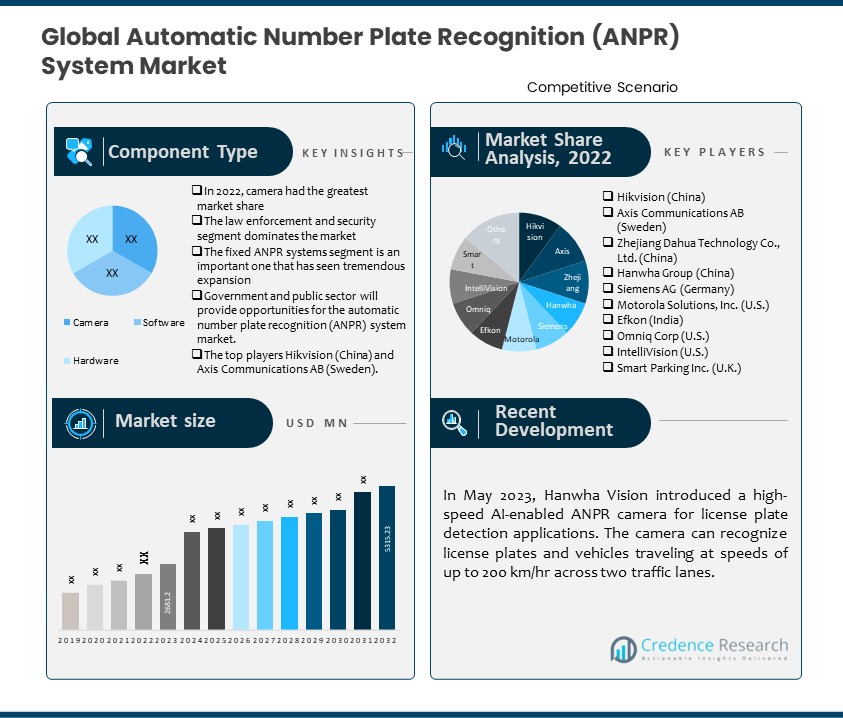
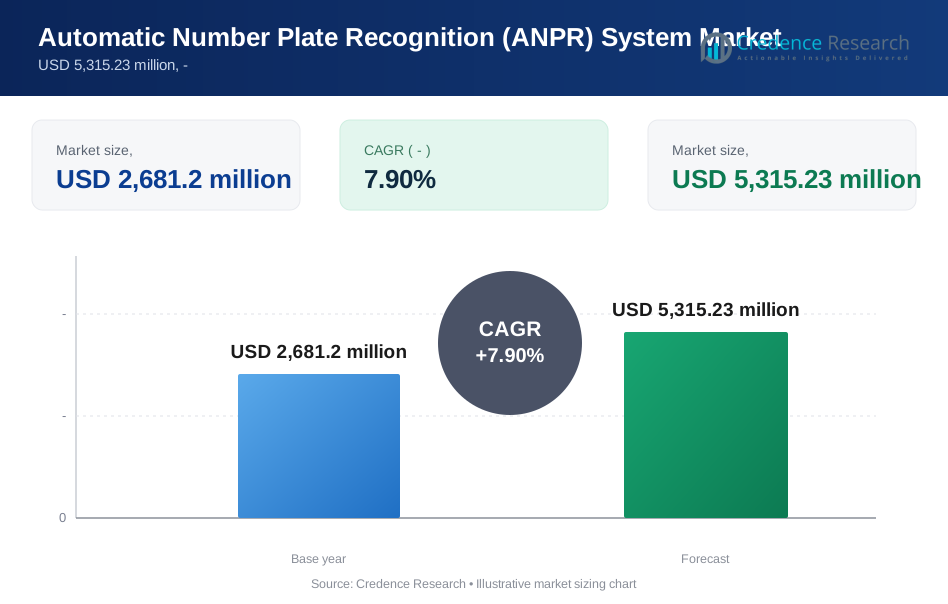
- The global market for automatic number plate recognition (ANPR) systems is expected to develop at a compound annual growth rate (CAGR) of 7.90% between 2024 and 2032, from its estimated USD 2681.2 million in 2023 to USD 5315.23 million in 2032.
- The largest category is the camera. Software, on the other hand, is expected to grow at a strong CAGR.
- The law enforcement and security category will expand at a rapid rate of growth.
- The CAGR for fixed ANPR systems is expected to be the highest during the projection period.
- The government and public sector will have the highest CAGR throughout the prediction period.
- Asia Pacific dominated the automatic number plate recognition (ANPR) system market.
- Europe is expected to come in second in terms of the market share of automatic number plate recognition (ANPR) systems.
- In the automatic number plate recognition (ANPR) system market, North America is anticipated to grow fastest.
- Technological developments in artificial intelligence and machine learning, as well as the increasing use of ANPR systems for security in the commercial and industrial sectors, are driving the growth of the global market.
- The industry for automatic number plate recognition (ANPR) systems may be impacted by the increasing use of these systems in emerging economies with developing transportation infrastructure, as well as in tolling applications for electronic toll collection and congestion pricing.
Executive Summary
Market Definition
Automatic number plate recognition (ANPR) systems use optical character recognition to scan license plates from pictures and derive vehicle location data. Two law enforcement agencies that keep databases of persons and cars that can be matched to the information gathered by the ANPR system are the Police National Road Agency and the Vehicle and Driver Licensing Agency. Tracking and identifying stolen vehicles or those involved in criminal activity is one way that ANPR technology can help law enforcement. Parking occupancy, duration, and infractions can all be tracked with the use of ANPR cameras in parking management.
Market Overview
The automatic number plate recognition (ANPR) system sector is estimated to develop at a 7.90% compound annual growth rate (CAGR) between 2024 and 2032, maintaining its current upward trend. The market will continue to develop, rising from its estimated USD 2681.2 million in 2023 to USD 5315.23 million in 2032.
ANPR systems are essential for improving security and surveillance protocols in a variety of contexts, including public areas, businesses, and government buildings. These systems enable fast identification of vehicles entering or leaving a monitored area by automatically detecting and recognizing license plate numbers. The demand for sophisticated surveillance solutions, such as ANPR systems, to support security measures is rising as security concerns across the globe continue to rise. Continuous developments in ANPR technology, such as better image processing algorithms, higher-quality cameras, and the incorporation of machine learning and artificial intelligence, are boosting the market by increasing the usefulness and efficiency of ANPR systems.
Moreover, ANPR systems are widely used in traffic management applications to monitor and control the flow of vehicular traffic efficiently. These systems allow law enforcement to monitor traffic infractions, control toll collection, enforce parking regulations, and optimize traffic flow through intelligent signal control systems by collecting and analyzing license plate data in real time. The need for effective traffic management solutions has increased due to growing urbanization and the resulting rise in traffic congestion in many cities, which in turn supports the demand for ANPR systems.
Segmentation by Component Type
- Camera is the market leader by component type. Cameras are strategically placed everywhere vehicle traffic has to be monitored, such as parking lots, toll booths, highways, and roadways. They can be fixed or mounted on cars (like police or surveillance cars).
- The software category will exhibit a sizable CAGR during the projected period. An automatic number plate recognition (ANPR) system is a software-driven solution that uses images or video streams recorded by cameras to identify and decipher license plate numbers automatically.
- Other component types, including hardware, also support the need for an automatic number plate recognition (ANPR) system.
Segmentation by Application Area
- Law enforcement and security are considered the best application area category. ANPR devices are useful for both detecting and preventing a variety of crimes. If they come across a car linked to illegal activity, like a stolen vehicle, they can notify law enforcement. Furthermore, investigators can utilize ANPR data to follow a suspect's movements or pinpoint the vehicles that were at the crime scene.
- The traffic management category will likely register a significant CAGR during forecasting. An alert for law enforcement or traffic management authorities can be generated by the ANPR system upon detection of a violation. The appropriate action, such as fining, warning, or deploying enforcement units, can be taken in response to these alerts, which can be sent in real-time to patrolling officers or to monitoring centers.
- Other application areas, such as tolling and congestion charging, parking management, and access control and security, also contribute to the demand for automatic number plate recognition (ANPR) systems.
Segmentation by Deployment Type
- The fixed ANPR systems category is projected to grow faster over the projection period. Alternatively referred to as stationary or static ANPR systems, fixed ANPR installations are made to automatically record and identify license plate data from passing cars in a given area. Typically, these systems include cameras, image processing software, illumination sources (such as infrared lights for operation at night), and occasionally extra hardware for data transmission and storage.
- Other deployment types influence the need for automatic number plate recognition (ANPR) systems, including mobile ANPR systems and portable handheld ANPR devices.
Segmentation by End-User Industry
- The government and public sector category will likely have the highest CAGR during the projection period. As part of its efforts for public safety and law enforcement, the government frequently takes the lead in putting ANPR systems into place. To do this, ANPR-equipped cameras must be installed in a variety of places, including parking lots, city streets, toll booths, and highways.
- Other end-user industries, such as commercial and industrial, transportation and logistics, and utilities and critical infrastructure, also contribute to the demand for automatic number plate recognition (ANPR) systems.
Segmentation by Region
- The Asia Pacific leads the automatic number plate recognition (ANPR) system industry. Strong government assistance has contributed to the region's rapid growth. China, Japan, and India are major contributors to the expansion of the APAC regional market.
- Europe is estimated to rank second in the market for automatic number plate recognition (ANPR) system size.
- The automatic number plate recognition (ANPR) system industry is predicted to flourish rapidly in North America.
- Regions such as Africa, the Middle East, and Latin America cover the remaining requirement for automatic number plate recognition (ANPR) systems.
The problems associated with urban parking spaces have been resolved by smart parking management, and the automatic number plate recognition system enhances the parking experience in general. Since ANPR cameras offer real-time data monitoring of cars and parking spaces, they are very helpful in parking management systems. The information is also used to lessen traffic and the inconvenience of parking, including car license plates and available spots. It is also anticipated that growing consumer, mall, and shopping plaza awareness of the availability of smart parking systems will result in increased market penetration for ANPR camera technology.
Based on projections, the automatic number plate recognition (ANPR) system market is anticipated to be controlled by Asia Pacific. Traffic congestion is a result of the population shifting to tier 1 and tier 2 cities owing to higher employment rates and better living standards. Furthermore, as more traffic infractions lead to an increase in traffic fatalities, the government is becoming increasingly concerned about the rising number of infractions. Therefore, in an effort to reduce traffic violations and alleviate congestion on the roads, major Asian nations are aggressively implementing ANPR.
The automatic number plate recognition (ANPR) system market in North America is anticipated to expand fastest throughout the forecast. Seven out of ten crimes take place in a vehicle, according to the International Association of Chiefs of Police. Reputable American ANPR system manufacturer Flock Safety noted in July 2022 that its technology is utilized by 2000 communities nationwide. Approximately 600–700 crimes are solved every day by the manufacturer's ANPR systems, accounting for 3% of all crimes in the US that are reported. Numerous ANPR systems have also been implemented in private spaces, and they are contributing to the success of crime-solving efforts by law enforcement.
Key Highlights of the Report
The global automatic number plate recognition (ANPR) system market is segmented by component type, application area, deployment type, end-user industry, and region. As far as the component type is concerned, cameras are the market spearhead. Law enforcement and security are the top category. The fixed ANPR systems category is anticipated to increase at the highest CAGR throughout the projection period. The government and public sector category will experience the highest CAGR during the forecast period. The automatic number plate recognition (ANPR) system market is expanding mostly in the Asia Pacific.
The effectiveness of automatic number plate recognition technology in identifying infractions and breaking traffic regulations has been demonstrated. Using optical character recognition, this system successfully reads license plates from moving cars. It then registers and stores the data in the software for further analysis and insights. The government's increasing emphasis on tightening traffic and safety regulations is expected to drive the automatic number plate recognition (ANPR) system market expansion during the forecast period.
Asia Pacific is expected to account for the largest automatic number plate recognition (ANPR) system market globally. Threats from terrorism, auto theft, and traffic infractions are just a few of the security issues the area faces. By automatically reading and recognizing license plates, ANPR systems provide increased security and make it easier for law enforcement to track and keep an eye on moving vehicles. The North American region is also assumed to have the market's sharpest growth. High levels of automobile traffic are common in North America, particularly in cities and important transit hubs. For authorities and transportation agencies, ANPR systems are essential tools because they can help manage traffic flow, enforce traffic laws, and improve security in these busy environments.
Which Key Factors Are Driving The Global Automatic Number Plate Recognition (ANPR) System Market?
The market for automatic number plate recognition (ANPR) systems is expanding due to expanding public and private sector investments in surveillance infrastructure, increased worries about vehicle theft and unauthorized access, and increasing utilization of ANPR systems in business and manufacturing industries for security.
What Are The Main Challenges Confronting The Global Automatic Number Plate Recognition (ANPR) System Market?
The main obstacles that the automatic number plate recognition (ANPR) system industry faces are the expenses connected with ANPR hardware and software, as well as the high setup costs of maintaining ANPR systems.
What Market Opportunities Exist For Automatic Number Plate Recognition (ANPR) System Globally?
The market for automatic number plate recognition (ANPR) systems is being driven by several factors, including the global implementation of smart city projects, the increasing acceptance of ANPR systems in developing countries, and the growth of the e-commerce and logistics sectors.
Market Drivers
Multiple factors propel the automatic number plate recognition (ANPR) system industry across the globe. The primary factors propelling the global automatic number plate recognition (ANPR) system market are as follows:
Rapid Integration of IoT and Data Analytics in Urban Cities
Globally significant economies are proactively incorporating diverse electronic techniques and sensor systems for a range of public applications in urban areas. These applications involve analyzing traffic patterns, population statistics, peak hours, and other variables linked to traffic congestion, public safety, and other urban-related concerns. Physical representation is not necessary when sensor-based and Internet of Things (IoT) technologies are integrated. It encourages data-driven decision-making, which boosts traffic compliance and enhances transportation efficiency. It also leads to less congested roads. Because ANPR technology offers real-time data visualization and enables civil enforcement to act on analytics and data-driven decisions, it greatly enhances the safety and security of urban areas. The search and recovery procedure for stolen vehicles is made easier for law enforcement agencies by the incorporation of ANPR technology. The entire smart infrastructure architecture also benefits from the Automatic Number Plate Recognition system's capacity to automate tasks like tracking automobiles, traffic infractions, and suspicious vehicle activity. Demand for ANPR technology is predicted to be high as more and more metropolitan areas move toward IoT-enabled operations.
Market Restraints
There are several obstacles that the global automatic number plate recognition (ANPR) system market must overcome to continue growing. Among them are the following:
Elevated Risk of Security and Data Breach
Modern major cities have found that automatic number plate recognition is a very helpful and efficient way to address their traffic and road problems. The world's reliance on technology for daily operations has led to an increase in cyber-attacks, which pose a significant threat to technology. For the ANPR systems to be protected against data breaches and hacking, a strong framework and server security solutions are necessary. This private information can be accessed and used to cause grave harm. This technology is fully digital, and server hacks and data breaches provide access to it. Strong firewalls and safety systems are, therefore, essential for fortifying these digital technologies and thwarting cyberattacks. However, inadequate safety and security measures combined with this technology could result in cyberattacks, which would further impede the uptake of the product.
Opportunities
There are plenty of potential prospects in the global automatic number plate recognition (ANPR) system industry. Among these are the following:
Integration of ANPR systems with emerging technologies like AI and IoT
The Internet of Things (IoT) and artificial intelligence (AI) are two examples of technologies that are currently being integrated with automatic number plate recognition (ANPR) systems. This integration facilitates faster image capture rates and increased efficiency. Nowadays, a number of companies offer ANPR systems and software with AI and IoT integration. For example, EFKON offers artificial intelligence-based ANPR systems that include a stable and readily integrated system that can read a variety of license plate types. Similarly, AI-based license plate detection, recognition, and search technology called Intelligent Integrated Video (i2V) offers i2V ANPR. It facilitates real-time license plate detection in camera view and recognizes English alphanumeric characters in both standard and non-standard formats. It also stores license plate data of vehicles that are stolen, wanted, hot-listed, or suspicious. Lastly, it aids in the detection of license plates in the field of view and saves license plate and vehicle images in the database. With 24x7 real-time operation, fast video processing, and over 90% accuracy in number plate detection and recognition, AI-based ANPR systems also require very little human intervention. Vehicle license plate recognition systems based on the Internet of Things are also being extensively researched and deployed in a number of nations.
Competitive Landscape
Key Players
Several major competitors exist in the fiercely competitive global automatic number plate recognition (ANPR) system market. The following are a few of the leading market participants and their market shares:
- Hikvision (China)
- Axis Communications AB (Sweden)
- Zhejiang Dahua Technology Co., Ltd. (China)
- Hanwha Group (China)
- Siemens AG (Germany)
- Motorola Solutions, Inc. (U.S.)
- Efkon (India)
- Omniq Corp (U.S.)
- IntelliVision (U.S.)
- Smart Parking Inc. (U.K.)
- Others
These companies prioritize product innovation, distribution channel expansion, mergers, and acquisitions to remain competitive.
The largest suppliers in the global automatic number plate recognition (ANPR) system market continuously work to stay one step ahead of the competition by developing innovative concepts and products.
In September 2023, Hikvision unveiled two cutting-edge new license plate recognition cameras that are ideal for a range of settings, including parking lots and farms. Two 7-Series LPR Dome Cameras and a 4 MP LPR Bullet Solar-Powered Camera Kit are part of the new product launch.
In April 2023, The ANPR camera software from Kapsch TrafficCom received a major security update that incorporates Artificial Intelligence (AI) features, resulting in a notable performance increase. With the help of deep learning and other techniques, the updated software is able to accurately recognize the license plates of hundreds of vehicles.
In April 2023, The staff of the New Zealand Police Department thoroughly examined over 350,000 ANPRs for review from 2018 to 2022, according to an audit findings report on ANPR technologies that was released. According to the department, efforts to make the nation's roads and driving habits safer have advanced as a result of the technology integration.
In March 2023, The Indian government declared that more automatic number plate recognition cameras would be installed on its roads to collect tolls. The government wants to promote smart road infrastructure, eliminate toll plazas, and install more ANPR camera systems and ANPR software for toll collection.
How are Companies Performing in the Automatic Number Plate Recognition (ANPR) System Market?
Several important factors contribute to the success of companies in the automatic number plate recognition (ANPR) system industry. Several companies in the industry are placing a strong emphasis on R&D expenditures since they enable them to create novel products. For example, Siemens introduced Sicore II, a new ANPR camera, in April 2017; it has an hourly scanning capacity of up to 2,000 automobiles. In addition, a number of other companies are concentrating on obtaining long-term contracts from governmental and law enforcement organizations in order to supply this equipment. For example, Genetec Inc. won a contract from the University of British Columbia in September 2017 to deploy its ANPR equipment in the parking structure.
Companies developing automatic number plate recognition systems are investing heavily in improving and developing the technology. One of the newest inventions that has proven quite successful in helping different governments track down cars is the portable automatic number plate recognition system. For example, the police in Hungary use the system to track vehicle speeds.
The market is inherently fragmented because the top companies have significant markets and strive to win big contracts. For example, the National Cooperative Purchasing Alliance (NCPA) awarded Jenoptik a contract in June 2022 for their cutting-edge fixed and mobile License Plate Recognition (LPR) systems.
Summary of Key Findings
- The market for automatic number plate recognition (ANPR) systems is anticipated to develop during the forecast period due to the convergence of ANPR technology with emerging trends like edge computing and 5G connection for real-time data processing.
- The market is segmented by component type, application area, deployment type, end-user industry, and region.
- In the market, cameras are the most widely used component type.
- Law enforcement and security are the foremost application areas.
- Fixed ANPR systems are expected to grow fastest in terms of CAGR during the forecast period.
- The government and public sector category will likely see the highest CAGR during the anticipated time frame.
- Asia Pacific is leading market development; the market is highly competitive with key players including Hikvision (China), Axis Communications AB (Sweden), Zhejiang Dahua Technology Co., Ltd. (China), Hanwha Group (China), Siemens AG (Germany), Motorola Solutions, Inc. (U.S.), Efkon (India), Omniq Corp (U.S.), IntelliVision (U.S.), Smart Parking Inc. (U.K.), and Others.
Future Outlook
- The automatic number plate recognition (ANPR) system industry is expected to increase significantly in Asia Pacific, and its outlook is positive worldwide.
- Developments in machine learning and artificial intelligence could influence the market for automatic number plate recognition (ANPR) systems.
- High initial setup costs can affect the expansion of the automatic number plate recognition (ANPR) system industry.
- To stay ahead of the competition, key enterprises must develop new products, expand their market reach, and keep their prices competitive.
How CXOs Can Benefit from the Credence Research Automatic Number Plate Recognition (ANPR) System Market Report
CXOs may get a detailed picture of the market in the Credence Research Automatic Number Plate Recognition (ANPR) System Market Report, which includes:
- Market size and growth forecast: The report provides detailed estimates of the global automatic number plate recognition (ANPR) system market size, segmented by component type, application area, deployment type, end-user industry, and region. It also includes forecasts for the market through 2032 based on key trends and drivers.
- Market segmentation: The research report breaks down the market for automatic number plate recognition (ANPR) systems into segments based on component type, application area, deployment type, end-user industry, and region. This segmentation provides CXOs with a granular understanding of the market and the opportunities in each segment.
- Competitive landscape: The research report offers a detailed analysis of the major companies in the automatic number plate recognition (ANPR) system industry, including information on their business plans, product lines, and earnings. CXOs can use this information to evaluate and identify their competitors.
- Key trends and drivers: The research report identifies and evaluates the main trends and factors influencing the automatic number plate recognition (ANPR) system market. CXOs can use this information to make well-informed choices regarding their plans and investments.
CXOs can use the insights from the Credence Research Automatic Number Plate Recognition (ANPR) System Market Report to:
- Identify growth opportunities: This analysis may help CXOs identify new growth opportunities in the automatic number plate recognition (ANPR) system sector. For example, the report identifies the growing demand for an automatic number plate recognition (ANPR) system from the government and public sector as a key opportunity.
- Make informed investment decisions: The report helps CXOs wisely choose an automatic number plate recognition (ANPR) system. For example, the research study provides information on the critical factors to consider when selecting automatic number plate recognition (ANPR) system solutions and evaluating suppliers.
- Develop competitive strategies: CXOs can use the research report to develop competitive strategies for their automatic number plate recognition (ANPR) system businesses. For example, the research paper outlines the main strategies that automatic number plate recognition (ANPR) system suppliers utilize to differentiate themselves from competitors.
- Track market developments: This research report may help CXOs stay ahead of the curve by tracking market developments. For instance, it offers insights into the most recent developments and trends in the automatic number plate recognition (ANPR) system market.
CXOs seeking to expand their industry knowledge and spot growth prospects will find the Credence Research Automatic Number Plate Recognition (ANPR) System Market Report useful.
Segmentation
- By Component Type
- Camera
- Software
- Hardware
- By Application Area
- Law Enforcement and Security
- Traffic Management
- Tolling and Congestion Charging
- Parking Management
- Access Control and Security
- By Deployment Type
- Fixed ANPR Systems
- Mobile ANPR Systems
- Portable Handheld ANPR Devices
- By End-User Industry
- Government and Public Sector
- Commercial and Industrial
- Transportation and Logistics
- Utilities and Critical Infrastructure
- By Region
- North America
- The U.S.
- Canada
- Mexico
- Europe
- Germany
- France
- The U.K.
- Italy
- Spain
- Rest of Europe
- Asia Pacific
- China
- Japan
- India
- South Korea
- South-east Asia
- Rest of Asia Pacific
- Latin America
- Brazil
- Argentina
- Rest of Latin America
- Middle East & Africa
- GCC Countries
- South Africa
- The Rest of the Middle East and Africa
- North America
Request a Free Sample
Fill in your details and we'll send you a free sample report.
- Sample data tables & charts
- Research methodology
Need a Custom Version of This Report?
Tailor the scope, geography, or segments to your exact requirements.
- Custom geography or segment scope
- Direct access to our analyst team
Frequently Asked Questions
How much does the global market currently hold for automatic number plate recognition (ANPR) systems?
What is the projected growth rate of the automatic number plate recognition (ANPR) system market between 2024 and 2032?
Regarding deployment type, which market category is in the lead?
Which end-user industry segment is estimated to have the highest CAGR throughout the forecast period?
Who are the main players globally in the automatic number plate recognition (ANPR) system industry?
Table of Content
Chapter 1. Report Introduction
- 1.1 Report Description & Purpose
- 1.1.1 Report Title & Market Definition
- 1.1.2 Unique Selling Propositions (USP) & Key Differentiators
- 1.1.3 Value Proposition for Stakeholders
- 1.2 Research Objectives
- 1.2.1 Market Sizing Objectives (Volume & Revenue)
- 1.2.2 Segmentation Objectives
- 1.2.3 Competitive Intelligence Objectives
- 1.2.4 Forecast & Scenario Objectives
- 1.3 Report Scope
- 1.3.1 Automatic Number Plate Recognition (ANPR) System Scope – Types & Subtypes Covered
- 1.3.2 Geographic Scope – Regions & Countries Covered
- 1.3.3 Historical Period, Base Year & Forecast Period (the historical period; forecast to the forecast period)
- 1.3.4 Inclusions & Exclusions
- 1.4 HS Code & Classification Framework
- 1.5 Currency, Units & Pricing Basis
- 1.6 Target Stakeholders
- 1.7 Limitations & Assumptions
Chapter 2. Executive Summary
- 2.1 Global Automatic Number Plate Recognition (ANPR) System Market Snapshot
- 2.1.1 Market Size – Historical (the historical period) & Forecast (the forecast period) (base year: USD 2,681.2 million → forecast year: USD 5,315.23 million)
- 2.1.2 Volume & Revenue – Global Totals
- 2.1.3 Key Market Highlights – Top Five Facts
- 2.2 Automatic Number Plate Recognition (ANPR) System Market Segmentation Snapshot
- 2.2.1 Market Split by Region – vs.
- 2.3 Competitive Snapshot
- 2.3.1 Top 10 Players by Revenue Share –
- 2.3.2 Top 10 Players by Volume Share –
- 2.3.3 Recent Strategic Developments (18-Month Summary)
- 2.4 Key Investment Highlights & Strategic Conclusions
Chapter 3. Automatic Number Plate Recognition (ANPR) System Market Dynamics & Industry Analysis
- 3.1 Market Overview & Context
- 3.1.1 Automatic Number Plate Recognition (ANPR) System Market Position in the Broader Automotive Value Chain
- 3.1.2 OEM vs. Replacement Market Dynamics
- 3.1.3 Market Maturity & Development Stage by Region
- 3.2 Automatic Number Plate Recognition (ANPR) System Market Drivers
- 3.3 Automatic Number Plate Recognition (ANPR) System Market Restraints & Challenges
- 3.4 Automatic Number Plate Recognition (ANPR) System Market Opportunities
- 3.5 Porter's Five Forces Analysis
- 3.5.1 Threat of New Entrants
- 3.5.2 Bargaining Power of Suppliers
- 3.5.3 Bargaining Power of Buyers
- 3.5.4 Threat of Substitutes
- 3.5.5 Competitive Rivalry – Intensity Assessment
- 3.6 Automatic Number Plate Recognition (ANPR) System Value Chain Analysis
- 3.6.1 Upstream – Raw Material/Input Suppliers
- 3.6.1.1 Raw Material/Input 1
- 3.6.1.2 Raw Material/Input 2
- 3.6.1.3 Raw Material/Input 3
- 3.6.2 Midstream – Production/Manufacturing/Service Delivery
- 3.6.2.1 Production/Process Overview
- 3.6.2.2 Key Facility Locations & Capacity by Manufacturer
- 3.6.3 Downstream – Distribution & End Consumer
- 3.6.3.1 Primary Channel – B2B/OEM
- 3.6.3.2 Secondary Channels – Dealer, Retail, Online, Direct
- 3.6.4 Value Chain Profitability Analysis
- 3.6.1 Upstream – Raw Material/Input Suppliers
- 3.7 PESTEL Analysis
- 3.7.1 Political Factors
- 3.7.2 Economic Factors
- 3.7.3 Social Factors
- 3.7.4 Technological Factors
- 3.7.5 Environmental Factors
- 3.7.6 Legal Factors
- 3.8 Automatic Number Plate Recognition (ANPR) System Supply Chain Analysis
- 3.8.1 Raw Material/Input Supply Risk Assessment
- 3.8.2 Manufacturing Concentration Risk (Geographic Exposure)
- 3.8.3 Trade Disruption Impact Analysis
- 3.9 Regulatory & Policy Landscape
Note: The regulatory and policy landscape section covers regulations based on their applicability to the market, Automatic Number Plate Recognition (ANPR) System category, geography, and scope of the study. Only regulatory frameworks with a material impact on operations, compliance, trade, sustainability, or market access are analyzed in detail.
Chapter 4. Key Investment Pockets & Opportunity Analysis
- 4.1 Automatic Number Plate Recognition (ANPR) System Market Attractiveness Analysis
- 4.1.1 By Region – Investment Attractiveness Matrix (Volume × CAGR)
- 4.2 Absolute Revenue Growth Opportunity
- 4.2.1 By Region – Absolute USD Growth Through the forecast period
- 4.3 Incremental Volume Opportunity
- 4.3.1 By Region – Incremental Volume Through the forecast period
- 4.3.2 Segment – Incremental Volume
- 4.4 Emerging Submarket Opportunity Deep Dive (Subject to Applicability)
- 4.5 Emerging Market Opportunity Scorecards
- 4.5.1 United States
- 4.5.2 Europe
- 4.5.3 Asia
- 4.5.4 Middle East & Africa
Note: Emerging Market Opportunity Scorecards will be included based on relevance and strategic importance. Regions listed are indicative and may vary depending on data availability and market dynamics.
Chapter 5. Automatic Number Plate Recognition (ANPR) System Import-Export Analysis & Trade Flows
- 5.1 Global Trade Overview
- 5.1.1 Global Export Value by Country (the historical period)
- 5.1.2 Global Export Volume by Country (the historical period)
- 5.1.3 Global Import Value by Country (the historical period)
- 5.1.4 Global Import Volume by Country (the historical period)
- 5.1.5 Net Trade Balance by Country (the historical period)
- 5.2 Export Analysis – Segment
- 5.2.1 Type 1 (HS Code)
- 5.2.2 Type 2 (HS Code)
- 5.2.3 Type 3 (HS Code)
- 5.2.4 Type 4 (HS Code)
- 5.2.5 Type 5 (HS Code)
- 5.3 Import Analysis – Segment
- 5.3.1 Type 1 (HS Code)
- 5.3.2 Type 2 (HS Code)
- 5.3.3 Type 3 (HS Code)
- 5.3.4 Type 4 (HS Code)
- 5.3.5 Type 5 (HS Code)
- 5.4 Average Unit Trade Prices
- 5.4.1 Average Export Price – Segment & Country
- 5.4.2 Average Import Price – Segment & Source Country
- 5.4.3 Price Trends (the historical period)
- 5.5 Key Trade Route Analysis
- 5.5.1 Trade Route 1
- 5.5.2 Trade Route 2
- 5.5.3 Trade Route 3
- 5.5.4 Trade Route 4
- 5.5.5 Trade Route 5
- 5.6 Trade Policy Impact Assessment
- 5.6.1 US Anti-Dumping & Section 301 Tariffs
- 5.6.2 EU Customs Union Impact
- 5.6.3 Major Free Trade Agreements
- 5.6.4 USMCA Rules of Origin
Note: Trade policy analysis will be included only where relevant to the Automatic Number Plate Recognition (ANPR) System market.
Chapter 6. Competitive Landscape & Company Benchmarking
- 6.1 Automatic Number Plate Recognition (ANPR) System Market Concentration & Structure
- 6.1.1 Herfindahl-Hirschman Index (HHI) – vs.
- 6.1.2 Tier 1, Tier 2 & Tier 3 Market Structure
- 6.1.3 Global, Regional & Local Player Dynamics
- 6.2 Automatic Number Plate Recognition (ANPR) System Market Share Analysis –
- 6.2.1 Global Revenue Share by Company
- 6.2.2 Global Volume Share by Company
- 6.2.3 Regional Revenue Share
- 6.2.4 Market Share Evolution ( vs. )
- 6.2.5 OEM Segment Share by Company
- 6.2.6 Replacement Segment Share by Company
- 6.3 Production/Delivery Capacity & Facility Analysis
- 6.3.1 Global Installed Capacity
- 6.3.2 Capacity Utilization Rates
- 6.3.3 Production/Output Volume
- 6.3.4 Facility Locations & Capacity Map
- 6.3.5 Planned Capacity Additions
- 6.4 Automatic Number Plate Recognition (ANPR) System Competitive Benchmarking Matrix
- 6.4.1 Revenue, Volume, CAGR & Profitability Comparison
- 6.4.2 Channel Revenue Mix
- 6.4.3 Geographic Revenue Exposure
- 6.4.4 R&D Intensity
- 6.4.5 Sustainability Maturity
- 6.5 Strategic Developments in Automatic Number Plate Recognition (ANPR) System (Last 24 Months)
- 6.5.1 Mergers, Acquisitions & Divestments
- 6.5.2 New Automatic Number Plate Recognition (ANPR) System Launches
- 6.5.3 Facility Expansions
- 6.5.4 Strategic Alliances, Joint Ventures & Partnerships
- 6.5.5 Distribution Expansion & Market Entry
- 6.5.6 Sustainability & ESG Initiatives
- 6.6 Competitive Strategy Mapping
- 6.6.1 Leader, Challenger, Follower & Niche Classification
- 6.6.2 Pricing Strategy Comparison
- 6.6.3 Channel Strategy Matrix
Note: Strategic developments are included based on their materiality and the availability of reliable information.
Chapter 7. Global Automatic Number Plate Recognition (ANPR) System Market – By Distribution Channel
- 7.1 Segment Overview
- 7.1.1 Volume & Revenue Split by Channel ( & )
- 7.1.2 Channel Mix Evolution (the forecast period)
Chapter 8. Regional Market Analysis – Global Overview
- 8.1 Global Regional Overview
- 8.1.1 Regional Volume Share
- 8.1.2 Regional Revenue Share
- 8.1.3 Regional Volume by Region
- 8.1.4 Regional Revenue by Region
- 8.1.5 Regional Forecast Through the forecast period
- 8.2 Cross-Regional Segment Analysis
- 8.2.1 By Distribution Channel
- 8.2.2 By Brand/Price Tier
Chapter 9. North America Automatic Number Plate Recognition (ANPR) System Market
- 9.1 United States
- 9.2 Canada
- 9.3 Mexico
Chapter 10. Europe Automatic Number Plate Recognition (ANPR) System Market
- 10.1 Germany
- 10.2 France
- 10.3 Italy
- 10.4 United Kingdom
- 10.5 Spain
- 10.6 Poland
- 10.7 Russia
- 10.8 Netherlands
- 10.9 Belgium
- 10.10 Sweden
- 10.11 Denmark
- 10.12 Norway
- 10.13 Rest of Europe
Chapter 11. Asia Pacific Automatic Number Plate Recognition (ANPR) System Market
- 11.1 China
- 11.2 India
- 11.3 Japan
- 11.4 South Korea
- 11.5 Thailand
- 11.6 Indonesia
- 11.7 Vietnam
- 11.8 Malaysia
- 11.9 Australia
- 11.10 Rest of Asia Pacific
Chapter 12. Latin America Automatic Number Plate Recognition (ANPR) System Market
- 12.1 Brazil
- 12.2 Argentina
- 12.3 Colombia
- 12.4 Chile
- 12.5 Rest of Latin America
Chapter 13. Middle East Automatic Number Plate Recognition (ANPR) System Market
- 13.1 Saudi Arabia
- 13.2 United Arab Emirates
- 13.3 Turkey
- 13.4 Israel
- 13.5 Iran
- 13.6 Rest of the Middle East
Chapter 14. Africa Automatic Number Plate Recognition (ANPR) System Market
- 14.1 South Africa
- 14.2 Egypt
- 14.3 Nigeria
- 14.4 Morocco
- 14.5 Rest of Africa
Chapter 15. Automatic Number Plate Recognition (ANPR) System Company Profiles
- 15.1 [Company 01]
- 15.1.1 Company Overview
- 15.1.2 Key Management Personnel
- 15.1.3 Products & Services Portfolio
- 15.1.4 Financial Performance
- 15.1.5 Key Market Focus & Geographic Presence
- 15.1.6 Recent Developments & Strategic Initiatives
Note: The company profile list is preliminary and may change based on research findings, market developments, data availability, and client requirements.
Chapter 16. Appendices
- Appendix A – List of Abbreviations & Acronyms
- Appendix B – Industry Classification Code Reference – Full Series
- Appendix C – Production & Capacity Data Tables
- Appendix D – End-Use & Demand Base Tables
- Appendix E – Consumption & Replacement Rate Assumptions
- Appendix F – ASP Reference Tables
- Appendix G – Manufacturing & Facility Database
- Appendix H – Import-Export Data Tables
- Appendix I – Regulatory Summary Tables
- Appendix J – Primary Research Participant List (Anonymized)
- Appendix K – Primary Research Questionnaire Framework
- Appendix L – Data Sources & Bibliography
- Appendix M – Market Size Divergence & Source Comparison
Chapter 17. Research Methodology
- 17.1 Research Framework & Philosophy
- 17.2 Secondary Research – Sources, Hierarchy & Data Extraction
- 17.3 Data Modeling – Bottom-Up & Top-Down Market Sizing
- 17.4 Primary Research – Stakeholder Framework, LOI & Sample Sizes
- 17.5 Forecast Methodology – Regression, Scenario & Sensitivity Analysis
- 17.6 Quality Control – Four-Layer Validation Framework
- 17.7 Limitations & Standard Assumptions
- 17.8 Disclaimer
