| REPORT ATTRIBUTE | DETAILS |
|---|---|
| Historical Period | 2020-2023 |
| Base Year | 2024 |
| Forecast Period | 2025-2032 |
| Automotive Bumper Market Size 2024 | USD 17,399.17 million |
| Automotive Bumper Market, CAGR | 3.65% |
| Automotive Bumper Market Size 2032 | USD 23,665.42 million |
Market Overview
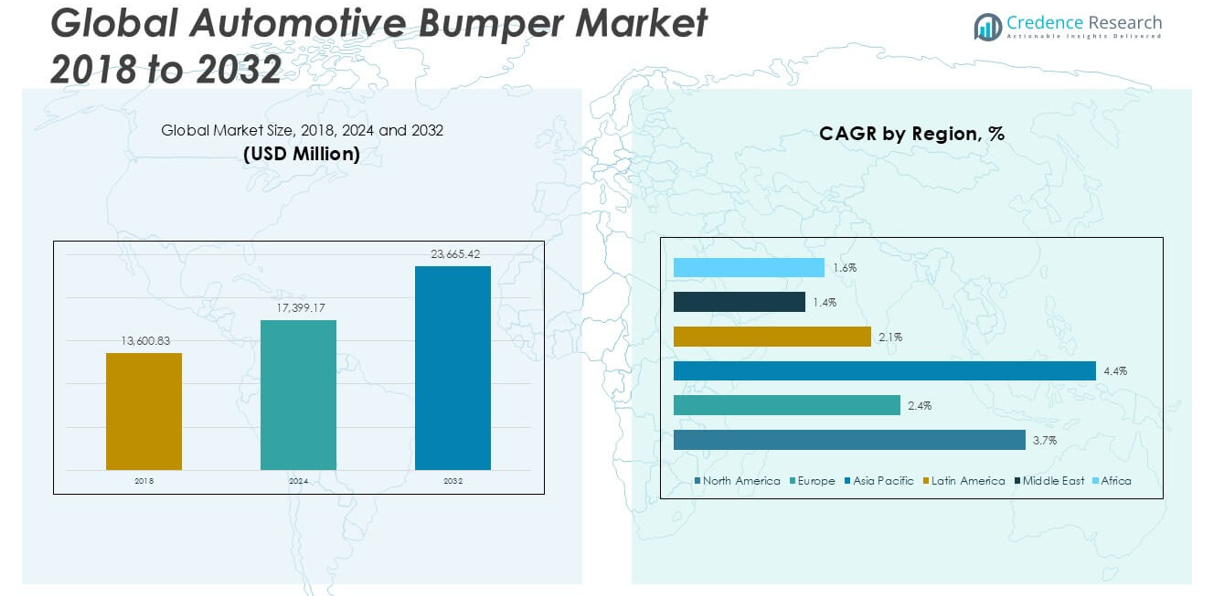
The Automotive Bumper Market size was valued at USD 13,600.83 million in 2018, increased to USD 17,399.17 million in 2024, and is anticipated to reach USD 23,665.42 million by 2032, at a CAGR of 3.65% during the forecast period.
The Automotive Bumper market is highly competitive, with key players such as Faurecia, Flex-N-Gate, Hyundai Mobis, Kirchhoff, Magna International, Montaplast, Samvardhana Motherson, Toyoda Gosei, Toyota Boshoku, and Futaba Industrial Co., Ltd. dominating the landscape. These companies focus on developing lightweight, impact-resistant bumpers with integrated safety and sensor technologies to meet evolving regulatory standards and vehicle design trends. Asia Pacific leads the global market, holding a commanding 42.3% share in 2018, driven by high vehicle production in China, India, and Japan, along with strong demand for passenger vehicles. North America and Europe follow, supported by advanced manufacturing, stringent safety regulations, and increasing adoption of electric and autonomous vehicles.
Market Insights
- The Automotive Bumper market was valued at USD 13,600.83 million in 2018, reached USD 17,399.17 million in 2024, and is projected to attain USD 23,665.42 million by 2032, growing at a CAGR of 3.65%.
- Asia Pacific dominates the market with a 42.3% share in 2018, followed by North America at 29.7% and Europe at 18.2%; by product type, standard bumpers hold the largest segment share due to their wide application across vehicle types.
- Growing global vehicle production and strict safety regulations are major drivers increasing the demand for advanced, lightweight bumpers in both passenger and commercial vehicles.
- The market is highly competitive with key players like Faurecia, Hyundai Mobis, and Magna International focusing on product innovation, lightweight materials, and partnerships with automotive OEMs.
- Volatile raw material prices and rising competition from low-cost aftermarket suppliers are key restraints that challenge sustained profitability and market growth.
Market Segmentation Analysis:
By Type
In the Automotive Bumper market, the Standard Bumper segment holds the dominant market share, driven by its widespread adoption across both passenger and commercial vehicles. Standard bumpers offer a balanced combination of cost-efficiency, durability, and compliance with safety regulations, making them the preferred choice for most automobile manufacturers. The consistent demand from mass-market and economy vehicles further strengthens the growth of this segment. Additionally, increasing safety awareness and evolving crash-test requirements continue to propel the adoption of standard bumpers across various regions, securing their leading position in the market.
- For instance, Hyundai Mobis produces over 1.5 million standard bumpers annually for its global vehicle portfolio, integrating crash-energy management systems specifically designed to meet stringent safety standards in key markets like the United States and Europe.
By Material
The Plastic bumper segment dominates the material category in the Automotive Bumper market, accounting for the largest share. Plastic bumpers are widely preferred due to their lightweight, cost-effectiveness, ease of manufacturing, and improved fuel efficiency benefits. Automotive manufacturers increasingly favor plastic bumpers to comply with stringent fuel economy standards and reduce overall vehicle weight. The flexibility and ease of molding complex designs in plastic also support modern vehicle aesthetics and aerodynamic efficiency. These factors collectively drive the dominance of the plastic bumper segment, particularly in passenger vehicles, where weight reduction is a key design objective.
- For instance, Faurecia supplies more than 2.3 million plastic bumpers annually, using advanced thermoplastic materials that reduce bumper weight by approximately 20 kilograms per vehicle, directly contributing to improved fuel efficiency and CO₂ reduction targets.
By Vehicle Type
The Passenger Vehicle segment leads the Automotive Bumper market by vehicle type, holding the highest market share. The surge in global passenger vehicle production, coupled with growing consumer demand for compact and mid-sized cars, significantly supports the dominance of this segment. Continuous innovation in bumper design, enhanced focus on vehicle safety, and aesthetic customization trends are key drivers boosting bumper demand in passenger vehicles. Furthermore, rising disposable incomes and expanding urbanization, especially in emerging economies, contribute to the sustained growth of this segment, reinforcing its leading position in the overall market.
Market Overview
Increasing Vehicle Production Globally
The rising global automotive production significantly drives the demand for automotive bumpers. As passenger and commercial vehicle manufacturing expands, particularly in emerging economies like China and India, the need for lightweight, durable, and cost-effective bumpers grows in parallel. Automotive manufacturers are increasingly focusing on safety and design integration, which further accelerates bumper adoption. The consistent growth in vehicle ownership, supported by urbanization and improving living standards, ensures steady bumper demand across original equipment manufacturers (OEMs) and aftermarket suppliers worldwide.
- For instance, Magna International manufactures approximately 4.5 million bumpers annually to meet the growing global vehicle production demands, supplying to major automakers like General Motors, Ford, and BMW across North America, Europe, and Asia.
Stringent Safety and Emission Regulations
Stringent global regulations regarding vehicle safety and emissions are compelling manufacturers to invest in advanced bumper systems. Governments across key markets, including Europe and North America, are enforcing stricter crash-test standards and pedestrian safety norms. This regulatory pressure is driving the integration of impact-absorbing materials and innovative bumper designs to enhance vehicle protection and reduce accident severity. Additionally, emission standards that demand lightweight components to improve fuel efficiency further support the shift toward modern plastic and composite bumpers.
- For instance, Toyoda Gosei has developed energy-absorbing bumpers that can withstand impact forces of up to 40 kilonewtons, specifically engineered to comply with the Euro NCAP and U.S. NHTSA safety requirements.
Growing Demand for Lightweight Materials
The automotive industry’s ongoing focus on fuel efficiency and electric vehicle (EV) range optimization is driving demand for lightweight bumper materials. Plastic, fiber, and composite bumpers are increasingly replacing traditional metal components to achieve weight reduction without compromising safety or durability. This trend aligns with manufacturers’ efforts to meet fuel economy targets and extend EV driving ranges. As vehicle electrification accelerates, lightweight bumpers play a crucial role in overall vehicle efficiency, making them a preferred choice in next-generation automotive designs.
Key Trends & Opportunities
Rising Adoption of Electric and Autonomous Vehicles
The increasing penetration of electric and autonomous vehicles presents significant opportunities for bumper manufacturers. These advanced vehicles require specialized bumper designs that can accommodate sensors, cameras, and radars essential for autonomous driving and collision avoidance systems. Lightweight, sensor-integrated bumpers are becoming a critical component in EVs and self-driving cars, offering manufacturers new avenues for technological differentiation. This trend is expected to reshape bumper design standards and fuel innovation in the coming years.
- For instance, Samvardhana Motherson has introduced smart bumpers embedded with over 15 integrated sensors and radar units per bumper to support Level 3 and Level 4 autonomous driving platforms, supplying directly to brands like Audi and Mercedes-Benz.
Advancements in Material and Manufacturing Technologies
Technological advancements in material science and bumper manufacturing processes are creating substantial growth opportunities. The development of high-strength, impact-resistant plastics and composites allows manufacturers to produce bumpers that meet both safety and aesthetic requirements. Additionally, innovations in injection molding and 3D printing are enabling cost-effective, high-precision bumper production. These advancements support greater customization, faster prototyping, and enhanced design flexibility, making it easier for manufacturers to meet diverse consumer preferences and evolving vehicle designs.
- For instance, Flex-N-Gate has implemented advanced 3D printing techniques to produce over 60,000 customized bumper prototypes per year, reducing lead times from four weeks to just five days in its North American facilities.
Key Challenges
Volatility in Raw Material Prices
Fluctuations in the prices of raw materials such as plastics, resins, and metals pose a significant challenge to bumper manufacturers. Sudden increases in material costs can directly impact production expenses and profit margins, especially in a highly competitive market. This volatility creates uncertainty in pricing strategies and supply chain management, forcing manufacturers to seek alternative sourcing options or develop cost-efficient materials to maintain their competitiveness and financial stability.
Stringent Quality and Safety Standards
Meeting evolving global quality and safety standards remains a critical challenge in the automotive bumper market. Bumper manufacturers must ensure that products comply with rigorous crashworthiness, pedestrian protection, and environmental regulations across different countries. The continuous updating of these standards requires sustained investment in research, testing, and certification processes. Failure to meet these requirements can result in costly recalls, legal liabilities, and reputational damage, making compliance a top priority for industry players.
Rising Competition from Unorganized Aftermarket
The growing presence of low-cost, unorganized aftermarket suppliers presents a major challenge for established bumper manufacturers. These suppliers often offer inexpensive bumper replacements that may not meet the same quality or safety standards, posing a threat to OEM and premium aftermarket sales. Price-sensitive customers, particularly in developing markets, frequently opt for such lower-cost alternatives. This increasing competition can erode market share and profit margins for organized players, compelling them to differentiate through quality, innovation, and brand positioning.
Regional Analysis
North America
In the Automotive Bumper market, North America accounted for a significant market share of approximately 29.7% in 2018, with a market size of USD 4,045.57 million. By 2024, the regional market expanded to USD 5,096.48 million, and it is projected to reach USD 6,960.35 million by 2032, growing at a CAGR of 3.7% during the forecast period. The market growth is primarily driven by strong vehicle production, increasing consumer demand for high-performance vehicles, and strict safety regulations in the United States and Canada, which continue to propel bumper innovation and replacement cycles in this region.
Europe
Europe held a market share of approximately 18.2% in 2018, with a market value of USD 2,480.04 million. By 2024, the market reached USD 2,994.70 million, and it is anticipated to grow to USD 3,694.59 million by 2032, at a CAGR of 2.4%. The European market is primarily driven by stringent safety norms, pedestrian protection regulations, and the presence of leading automotive manufacturers. Although growth is comparatively moderate, continuous advancements in sustainable materials and increasing adoption of electric vehicles support steady bumper demand across both OEM and aftermarket channels in the region.
Asia Pacific
Asia Pacific dominates the Automotive Bumper market with the largest market share of 42.3% in 2018, valued at USD 5,757.77 million. By 2024, the market size rose to USD 7,646.50 million, and it is forecasted to reach USD 11,054.47 million by 2032, registering the highest CAGR of 4.4%. The rapid expansion of the automotive industry in China, India, and Southeast Asia, coupled with increasing disposable incomes and urbanization, fuels bumper demand. The region benefits from high vehicle production, favorable government policies, and growing investments in electric and lightweight vehicle components.
Latin America
Latin America represented a market share of approximately 4.7% in 2018, with a market size of USD 645.36 million. By 2024, the market grew to USD 815.37 million and is expected to reach USD 982.18 million by 2032, progressing at a CAGR of 2.1%. The growth in this region is supported by the gradual recovery of the automotive sector, increasing demand for passenger cars, and expansion of manufacturing bases in countries like Brazil and Mexico. However, economic fluctuations and limited technological advancements somewhat restrain faster market penetration compared to other regions.
Middle East
The Middle East held a market share of approximately 2.7% in 2018, valued at USD 371.91 million. The market increased to USD 433.91 million by 2024 and is projected to reach USD 495.52 million by 2032, with a CAGR of 1.4%. Growth in the region is relatively slow due to limited automotive production capacities and a smaller consumer base. However, rising vehicle imports, increasing urbanization, and growing demand for luxury and sports utility vehicles contribute to moderate market expansion, particularly in the Gulf Cooperation Council (GCC) countries.
Africa
Africa captured a market share of approximately 2.2% in 2018, with a market size of USD 300.17 million. By 2024, the market grew to USD 412.20 million and is expected to reach USD 478.30 million by 2032, growing at a CAGR of 1.6%. The African market experiences gradual growth driven by rising vehicle imports, increasing infrastructure development, and the growing preference for used vehicles. However, challenges such as limited local manufacturing and high dependency on imported automotive parts continue to restrict faster growth in this region compared to more developed markets.
Market Segmentations:
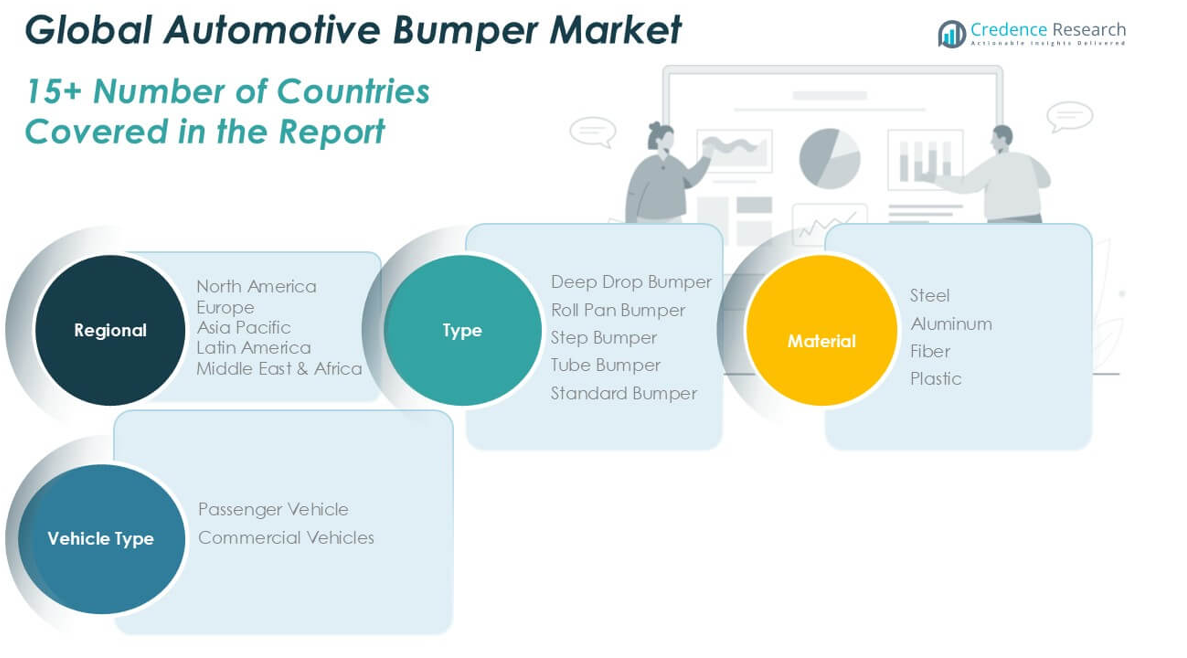
By Type
- Deep Drop Bumper
- Roll Pan Bumper
- Step Bumper
- Tube Bumper
- Standard Bumper
By Material
- Steel
- Aluminum
- Fiber
- Plastic
By Vehicle Type
- Passenger Vehicle
- Commercial Vehicles
By Geography
- North America
- U.S.
- Canada
- Mexico
- Europe
- Germany
- France
- U.K.
- Italy
- Spain
- Rest of Europe
- Asia Pacific
- China
- Japan
- India
- South Korea
- South-east Asia
- Rest of Asia Pacific
- Latin America
- Brazil
- Argentina
- Rest of Latin America
- Middle East & Africa
- GCC Countries
- South Africa
- Rest of the Middle East and Africa
Competitive Landscape
The Automotive Bumper market is highly competitive, characterized by the presence of several well-established global and regional players striving to enhance their market positions through innovation, strategic partnerships, and capacity expansion. Key companies such as Faurecia, Flex-N-Gate, Hyundai Mobis, Magna International, and Samvardhana Motherson focus on developing lightweight, durable, and technologically advanced bumpers to meet evolving safety and design standards. Many leading players are investing heavily in research and development to integrate sensors, energy-absorbing structures, and pedestrian safety features into bumper systems, particularly in response to the growing demand for electric and autonomous vehicles. Collaborations with automotive OEMs and the establishment of new manufacturing facilities in emerging markets are common strategies to strengthen global reach and reduce production costs. Additionally, companies are emphasizing sustainability by adopting recyclable materials and improving manufacturing efficiencies. The competitive landscape is further shaped by the influx of low-cost suppliers in the aftermarket, intensifying price competition across several regions.
Key Player Analysis
- Faurecia
- Flex-N-Gate
- Hyundai Mobis
- Kirchhoff
- Magna International
- Montaplast
- Samvardhana Motherson
- Toyoda Gosei
- Toyota Boshoku
- Futaba Industrial Co., Ltd.
Recent Developments
- In June 2025, Hyundai Mobis unveiled a new defensive driving technology that uses rear-side radars and cameras integrated into bumpers to help prevent rear-end collisions. This system, expected to reach the market soon, aims to autonomously adjust vehicle speed to maintain a safe distance from vehicles approaching from behind.
- In 2025, Kirchhoff is expected to continue its focus on lightweight, high-strength bumpers for original equipment manufacturers(OEMs), with a strong emphasis on integrating advanced driver-assistance systems (ADAS) sensors and meeting evolving safety regulations. This trend aligns with the broader automotive industry's push towards fuel efficiency, safety, and compliance with stricter standards.
- In 2025, Faurecia is actively developing lightweight, impact-resistant bumper systems, particularly for electric vehicles, to meet evolving safety and efficiency standards. This involves a focus on composite materials and sustainable solutions, including bio-based and recyclable plastics.
- In 2025, Montaplast is expected to remain a key player in the plastic bumper market, focusing on lightweight designs and integration with ADAS (Advanced Driver Assistance Systems) sensors, particularly for electric vehicles and premium cars. This aligns with the broader trend of increasing demand for lightweight components and the growing adoption of ADAS technology in the automotive industry.
- In Oct 2023, Flex-N-Gate acquired Eagle Wings Industries to expand its expertise in integrated bumper systems, exterior plastic components, and sheet metal fabrication for light vehicles
Market Concentration & Characteristics
The Automotive Bumper Market demonstrates moderate to high market concentration, with a few large players controlling a significant share. Companies such as Faurecia, Hyundai Mobis, and Magna International lead the competitive landscape through technological advancements and established relationships with major automotive OEMs. It is characterized by strong reliance on high-volume vehicle production and strict safety regulations that drive continuous product innovation. The market demands cost-effective, lightweight, and impact-resistant materials to meet fuel efficiency and safety standards. Rapid advancements in bumper design and the growing integration of sensors for autonomous driving contribute to its evolving product requirements. Price competition remains intense, particularly from low-cost aftermarket suppliers, which pressures profit margins for established manufacturers. Regional differences in regulatory frameworks and vehicle design preferences create diverse growth dynamics across key markets, including Asia Pacific, North America, and Europe. The Automotive Bumper Market requires high capital investment in tooling, material research, and quality assurance to meet global production standards. Supply chain efficiency, technological capability, and close partnerships with vehicle manufacturers are critical factors for success in this market.
Report Coverage
The research report offers an in-depth analysis based on Type, Material, Vehicle Type and Geography. It details leading market players, providing an overview of their business, product offerings, investments, revenue streams, and key applications. Additionally, the report includes insights into the competitive environment, SWOT analysis, current market trends, as well as the primary drivers and constraints. Furthermore, it discusses various factors that have driven market expansion in recent years. The report also explores market dynamics, regulatory scenarios, and technological advancements that are shaping the industry. It assesses the impact of external factors and global economic changes on market growth. Lastly, it provides strategic recommendations for new entrants and established companies to navigate the complexities of the market.
Future Outlook
- The demand for lightweight bumpers will continue to grow as automakers prioritize fuel efficiency and vehicle weight reduction.
- Increasing adoption of electric and autonomous vehicles will drive the need for sensor-integrated and advanced bumper designs.
- Safety regulations worldwide will push manufacturers to develop bumpers with enhanced impact absorption and pedestrian protection features.
- The use of recyclable and eco-friendly materials in bumper production is expected to become a key industry focus.
- Rapid growth in vehicle production across Asia Pacific will remain a major contributor to bumper market expansion.
- Advanced manufacturing technologies like 3D printing and injection molding will improve bumper customization and production efficiency.
- Rising demand for premium and aesthetically designed bumpers will shape future product development trends.
- The aftermarket segment will face growing competition from low-cost regional suppliers, especially in developing economies.
- Strategic partnerships between bumper manufacturers and automotive OEMs will become more common to meet specific design and safety needs.
- Volatile raw material prices and supply chain disruptions will continue to challenge manufacturers’ cost management and production planning.

Request a Free Sample
Fill in your details and we'll send you a free sample report.
- Sample data tables & charts
- Research methodology
Market Dynamics
Increasing Global Vehicle Production
The expansion of automotive manufacturing, especially in emerging economies like China and India, is directly boosting demand for bumpers as essential vehicle components. Higher vehicle ownership and urbanization further support sustained bumper sales to both OEMs and aftermarket suppliers.
Stringent Safety and Emission Regulations
Governments in key markets are enforcing stricter crash-test and pedestrian safety standards, compelling manufacturers to develop advanced, impact-absorbing bumpers. Emission regulations also drive the adoption of lightweight materials to improve fuel efficiency, increasing demand for modern bumper designs.
Rising Adoption of Lightweight Materials
Automakers are prioritizing lightweight bumpers made from plastics and composites to enhance fuel economy and extend electric vehicle range. This trend is accelerating as manufacturers seek to meet regulatory targets and consumer expectations for efficient, eco-friendly vehicles.
Growth of Electric and Autonomous Vehicles
The proliferation of electric and self-driving vehicles is creating new requirements for bumpers that integrate sensors, cameras, and radar systems. This shift is driving innovation in bumper design and opening new opportunities for technologically advanced, sensor-integrated products.
Advancements in Material and Manufacturing Technologies
Innovations in high-strength plastics, composites, and manufacturing processes like 3D printing are enabling the production of safer, lighter, and more customizable bumpers. These advancements support rapid prototyping, design flexibility, and cost-effective manufacturing, fueling market growth.
Need a Custom Version of This Report?
Tailor the scope, geography, or segments to your exact requirements.
- Custom geography or segment scope
- Direct access to our analyst team
Frequently Asked Questions
What is the current size of the Automotive Bumper Market?
What are the key segments within the Automotive Bumper Market?
What are some challenges faced by the Automotive Bumper Market?
Who are the major players in the Automotive Bumper Market?
Table of Content
Chapter 1 Market Segmentation
- 1.1 Segmentation Framework
- 1.1.1 Product and Service Classification
- 1.1.2 Application and End-Use Classification
- 1.1.3 Technology and Solution Classification
- 1.1.4 Customer and Distribution Channel Classification
- 1.1.5 Geographic Segmentation
- 1.1.6 Market Segment Definitions and Boundaries
- 1.2 By Type
- 1.2.1 Deep Drop Bumper
- 1.2.2 Roll Pan Bumper
- 1.2.3 Step Bumper
- 1.2.4 Tube Bumper
- 1.2.5 Standard Bumper
- 1.3 By Material
- 1.3.1 Steel
- 1.3.2 Aluminum
- 1.3.3 Fiber
- 1.3.4 Plastic
- 1.4 By Vehicle Type
- 1.4.1 Passenger Vehicle
- 1.4.2 Commercial Vehicles
Chapter 2 Introduction
- 2.1 Report Objectives and Scope
- 2.2 Product Definition and Industry Terminology
- 2.3 Market Inclusions and Exclusions
- 2.4 Research Process
- 2.4.1 Primary Research and Expert Interviews
- 2.4.2 Secondary Research and Source Review
- 2.4.3 Top-Down and Bottom-Up Estimation
- 2.4.4 Data Triangulation and Verification
- 2.5 Market Size Measurement Basis
- 2.5.1 2024: USD 17,399.17 million → 2032: USD 23,665.42 million
- 2.6 Historical and Forecast Reference Periods
- 2.6.1 Base Year: 2024
- 2.6.2 Forecast Period: 2024-2032
- 2.7 Research Assumptions and Limitations
Chapter 3 Executive Summary
- 3.1 Market Snapshot and Key Findings
- 3.2 Base-Year Market Size, 2024
- 3.3 Forecast Market Size, 2032
- 3.4 Revenue and Volume Growth Outlook
- 3.5 Key Demand and Supply Indicators
- 3.6 Leading Market Segments
- 3.7 Fastest-Growing Market Opportunities
- 3.8 Regional Performance Highlights
- 3.9 Technology and Industry Transformation
- 3.10 Competitive Landscape Summary
- 3.11 Analyst View and Strategic Implications
Chapter 4 Global Automotive Bumper Market Trends and Developments
- 4.1 Historical Industry Development
- 4.2 Recent Market Trends and Developments
- 4.3 Demand and Customer Behavior Trends
- 4.4 Technology and Product Innovation
- 4.5 Artificial Intelligence, Automation and Digitalization
- 4.6 Local Manufacturing and Supply Chain Realignment
- 4.7 Industry Partnerships, Mergers and Acquisitions
- 4.8 Sustainability and Circular Economy Developments
- 4.9 Government and Private Sector Investment Trends
- 4.10 Emerging Business Models and Commercialization
- 4.11 Industry Developments and Announcements
Chapter 5 Global Automotive Bumper Market Production, Supply and Demand Analysis
- 5.1 Demand Trend and Consumption Analysis
- 5.2 Demand Forecast, 2024-2032
- 5.3 Production and Output Trend
- 5.4 Production and Output Forecast, 2024-2032
- 5.5 Installed Capacity and Capacity Utilization
- 5.6 Company-Wise Production Plants and Statistics
- 5.6.1 Installed Production Capacity
- 5.6.2 Actual Production
- 5.6.3 Planned Capacity and Expansion Targets
- 5.7 Supply Chain Structure and Procurement Trends
- 5.8 Supply-Demand Gap and Bottlenecks
- 5.9 Import Dependence and Sourcing Structure
- 5.10 Contract Manufacturing and Outsourcing
- 5.11 Regional Supply and Demand Concentration
Chapter 6 Global Automotive Bumper Market Pricing Analysis
- 6.1 Pricing Structure and Measurement
- 6.2 Historical Pricing Trends
- 6.3 Pricing Outlook, 2024-2032
- 6.4 Average Selling Price and Unit Economics
- 6.5 Pricing by Product and Market Segment
- 6.6 Geographic Pricing Differences
- 6.7 Key Input, Energy, Labor and Logistics Costs
- 6.8 Contract Pricing and Purchasing Models
- 6.9 Pricing Sensitivity and Competitive Positioning
- 6.10 Price, Margin and Profitability Implications
Chapter 7 Global Automotive Bumper Market Dynamics
- 7.1 Market Growth Drivers
- 7.1.1 Demand-Side Drivers
- 7.1.2 Technology and Innovation Drivers
- 7.1.3 Infrastructure and Investment Drivers
- 7.1.4 Regulatory and Policy Drivers
- 7.2 Market Restraints
- 7.2.1 Cost and Affordability Constraints
- 7.2.2 Technology and Adoption Barriers
- 7.2.3 Supply Chain and Operational Constraints
- 7.3 Market Challenges
- 7.3.1 Competitive Pressure and Margin Erosion
- 7.3.2 Skills, Infrastructure and Implementation Gaps
- 7.4 Emerging Market Opportunities
- 7.5 Market Dynamics Impact and Time-Horizon Assessment
Chapter 8 Global Automotive Bumper Value Chain Analysis
- 8.1 Industry Value Chain Overview
- 8.2 Upstream Suppliers and Critical Inputs
- 8.3 Technology and Component Providers
- 8.4 Manufacturing or Service Delivery
- 8.5 Distribution, Channel Partners and Integrators
- 8.6 Downstream Applications and End Users
- 8.7 Value Addition and Profit Pools
- 8.8 Vertical Integration and Outsourcing
- 8.9 Supplier Concentration and Risk
- 8.10 Supply Chain Localization and Resilience
Chapter 9 Global Automotive Bumper Market Regulations and Policies
- 9.1 Relevant Laws, Standards and Compliance Frameworks
- 9.2 Product, Service, Safety and Quality Requirements
- 9.3 Government Policies, Incentives and Subsidies
- 9.4 Imports, Exports and Trade Barriers
- 9.5 Public Procurement and Local Content Requirements
- 9.6 Environmental and Sustainability Compliance
- 9.7 Upcoming Policy Changes and Market Implications
Chapter 10 Global Automotive Bumper Market Hotspots and Opportunities
- 10.1 Market Opportunity Mapping and Growth Hotspots
- 10.2 High-Growth Applications and Customer Groups
- 10.3 Underserved Markets and White-Space Opportunities
- 10.4 Emerging Technology and Product Opportunities
- 10.5 New Capacity and Investment Hotspots
- 10.6 Market Entry and Expansion Opportunities
- 10.7 Distribution and Partnership Opportunities
- 10.8 Near-Term and Long-Term Commercial Potential
- 10.9 Opportunity Attractiveness and Execution Risks
Chapter 11 Global Automotive Bumper Market Outlook, 2024-2032
- 11.1 Market Size and Analysis
- 11.1.1 Revenue (Market Measurement: 2024: USD 17,399.17 million → 2032: USD 23,665.42 million)
- 11.1.2 Market Volume and Quantity Sold
- 11.1.3 Historical Market Size
- 11.1.4 Base-Year Market Size, 2024
- 11.2 Market Forecast, 2024-2032
- 11.2.1 Revenue Forecast to 2032
- 11.2.2 Volume Forecast to 2032
- 11.2.3 CAGR and Year-on-Year Growth
- 11.2.4 Incremental Revenue Opportunity
- 11.3 Forecast Assumptions and Scenario Analysis
- 11.3.1 Base-Case Forecast
- 11.3.2 Optimistic and Conservative Scenarios
- 11.3.3 Technology, Pricing and Policy Sensitivities
- 11.4 Market Attractiveness and Growth Outlook
Chapter 12 Global Automotive Bumper Market Segmentation and Outlook
- 12.1 Segmentation Summary and Market Shares, 2024
- 12.2 Largest and Fastest-Growing Segments
- 12.3 By Type - Market Size and Forecast, 2024-2032
- 12.3.1 Segment Definition and Scope
- 12.3.2 Historical Market Size
- 12.3.3 Revenue Forecast, 2024-2032
- 12.3.4 Volume Forecast, 2024-2032
- 12.3.5 Base-Year Market Share, 2024
- 12.3.6 Segment CAGR and Growth Drivers
- 12.3.7 Subsegment Market Size and Forecast
- 12.3.7.1 Deep Drop Bumper
- 12.3.7.2 Roll Pan Bumper
- 12.3.7.3 Step Bumper
- 12.3.7.4 Tube Bumper
- 12.3.7.5 Standard Bumper
- 12.3.8 Subsegment Pricing and Adoption Trends
- 12.3.9 Leading Suppliers and Competition
- 12.3.10 Regional Demand and Opportunities
- 12.4 By Material - Market Size and Forecast, 2024-2032
- 12.4.1 Segment Definition and Scope
- 12.4.2 Historical Market Size
- 12.4.3 Revenue Forecast, 2024-2032
- 12.4.4 Volume Forecast, 2024-2032
- 12.4.5 Base-Year Market Share, 2024
- 12.4.6 Segment CAGR and Growth Drivers
- 12.4.7 Subsegment Market Size and Forecast
- 12.4.7.1 Steel
- 12.4.7.2 Aluminum
- 12.4.7.3 Fiber
- 12.4.7.4 Plastic
- 12.4.8 Subsegment Pricing and Adoption Trends
- 12.4.9 Leading Suppliers and Competition
- 12.4.10 Regional Demand and Opportunities
- 12.5 By Vehicle Type - Market Size and Forecast, 2024-2032
- 12.5.1 Segment Definition and Scope
- 12.5.2 Historical Market Size
- 12.5.3 Revenue Forecast, 2024-2032
- 12.5.4 Volume Forecast, 2024-2032
- 12.5.5 Base-Year Market Share, 2024
- 12.5.6 Segment CAGR and Growth Drivers
- 12.5.7 Subsegment Market Size and Forecast
- 12.5.7.1 Passenger Vehicle
- 12.5.7.2 Commercial Vehicles
- 12.5.8 Subsegment Pricing and Adoption Trends
- 12.5.9 Leading Suppliers and Competition
- 12.5.10 Regional Demand and Opportunities
- 12.6 Segment Growth Comparison
- 12.7 Segment Attractiveness and Priority Matrix
Chapter 13 Global Automotive Bumper Geographic Market Outlook, 2024-2032
- 13.1 Regional Market Size and Share, 2024
- 13.2 Regional Market Forecast, 2024-2032
- 13.3 Regional Pricing, Production and Demand Differences
- 13.4 North America
- 13.4.1 United States
- 13.4.2 Canada
- 13.4.3 Mexico
- 13.5 Europe
- 13.5.1 Germany
- 13.5.2 France
- 13.5.3 Italy
- 13.5.4 United Kingdom
- 13.5.5 Spain
- 13.5.6 Poland
- 13.5.7 Russia
- 13.5.8 Netherlands
- 13.5.9 Belgium
- 13.5.10 Sweden
- 13.5.11 Denmark
- 13.5.12 Norway
- 13.5.13 Rest of Europe
- 13.6 Asia Pacific
- 13.6.1 China
- 13.6.2 India
- 13.6.3 Japan
- 13.6.4 South Korea
- 13.6.5 Thailand
- 13.6.6 Indonesia
- 13.6.7 Vietnam
- 13.6.8 Malaysia
- 13.6.9 Australia
- 13.6.10 Rest of Asia Pacific
- 13.7 Latin America
- 13.7.1 Brazil
- 13.7.2 Argentina
- 13.7.3 Colombia
- 13.7.4 Chile
- 13.7.5 Rest of Latin America
- 13.8 Middle East
- 13.8.1 Saudi Arabia
- 13.8.2 United Arab Emirates
- 13.8.3 Turkey
- 13.8.4 Israel
- 13.8.5 Iran
- 13.8.6 Rest of the Middle East
- 13.9 Africa
- 13.9.1 South Africa
- 13.9.2 Egypt
- 13.9.3 Nigeria
- 13.9.4 Morocco
- 13.9.5 Rest of Africa
- 13.10 Regional Investment, Policy and Supply Chain Differences
- 13.11 Regional Competitive Landscape
- 13.12 Geographic Growth Hotspots
Chapter 14 Global Automotive Bumper Technology, Innovation and Sustainability Outlook
- 14.1 Technology Landscape and Maturity
- 14.2 Product, Process and Service Innovation
- 14.3 AI, Automation and Digital Tools in the Industry
- 14.4 Technology Adoption and Performance Benchmarking
- 14.5 Innovation Pipeline and R&D Investment
- 14.6 Patent and Intellectual Property Trends
- 14.7 Energy Efficiency and Resource Management
- 14.8 Sustainability, Recycling and Circularity
- 14.9 Technology Roadmap, 2024-2032
- 14.10 Risks of Obsolescence and Technology Substitution
Chapter 15 Global Automotive Bumper Market Key Strategic Imperatives
- 15.1 Growth and Market Entry Priorities
- 15.2 High-Return Products and Segments
- 15.3 Pricing, Profitability and Cost Optimization
- 15.4 Technology Investment and Product Differentiation
- 15.5 Supply Chain Localization and Resilience
- 15.6 Distribution and Customer Acquisition
- 15.7 Partnership, Acquisition and Capacity Strategy
- 15.8 Regional Expansion Priorities
- 15.9 Short-, Medium- and Long-Term Actions
Chapter 16 Competition Outlook
- 16.1 Industry Competition Characteristics
- 16.2 Market Structure and Concentration
- 16.3 Market Share and Competitive Positioning, 2024
- 16.4 Company-Wise Revenue and Product Benchmarking
- 16.5 Production and Service Capacity Benchmarking
- 16.6 Technology, Pricing and Differentiation
- 16.7 Regional Footprint and Distribution Strength
- 16.8 Mergers, Acquisitions and Strategic Alliances
- 16.9 New Entrants and Competitive Threats
- 16.10 Porter's Five Forces and Industry Attractiveness
- 16.11 Competitive Outlook, 2024-2032
Chapter 17 Company Profiles
- 17.1 Company Coverage and Selection Criteria
- 17.2 Faurecia
- 17.2.1 Business Description
- 17.2.2 Company Ownership and Geographic Presence
- 17.2.3 Product and Service Portfolio
- 17.2.4 Manufacturing and Operating Footprint
- 17.2.5 Production Capacity and Expansion Plans
- 17.2.6 Financial Performance and Investment
- 17.2.7 Market Share and Competitive Position
- 17.2.8 Technology and Innovation Capabilities
- 17.2.9 Strategic Alliances or Partnerships
- 17.2.10 Recent Developments
- 17.2.11 Growth Strategy and Outlook
- 17.3 Flex-N-Gate
- 17.4 Hyundai Mobis
- 17.5 Kirchhoff
- 17.6 Magna International
- 17.7 Montaplast
- 17.8 Samvardhana Motherson
- 17.9 Toyoda Gosei
- 17.10 Toyota Boshoku
- 17.11 Futaba Industrial Co., Ltd.
- 17.12 Other Relevant Market Participants
Note: Every listed company is profiled on the structure shown under the first company. The company list is preliminary and may change based on research findings, market developments, data availability and client requirements.
Chapter 18 Disclaimer
- 18.1 Research and Forecast Disclaimer
- 18.2 Data Source and Estimation Limitations
Note: The depth of individual sections depends on data availability for this market. Volume, capacity, trade and other unit-based metrics are included where applicable.