
Market Overviews
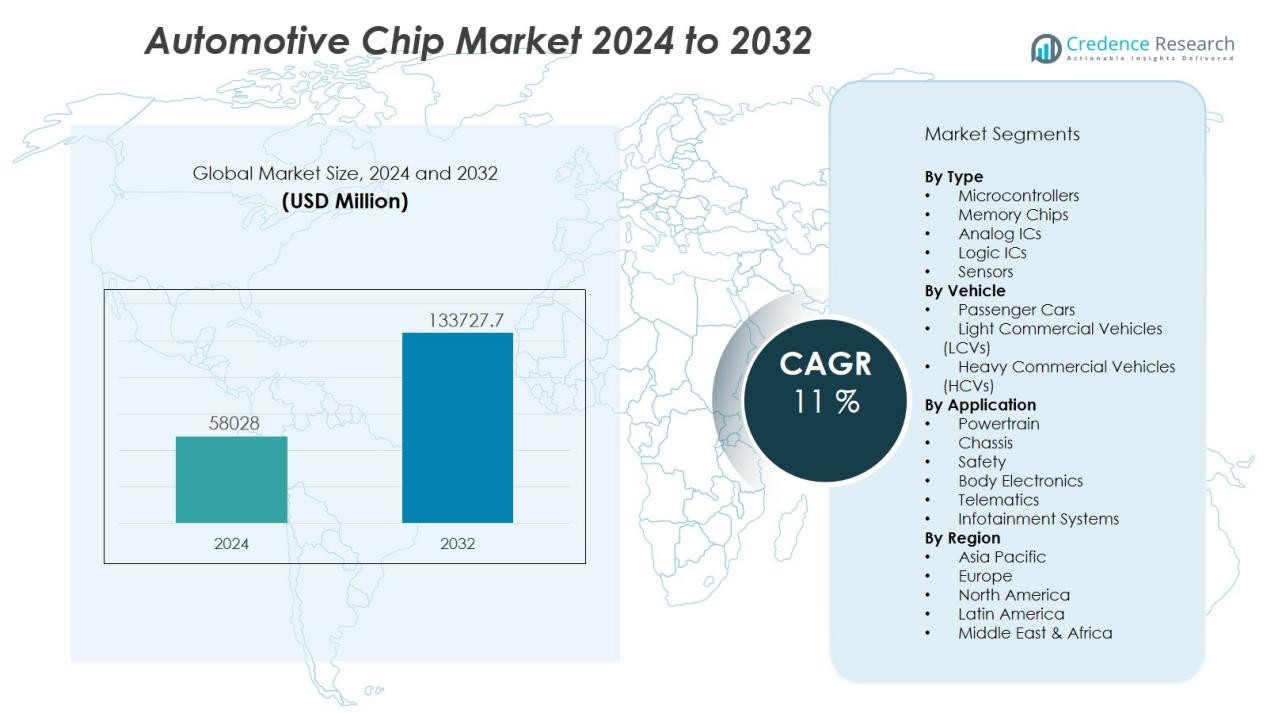
The automotive chip market size was valued at USD 58028 million in 2024 and is anticipated to reach USD 133727.7 million by 2032, at a CAGR of 11 % during the forecast period (2024-2032).
| REPORT ATTRIBUTE | DETAILS |
|---|---|
| Historical Period | 2020-2024 |
| Base Year | 2024 |
| Forecast Period | 2025-2032 |
| Automotive Chip Market Size 2024 | USD 58028 Million |
| Automotive Chip Market, CAGR | 11 % |
| Automotive Chip Market Size 2032 | USD 133727.7 Million |
Market growth is driven by the rising demand for intelligent mobility solutions, stringent government regulations on vehicle safety, and the shift toward energy-efficient transportation. The proliferation of ADAS (Advanced Driver Assistance Systems), vehicle-to-everything (V2X) communication, and connected car technologies is boosting the need for high-performance automotive chips. Furthermore, advancements in semiconductor manufacturing, including smaller process nodes and higher integration capabilities, are enabling more powerful and efficient solutions for both traditional and emerging automotive applications.
Regionally, Asia-Pacific dominates the automotive chip market due to its strong automotive manufacturing base in countries such as China, Japan, and South Korea, coupled with rapid EV adoption. North America holds a significant share, supported by technological leadership and R&D investments in autonomous and connected vehicle systems. Europe remains a key market driven by premium car manufacturers, stringent emission standards, and robust safety regulations.
Market Insights:
- The automotive chip market was valued at USD 58,028 million in 2024 and is projected to reach USD 133,727.7 million by 2032, driven by rapid technological integration in vehicles.
- Rising adoption of ADAS and semi-autonomous driving features increases demand for high-performance chips capable of real-time data processing and sensor fusion.
- Electrification of the automotive industry fuels the need for advanced power management, battery monitoring, and drivetrain control semiconductors.
- Growth in connected vehicle technologies, including 5G, V2X communication, and high-resolution infotainment systems, boosts semiconductor innovation.
- Global supply chain disruptions and semiconductor shortages continue to challenge production timelines and inventory stability.
- Asia-Pacific leads with a 49% market share due to its strong manufacturing base, high EV adoption, and significant investment in chip fabrication.
- North America and Europe remain key markets, supported by advanced R&D capabilities, stringent safety regulations, and strong adoption of connected and electrified vehicle technologies.
Market Drivers:
Rising Demand for Advanced Driver Assistance Systems (ADAS) and Autonomous Features:
The automotive chip market benefits from the growing integration of ADAS and semi-autonomous functionalities across vehicle segments. Consumers and regulators are prioritizing enhanced safety, pushing manufacturers to adopt high-performance chips for real-time data processing and sensor fusion. It enables functions such as lane-keeping assist, adaptive cruise control, and collision avoidance. Increased affordability of these systems in mass-market vehicles accelerates adoption. The push toward higher levels of autonomy continues to expand semiconductor content per vehicle.
- For instance, Bosch has developed and commercially introduced a radar sensor with RF CMOS technology at 22-nanometer transistor size, integrating high-frequency and digital circuits on a single chip, enabling efficient ADAS functions.
Electrification of the Automotive Industry and Growth of Electric Vehicles (EVs):
The transition to electric mobility significantly boosts the demand for automotive chips. It requires advanced power management, battery monitoring, and thermal control solutions to ensure efficiency and safety in EVs. Semiconductor components play a crucial role in electric drivetrain control and charging infrastructure compatibility. The automotive chip market experiences heightened demand from leading EV manufacturers and emerging players. Expanding charging networks and supportive policies further strengthen this trend.
- For instance, NXP’s BMx7318 series 18-channel Li-ion battery cell controller ICs have shipped over 1 million units to Chevrolet Bolt EV battery packs as of July 2025.
Proliferation of Connected Vehicle Technologies and In-Vehicle Infotainment:
Connectivity has become a central feature in modern vehicles, driving the need for robust processing capabilities. It supports infotainment systems, navigation, real-time traffic updates, and over-the-air software upgrades. The automotive chip market sees growth from integrating 5G, V2X communication, and high-resolution displays into vehicles. Strong consumer expectations for seamless digital experiences influence automakers to invest in advanced semiconductor solutions. This convergence of automotive and consumer electronics accelerates innovation in chip design.
Regulatory Pressure for Safety, Emissions, and Energy Efficiency:
Governments worldwide are imposing stricter regulations on vehicle safety and environmental performance. It drives automakers to incorporate semiconductor-based solutions for compliance and competitive advantage. The automotive chip market benefits from demand for sensors, microcontrollers, and processors that enable low-emission powertrains and predictive maintenance. Enhanced monitoring of vehicle systems helps meet regulatory standards while improving reliability. This alignment between policy objectives and technological advancement sustains long-term market growth.
Market Trends:
Integration of Artificial Intelligence (AI) and Machine Learning in Automotive Semiconductors:
The automotive chip market is witnessing rapid adoption of AI and machine learning capabilities to enhance vehicle intelligence and automation. It enables real-time decision-making in autonomous driving, predictive maintenance, and advanced safety systems. AI-powered chips are supporting complex data processing from multiple sensors, cameras, and LiDAR units, improving accuracy and responsiveness. Automakers are investing in AI-driven semiconductor platforms to differentiate products and meet evolving consumer expectations. The trend extends to optimizing energy consumption and improving battery management in EVs. Semiconductor companies are collaborating with automotive OEMs to develop custom AI accelerators tailored for specific applications, driving innovation in chip architectures.
- For instance, Tesla’s AI6 chip, built on a 3nm process featuring eight tensor cores and 5 exaflops of mixed-precision performance, powers Full Self-Driving (FSD) systems and Optimus robots, showcasing a significant leap in vertical integration and AI coherence across applications with a cost efficiency of $80 per unit.
Shift Toward System-on-Chip (SoC) Designs and Advanced Packaging Technologies:
Vehicle electronics are becoming more compact, efficient, and multifunctional, driving the shift toward SoC-based solutions in the automotive chip market. It consolidates multiple functions-such as infotainment, safety, and connectivity-onto a single chip, reducing space, weight, and cost. Advanced packaging methods, including 3D stacking and chiplet architectures, are improving performance and thermal efficiency. These innovations address the growing demand for high-performance computing in vehicles without compromising reliability. The adoption of SoCs aligns with the push for modular and scalable electronic control units (ECUs), enabling faster design cycles and easier software updates. This integration trend supports the move toward centralized vehicle computing, which simplifies architecture and enhances overall vehicle performance.
- For instance, NXP’s S32G3 SoC integrates four Arm Cortex-A53 cores running at up to 1.5 GHz alongside dual real-time Cortex-M7 cores, all in a single package with 10 Gbps Time-Sensitive Networking (TSN) support for in-vehicle Ethernet.
Market Challenges Analysis:
Supply Chain Disruptions and Semiconductor Shortages:
The automotive chip market continues to face challenges from global semiconductor supply constraints. It experiences production delays due to limited wafer fabrication capacity and disruptions in raw material availability. Geopolitical tensions, natural disasters, and logistical bottlenecks further strain the supply chain. Automakers are forced to prioritize high-margin models or delay new launches, impacting overall market growth. The cyclical nature of semiconductor demand complicates inventory planning for both chipmakers and vehicle manufacturers. Long lead times and dependency on a few foundries heighten the risk of production halts.
Rising Complexity and Cost of Advanced Chip Development:
The shift toward autonomous driving, electrification, and connected vehicles demands high-performance semiconductors with advanced design features. It increases development costs, testing requirements, and time-to-market for new chip architectures. Smaller process nodes and specialized functionalities require substantial R&D investment. The automotive chip market faces the added challenge of meeting stringent automotive-grade safety and reliability standards, which lengthen product qualification cycles. Compliance with multiple regional regulations adds complexity to design and manufacturing processes. These factors create barriers for new entrants and pressure existing players to continuously innovate while maintaining cost competitiveness.
Market Opportunities:
Expansion of Electric and Autonomous Vehicle Segments:
The automotive chip market holds significant growth potential from the accelerating shift toward electric and autonomous vehicles. It benefits from the increasing semiconductor content required for power electronics, battery management systems, and advanced driver assistance features. High-performance chips enable efficient energy conversion, predictive safety measures, and real-time navigation capabilities. Growing government incentives and infrastructure development for EV adoption create a favorable business environment. The rise of Level 3 and above autonomy expands demand for specialized processors, AI accelerators, and sensor fusion technologies. This segment presents long-term opportunities for both established players and innovative startups.
Adoption of Connected Mobility and Over-the-Air (OTA) Upgrades:
The surge in connected vehicle solutions opens new revenue streams for the automotive chip market. It supports in-vehicle infotainment, telematics, predictive maintenance, and fleet management applications. Integration of 5G connectivity, V2X communication, and cloud-based platforms increases the need for high-speed, secure semiconductors. Automakers are focusing on OTA software updates to enhance performance and add new features without physical intervention. This trend drives demand for chips with robust processing power, cybersecurity capabilities, and scalability. The growing ecosystem of connected mobility services creates opportunities for continuous innovation in chip design and functionality.
Market Segmentation Analysis:
By Type:
The automotive chip market includes segments such as microcontrollers, memory chips, analog ICs, logic ICs, and sensors. Microcontrollers hold a significant share due to their role in controlling various electronic systems within vehicles. Memory chips support data storage for infotainment, navigation, and advanced safety features. Analog ICs enable power management and signal processing, while sensors are essential for ADAS, autonomous driving, and environmental monitoring. It continues to see innovation in integrated solutions that combine multiple functions for efficiency and performance gains.
- For instance, NXP Semiconductors offers a 32-bit high-performance microcontroller optimized for radar signal processing that supports up to ASIL D radar applications, combining microcontroller and DSP features to deliver efficient real-time control and safety.
By Vehicle:
This market serves passenger cars, light commercial vehicles (LCVs), and heavy commercial vehicles (HCVs). Passenger cars represent the largest demand, driven by the integration of infotainment, connectivity, and safety systems across all price segments. LCVs are adopting advanced electronics to improve efficiency, navigation, and driver safety. HCVs require durable, high-performance chips for telematics, fleet management, and load monitoring. It experiences rising demand from electric vehicles across all categories, boosting semiconductor content per unit.
- For instance, Volvo Cars’ next-generation XC90 SPA2 uses the NVIDIA DRIVE Orin SoC delivering 254 TOPS of AI compute performance for Level 2+ autonomous and intelligent cockpit functions in production models.
By Application:
Applications span powertrain, chassis, safety, body electronics, telematics, and infotainment systems. Powertrain applications require chips for engine control, battery management, and energy optimization. Safety systems depend on advanced processors and sensors for collision prevention and stability control. Body electronics include lighting, HVAC, and comfort features, while infotainment and telematics demand high-speed processors for connectivity and entertainment. It benefits from the growing convergence of safety, performance, and user experience in modern vehicles.
Segmentations:
By Type:
- Microcontrollers
- Memory Chips
- Analog ICs
- Logic ICs
- Sensors
By Vehicle:
- Passenger Cars
- Light Commercial Vehicles (LCVs)
- Heavy Commercial Vehicles (HCVs)
By Application:
- Powertrain
- Chassis
- Safety
- Body Electronics
- Telematics
- Infotainment Systems
By Region:
- Asia-Pacific
- North America
- Europe
- Latin America
- Middle East & Africa
Regional Analysis:
Asia-Pacific :
Asia-Pacific holds a market share of 49% in the automotive chip market, driven by its dominant position in global vehicle and semiconductor manufacturing. China, Japan, and South Korea lead production capacity, supported by established supply chains and rapid technological adoption. It benefits from high EV penetration, strong government incentives, and rising demand for advanced safety systems. Local semiconductor companies collaborate with global players to meet the increasing requirements for high-performance chips. The region’s focus on smart mobility and autonomous driving accelerates innovation in chip design. Continuous investment in fabrication plants strengthens its competitive advantage in both domestic and export markets.
North America :
North America accounts for a market share of 27% in the automotive chip market, supported by its expertise in advanced semiconductor design and integration. The United States leads innovation in autonomous vehicle platforms, AI-driven systems, and EV technologies. It benefits from strong collaborations between automakers, technology firms, and semiconductor manufacturers. The region’s robust regulatory framework for safety and emissions drives adoption of cutting-edge electronics in vehicles. Expansion of EV charging infrastructure and government-backed incentives enhances market demand. Strong venture capital support fuels the growth of startups specializing in automotive-grade semiconductor solutions.
Europe :
Europe holds a market share of 18% in the automotive chip market, driven by its premium car manufacturers and strict regulatory standards. Germany, France, and the United Kingdom lead adoption of advanced driver assistance, connectivity, and electrification technologies. It focuses heavily on meeting sustainability targets, which promotes integration of efficient semiconductor solutions in low-emission vehicles. Collaborations between OEMs and chipmakers aim to optimize performance and compliance. The region’s commitment to autonomous driving research further supports long-term demand. Strong investment in local semiconductor production capacity reduces dependency on external suppliers and strengthens supply chain resilience.
Key Player Analysis:
- Qualcomm Technologies, Inc.
- Infineon Technologies AG
- Renesas Electronics Corporation
- STMicroelectronics
- NXP Semiconductors
- Texas Instruments Incorporated
- Broadcom
- Intel Corporation
- Micron Technology, Inc.
- ROHM CO., LTD
Competitive Analysis:
The automotive chip market is highly competitive, with established semiconductor manufacturers leveraging technology leadership and strong industry partnerships to secure market share. Key players include Qualcomm Technologies, Inc., Infineon Technologies AG, Renesas Electronics Corporation, STMicroelectronics, NXP Semiconductors, Texas Instruments Incorporated, and Broadcom. It is driven by continuous innovation in AI integration, advanced packaging, and system-on-chip designs to meet evolving automotive requirements. Companies focus on expanding product portfolios to address applications in ADAS, electrification, connectivity, and infotainment. Strategic collaborations with automakers and Tier 1 suppliers enhance customization and speed to market. Investment in manufacturing capacity, supply chain resilience, and compliance with stringent automotive-grade standards remains a priority. Competitive differentiation is shaped by performance, reliability, scalability, and cost efficiency of semiconductor solutions tailored for diverse vehicle platforms
Market Concentration & Characteristics:
The automotive chip market is moderately concentrated, with a mix of global semiconductor leaders and specialized automotive-focused suppliers holding significant competitive positions. It is characterized by high entry barriers due to complex design requirements, stringent automotive-grade certifications, and substantial R&D investment needs. Leading companies leverage strong partnerships with automakers to deliver customized, high-performance solutions for safety, electrification, and connectivity applications. The market exhibits long product development cycles and rigorous testing to ensure reliability under extreme operating conditions. Technological innovation, such as AI integration, advanced packaging, and system-on-chip architectures, shapes competitive differentiation. Supply chain resilience, vertical integration, and manufacturing capacity expansion remain critical factors influencing market leadership.
Report Coverage:
The research report offers an in-depth analysis based on Type, Vehicle, Application and Region. It details leading Market players, providing an overview of their business, product offerings, investments, revenue streams, and key applications. Additionally, the report includes insights into the competitive environment, SWOT analysis, current Market trends, as well as the primary drivers and constraints. Furthermore, it discusses various factors that have driven Market expansion in recent years. The report also explores Market dynamics, regulatory scenarios, and technological advancements that are shaping the industry. It assesses the impact of external factors and global economic changes on Market growth. Lastly, it provides strategic recommendations for new entrants and established companies to navigate the complexities of the Market.
Future Outlook:
- Increasing adoption of autonomous and semi-autonomous driving features will drive demand for high-performance AI-enabled automotive chips.
- Expansion of electric vehicle production will boost the need for advanced power management, battery monitoring, and energy efficiency solutions.
- Integration of 5G and V2X communication will enhance connectivity and require chips with faster processing speeds and low-latency performance.
- Growing consumer demand for advanced infotainment systems will spur innovation in multimedia and high-resolution display processing chips.
- Advancements in system-on-chip architectures will enable compact, multifunctional solutions that reduce cost and improve vehicle design flexibility.
- Development of automotive-grade chips with enhanced cybersecurity features will gain priority to safeguard connected vehicle ecosystems.
- Increased localization of semiconductor manufacturing will improve supply chain stability and reduce dependency on limited global foundry capacity.
- Rising demand for over-the-air software updates will encourage the adoption of scalable, upgrade-ready chip platforms.
- Collaboration between automakers and semiconductor companies will accelerate customized chip development tailored to specific vehicle platforms.
- Focus on sustainable and energy-efficient semiconductor production processes will align with global environmental regulations and corporate ESG goals.

Request a Free Sample
Fill in your details and we'll send you a free sample report.
- Sample data tables & charts
- Research methodology
Market Dynamics
Integration of Advanced Driver Assistance Systems (ADAS) and Autonomous Features
Automotive manufacturers are increasingly incorporating ADAS and semi-autonomous driving technologies, which require high-performance chips for real-time data processing, sensor fusion, and safety-critical functions. This trend is expanding semiconductor content per vehicle and accelerating market growth.
Electrification and Growth of Electric Vehicles (EVs)
The shift toward electric mobility is driving demand for advanced power management, battery monitoring, and drivetrain control chips. As EV adoption rises globally, the need for specialized semiconductors to ensure efficiency, safety, and compatibility with charging infrastructure is significantly boosting the market.
Proliferation of Connected Vehicle Technologies
The integration of 5G, V2X communication, and high-resolution infotainment systems in vehicles is increasing the need for robust, high-speed automotive chips. Consumer expectations for seamless connectivity and digital experiences are pushing automakers to adopt innovative semiconductor solutions.
Stringent Safety, Emissions, and Energy Efficiency Regulations
Governments worldwide are enforcing stricter vehicle safety and environmental standards, compelling automakers to use advanced chips for compliance. This regulatory pressure is driving the adoption of sensors, microcontrollers, and processors that enable low-emission powertrains and predictive maintenance.
Advancements in Semiconductor Manufacturing and System-on-Chip (SoC) Designs
Progress in semiconductor process nodes, integration capabilities, and SoC architectures is enabling more powerful, compact, and energy-efficient automotive chips. These technological advancements support the increasing complexity of vehicle electronics and facilitate the development of multifunctional, scalable solutions.
Need a Custom Version of This Report?
Tailor the scope, geography, or segments to your exact requirements.
- Custom geography or segment scope
- Direct access to our analyst team
Frequently Asked Questions
What is the current market size for the automotive chip market, and what is its projected size in 2032?
At what Compound Annual Growth Rate is the automotive chip market projected to grow between 2024 and 2032?
Which automotive chip market segment held the largest share in 2024?
What are the primary factors fueling the growth of the automotive chip market?
Who are the leading companies in the automotive chip market?
Which region commanded the largest share of the automotive chip market in 2024?
Table of Content
Chapter 1 Market Segmentation
- 1.1 Segmentation Framework
- 1.1.1 Product and Service Classification
- 1.1.2 Application and End-Use Classification
- 1.1.3 Technology and Solution Classification
- 1.1.4 Customer and Distribution Channel Classification
- 1.1.5 Geographic Segmentation
- 1.1.6 Market Segment Definitions and Boundaries
- 1.2 By Type
- 1.2.1 Microcontrollers
- 1.2.2 Memory Chips
- 1.2.3 Analog ICs
- 1.2.4 Logic ICs
- 1.2.5 Sensors
- 1.3 By Vehicle
- 1.3.1 Passenger Cars
- 1.3.2 Light Commercial Vehicles (LCVs)
- 1.3.3 Heavy Commercial Vehicles (HCVs)
- 1.4 By Application
- 1.4.1 Powertrain
- 1.4.2 Chassis
- 1.4.3 Safety
- 1.4.4 Body Electronics
- 1.4.5 Telematics
- 1.4.6 Infotainment Systems
Chapter 2 Introduction
- 2.1 Report Objectives and Scope
- 2.2 Product Definition and Industry Terminology
- 2.3 Market Inclusions and Exclusions
- 2.4 Research Process
- 2.4.1 Primary Research and Expert Interviews
- 2.4.2 Secondary Research and Source Review
- 2.4.3 Top-Down and Bottom-Up Estimation
- 2.4.4 Data Triangulation and Verification
- 2.5 Market Size Measurement Basis
- 2.5.1 2024: USD 58,028 million → 2032: USD 133,727.7 million
- 2.6 Historical and Forecast Reference Periods
- 2.6.1 Base Year: 2024
- 2.6.2 Forecast Period: 2024-2032
- 2.7 Research Assumptions and Limitations
Chapter 3 Executive Summary
- 3.1 Market Snapshot and Key Findings
- 3.2 Base-Year Market Size, 2024
- 3.3 Forecast Market Size, 2032
- 3.4 Revenue and Volume Growth Outlook
- 3.5 Key Demand and Supply Indicators
- 3.6 Leading Market Segments
- 3.7 Fastest-Growing Market Opportunities
- 3.8 Regional Performance Highlights
- 3.9 Technology and Industry Transformation
- 3.10 Competitive Landscape Summary
- 3.11 Analyst View and Strategic Implications
Chapter 4 Global Automotive Chip Market Trends and Developments
- 4.1 Historical Industry Development
- 4.2 Recent Market Trends and Developments
- 4.3 Demand and Customer Behavior Trends
- 4.4 Technology and Product Innovation
- 4.5 Artificial Intelligence, Automation and Digitalization
- 4.6 Local Manufacturing and Supply Chain Realignment
- 4.7 Industry Partnerships, Mergers and Acquisitions
- 4.8 Sustainability and Circular Economy Developments
- 4.9 Government and Private Sector Investment Trends
- 4.10 Emerging Business Models and Commercialization
- 4.11 Industry Developments and Announcements
Chapter 5 Global Automotive Chip Market Production, Supply and Demand Analysis
- 5.1 Demand Trend and Consumption Analysis
- 5.2 Demand Forecast, 2024-2032
- 5.3 Production and Output Trend
- 5.4 Production and Output Forecast, 2024-2032
- 5.5 Installed Capacity and Capacity Utilization
- 5.6 Company-Wise Production Plants and Statistics
- 5.6.1 Installed Production Capacity
- 5.6.2 Actual Production
- 5.6.3 Planned Capacity and Expansion Targets
- 5.7 Supply Chain Structure and Procurement Trends
- 5.8 Supply-Demand Gap and Bottlenecks
- 5.9 Import Dependence and Sourcing Structure
- 5.10 Contract Manufacturing and Outsourcing
- 5.11 Regional Supply and Demand Concentration
Chapter 6 Global Automotive Chip Market Pricing Analysis
- 6.1 Pricing Structure and Measurement
- 6.2 Historical Pricing Trends
- 6.3 Pricing Outlook, 2024-2032
- 6.4 Average Selling Price and Unit Economics
- 6.5 Pricing by Product and Market Segment
- 6.6 Geographic Pricing Differences
- 6.7 Key Input, Energy, Labor and Logistics Costs
- 6.8 Contract Pricing and Purchasing Models
- 6.9 Pricing Sensitivity and Competitive Positioning
- 6.10 Price, Margin and Profitability Implications
Chapter 7 Global Automotive Chip Market Dynamics
- 7.1 Market Growth Drivers
- 7.1.1 Demand-Side Drivers
- 7.1.2 Technology and Innovation Drivers
- 7.1.3 Infrastructure and Investment Drivers
- 7.1.4 Regulatory and Policy Drivers
- 7.2 Market Restraints
- 7.2.1 Cost and Affordability Constraints
- 7.2.2 Technology and Adoption Barriers
- 7.2.3 Supply Chain and Operational Constraints
- 7.3 Market Challenges
- 7.3.1 Competitive Pressure and Margin Erosion
- 7.3.2 Skills, Infrastructure and Implementation Gaps
- 7.4 Emerging Market Opportunities
- 7.5 Market Dynamics Impact and Time-Horizon Assessment
Chapter 8 Global Automotive Chip Value Chain Analysis
- 8.1 Industry Value Chain Overview
- 8.2 Upstream Suppliers and Critical Inputs
- 8.3 Technology and Component Providers
- 8.4 Manufacturing or Service Delivery
- 8.5 Distribution, Channel Partners and Integrators
- 8.6 Downstream Applications and End Users
- 8.7 Value Addition and Profit Pools
- 8.8 Vertical Integration and Outsourcing
- 8.9 Supplier Concentration and Risk
- 8.10 Supply Chain Localization and Resilience
Chapter 9 Global Automotive Chip Market Regulations and Policies
- 9.1 Relevant Laws, Standards and Compliance Frameworks
- 9.2 Product, Service, Safety and Quality Requirements
- 9.3 Government Policies, Incentives and Subsidies
- 9.4 Imports, Exports and Trade Barriers
- 9.5 Public Procurement and Local Content Requirements
- 9.6 Environmental and Sustainability Compliance
- 9.7 Upcoming Policy Changes and Market Implications
Chapter 10 Global Automotive Chip Market Hotspots and Opportunities
- 10.1 Market Opportunity Mapping and Growth Hotspots
- 10.2 High-Growth Applications and Customer Groups
- 10.3 Underserved Markets and White-Space Opportunities
- 10.4 Emerging Technology and Product Opportunities
- 10.5 New Capacity and Investment Hotspots
- 10.6 Market Entry and Expansion Opportunities
- 10.7 Distribution and Partnership Opportunities
- 10.8 Near-Term and Long-Term Commercial Potential
- 10.9 Opportunity Attractiveness and Execution Risks
Chapter 11 Global Automotive Chip Market Outlook, 2024-2032
- 11.1 Market Size and Analysis
- 11.1.1 Revenue (Market Measurement: 2024: USD 58,028 million → 2032: USD 133,727.7 million)
- 11.1.2 Market Volume and Quantity Sold
- 11.1.3 Historical Market Size
- 11.1.4 Base-Year Market Size, 2024
- 11.2 Market Forecast, 2024-2032
- 11.2.1 Revenue Forecast to 2032
- 11.2.2 Volume Forecast to 2032
- 11.2.3 CAGR and Year-on-Year Growth
- 11.2.4 Incremental Revenue Opportunity
- 11.3 Forecast Assumptions and Scenario Analysis
- 11.3.1 Base-Case Forecast
- 11.3.2 Optimistic and Conservative Scenarios
- 11.3.3 Technology, Pricing and Policy Sensitivities
- 11.4 Market Attractiveness and Growth Outlook
Chapter 12 Global Automotive Chip Market Segmentation and Outlook
- 12.1 Segmentation Summary and Market Shares, 2024
- 12.2 Largest and Fastest-Growing Segments
- 12.3 By Type - Market Size and Forecast, 2024-2032
- 12.3.1 Segment Definition and Scope
- 12.3.2 Historical Market Size
- 12.3.3 Revenue Forecast, 2024-2032
- 12.3.4 Volume Forecast, 2024-2032
- 12.3.5 Base-Year Market Share, 2024
- 12.3.6 Segment CAGR and Growth Drivers
- 12.3.7 Subsegment Market Size and Forecast
- 12.3.7.1 Microcontrollers
- 12.3.7.2 Memory Chips
- 12.3.7.3 Analog ICs
- 12.3.7.4 Logic ICs
- 12.3.7.5 Sensors
- 12.3.8 Subsegment Pricing and Adoption Trends
- 12.3.9 Leading Suppliers and Competition
- 12.3.10 Regional Demand and Opportunities
- 12.4 By Vehicle - Market Size and Forecast, 2024-2032
- 12.4.1 Segment Definition and Scope
- 12.4.2 Historical Market Size
- 12.4.3 Revenue Forecast, 2024-2032
- 12.4.4 Volume Forecast, 2024-2032
- 12.4.5 Base-Year Market Share, 2024
- 12.4.6 Segment CAGR and Growth Drivers
- 12.4.7 Subsegment Market Size and Forecast
- 12.4.7.1 Passenger Cars
- 12.4.7.2 Light Commercial Vehicles (LCVs)
- 12.4.7.3 Heavy Commercial Vehicles (HCVs)
- 12.4.8 Subsegment Pricing and Adoption Trends
- 12.4.9 Leading Suppliers and Competition
- 12.4.10 Regional Demand and Opportunities
- 12.5 By Application - Market Size and Forecast, 2024-2032
- 12.5.1 Segment Definition and Scope
- 12.5.2 Historical Market Size
- 12.5.3 Revenue Forecast, 2024-2032
- 12.5.4 Volume Forecast, 2024-2032
- 12.5.5 Base-Year Market Share, 2024
- 12.5.6 Segment CAGR and Growth Drivers
- 12.5.7 Subsegment Market Size and Forecast
- 12.5.7.1 Powertrain
- 12.5.7.2 Chassis
- 12.5.7.3 Safety
- 12.5.7.4 Body Electronics
- 12.5.7.5 Telematics
- 12.5.7.6 Infotainment Systems
- 12.5.8 Subsegment Pricing and Adoption Trends
- 12.5.9 Leading Suppliers and Competition
- 12.5.10 Regional Demand and Opportunities
- 12.6 Segment Growth Comparison
- 12.7 Segment Attractiveness and Priority Matrix
Chapter 13 Global Automotive Chip End-Use and Application Market Outlook
- 13.1 End-Use Industry and Customer Demand Structure
- 13.2 Leading Applications and Customer Groups
- 13.3 End-Use Market Size, Share and Forecast
- 13.4 Major End-Use Industry Deep Dives
- 13.4.1 Customer Requirements and Use Cases
- 13.4.2 Demand and Replacement Cycles
- 13.4.3 Technical and Regulatory Considerations
- 13.4.4 Purchasing and Procurement Models
- 13.4.5 Leading Vendors and Distribution Channels
- 13.4.6 Forecast and Commercial Opportunities
- 13.5 Emerging Applications and Cross-Segment Demand
- 13.6 End-Use Industry Investment Priorities
Chapter 14 Global Automotive Chip Geographic Market Outlook, 2024-2032
- 14.1 Regional Market Size and Share, 2024
- 14.2 Regional Market Forecast, 2024-2032
- 14.3 Regional Pricing, Production and Demand Differences
- 14.4 North America
- 14.4.1 United States
- 14.4.2 Canada
- 14.4.3 Mexico
- 14.5 Europe
- 14.5.1 Germany
- 14.5.2 France
- 14.5.3 Italy
- 14.5.4 United Kingdom
- 14.5.5 Spain
- 14.5.6 Poland
- 14.5.7 Russia
- 14.5.8 Netherlands
- 14.5.9 Belgium
- 14.5.10 Sweden
- 14.5.11 Denmark
- 14.5.12 Norway
- 14.5.13 Rest of Europe
- 14.6 Asia Pacific
- 14.6.1 China
- 14.6.2 India
- 14.6.3 Japan
- 14.6.4 South Korea
- 14.6.5 Thailand
- 14.6.6 Indonesia
- 14.6.7 Vietnam
- 14.6.8 Malaysia
- 14.6.9 Australia
- 14.6.10 Rest of Asia Pacific
- 14.7 Latin America
- 14.7.1 Brazil
- 14.7.2 Argentina
- 14.7.3 Colombia
- 14.7.4 Chile
- 14.7.5 Rest of Latin America
- 14.8 Middle East
- 14.8.1 Saudi Arabia
- 14.8.2 United Arab Emirates
- 14.8.3 Turkey
- 14.8.4 Israel
- 14.8.5 Iran
- 14.8.6 Rest of the Middle East
- 14.9 Africa
- 14.9.1 South Africa
- 14.9.2 Egypt
- 14.9.3 Nigeria
- 14.9.4 Morocco
- 14.9.5 Rest of Africa
- 14.10 Regional Investment, Policy and Supply Chain Differences
- 14.11 Regional Competitive Landscape
- 14.12 Geographic Growth Hotspots
Chapter 15 Global Automotive Chip Technology, Innovation and Sustainability Outlook
- 15.1 Technology Landscape and Maturity
- 15.2 Product, Process and Service Innovation
- 15.3 AI, Automation and Digital Tools in the Industry
- 15.4 Technology Adoption and Performance Benchmarking
- 15.5 Innovation Pipeline and R&D Investment
- 15.6 Patent and Intellectual Property Trends
- 15.7 Energy Efficiency and Resource Management
- 15.8 Sustainability, Recycling and Circularity
- 15.9 Technology Roadmap, 2024-2032
- 15.10 Risks of Obsolescence and Technology Substitution
Chapter 16 Global Automotive Chip Market Key Strategic Imperatives
- 16.1 Growth and Market Entry Priorities
- 16.2 High-Return Products and Segments
- 16.3 Pricing, Profitability and Cost Optimization
- 16.4 Technology Investment and Product Differentiation
- 16.5 Supply Chain Localization and Resilience
- 16.6 Distribution and Customer Acquisition
- 16.7 Partnership, Acquisition and Capacity Strategy
- 16.8 Regional Expansion Priorities
- 16.9 Short-, Medium- and Long-Term Actions
Chapter 17 Competition Outlook
- 17.1 Industry Competition Characteristics
- 17.2 Market Structure and Concentration
- 17.3 Market Share and Competitive Positioning, 2024
- 17.4 Company-Wise Revenue and Product Benchmarking
- 17.5 Production and Service Capacity Benchmarking
- 17.6 Technology, Pricing and Differentiation
- 17.7 Regional Footprint and Distribution Strength
- 17.8 Mergers, Acquisitions and Strategic Alliances
- 17.9 New Entrants and Competitive Threats
- 17.10 Porter's Five Forces and Industry Attractiveness
- 17.11 Competitive Outlook, 2024-2032
Chapter 18 Company Profiles
- 18.1 Company Coverage and Selection Criteria
- 18.2 Qualcomm Technologies, Inc.
- 18.2.1 Business Description
- 18.2.2 Company Ownership and Geographic Presence
- 18.2.3 Product and Service Portfolio
- 18.2.4 Manufacturing and Operating Footprint
- 18.2.5 Production Capacity and Expansion Plans
- 18.2.6 Financial Performance and Investment
- 18.2.7 Market Share and Competitive Position
- 18.2.8 Technology and Innovation Capabilities
- 18.2.9 Strategic Alliances or Partnerships
- 18.2.10 Recent Developments
- 18.2.11 Growth Strategy and Outlook
- 18.3 Infineon Technologies AG
- 18.4 Renesas Electronics Corporation
- 18.5 STMicroelectronics
- 18.6 NXP Semiconductors
- 18.7 Texas Instruments Incorporated
- 18.8 Broadcom
- 18.9 Intel Corporation
- 18.10 Micron Technology, Inc.
- 18.11 ROHM CO., LTD
- 18.12 Other Relevant Market Participants
Note: Every listed company is profiled on the structure shown under the first company. The company list is preliminary and may change based on research findings, market developments, data availability and client requirements.
Chapter 19 Disclaimer
- 19.1 Research and Forecast Disclaimer
- 19.2 Data Source and Estimation Limitations
Note: The depth of individual sections depends on data availability for this market. Volume, capacity, trade and other unit-based metrics are included where applicable.

