
Market Overview:
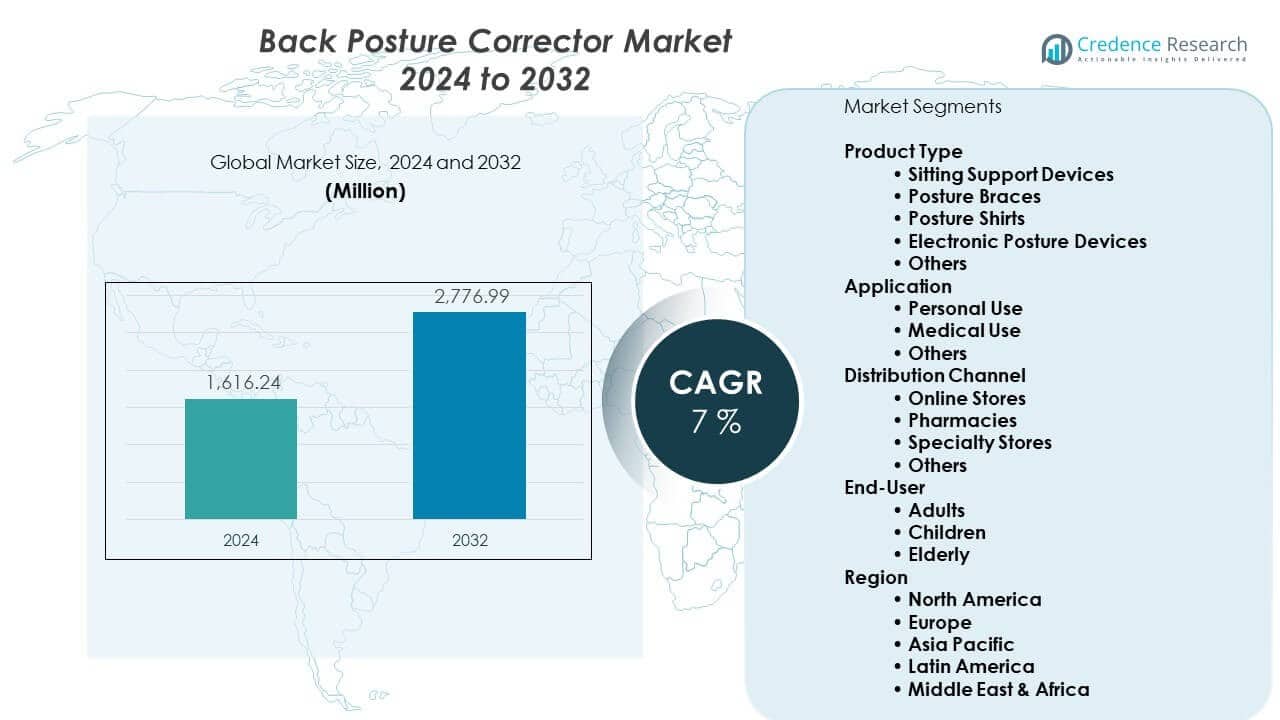
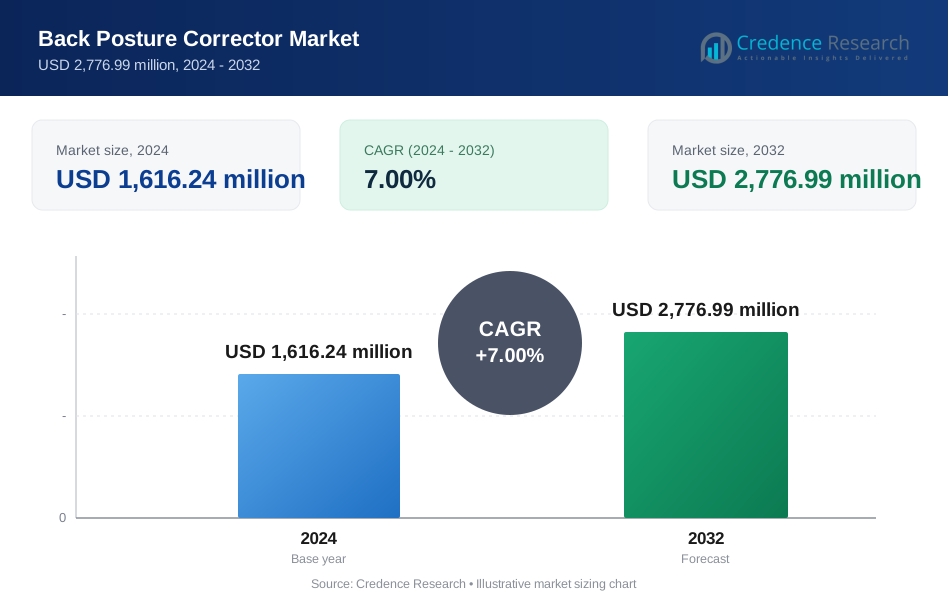
The Back Posture Corrector Market is projected to grow from USD 1,616.24 million in 2024 to USD 2,776.99 million by 2032, supported by a 7% CAGR from 2024 to 2032. Demand strengthens due to rising posture issues linked to long desk hours, digital device use, and increasing awareness of spinal health across diverse user groups.
| REPORT ATTRIBUTE | DETAILS |
|---|---|
| Historical Period | 2020-2023 |
| Base Year | 2024 |
| Forecast Period | 2025-2032 |
| Back Posture Corrector Market Size 2024 | USD 1,616.24 Million |
| Back Posture Corrector Market, CAGR | 7% |
| Back Posture Corrector Market Size 2032 | USD 2,776.99 Million |
Rising concern over musculoskeletal discomfort drives stronger interest in corrective posture products across home, workplace, and fitness settings. Workers rely on alignment aids to reduce tension caused by extended sitting. Physiotherapists recommend posture devices to support rehabilitation and long-term alignment habits. Fitness users choose braces for better stability during strength routines. Brands introduce flexible and lightweight designs that improve all-day comfort. Awareness campaigns highlight the benefits of early correction for long-term spine health. Consumers adopt posture solutions to improve balance and reduce daily strain. The Back posture corrector market gains traction from broader ergonomic education.
North America leads due to strong ergonomic product adoption and high workplace wellness participation. Europe follows with mature physiotherapy networks and growing consumer interest in posture improvement routines. Asia Pacific emerges as the fastest-growing region due to large working populations, rapid digital retail expansion, and rising awareness of spine health. Latin America shows gradual progress with expanding wellness culture. The Middle East and Africa advance through urban demand and broader access to posture aids. Regional growth patterns reflect lifestyle shifts, occupational habits, and awareness levels. Each region progresses based on healthcare support and consumer readiness.
Market Insights:
- The Back posture corrector market is valued at USD 1,616.24 million in 2024 and is projected to reach USD 2,776.99 million by 2032, expanding at a 7% CAGR.
- North America leads with 34%, supported by strong ergonomic awareness; Europe holds 28% due to physiotherapy adoption; Asia Pacific accounts for 26% driven by rising posture-health focus.
- Asia Pacific is the fastest-growing region with its 26% share, supported by a large working population and rapid e-commerce penetration.
- Posture braces held the largest product-type share at 38%, driven by wide familiarity and structured support advantages.
- Personal use dominated applications with a 54% share, supported by rising home-based posture correction needs.
Market Drivers:
Rising Focus On Musculoskeletal Health Awareness
People show higher interest in spine care due to long work hours and tech use. Users monitor posture issues earlier because daily routines strain upper and lower back muscles. Healthcare campaigns highlight benefits of early correction for long-term wellness improvement. Physiotherapists encourage posture devices to support recovery and reduce repeat injuries. Social media pushes stronger attention toward preventive spine habits. The Back posture corrector market benefits from rising awareness in younger and older groups. Brands design accessible tools that match daily movements without major effort. Many workers adopt posture aids to balance long desk schedules and screen exposure.
- For instance, Upright’s smart posture trainers report helping more than 750,000 users worldwide, supported by over 15,000 customer reviews for its connected coaching app.
Strong Demand For Ergonomic And Adjustable Support Designs
Consumers look for posture products that adapt to personal comfort and mobility needs. Brands introduce adjustable straps and lightweight frames that reduce pressure during extended wear. Engineers focus on breathable materials that improve user comfort across daily tasks. Healthcare providers recommend ergonomic devices that align with therapy routines. Users prefer flexible designs that support varied work and home activities. Many companies create customized devices tailored to different body types. The Back posture corrector market expands due to interest in ergonomic engineering. People value posture solutions that deliver comfort without limiting movement.
- For instance, a study on the AlignMed Posture Shirt reported a 23.5% improvement in pitching accuracy among baseball players, demonstrating measurable functional gains from its NeuroBand garment design.
Growing Adoption Across Fitness, Occupational, And Clinical Use Cases
Gyms promote devices that guide correct form during strength sessions and injury prevention routines. Corporate offices encourage posture tools to reduce employee strain from long desk shifts. Clinics integrate posture supports into treatment plans for spine and shoulder issues. Sports trainers use aids to maintain alignment during physical drills. Wellness centers expand programs that include posture assessment and correction steps. Users turn to posture devices for both training and rehabilitation support. The Back posture corrector market grows with widespread adoption across multiple settings. People appreciate tools that reinforce alignment through consistent daily routines.
Rising Influence Of Digital Health Guidance And Professional Recommendations
Digital platforms highlight corrective exercises and posture support routines. Influencers share real-life improvements after using structured posture aids. Medical experts publish guidance that stresses early correction for back and neck tension. Patients trust professional advice that explains long-term alignment benefits. Mobile applications promote better posture behavior through routine tips and awareness videos. Office workers pay attention to ergonomic rules promoted in workplace learning modules. The Back posture corrector market gains traction from trusted digital education. Many buyers follow verified guidance before selecting corrective products.
Market Trends:
Expansion Of Smart Posture Devices With Real-Time Feedback Technologies
Manufacturers develop sensors that track user alignment during work and exercise. Smart devices alert wearers when posture drops below recommended angles. Bluetooth platforms link posture tools to mobile dashboards for daily progress review. Users rely on data to reinforce alignment habits through routine corrections. Tech brands introduce vibration cues that guide rapid posture adjustments. Many firms enhance battery life to support full-day use. The Back posture corrector market advances with integrated digital features. Buyers adopt smart solutions for structured monitoring and long-term posture discipline.
- For instance, the UPRIGHT GO series uses medical-grade silicon adhesives that can be reused up to 10 times and delivers gentle vibration cues, with 8 out of 10 users reporting posture improvement of up to 92% in self-reported feedback.
Growth Of Invisible Wearable Designs For Lifestyle Integration
Shoppers prefer thin, discreet posture tools that fit under casual and formal clothing. Designers create low-profile structures that blend with regular outfits. Users select lightweight materials that avoid discomfort during extended wear. Athleisure trends push interest toward flexible wearables that match active lifestyles. Brands launch posture tools with sleek profiles aimed at young workers. Wearers appreciate support that maintains privacy in office and travel environments. The Back posture corrector market evolves with more lifestyle-focused formats. Many choose invisible options to maintain comfort and style throughout the day.
- For instance, a scoping review of six studies on posture-correcting shirts found that users reported improved comfort, energy, and productivity, supporting the value of subtle garment-based solutions for daily wear.
Rising Placement Of Posture Tools In E-Commerce Wellness Categories
Online platforms highlight posture products within wellness and medical accessories sections. Search traffic grows due to user interest in home-based corrective solutions. Retailers add posture devices to bundles that promote spine and muscle care. Influencer reviews guide shoppers toward reliable and easy-to-use devices. People explore posture solutions through online videos that show real-time use. Market visibility rises due to algorithm-driven product placement. The Back posture corrector market benefits from strong digital reach. Many users shift to e-commerce channels for faster comparison and delivery.
Higher Demand For Gender-Specific And Age-Specific Posture Support Structures
Brands design posture tools shaped to meet female, male, and youth body variations. Manufacturers tailor shoulder width, strap tension, and fit design for different groups. Parents buy youth-specific supports to correct early posture habits. Seniors look for comfortable tools with softer tension to protect sensitive joints. Lifestyle differences shape how buyers choose structure types for daily use. Product lines expand to include options for physical therapy, fitness routines, and mild correction. The Back posture corrector market grows with diverse ergonomic profiles. Users respond well to solutions that match body shape and age-based comfort levels.
Market Challenges Analysis:
Limited User Compliance And Comfort-Related Constraints Affect Long-Term Usage
Many users struggle to maintain daily wear schedules due to discomfort during long hours. Strap tension causes pressure for sensitive individuals who prefer softer support. Some buyers abandon posture aids when alignment results appear slower than expected. Healthcare providers emphasize consistent use, yet many people deviate from guidance. Users resist rigid designs that restrict motion during active tasks. Incorrect sizing reduces performance and lowers user motivation. The Back posture corrector market faces challenges linked to inconsistent adherence. Many brands focus on education to improve long-term usage behavior.
High Competition And Product Similarity Reduce Market Differentiation
Brands fight for visibility due to wide availability of similar posture aids. Many companies lack unique features that support premium pricing strategies. Users struggle to identify the most effective options among crowded listings. Retailers push low-cost products that weaken interest in advanced formats. Manufacturers face difficulty in communicating evidence-backed benefits to new buyers. Innovation slows when firms rely on basic designs without clear differentiation. The Back posture corrector market confronts pressure from intense competition. Several brands seek patented designs to improve distinct value.
Market Opportunities:
Broader Expansion Into Preventive Wellness, Corporate Ergonomics, And Youth Health Programs
Wellness programs integrate posture correction guidance across fitness, workplace, and home settings. Corporate offices adopt ergonomic initiatives that highlight posture issues among staff. Schools explore youth posture education to prevent long-term alignment problems. Health providers promote posture tools within preventive care counselling. Retailers add advanced braces to health sections for early-condition management. The Back posture corrector market gains leverage from preventive awareness. Many companies create devices tailored for organized wellness activities. Buyers respond positively to programs that combine guidance and product use.
Advancement In Smart Features, Material Innovation, And Personalized Fit Solutions
Tech-driven posture aids expand through adaptive sensors and digital coaching features. Material research supports softer fabrics that suit extended wear periods. Manufacturers apply 3D measurement tools to offer better custom-fit solutions. Smart dashboards improve user visibility on daily posture performance. Product upgrades encourage greater confidence among long-term users. The Back posture corrector market moves toward higher personalization. Many brands target global buyers through advanced design innovations. Retail interest increases where customization and comfort improve adoption.
Market Segmentation Analysis:
Product Type
The Back posture corrector market shows strong activity across diverse product formats that support varied posture needs. Sitting support devices gain attention from workers who experience strain during long desk hours. Posture braces maintain high usage due to structured support that aligns the upper back. Posture shirts appeal to users who prefer wearable comfort and soft compression. Electronic posture devices grow quickly with demand for alerts and digital feedback. Other niche products fill specific requirements across fitness and rehabilitation settings. Each product type serves unique user expectations and daily routines.
- For instance, BackJoy’s SitSmart posture seat, measuring about 13 by 15.5 inches, repositions the pelvis to promote upright sitting and is marketed as a safe, effective way to relieve lower back pain through better posture.
Application
Personal use leads adoption due to rising awareness of posture habits in home and work environments. Users prefer simple, adjustable devices that improve alignment during long sitting hours. Medical use grows through physiotherapy guidance and rehabilitation needs supported by specialists. Clinics include posture devices in treatment plans for chronic pain and muscle weakness. Other application areas expand through wellness programs that promote healthier routines. The Back posture corrector market benefits from broad application suitability across lifestyle and recovery needs.
- For instance, DarioHealth’s acquisition of Upright Technologies for about 31 million dollars, including roughly 1.7 million shares of stock, expanded an established digital chronic-condition platform into structured musculoskeletal and posture-coaching programs for back pain patients.
Distribution Channel
Online stores dominate due to wide product choice, user reviews, and easy delivery access. E-commerce platforms highlight posture solutions within wellness categories. Pharmacies maintain steady demand from users seeking medically guided support tools. Specialty stores attract buyers who prefer expert advice during product selection. Other channels gain traction where local retailers expand ergonomic product offerings. Each channel shapes buying decisions based on user expectations and accessibility. The Back posture corrector market grows through strong multi-channel availability.
End-User
Adults represent the largest group due to work-related posture issues and high digital device use. Children adopt posture products to correct early alignment habits influenced by study routines. Elderly users seek gentle support that reduces tension and improves mobility comfort. Caregivers and physiotherapists guide end-user choices based on comfort and stability needs. Product designs adjust to age-specific fit and pressure requirements for safe use. The Back posture corrector market advances with rising interest across all age groups.
Segmentation:
Product Type
• Sitting Support Devices • Posture Braces • Posture Shirts • Electronic Posture Devices • Others
Application
• Personal Use • Medical Use • Others
Distribution Channel
• Online Stores • Pharmacies • Specialty Stores • Others
End-User
• Adults • Children • Elderly
Region
- North America
- U.S.
- Canada
- Mexico
- Europe
- Germany
- France
- U.K.
- Italy
- Spain
- Rest of Europe
- Asia Pacific
- China
- Japan
- India
- South Korea
- South-east Asia
- Rest of Asia Pacific
- Latin America
- Brazil
- Argentina
- Rest of Latin America
- Middle East & Africa
- GCC Countries
- South Africa
- Rest of the Middle East and Africa
Regional Analysis:
North America
North America leads the Back posture corrector market with an estimated 34% share driven by strong awareness of ergonomic wellness and advanced product adoption. Consumers prioritize solutions that support alignment during long work hours, which increases regional demand. Physiotherapy networks recommend posture aids for rehabilitation and preventive care. E-commerce platforms highlight digital posture devices that attract younger buyers. Corporate wellness programs push alignment support tools into mainstream use. The Back posture corrector market remains strong in this region due to broad access, high product literacy, and consistent healthcare guidance.
Europe
Europe holds an estimated 28% share, supported by active physiotherapy involvement and growing interest in posture improvement routines. Users adopt structured support devices to manage musculoskeletal discomfort linked to office and remote work. Retailers stock a wide mix of braces, shirts, and smart devices that address regional preferences for comfort and clinical validation. Wellness campaigns promote spine health across workplaces and fitness centers. Healthcare providers include posture aids in recovery programs for shoulder and back strain. The Back posture corrector market grows in Europe through strong clinical influence and rising ergonomic awareness.
Asia Pacific, Latin America, and Middle East & Africa
Asia Pacific captures an estimated 26% share and stands as the fastest-growing region due to large working populations and rapid e-commerce expansion. Users across urban centers show high interest in posture correction driven by long digital usage hours. Latin America holds roughly 7% share supported by gradual growth in wellness participation and broader access to affordable posture aids. Middle East & Africa account for an estimated 5% share, with adoption concentrated in urban markets seeking preventive alignment tools. Rising awareness of spinal health encourages steady interest across all emerging markets. The Back posture corrector market advances in these regions through improving retail access and expanding ergonomic education.
Key Player Analysis:
- ComfyMed
- Upright Technologies Ltd.
- Vibo Care
- Marakym
- Truweo
- Evoke Pro
- FlexGuard Support
- BackJoy
- Berlin & Daughter
- Vive Health
- AlignMed
- Copper Compression
- Neo G
- PostureMedic
- IntelliSkin
Competitive Analysis:
The Back posture corrector market features strong competition driven by innovation, comfort, and design upgrades. Brands focus on adjustable formats, breathable materials, and improved user experience to strengthen visibility. Leading players expand digital posture devices that support real-time alerts and app connectivity. Companies enhance online presence to meet rising demand from e-commerce platforms. Healthcare-driven brands work with physiotherapists to validate product benefits and build credibility. It gains competitive depth through varied offerings that target personal, medical, and fitness-oriented users. Firms adopt targeted marketing to reach adults, children, and seniors. Global and regional players compete through pricing, design differentiation, and ergonomic quality.
Report Coverage:
The research report offers an in-depth analysis based on Product Type, Application, Distribution Channel, and End-User. It details leading market players, providing an overview of their business, product offerings, investments, revenue streams, and key applications. Additionally, the report includes insights into the competitive environment, SWOT analysis, current market trends, as well as the primary drivers and constraints. Furthermore, it discusses various factors that have driven market expansion in recent years. The report also explores market dynamics, regulatory scenarios, and technological advancements that are shaping the industry. It assesses the impact of external factors and global economic changes on market growth. Lastly, it provides strategic recommendations for new entrants and established companies to navigate the complexities of the market.
Future Outlook:
- Adoption grows through rising awareness of long-term spine health.
- Smart posture devices expand with improved sensors and app functions.
- Workplace ergonomics programs increase demand from corporate users.
- E-commerce platforms strengthen global distribution reach.
- Lightweight materials and flexible designs improve daily comfort.
- Medical practitioners recommend posture aids for rehabilitation support.
- Youth-focused offerings expand due to early correction awareness.
- Preventive wellness programs drive higher product visibility.
- Personalized fit technologies improve user satisfaction.
- Global brands invest in targeted marketing to capture emerging regions.
Request a Free Sample
Fill in your details and we'll send you a free sample report.
- Sample data tables & charts
- Research methodology
Need a Custom Version of This Report?
Tailor the scope, geography, or segments to your exact requirements.
- Custom geography or segment scope
- Direct access to our analyst team
Frequently Asked Questions
What is the current market size for the Back posture corrector market, and what is its projected size in 2032?
At what Compound Annual Growth Rate is the Back posture corrector market projected to grow between 2024 and 2032?
Which Back posture corrector market segment held the largest share in 2024?
What are the primary factors fueling the growth of the Back posture corrector market?
Who are the leading companies in the Back posture corrector market?
Which region commanded the largest share of the Back posture corrector market in 2024?
Table of Content
Chapter 1. Report Introduction
- 1.1 Report Description & Purpose
- 1.1.1 Report Title & Market Definition
- 1.1.2 Unique Selling Propositions (USP) & Key Differentiators
- 1.1.3 Value Proposition for Stakeholders
- 1.2 Research Objectives
- 1.2.1 Market Sizing Objectives (Volume & Revenue) (Volume Where Applicable)
- 1.2.2 Segmentation Objectives
- 1.2.3 Competitive Intelligence Objectives
- 1.2.4 Forecast & Scenario Objectives
- 1.3 Report Scope
- 1.3.1 Back Posture Corrector Scope – Segments & Subsegments Covered
- 1.3.2 Geographic Scope – Regions & Countries Covered
- 1.3.3 Historical Period, Base Year & Forecast Period (2024; forecast to 2032)
- 1.3.4 Inclusions & Exclusions
- 1.4 Industry Classification & Applicable Codes
- 1.5 Currency, Measurement Units & Valuation Basis
- 1.6 Target Stakeholders
- 1.7 Limitations & Assumptions
Chapter 2. Executive Summary
- 2.1 Global Back Posture Corrector Market Snapshot
- 2.1.1 Market Size – Historical (2024) & Forecast (2024-2032) (2024: USD 1,616.24 million → 2032: USD 2,776.99 million)
- 2.1.2 Volume & Revenue – Global Totals (Volume Where Applicable)
- 2.1.3 Key Market Highlights – Top Five Facts
- 2.2 Back Posture Corrector Market Segmentation Snapshot
- 2.2.1 Market Split by Region – 2024 vs. 2032
- 2.3 Competitive Snapshot
- 2.3.1 Top 10 Players by Revenue Share – 2024
- 2.3.2 Top 10 Players by Volume Share – 2024 (Volume Where Applicable)
- 2.3.3 Recent Strategic Developments (18-Month Summary)
- 2.4 Key Investment Highlights & Strategic Conclusions
Chapter 3. Back Posture Corrector Market Dynamics & Industry Analysis
- 3.1 Market Overview & Context
- 3.1.1 Back Posture Corrector Market Position in the Broader Industry Value Chain
- 3.1.2 Demand Structure & Purchasing Dynamics
- 3.1.3 Market Maturity & Development Stage by Region
- 3.2 Back Posture Corrector Market Drivers
- 3.3 Back Posture Corrector Market Restraints & Challenges
- 3.4 Back Posture Corrector Market Opportunities
- 3.5 Porter's Five Forces Analysis
- 3.5.1 Threat of New Entrants
- 3.5.2 Bargaining Power of Suppliers
- 3.5.3 Bargaining Power of Buyers
- 3.5.4 Threat of Substitutes
- 3.5.5 Competitive Rivalry – Intensity Assessment
- 3.6 Back Posture Corrector Value Chain Analysis
- 3.6.1 Upstream – Key Inputs, Resources & Suppliers
- 3.6.1.1 Key Input/Resource 1
- 3.6.1.2 Key Input/Resource 2
- 3.6.1.3 Key Input/Resource 3
- 3.6.2 Midstream – Core Operations & Value Creation
- 3.6.2.1 Operating Model & Process Overview
- 3.6.2.2 Key Operating Locations & Capabilities by Company
- 3.6.3 Downstream – Market Channels & End Users
- 3.6.3.1 Direct Sales & Customer Engagement Channels
- 3.6.3.2 Indirect Sales, Intermediaries & Partner Channels
- 3.6.4 Value Chain Profitability Analysis
- 3.6.1 Upstream – Key Inputs, Resources & Suppliers
- 3.7 PESTEL Analysis
- 3.7.1 Political Factors
- 3.7.2 Economic Factors
- 3.7.3 Social Factors
- 3.7.4 Technological Factors
- 3.7.5 Environmental Factors
- 3.7.6 Legal Factors
- 3.8 Back Posture Corrector Supply Chain Analysis
- 3.8.1 Critical Input & Resource Availability Risk Assessment
- 3.8.2 Supplier & Operational Concentration Risk (Geographic Exposure)
- 3.8.3 Supply & Service Disruption Impact Analysis
- 3.9 Regulatory & Policy Landscape
Note: The regulatory and policy landscape section covers regulations based on their applicability to the market, Back Posture Corrector category, geography, and scope of the study. Only regulatory frameworks with a material impact on operations, compliance, trade, sustainability, or market access are analyzed in detail.
Chapter 4. Key Investment Pockets & Opportunity Analysis
- 4.1 Back Posture Corrector Market Attractiveness Analysis
- 4.1.1 By Region – Investment Attractiveness Matrix (Market Size × CAGR)
- 4.2 Absolute Revenue Growth Opportunity
- 4.2.1 By Region – Absolute Revenue Growth Through 2032
- 4.3 Incremental Demand Opportunity
- 4.3.1 By Region – Incremental Demand Through 2032
- 4.3.2 Segment – Incremental Demand
- 4.4 Emerging Submarket Opportunity Deep Dive (Subject to Applicability)
- 4.5 Priority Market Opportunity Scorecards
- 4.5.1 United States
- 4.5.2 Europe
- 4.5.3 Asia
- 4.5.4 Middle East & Africa
Note: Priority market opportunity scorecards reflect the geographic scope and strategic relevance of the study. Listed markets are indicative and may be adapted to the industry.
Chapter 5. Back Posture Corrector Cross-Border Trade & Market Access Analysis
- 5.1 International Trade & Cross-Border Activity Overview
- 5.1.1 Global Export Value by Country (2024)
- 5.1.2 Global Export Volume by Country (2024) (Volume Where Applicable)
- 5.1.3 Global Import Value by Country (2024)
- 5.1.4 Global Import Volume by Country (2024) (Volume Where Applicable)
- 5.1.5 Net Trade Balance by Country (2024)
- 5.2 Export Analysis – Segment
- 5.2.1 Category 1 (Applicable Classification Code)
- 5.2.2 Category 2 (Applicable Classification Code)
- 5.2.3 Category 3 (Applicable Classification Code)
- 5.2.4 Category 4 (Applicable Classification Code)
- 5.2.5 Category 5 (Applicable Classification Code)
- 5.3 Import Analysis – Segment
- 5.3.1 Category 1 (Applicable Classification Code)
- 5.3.2 Category 2 (Applicable Classification Code)
- 5.3.3 Category 3 (Applicable Classification Code)
- 5.3.4 Category 4 (Applicable Classification Code)
- 5.3.5 Category 5 (Applicable Classification Code)
- 5.4 Cross-Border Pricing & Transaction Benchmarks
- 5.4.1 Export Pricing – Segment & Country
- 5.4.2 Import Pricing – Segment & Source Country
- 5.4.3 Price Trends (2024)
- 5.5 Key Cross-Border Trade & Delivery Routes
- 5.5.1 Cross-Border Trade/Delivery Route 1
- 5.5.2 Cross-Border Trade/Delivery Route 2
- 5.5.3 Cross-Border Trade/Delivery Route 3
- 5.5.4 Cross-Border Trade/Delivery Route 4
- 5.5.5 Cross-Border Trade/Delivery Route 5
- 5.6 Trade Policy & Market Access Impact Assessment
- 5.6.1 Tariff & Non-Tariff Barriers
- 5.6.2 Regional Trade & Economic Integration Frameworks
- 5.6.3 Bilateral & Multilateral Trade Agreements
- 5.6.4 Cross-Border Operating, Licensing & Localization Requirements
Note: This chapter applies where cross-border trade or delivery is relevant to Back Posture Corrector. Goods, services, and digital offerings are assessed using applicable classifications and transaction measures. Import-export volumes, trade balances, and route analyses are included only where meaningful to the market.
Chapter 6. Competitive Landscape & Company Benchmarking
- 6.1 Back Posture Corrector Market Concentration & Structure
- 6.1.1 Herfindahl-Hirschman Index (HHI) – vs. 2024
- 6.1.2 Leading, Mid-Sized & Emerging Player Structure
- 6.1.3 Global, Regional & Local Player Dynamics
- 6.2 Back Posture Corrector Market Share Analysis – 2024
- 6.2.1 Global Revenue Share by Company
- 6.2.2 Global Volume Share by Company (Volume Where Applicable)
- 6.2.3 Regional Revenue Share
- 6.2.4 Market Share Evolution ( vs. 2024)
- 6.2.5 Company Market Share by Key Segment
- 6.2.6 Company Market Share by Customer Group
- 6.3 Operating Scale, Capacity & Infrastructure Analysis
- 6.3.1 Global Operating Scale & Supply Capacity
- 6.3.2 Resource Utilization & Operating Efficiency
- 6.3.3 Output, Service Delivery & Activity Metrics
- 6.3.4 Operating Footprint & Infrastructure Map
- 6.3.5 Planned Operational & Capacity Expansion
- 6.4 Back Posture Corrector Competitive Benchmarking Matrix
- 6.4.1 Revenue, Growth, Profitability & Operating Metric Comparison
- 6.4.2 Channel Revenue Mix
- 6.4.3 Geographic Revenue Exposure
- 6.4.4 R&D Intensity
- 6.4.5 Sustainability Maturity
- 6.5 Strategic Developments in Back Posture Corrector (Last 24 Months)
- 6.5.1 Mergers, Acquisitions & Divestments
- 6.5.2 New Products, Services & Solutions in Back Posture Corrector
- 6.5.3 Operational & Infrastructure Expansions
- 6.5.4 Strategic Alliances, Joint Ventures & Partnerships
- 6.5.5 Distribution Expansion & Market Entry
- 6.5.6 Sustainability & ESG Initiatives
- 6.6 Competitive Strategy Mapping
- 6.6.1 Leader, Challenger, Follower & Niche Classification
- 6.6.2 Pricing Strategy Comparison
- 6.6.3 Channel Strategy Matrix
Note: Strategic developments are included based on their materiality and the availability of reliable information.
Chapter 7. Global Back Posture Corrector Market – By Sales & Delivery Channel
- 7.1 Segment Overview
- 7.1.1 Volume & Revenue Split by Channel (2024 & 2032) (Volume Where Applicable)
- 7.1.2 Channel Mix Evolution (2024-2032)
Chapter 8. Regional Market Analysis – Global Overview
- 8.1 Global Regional Overview
- 8.1.1 Regional Volume Share (Volume Where Applicable)
- 8.1.2 Regional Revenue Share
- 8.1.3 Regional Volume by Region (Volume Where Applicable)
- 8.1.4 Regional Revenue by Region
- 8.1.5 Regional Forecast Through 2032
- 8.2 Cross-Regional Segment Analysis
- 8.2.1 By Sales & Delivery Channel
- 8.2.2 By Competitive Positioning & Price Tier
Chapter 9. North America Back Posture Corrector Market
- 9.1 United States
- 9.2 Canada
- 9.3 Mexico
Chapter 10. Europe Back Posture Corrector Market
- 10.1 Germany
- 10.2 France
- 10.3 Italy
- 10.4 United Kingdom
- 10.5 Spain
- 10.6 Poland
- 10.7 Russia
- 10.8 Netherlands
- 10.9 Belgium
- 10.10 Sweden
- 10.11 Denmark
- 10.12 Norway
- 10.13 Rest of Europe
Chapter 11. Asia Pacific Back Posture Corrector Market
- 11.1 China
- 11.2 India
- 11.3 Japan
- 11.4 South Korea
- 11.5 Thailand
- 11.6 Indonesia
- 11.7 Vietnam
- 11.8 Malaysia
- 11.9 Australia
- 11.10 Rest of Asia Pacific
Chapter 12. Latin America Back Posture Corrector Market
- 12.1 Brazil
- 12.2 Argentina
- 12.3 Colombia
- 12.4 Chile
- 12.5 Rest of Latin America
Chapter 13. Middle East Back Posture Corrector Market
- 13.1 Saudi Arabia
- 13.2 United Arab Emirates
- 13.3 Turkey
- 13.4 Israel
- 13.5 Iran
- 13.6 Rest of the Middle East
Chapter 14. Africa Back Posture Corrector Market
- 14.1 South Africa
- 14.2 Egypt
- 14.3 Nigeria
- 14.4 Morocco
- 14.5 Rest of Africa
Chapter 15. Back Posture Corrector Company Profiles
- 15.1 [Company 01]
- 15.1.1 Company Overview
- 15.1.2 Key Management Personnel
- 15.1.3 Products & Services Portfolio
- 15.1.4 Financial Performance
- 15.1.5 Key Market Focus & Geographic Presence
- 15.1.6 Recent Developments & Strategic Initiatives
Note: The company profile list is preliminary and may change based on research findings, market developments, data availability, and client requirements.
Chapter 16. Appendices
- Appendix A – List of Abbreviations & Acronyms
- Appendix B – Industry Classification Code Reference – Full Series
- Appendix C – Supply, Output & Operating Capacity Data Tables
- Appendix D – End-Use & Demand Base Tables
- Appendix E – Demand, Adoption & Usage Assumptions
- Appendix F – Pricing & Revenue Metric Reference Tables
- Appendix G – Company Operations & Infrastructure Database
- Appendix H – Cross-Border Trade & Activity Data Tables (Where Applicable)
- Appendix I – Regulatory Summary Tables
- Appendix J – Primary Research Participant List (Anonymized)
- Appendix K – Primary Research Questionnaire Framework
- Appendix L – Data Sources & Bibliography
- Appendix M – Market Size Divergence & Source Comparison
Chapter 17. Research Methodology
- 17.1 Research Framework & Philosophy
- 17.2 Secondary Research – Sources, Hierarchy & Data Extraction
- 17.3 Data Modeling – Bottom-Up & Top-Down Market Sizing
- 17.4 Primary Research – Stakeholder Framework, LOI & Sample Sizes
- 17.5 Forecast Methodology – Regression, Scenario & Sensitivity Analysis
- 17.6 Quality Control – Four-Layer Validation Framework
- 17.7 Limitations & Standard Assumptions
- 17.8 Disclaimer
