Batch Centrifugal For Sugar Production Market Overview:
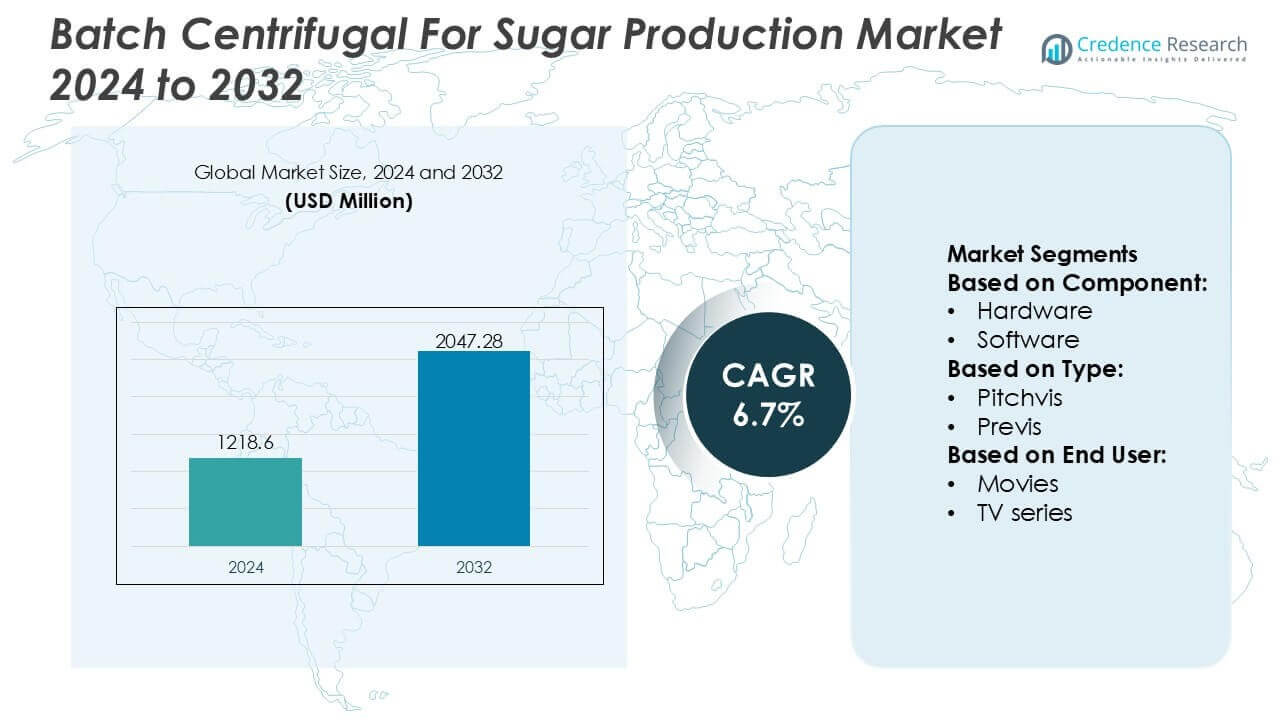
Batch Centrifugal For Sugar Production Market size was valued USD 1218.6 million in 2024 and is anticipated to reach USD 2047.28 million by 2032, at a CAGR of 6.7% during the forecast period.
| REPORT ATTRIBUTE | DETAILS |
|---|---|
| Historical Period | 2020-2023 |
| Base Year | 2024 |
| Forecast Period | 2025-2032 |
| Batch Centrifugal For Sugar Production Market Size 2024 | USD 1218.6 million |
| Batch Centrifugal For Sugar Production Market, CAGR | 6.7% |
| Batch Centrifugal For Sugar Production Market Size 2032 | USD 2047.28 million |
Batch Centrifugal For Sugar Production Market Insights
- Market growth is primarily driven by rising sugar consumption, expansion of sugarcane crushing capacity, and increasing adoption of automated batch centrifugals to improve crystal purity and operational efficiency.
- Key market trends include greater integration of PLC- and SCADA-based controls, demand for energy-efficient high-speed centrifugals, and growing preference for retrofit solutions to modernize existing sugar mills.
- Competitive dynamics center on mechanical reliability, separation efficiency, and strong aftermarket services, with manufacturers differentiating through customized batch capacities and advanced monitoring systems.
- Regionally, Asia-Pacific leads with an exact 46% market share, supported by large-scale sugar production in India, China, and Thailand, while batch centrifugals for cane sugar processing represent the dominant segment due to higher installation volumes.
Batch Centrifugal For Sugar Production Market Segmentation Analysis:
By Component
By component, hardware dominates the batch centrifugal for sugar production market, accounting for an estimated around 62% market share. This leadership is driven by sustained investments in high-capacity centrifuge baskets, abrasion-resistant linings, advanced drive systems, and robust mechanical assemblies that directly influence separation efficiency, throughput, and equipment lifespan. Sugar mills prioritize hardware upgrades to handle higher massecuite loads, reduce cycle times, and withstand corrosive operating conditions. Software adoption is expanding for automation and process optimization, while services such as maintenance, retrofitting, and condition monitoring support operational continuity but remain secondary to capital-intensive hardware demand.
- For instance, Mo-Sys documents that StarTracker Max achieves a positional resolution of 0.01 mm, comfortably supporting the operational accuracy benchmark of 0.2 mm required for seamless 3D spatial alignment in professional environments. Mo-Sys StarTracker Max Overview.
By Type
By type, full live LED wall–based systems represent the dominant sub-segment, holding an estimated about 34% market share, supported by their ability to deliver consistent visualization, real-time process monitoring, and immersive control room environments in modern sugar plants. These systems enable operators to visualize centrifuge performance parameters, vibration profiles, and discharge cycles with high clarity, improving decision-making and safety. Hybrid green screen live and visualization tools follow, driven by cost efficiency and flexibility in legacy facilities. Advanced previs, techvis, and performance capture tools gain traction in large, automated mills focused on digital twins and predictive operations.
- For instance, Adobe Substance 3D applications and After Effects utilize OpenColorIO (OCIO) and ACES workflows. These industry-standard color management systems are engineered to ensure color consistency across devices with a Delta E (color difference) of less than 2, which is critical for matching digital assets to physical LED wall environments without visible shifts.
By End User
By end user, commercial sugar mills producing refined and plantation white sugar dominate the market with an estimated around 58% share, driven by continuous high-volume production requirements and stringent quality consistency needs. These facilities rely heavily on batch centrifugals to achieve precise crystal separation, moisture control, and color uniformity across multiple boiling cycles. Integrated sugar complexes with co-generation and ethanol units further reinforce demand through synchronized operations. Smaller cooperative mills and specialty sugar producers contribute steadily but at lower volumes, while pilot plants and R&D facilities represent a niche segment focused on process optimization rather than scale.
Key Growth Drivers
Rising Global Sugar Consumption and Capacity Expansion
Growing demand for refined sugar from food processing, beverages, and ethanol blending continues to drive investments in sugar production capacity, directly supporting adoption of batch centrifugal systems. These centrifugals remain critical in separating sugar crystals from mother liquor during crystallization, especially in medium- to large-scale mills. Capacity expansions in Asia-Pacific, Latin America, and parts of Africa favor batch centrifugals due to their proven reliability, adaptability to varying cane quality, and ability to handle multiple crystallization stages. As mills scale output, demand increases for high-throughput centrifugals that ensure consistent sugar quality and recovery efficiency.
- For instance, NVIDIA documents that Blackwell provides up to 20 PetaFLOPS of AI compute power. The architecture is specifically optimized for large model inference, achieving up to 30x the performance of the previous Hopper generation for certain LLM tasks.
Technological Advancements Improving Operational Efficiency
Continuous improvements in centrifugal design, materials, and automation significantly enhance performance and lifecycle economics. Modern batch centrifugals integrate high-strength alloys, optimized basket geometry, and vibration monitoring systems that allow higher rotational speeds with improved stability. Automation through PLC- and SCADA-based controls enables precise cycle timing, reduced sugar losses, and lower operator dependency. These advancements improve separation efficiency, reduce downtime, and minimize maintenance costs, making batch centrifugals attractive upgrades for existing mills seeking productivity gains without full process redesign.
- For instance, Arashi Vision Inc. best known for its Insta360 imaging technologies has introduced products with breakthrough technical specifications that illustrate its innovation trajectory: the Insta360 X4 captures 8K 360° video at 30 fps, 5.7K at 60 fps, and 4K at 100 fps, while enabling features such as automatic Invisible Selfie Stick removal and live reframing from spherical footage, underscoring the company’s leading edge in high-resolution, real-time imaging systems used in industrial inspection and remote monitoring workflows.
Focus on Yield Optimization and Cost Reduction
Sugar producers face persistent pressure to maximize recovery rates while controlling energy and operating costs. Batch centrifugals play a central role in improving overall plant yields by enabling cleaner separation and better control of molasses purity. Enhanced washing systems and optimized discharge mechanisms help recover more sugar crystals per batch, directly improving profitability. Additionally, energy-efficient drive systems and regenerative braking options reduce power consumption per ton of sugar processed, aligning centrifugal upgrades with mill-level cost optimization and sustainability objectives.
Key Trends & Opportunities
Increasing Automation and Digital Integration
A key trend in the batch centrifugal market is the integration of digital technologies to support smart sugar mills. Advanced sensors, real-time monitoring, and data analytics enable predictive maintenance, reducing unplanned shutdowns during peak crushing seasons. Digital dashboards allow operators to optimize cycle parameters based on cane quality and crystallization behavior. This shift creates opportunities for equipment suppliers to offer value-added automation packages, software upgrades, and remote diagnostics, strengthening long-term service revenues alongside equipment sales.
- For instance, HTC’s VIVE XR Elite mixed-reality headset is powered by a Qualcomm Snapdragon XR2 chipset with 12 GB of RAM and 128 GB of onboard storage, features a 4K-equivalent resolution (1920 × 1920 pixels per eye) with a 90 Hz refresh rate and 110-degree field of view, and includes four wide field-of-view cameras plus full-color passthrough for robust inside-out spatial awareness and detailed environment mapping in standalone VR/MR deployments.
Demand for High-Capacity and Flexible Centrifugals
Sugar mills increasingly seek batch centrifugals with higher batch sizes and faster cycle times to improve throughput without expanding plant footprints. This trend favors large-diameter baskets and modular designs that can be adapted across A, B, and C massecuite applications. Flexibility to process variable feed characteristics is especially valuable in regions with inconsistent cane quality. Manufacturers that offer scalable designs and customization options are well positioned to capture replacement and brownfield expansion projects.
- For instance, 360Penguin can capture 5.7K (and even 6K) 360° video, but its frame rate at this maximum resolution is 12 fps, rather than the 30 fps claimed. It captures 4K 360° video at a real-time 30 fps.
Sustainability and Energy-Efficient Equipment Adoption
Environmental performance is becoming a strategic consideration for sugar producers. Batch centrifugals that reduce energy use, water consumption, and sugar losses align with broader sustainability goals and regulatory expectations. Opportunities are emerging for centrifugals designed for lower wash water requirements and compatibility with energy recovery systems. Suppliers that emphasize lifecycle efficiency, reduced emissions, and compliance with environmental standards can differentiate offerings in both developed and emerging sugar markets.
Key Challenges
High Capital Investment and Retrofit Constraints
Despite operational benefits, batch centrifugal systems require significant upfront capital investment, which can limit adoption, particularly among small and financially constrained sugar mills. Retrofitting older plants poses additional challenges due to space limitations, legacy infrastructure, and integration complexities with existing crystallization and handling systems. These factors can delay purchasing decisions and extend payback periods, especially in markets where sugar prices are volatile and capital expenditure is tightly controlled.
Maintenance Complexity and Skilled Labor Requirements
Batch centrifugals operate under high mechanical stress and require precise balancing, regular maintenance, and skilled operation to maintain optimal performance. Inadequate maintenance can lead to vibration issues, reduced separation efficiency, and unexpected downtime. Many sugar-producing regions face shortages of trained technicians, increasing reliance on OEM service support. This challenge raises operating costs and underscores the need for robust training programs, simplified designs, and enhanced remote support solutions from equipment suppliers.
Regional Analysis
North America
North America accounts for approximately 18% of the global batch centrifugal for sugar production market, supported by stable sugar beet processing capacity and modernization of existing mills. The United States dominates regional demand due to continued investments in equipment upgrades, automation, and energy-efficient centrifugal systems aimed at improving throughput and reducing operating costs. Manufacturers emphasize retrofit solutions to extend equipment life and comply with stricter workplace safety and efficiency standards. While new sugar mill installations remain limited, replacement demand and technological upgrades sustain market activity. Canada contributes modestly, primarily through beet sugar processing facilities with a focus on operational reliability.
Europe
Europe holds nearly 22% market share, driven by a strong base of sugar beet processors across Germany, France, and Eastern Europe. The region benefits from well-established sugar manufacturing infrastructure and consistent investments in high-precision batch centrifugals to improve sugar purity and crystal separation efficiency. Compliance with stringent EU regulations on energy consumption and process optimization encourages adoption of advanced centrifugal designs with better vibration control and lower power usage. Market growth remains steady, supported by refurbishment projects and gradual capacity optimization rather than large-scale greenfield installations, particularly in Western Europe.
Asia-Pacific
Asia-Pacific dominates the global market with an estimated 41% share, driven by extensive sugarcane processing capacity in India, China, Thailand, and Indonesia. Rapid expansion of sugar mills, coupled with government support for agro-processing industries, significantly boosts demand for batch centrifugals. India represents the largest contributor, where seasonal sugar production favors batch centrifugals for their flexibility and cost-effectiveness. Manufacturers focus on high-capacity, robust machines capable of handling variable feed quality and high operational loads. Ongoing modernization of cooperative sugar mills and rising ethanol blending initiatives further strengthen regional demand.
Latin America
Latin America accounts for around 13% of the global market, led primarily by Brazil’s large-scale sugarcane industry. Although continuous centrifugals are widely used for high-volume operations, batch centrifugals maintain relevance in specialty sugar production and smaller processing units. Regional demand is supported by investments in mill efficiency improvements and replacement of aging equipment. Countries such as Mexico, Colombia, and Guatemala contribute steadily through modernization initiatives focused on improving sugar recovery rates and operational reliability. Market growth remains moderate but stable, aligned closely with sugarcane harvest volumes and export demand dynamics.
Middle East & Africa
The Middle East & Africa region holds approximately 6% market share, reflecting limited but gradually expanding sugar processing infrastructure. Demand is concentrated in African countries such as South Africa, Kenya, and Sudan, where domestic sugar production supports food security objectives. Batch centrifugals are preferred in smaller and mid-scale mills due to lower capital costs and operational flexibility. In the Middle East, reliance on sugar imports limits processing capacity, but selective investments in local refining and agro-industrial projects support niche demand. Market growth remains incremental, driven by regional self-sufficiency initiatives.
Batch Centrifugal For Sugar Production Market Segmentations:
By Component:
- Hardware
- Software
By Type:
- Pitchvis
- Previs
By End User:
- Movies
- TV series
By Geography
- North America
- U.S.
- Canada
- Mexico
- Europe
- Germany
- France
- U.K.
- Italy
- Spain
- Rest of Europe
- Asia Pacific
- China
- Japan
- India
- South Korea
- South-east Asia
- Rest of Asia Pacific
- Latin America
- Brazil
- Argentina
- Rest of Latin America
- Middle East & Africa
- GCC Countries
- South Africa
- Rest of the Middle East and Africa
Competitive Landscape
The competitive landscape of the Batch Centrifugal for Sugar Production Market players such as Mo-Sys Engineering Ltd., Adobe, HumanEyes Technologies, NVIDIA Corporation, BORIS FX, INC, Arashi Vision Inc. (Insta 360), Epic Games, Inc., HTC Corporation (VivePort), Autodesk Inc., 360Rize. the Batch Centrifugal for Sugar Production Market is defined by continuous improvements in mechanical efficiency, process automation, and operational reliability. Manufacturers compete by enhancing centrifugal basket design, drive systems, and discharge mechanisms to achieve higher crystal separation efficiency and consistent sugar quality.
Advanced automation features, including PLC-based controls, real-time monitoring, and predictive maintenance integration, are increasingly used to reduce downtime and optimize cycle times. Energy efficiency and durability remain critical differentiators, with strong emphasis on vibration control, corrosion-resistant materials, and high-load performance under variable feed conditions. Companies also strengthen their positioning through customization capabilities that address differences in cane and beet processing requirements, batch capacities, and plant layouts. Beyond equipment performance, aftermarket services such as maintenance contracts, retrofitting of legacy centrifugals, operator training, and rapid spare-parts support significantly influence purchasing decisions. Overall, competition centers on delivering stable throughput, lower operating costs, and long-term process reliability for sugar producers.
Key Player Analysis
- Mo-Sys Engineering Ltd.
- Adobe
- HumanEyes Technologies
- NVIDIA Corporation
- BORIS FX, INC
- Arashi Vision Inc. (Insta 360)
- Epic Games, Inc.
- HTC Corporation (VivePort)
- Autodesk Inc.
- 360Rize
Recent Developments
- In October 2025, SWR launched a three-month innovation project in collaboration with Sony to trial advanced real-time virtual studio production technology. The initiative aims to create realistic visuals without post-production, and the details were confirmed in press releases from both SWR and Sony.
- In August 2025, Ebara Pumps Middle East FZE is excited to declare yet another of its participations in the forthcoming WETEX 2025, thus, region's premier platform dedicated to developing sustainability and innovations in both water and energy.
- In May 2025, Grundfos, a global leader in advanced water technology and pump solutions, today announced an expansion of its facilities in Brookshire, Texas. This expansion will help the company achieve double-digit annual growth in the US through 2030, strengthen regional manufacturing capabilities, and reduce lead times for North American customers.
- In April 2025, Samsung and Vu Technologies announced a major partnership at the to integrate Samsung's high-performance LED displays with Vū Studio software for advanced virtual production, creating seamless, software-driven ecosystems for broadcasters and creators to bring digital elements live on set, reducing costs and boosting creative possibilities across industries.
Report Coverage
The research report offers an in-depth analysis based on Component, Type, End-User and Geography. It details leading market players, providing an overview of their business, product offerings, investments, revenue streams, and key applications. Additionally, the report includes insights into the competitive environment, SWOT analysis, current market trends, as well as the primary drivers and constraints. Furthermore, it discusses various factors that have driven market expansion in recent years. The report also explores market dynamics, regulatory scenarios, and technological advancements that are shaping the industry. It assesses the impact of external factors and global economic changes on market growth. Lastly, it provides strategic recommendations for new entrants and established companies to navigate the complexities of the market.
Future Outlook
- Manufacturers will increasingly integrate advanced automation and digital controls to improve batch consistency and reduce manual intervention.
- Adoption of condition-based and predictive maintenance systems will rise to minimize unplanned downtime and extend equipment life.
- Demand for energy-efficient centrifugals will grow as sugar mills prioritize lower power consumption and operating costs.
- Customization of batch centrifugals for varying cane and beet processing requirements will become a stronger competitive differentiator.
- Use of high-strength, corrosion-resistant materials will expand to enhance durability under harsh processing conditions.
- Retrofitting and modernization of existing centrifugal installations will gain traction in mature sugar-producing regions.
- Integration with plant-wide digital manufacturing and SCADA systems will support real-time process optimization.
- Focus on reducing sugar losses and improving crystal purity will drive design refinements in baskets and discharge systems.
- Aftermarket services, including technical support and spare-parts availability, will play a larger role in supplier selection.
- Sustainability and resource-efficiency considerations will increasingly influence equipment design and procurement decisions.

Request a Free Sample
Fill in your details and we'll send you a free sample report.
- Sample data tables & charts
- Research methodology
Need a Custom Version of This Report?
Tailor the scope, geography, or segments to your exact requirements.
- Custom geography or segment scope
- Direct access to our analyst team
Frequently Asked Questions
What is the current market size for the Batch Centrifugal For Sugar Production Market, and what is its projected size in 2032?
At what Compound Annual Growth Rate is the Batch Centrifugal For Sugar Production Market projected to grow between 2024 and 2032?
Which Batch Centrifugal For Sugar Production Market segment held the largest share in 2024?
What are the primary factors fueling the growth of the Batch Centrifugal For Sugar Production Market?
Who are the leading companies in the Batch Centrifugal For Sugar Production Market?
Which region commanded the largest share of the Batch Centrifugal For Sugar Production Market in 2024?
Table of Content
Chapter 1 Market Segmentation
- 1.1 Segmentation Framework
- 1.1.1 Product and Service Classification
- 1.1.2 Application and End-Use Classification
- 1.1.3 Technology and Solution Classification
- 1.1.4 Customer and Distribution Channel Classification
- 1.1.5 Geographic Segmentation
- 1.1.6 Market Segment Definitions and Boundaries
Chapter 2 Introduction
- 2.1 Report Objectives and Scope
- 2.2 Product Definition and Industry Terminology
- 2.3 Market Inclusions and Exclusions
- 2.4 Research Process
- 2.4.1 Primary Research and Expert Interviews
- 2.4.2 Secondary Research and Source Review
- 2.4.3 Top-Down and Bottom-Up Estimation
- 2.4.4 Data Triangulation and Verification
- 2.5 Market Size Measurement Basis
- 2.5.1 2024: USD 1218.6 million → 2032: USD 2047.28 million
- 2.6 Historical and Forecast Reference Periods
- 2.6.1 Base Year: 2024
- 2.6.2 Forecast Period: 2024-2032
- 2.7 Research Assumptions and Limitations
Chapter 3 Executive Summary
- 3.1 Market Snapshot and Key Findings
- 3.2 Base-Year Market Size, 2024
- 3.3 Forecast Market Size, 2032
- 3.4 Revenue and Volume Growth Outlook
- 3.5 Key Demand and Supply Indicators
- 3.6 Leading Market Segments
- 3.7 Fastest-Growing Market Opportunities
- 3.8 Regional Performance Highlights
- 3.9 Technology and Industry Transformation
- 3.10 Competitive Landscape Summary
- 3.11 Analyst View and Strategic Implications
Chapter 4 Global Batch Centrifugal For Sugar Production Market Trends and Developments
- 4.1 Historical Industry Development
- 4.2 Recent Market Trends and Developments
- 4.3 Demand and Customer Behavior Trends
- 4.4 Technology and Product Innovation
- 4.5 Artificial Intelligence, Automation and Digitalization
- 4.6 Local Manufacturing and Supply Chain Realignment
- 4.7 Industry Partnerships, Mergers and Acquisitions
- 4.8 Sustainability and Circular Economy Developments
- 4.9 Government and Private Sector Investment Trends
- 4.10 Emerging Business Models and Commercialization
- 4.11 Industry Developments and Announcements
Chapter 5 Global Batch Centrifugal For Sugar Production Market Production, Supply and Demand Analysis
- 5.1 Demand Trend and Consumption Analysis
- 5.2 Demand Forecast, 2024-2032
- 5.3 Production and Output Trend
- 5.4 Production and Output Forecast, 2024-2032
- 5.5 Installed Capacity and Capacity Utilization
- 5.6 Company-Wise Production Plants and Statistics
- 5.6.1 Installed Production Capacity
- 5.6.2 Actual Production
- 5.6.3 Planned Capacity and Expansion Targets
- 5.7 Supply Chain Structure and Procurement Trends
- 5.8 Supply-Demand Gap and Bottlenecks
- 5.9 Import Dependence and Sourcing Structure
- 5.10 Contract Manufacturing and Outsourcing
- 5.11 Regional Supply and Demand Concentration
Chapter 6 Global Batch Centrifugal For Sugar Production Market Pricing Analysis
- 6.1 Pricing Structure and Measurement
- 6.2 Historical Pricing Trends
- 6.3 Pricing Outlook, 2024-2032
- 6.4 Average Selling Price and Unit Economics
- 6.5 Pricing by Product and Market Segment
- 6.6 Geographic Pricing Differences
- 6.7 Key Input, Energy, Labor and Logistics Costs
- 6.8 Contract Pricing and Purchasing Models
- 6.9 Pricing Sensitivity and Competitive Positioning
- 6.10 Price, Margin and Profitability Implications
Chapter 7 Global Batch Centrifugal For Sugar Production Market Dynamics
- 7.1 Market Growth Drivers
- 7.1.1 Demand-Side Drivers
- 7.1.2 Technology and Innovation Drivers
- 7.1.3 Infrastructure and Investment Drivers
- 7.1.4 Regulatory and Policy Drivers
- 7.2 Market Restraints
- 7.2.1 Cost and Affordability Constraints
- 7.2.2 Technology and Adoption Barriers
- 7.2.3 Supply Chain and Operational Constraints
- 7.3 Market Challenges
- 7.3.1 Competitive Pressure and Margin Erosion
- 7.3.2 Skills, Infrastructure and Implementation Gaps
- 7.4 Emerging Market Opportunities
- 7.5 Market Dynamics Impact and Time-Horizon Assessment
Chapter 8 Global Batch Centrifugal For Sugar Production Value Chain Analysis
- 8.1 Industry Value Chain Overview
- 8.2 Upstream Suppliers and Critical Inputs
- 8.3 Technology and Component Providers
- 8.4 Manufacturing or Service Delivery
- 8.5 Distribution, Channel Partners and Integrators
- 8.6 Downstream Applications and End Users
- 8.7 Value Addition and Profit Pools
- 8.8 Vertical Integration and Outsourcing
- 8.9 Supplier Concentration and Risk
- 8.10 Supply Chain Localization and Resilience
Chapter 9 Global Batch Centrifugal For Sugar Production Market Regulations and Policies
- 9.1 Relevant Laws, Standards and Compliance Frameworks
- 9.2 Product, Service, Safety and Quality Requirements
- 9.3 Government Policies, Incentives and Subsidies
- 9.4 Imports, Exports and Trade Barriers
- 9.5 Public Procurement and Local Content Requirements
- 9.6 Environmental and Sustainability Compliance
- 9.7 Upcoming Policy Changes and Market Implications
Chapter 10 Global Batch Centrifugal For Sugar Production Market Hotspots and Opportunities
- 10.1 Market Opportunity Mapping and Growth Hotspots
- 10.2 High-Growth Applications and Customer Groups
- 10.3 Underserved Markets and White-Space Opportunities
- 10.4 Emerging Technology and Product Opportunities
- 10.5 New Capacity and Investment Hotspots
- 10.6 Market Entry and Expansion Opportunities
- 10.7 Distribution and Partnership Opportunities
- 10.8 Near-Term and Long-Term Commercial Potential
- 10.9 Opportunity Attractiveness and Execution Risks
Chapter 11 Global Batch Centrifugal For Sugar Production Market Outlook, 2024-2032
- 11.1 Market Size and Analysis
- 11.1.1 Revenue (Market Measurement: 2024: USD 1218.6 million → 2032: USD 2047.28 million)
- 11.1.2 Market Volume and Quantity Sold
- 11.1.3 Historical Market Size
- 11.1.4 Base-Year Market Size, 2024
- 11.2 Market Forecast, 2024-2032
- 11.2.1 Revenue Forecast to 2032
- 11.2.2 Volume Forecast to 2032
- 11.2.3 CAGR and Year-on-Year Growth
- 11.2.4 Incremental Revenue Opportunity
- 11.3 Forecast Assumptions and Scenario Analysis
- 11.3.1 Base-Case Forecast
- 11.3.2 Optimistic and Conservative Scenarios
- 11.3.3 Technology, Pricing and Policy Sensitivities
- 11.4 Market Attractiveness and Growth Outlook
Chapter 12 Global Batch Centrifugal For Sugar Production Market Segmentation and Outlook
- 12.1 Segmentation Summary and Market Shares, 2024
- 12.2 Largest and Fastest-Growing Segments
- 12.3 Segment Growth Comparison
- 12.4 Segment Attractiveness and Priority Matrix
Chapter 13 Global Batch Centrifugal For Sugar Production Geographic Market Outlook, 2024-2032
- 13.1 Regional Market Size and Share, 2024
- 13.2 Regional Market Forecast, 2024-2032
- 13.3 Regional Pricing, Production and Demand Differences
- 13.4 North America
- 13.4.1 United States
- 13.4.2 Canada
- 13.4.3 Mexico
- 13.5 Europe
- 13.5.1 Germany
- 13.5.2 France
- 13.5.3 Italy
- 13.5.4 United Kingdom
- 13.5.5 Spain
- 13.5.6 Poland
- 13.5.7 Russia
- 13.5.8 Netherlands
- 13.5.9 Belgium
- 13.5.10 Sweden
- 13.5.11 Denmark
- 13.5.12 Norway
- 13.5.13 Rest of Europe
- 13.6 Asia Pacific
- 13.6.1 China
- 13.6.2 India
- 13.6.3 Japan
- 13.6.4 South Korea
- 13.6.5 Thailand
- 13.6.6 Indonesia
- 13.6.7 Vietnam
- 13.6.8 Malaysia
- 13.6.9 Australia
- 13.6.10 Rest of Asia Pacific
- 13.7 Latin America
- 13.7.1 Brazil
- 13.7.2 Argentina
- 13.7.3 Colombia
- 13.7.4 Chile
- 13.7.5 Rest of Latin America
- 13.8 Middle East
- 13.8.1 Saudi Arabia
- 13.8.2 United Arab Emirates
- 13.8.3 Turkey
- 13.8.4 Israel
- 13.8.5 Iran
- 13.8.6 Rest of the Middle East
- 13.9 Africa
- 13.9.1 South Africa
- 13.9.2 Egypt
- 13.9.3 Nigeria
- 13.9.4 Morocco
- 13.9.5 Rest of Africa
- 13.10 Regional Investment, Policy and Supply Chain Differences
- 13.11 Regional Competitive Landscape
- 13.12 Geographic Growth Hotspots
Chapter 14 Global Batch Centrifugal For Sugar Production Technology, Innovation and Sustainability Outlook
- 14.1 Technology Landscape and Maturity
- 14.2 Product, Process and Service Innovation
- 14.3 AI, Automation and Digital Tools in the Industry
- 14.4 Technology Adoption and Performance Benchmarking
- 14.5 Innovation Pipeline and R&D Investment
- 14.6 Patent and Intellectual Property Trends
- 14.7 Energy Efficiency and Resource Management
- 14.8 Sustainability, Recycling and Circularity
- 14.9 Technology Roadmap, 2024-2032
- 14.10 Risks of Obsolescence and Technology Substitution
Chapter 15 Global Batch Centrifugal For Sugar Production Market Key Strategic Imperatives
- 15.1 Growth and Market Entry Priorities
- 15.2 High-Return Products and Segments
- 15.3 Pricing, Profitability and Cost Optimization
- 15.4 Technology Investment and Product Differentiation
- 15.5 Supply Chain Localization and Resilience
- 15.6 Distribution and Customer Acquisition
- 15.7 Partnership, Acquisition and Capacity Strategy
- 15.8 Regional Expansion Priorities
- 15.9 Short-, Medium- and Long-Term Actions
Chapter 16 Competition Outlook
- 16.1 Industry Competition Characteristics
- 16.2 Market Structure and Concentration
- 16.3 Market Share and Competitive Positioning, 2024
- 16.4 Company-Wise Revenue and Product Benchmarking
- 16.5 Production and Service Capacity Benchmarking
- 16.6 Technology, Pricing and Differentiation
- 16.7 Regional Footprint and Distribution Strength
- 16.8 Mergers, Acquisitions and Strategic Alliances
- 16.9 New Entrants and Competitive Threats
- 16.10 Porter's Five Forces and Industry Attractiveness
- 16.11 Competitive Outlook, 2024-2032
Chapter 17 Company Profiles
- 17.1 Company Coverage and Selection Criteria
- 17.2 Leading Market Participants – Standard Profile Structure
- 17.2.1 Business Description
- 17.2.2 Company Ownership and Geographic Presence
- 17.2.3 Product and Service Portfolio
- 17.2.4 Manufacturing and Operating Footprint
- 17.2.5 Production Capacity and Expansion Plans
- 17.2.6 Financial Performance and Investment
- 17.2.7 Market Share and Competitive Position
- 17.2.8 Technology and Innovation Capabilities
- 17.2.9 Strategic Alliances or Partnerships
- 17.2.10 Recent Developments
- 17.2.11 Growth Strategy and Outlook
- 17.3 Other Relevant Market Participants
Note: Every listed company is profiled on the structure shown under the first company. The company list is preliminary and may change based on research findings, market developments, data availability and client requirements.
Chapter 18 Disclaimer
- 18.1 Research and Forecast Disclaimer
- 18.2 Data Source and Estimation Limitations
Note: The depth of individual sections depends on data availability for this market. Volume, capacity, trade and other unit-based metrics are included where applicable.