Executive Summary & Core Metrics
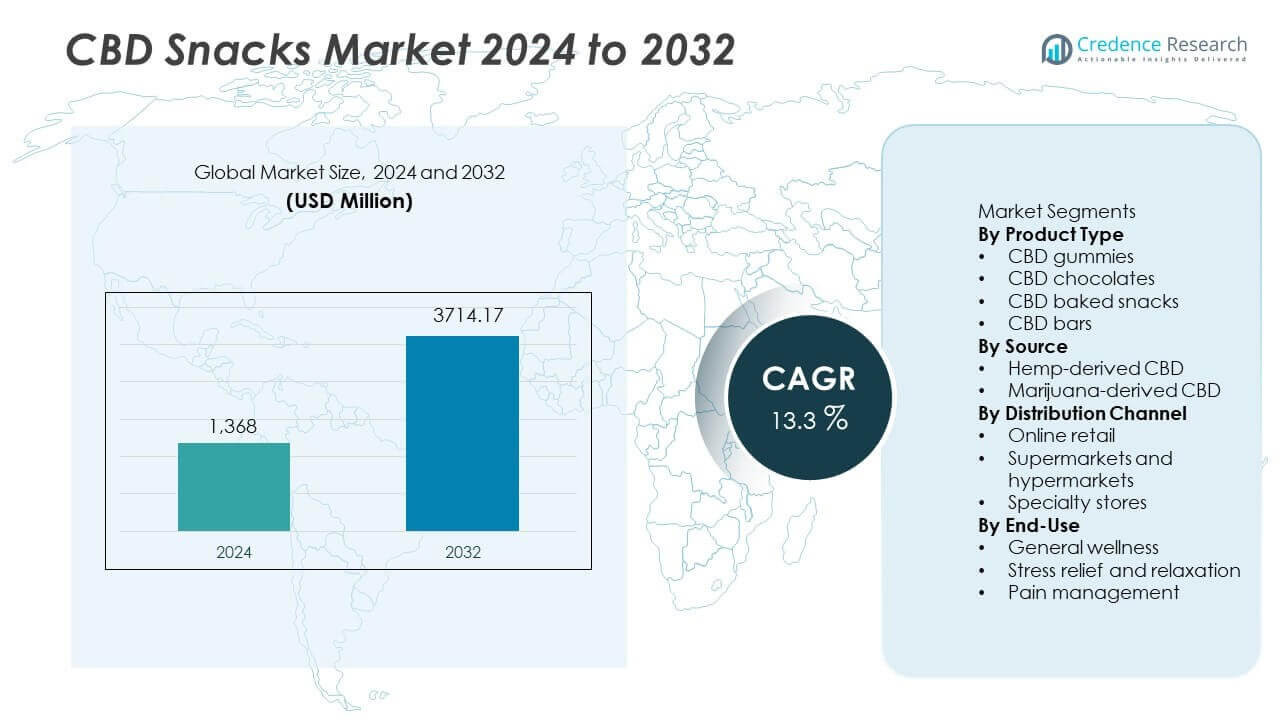
The global CBD snacks market was valued at USD 1,368 million in 2024 and is projected to reach USD 3,714.17 million by 2032, expanding at a compound annual growth rate (CAGR) of 13.3% during the forecast period, according to Credence Research. This growth reflects rising consumer interest in wellness-oriented snacks, hemp-derived CBD formulations, functional food formats and convenient products positioned for relaxation, general wellness and lifestyle-based consumption.
| REPORT ATTRIBUTE | DETAILS |
|---|---|
| Historical Period | 2020-2023 |
| Base Year | 2024 |
| Forecast Period | 2025-2032 |
| CBD Snacks Market Size 2024 | USD 1,368 million |
| CBD Snacks Market, CAGR | 13.3% |
| CBD Snacks Market Size 2032 | USD 3,714.17 million |
The global CBD snacks market is characterized by the presence of branded CBD companies, wellness product manufacturers and functional snack producers competing on product quality, flavor innovation, dosage consistency, clean-label positioning and regulatory compliance. Leading players focus on gummies, chocolates, baked snacks and CBD bars designed for convenient consumption and strong retail visibility. Strategic priorities across the sector include hemp-derived CBD sourcing, transparent labeling, third-party testing, premium packaging, online retail expansion, flavor diversification and direct-to-consumer brand development.
Strategic Market Insights
- Market growth is primarily driven by rising demand for wellness-focused, functional and convenient snack products, with CBD gummies leading the product type segment due to ease of consumption, familiar format, portability and broad flavor variety.
- Dominant industry trends highlight product innovation across gummies, chocolates, baked snacks and CBD bars, supported by premium positioning, clean-label formulations, taste improvement and stronger direct-to-consumer engagement.
- The competitive landscape remains intense as companies focus on hemp-derived sourcing, dosage consistency, transparent labeling, third-party testing and digital marketing strategies to strengthen brand trust and regulatory readiness.
- According to Credence Research regional mapping, North America represents the largest market, accounting for a definitive 46% share due to high consumer awareness, favorable hemp-derived CBD regulations, strong online retail penetration and the presence of established CBD brands.
CBD Snacks Market Segmentation Analysis
By Product Type
- CBD gummies
- CBD chocolates
- CBD baked snacks
- CBD bars
Data compiled by Credence Research confirms that CBD gummies constitute the dominant product type, holding an estimated 39% market share. Their leadership is supported by ease of consumption, familiar candy-like format, precise dosage control and wide flavor availability. Gummies are especially attractive to first-time CBD consumers because they offer portability, taste masking and convenient daily use. Strong shelf presence across online stores, specialty retailers and wellness brands further supports demand. Their ability to combine functional positioning with approachable formats makes gummies the most accessible entry product in the CBD snacks market.
CBD chocolates follow as a premium segment, supported by indulgence appeal, gifting potential and higher-value positioning. CBD baked snacks and CBD bars show steady growth through functional snacking trends and consumer interest in convenient wellness formats. However, gummies remain the leading format because they combine dosage consistency, flavor variety and strong consumer familiarity.
Charlotte’s Web developed CBD gummies with consistent CBD content per unit and multiple flavor SKUs, supporting dose consistency and improved shelf visibility across branded wellness snack formats.
By Source
- Hemp-derived CBD
- Marijuana-derived CBD
Credence Research identifies hemp-derived CBD as the leading source segment, accounting for approximately 72% of global market share. Hemp-derived CBD dominates because it benefits from broader legal acceptance, lower THC content and stronger alignment with food safety and wellness positioning. Manufacturers prefer hemp-derived CBD to support regulatory compliance and consumer trust across major retail and online channels. Clear labeling and quality testing further strengthen adoption in daily wellness products.
Marijuana-derived CBD holds a smaller share due to stricter regulatory controls, limited market access and higher compliance complexity. While gradual legalization may support selective growth in certain markets, hemp-derived CBD remains the preferred source for snack formulations because it offers wider commercial flexibility and stronger acceptance among wellness-focused consumers.
CV Sciences operates hemp extraction capabilities and uses quality standards, including independent testing, to support product safety and regulatory compliance for hemp-based CBD products.
By Distribution Channel
- Online retail
- Supermarkets and hypermarkets
- Specialty stores
Online retail dominates the distribution channel segment with an estimated 44% market share. This leadership is driven by convenience, product variety, direct-to-consumer pricing and the ability of brands to educate consumers on product formats, serving guidance and ingredient transparency. E-commerce platforms allow CBD snack companies to build direct relationships with buyers, promote subscriptions and use digital marketing to strengthen brand visibility. Online channels also support discreet purchasing, which remains important for many consumers in regulated product categories.
Specialty stores follow, supported by personalized guidance, curated wellness product selections and premium positioning. Supermarkets and hypermarkets are gaining traction as mainstream acceptance improves and regulatory pathways become clearer. However, online retail remains the leading channel because it offers broader brand access, education-led selling and strong penetration among wellness-oriented consumers.
Key Market Dynamics
Primary Market Drivers
Rising Consumer Focus on Wellness and Functional Foods:
Growing consumer interest in wellness-oriented foods remains a core commercial driver for the CBD snacks market. Consumers increasingly seek snack products positioned around relaxation, balance, lifestyle support and functional nutrition. CBD snacks align with this shift because they combine familiar snack formats with perceived wellness value. Gummies, chocolates and bars make CBD more approachable for new consumers compared with oils or tinctures. Urban lifestyles, stress management concerns and rising demand for convenient wellness options support repeat purchases. Credence Research identifies functional snacking and wellness-focused consumption as major long-term growth catalysts for CBD snack adoption. Medterra formulated CBD gummies with 25 mg CBD per serving and conducted 12-month stability testing to support product consistency.
Expanding Legal Acceptance of Hemp-Derived CBD:
Expanding legal acceptance of hemp-derived CBD supports broader market development. Regulatory clarity in several markets allows manufacturers to launch compliant snack formats and improve consumer trust. Clear THC limits, hemp sourcing standards and labeling requirements help reduce entry barriers for established brands. Retailers are gradually expanding shelf space for CBD snacks as rules become clearer and consumer interest grows. This regulatory progress also attracts investment in product development, packaging and e-commerce distribution. cbdMD sources hemp from farms operating under the 2018 U.S. Farm Bill and tests batches through certified laboratories to support compliance with legal THC requirements.
Product Innovation and Flavor Diversification:
Product innovation and flavor diversification continue to strengthen the CBD snacks market. Manufacturers are expanding beyond basic gummies into chocolates, baked snacks, bars, low-sugar options, vegan formats and premium flavor combinations. Improved formulations help mask CBD’s natural bitterness and make products more appealing to mainstream consumers. Clean-label ingredients, natural flavors and portable packaging also support product differentiation. Innovation increases trial, encourages repeat consumption and supports premium pricing strategies. Credence Research indicates that differentiated flavor profiles and value-added snack formats will remain important for brand growth in a competitive market.
Key Trends & Structural Opportunities
Growth of Online and Direct-to-Consumer Sales:
Online retail and direct-to-consumer channels are expanding rapidly in the CBD snacks market. Digital platforms allow brands to present product education, ingredient details, batch testing information and serving guidance in a controlled environment. Subscription models improve customer retention and support repeat purchases. Social media, influencer marketing and search-based wellness content increase brand visibility. Direct engagement also helps companies build trust in a category where consumers often seek clarity before purchase. Joy Organics operates a direct website offering subscription options and provides third-party lab reports for every batch to verify potency and purity across product strengths.
Premiumization and Clean-Label Positioning:
Premiumization is a major trend across CBD snacks as consumers increasingly seek high-quality, natural and better-formulated products. Clean-label ingredients, natural flavors, lower sugar content and plant-based positioning attract health-conscious buyers. Premium packaging supports gifting, lifestyle branding and stronger shelf differentiation. This trend enables manufacturers to command higher margins while targeting affluent urban consumers. Brands that emphasize transparency, hemp sourcing and third-party testing are better positioned to build long-term trust. Lord Jones produces CBD gumdrops using hemp extract and limited ingredient lists, supporting premium and clean-label positioning.
Expansion of Functional Snack Formats:
Functional snack diversification creates strong opportunities for CBD snack brands. Consumers are increasingly interested in products that combine CBD with snack formats such as bars, chocolates, baked items and portion-controlled gummies. These products can be positioned for general wellness, relaxation and daily routines without requiring consumers to change existing snacking habits. Flavor innovation and improved texture also make CBD snacks more appealing to mainstream audiences. Credence Research identifies functional format expansion as a structural opportunity because it allows companies to move beyond niche CBD users and reach broader wellness-oriented consumers.
Industry Challenges
Regulatory Uncertainty Across Regions
Regulatory inconsistency remains a major challenge for the CBD snacks market. Frameworks for edible CBD products vary widely across countries and even within regions. Some markets lack clear guidelines on dosage, labeling, permissible ingredients and retail distribution. This uncertainty delays product launches, increases compliance costs and limits geographic expansion. Retailers may remain cautious in countries where rules are unclear or subject to change. Companies must closely monitor legal updates and maintain flexible compliance strategies to reduce market-entry risk.
Consumer Awareness and Dosage Concerns
Consumer education remains a key challenge. Many consumers lack clear understanding of CBD serving sizes, product formats and responsible consumption. Concerns about dosage, overconsumption and product claims can affect purchase decisions, especially among first-time users. Misinformation and inconsistent labeling across the broader CBD category can also weaken trust. Brands must invest in transparent communication, clear packaging, third-party test results and responsible marketing. Credence Research indicates that consumer education will remain essential for broader CBD snack adoption, particularly in conservative or newly regulated markets.
Detailed Regional Analysis
| Region | Market Share (%) | Strategic Regional Catalysts & Insights |
| North America | 46.0% | Global leader. Driven by high consumer awareness, early legalization, strong hemp-derived CBD adoption, established CBD brands and advanced online retail penetration. |
| Europe | 28.0% | Mature growth market. Supported by wellness trends, premium snack demand, growing CBD acceptance and expanding specialty store and online distribution. |
| Asia Pacific | 16.0% | Emerging growth market. Powered by rising wellness interest, plant-based snack demand, e-commerce expansion and gradual CBD awareness in markets such as Japan, Australia and South Korea. |
| Rest of the World | 10.0% | Nascent territory. Supported by gradual legalization, niche wellness demand, specialty retail growth and early adoption across select Latin American, Middle Eastern and African markets. |
North America leads the global CBD snacks market with a 46% share, according to Credence Research. The region benefits from early legalization, strong consumer awareness and broad acceptance of hemp-derived CBD products. The United States drives regional demand due to strong online retail penetration, established CBD brands and high consumer spending on wellness products. Gummies and chocolates remain popular formats because they provide familiar and convenient consumption. Canada also contributes through regulated cannabis and hemp-based product markets. Strong digital marketing, direct-to-consumer sales and frequent product launches continue to support regional dominance.
Europe holds 28% of the global CBD snacks market, driven by growing acceptance of CBD as a wellness ingredient. The United Kingdom, Germany and Switzerland lead adoption through online platforms, specialty stores and premium wellness retail channels. Consumers in the region show strong interest in clean-label, natural and premium snack products. Rising focus on stress management, functional foods and plant-based nutrition supports steady demand. However, regulatory differences across countries slow uniform expansion. Continued policy harmonization and consumer education are expected to support broader market growth.
Asia Pacific accounts for 16% of the global market, supported by increasing awareness of CBD and rising demand for functional snack products. Japan, Australia and South Korea lead regional demand as consumers show interest in wellness-focused and plant-based products. Online channels play a critical role because physical retail availability remains limited in many markets. Regulatory frameworks remain restrictive in several countries, slowing faster adoption. However, premium snack demand, e-commerce expansion and education-driven marketing are expected to create gradual opportunities across the region.
Rest of the World captures 10% of the global CBD snacks market. Latin America shows early growth due to improving hemp regulations and rising wellness awareness. The Middle East and Africa remain at a nascent stage, with limited product availability and low consumer familiarity. Specialty wellness stores and online exposure are supporting early adoption among urban consumers. Premium CBD snacks appeal to niche wellness buyers, but regulatory uncertainty continues to limit broad market expansion. Long-term growth is expected to improve as legal frameworks mature and consumer education expands.
Competitive Landscape & Recent Developments
The CBD snacks market is highly competitive, with strong participation from branded CBD companies, wellness product manufacturers and functional snack specialists. Key players include Charlotte’s Web Holdings Inc., CV Sciences Inc., Medterra, Green Roads, cbdMD Inc., Lord Jones, Joy Organics, Plus Products Inc., Diamond CBD and Koi CBD. These companies compete through flavor innovation, product quality, dosage consistency, hemp-derived sourcing, clean-label formulations and direct-to-consumer engagement.
Market leaders focus on expanding gummies, chocolates, baked snacks and functional snack portfolios to attract wellness-oriented consumers. Transparent labeling, third-party testing and regulatory compliance support consumer trust and brand credibility. Companies invest heavily in digital marketing, e-commerce platforms and subscription models to strengthen reach. Strategic partnerships with specialty wellness retailers enhance offline presence. Packaging innovation, premium positioning and clean-label differentiation remain central to competitive strategies. Continuous product launches and geographic expansion are expected to shape competition in this fast-growing market.
Recent Industry Developments (2024–2025)
- In October 2025, Charlotte’s Web Holdings Inc. launched Knockout Hemp THC Sleep Gummies in its Brightside line, expanding its functional gummies portfolio with a sleep-focused product.
- In September 2025, Charlotte’s Web Holdings Inc. announced plans for a Scientific Advisory Board to guide research and clinical engagement.
- In March 2024, CV Sciences Inc. launched +PlusCBD Pet Hip & Joint Health Chews and Calming Care Chews designed for pets.

Request a Free Sample
Fill in your details and we'll send you a free sample report.
- Sample data tables & charts
- Research methodology
Market Dynamics
Wellness and Functional Food Trends
Consumers are increasingly seeking snacks that offer functional benefits such as relaxation, stress management, and general wellness, making CBD-infused snacks attractive for their perceived health value and convenience.
Expanding Legal Acceptance of Hemp-Derived CBD
Broader legalization and regulatory clarity for hemp-derived CBD in key markets, especially North America and parts of Europe, are enabling more brands to launch compliant products and expand distribution channels.
Product Innovation and Flavor Diversification
Manufacturers are investing in new product formats, improved taste profiles, and clean-label formulations, making CBD snacks more appealing to mainstream consumers and supporting premium pricing strategies.
Growth of Online and Direct-to-Consumer Sales
The rise of e-commerce and direct-to-consumer platforms allows brands to educate buyers, offer subscriptions, and provide transparent product information, driving higher adoption rates and repeat purchases.
Premiumization and Clean-Label Positioning
Consumers are willing to pay more for high-quality, natural, and transparently sourced CBD snacks, encouraging brands to focus on premium packaging, third-party testing, and clean-label ingredients to build trust and differentiate in a crowded market.
Need a Custom Version of This Report?
Tailor the scope, geography, or segments to your exact requirements.
- Custom geography or segment scope
- Direct access to our analyst team
Frequently Asked Questions
What is the current and projected size of the global CBD snacks market?
What is the projected growth rate of the CBD snacks industry over the forecast period?
Which product type holds the maximum market share within the CBD snacks industry?
Which source segment dominates the CBD snacks market?
Which distribution channel leads the CBD snacks market?
Which region commands the highest market share in the global CBD snacks space?
Table of Content
Chapter 1 Market Segmentation
- 1.1 Segmentation Framework
- 1.1.1 Product and Service Classification
- 1.1.2 Application and End-Use Classification
- 1.1.3 Technology and Solution Classification
- 1.1.4 Customer and Distribution Channel Classification
- 1.1.5 Geographic Segmentation
- 1.1.6 Market Segment Definitions and Boundaries
- 1.2 By Source
- 1.2.1 Hemp-derived CBD
- 1.2.2 Marijuana-derived CBD
- 1.3 By Product Type
- 1.3.1 CBD gummies
- 1.3.2 CBD chocolates
- 1.3.3 CBD baked snacks
- 1.3.4 CBD bars
Chapter 2 Introduction
- 2.1 Report Objectives and Scope
- 2.2 Product Definition and Industry Terminology
- 2.3 Market Inclusions and Exclusions
- 2.4 Research Process
- 2.4.1 Primary Research and Expert Interviews
- 2.4.2 Secondary Research and Source Review
- 2.4.3 Top-Down and Bottom-Up Estimation
- 2.4.4 Data Triangulation and Verification
- 2.5 Market Size Measurement Basis
- 2.5.1 2024: USD 1,368 million → 2032: USD 3,714.17 million
- 2.6 Historical and Forecast Reference Periods
- 2.6.1 Base Year: 2024
- 2.6.2 Forecast Period: 2024-2032
- 2.7 Research Assumptions and Limitations
Chapter 3 Executive Summary
- 3.1 Market Snapshot and Key Findings
- 3.2 Base-Year Market Size, 2024
- 3.3 Forecast Market Size, 2032
- 3.4 Revenue and Volume Growth Outlook
- 3.5 Key Demand and Supply Indicators
- 3.6 Leading Market Segments
- 3.7 Fastest-Growing Market Opportunities
- 3.8 Regional Performance Highlights
- 3.9 Technology and Industry Transformation
- 3.10 Competitive Landscape Summary
- 3.11 Analyst View and Strategic Implications
Chapter 4 Global CBD Snacks Market Trends and Developments
- 4.1 Historical Industry Development
- 4.2 Recent Market Trends and Developments
- 4.3 Demand and Customer Behavior Trends
- 4.4 Technology and Product Innovation
- 4.5 Artificial Intelligence, Automation and Digitalization
- 4.6 Local Manufacturing and Supply Chain Realignment
- 4.7 Industry Partnerships, Mergers and Acquisitions
- 4.8 Sustainability and Circular Economy Developments
- 4.9 Government and Private Sector Investment Trends
- 4.10 Emerging Business Models and Commercialization
- 4.11 Industry Developments and Announcements
Chapter 5 Global CBD Snacks Market Production, Supply and Demand Analysis
- 5.1 Demand Trend and Consumption Analysis
- 5.2 Demand Forecast, 2024-2032
- 5.3 Production and Output Trend
- 5.4 Production and Output Forecast, 2024-2032
- 5.5 Installed Capacity and Capacity Utilization
- 5.6 Company-Wise Production Plants and Statistics
- 5.6.1 Installed Production Capacity
- 5.6.2 Actual Production
- 5.6.3 Planned Capacity and Expansion Targets
- 5.7 Supply Chain Structure and Procurement Trends
- 5.8 Supply-Demand Gap and Bottlenecks
- 5.9 Import Dependence and Sourcing Structure
- 5.10 Contract Manufacturing and Outsourcing
- 5.11 Regional Supply and Demand Concentration
Chapter 6 Global CBD Snacks Market Pricing Analysis
- 6.1 Pricing Structure and Measurement
- 6.2 Historical Pricing Trends
- 6.3 Pricing Outlook, 2024-2032
- 6.4 Average Selling Price and Unit Economics
- 6.5 Pricing by Product and Market Segment
- 6.6 Geographic Pricing Differences
- 6.7 Key Input, Energy, Labor and Logistics Costs
- 6.8 Contract Pricing and Purchasing Models
- 6.9 Pricing Sensitivity and Competitive Positioning
- 6.10 Price, Margin and Profitability Implications
Chapter 7 Global CBD Snacks Market Dynamics
- 7.1 Market Growth Drivers
- 7.1.1 Demand-Side Drivers
- 7.1.2 Technology and Innovation Drivers
- 7.1.3 Infrastructure and Investment Drivers
- 7.1.4 Regulatory and Policy Drivers
- 7.2 Market Restraints
- 7.2.1 Cost and Affordability Constraints
- 7.2.2 Technology and Adoption Barriers
- 7.2.3 Supply Chain and Operational Constraints
- 7.3 Market Challenges
- 7.3.1 Competitive Pressure and Margin Erosion
- 7.3.2 Skills, Infrastructure and Implementation Gaps
- 7.4 Emerging Market Opportunities
- 7.5 Market Dynamics Impact and Time-Horizon Assessment
Chapter 8 Global CBD Snacks Value Chain Analysis
- 8.1 Industry Value Chain Overview
- 8.2 Upstream Suppliers and Critical Inputs
- 8.3 Technology and Component Providers
- 8.4 Manufacturing or Service Delivery
- 8.5 Distribution, Channel Partners and Integrators
- 8.6 Downstream Applications and End Users
- 8.7 Value Addition and Profit Pools
- 8.8 Vertical Integration and Outsourcing
- 8.9 Supplier Concentration and Risk
- 8.10 Supply Chain Localization and Resilience
Chapter 9 Global CBD Snacks Market Regulations and Policies
- 9.1 Relevant Laws, Standards and Compliance Frameworks
- 9.2 Product, Service, Safety and Quality Requirements
- 9.3 Government Policies, Incentives and Subsidies
- 9.4 Imports, Exports and Trade Barriers
- 9.5 Public Procurement and Local Content Requirements
- 9.6 Environmental and Sustainability Compliance
- 9.7 Upcoming Policy Changes and Market Implications
Chapter 10 Global CBD Snacks Market Hotspots and Opportunities
- 10.1 Market Opportunity Mapping and Growth Hotspots
- 10.2 High-Growth Applications and Customer Groups
- 10.3 Underserved Markets and White-Space Opportunities
- 10.4 Emerging Technology and Product Opportunities
- 10.5 New Capacity and Investment Hotspots
- 10.6 Market Entry and Expansion Opportunities
- 10.7 Distribution and Partnership Opportunities
- 10.8 Near-Term and Long-Term Commercial Potential
- 10.9 Opportunity Attractiveness and Execution Risks
Chapter 11 Global CBD Snacks Market Outlook, 2024-2032
- 11.1 Market Size and Analysis
- 11.1.1 Revenue (Market Measurement: 2024: USD 1,368 million → 2032: USD 3,714.17 million)
- 11.1.2 Market Volume and Quantity Sold
- 11.1.3 Historical Market Size
- 11.1.4 Base-Year Market Size, 2024
- 11.2 Market Forecast, 2024-2032
- 11.2.1 Revenue Forecast to 2032
- 11.2.2 Volume Forecast to 2032
- 11.2.3 CAGR and Year-on-Year Growth
- 11.2.4 Incremental Revenue Opportunity
- 11.3 Forecast Assumptions and Scenario Analysis
- 11.3.1 Base-Case Forecast
- 11.3.2 Optimistic and Conservative Scenarios
- 11.3.3 Technology, Pricing and Policy Sensitivities
- 11.4 Market Attractiveness and Growth Outlook
Chapter 12 Global CBD Snacks Market Segmentation and Outlook
- 12.1 Segmentation Summary and Market Shares, 2024
- 12.2 Largest and Fastest-Growing Segments
- 12.3 By Source - Market Size and Forecast, 2024-2032
- 12.3.1 Segment Definition and Scope
- 12.3.2 Historical Market Size
- 12.3.3 Revenue Forecast, 2024-2032
- 12.3.4 Volume Forecast, 2024-2032
- 12.3.5 Base-Year Market Share, 2024
- 12.3.6 Segment CAGR and Growth Drivers
- 12.3.7 Subsegment Market Size and Forecast
- 12.3.7.1 Hemp-derived CBD
- 12.3.7.2 Marijuana-derived CBD
- 12.3.8 Subsegment Pricing and Adoption Trends
- 12.3.9 Leading Suppliers and Competition
- 12.3.10 Regional Demand and Opportunities
- 12.4 By Product Type - Market Size and Forecast, 2024-2032
- 12.4.1 Segment Definition and Scope
- 12.4.2 Historical Market Size
- 12.4.3 Revenue Forecast, 2024-2032
- 12.4.4 Volume Forecast, 2024-2032
- 12.4.5 Base-Year Market Share, 2024
- 12.4.6 Segment CAGR and Growth Drivers
- 12.4.7 Subsegment Market Size and Forecast
- 12.4.7.1 CBD gummies
- 12.4.7.2 CBD chocolates
- 12.4.7.3 CBD baked snacks
- 12.4.7.4 CBD bars
- 12.4.8 Subsegment Pricing and Adoption Trends
- 12.4.9 Leading Suppliers and Competition
- 12.4.10 Regional Demand and Opportunities
- 12.5 Segment Growth Comparison
- 12.6 Segment Attractiveness and Priority Matrix
Chapter 13 Global CBD Snacks Geographic Market Outlook, 2024-2032
- 13.1 Regional Market Size and Share, 2024
- 13.2 Regional Market Forecast, 2024-2032
- 13.3 Regional Pricing, Production and Demand Differences
- 13.4 North America
- 13.4.1 United States
- 13.4.2 Canada
- 13.4.3 Mexico
- 13.5 Europe
- 13.5.1 Germany
- 13.5.2 France
- 13.5.3 Italy
- 13.5.4 United Kingdom
- 13.5.5 Spain
- 13.5.6 Poland
- 13.5.7 Russia
- 13.5.8 Netherlands
- 13.5.9 Belgium
- 13.5.10 Sweden
- 13.5.11 Denmark
- 13.5.12 Norway
- 13.5.13 Rest of Europe
- 13.6 Asia Pacific
- 13.6.1 China
- 13.6.2 India
- 13.6.3 Japan
- 13.6.4 South Korea
- 13.6.5 Thailand
- 13.6.6 Indonesia
- 13.6.7 Vietnam
- 13.6.8 Malaysia
- 13.6.9 Australia
- 13.6.10 Rest of Asia Pacific
- 13.7 Latin America
- 13.7.1 Brazil
- 13.7.2 Argentina
- 13.7.3 Colombia
- 13.7.4 Chile
- 13.7.5 Rest of Latin America
- 13.8 Middle East
- 13.8.1 Saudi Arabia
- 13.8.2 United Arab Emirates
- 13.8.3 Turkey
- 13.8.4 Israel
- 13.8.5 Iran
- 13.8.6 Rest of the Middle East
- 13.9 Africa
- 13.9.1 South Africa
- 13.9.2 Egypt
- 13.9.3 Nigeria
- 13.9.4 Morocco
- 13.9.5 Rest of Africa
- 13.10 Regional Investment, Policy and Supply Chain Differences
- 13.11 Regional Competitive Landscape
- 13.12 Geographic Growth Hotspots
Chapter 14 Global CBD Snacks Technology, Innovation and Sustainability Outlook
- 14.1 Technology Landscape and Maturity
- 14.2 Product, Process and Service Innovation
- 14.3 AI, Automation and Digital Tools in the Industry
- 14.4 Technology Adoption and Performance Benchmarking
- 14.5 Innovation Pipeline and R&D Investment
- 14.6 Patent and Intellectual Property Trends
- 14.7 Energy Efficiency and Resource Management
- 14.8 Sustainability, Recycling and Circularity
- 14.9 Technology Roadmap, 2024-2032
- 14.10 Risks of Obsolescence and Technology Substitution
Chapter 15 Global CBD Snacks Market Key Strategic Imperatives
- 15.1 Growth and Market Entry Priorities
- 15.2 High-Return Products and Segments
- 15.3 Pricing, Profitability and Cost Optimization
- 15.4 Technology Investment and Product Differentiation
- 15.5 Supply Chain Localization and Resilience
- 15.6 Distribution and Customer Acquisition
- 15.7 Partnership, Acquisition and Capacity Strategy
- 15.8 Regional Expansion Priorities
- 15.9 Short-, Medium- and Long-Term Actions
Chapter 16 Competition Outlook
- 16.1 Industry Competition Characteristics
- 16.2 Market Structure and Concentration
- 16.3 Market Share and Competitive Positioning, 2024
- 16.4 Company-Wise Revenue and Product Benchmarking
- 16.5 Production and Service Capacity Benchmarking
- 16.6 Technology, Pricing and Differentiation
- 16.7 Regional Footprint and Distribution Strength
- 16.8 Mergers, Acquisitions and Strategic Alliances
- 16.9 New Entrants and Competitive Threats
- 16.10 Porter's Five Forces and Industry Attractiveness
- 16.11 Competitive Outlook, 2024-2032
Chapter 17 Company Profiles
- 17.1 Company Coverage and Selection Criteria
- 17.2 Charlotte’s Web Holdings Inc.
- 17.2.1 Business Description
- 17.2.2 Company Ownership and Geographic Presence
- 17.2.3 Product and Service Portfolio
- 17.2.4 Manufacturing and Operating Footprint
- 17.2.5 Production Capacity and Expansion Plans
- 17.2.6 Financial Performance and Investment
- 17.2.7 Market Share and Competitive Position
- 17.2.8 Technology and Innovation Capabilities
- 17.2.9 Strategic Alliances or Partnerships
- 17.2.10 Recent Developments
- 17.2.11 Growth Strategy and Outlook
- 17.3 CV Sciences Inc.
- 17.4 Medterra
- 17.5 Green Roads
- 17.6 cbdMD Inc.
- 17.7 Lord Jones
- 17.8 Joy Organics
- 17.9 Plus Products Inc.
- 17.10 Diamond CBD
- 17.11 Koi CBD
- 17.12 Other Relevant Market Participants
Note: Every listed company is profiled on the structure shown under the first company. The company list is preliminary and may change based on research findings, market developments, data availability and client requirements.
Chapter 18 Disclaimer
- 18.1 Research and Forecast Disclaimer
- 18.2 Data Source and Estimation Limitations
Note: The depth of individual sections depends on data availability for this market. Volume, capacity, trade and other unit-based metrics are included where applicable.