
Brain PET-MRI Systems Market Overview:
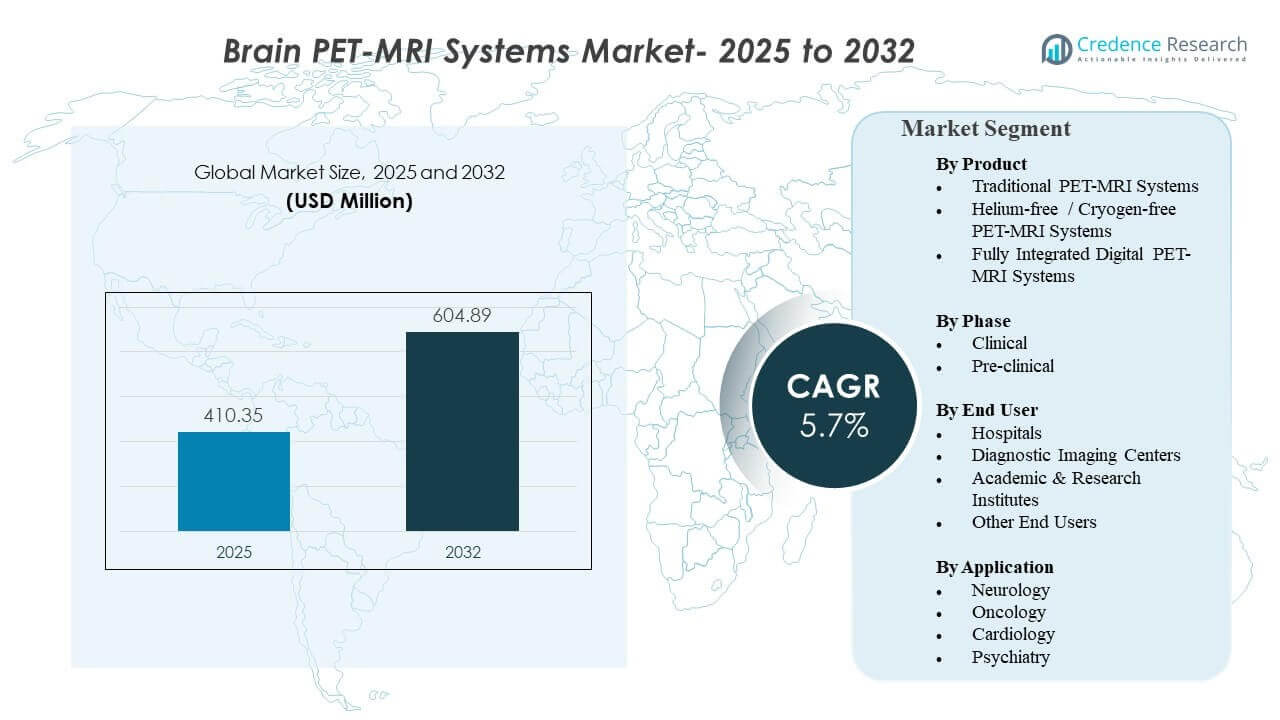
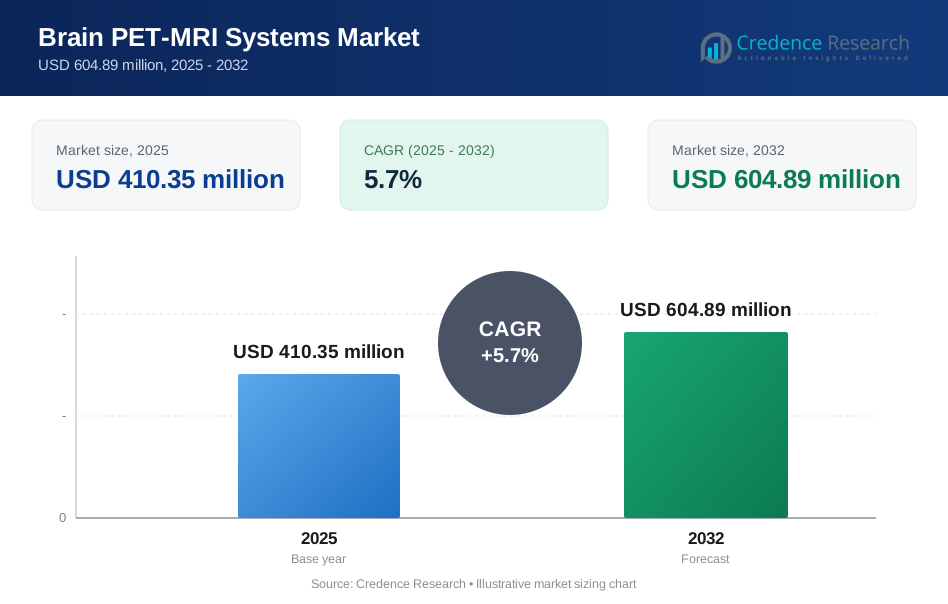
The global Brain PET-MRI Systems Market size was estimated at USD 410.35 million in 2025 and is expected to reach USD 604.89 million by 2032, growing at a CAGR of 5.7% from 2025 to 2032. The Brain PET-MRI Systems Market expansion is supported by rising demand for multimodal neuroimaging that can combine metabolic PET signals with high-resolution MRI for improved lesion characterization and therapy monitoring. The Brain PET-MRI Systems Market outlook is also influenced by technology upgrades that improve workflow efficiency and reduce operating constraints associated with conventional cryogen requirements.
| REPORT ATTRIBUTE | DETAILS |
|---|---|
| Historical Period | 2020-2024 |
| Base Year | 2025 |
| Forecast Period | 2026-2032 |
| Brain PET-MRI Systems Market Size 2025 | USD 410.35 million |
| Brain PET-MRI Systems Market, CAGR | 5.7% |
| Brain PET-MRI Systems Market Size 2032 | USD 604.89 million |
Key Market Trends & Insights
- The global Brain PET-MRI Systems Market is projected to grow at a CAGR of 5.7% during 2025–2032, reaching USD 604.89 million by 2032 from USD 410.35 million in 2025.
- Traditional PET-MRI Systems accounted for the largest share of 76.90% in 2025, reflecting stronger installed-base preference and established clinical workflows.
- Clinical phase usage represented 61.20% share in 2025, supported by protocol standardization and expanding hybrid imaging utilization in routine care pathways.
- Hospitals held 54.60% share in 2025, driven by integrated nuclear medicine infrastructure and multidisciplinary referral networks.
- North America accounted for 41.30% share in 2025, supported by higher technology adoption, reimbursement depth, and concentration of advanced imaging centers.
Segment Analysis
The Brain PET-MRI Systems Market reflects a high-capex purchase environment in which buyers prioritize validated performance, service support, and throughput reliability. Brain PET-MRI Systems Market procurement decisions typically include total cost of ownership factors such as suite buildout, shielding, and specialized staffing, which can push total installation costs above typical standalone MRI projects. Brain PET-MRI Systems Market adoption is also influenced by utilization economics, since financial feasibility improves when scan volumes remain consistently high across neuro-oncology and advanced neurology pathways.
The Brain PET-MRI Systems Market dynamics also reflect operating-cost sensitivity tied to cryogen management and energy use. Brain PET-MRI Systems Market demand for helium-free or cryogen-free configurations is strengthened by efforts to reduce helium dependency and stabilize lifecycle costs. Brain PET-MRI Systems Market workflows increasingly emphasize faster reconstructions, motion correction, and quantitative analysis that can improve clinical confidence and reduce repeat imaging. Brain PET-MRI Systems Market growth is further supported by expanding research pipelines that require multimodal biomarkers for therapy stratification and response tracking.
By Product Insights
Traditional PET-MRI Systems accounted for the largest share of 76.90% in 2025. Traditional PET-MRI Systems lead because hospitals and advanced imaging sites often prioritize clinically established platforms with broader protocol libraries and trained operator familiarity. Traditional PET-MRI Systems also benefit from existing service ecosystems and integration pathways that reduce commissioning risk. Helium-free and digital-oriented configurations gain traction as buyers seek improved operational stability and future-ready performance without disrupting mature clinical pathways.
By Phase Insights
Clinical accounted for the largest share of 61.20% in 2025. Clinical adoption leads because patient pathways in neuro-oncology and neurodegenerative disease increasingly rely on imaging-supported decision making, which supports routine hybrid imaging utilization. Clinical settings also benefit from standardized operating procedures, established radiotracer logistics, and multidisciplinary interpretation frameworks. Pre-clinical systems grow from translational neuroscience demand, but clinical settings retain the majority share due to higher scan volumes and wider care delivery reach.
By End User Insights
Hospitals accounted for the largest share of 54.60% in 2025. Hospitals lead because hospital systems can combine nuclear medicine operations, radiopharmacy access, and specialty neurology and oncology service lines under one organizational structure. Hospitals also gain stronger scheduling flexibility and referral capture for advanced imaging, supporting better utilization per installed system. Diagnostic imaging centers expand through outpatient network growth, but hospital dominance remains supported by complex-case concentration and integrated care pathways.
By Application Insights
Oncology accounted for the largest share of 44.30% in 2025. Oncology leadership is supported by demand for tumor characterization, therapy response monitoring, and improved delineation in challenging brain lesions where multimodal signals can improve interpretation confidence. Oncology workflows also tend to justify higher-cost imaging through treatment planning value and longitudinal follow-up requirements. Neurology and psychiatry expand with biomarker-driven pathways and clinical trial imaging, but oncology remains the largest near-term demand pool for brain-focused PET-MRI utilization.
Brain PET-MRI Systems Market Drivers
Rising demand for multimodal brain imaging in complex neurological care
The Brain PET-MRI Systems Market growth is driven by care pathways that require both metabolic and structural information for diagnostic certainty. The Brain PET-MRI Systems Market benefits from neuro-oncology and neurodegenerative disease workflows where PET adds functional insight and MRI provides anatomic precision. The Brain PET-MRI Systems Market also gains support from expanding emphasis on quantitative imaging endpoints in treatment monitoring. The Brain PET-MRI Systems Market adoption increases when hybrid imaging reduces diagnostic ambiguity and supports clearer clinical decisions.
Technology upgrades improving workflow efficiency and image quality
The Brain PET-MRI Systems Market is supported by advances in detector technology, reconstruction methods, and motion correction that improve usability and throughput. The Brain PET-MRI Systems Market benefits when improved image quality reduces rescans and strengthens diagnostic confidence in small or subtle lesions. The Brain PET-MRI Systems Market demand increases as automation features reduce operator burden and improve consistency across sites. The Brain PET-MRI Systems Market also sees replacement demand as installed systems undergo refresh cycles aligned with software and hardware upgrades.
- For instance, GE HealthCare’s SIGNA PET/MR uses SiPM time-of-flight PET detectors with a 25 cm axial PET field of view, 21.0 cps/kBq sensitivity, and less than 400 psec timing resolution, while its PET/MR coil configuration is designed to reduce coil changes and help shorten total exam duration.
Operating-cost stability and sustainability focus favoring helium-free designs
The Brain PET-MRI Systems Market is influenced by the need to reduce lifecycle cost volatility associated with cryogen supply and maintenance requirements. The Brain PET-MRI Systems Market demand for helium-free or cryogen-free PET-MRI configurations grows as providers prioritize operational continuity and sustainability goals. The Brain PET-MRI Systems Market adoption is supported when reduced cryogen dependency simplifies site management and lowers risk of downtime. The Brain PET-MRI Systems Market also benefits when energy efficiency becomes a procurement criterion in capital committee decisions.
- For instance, MR Solutions’ MRS*PET/MR 7.0T uses cryogen-free DRYMAG technology that does not require liquid helium, supports gradient strength up to 2000 mT/m, and specifies PET field of view dimensions of up to 200 mm axially and 200 mm transaxially, directly addressing cryogen dependence and installation complexity.
Expansion of research pipelines and translational neuroscience programs
The Brain PET-MRI Systems Market gains momentum from research institutions and pharma-sponsored studies that require multimodal biomarkers. The Brain PET-MRI Systems Market demand rises as neurodegenerative therapy development and brain oncology trials increase imaging intensity and analytical rigor. The Brain PET-MRI Systems Market adoption strengthens when translational programs use PET-MRI to align preclinical and clinical endpoints. The Brain PET-MRI Systems Market also benefits from collaborations that accelerate protocol standardization and quantitative analysis readiness.
Brain PET-MRI Systems Market Challenges
The Brain PET-MRI Systems Market faces adoption friction due to high upfront capital requirements, complex site preparation, and specialized staffing needs. The Brain PET-MRI Systems Market also encounters procurement constraints when competing priorities exist for MRI, CT, and PET-CT upgrades. The Brain PET-MRI Systems Market demand can be limited in smaller hospitals where scan volumes cannot consistently justify premium system costs. The Brain PET-MRI Systems Market expansion is further slowed when payers and providers require stronger cost-effectiveness evidence for routine utilization.
- For instance, Siemens Healthineers’ Biograph mMR combines a 3 Tesla magnet, a 60 cm bore, MQ gradients rated at 45 mT/m with 200 T/m/s slew rate, and up to 102 channels, reflecting the kind of high-specification integrated platform that can intensify capital approval and installation complexity for brain PET-MRI adoption.
The Brain PET-MRI Systems Market also faces operational complexity challenges linked to scheduling, tracer coordination, and multidisciplinary interpretation workflows. The Brain PET-MRI Systems Market utilization can be constrained by limited radiotracer access and on-site nuclear medicine capabilities in certain geographies. The Brain PET-MRI Systems Market growth can be affected by integration hurdles across PACS, analytics platforms, and cross-modality reporting standards. The Brain PET-MRI Systems Market adoption improves when vendors provide training and workflow support, but operational ramp-up remains a barrier in low-experience sites.
Brain PET-MRI Systems Market Trends and Opportunities
The Brain PET-MRI Systems Market is seeing increased interest in quantitative imaging and AI-enabled reconstruction to support faster reads and stronger reproducibility. The Brain PET-MRI Systems Market benefits when advanced software improves motion correction and strengthens image interpretability in challenging patient populations. The Brain PET-MRI Systems Market opportunities expand as multimodal biomarkers gain relevance in therapy stratification and longitudinal monitoring. The Brain PET-MRI Systems Market also trends toward integrated data pipelines that support research-grade analytics in clinical environments.
The Brain PET-MRI Systems Market opportunities are also supported by growing outpatient neuro-oncology and advanced neurology networks that can increase system utilization. The Brain PET-MRI Systems Market can benefit from partnerships between vendors and academic centers that validate new protocols and broaden clinical confidence. The Brain PET-MRI Systems Market growth potential increases when helium-free systems reduce operating constraints and simplify long-term planning. The Brain PET-MRI Systems Market expansion also aligns with increasing adoption of hybrid imaging in precision medicine initiatives.
- For instance, Philips reports that its BlueSeal MRI technology operates with only 7 liters of helium in a permanently sealed cryogenic circuit, requires no vent pipe, is up to 1,700 kg lighter, and can keep the magnet cold and superconductive for more than 4 hours during a power outage, demonstrating how helium-free MRI architecture can ease siting and operational planning for advanced neuroimaging infrastructure.
Regional Insights
North America
North America accounted for 41.30% share in 2025, supported by strong technology adoption, reimbursement depth, and concentration of tertiary care centers. The Brain PET-MRI Systems Market in North America benefits from higher availability of specialized neuro-oncology programs and research hospitals that can sustain utilization. The Brain PET-MRI Systems Market growth also aligns with clinical trial intensity and advanced imaging infrastructure readiness.
Europe
Europe represented 27.60% share in 2025, supported by mature imaging networks and strong academic research participation across major countries. The Brain PET-MRI Systems Market in Europe benefits from established nuclear medicine capabilities and structured clinical pathways in large public hospital systems. The Brain PET-MRI Systems Market growth is supported when national health systems prioritize high-value diagnostics for complex neurological and oncology cases.
Asia Pacific
Asia Pacific held 22.40% share in 2025, with growth supported by rising investment in advanced imaging capacity and expansion of specialty hospital networks. The Brain PET-MRI Systems Market in Asia Pacific benefits from increasing research activity and greater focus on neurodegenerative care demand. The Brain PET-MRI Systems Market adoption is supported as large urban hospitals and academic hubs expand hybrid imaging infrastructure.
Latin America
Latin America accounted for 4.90% share in 2025, reflecting selective adoption concentrated in large private hospitals and flagship academic centers. The Brain PET-MRI Systems Market in Latin America is influenced by capital budget constraints and uneven radiotracer ecosystem availability. The Brain PET-MRI Systems Market growth improves when diagnostic networks expand and vendor financing models reduce procurement barriers.
Middle East & Africa
Middle East & Africa represented 3.80% share in 2025, with demand concentrated in premium diagnostic centers and major referral hospitals in select countries. The Brain PET-MRI Systems Market in Middle East & Africa is shaped by infrastructure readiness, specialized staffing availability, and investment cycles in healthcare modernization. The Brain PET-MRI Systems Market expansion strengthens as tertiary care capacity grows and multidisciplinary oncology programs scale.
Competitive Landscape
The Brain PET-MRI Systems Market remains competitive, with leading participants focusing on performance upgrades, workflow integration, and service depth to reduce adoption friction for hybrid imaging. The Brain PET-MRI Systems Market competition also reflects differentiation across detector technology, reconstruction software, motion correction, and integration with enterprise imaging ecosystems. The Brain PET-MRI Systems Market vendor strategies commonly include partnerships with academic centers, installed-base upgrades, and ecosystem interoperability to support long-term customer retention. The Brain PET-MRI Systems Market also sees competition across both clinical and preclinical configurations, reflecting diverse buyer needs.
Siemens Healthineers AG maintains a strong position in hybrid imaging through platform innovation, clinical workflow optimization, and broad enterprise imaging integration capabilities. The Brain PET-MRI Systems Market presence for Siemens Healthineers AG is supported by continued product introductions and ecosystem development designed to improve usability and quantitative readiness. The Brain PET-MRI Systems Market approach for Siemens Healthineers AG also emphasizes interoperability and clinical adoption support through service and training networks. The Brain PET-MRI Systems Market competitiveness for Siemens Healthineers AG strengthens as advanced reconstruction and system efficiency improvements lower barriers for routine utilization.
The industry research and growth report includes detailed analyses of the competitive landscape of the market and information about key companies, including:
- Siemens Healthineers AG
- GE HealthCare
- Koninklijke Philips N.V.
- Bruker
- Mediso Ltd.
- MR Solutions
- Cubresa Inc.
- Canon Medical Systems Corporation
Qualitative and quantitative analysis of companies has been conducted to help clients understand the wider business environment as well as the strengths and weaknesses of key industry players. Data is qualitatively analyzed to categorize companies as pure play, category-focused, industry-focused, and diversified; it is quantitatively analyzed to categorize companies as dominant, leading, strong, tentative, and weak.
Recent Developments
- In February 2025, Cubresa entered a partnership with Siemens Healthineers through a global Master Interface Agreement for the Cubresa BrainPET scanner. According to the announcement, the agreement supports development and compatibility testing of BrainPET with Siemens Healthineers MAGNETOM MRI scanners, and the BrainPET system is designed for brain-optimized simultaneous PET/MR imaging using a low-profile retrofit approach.
- In February 2026, Siemens Healthineers and Mayo Clinic expanded their strategic collaboration, adding a Whole Body PET/CT and PET/MR innovation center to their joint priorities. The expanded collaboration also includes work in neurodegenerative disease focused on AI-enabled MRI protocols, while the PET/MR component is intended to support simultaneous anatomical and metabolic MR imaging for more precise diagnostic and therapeutic planning.
- In February 2026, Siemens Healthineers AG expanded its strategic collaboration with Mayo Clinic, adding work in neurodegenerative disease and a Whole Body PET/CT & PET/MR innovation center, which is highly relevant to advanced brain and hybrid imaging development.
Report Scope
| Report Attribute | Details |
| Market size value in 2025 | USD 410.35 million |
| Revenue forecast in 2032 | USD 604.89 million |
| Growth rate (CAGR) | 5.7% (2025–2032) |
| Base year | 2025 |
| Forecast period | 2026-2032 |
| Quantitative units | USD million |
| Segments covered | By Product; By Phase; By End User; By Application |
| Regional scope | North America, Europe, Asia Pacific, Latin America, Middle East & Africa |
| Key companies profiled | Siemens Healthineers AG, GE HealthCare, Koninklijke Philips N.V., Bruker, Mediso Ltd., MR Solutions, Cubresa Inc., Canon Medical Systems Corporation |
| No. of Pages | 330 |
Segmentation
By Product
- Traditional PET-MRI Systems
- Helium-free / Cryogen-free PET-MRI Systems
- Fully Integrated Digital PET-MRI Systems
By Phase
- Clinical
- Pre-clinical
By End User
- Hospitals
- Diagnostic Imaging Centers
- Academic & Research Institutes
- Other End Users
By Application
- Neurology
- Oncology
- Cardiology
- Psychiatry
By Region
- North America
- U.S.
- Canada
- Mexico
- Europe
- Germany
- France
- U.K.
- Italy
- Spain
- Rest of Europe
- Asia Pacific
- China
- Japan
- India
- South Korea
- South-east Asia
- Rest of Asia Pacific
- Latin America
- Brazil
- Argentina
- Rest of Latin America
- Middle East & Africa
- GCC Countries
- South Africa
- Rest of the Middle East and Africa
Request a Free Sample
Fill in your details and we'll send you a free sample report.
- Sample data tables & charts
- Research methodology
Need a Custom Version of This Report?
Tailor the scope, geography, or segments to your exact requirements.
- Custom geography or segment scope
- Direct access to our analyst team
Frequently Asked Questions
What is the current market size of the Brain PET-MRI Systems Market?
What is the forecast value of the Brain PET-MRI Systems Market?
What is the CAGR for the Brain PET-MRI Systems Market during 2025–2032?
Which segment holds the largest share in the Brain PET-MRI Systems Market?
Who are the leading companies in the Brain PET-MRI Systems Market?
Which region leads the Brain PET-MRI Systems Market?
Table of Content
Chapter 1. Report Introduction
- 1.1 Report Description & Purpose
- 1.1.1 Report Title & Market Definition
- 1.1.2 Unique Selling Propositions (USP) & Key Differentiators
- 1.1.3 Value Proposition for Stakeholders
- 1.2 Research Objectives
- 1.2.1 Market Sizing Objectives (Volume & Revenue)
- 1.2.2 Segmentation Objectives
- 1.2.3 Competitive Intelligence Objectives
- 1.2.4 Forecast & Scenario Objectives
- 1.3 Report Scope
- 1.3.1 Brain PET-MRI Systems Scope – Types & Subtypes Covered
- 1.3.2 Geographic Scope – Regions & Countries Covered
- 1.3.3 Historical Period, Base Year & Forecast Period (2025; forecast to 2032)
- 1.3.4 Inclusions & Exclusions
- 1.4 HS Code & Classification Framework
- 1.5 Currency, Units & Pricing Basis
- 1.6 Target Stakeholders
- 1.7 Limitations & Assumptions
Chapter 2. Executive Summary
- 2.1 Global Brain PET-MRI Systems Market Snapshot
- 2.1.1 Market Size – Historical (2025) & Forecast (2025-2032) (2025: USD 410.35 million → 2032: USD 604.89 million)
- 2.1.2 Volume & Revenue – Global Totals
- 2.1.3 Key Market Highlights – Top Five Facts
- 2.2 Brain PET-MRI Systems Market Segmentation Snapshot
- 2.2.1 Market Split by Region – 2025 vs. 2032
- 2.3 Competitive Snapshot
- 2.3.1 Top 10 Players by Revenue Share – 2025
- 2.3.2 Top 10 Players by Volume Share – 2025
- 2.3.3 Recent Strategic Developments (18-Month Summary)
- 2.4 Key Investment Highlights & Strategic Conclusions
Chapter 3. Brain PET-MRI Systems Market Dynamics & Industry Analysis
- 3.1 Market Overview & Context
- 3.1.1 Brain PET-MRI Systems Market Position in the Broader Automotive Value Chain
- 3.1.2 OEM vs. Replacement Market Dynamics
- 3.1.3 Market Maturity & Development Stage by Region
- 3.2 Brain PET-MRI Systems Market Drivers
- 3.3 Brain PET-MRI Systems Market Restraints & Challenges
- 3.4 Brain PET-MRI Systems Market Opportunities
- 3.5 Porter's Five Forces Analysis
- 3.5.1 Threat of New Entrants
- 3.5.2 Bargaining Power of Suppliers
- 3.5.3 Bargaining Power of Buyers
- 3.5.4 Threat of Substitutes
- 3.5.5 Competitive Rivalry – Intensity Assessment
- 3.6 Brain PET-MRI Systems Value Chain Analysis
- 3.6.1 Upstream – Raw Material/Input Suppliers
- 3.6.1.1 Raw Material/Input 1
- 3.6.1.2 Raw Material/Input 2
- 3.6.1.3 Raw Material/Input 3
- 3.6.2 Midstream – Production/Manufacturing/Service Delivery
- 3.6.2.1 Production/Process Overview
- 3.6.2.2 Key Facility Locations & Capacity by Manufacturer
- 3.6.3 Downstream – Distribution & End Consumer
- 3.6.3.1 Primary Channel – B2B/OEM
- 3.6.3.2 Secondary Channels – Dealer, Retail, Online, Direct
- 3.6.4 Value Chain Profitability Analysis
- 3.6.1 Upstream – Raw Material/Input Suppliers
- 3.7 PESTEL Analysis
- 3.7.1 Political Factors
- 3.7.2 Economic Factors
- 3.7.3 Social Factors
- 3.7.4 Technological Factors
- 3.7.5 Environmental Factors
- 3.7.6 Legal Factors
- 3.8 Brain PET-MRI Systems Supply Chain Analysis
- 3.8.1 Raw Material/Input Supply Risk Assessment
- 3.8.2 Manufacturing Concentration Risk (Geographic Exposure)
- 3.8.3 Trade Disruption Impact Analysis
- 3.9 Regulatory & Policy Landscape
Note: The regulatory and policy landscape section covers regulations based on their applicability to the market, Brain PET-MRI Systems category, geography, and scope of the study. Only regulatory frameworks with a material impact on operations, compliance, trade, sustainability, or market access are analyzed in detail.
Chapter 4. Key Investment Pockets & Opportunity Analysis
- 4.1 Brain PET-MRI Systems Market Attractiveness Analysis
- 4.1.1 By Region – Investment Attractiveness Matrix (Volume × CAGR)
- 4.2 Absolute Revenue Growth Opportunity
- 4.2.1 By Region – Absolute USD Growth Through 2032
- 4.3 Incremental Volume Opportunity
- 4.3.1 By Region – Incremental Volume Through 2032
- 4.3.2 Segment – Incremental Volume
- 4.4 Emerging Submarket Opportunity Deep Dive (Subject to Applicability)
- 4.5 Emerging Market Opportunity Scorecards
- 4.5.1 United States
- 4.5.2 Europe
- 4.5.3 Asia
- 4.5.4 Middle East & Africa
Note: Emerging Market Opportunity Scorecards will be included based on relevance and strategic importance. Regions listed are indicative and may vary depending on data availability and market dynamics.
Chapter 5. Brain PET-MRI Systems Import-Export Analysis & Trade Flows
- 5.1 Global Trade Overview
- 5.1.1 Global Export Value by Country (2025)
- 5.1.2 Global Export Volume by Country (2025)
- 5.1.3 Global Import Value by Country (2025)
- 5.1.4 Global Import Volume by Country (2025)
- 5.1.5 Net Trade Balance by Country (2025)
- 5.2 Export Analysis – Segment
- 5.2.1 Type 1 (HS Code)
- 5.2.2 Type 2 (HS Code)
- 5.2.3 Type 3 (HS Code)
- 5.2.4 Type 4 (HS Code)
- 5.2.5 Type 5 (HS Code)
- 5.3 Import Analysis – Segment
- 5.3.1 Type 1 (HS Code)
- 5.3.2 Type 2 (HS Code)
- 5.3.3 Type 3 (HS Code)
- 5.3.4 Type 4 (HS Code)
- 5.3.5 Type 5 (HS Code)
- 5.4 Average Unit Trade Prices
- 5.4.1 Average Export Price – Segment & Country
- 5.4.2 Average Import Price – Segment & Source Country
- 5.4.3 Price Trends (2025)
- 5.5 Key Trade Route Analysis
- 5.5.1 Trade Route 1
- 5.5.2 Trade Route 2
- 5.5.3 Trade Route 3
- 5.5.4 Trade Route 4
- 5.5.5 Trade Route 5
- 5.6 Trade Policy Impact Assessment
- 5.6.1 US Anti-Dumping & Section 301 Tariffs
- 5.6.2 EU Customs Union Impact
- 5.6.3 Major Free Trade Agreements
- 5.6.4 USMCA Rules of Origin
Note: Trade policy analysis will be included only where relevant to the Brain PET-MRI Systems market.
Chapter 6. Competitive Landscape & Company Benchmarking
- 6.1 Brain PET-MRI Systems Market Concentration & Structure
- 6.1.1 Herfindahl-Hirschman Index (HHI) – vs. 2025
- 6.1.2 Tier 1, Tier 2 & Tier 3 Market Structure
- 6.1.3 Global, Regional & Local Player Dynamics
- 6.2 Brain PET-MRI Systems Market Share Analysis – 2025
- 6.2.1 Global Revenue Share by Company
- 6.2.2 Global Volume Share by Company
- 6.2.3 Regional Revenue Share
- 6.2.4 Market Share Evolution ( vs. 2025)
- 6.2.5 OEM Segment Share by Company
- 6.2.6 Replacement Segment Share by Company
- 6.3 Production/Delivery Capacity & Facility Analysis
- 6.3.1 Global Installed Capacity
- 6.3.2 Capacity Utilization Rates
- 6.3.3 Production/Output Volume
- 6.3.4 Facility Locations & Capacity Map
- 6.3.5 Planned Capacity Additions
- 6.4 Brain PET-MRI Systems Competitive Benchmarking Matrix
- 6.4.1 Revenue, Volume, CAGR & Profitability Comparison
- 6.4.2 Channel Revenue Mix
- 6.4.3 Geographic Revenue Exposure
- 6.4.4 R&D Intensity
- 6.4.5 Sustainability Maturity
- 6.5 Strategic Developments in Brain PET-MRI Systems (Last 24 Months)
- 6.5.1 Mergers, Acquisitions & Divestments
- 6.5.2 New Brain PET-MRI Systems Launches
- 6.5.3 Facility Expansions
- 6.5.4 Strategic Alliances, Joint Ventures & Partnerships
- 6.5.5 Distribution Expansion & Market Entry
- 6.5.6 Sustainability & ESG Initiatives
- 6.6 Competitive Strategy Mapping
- 6.6.1 Leader, Challenger, Follower & Niche Classification
- 6.6.2 Pricing Strategy Comparison
- 6.6.3 Channel Strategy Matrix
Note: Strategic developments are included based on their materiality and the availability of reliable information.
Chapter 7. Global Brain PET-MRI Systems Market – By Distribution Channel
- 7.1 Segment Overview
- 7.1.1 Volume & Revenue Split by Channel (2025 & 2032)
- 7.1.2 Channel Mix Evolution (2025-2032)
Chapter 8. Regional Market Analysis – Global Overview
- 8.1 Global Regional Overview
- 8.1.1 Regional Volume Share
- 8.1.2 Regional Revenue Share
- 8.1.3 Regional Volume by Region
- 8.1.4 Regional Revenue by Region
- 8.1.5 Regional Forecast Through 2032
- 8.2 Cross-Regional Segment Analysis
- 8.2.1 By Distribution Channel
- 8.2.2 By Brand/Price Tier
Chapter 9. North America Brain PET-MRI Systems Market
- 9.1 United States
- 9.2 Canada
- 9.3 Mexico
Chapter 10. Europe Brain PET-MRI Systems Market
- 10.1 Germany
- 10.2 France
- 10.3 Italy
- 10.4 United Kingdom
- 10.5 Spain
- 10.6 Poland
- 10.7 Russia
- 10.8 Netherlands
- 10.9 Belgium
- 10.10 Sweden
- 10.11 Denmark
- 10.12 Norway
- 10.13 Rest of Europe
Chapter 11. Asia Pacific Brain PET-MRI Systems Market
- 11.1 China
- 11.2 India
- 11.3 Japan
- 11.4 South Korea
- 11.5 Thailand
- 11.6 Indonesia
- 11.7 Vietnam
- 11.8 Malaysia
- 11.9 Australia
- 11.10 Rest of Asia Pacific
Chapter 12. Latin America Brain PET-MRI Systems Market
- 12.1 Brazil
- 12.2 Argentina
- 12.3 Colombia
- 12.4 Chile
- 12.5 Rest of Latin America
Chapter 13. Middle East Brain PET-MRI Systems Market
- 13.1 Saudi Arabia
- 13.2 United Arab Emirates
- 13.3 Turkey
- 13.4 Israel
- 13.5 Iran
- 13.6 Rest of the Middle East
Chapter 14. Africa Brain PET-MRI Systems Market
- 14.1 South Africa
- 14.2 Egypt
- 14.3 Nigeria
- 14.4 Morocco
- 14.5 Rest of Africa
Chapter 15. Brain PET-MRI Systems Company Profiles
- 15.1 [Company 01]
- 15.1.1 Company Overview
- 15.1.2 Key Management Personnel
- 15.1.3 Products & Services Portfolio
- 15.1.4 Financial Performance
- 15.1.5 Key Market Focus & Geographic Presence
- 15.1.6 Recent Developments & Strategic Initiatives
Note: The company profile list is preliminary and may change based on research findings, market developments, data availability, and client requirements.
Chapter 16. Appendices
- Appendix A – List of Abbreviations & Acronyms
- Appendix B – Industry Classification Code Reference – Full Series
- Appendix C – Production & Capacity Data Tables
- Appendix D – End-Use & Demand Base Tables
- Appendix E – Consumption & Replacement Rate Assumptions
- Appendix F – ASP Reference Tables
- Appendix G – Manufacturing & Facility Database
- Appendix H – Import-Export Data Tables
- Appendix I – Regulatory Summary Tables
- Appendix J – Primary Research Participant List (Anonymized)
- Appendix K – Primary Research Questionnaire Framework
- Appendix L – Data Sources & Bibliography
- Appendix M – Market Size Divergence & Source Comparison
Chapter 17. Research Methodology
- 17.1 Research Framework & Philosophy
- 17.2 Secondary Research – Sources, Hierarchy & Data Extraction
- 17.3 Data Modeling – Bottom-Up & Top-Down Market Sizing
- 17.4 Primary Research – Stakeholder Framework, LOI & Sample Sizes
- 17.5 Forecast Methodology – Regression, Scenario & Sensitivity Analysis
- 17.6 Quality Control – Four-Layer Validation Framework
- 17.7 Limitations & Standard Assumptions
- 17.8 Disclaimer
