
Market Overview
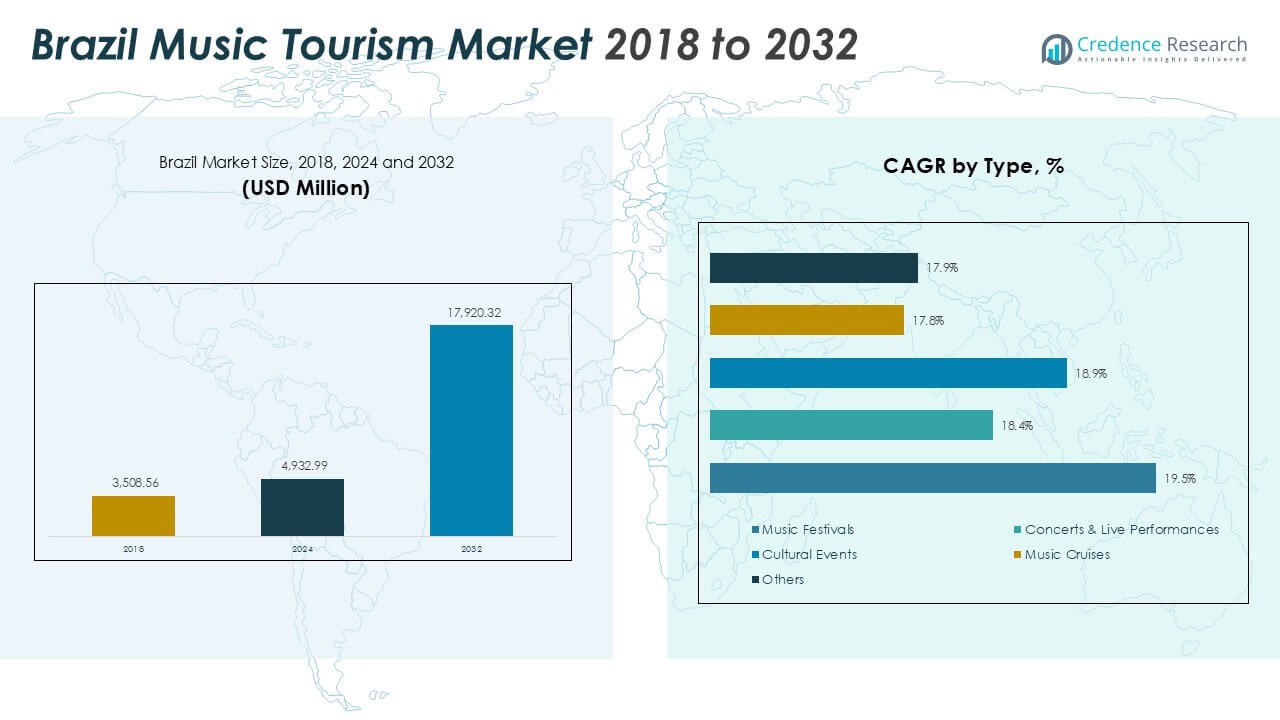
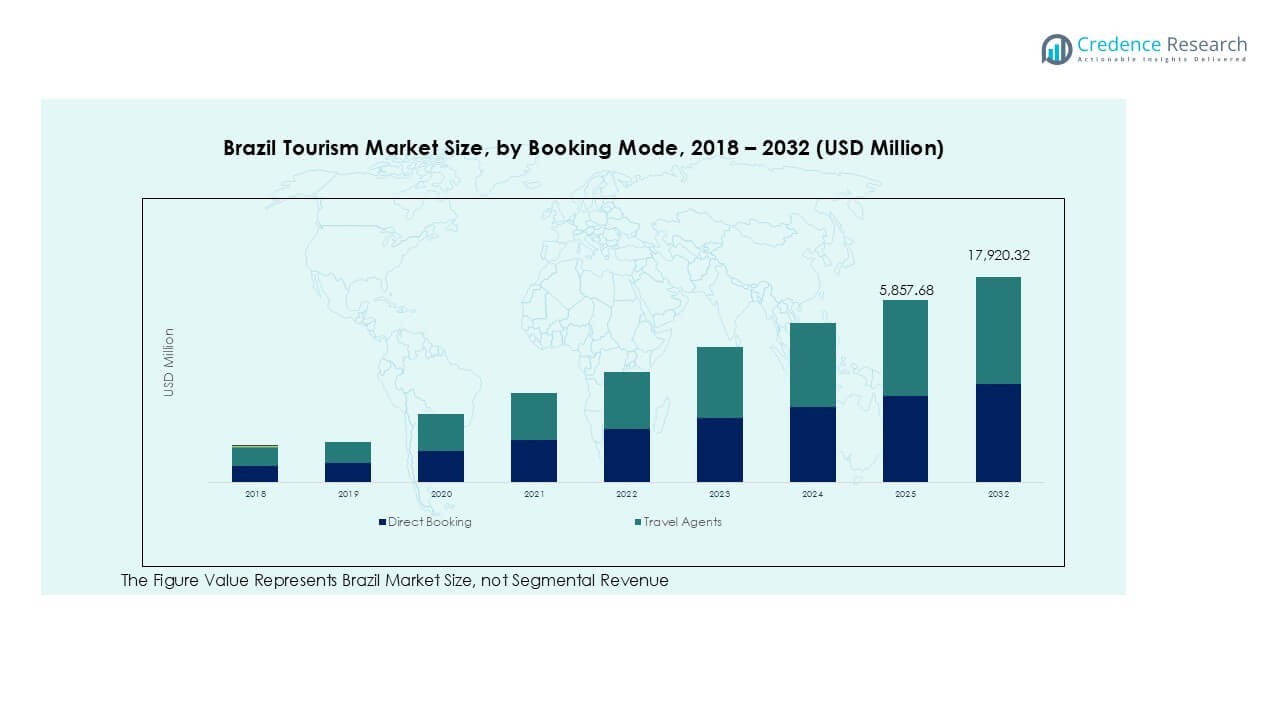
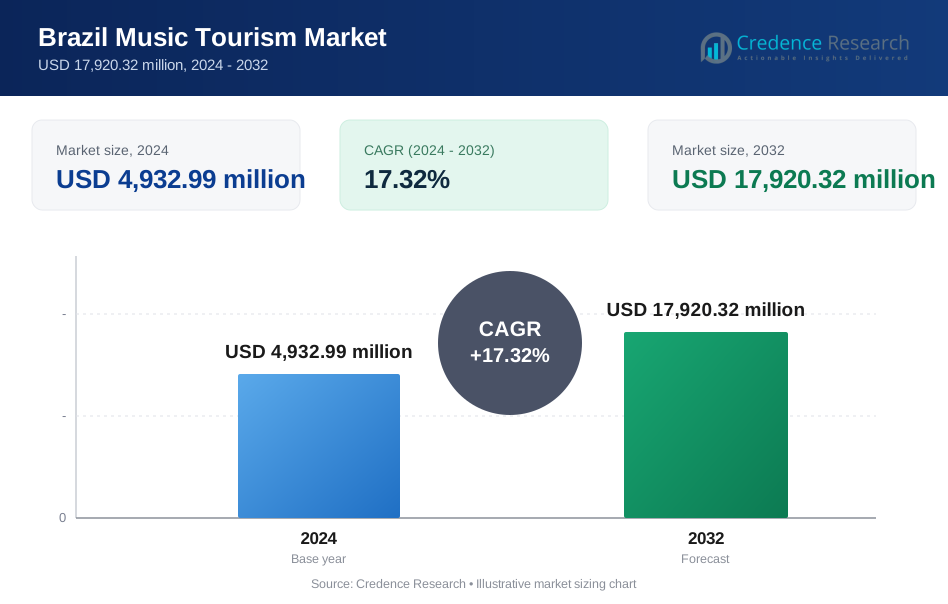
The Brazil Music Tourism market size was valued at USD 3,508.56 million in 2018 and grew to USD 4,932.99 million in 2024. It is anticipated to reach USD 17,920.32 million by 2032, expanding at a CAGR of 17.32% during the forecast period.
| REPORT ATTRIBUTE | DETAILS |
|---|---|
| Historical Period | 2020-2023 |
| Base Year | 2024 |
| Forecast Period | 2025-2032 |
| Brazil Music Tourism market Size 2024 | USD 4,932.99 Million |
| Brazil Music Tourism market, CAGR | 17.32% |
| Brazil Music Tourism market Size 2032 | USD 17,920.32 Million |
The Brazil Music Tourism market is led by prominent companies such as Live Nation Brazil, Time For Fun (T4F), Move Concerts Brazil, Rock in Rio, and Lollapalooza Brazil. These firms dominate large-scale festival organization, concert promotion, and international artist management, shaping Brazil’s global reputation as a top music destination. Live Nation Brazil and T4F hold strong positions through exclusive partnerships and extensive event portfolios, while Move Concerts Brazil enhances regional outreach. The Southeast region remains the leading hub, capturing around 48% of the total market share in 2024, supported by robust infrastructure, world-class venues, and high tourist inflow across São Paulo and Rio de Janeiro.
Market Insights
- The Brazil Music Tourism market was valued at USD 4,932.99 million in 2024 and is projected to reach USD 17,920.32 million by 2032, growing at a CAGR of 17.32% during the forecast period.
- Strong festival culture and growing youth participation drive market expansion, supported by international events like Rock in Rio and Lollapalooza Brazil that attract millions of visitors annually.
- Emerging trends include digital ticketing, virtual concert experiences, and sustainable “eco-festival” initiatives promoting green tourism and local cultural integration.
- The market is highly competitive, with leading players such as Live Nation Brazil, Time For Fun (T4F), and Move Concerts Brazil investing in large-scale event management and technology-driven audience engagement.
- Regionally, the Southeast dominates with a 48% share, followed by the Northeast at 26%, while the music festivals segment leads by type with 42% share, supported by urban infrastructure and international sponsorship growth.
Market Segmentation Analysis:
By Type
The music festivals segment dominated the Brazil Music Tourism market in 2024, accounting for nearly 42% of total revenue. The segment’s growth stems from Brazil’s rich cultural heritage and globally recognized events such as Rock in Rio, Lollapalooza Brazil, and Salvador Carnival. These festivals attract both domestic and international tourists seeking immersive musical and cultural experiences. Rising sponsorship from global brands and increasing digital promotion of live events further strengthen festival attendance. Additionally, the country’s strong infrastructure for large-scale outdoor concerts continues to support this segment’s leadership across urban and coastal destinations.
- For instance, Rock in Rio 2024 hosted over 730,000 attendees across seven days and featured 250 international and local acts, while Lollapalooza Brazil generated more than 35,000 hotel bookings in São Paulo during its three-day run, underscoring its strong tourism influence.
By Age Group
The 18–34 years segment led the Brazil Music Tourism market with around 46% share in 2024. This demographic actively participates in concerts, electronic dance festivals, and cultural events, driven by social media engagement and growing disposable income. Young travelers seek unique music experiences that combine entertainment, nightlife, and adventure. The segment benefits from budget-friendly travel options, online ticketing platforms, and group tour packages. Increased popularity of music-based social tourism among millennials and Gen Z further drives participation, making this group the largest contributor to market expansion.
- For instance, Rock in Rio's 2024 edition in Brazil attracted approximately 730,000 attendees over seven days, generating R$2.9 billion in economic impact for the city.
By End-User
The leisure travelers category held the dominant share of about 49% in 2024. Rising interest in combining vacations with live music experiences is boosting this segment’s appeal. Leisure tourists frequently attend music festivals, beach concerts, and cultural parades during seasonal breaks. Growing popularity of musical destinations such as Rio de Janeiro and São Paulo enhances travel bookings during major music events. Affordable flight connections, event-based tourism packages, and collaboration between music promoters and travel agencies are key drivers supporting sustained growth of the leisure traveler segment in Brazil’s music tourism landscape.
Key Growth Drivers
Expanding Festival Infrastructure and Global Recognition
Brazil’s expanding music festival infrastructure remains a core growth driver for its music tourism market. Events such as Rock in Rio, The Town, and Lollapalooza Brazil attract millions of visitors annually, positioning Brazil as a global entertainment hub. The government and private sector are investing heavily in stage technology, safety systems, and event logistics to enhance visitor experience. Improved accessibility through air and road networks, coupled with urban redevelopment near major venues, further boosts participation. Growing international sponsorships and digital marketing campaigns have also amplified the country’s visibility as a leading destination for music-driven travel experiences.
- For instance, The Town Festival 2023 in São Paulo drew more than 500,000 attendees over five days, featuring 235 artists and utilizing a 360° LED stage system developed by Robe Lighting.
Rising Youth Participation and Cultural Engagement
Youth engagement plays a vital role in expanding Brazil’s music tourism market. The 18–34 age group represents the largest segment, drawn to immersive musical experiences and vibrant nightlife. Increasing disposable income among millennials and Gen Z supports higher spending on concert tickets, travel, and accommodations. Social media platforms amplify awareness and event attendance, with influencers promoting festivals and live performances. Domestic and regional tourism programs now focus on promoting local artists and genres such as samba, bossa nova, and funk carioca. This cultural connection between modern and traditional music continues to attract a diverse youth audience.
- For instance, Lollapalooza Brazil 2024 took place from March 22 to 24 in São Paulo, attracting an estimated 240,000 visitors over the three days.
Government Support and Tourism Integration Initiatives
Government-led initiatives promoting cultural and entertainment tourism have strengthened Brazil’s position as a music destination. Programs by the Ministry of Tourism encourage collaboration between event organizers, local governments, and international promoters. Simplified visa processes, infrastructure upgrades, and targeted marketing under campaigns like “Visit Brazil” have boosted inbound tourism for music events. Partnerships with airlines and hospitality providers offer discounted travel packages during major festivals. Additionally, regional governments are investing in smaller-scale music events to promote lesser-known destinations, diversifying tourism income beyond major cities. These efforts collectively enhance Brazil’s competitiveness in the global music tourism landscape.
Key Trends and Opportunities
Integration of Digital Platforms and Virtual Engagement
Digital transformation is shaping the future of Brazil’s music tourism industry. Event organizers are adopting advanced ticketing platforms, mobile apps, and AI-driven marketing tools to improve user convenience and engagement. Virtual concerts and hybrid music festivals gained traction post-pandemic, allowing fans to experience performances remotely while planning future trips. Influencer-led campaigns and real-time social media interactions have enhanced event visibility globally. The trend toward digital engagement provides opportunities for streaming partnerships, immersive AR experiences, and real-time travel coordination, expanding revenue beyond physical event attendance.
- For instance, Rock in Rio 2024 embraced digital integration, partnering with platforms like YouTube and TikTok to livestream performances and expand its global reach. Similarly, ticket vendors like Eventim Brasil used their mobile platforms to process a large volume of digital transactions, reflecting the growing trend of integrating digital and on-site engagement.
Sustainable Tourism and Eco-Music Experiences
Sustainability has become a defining trend in Brazil’s tourism sector, influencing how music events are organized and promoted. Festival organizers are adopting eco-friendly practices such as waste reduction, renewable energy use, and carbon-neutral logistics. Destinations like Bahia and Florianópolis are introducing “eco-festivals” that blend music with environmental education and cultural preservation. Travelers increasingly prefer socially responsible events that minimize ecological impact while promoting local artisans and communities. This shift presents opportunities for brands and promoters to align with sustainability goals, enhancing brand loyalty and long-term tourism growth.
Key Challenges
Infrastructure Limitations and Event Management Issues
Despite progress, infrastructure gaps remain a major barrier to consistent music tourism growth in Brazil. Smaller cities often lack adequate transport connectivity, accommodation, and event safety measures. During large-scale festivals, overcrowding and logistical inefficiencies can strain local systems and affect visitor satisfaction. Weather-related disruptions and inconsistent local coordination further challenge event execution. Addressing these gaps requires sustained investment in transportation, crowd management, and smart venue planning. Enhanced collaboration between public authorities and private stakeholders is crucial to ensure safety, efficiency, and positive tourist experiences.
Economic Volatility and Currency Fluctuations
Economic instability and currency fluctuations continue to pose challenges for Brazil’s music tourism market. Periodic inflation and exchange rate shifts increase travel and operational costs, discouraging both domestic and international visitors. Event organizers face difficulties in pricing tickets and managing import costs for equipment and international artists. Moreover, reduced consumer confidence during downturns can lower discretionary spending on entertainment and travel. Maintaining affordability while ensuring quality event experiences remains a balancing act. Strategic pricing, partnerships, and flexible travel packages can help mitigate these financial challenges in the evolving tourism landscape.
Regional Analysis
Southeast Brazil
The Southeast region dominated the Brazil Music Tourism market in 2024, accounting for around 48% of total revenue. Cities like São Paulo and Rio de Janeiro serve as the country’s primary music tourism hubs, hosting global festivals such as Rock in Rio and The Town. The region’s strong infrastructure, international flight connectivity, and hospitality sector support large-scale music events. Government-backed cultural programs and private sponsorships continue to attract both domestic and international travelers. Expanding urban nightlife and diverse music genres, including samba, funk, and rock, further solidify the Southeast’s leadership in Brazil’s music tourism landscape.
Northeast Brazil
The Northeast region captured nearly 26% of the market share in 2024, driven by vibrant cultural festivals and strong local participation. Popular destinations like Salvador, Recife, and Fortaleza attract large crowds through Carnival celebrations, Axé music festivals, and beach concerts. The region’s fusion of Afro-Brazilian music traditions and modern rhythms enhances its cultural appeal. Tourism boards actively promote sustainable and community-driven events, boosting regional economic impact. The combination of scenic coastal venues, rich heritage, and festive atmosphere continues to make the Northeast a dynamic center for music-inspired tourism growth in Brazil.
South Brazil
The South region accounted for about 14% of Brazil’s music tourism market in 2024, supported by rising demand for regional music festivals and open-air concerts. Cities such as Curitiba, Porto Alegre, and Florianópolis have gained attention for hosting indie, electronic, and folk music events. The area’s cooler climate and organized urban structure attract both young domestic travelers and international visitors. Growth in boutique festivals and university-led cultural initiatives is further strengthening tourism potential. Improved transport links and increased hotel capacity continue to position the South as an emerging contributor to Brazil’s diversified music tourism ecosystem.
Central-West Brazil
The Central-West region represented nearly 8% of the national market in 2024. Brasília, Goiânia, and Campo Grande are emerging destinations known for sertanejo and country music festivals. The region’s expanding event calendar and affordable travel options attract domestic tourists from neighboring states. Infrastructure development and government-backed tourism initiatives are improving accessibility to remote event locations. Growing collaboration between local artists, sponsors, and municipalities fosters community engagement and new cultural experiences. Although smaller than coastal markets, Central-West Brazil shows strong potential as an inland hub for authentic and regionally themed music tourism.
North Brazil
The North region held an estimated 4% share of the Brazil Music Tourism market in 2024. Cities like Manaus and Belém host culturally rich events blending indigenous, folk, and Amazonian musical traditions. Festivals such as Festival Folclórico de Parintins attract both local audiences and international visitors seeking unique cultural immersion. Limited infrastructure and accessibility challenges have restrained broader market expansion, but ongoing investment in eco-tourism and river-based music cruises is creating niche growth opportunities. The North’s distinctive soundscapes and cultural authenticity position it as a promising frontier for experiential music tourism in Brazil.
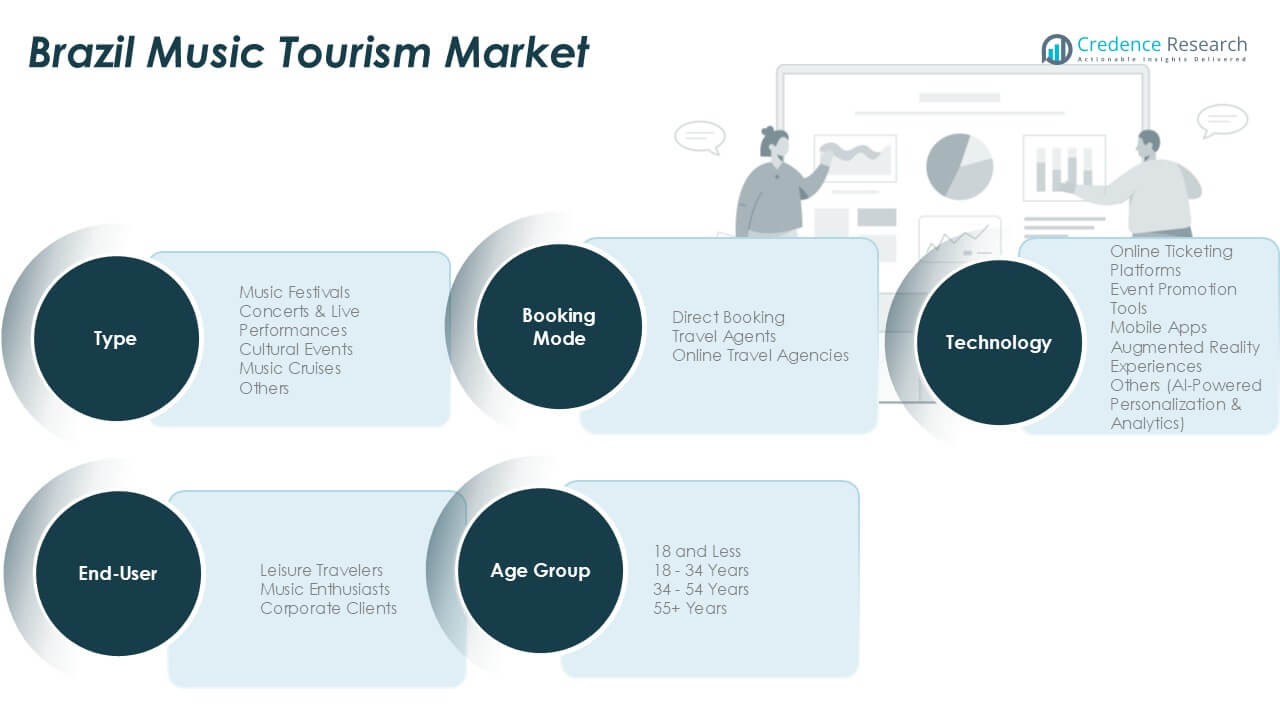
Market Segmentations:
By Type
- Music Festivals
- Concerts & Live Performances
- Cultural Events
- Music Cruises
- Others
By Age Group
- 18 and Less
- 18–34 Years
- 34–54 Years
- 55+ Years
By End-User
- Leisure Travelers
- Music Enthusiasts
- Corporate Clients
By Technology
- Online Ticketing Platforms
- Event Promotion Tools
- Mobile Apps
- Augmented Reality Experiences
- Others (AI-Powered Personalization & Analytics)
By Booking Mode
- Direct Booking
- Travel Agents
- Online Travel Agencies
By Geography
- Southeast Brazil
- Northeast Brazil
- South Brazil
- Central-West Brazil
- North Brazil
Competitive Landscape
The Brazil Music Tourism market features a dynamic and competitive landscape dominated by event organizers, promoters, and ticketing platforms that shape the nation’s entertainment ecosystem. Major players such as Live Nation Brazil, Time For Fun (T4F), and Move Concerts Brazil lead large-scale concert and festival management, leveraging global partnerships and advanced logistics. Prominent event brands like Rock in Rio, Lollapalooza Brazil, and The Town Festival anchor the market, drawing millions of domestic and international attendees annually. Ticketing giants Ticketmaster Brazil and Eventim Brazil enhance accessibility through digital platforms, while local firms such as Opus Entretenimento and AudioMix Entertainment focus on regional music genres and artist promotion. Growing competition is driving innovation in event production, digital engagement, and audience experience. Strategic collaborations between promoters, tourism boards, and sponsors continue to strengthen Brazil’s global position as a leading destination for music-centered tourism experiences.
Key Player Analysis
- Live Nation Brazil
- Time For Fun (T4F)
- DC Set Group
- XYZ Live
- Move Concerts Brazil
- Planmusic
- Opus Entretenimento
- AudioMix Entertainment
- 30E (Thirty Entertainment)
- Ticketmaster Brazil
- Eventim Brazil
- Rock in Rio
- Lollapalooza Brazil
- The Town Festival
Recent Developments
- In February 2025, Busan Concert Hall launched its official website to provide classical music enthusiasts with a seamless platform for ticket reservations, venue rentals, and academy schedules. Designed with responsive technology, the site ensures accessibility across devices and features a mobile ticketing service for quick entry via barcode scanning. The initiative enhances convenience and enriches the cultural experience for visitors in Busan.
- In August 2024, Brightline launched "The Big Concert Sweepstakes," offering tickets to Taylor Swift's sold-out Miami concert on October 20. The prize included two concert tickets, four round-trip Brightline tickets on a special "Tay-keover Sing-Along" train, and exclusive lounge perks. Participants entered by following Brightline on Instagram and signing a rail safety pledge, with the winner announced during Rail Safety Week in late September.
- In May 2024, Live Nation brought back its annual Concert Week promotion, offering USD 25 all-in tickets for over 5,000 shows across North America. Featuring artists like Janet Jackson and 21 Savage, the week-long event made live music more accessible to fans. Tickets, available from May 8 to May 14, could be purchased online without a promo code, allowing fans to enjoy significant savings on select concerts and festivals. The initiative aimed to enhance the summer touring season with budget-friendly options.
Report Coverage
The research report offers an in-depth analysis based on Type, Age Group, End-User, Technology, Booking Mode and Geography. It details leading market players, providing an overview of their business, product offerings, investments, revenue streams, and key applications. Additionally, the report includes insights into the competitive environment, SWOT analysis, current market trends, as well as the primary drivers and constraints. Furthermore, it discusses various factors that have driven market expansion in recent years. The report also explores market dynamics, regulatory scenarios, and technological advancements that are shaping the industry. It assesses the impact of external factors and global economic changes on market growth. Lastly, it provides strategic recommendations for new entrants and established companies to navigate the complexities of the market.
Future Outlook
- The market will witness strong growth driven by increasing international music festival participation.
- Digital ticketing and mobile app integration will enhance traveler convenience and engagement.
- Rising youth travel for cultural and live music experiences will expand tourism demand.
- Sustainable and eco-friendly festival practices will gain more attention among organizers and travelers.
- Collaboration between event promoters and tourism boards will strengthen cross-regional music travel packages.
- Hybrid and virtual concert formats will continue to attract remote audiences and new revenue streams.
- Local and regional artists will gain higher exposure through global event partnerships.
- Expanding air connectivity and tourism infrastructure will improve accessibility to major music destinations.
- Growing corporate sponsorship and brand partnerships will boost event funding and promotion.
- Brazil’s diverse cultural heritage will continue to position the country as a leading global music tourism hub.
Request a Free Sample
Fill in your details and we'll send you a free sample report.
- Sample data tables & charts
- Research methodology
Need a Custom Version of This Report?
Tailor the scope, geography, or segments to your exact requirements.
- Custom geography or segment scope
- Direct access to our analyst team
Frequently Asked Questions
What is the current market size for the Brazil Music Tourism market, and what is its projected size in 2032?
At what Compound Annual Growth Rate is the Brazil Music Tourism market projected to grow between 2025 and 2032?
Which Brazil Music Tourism market segment held the largest share in 2024?
What are the primary factors fueling the growth of the Brazil Music Tourism market?
Who are the leading companies in the Brazil Music Tourism market?
Which region commanded the largest share of the Brazil Music Tourism market in 2024?
Table of Content
Chapter 1. Report Introduction
- 1.1 Report Description & Purpose
- 1.1.1 Report Title & Market Definition
- 1.1.2 Unique Selling Propositions (USP) & Key Differentiators
- 1.1.3 Value Proposition for Stakeholders
- 1.2 Research Objectives
- 1.2.1 Market Sizing Objectives (Volume & Revenue)
- 1.2.2 Segmentation Objectives
- 1.2.3 Competitive Intelligence Objectives
- 1.2.4 Forecast & Scenario Objectives
- 1.3 Report Scope
- 1.3.1 Brazil Music Tourism Scope – Types & Subtypes Covered
- 1.3.2 Geographic Scope – Regions & Countries Covered
- 1.3.3 Historical Period, Base Year & Forecast Period (2024; forecast to 2032)
- 1.3.4 Inclusions & Exclusions
- 1.4 HS Code & Classification Framework
- 1.5 Currency, Units & Pricing Basis
- 1.6 Target Stakeholders
- 1.7 Limitations & Assumptions
Chapter 2. Executive Summary
- 2.1 Global Brazil Music Tourism Market Snapshot
- 2.1.1 Market Size – Historical (2024) & Forecast (2024-2032) (2024: USD 4,932.99 million → 2032: USD 17,920.32 million)
- 2.1.2 Volume & Revenue – Global Totals
- 2.1.3 Key Market Highlights – Top Five Facts
- 2.2 Brazil Music Tourism Market Segmentation Snapshot
- 2.2.1 Market Split by Region – 2024 vs. 2032
- 2.3 Competitive Snapshot
- 2.3.1 Top 10 Players by Revenue Share – 2024
- 2.3.2 Top 10 Players by Volume Share – 2024
- 2.3.3 Recent Strategic Developments (18-Month Summary)
- 2.4 Key Investment Highlights & Strategic Conclusions
Chapter 3. Brazil Music Tourism Market Dynamics & Industry Analysis
- 3.1 Market Overview & Context
- 3.1.1 Brazil Music Tourism Market Position in the Broader Automotive Value Chain
- 3.1.2 OEM vs. Replacement Market Dynamics
- 3.1.3 Market Maturity & Development Stage by Region
- 3.2 Brazil Music Tourism Market Drivers
- 3.3 Brazil Music Tourism Market Restraints & Challenges
- 3.4 Brazil Music Tourism Market Opportunities
- 3.5 Porter's Five Forces Analysis
- 3.5.1 Threat of New Entrants
- 3.5.2 Bargaining Power of Suppliers
- 3.5.3 Bargaining Power of Buyers
- 3.5.4 Threat of Substitutes
- 3.5.5 Competitive Rivalry – Intensity Assessment
- 3.6 Brazil Music Tourism Value Chain Analysis
- 3.6.1 Upstream – Raw Material/Input Suppliers
- 3.6.1.1 Raw Material/Input 1
- 3.6.1.2 Raw Material/Input 2
- 3.6.1.3 Raw Material/Input 3
- 3.6.2 Midstream – Production/Manufacturing/Service Delivery
- 3.6.2.1 Production/Process Overview
- 3.6.2.2 Key Facility Locations & Capacity by Manufacturer
- 3.6.3 Downstream – Distribution & End Consumer
- 3.6.3.1 Primary Channel – B2B/OEM
- 3.6.3.2 Secondary Channels – Dealer, Retail, Online, Direct
- 3.6.4 Value Chain Profitability Analysis
- 3.6.1 Upstream – Raw Material/Input Suppliers
- 3.7 PESTEL Analysis
- 3.7.1 Political Factors
- 3.7.2 Economic Factors
- 3.7.3 Social Factors
- 3.7.4 Technological Factors
- 3.7.5 Environmental Factors
- 3.7.6 Legal Factors
- 3.8 Brazil Music Tourism Supply Chain Analysis
- 3.8.1 Raw Material/Input Supply Risk Assessment
- 3.8.2 Manufacturing Concentration Risk (Geographic Exposure)
- 3.8.3 Trade Disruption Impact Analysis
- 3.9 Regulatory & Policy Landscape
Note: The regulatory and policy landscape section covers regulations based on their applicability to the market, Brazil Music Tourism category, geography, and scope of the study. Only regulatory frameworks with a material impact on operations, compliance, trade, sustainability, or market access are analyzed in detail.
Chapter 4. Key Investment Pockets & Opportunity Analysis
- 4.1 Brazil Music Tourism Market Attractiveness Analysis
- 4.1.1 By Region – Investment Attractiveness Matrix (Volume × CAGR)
- 4.2 Absolute Revenue Growth Opportunity
- 4.2.1 By Region – Absolute USD Growth Through 2032
- 4.3 Incremental Volume Opportunity
- 4.3.1 By Region – Incremental Volume Through 2032
- 4.3.2 Segment – Incremental Volume
- 4.4 Emerging Submarket Opportunity Deep Dive (Subject to Applicability)
- 4.5 Emerging Market Opportunity Scorecards
- 4.5.1 United States
- 4.5.2 Europe
- 4.5.3 Asia
- 4.5.4 Middle East & Africa
Note: Emerging Market Opportunity Scorecards will be included based on relevance and strategic importance. Regions listed are indicative and may vary depending on data availability and market dynamics.
Chapter 5. Brazil Music Tourism Import-Export Analysis & Trade Flows
- 5.1 Global Trade Overview
- 5.1.1 Global Export Value by Country (2024)
- 5.1.2 Global Export Volume by Country (2024)
- 5.1.3 Global Import Value by Country (2024)
- 5.1.4 Global Import Volume by Country (2024)
- 5.1.5 Net Trade Balance by Country (2024)
- 5.2 Export Analysis – Segment
- 5.2.1 Type 1 (HS Code)
- 5.2.2 Type 2 (HS Code)
- 5.2.3 Type 3 (HS Code)
- 5.2.4 Type 4 (HS Code)
- 5.2.5 Type 5 (HS Code)
- 5.3 Import Analysis – Segment
- 5.3.1 Type 1 (HS Code)
- 5.3.2 Type 2 (HS Code)
- 5.3.3 Type 3 (HS Code)
- 5.3.4 Type 4 (HS Code)
- 5.3.5 Type 5 (HS Code)
- 5.4 Average Unit Trade Prices
- 5.4.1 Average Export Price – Segment & Country
- 5.4.2 Average Import Price – Segment & Source Country
- 5.4.3 Price Trends (2024)
- 5.5 Key Trade Route Analysis
- 5.5.1 Trade Route 1
- 5.5.2 Trade Route 2
- 5.5.3 Trade Route 3
- 5.5.4 Trade Route 4
- 5.5.5 Trade Route 5
- 5.6 Trade Policy Impact Assessment
- 5.6.1 US Anti-Dumping & Section 301 Tariffs
- 5.6.2 EU Customs Union Impact
- 5.6.3 Major Free Trade Agreements
- 5.6.4 USMCA Rules of Origin
Note: Trade policy analysis will be included only where relevant to the Brazil Music Tourism market.
Chapter 6. Competitive Landscape & Company Benchmarking
- 6.1 Brazil Music Tourism Market Concentration & Structure
- 6.1.1 Herfindahl-Hirschman Index (HHI) – vs. 2024
- 6.1.2 Tier 1, Tier 2 & Tier 3 Market Structure
- 6.1.3 Global, Regional & Local Player Dynamics
- 6.2 Brazil Music Tourism Market Share Analysis – 2024
- 6.2.1 Global Revenue Share by Company
- 6.2.2 Global Volume Share by Company
- 6.2.3 Regional Revenue Share
- 6.2.4 Market Share Evolution ( vs. 2024)
- 6.2.5 OEM Segment Share by Company
- 6.2.6 Replacement Segment Share by Company
- 6.3 Production/Delivery Capacity & Facility Analysis
- 6.3.1 Global Installed Capacity
- 6.3.2 Capacity Utilization Rates
- 6.3.3 Production/Output Volume
- 6.3.4 Facility Locations & Capacity Map
- 6.3.5 Planned Capacity Additions
- 6.4 Brazil Music Tourism Competitive Benchmarking Matrix
- 6.4.1 Revenue, Volume, CAGR & Profitability Comparison
- 6.4.2 Channel Revenue Mix
- 6.4.3 Geographic Revenue Exposure
- 6.4.4 R&D Intensity
- 6.4.5 Sustainability Maturity
- 6.5 Strategic Developments in Brazil Music Tourism (Last 24 Months)
- 6.5.1 Mergers, Acquisitions & Divestments
- 6.5.2 New Brazil Music Tourism Launches
- 6.5.3 Facility Expansions
- 6.5.4 Strategic Alliances, Joint Ventures & Partnerships
- 6.5.5 Distribution Expansion & Market Entry
- 6.5.6 Sustainability & ESG Initiatives
- 6.6 Competitive Strategy Mapping
- 6.6.1 Leader, Challenger, Follower & Niche Classification
- 6.6.2 Pricing Strategy Comparison
- 6.6.3 Channel Strategy Matrix
Note: Strategic developments are included based on their materiality and the availability of reliable information.
Chapter 7. Global Brazil Music Tourism Market – By Distribution Channel
- 7.1 Segment Overview
- 7.1.1 Volume & Revenue Split by Channel (2024 & 2032)
- 7.1.2 Channel Mix Evolution (2024-2032)
Chapter 8. Regional Market Analysis – Global Overview
- 8.1 Global Regional Overview
- 8.1.1 Regional Volume Share
- 8.1.2 Regional Revenue Share
- 8.1.3 Regional Volume by Region
- 8.1.4 Regional Revenue by Region
- 8.1.5 Regional Forecast Through 2032
- 8.2 Cross-Regional Segment Analysis
- 8.2.1 By Distribution Channel
- 8.2.2 By Brand/Price Tier
Chapter 9. North America Brazil Music Tourism Market
- 9.1 United States
- 9.2 Canada
- 9.3 Mexico
Chapter 10. Europe Brazil Music Tourism Market
- 10.1 Germany
- 10.2 France
- 10.3 Italy
- 10.4 United Kingdom
- 10.5 Spain
- 10.6 Poland
- 10.7 Russia
- 10.8 Netherlands
- 10.9 Belgium
- 10.10 Sweden
- 10.11 Denmark
- 10.12 Norway
- 10.13 Rest of Europe
Chapter 11. Asia Pacific Brazil Music Tourism Market
- 11.1 China
- 11.2 India
- 11.3 Japan
- 11.4 South Korea
- 11.5 Thailand
- 11.6 Indonesia
- 11.7 Vietnam
- 11.8 Malaysia
- 11.9 Australia
- 11.10 Rest of Asia Pacific
Chapter 12. Latin America Brazil Music Tourism Market
- 12.1 Brazil
- 12.2 Argentina
- 12.3 Colombia
- 12.4 Chile
- 12.5 Rest of Latin America
Chapter 13. Middle East Brazil Music Tourism Market
- 13.1 Saudi Arabia
- 13.2 United Arab Emirates
- 13.3 Turkey
- 13.4 Israel
- 13.5 Iran
- 13.6 Rest of the Middle East
Chapter 14. Africa Brazil Music Tourism Market
- 14.1 South Africa
- 14.2 Egypt
- 14.3 Nigeria
- 14.4 Morocco
- 14.5 Rest of Africa
Chapter 15. Brazil Music Tourism Company Profiles
- 15.1 [Company 01]
- 15.1.1 Company Overview
- 15.1.2 Key Management Personnel
- 15.1.3 Products & Services Portfolio
- 15.1.4 Financial Performance
- 15.1.5 Key Market Focus & Geographic Presence
- 15.1.6 Recent Developments & Strategic Initiatives
Note: The company profile list is preliminary and may change based on research findings, market developments, data availability, and client requirements.
Chapter 16. Appendices
- Appendix A – List of Abbreviations & Acronyms
- Appendix B – Industry Classification Code Reference – Full Series
- Appendix C – Production & Capacity Data Tables
- Appendix D – End-Use & Demand Base Tables
- Appendix E – Consumption & Replacement Rate Assumptions
- Appendix F – ASP Reference Tables
- Appendix G – Manufacturing & Facility Database
- Appendix H – Import-Export Data Tables
- Appendix I – Regulatory Summary Tables
- Appendix J – Primary Research Participant List (Anonymized)
- Appendix K – Primary Research Questionnaire Framework
- Appendix L – Data Sources & Bibliography
- Appendix M – Market Size Divergence & Source Comparison
Chapter 17. Research Methodology
- 17.1 Research Framework & Philosophy
- 17.2 Secondary Research – Sources, Hierarchy & Data Extraction
- 17.3 Data Modeling – Bottom-Up & Top-Down Market Sizing
- 17.4 Primary Research – Stakeholder Framework, LOI & Sample Sizes
- 17.5 Forecast Methodology – Regression, Scenario & Sensitivity Analysis
- 17.6 Quality Control – Four-Layer Validation Framework
- 17.7 Limitations & Standard Assumptions
- 17.8 Disclaimer