
| REPORT ATTRIBUTE | DETAILS |
|---|---|
| Historical Period | 2020-2023 |
| Base Year | 2024 |
| Forecast Period | 2025-2032 |
| Butcher Paper Market Size 2024 | USD 1,163.40 million |
| Butcher Paper Market, CAGR | 4.42% |
| Butcher Paper Market Size 2032 | USD 1,685.61 million |
Market Overview
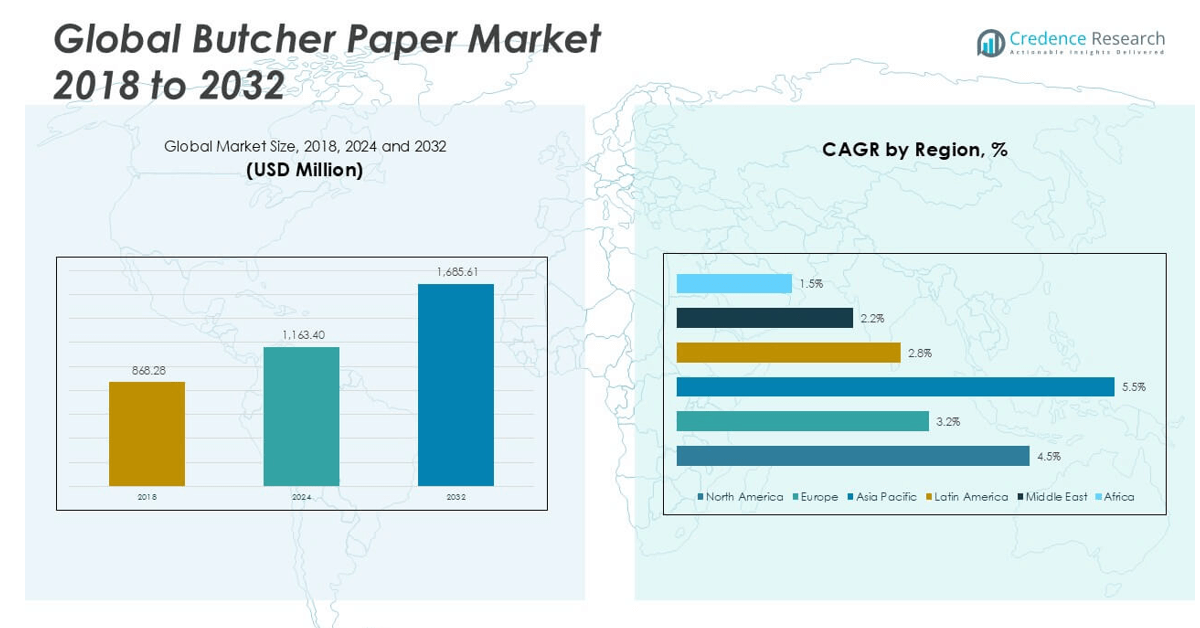
The Butcher Paper market size was valued at USD 868.28 million in 2018 and increased to USD 1,163.40 million in 2024. It is anticipated to reach USD 1,685.61 million by 2032, growing at a CAGR of 4.42% during the forecast period.
The Butcher Paper market is led by prominent players including Georgia-Pacific LLC, International Paper Company, WestRock Company, Mondi Group, and Sappi Limited, who drive innovation and maintain strong global footprints. These companies focus on expanding sustainable product lines and enhancing supply chain efficiencies to meet growing demand. North America dominates the market with a 42.5% share, followed by Asia Pacific holding approximately 29.6%. Europe accounts for 18.7%, supported by stringent environmental regulations and high consumer awareness. The leadership of these regions reflects robust demand from food packaging and retail sectors, while emerging markets in Asia Pacific offer significant growth potential. Together, these factors position the top companies to capitalize on evolving trends and regional dynamics in the butcher paper industry.
Market Insights
- The global Butcher Paper market was valued at USD 868.28 million in 2018 and is expected to reach USD 1,685.61 million by 2032, growing at a CAGR of 4.42%.
- Increasing demand for sustainable and biodegradable packaging in food and beverage industries drives market growth, supported by regulatory emphasis on eco-friendly materials.
- Growing adoption of custom printed butcher paper and advancements in coating technologies enhance product functionality and brand visibility, reflecting key market trends.
- Market competition is intense, with leading players such as Georgia-Pacific LLC, International Paper Company, and WestRock Company focusing on innovation and strategic expansions to capture larger shares.
- North America leads with a 42.5% market share, followed by Asia Pacific at 29.6%, and Europe at 18.7%; emerging markets in Asia Pacific offer strong growth opportunities despite slower expansion in regions like Africa and the Middle East.
Market Segmentation Analysis:
By Grade Type:
The Butcher Paper market is segmented into Bleached, Unbleached, Wrapping and Packaging, Sack Butcher Paper, and Others. Among these, the Wrapping and Packaging sub-segment dominates, accounting for the largest market share due to its extensive use in food wrapping and industrial applications. The rising demand for sustainable and biodegradable packaging solutions drives growth in this segment, as manufacturers prioritize eco-friendly materials. Bleached and unbleached papers also see steady demand, particularly in the food and beverage industry, where hygiene and strength are critical factors.
- For instance, Georgia-Pacific LLC increased its production capacity of wrapping-grade kraft paper by 120,000 tons annually in 2023 to meet growing packaging demands with sustainable materials.
By Packaging Form:
Wraps lead the packaging form segment with a significant market share, propelled by their versatility in protecting and preserving perishable goods. Pouches and sachets follow, benefiting from increasing demand for convenient, single-use packaging in food and pharmaceutical sectors. Grocery bags and industrial bags hold steady demand, driven by retail and logistics growth. Corrugated boxes, while smaller in market share, gain traction due to their protective qualities and recyclability. Overall, rising consumer preference for sustainable and efficient packaging fuels growth across these sub-segments.
- For instance, WestRock Company implemented a new corrugated box manufacturing line in 2022, increasing output by 75 million square feet annually with improved recyclability.
By End User:
Food and Beverages dominate the end user segment, reflecting the critical role of butcher paper in meat, bakery, and fresh produce packaging. This sub-segment commands the largest market share, supported by increasing consumption of packaged food globally. Pharmaceuticals and Cosmetics and Personal Care also contribute notably, leveraging butcher paper for safe, hygienic packaging. The Building and Construction and Electronics and Electricals segments exhibit moderate growth, using butcher paper primarily for protective wrapping and insulation. The demand in these end-use areas is driven by industry expansion and stricter packaging regulations.
Market Overview
Rising Demand for Sustainable Packaging Solutions
Growing environmental concerns and regulatory pressure have increased the demand for eco-friendly packaging materials, propelling the butcher paper market. Businesses and consumers are shifting towards biodegradable and recyclable packaging to reduce plastic waste. Butcher paper, being renewable and compostable, fits well with this sustainability trend. This shift is particularly strong in the food and beverage sector, where packaging must meet strict environmental standards without compromising product safety and quality.
- For instance, WestRock Company reported producing over 1.5 billion pounds of sustainable fiber-based packaging materials annually, emphasizing their investment in renewable paper products that align with compostability standards.
Expansion of the Food and Beverage Industry
The expanding global food and beverage industry serves as a significant growth driver for butcher paper. Increasing consumer preference for packaged meat, bakery, and fresh produce boosts demand for effective wrapping materials. Butcher paper provides moisture resistance, breathability, and protection, making it ideal for preserving food freshness. Rising urbanization and changing lifestyles further fuel the market, with retail chains and food service providers adopting butcher paper to meet packaging needs efficiently.
- For instance, Mondi Group supplied over 85,000 tons of butcher paper to major foodservice companies in 2023, supporting growth in packaged fresh foods.
Growth in E-commerce and Retail Sectors
The rise of e-commerce and modern retail formats creates new avenues for butcher paper usage. Online grocery deliveries and meal kit services require robust, hygienic packaging that can sustain transportation while preserving product integrity. Butcher paper’s strength and eco-friendliness make it a preferred choice for packaging meats and perishables in these channels. This trend encourages manufacturers to innovate and expand product offerings to meet evolving packaging demands in fast-growing retail segments.
Key Trends & Opportunities
Increased Adoption of Custom Printed Butcher Paper
Personalized and branded packaging using custom printed butcher paper is gaining traction. Companies leverage printing technologies to enhance brand visibility and provide product information, aligning packaging with marketing strategies. This trend offers opportunities for paper manufacturers to diversify their portfolios and collaborate with retailers to develop value-added products. The growing emphasis on aesthetics and consumer engagement drives demand for high-quality, printable butcher paper.
- For instance, Sappi Limited expanded its custom printed packaging segment by 18 million square meters in 2023, driven by increasing demand for premium branded wraps.
Technological Advancements in Coating and Treatment
Advances in coating technologies enhance butcher paper’s barrier properties against moisture, grease, and odors. These innovations improve product durability and extend shelf life, attracting food processors and packaging companies. Such improvements enable the paper to replace plastic in more demanding applications, presenting a growth opportunity in the eco-conscious market. Continuous research and development in functional coatings position butcher paper as a competitive alternative in sustainable packaging.
- For instance, UPM-Kymmene Corporation launched a new grease-resistant coated paper line in 2022, producing over 25,000 tons annually with improved barrier performance.
Rising Demand from Emerging Markets
Emerging economies in Asia-Pacific, Latin America, and Africa present lucrative growth opportunities due to increasing industrialization, urbanization, and disposable incomes. The expanding food processing and retail sectors in these regions drive demand for cost-effective and sustainable packaging solutions like butcher paper. Companies targeting these markets benefit from rising consumer awareness of environmental issues and regulatory initiatives promoting biodegradable materials, positioning butcher paper as a preferred packaging choice.
Key Challenges
Competition from Plastic and Synthetic Alternatives
Despite its environmental benefits, butcher paper faces stiff competition from plastic films and synthetic packaging materials, which often offer superior moisture barriers and lower costs. Many manufacturers and end-users still prefer plastics for certain applications due to their durability and convenience. Overcoming this challenge requires continued innovation in paper treatments and consumer education on sustainability, which can be resource-intensive and time-consuming.
Fluctuating Raw Material Prices
The butcher paper market is vulnerable to price volatility in raw materials such as wood pulp and chemicals used for paper coating. These fluctuations impact production costs and profit margins, creating uncertainty for manufacturers. Supply chain disruptions and geopolitical tensions further exacerbate price instability, forcing companies to optimize sourcing strategies and potentially pass increased costs to consumers, which may affect market growth negatively.
Stringent Regulatory Compliance and Quality Standards
Meeting diverse regulatory requirements and quality standards across different regions poses a significant challenge. Butcher paper used in food packaging must comply with strict hygiene, safety, and environmental norms, requiring substantial investments in manufacturing processes and certifications. Failure to comply can lead to product recalls, legal penalties, and reputational damage, which discourage smaller players and increase operational complexity for market participants.
Regional Analysis
North America
North America held the largest share of the butcher paper market in 2018, valued at USD 369.22 million, accounting for approximately 42.5% of the global market. The region is projected to grow steadily at a CAGR of 4.5%, reaching USD 711.16 million by 2032. Strong demand from the food and beverage sector, coupled with growing awareness of sustainable packaging, drives market expansion. Increasing adoption of eco-friendly materials in retail and foodservice industries further bolsters growth, positioning North America as the dominant market throughout the forecast period.
Europe
Europe accounted for around 18.7% of the global butcher paper market in 2018, with a valuation of USD 162.66 million. The region is expected to grow at a CAGR of 3.2%, reaching USD 271.57 million by 2032. Growth is supported by stringent environmental regulations encouraging sustainable packaging use and rising demand from food processing and pharmaceutical industries. The European market emphasizes quality and compliance, with a focus on recyclable and biodegradable packaging solutions, ensuring steady growth despite moderate CAGR compared to other regions.
Asia Pacific
Asia Pacific represented approximately 29.6% of the global butcher paper market in 2018, valued at USD 257.31 million. The region is forecasted to grow at the highest CAGR of 5.5%, reaching USD 573.30 million by 2032. Rapid urbanization, expanding food and retail sectors, and rising consumer preference for sustainable packaging propel market growth. Emerging economies such as China and India drive demand due to increasing disposable incomes and growing food processing industries. The region’s robust growth potential makes it a key market for manufacturers and suppliers.
Latin America
Latin America held about 4.7% of the global butcher paper market share in 2018, with a market size of USD 41.01 million. The region is projected to grow at a CAGR of 2.8%, reaching USD 69.59 million by 2032. Growth is driven by expanding retail and food service industries and increasing consumer awareness of sustainable packaging options. However, slower economic growth and infrastructure challenges limit market expansion. Nonetheless, gradual improvements in regulatory frameworks supporting eco-friendly materials present opportunities for future growth.
Middle East
The Middle East accounted for roughly 3.1% of the global butcher paper market in 2018, valued at USD 24.61 million. The region is expected to grow at a CAGR of 2.2%, reaching USD 36.97 million by 2032. Market growth is influenced by increasing demand from food processing and pharmaceutical sectors alongside gradual adoption of sustainable packaging. However, geopolitical uncertainties and limited regulatory enforcement on environmental standards restrain growth. Investments in packaging innovation and rising awareness of eco-conscious consumption could drive moderate expansion.
Africa
Africa represented around 1.5% of the global butcher paper market in 2018, with a market value of USD 13.47 million. The region is forecasted to grow at a CAGR of 1.5%, reaching USD 23.02 million by 2032. Market growth remains modest due to economic challenges, limited infrastructure, and low consumer awareness regarding sustainable packaging. Despite these constraints, increasing urbanization and gradual improvements in regulatory policies create opportunities for market development. Growth potential exists, particularly in food packaging and retail sectors, as demand for eco-friendly materials slowly rises.
Market Segmentations:
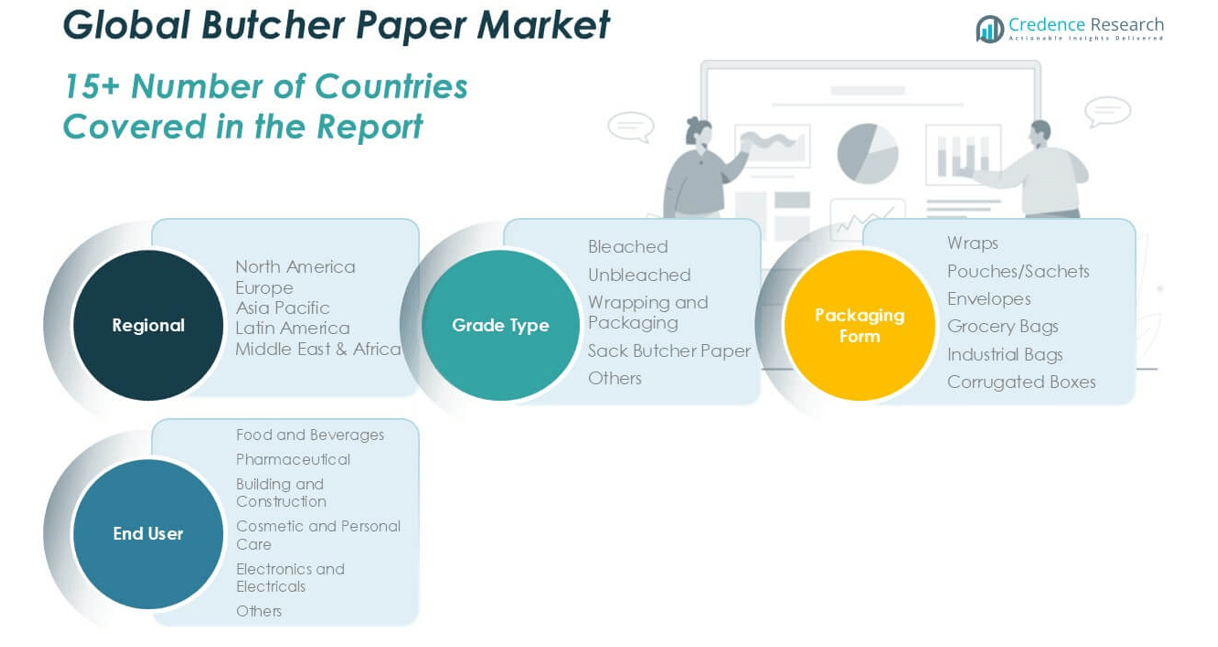
By Grade Type
- Bleached
- Unbleached
- Wrapping and Packaging
- Sack Butcher Paper
- Others
By Packaging Form
- Wraps
- Pouches/Sachets
- Envelopes
- Grocery Bags
- Industrial Bags
- Corrugated Boxes
By End User
- Food and Beverages
- Pharmaceutical
- Building and Construction
- Cosmetic and Personal Care
- Electronics and Electricals
- Others
By Geography
- North America
- U.S.
- Canada
- Mexico
- Europe
- Germany
- France
- U.K.
- Italy
- Spain
- Rest of Europe
- Asia Pacific
- China
- Japan
- India
- South Korea
- South-east Asia
- Rest of Asia Pacific
- Latin America
- Brazil
- Argentina
- Rest of Latin America
- Middle East & Africa
- GCC Countries
- South Africa
- Rest of the Middle East and Africa
Competitive Landscape
The Butcher Paper market features a competitive landscape dominated by several established global and regional players, including Georgia-Pacific LLC, International Paper Company, WestRock Company, and Mondi Group. These companies leverage extensive product portfolios, robust distribution networks, and continuous innovation to maintain and expand their market presence. Strategic initiatives such as mergers, acquisitions, and partnerships are common to enhance capabilities and enter new markets. Innovation in sustainable and customized packaging solutions remains a key focus, driven by increasing demand for eco-friendly and functional butcher paper products. Market leaders invest significantly in research and development to improve product quality, coating technologies, and printability, thereby meeting diverse end-user requirements across food, pharmaceutical, and industrial sectors. Despite strong competition, smaller and regional manufacturers continue to capitalize on niche applications and local demand. Overall, the market’s competitive intensity drives continuous improvement and diversification, fostering growth opportunities in an evolving packaging landscape.
Key Player Analysis
- Georgia-Pacific LLC
- International Paper Company
- WestRock Company
- Mondi Group
- Sappi Limited
- Nippon Paper Industries Co., Ltd.
- UPM-Kymmene Corporation
- Stora Enso Oyj
- Packaging Corporation of America
- Sonoco Products Company
Recent Developments
- In June 2025, Georgia-Pacific continues to focus on sustainable food packaging with its CounterKraft® pink and bleached butcher paper grades, emphasizing recyclable and compostable options. The company has also invested in anti-bacterial and greaseproof solutions to address the rising demand for eco-friendly and food-safe packaging. This commitment aligns with increasing consumer interest in sustainable packaging and relevant U.S. regulations for food-grade butcher paper.
- In May 2025, Georgia-Pacific announced the closure of its Cedar Springs, Georgia containerboard mill, impacting 535 jobs and shifting production to other facilities. While the closure directly affects containerboard, it signals a broader strategic shift in production and supply chain management within the company, potentially influencing the availability and pricing of related paper products like butcher paper.
- In 2025, International Paper remains a prominent global player in sustainable packaging and industrial paper, with a strong focus on food-grade packaging solutions. The company continues to expand its sustainable product lines and maintain its significant presence in both North American and international markets.
Market Concentration & Characteristics
The Butcher Paper Market exhibits a moderately concentrated structure, dominated by a handful of global players such as Georgia-Pacific LLC, International Paper Company, and WestRock Company. These key companies hold significant market shares due to their extensive product portfolios, strong distribution networks, and continuous investments in innovation and sustainability. The market features high entry barriers owing to the need for specialized manufacturing processes and compliance with stringent environmental regulations. It also demonstrates product differentiation through variations in grade types, packaging forms, and end-user applications, catering to diverse industry requirements. Smaller regional players compete by focusing on niche markets and customizing solutions to local demands. The market emphasizes eco-friendly materials, driving innovation in biodegradable and coated paper products that balance performance with environmental impact. Competitive rivalry pushes companies to adopt growth strategies such as mergers, acquisitions, and partnerships to expand geographic reach and product offerings. Overall, the market maintains steady growth, supported by increasing demand for sustainable packaging solutions across food, pharmaceutical, and industrial sectors. This concentration and competitive dynamic shape the evolving landscape of the butcher paper industry.
Report Coverage
The research report offers an in-depth analysis based on Grade Type, Packaging Form, End User and Geography. It details leading market players, providing an overview of their business, product offerings, investments, revenue streams, and key applications. Additionally, the report includes insights into the competitive environment, SWOT analysis, current market trends, as well as the primary drivers and constraints. Furthermore, it discusses various factors that have driven market expansion in recent years. The report also explores market dynamics, regulatory scenarios, and technological advancements that are shaping the industry. It assesses the impact of external factors and global economic changes on market growth. Lastly, it provides strategic recommendations for new entrants and established companies to navigate the complexities of the market.
Future Outlook
- The butcher paper market will witness steady growth driven by rising demand from the foodservice and packaging industries.
- Increasing consumer preference for sustainable and biodegradable packaging materials will boost the adoption of butcher paper.
- Expansion of the meat processing sector globally will create new opportunities for butcher paper manufacturers.
- Innovations in coated and treated butcher paper will enhance product durability and functionality.
- E-commerce growth, especially in food delivery, will increase the need for efficient and eco-friendly packaging solutions.
- Regulatory emphasis on reducing plastic waste will favor the use of butcher paper over conventional plastic wraps.
- Market players will focus on expanding their production capacities to meet growing demand in emerging regions.
- Collaborations between paper manufacturers and food processors will drive tailored solutions and product improvements.
- Rising awareness about food safety and hygiene will increase the use of butcher paper in retail and food handling.
- Technological advancements in paper manufacturing will lead to cost-effective and high-performance butcher paper products.

Request a Free Sample
Fill in your details and we'll send you a free sample report.
- Sample data tables & charts
- Research methodology
Market Dynamics
Sustainability and Regulatory Pressure
Growing environmental concerns and stricter regulations on packaging waste are pushing businesses and consumers toward biodegradable and recyclable materials. Butcher paper, being renewable and compostable, is increasingly favored as an alternative to plastic, especially in food packaging.
Expansion of Food and Beverage Industry
The global rise in consumption of packaged meat, bakery, and fresh produce is driving demand for butcher paper, which offers moisture resistance and breathability. Urbanization and changing lifestyles further boost its adoption in retail and foodservice sectors.
Growth in E-commerce and Retail
The surge in online grocery and meal kit deliveries requires robust, hygienic, and eco-friendly packaging. Butcher paper’s strength and sustainability make it a preferred choice for protecting perishable goods during transit, supporting its market growth.
Technological Advancements in Coating and Printing
Innovations in greaseproof coatings and custom printing enhance butcher paper’s functionality and brand appeal. Improved barrier properties and printability allow it to replace plastics in more demanding applications and support marketing efforts.
Emerging Market Opportunities
Rapid industrialization and rising disposable incomes in Asia Pacific, Latin America, and Africa are increasing demand for cost-effective, sustainable packaging. Regulatory initiatives and consumer awareness in these regions are creating new growth avenues for butcher paper manufacturers.
Need a Custom Version of This Report?
Tailor the scope, geography, or segments to your exact requirements.
- Custom geography or segment scope
- Direct access to our analyst team
Frequently Asked Questions
What is the current size of the Butcher Paper Market?
What are the key segments within the Butcher Paper Market?
What are some challenges faced by the Butcher Paper Market?
Who are the major players in the Butcher Paper Market?
Table of Content
Chapter 1 Market Segmentation
- 1.1 Segmentation Framework
- 1.1.1 Product and Service Classification
- 1.1.2 Application and End-Use Classification
- 1.1.3 Technology and Solution Classification
- 1.1.4 Customer and Distribution Channel Classification
- 1.1.5 Geographic Segmentation
- 1.1.6 Market Segment Definitions and Boundaries
- 1.2 By End User
- 1.2.1 Food and Beverages
- 1.2.2 Pharmaceutical
- 1.2.3 Building and Construction
- 1.2.4 Cosmetic and Personal Care
- 1.2.5 Electronics and Electricals
- 1.2.6 Others
- 1.3 By Grade Type
- 1.3.1 Bleached
- 1.3.2 Unbleached
- 1.3.3 Wrapping and Packaging
- 1.3.4 Sack Butcher Paper
- 1.3.5 Others
- 1.4 By Packaging Form
- 1.4.1 Wraps
- 1.4.2 Pouches/Sachets
- 1.4.3 Envelopes
- 1.4.4 Grocery Bags
- 1.4.5 Industrial Bags
- 1.4.6 Corrugated Boxes
Chapter 2 Introduction
- 2.1 Report Objectives and Scope
- 2.2 Product Definition and Industry Terminology
- 2.3 Market Inclusions and Exclusions
- 2.4 Research Process
- 2.4.1 Primary Research and Expert Interviews
- 2.4.2 Secondary Research and Source Review
- 2.4.3 Top-Down and Bottom-Up Estimation
- 2.4.4 Data Triangulation and Verification
- 2.5 Market Size Measurement Basis
- 2.5.1 2024: USD 1,163.40 million → 2032: USD 1,685.61 million
- 2.6 Historical and Forecast Reference Periods
- 2.6.1 Base Year: 2024
- 2.6.2 Forecast Period: 2024-2032
- 2.7 Research Assumptions and Limitations
Chapter 3 Executive Summary
- 3.1 Market Snapshot and Key Findings
- 3.2 Base-Year Market Size, 2024
- 3.3 Forecast Market Size, 2032
- 3.4 Revenue and Volume Growth Outlook
- 3.5 Key Demand and Supply Indicators
- 3.6 Leading Market Segments
- 3.7 Fastest-Growing Market Opportunities
- 3.8 Regional Performance Highlights
- 3.9 Technology and Industry Transformation
- 3.10 Competitive Landscape Summary
- 3.11 Analyst View and Strategic Implications
Chapter 4 Global Butcher Paper Market Trends and Developments
- 4.1 Historical Industry Development
- 4.2 Recent Market Trends and Developments
- 4.3 Demand and Customer Behavior Trends
- 4.4 Technology and Product Innovation
- 4.5 Artificial Intelligence, Automation and Digitalization
- 4.6 Local Manufacturing and Supply Chain Realignment
- 4.7 Industry Partnerships, Mergers and Acquisitions
- 4.8 Sustainability and Circular Economy Developments
- 4.9 Government and Private Sector Investment Trends
- 4.10 Emerging Business Models and Commercialization
- 4.11 Industry Developments and Announcements
Chapter 5 Global Butcher Paper Market Production, Supply and Demand Analysis
- 5.1 Demand Trend and Consumption Analysis
- 5.2 Demand Forecast, 2024-2032
- 5.3 Production and Output Trend
- 5.4 Production and Output Forecast, 2024-2032
- 5.5 Installed Capacity and Capacity Utilization
- 5.6 Company-Wise Production Plants and Statistics
- 5.6.1 Installed Production Capacity
- 5.6.2 Actual Production
- 5.6.3 Planned Capacity and Expansion Targets
- 5.7 Supply Chain Structure and Procurement Trends
- 5.8 Supply-Demand Gap and Bottlenecks
- 5.9 Import Dependence and Sourcing Structure
- 5.10 Contract Manufacturing and Outsourcing
- 5.11 Regional Supply and Demand Concentration
Chapter 6 Global Butcher Paper Market Pricing Analysis
- 6.1 Pricing Structure and Measurement
- 6.2 Historical Pricing Trends
- 6.3 Pricing Outlook, 2024-2032
- 6.4 Average Selling Price and Unit Economics
- 6.5 Pricing by Product and Market Segment
- 6.6 Geographic Pricing Differences
- 6.7 Key Input, Energy, Labor and Logistics Costs
- 6.8 Contract Pricing and Purchasing Models
- 6.9 Pricing Sensitivity and Competitive Positioning
- 6.10 Price, Margin and Profitability Implications
Chapter 7 Global Butcher Paper Market Dynamics
- 7.1 Market Growth Drivers
- 7.1.1 Demand-Side Drivers
- 7.1.2 Technology and Innovation Drivers
- 7.1.3 Infrastructure and Investment Drivers
- 7.1.4 Regulatory and Policy Drivers
- 7.2 Market Restraints
- 7.2.1 Cost and Affordability Constraints
- 7.2.2 Technology and Adoption Barriers
- 7.2.3 Supply Chain and Operational Constraints
- 7.3 Market Challenges
- 7.3.1 Competitive Pressure and Margin Erosion
- 7.3.2 Skills, Infrastructure and Implementation Gaps
- 7.4 Emerging Market Opportunities
- 7.5 Market Dynamics Impact and Time-Horizon Assessment
Chapter 8 Global Butcher Paper Value Chain Analysis
- 8.1 Industry Value Chain Overview
- 8.2 Upstream Suppliers and Critical Inputs
- 8.3 Technology and Component Providers
- 8.4 Manufacturing or Service Delivery
- 8.5 Distribution, Channel Partners and Integrators
- 8.6 Downstream Applications and End Users
- 8.7 Value Addition and Profit Pools
- 8.8 Vertical Integration and Outsourcing
- 8.9 Supplier Concentration and Risk
- 8.10 Supply Chain Localization and Resilience
Chapter 9 Global Butcher Paper Market Regulations and Policies
- 9.1 Relevant Laws, Standards and Compliance Frameworks
- 9.2 Product, Service, Safety and Quality Requirements
- 9.3 Government Policies, Incentives and Subsidies
- 9.4 Imports, Exports and Trade Barriers
- 9.5 Public Procurement and Local Content Requirements
- 9.6 Environmental and Sustainability Compliance
- 9.7 Upcoming Policy Changes and Market Implications
Chapter 10 Global Butcher Paper Market Hotspots and Opportunities
- 10.1 Market Opportunity Mapping and Growth Hotspots
- 10.2 High-Growth Applications and Customer Groups
- 10.3 Underserved Markets and White-Space Opportunities
- 10.4 Emerging Technology and Product Opportunities
- 10.5 New Capacity and Investment Hotspots
- 10.6 Market Entry and Expansion Opportunities
- 10.7 Distribution and Partnership Opportunities
- 10.8 Near-Term and Long-Term Commercial Potential
- 10.9 Opportunity Attractiveness and Execution Risks
Chapter 11 Global Butcher Paper Market Outlook, 2024-2032
- 11.1 Market Size and Analysis
- 11.1.1 Revenue (Market Measurement: 2024: USD 1,163.40 million → 2032: USD 1,685.61 million)
- 11.1.2 Market Volume and Quantity Sold
- 11.1.3 Historical Market Size
- 11.1.4 Base-Year Market Size, 2024
- 11.2 Market Forecast, 2024-2032
- 11.2.1 Revenue Forecast to 2032
- 11.2.2 Volume Forecast to 2032
- 11.2.3 CAGR and Year-on-Year Growth
- 11.2.4 Incremental Revenue Opportunity
- 11.3 Forecast Assumptions and Scenario Analysis
- 11.3.1 Base-Case Forecast
- 11.3.2 Optimistic and Conservative Scenarios
- 11.3.3 Technology, Pricing and Policy Sensitivities
- 11.4 Market Attractiveness and Growth Outlook
Chapter 12 Global Butcher Paper Market Segmentation and Outlook
- 12.1 Segmentation Summary and Market Shares, 2024
- 12.2 Largest and Fastest-Growing Segments
- 12.3 By End User - Market Size and Forecast, 2024-2032
- 12.3.1 Segment Definition and Scope
- 12.3.2 Historical Market Size
- 12.3.3 Revenue Forecast, 2024-2032
- 12.3.4 Volume Forecast, 2024-2032
- 12.3.5 Base-Year Market Share, 2024
- 12.3.6 Segment CAGR and Growth Drivers
- 12.3.7 Subsegment Market Size and Forecast
- 12.3.7.1 Food and Beverages
- 12.3.7.2 Pharmaceutical
- 12.3.7.3 Building and Construction
- 12.3.7.4 Cosmetic and Personal Care
- 12.3.7.5 Electronics and Electricals
- 12.3.7.6 Others
- 12.3.8 Subsegment Pricing and Adoption Trends
- 12.3.9 Leading Suppliers and Competition
- 12.3.10 Regional Demand and Opportunities
- 12.4 By Grade Type - Market Size and Forecast, 2024-2032
- 12.4.1 Segment Definition and Scope
- 12.4.2 Historical Market Size
- 12.4.3 Revenue Forecast, 2024-2032
- 12.4.4 Volume Forecast, 2024-2032
- 12.4.5 Base-Year Market Share, 2024
- 12.4.6 Segment CAGR and Growth Drivers
- 12.4.7 Subsegment Market Size and Forecast
- 12.4.7.1 Bleached
- 12.4.7.2 Unbleached
- 12.4.7.3 Wrapping and Packaging
- 12.4.7.4 Sack Butcher Paper
- 12.4.7.5 Others
- 12.4.8 Subsegment Pricing and Adoption Trends
- 12.4.9 Leading Suppliers and Competition
- 12.4.10 Regional Demand and Opportunities
- 12.5 By Packaging Form - Market Size and Forecast, 2024-2032
- 12.5.1 Segment Definition and Scope
- 12.5.2 Historical Market Size
- 12.5.3 Revenue Forecast, 2024-2032
- 12.5.4 Volume Forecast, 2024-2032
- 12.5.5 Base-Year Market Share, 2024
- 12.5.6 Segment CAGR and Growth Drivers
- 12.5.7 Subsegment Market Size and Forecast
- 12.5.7.1 Wraps
- 12.5.7.2 Pouches/Sachets
- 12.5.7.3 Envelopes
- 12.5.7.4 Grocery Bags
- 12.5.7.5 Industrial Bags
- 12.5.7.6 Corrugated Boxes
- 12.5.8 Subsegment Pricing and Adoption Trends
- 12.5.9 Leading Suppliers and Competition
- 12.5.10 Regional Demand and Opportunities
- 12.6 Segment Growth Comparison
- 12.7 Segment Attractiveness and Priority Matrix
Chapter 13 Global Butcher Paper End-Use and Application Market Outlook
- 13.1 End-Use Industry and Customer Demand Structure
- 13.2 Leading Applications and Customer Groups
- 13.3 End-Use Market Size, Share and Forecast
- 13.4 Major End-Use Industry Deep Dives
- 13.4.1 Customer Requirements and Use Cases
- 13.4.2 Demand and Replacement Cycles
- 13.4.3 Technical and Regulatory Considerations
- 13.4.4 Purchasing and Procurement Models
- 13.4.5 Leading Vendors and Distribution Channels
- 13.4.6 Forecast and Commercial Opportunities
- 13.5 Emerging Applications and Cross-Segment Demand
- 13.6 End-Use Industry Investment Priorities
Chapter 14 Global Butcher Paper Geographic Market Outlook, 2024-2032
- 14.1 Regional Market Size and Share, 2024
- 14.2 Regional Market Forecast, 2024-2032
- 14.3 Regional Pricing, Production and Demand Differences
- 14.4 North America
- 14.4.1 United States
- 14.4.2 Canada
- 14.4.3 Mexico
- 14.5 Europe
- 14.5.1 Germany
- 14.5.2 France
- 14.5.3 Italy
- 14.5.4 United Kingdom
- 14.5.5 Spain
- 14.5.6 Poland
- 14.5.7 Russia
- 14.5.8 Netherlands
- 14.5.9 Belgium
- 14.5.10 Sweden
- 14.5.11 Denmark
- 14.5.12 Norway
- 14.5.13 Rest of Europe
- 14.6 Asia Pacific
- 14.6.1 China
- 14.6.2 India
- 14.6.3 Japan
- 14.6.4 South Korea
- 14.6.5 Thailand
- 14.6.6 Indonesia
- 14.6.7 Vietnam
- 14.6.8 Malaysia
- 14.6.9 Australia
- 14.6.10 Rest of Asia Pacific
- 14.7 Latin America
- 14.7.1 Brazil
- 14.7.2 Argentina
- 14.7.3 Colombia
- 14.7.4 Chile
- 14.7.5 Rest of Latin America
- 14.8 Middle East
- 14.8.1 Saudi Arabia
- 14.8.2 United Arab Emirates
- 14.8.3 Turkey
- 14.8.4 Israel
- 14.8.5 Iran
- 14.8.6 Rest of the Middle East
- 14.9 Africa
- 14.9.1 South Africa
- 14.9.2 Egypt
- 14.9.3 Nigeria
- 14.9.4 Morocco
- 14.9.5 Rest of Africa
- 14.10 Regional Investment, Policy and Supply Chain Differences
- 14.11 Regional Competitive Landscape
- 14.12 Geographic Growth Hotspots
Chapter 15 Global Butcher Paper Technology, Innovation and Sustainability Outlook
- 15.1 Technology Landscape and Maturity
- 15.2 Product, Process and Service Innovation
- 15.3 AI, Automation and Digital Tools in the Industry
- 15.4 Technology Adoption and Performance Benchmarking
- 15.5 Innovation Pipeline and R&D Investment
- 15.6 Patent and Intellectual Property Trends
- 15.7 Energy Efficiency and Resource Management
- 15.8 Sustainability, Recycling and Circularity
- 15.9 Technology Roadmap, 2024-2032
- 15.10 Risks of Obsolescence and Technology Substitution
Chapter 16 Global Butcher Paper Market Key Strategic Imperatives
- 16.1 Growth and Market Entry Priorities
- 16.2 High-Return Products and Segments
- 16.3 Pricing, Profitability and Cost Optimization
- 16.4 Technology Investment and Product Differentiation
- 16.5 Supply Chain Localization and Resilience
- 16.6 Distribution and Customer Acquisition
- 16.7 Partnership, Acquisition and Capacity Strategy
- 16.8 Regional Expansion Priorities
- 16.9 Short-, Medium- and Long-Term Actions
Chapter 17 Competition Outlook
- 17.1 Industry Competition Characteristics
- 17.2 Market Structure and Concentration
- 17.3 Market Share and Competitive Positioning, 2024
- 17.4 Company-Wise Revenue and Product Benchmarking
- 17.5 Production and Service Capacity Benchmarking
- 17.6 Technology, Pricing and Differentiation
- 17.7 Regional Footprint and Distribution Strength
- 17.8 Mergers, Acquisitions and Strategic Alliances
- 17.9 New Entrants and Competitive Threats
- 17.10 Porter's Five Forces and Industry Attractiveness
- 17.11 Competitive Outlook, 2024-2032
Chapter 18 Company Profiles
- 18.1 Company Coverage and Selection Criteria
- 18.2 Georgia-Pacific LLC
- 18.2.1 Business Description
- 18.2.2 Company Ownership and Geographic Presence
- 18.2.3 Product and Service Portfolio
- 18.2.4 Manufacturing and Operating Footprint
- 18.2.5 Production Capacity and Expansion Plans
- 18.2.6 Financial Performance and Investment
- 18.2.7 Market Share and Competitive Position
- 18.2.8 Technology and Innovation Capabilities
- 18.2.9 Strategic Alliances or Partnerships
- 18.2.10 Recent Developments
- 18.2.11 Growth Strategy and Outlook
- 18.3 International Paper Company
- 18.4 WestRock Company
- 18.5 Mondi Group
- 18.6 Sappi Limited
- 18.7 Nippon Paper Industries Co., Ltd.
- 18.8 UPM-Kymmene Corporation
- 18.9 Stora Enso Oyj
- 18.10 Packaging Corporation of America
- 18.11 Sonoco Products Company
- 18.12 Other Relevant Market Participants
Note: Every listed company is profiled on the structure shown under the first company. The company list is preliminary and may change based on research findings, market developments, data availability and client requirements.
Chapter 19 Disclaimer
- 19.1 Research and Forecast Disclaimer
- 19.2 Data Source and Estimation Limitations
Note: The depth of individual sections depends on data availability for this market. Volume, capacity, trade and other unit-based metrics are included where applicable.

