
Market Overview:
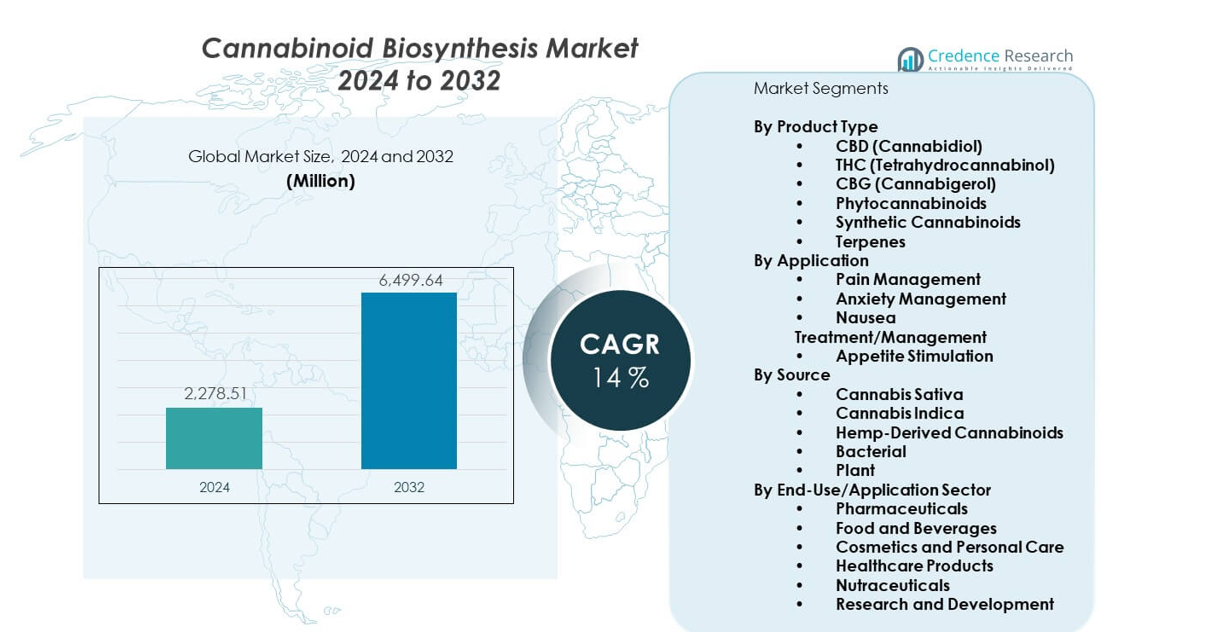
The Cannabinoid biosynthesis market is projected to grow from USD 2,278.51 million in 2024 to an estimated USD 6,499.64 million by 2032, with a compound annual growth rate (CAGR) of 14% from 2024 to 2032.
| REPORT ATTRIBUTE | DETAILS |
|---|---|
| Historical Period | 2020-2023 |
| Base Year | 2024 |
| Forecast Period | 2025-2032 |
| Cannabinoid Biosynthesis Market Size 2024 | USD 2,278.51 million |
| Cannabinoid Biosynthesis Market, CAGR | 14% |
| Cannabinoid Biosynthesis Market Size 2032 | USD 6,499.64 million |
The market gains momentum due to rising demand for medical-grade cannabinoids, expanding R&D in synthetic biology, and growing interest in cost-efficient production methods. Producers use engineered microbes to deliver higher purity and yield, which supports drug development and regulated wellness applications. Companies also scale bioprocess facilities to overcome limits linked to plant-based extraction. This shift improves reliability and supports wider applications across therapeutics, food supplements, and functional products.
Regional growth reflects strong leadership from North America due to advanced biotech ecosystems and expanding clinical adoption of cannabinoid-based therapies. Europe rises as a key player with strong regulatory support for pharmaceutical-grade ingredients and growing interest in rare cannabinoid development. Asia-Pacific emerges quickly as countries invest in fermentation capacity and biosynthetic research. Latin America and the Middle East show early momentum as regulations evolve and biotech infrastructure expands.
Market Insights:
- The cannabinoid biosynthesis market is projected to grow from USD 2,278.51 million in 2024 to USD 6,499.64 million by 2032, advancing at a 14% CAGR due to rising demand for high-purity and scalable cannabinoid production.
- North America 38%, Europe 29%, and Asia-Pacific 22% hold the top regional shares, driven by strong biotech ecosystems, regulatory clarity, and expanding pharmaceutical adoption across these core markets.
- Asia-Pacific, with 22% share, represents the fastest-growing region supported by rising synthetic biology investments, expanding fermentation capacity, and increasing demand for cost-efficient cannabinoid production.
- By product type, CBD accounts for 41% share, supported by broad therapeutic use and wide regulatory acceptance across medical and wellness applications.
- By end-use sector, pharmaceuticals hold 36% share, driven by high-purity requirements, clinical research expansion, and rapid adoption of biosynthesized rare cannabinoids.
Market Drivers:
Growing Need for High-Purity Cannabinoids in Regulated Applications
Demand for high-purity compounds drives strong interest in the cannabinoid biosynthesis market. Pharmaceutical developers prefer biosynthetic cannabinoids due to consistent quality and precise bioactivity. Brands focus on reliable inputs to support clinical studies and regulated formulations. Producers adopt microbial fermentation to secure controlled output and reduce impurity risks. This method supports rapid scaling for medical and wellness use. Companies reduce dependency on crop cycles and environmental limits. Stakeholders value predictable yields in a market driven by quality standards. It supports broader adoption across treatment and supplement applications.
- For instance, Amyris Inc. achieved a milestone by scaling up fermentation-based cannabinoid production and delivering about one ton per year of high-purity cannabigerol (CBG) entirely free of detectable tetrahydrocannabinol (THC).
Expansion of Synthetic Biology Capabilities Across Commercial Platforms
Synthetic biology advances strengthen production efficiency and help companies lower cost per gram. Engineered microbes support targeted conversion pathways with higher output. Firms invest in genome editing, strain optimization, and enzyme enhancement to improve cannabinoid profiles. Production teams upgrade fermentation systems to meet rising industry demand. The cannabinoid biosynthesis market gains traction due to better control of rare cannabinoid synthesis. Brands use precision methods to create uniform compositions for research and commercial use. These capabilities improve operational resilience for large developers. It elevates the role of bioprocess engineering in long-term market growth.
- For instance, Demetrix implemented an industry-leading fermentation technology with a 15,000-liter demo-scale fermentation run for rare cannabinoids like CBG, achieving high-purity products in under three years from initial development, and making production of such rare molecules-present at less than 1% in traditional cannabis-commercially viable at scale with faster and more consistent output.
Shift Toward Scalable and Energy-Efficient Production Models
Manufacturers seek solutions that reduce energy consumption and material waste compared to cultivation methods. Biosynthesis supports predictable batch processing with lower operational risks. Companies introduce advanced bioreactor systems to support continuous output. Controlled environments help reduce variability in cannabinoid composition. This strengthens supply reliability for high-value products. The cannabinoid biosynthesis market benefits from reduced land use and water needs. These factors align with global sustainability goals across pharma and nutraceutical sectors. It creates a strong case for wider adoption in regulated markets.
Rising Demand for Rare Cannabinoids With Therapeutic Potential
Interest in minor cannabinoids supports rapid growth across product pipelines. These variants show potential in pain, anxiety, inflammation, and neurological applications. Traditional extraction yields low quantities and limits development. Biosynthesis addresses this challenge by enabling high-volume output of targeted molecules. Companies invest in precision pathways to support specialized formulations. Medical researchers value predictable purity for therapeutic evaluations. The cannabinoid biosynthesis market gains momentum as drug developers expand clinical programs. It unlocks broader access to compounds once considered commercially challenging.
Market Trends:
Growth of Fermentation-Driven Contract Manufacturing Models
Contract manufacturers expand their capabilities to support biotech firms seeking efficient production routes. These service providers manage large-scale fermentation for commercial clients. Companies prefer outsourced strategies to reduce capital expenditure. This structure accelerates entry into medical and wellness markets. The cannabinoid biosynthesis market benefits from standardized protocols across GMP-focused facilities. Service platforms deliver flexible volumes for early market entrants. Brands gain access to specialized engineering support for new cannabinoid development. It encourages faster commercialization of advanced formulations.
- For instance, Willow Bioscience Inc. successfully scaled its production of cannabigerol (CBG) to a 500-liter pilot scale, delivering material with greater than 99% purity and no detectable THC to global cosmetic, food, and nutraceutical companies for evaluation, demonstrating the value of contract manufacturing in quickly meeting customer requirements at high purity standards.
Increased Focus on Pharmaceutical-Grade Standardization and Compliance
Regulators push for strict quality control across cannabinoid ingredients. Producers adopt advanced purification, testing, and compliance frameworks. Laboratories introduce analytical tools to support identity and potency checks. These methods reduce safety risks in medicinal applications. Pharmaceutical buyers demand consistent purity across global supply chains. Companies design systems that align with evolving compliance rules. The cannabinoid biosynthesis market adapts to higher documentation standards. It improves trust across healthcare and biotech clients.
- For instance, InMed Pharmaceuticals’ IntegraSyn™ system has advanced cannabinoid yield up to 5 g/L-a 2.5-fold increase versus its previous process-enabling more reproducible and high-purity output, which supports GMP compliance and repeatable pharmaceutical product quality. Companies design systems that align with evolving compliance rules.
Expansion of Multi-Cannabinoid Formulation Research Across Therapeutic Lines
Research teams explore combinations of cannabinoids for enhanced therapeutic benefit. Biosynthesis supports precise ratios needed for experimental treatments. Developers use controlled compositions to study targeted biological pathways. This trend elevates interest in rare and novel compounds. Clinical teams analyze compounds for neurological, metabolic, and immune disorders. These research programs strengthen market visibility across healthcare partners. The cannabinoid biosynthesis market evolves with rising clinical interest. It reinforces the role of precision production in advanced therapeutics.
Integration of AI and Automation Across Bioprocess Management
Producers integrate automated controls into fermentation workflows to improve performance. AI models support strain optimization and real-time output analysis. Automation reduces manual errors and stabilizes production quality. Companies deploy digital tools to monitor batches with higher accuracy. Predictive systems identify factors that can influence cannabinoid yield. This enhances efficiency across mature and emerging facilities. The cannabinoid biosynthesis market gains from faster optimization cycles. It strengthens long-term operational stability for key developers.
Market Challenges Analysis:
Regulatory Uncertainty and Variability Across International Markets
Regulatory differences across regions create operational risk for new entrants. Some markets enforce strict approval processes for cannabinoid-based ingredients. Others lack clear guidelines for biosynthetic production methods. This creates delays for companies preparing compliance documentation. Supply chains become complex when approvals vary across borders. The cannabinoid biosynthesis market faces hurdles when aligning with evolving rules. Firms invest heavily in legal and compliance frameworks to secure approvals. It requires strategic planning to manage shifting policy landscapes effectively.
High Production Costs and Technical Barriers in Pathway Optimization
Complex biosynthetic pathways require advanced engineering and costly R&D cycles. Developers work to improve strain performance and reduce purification expenses. Some rare cannabinoids require multi-step processes that increase cost. Scaling fermentation systems demands skilled personnel and specialized equipment. This creates an entry barrier for smaller biotech firms. The cannabinoid biosynthesis market struggles with balancing efficiency and affordability. Companies refine downstream systems to improve conversion rates. It remains a challenge to deliver competitive pricing for large-scale commercial use.
Market Opportunities:
Emerging Pharmaceutical Demand for Rare Cannabinoids Across New Therapy Areas
Drug developers explore new therapeutic applications that depend on consistent compound availability. Biosynthesis supports high-purity production of rare cannabinoids with strong clinical interest. These compounds help research teams expand programs targeting neurological and inflammatory disorders. Medical companies seek partners that deliver reliable supply for long-term studies. The cannabinoid biosynthesis market aligns with this shift toward precision ingredients. New collaborations support rapid growth in clinical evaluation pipelines. It presents significant potential for long-term pharmaceutical adoption.
Growth Potential Across Wellness, Food, and Functional Ingredient Markets
Consumer brands explore biosynthetic cannabinoids for wellness and nutraceutical products. Companies prefer stable supply chains that avoid agricultural variability. Biosynthesis supports scalable production for broad consumer markets. Functional food and beverage developers explore new formulations. This opens pathways for high-purity compounds in non-medical applications. The cannabinoid biosynthesis market expands as brands diversify product portfolios. It creates opportunity for suppliers offering flexible output and reliable quality.
Market Segmentation Analysis:
By Product Type
CBD leads the product landscape due to strong therapeutic relevance and wide regulatory acceptance. THC maintains demand in controlled medical programs that support targeted treatment pathways. CBG grows quickly as developers explore its potential in inflammation, neuroprotection, and metabolic health. Phytocannabinoids remain essential for natural formulations in wellness and personal care. Synthetic cannabinoids gain traction in pharmaceutical pipelines that prioritize purity and structural precision. Terpenes strengthen product innovation through aroma, stability, and functional benefits. The cannabinoid biosynthesis market supports scalable production across all product categories. It enables consistent supply for high-value applications.
- For instance, Hyasynth Biologicals’ fermentation process is 12 times faster than crop-based production, taking under a week to synthesize cannabinoids and enabling production of over 20 rare cannabinoids as well as high-volume commercial CBD without agricultural bottlenecks; this reduces cost, time, and environmental footprint for medical and wellness brands.
By Application
Pain management represents the largest application due to strong clinical interest in safer alternatives to conventional analgesics. Anxiety management gains momentum as consumers seek non-sedative wellness solutions. Nausea treatment supports stable demand across oncology and chronic care. Appetite stimulation remains important in clinical nutrition segments. Companies develop precise formulations that align with therapeutic needs. Research groups test cannabinoid combinations across diverse medical pathways. The cannabinoid biosynthesis market benefits from rising interest in specialized applications. It continues to support evolving treatment demands.
- For instance, Willow Biosciences developed and delivered CBG at over 99% purity for use across cosmetics and functional supplements, facilitating rigorous application-specific product trials and enabling commercialization in pain, anxiety, and inflammation settings, as product purity supports targeted, repeatable outcomes required for clinical and wellness brands.
By Source
Cannabis sativa and cannabis indica remain core botanical sources for research and formulation design. Hemp-derived cannabinoids gain preference due to regulatory clarity and low THC profiles. Bacterial systems unlock efficient pathways for producing rare cannabinoids at scale. Plant-based methods support natural-positioned product lines for wellness and cosmetic sectors. Developers integrate hybrid sourcing models to balance purity, yield, and cost. Producers invest in systems that standardize output across diverse strains and organisms. The cannabinoid biosynthesis market adapts to varied sourcing needs. It strengthens supply stability across global segments.
By End-Use/Application Sector
Pharmaceuticals lead demand due to strict purity requirements and expanding clinical research programs. Food and beverage companies explore cannabinoids for functional and wellness-oriented formulations. Cosmetics and personal care brands integrate cannabinoids for skin-calming and barrier-supporting roles. Healthcare products adopt cannabinoids for broad preventive and supportive care categories. Nutraceuticals gain momentum with rising consumer interest in natural bioactive compounds. Research and development teams focus on strain improvement, bioprocess optimization, and new therapeutic targets. The cannabinoid biosynthesis market supports innovation across diverse industries. It enables scalable and consistent ingredient supply for commercial growth.
Segmentation:
By Product Type
- CBD (Cannabidiol)
- THC (Tetrahydrocannabinol)
- CBG (Cannabigerol)
- Phytocannabinoids
- Synthetic Cannabinoids
- Terpenes
- Pain Management
- Anxiety Management
- Nausea Treatment/Management
- Appetite Stimulation
- Cannabis Sativa
- Cannabis Indica
- Hemp-Derived Cannabinoids
- Bacterial
- Plant
- Pharmaceuticals
- Food and Beverages
- Cosmetics and Personal Care
- Healthcare Products
- Nutraceuticals
- Research and Development
- North America
- U.S.
- Canada
- Mexico
- Europe
- Germany
- France
- U.K.
- Italy
- Spain
- Rest of Europe
- Asia Pacific
- China
- Japan
- India
- South Korea
- South-east Asia
- Rest of Asia Pacific
- Latin America
- Brazil
- Argentina
- Rest of Latin America
- Middle East & Africa
- GCC Countries
- South Africa
- Rest of the Middle East and Africa
Regional Analysis:
North America
North America holds the largest market share in the cannabinoid biosynthesis market due to its advanced biotech ecosystem and strong regulatory support for research-driven cannabinoid development. Leading companies scale fermentation and synthetic biology platforms to meet rising pharmaceutical and wellness demand. The region benefits from mature clinical infrastructure that supports high-purity cannabinoid evaluation. Investors back early-stage and late-stage biosynthesis firms that target rare cannabinoid production. Strong R&D capabilities help companies accelerate innovation across therapeutic applications. The cannabinoid biosynthesis market gains steady momentum from these established advantages. It continues to expand as regulatory clarity improves across federal and state channels.
Europe
Europe secures the second-largest market share driven by strict quality standards and growing acceptance of pharmaceutical-grade cannabinoids. Countries support biosynthesis research focused on rare compounds, safety testing, and high-purity formulation development. Industrial biotechnology clusters strengthen partnerships between manufacturers, research institutes, and healthcare companies. Firms adopt precision fermentation to comply with evolving regulatory expectations. Demand increases across nutraceutical, cosmetic, and therapeutic product categories. The cannabinoid biosynthesis market grows steadily as Europe integrates sustainable bioprocess technologies. It benefits from rising investment in compliant production systems.
Asia-Pacific
Asia-Pacific records the fastest-growing share due to expanding biotech capacity and rising interest in cost-efficient cannabinoid production. Countries invest in microbial fermentation, enzyme engineering, and hybrid plant-biotech models. Rapid industrial expansion supports new facilities focused on scalable and energy-efficient manufacturing. Local and international companies collaborate to develop rare cannabinoids for wellness, pharmaceutical, and research applications. Governments promote biotechnology as a strategic industry, which accelerates adoption across emerging markets. The cannabinoid biosynthesis market strengthens its presence as new producers enter clinical and commercial supply chains. It continues to gain momentum with improvements in technical capability and regulatory progression.
Key Player Analysis:
- Amyris Inc.
- Ginkgo Bioworks
- Demetrix
- Hyasynth Biologicals
- Cronos Group
- Canopy Growth Corporation
- Jazz Pharmaceuticals PLC
- Willow Bioscience Inc.
- InMed Pharmaceuticals
- Zymergen Inc.
- Renew Biopharma
- CB Therapeutics
- Evolva Holding SA
- Constellation Brands Inc.
- GW Pharmaceuticals
- Aurora Cannabis
- Lygos
- Tilray
Competitive Analysis:
The cannabinoid biosynthesis market features intensive competition driven by companies focused on synthetic biology, precision fermentation, and pharmaceutical-grade production. Firms strengthen their portfolios with rare cannabinoids, high-purity compounds, and scalable pathways. Leaders invest in strain engineering, automation, and compliant manufacturing infrastructure. Many companies target pharmaceutical and nutraceutical clients that demand consistent quality. Strategic partnerships help firms expand technology access and reduce research timelines. The market continues to shift toward energy-efficient and high-output fermentation systems. It supports rapid innovation cycles as companies pursue differentiated molecules.
Recent Developments:
- In November 2025, Amyris Inc., which had emerged from Chapter 11 bankruptcy in May 2024, announced the launch of a new brand and website. The rebranding, with the new tagline "Unlock The Chemistry of Life™," was implemented to align with the company's refreshed vision and its technology leadership in renewable biological chemistry. The new strategy is focused on its business-to-business (B2B) partnerships, which involve developing and scaling up ingredients for use in flavors, fragrances, beauty, and food, rather than a continued emphasis on its former consumer brands.
Report Coverage:
The research report offers an in-depth analysis based on By Product Type, By Application, By Source, and By End-Use/Application Sector. It details leading market players, providing an overview of their business, product offerings, investments, revenue streams, and key applications. Additionally, the report includes insights into the competitive environment, SWOT analysis, current market trends, as well as the primary drivers and constraints. Furthermore, it discusses various factors that have driven market expansion in recent years. The report also explores market dynamics, regulatory scenarios, and technological advancements that are shaping the industry. It assesses the impact of external factors and global economic changes on market growth. Lastly, it provides strategic recommendations for new entrants and established companies to navigate the complexities of the market.
Future Outlook:
- Rising investment in synthetic biology will expand high-purity cannabinoid development.
- Pharmaceutical demand for rare cannabinoids will support deeper clinical pipelines.
- Fermentation scale-up technologies will reduce production time and operational cost.
- Partnerships between biotech firms and drug developers will accelerate commercialization.
- Regulatory clarity will support smoother entry for medical and wellness applications.
- New terpene and phytochemical integrations will strengthen formulation diversity.
- Automation and AI-driven optimization will enhance microbial yield performance.
- Sustainability goals will shift producers toward energy-efficient bioprocess models.
- Regional biotech clusters will drive competitive expansion across global supply chains.
- Companies will diversify portfolios to target both therapeutic and consumer sectors.
Request a Free Sample
Fill in your details and we'll send you a free sample report.
- Sample data tables & charts
- Research methodology
Need a Custom Version of This Report?
Tailor the scope, geography, or segments to your exact requirements.
- Custom geography or segment scope
- Direct access to our analyst team
Frequently Asked Questions
What is the current market size for the Cannabinoid biosynthesis market, and what is its projected size in 2032?
At what Compound Annual Growth Rate is the Cannabinoid biosynthesis market projected to grow between 2025 and 2032?
Who are the major players in the global cannabinoid biosynthesis market?
What is the major market driver of the cannabinoid biosynthesis industry?
What are the major market restraints of the cannabinoid biosynthesis industry?
What are the major market opportunities of the cannabinoid biosynthesis industry?
Who are the leading companies in the Cannabinoid biosynthesis market?
Table of Content
Chapter 1. Report Introduction
- 1.1 Report Description & Purpose
- 1.1.1 Report Title & Market Definition
- 1.1.2 Unique Selling Propositions (USP) & Key Differentiators
- 1.1.3 Value Proposition for Stakeholders
- 1.2 Research Objectives
- 1.2.1 Market Sizing Objectives (Volume & Revenue) (Volume Where Applicable)
- 1.2.2 Segmentation Objectives
- 1.2.3 Competitive Intelligence Objectives
- 1.2.4 Forecast & Scenario Objectives
- 1.3 Report Scope
- 1.3.1 Cannabinoid Biosynthesis Scope – Segments & Subsegments Covered
- 1.3.2 Geographic Scope – Regions & Countries Covered
- 1.3.3 Historical Period, Base Year & Forecast Period (2024; forecast to 2032)
- 1.3.4 Inclusions & Exclusions
- 1.4 Industry Classification & Applicable Codes
- 1.5 Currency, Measurement Units & Valuation Basis
- 1.6 Target Stakeholders
- 1.7 Limitations & Assumptions
Chapter 2. Executive Summary
- 2.1 Global Cannabinoid Biosynthesis Market Snapshot
- 2.1.1 Market Size – Historical (2024) & Forecast (2024-2032) (2024: USD 2,278.51 million → 2032: USD 6,499.64 million)
- 2.1.2 Volume & Revenue – Global Totals (Volume Where Applicable)
- 2.1.3 Key Market Highlights – Top Five Facts
- 2.2 Cannabinoid Biosynthesis Market Segmentation Snapshot
- 2.2.1 Market Split by Region – 2024 vs. 2032
- 2.3 Competitive Snapshot
- 2.3.1 Top 10 Players by Revenue Share – 2024
- 2.3.2 Top 10 Players by Volume Share – 2024 (Volume Where Applicable)
- 2.3.3 Recent Strategic Developments (18-Month Summary)
- 2.4 Key Investment Highlights & Strategic Conclusions
Chapter 3. Cannabinoid Biosynthesis Market Dynamics & Industry Analysis
- 3.1 Market Overview & Context
- 3.1.1 Cannabinoid Biosynthesis Market Position in the Broader Industry Value Chain
- 3.1.2 Demand Structure & Purchasing Dynamics
- 3.1.3 Market Maturity & Development Stage by Region
- 3.2 Cannabinoid Biosynthesis Market Drivers
- 3.3 Cannabinoid Biosynthesis Market Restraints & Challenges
- 3.4 Cannabinoid Biosynthesis Market Opportunities
- 3.5 Porter's Five Forces Analysis
- 3.5.1 Threat of New Entrants
- 3.5.2 Bargaining Power of Suppliers
- 3.5.3 Bargaining Power of Buyers
- 3.5.4 Threat of Substitutes
- 3.5.5 Competitive Rivalry – Intensity Assessment
- 3.6 Cannabinoid Biosynthesis Value Chain Analysis
- 3.6.1 Upstream – Key Inputs, Resources & Suppliers
- 3.6.1.1 Key Input/Resource 1
- 3.6.1.2 Key Input/Resource 2
- 3.6.1.3 Key Input/Resource 3
- 3.6.2 Midstream – Core Operations & Value Creation
- 3.6.2.1 Operating Model & Process Overview
- 3.6.2.2 Key Operating Locations & Capabilities by Company
- 3.6.3 Downstream – Market Channels & End Users
- 3.6.3.1 Direct Sales & Customer Engagement Channels
- 3.6.3.2 Indirect Sales, Intermediaries & Partner Channels
- 3.6.4 Value Chain Profitability Analysis
- 3.6.1 Upstream – Key Inputs, Resources & Suppliers
- 3.7 PESTEL Analysis
- 3.7.1 Political Factors
- 3.7.2 Economic Factors
- 3.7.3 Social Factors
- 3.7.4 Technological Factors
- 3.7.5 Environmental Factors
- 3.7.6 Legal Factors
- 3.8 Cannabinoid Biosynthesis Supply Chain Analysis
- 3.8.1 Critical Input & Resource Availability Risk Assessment
- 3.8.2 Supplier & Operational Concentration Risk (Geographic Exposure)
- 3.8.3 Supply & Service Disruption Impact Analysis
- 3.9 Regulatory & Policy Landscape
Note: The regulatory and policy landscape section covers regulations based on their applicability to the market, Cannabinoid Biosynthesis category, geography, and scope of the study. Only regulatory frameworks with a material impact on operations, compliance, trade, sustainability, or market access are analyzed in detail.
Chapter 4. Key Investment Pockets & Opportunity Analysis
- 4.1 Cannabinoid Biosynthesis Market Attractiveness Analysis
- 4.1.1 By Region – Investment Attractiveness Matrix (Market Size × CAGR)
- 4.2 Absolute Revenue Growth Opportunity
- 4.2.1 By Region – Absolute Revenue Growth Through 2032
- 4.3 Incremental Demand Opportunity
- 4.3.1 By Region – Incremental Demand Through 2032
- 4.3.2 Segment – Incremental Demand
- 4.4 Emerging Submarket Opportunity Deep Dive (Subject to Applicability)
- 4.5 Priority Market Opportunity Scorecards
- 4.5.1 United States
- 4.5.2 Europe
- 4.5.3 Asia
- 4.5.4 Middle East & Africa
Note: Priority market opportunity scorecards reflect the geographic scope and strategic relevance of the study. Listed markets are indicative and may be adapted to the industry.
Chapter 5. Cannabinoid Biosynthesis Cross-Border Trade & Market Access Analysis
- 5.1 International Trade & Cross-Border Activity Overview
- 5.1.1 Global Export Value by Country (2024)
- 5.1.2 Global Export Volume by Country (2024) (Volume Where Applicable)
- 5.1.3 Global Import Value by Country (2024)
- 5.1.4 Global Import Volume by Country (2024) (Volume Where Applicable)
- 5.1.5 Net Trade Balance by Country (2024)
- 5.2 Export Analysis – Segment
- 5.2.1 Category 1 (Applicable Classification Code)
- 5.2.2 Category 2 (Applicable Classification Code)
- 5.2.3 Category 3 (Applicable Classification Code)
- 5.2.4 Category 4 (Applicable Classification Code)
- 5.2.5 Category 5 (Applicable Classification Code)
- 5.3 Import Analysis – Segment
- 5.3.1 Category 1 (Applicable Classification Code)
- 5.3.2 Category 2 (Applicable Classification Code)
- 5.3.3 Category 3 (Applicable Classification Code)
- 5.3.4 Category 4 (Applicable Classification Code)
- 5.3.5 Category 5 (Applicable Classification Code)
- 5.4 Cross-Border Pricing & Transaction Benchmarks
- 5.4.1 Export Pricing – Segment & Country
- 5.4.2 Import Pricing – Segment & Source Country
- 5.4.3 Price Trends (2024)
- 5.5 Key Cross-Border Trade & Delivery Routes
- 5.5.1 Cross-Border Trade/Delivery Route 1
- 5.5.2 Cross-Border Trade/Delivery Route 2
- 5.5.3 Cross-Border Trade/Delivery Route 3
- 5.5.4 Cross-Border Trade/Delivery Route 4
- 5.5.5 Cross-Border Trade/Delivery Route 5
- 5.6 Trade Policy & Market Access Impact Assessment
- 5.6.1 Tariff & Non-Tariff Barriers
- 5.6.2 Regional Trade & Economic Integration Frameworks
- 5.6.3 Bilateral & Multilateral Trade Agreements
- 5.6.4 Cross-Border Operating, Licensing & Localization Requirements
Note: This chapter applies where cross-border trade or delivery is relevant to Cannabinoid Biosynthesis. Goods, services, and digital offerings are assessed using applicable classifications and transaction measures. Import-export volumes, trade balances, and route analyses are included only where meaningful to the market.
Chapter 6. Competitive Landscape & Company Benchmarking
- 6.1 Cannabinoid Biosynthesis Market Concentration & Structure
- 6.1.1 Herfindahl-Hirschman Index (HHI) – vs. 2024
- 6.1.2 Leading, Mid-Sized & Emerging Player Structure
- 6.1.3 Global, Regional & Local Player Dynamics
- 6.2 Cannabinoid Biosynthesis Market Share Analysis – 2024
- 6.2.1 Global Revenue Share by Company
- 6.2.2 Global Volume Share by Company (Volume Where Applicable)
- 6.2.3 Regional Revenue Share
- 6.2.4 Market Share Evolution ( vs. 2024)
- 6.2.5 Company Market Share by Key Segment
- 6.2.6 Company Market Share by Customer Group
- 6.3 Operating Scale, Capacity & Infrastructure Analysis
- 6.3.1 Global Operating Scale & Supply Capacity
- 6.3.2 Resource Utilization & Operating Efficiency
- 6.3.3 Output, Service Delivery & Activity Metrics
- 6.3.4 Operating Footprint & Infrastructure Map
- 6.3.5 Planned Operational & Capacity Expansion
- 6.4 Cannabinoid Biosynthesis Competitive Benchmarking Matrix
- 6.4.1 Revenue, Growth, Profitability & Operating Metric Comparison
- 6.4.2 Channel Revenue Mix
- 6.4.3 Geographic Revenue Exposure
- 6.4.4 R&D Intensity
- 6.4.5 Sustainability Maturity
- 6.5 Strategic Developments in Cannabinoid Biosynthesis (Last 24 Months)
- 6.5.1 Mergers, Acquisitions & Divestments
- 6.5.2 New Products, Services & Solutions in Cannabinoid Biosynthesis
- 6.5.3 Operational & Infrastructure Expansions
- 6.5.4 Strategic Alliances, Joint Ventures & Partnerships
- 6.5.5 Distribution Expansion & Market Entry
- 6.5.6 Sustainability & ESG Initiatives
- 6.6 Competitive Strategy Mapping
- 6.6.1 Leader, Challenger, Follower & Niche Classification
- 6.6.2 Pricing Strategy Comparison
- 6.6.3 Channel Strategy Matrix
Note: Strategic developments are included based on their materiality and the availability of reliable information.
Chapter 7. Global Cannabinoid Biosynthesis Market – By Sales & Delivery Channel
- 7.1 Segment Overview
- 7.1.1 Volume & Revenue Split by Channel (2024 & 2032) (Volume Where Applicable)
- 7.1.2 Channel Mix Evolution (2024-2032)
Chapter 8. Regional Market Analysis – Global Overview
- 8.1 Global Regional Overview
- 8.1.1 Regional Volume Share (Volume Where Applicable)
- 8.1.2 Regional Revenue Share
- 8.1.3 Regional Volume by Region (Volume Where Applicable)
- 8.1.4 Regional Revenue by Region
- 8.1.5 Regional Forecast Through 2032
- 8.2 Cross-Regional Segment Analysis
- 8.2.1 By Sales & Delivery Channel
- 8.2.2 By Competitive Positioning & Price Tier
Chapter 9. North America Cannabinoid Biosynthesis Market
- 9.1 United States
- 9.2 Canada
- 9.3 Mexico
Chapter 10. Europe Cannabinoid Biosynthesis Market
- 10.1 Germany
- 10.2 France
- 10.3 Italy
- 10.4 United Kingdom
- 10.5 Spain
- 10.6 Poland
- 10.7 Russia
- 10.8 Netherlands
- 10.9 Belgium
- 10.10 Sweden
- 10.11 Denmark
- 10.12 Norway
- 10.13 Rest of Europe
Chapter 11. Asia Pacific Cannabinoid Biosynthesis Market
- 11.1 China
- 11.2 India
- 11.3 Japan
- 11.4 South Korea
- 11.5 Thailand
- 11.6 Indonesia
- 11.7 Vietnam
- 11.8 Malaysia
- 11.9 Australia
- 11.10 Rest of Asia Pacific
Chapter 12. Latin America Cannabinoid Biosynthesis Market
- 12.1 Brazil
- 12.2 Argentina
- 12.3 Colombia
- 12.4 Chile
- 12.5 Rest of Latin America
Chapter 13. Middle East Cannabinoid Biosynthesis Market
- 13.1 Saudi Arabia
- 13.2 United Arab Emirates
- 13.3 Turkey
- 13.4 Israel
- 13.5 Iran
- 13.6 Rest of the Middle East
Chapter 14. Africa Cannabinoid Biosynthesis Market
- 14.1 South Africa
- 14.2 Egypt
- 14.3 Nigeria
- 14.4 Morocco
- 14.5 Rest of Africa
Chapter 15. Cannabinoid Biosynthesis Company Profiles
- 15.1 [Company 01]
- 15.1.1 Company Overview
- 15.1.2 Key Management Personnel
- 15.1.3 Products & Services Portfolio
- 15.1.4 Financial Performance
- 15.1.5 Key Market Focus & Geographic Presence
- 15.1.6 Recent Developments & Strategic Initiatives
Note: The company profile list is preliminary and may change based on research findings, market developments, data availability, and client requirements.
Chapter 16. Appendices
- Appendix A – List of Abbreviations & Acronyms
- Appendix B – Industry Classification Code Reference – Full Series
- Appendix C – Supply, Output & Operating Capacity Data Tables
- Appendix D – End-Use & Demand Base Tables
- Appendix E – Demand, Adoption & Usage Assumptions
- Appendix F – Pricing & Revenue Metric Reference Tables
- Appendix G – Company Operations & Infrastructure Database
- Appendix H – Cross-Border Trade & Activity Data Tables (Where Applicable)
- Appendix I – Regulatory Summary Tables
- Appendix J – Primary Research Participant List (Anonymized)
- Appendix K – Primary Research Questionnaire Framework
- Appendix L – Data Sources & Bibliography
- Appendix M – Market Size Divergence & Source Comparison
Chapter 17. Research Methodology
- 17.1 Research Framework & Philosophy
- 17.2 Secondary Research – Sources, Hierarchy & Data Extraction
- 17.3 Data Modeling – Bottom-Up & Top-Down Market Sizing
- 17.4 Primary Research – Stakeholder Framework, LOI & Sample Sizes
- 17.5 Forecast Methodology – Regression, Scenario & Sensitivity Analysis
- 17.6 Quality Control – Four-Layer Validation Framework
- 17.7 Limitations & Standard Assumptions
- 17.8 Disclaimer
