
| REPORT ATTRIBUTE | DETAILS |
|---|---|
| Historical Period | 2020-2023 |
| Base Year | 2024 |
| Forecast Period | 2025-2032 |
| China Water Pump Market Size 2023 | USD 6,735.39 Million |
| China Water Pump Market, CAGR | 6.12% |
| China Water Pump Market Size 2032 | USD 11,508.85 Million |
Market Overview:
China Water Pump Market size was valued at USD 6,735.39 million in 2023 and is anticipated to reach USD 11,508.85 million by 2032, at a CAGR of 6.12% during the forecast period (2023-2032).
Several factors are propelling the growth of China's water pump market. The nation's rapid urbanization necessitates the expansion and modernization of municipal water supply and wastewater treatment facilities. Industrial growth, particularly in sectors like manufacturing, chemicals, and power generation, demands efficient water management systems, thereby increasing the need for advanced pumps. Additionally, the Chinese government's emphasis on sustainable practices has led to increased investments in energy-efficient and smart pump technologies, aligning with global trends towards environmental conservation. Rising demand for renewable energy solutions and stricter environmental regulations have further pushed manufacturers to innovate and improve pump efficiency. Moreover, the increasing adoption of automation and digital monitoring in industrial processes continues to boost the demand for technologically integrated water pumps.
Within the Asia-Pacific region, China holds a significant share of the water pump market, accounting for approximately 57.5% in 2024. The country's extensive industrial base and ongoing infrastructure projects, including water conservation and hydropower initiatives, contribute to this dominance. Furthermore, China's focus on improving water management systems and reducing water wastage supports the demand for high-performance water pumps. The integration of advanced technologies, such as IoT-enabled pumps, enhances operational efficiency and aligns with China's goals for sustainable development. Eastern China, being a hub for industrial and urban activity, leads in water pump deployment, while western regions are witnessing increased investment due to developmental policies. Additionally, provincial initiatives and localized government subsidies have accelerated the installation of modern water pumping systems across both urban and rural regions.
Market Insights:
- China Water Pump Market size was valued at USD 6,735.39 million in 2023 and is anticipated to reach USD 11,508.85 million by 2032, at a CAGR of 6.12% during the forecast period (2023-2032).
- The global water pump market was valued at USD 55,454.00 million in 2023 and is projected to reach USD 80,304.96 million by 2032, growing at a CAGR of 4.2% during the forecast period.
- Rapid urbanization and government-backed infrastructure development, particularly under the 14th Five-Year Plan, are significantly boosting demand for water pumps.
- Industrial sectors such as chemicals, power generation, and advanced manufacturing are driving continuous adoption of high-performance and energy-efficient pumps.
- Regulatory initiatives supporting China's "dual carbon" goals are accelerating the shift toward low-emission, smart pumping systems.
- Technological innovation, including the integration of IoT and AI for predictive maintenance, is transforming product offerings and end-user expectations.
- High upfront costs and maintenance expenses, along with technical limitations in older infrastructure, pose notable market restraints.
- Eastern China leads the market with the highest deployment, while western regions are experiencing increased investments due to targeted development policies and subsidies.
Market Drivers:
Urbanization and Infrastructure Development
Rapid urbanization remains a central driver of the China water pump market. As urban populations continue to expand, the demand for improved water supply systems and efficient wastewater management has intensified. Local governments are investing heavily in modernizing water infrastructure to support growing urban centers, which directly boosts the demand for water pumps. For instance, smart city projects and urban sewage upgrades require advanced pumping systems like centrifugal and submersible pumps. Projects related to smart cities, urban sewage upgrades, and regional water supply enhancements require a broad range of pumping systems, from centrifugal to submersible and pressure booster pumps. The Chinese government’s ongoing commitment to infrastructure development under initiatives such as the 14th Five-Year Plan further accelerates market growth. Investment in water pipelines, treatment plants, and urban drainage networks not only strengthens water resource management but also stimulates the adoption of advanced pump technologies. This trend is particularly evident in second- and third-tier cities, where infrastructure modernization is catching up with the pace of urban expansion.
Industrial Expansion and Water-Intensive Processes
China's strong industrial base continues to be a major contributor to water pump demand, particularly across sectors such as chemicals, power generation, metallurgy, and manufacturing. These industries rely on water-intensive processes that necessitate continuous and efficient water circulation, cooling, and waste discharge. As industrial output grows, companies increasingly require durable and energy efficient pumping solutions that can support high-capacity operations. For example, the mining sector requires robust dewatering pumps to handle groundwater challenges in coal mines. Furthermore, China’s strategic focus on transitioning to advanced manufacturing and clean energy production creates fresh demand for precision-engineered pumping systems. In sectors such as solar PV, wind, and hydropower, water pumps are critical components for cooling systems, slurry handling, and process optimization. Industrial compliance with environmental standards also encourages the use of upgraded pump systems that offer reduced energy consumption and operational flexibility.
Government Regulations and Sustainability Goals
The push toward environmental sustainability has significantly influenced the water pump market in China. Regulatory bodies have implemented stricter guidelines on water conservation, emissions control, and industrial discharge. In response, industries and municipalities are upgrading to energy-efficient pumps that comply with national environmental standards and international efficiency ratings. These shifts have encouraged widespread adoption of variable speed drive pumps and smart water systems that offer real-time monitoring and control. In line with China’s "dual carbon" goals to peak carbon emissions by 2030 and achieve carbon neutrality by 2060 energy efficient water management solutions have become a national priority. As part of this initiative, subsidies and tax incentives are provided to promote the adoption of green technologies, including low-emission and low-noise pumps. The integration of digital tools such as AI and IoT into pumping systems further supports energy optimization and sustainability compliance.
Technological Advancements and Digital Integration
Technological innovation plays a crucial role in transforming the China water pump market. Manufacturers are increasingly incorporating smart features, including sensors, remote monitoring capabilities, and automation technologies, into pump systems. These advancements enable predictive maintenance, minimize downtime, and extend equipment life, delivering cost and efficiency benefits to end-users. The rise of Industry 4.0 across China’s manufacturing sector has driven greater integration of digital technologies with industrial equipment, including water pumps. Smart factories and connected infrastructure projects demand intelligent pump systems that can communicate seamlessly with centralized control units. As a result, demand is shifting toward digitally integrated solutions that offer not only mechanical reliability but also analytical insights and operational transparency.
Market Trends:
Rising Demand for Smart Water Management Solutions
A prominent trend in the China water pump market is the rising adoption of smart water management systems. With increasing stress on water resources, both public and private sectors are shifting towards integrated systems that optimize water usage and reduce wastage. Smart water pumps, equipped with digital monitoring tools and real-time data analytics, are gaining momentum across municipal and industrial applications. These systems enable users to track performance metrics, automate operations, and detect anomalies early, enhancing system reliability and efficiency. The push for smart infrastructure aligns with China's broader digital transformation goals and is becoming a standard feature in new water management projects.
Growth in Agricultural Irrigation Applications
Agricultural development continues to be a key focus in China, especially in the context of national food security goals. The government has been actively promoting modern irrigation techniques to increase farming efficiency and yield. As a result, there is a growing trend toward the use of energy-efficient and solar-powered water pumps in rural areas. For instance, the Shule River irrigation area in Gansu province uses digital twin technology combined with drip irrigation and precision fertilization to optimize water use and labor efficiency. This approach has made the region a leading example of water-saving agriculture. These pumps support sustainable irrigation practices by reducing dependence on grid electricity and minimizing operational costs for farmers. According to industry estimates, the adoption of solar water pumps in Chinese agriculture is growing significantly reflecting a long-term commitment to rural modernization and renewable energy utilization.
Shift Toward Customization and Application-Specific Pumps
Manufacturers in the Chinese water pump market are increasingly offering customized and application-specific solutions to cater to diverse industry needs. The demand for specialized pumps such as those designed for corrosive fluids, high-pressure operations, or compact installations has grown significantly. For example, sectors like pharmaceuticals and food processing demand pumps with precise material specifications and operating parameters. This shift reflects the maturation of the market, where end-users seek not only performance and durability but also operational compatibility and lifecycle efficiency. Local manufacturers are also investing in R&D to create differentiated products that meet the evolving technical demands of niche applications.
Expansion of Export-Oriented Production
China has emerged as a key exporter of water pumps, particularly to markets in Southeast Asia, Africa, and Latin America. Competitive pricing, improved product quality, and expanding manufacturing capabilities have strengthened China's position in the global supply chain. In recent years, Chinese firms have increased their focus on complying with international quality certifications such as ISO and CE, enhancing their global competitiveness. Moreover, the easing of cross-border trade restrictions and the growth of e-commerce platforms have further facilitated the export of Chinese pump technologies. This trend has also encouraged domestic manufacturers to standardize production processes and innovate more aggressively to maintain their global presence.
Market Challenges Analysis:
High Initial Investment and Maintenance Costs
One of the primary restraints in the China water pump market is the high initial investment required for advanced and energy-efficient pump systems. Although modern pumps offer long-term operational benefits, the upfront costs of acquisition, installation, and system integration can deter small-scale users and budget-constrained municipalities. Moreover, the cost of maintenance, particularly for high-capacity or technologically integrated pumps, adds to the financial burden. This concern is more pronounced in rural areas, where access to technical support and replacement parts remains limited.
Technical Limitations and Compatibility Issues
As the market shifts toward smart and digitally integrated water pumps, compatibility with existing legacy systems poses a significant challenge. Many older infrastructure setups are not designed to support IoT-enabled or sensor-based pump technologies, requiring substantial modifications or complete system overhauls. This limits the scalability of modern pump adoption in certain regions and industries. Additionally, a shortage of skilled labor familiar with advanced pump technologies hinders the effective deployment and operation of these systems, especially in remote and underdeveloped areas.
Fluctuations in Raw Material Prices
Volatility in the prices of raw materials, such as stainless steel, cast iron, and aluminum, used in pump manufacturing significantly affects production costs and profit margins. Chinese manufacturers are especially vulnerable to global commodity price shifts, trade tensions, and supply chain disruptions. For example, disruptions in global steel supply chains due to geopolitical events have led to price spikes, forcing manufacturers to either absorb losses or increase pump prices. These fluctuations not only impact pricing strategies but also pose challenges in inventory planning and long-term contract management.
Environmental and Regulatory Compliance Pressure
While environmental regulations promote sustainable growth, they also introduce compliance challenges for manufacturers. Meeting increasingly stringent energy efficiency and emission standards requires continuous investment in R&D and process upgrades. Smaller manufacturers may struggle to keep pace with regulatory changes, leading to reduced market competitiveness and potential operational disruptions.
Market Opportunities:
The China water pump market presents substantial growth opportunities, primarily driven by the country’s ongoing urban and rural development initiatives. As China continues to modernize its water infrastructure, the demand for efficient and technologically advanced pumping systems is expected to rise. Government-backed projects focusing on urban water supply expansion, rural water access, and smart city developments create a favorable environment for pump manufacturers to introduce innovative solutions. Additionally, the rising emphasis on environmental protection and the need for wastewater treatment in both urban and industrial settings offer significant opportunities for the deployment of high-efficiency and low-emission pump technologies. These trends align with China’s long-term sustainability goals and open avenues for local and international players to tap into public infrastructure contracts and long-term supply agreements.
Moreover, the rapid digitalization of the industrial sector and the increasing penetration of Industry 4.0 in China present a strong opportunity for smart pump solutions. The integration of automation, real-time data monitoring, and IoT capabilities into pump systems is gaining traction, particularly in manufacturing, power generation, and chemical processing industries. This creates room for growth in the high-value segment of intelligent and predictive maintenance-enabled pumps. Additionally, the surge in agricultural modernization supported by government incentives is fostering demand for solar-powered and energy-efficient pumps in rural areas. These evolving dynamics underscore a market ripe for innovation, customization, and export potential, allowing manufacturers to differentiate themselves through performance, adaptability, and sustainability.
Market Segmentation Analysis:
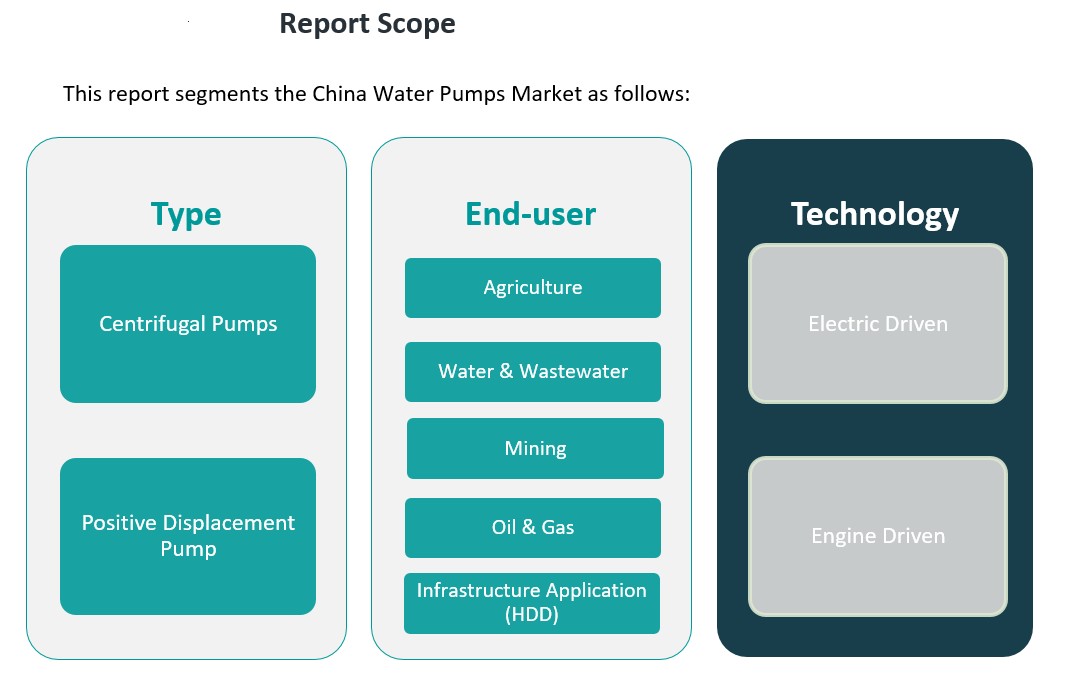
The China water pump market is segmented by type, end-user, and technology, each reflecting distinct demand patterns driven by specific industrial and infrastructural needs.
By type, centrifugal pumps dominate the market due to their broad application across water supply, industrial processes, and municipal wastewater treatment. Their relatively low cost, ease of maintenance, and suitability for continuous operations make them the preferred choice in both urban and rural settings. Positive displacement pumps, while accounting for a smaller share, are gaining traction in applications requiring precise flow control, especially in the chemical, oil & gas, and food processing industries.
In terms of end-user segments, the water and wastewater sector holds a significant share, supported by China's ongoing efforts to upgrade its water infrastructure and expand access to safe water. The agriculture segment follows closely, with the adoption of modern irrigation techniques and solar-powered pumps in rural regions. The oil & gas and mining sectors also contribute steadily, driven by the need for rugged, high-capacity pump systems. Infrastructure applications, particularly horizontal directional drilling (HDD), are witnessing rising adoption of specialized pumping solutions as urban construction activities expand.
By technology, electric-driven pumps lead the market, favored for their energy efficiency, compatibility with automation, and suitability in urban settings. Engine-driven pumps serve as an important alternative in off-grid and emergency applications, especially in agriculture and mining. The increasing integration of smart controls and IoT capabilities within electric pump systems is further reinforcing their dominance in modern industrial and municipal environments.
Segmentation:
By Type Segment:
- Centrifugal Pumps
- Positive Displacement Pumps
By End-User Segment:
- Agriculture
- Water & Wastewater
- Mining
- Oil & Gas
- Infrastructure Application (HDD)
By Technology Segment:
- Electric Driven
- Engine Driven
Regional Analysis:
The China water pump market exhibits significant regional variations, influenced by factors such as industrialization levels, urbanization rates, and infrastructure development. Eastern China, encompassing provinces like Jiangsu, Zhejiang, and Shandong, leads the market with approximately 40% share. This dominance is attributed to the region's dense industrial base, advanced manufacturing sectors, and extensive urban infrastructure projects. The concentration of chemical, petrochemical, and power generation industries in these provinces drives the demand for high-capacity and specialized water pumps.
Central China, including provinces such as Henan, Hubei, and Hunan, accounts for around 25% of the market share. The region's growing urban centers and expanding agricultural activities necessitate efficient water management systems, thereby increasing the demand for water pumps. Government initiatives aimed at improving rural water supply and irrigation infrastructure further bolster market growth in this area.
Western China, comprising provinces like Sichuan, Yunnan, and Shaanxi, holds approximately 20% of the market. Despite being less industrialized, the region is witnessing increased investment in infrastructure and water conservation projects. The development of hydropower stations and efforts to enhance water accessibility in remote areas contribute to the rising demand for water pumps.
Northeastern China, including Liaoning, Jilin, and Heilongjiang provinces, represents about 10% of the market share. The region's focus on revitalizing its industrial base and upgrading municipal water systems drives the need for modern pumping solutions. Additionally, the cold climate necessitates specialized pumps capable of operating efficiently in low-temperature conditions.
Lastly, the remaining 5% of the market is distributed among other regions, including autonomous areas and municipalities. These areas, though smaller in market size, present niche opportunities for water pump manufacturers, particularly in addressing unique geographical and climatic challenges. Overall, the diverse regional demands within China offer a broad spectrum of opportunities for tailored water pump solutions.
Key Player Analysis:
- SLB
- Ingersoll Rand
- The Weir Group PLC
- Vaughan Company
- KSB SE & Co. KGaA
- Pentair
- Grundfos Holding A/S
- Xylem
- Flowserve Corporation
- ITT Inc.
- Ebara Corporation
- Kaiquan
- Modo
Competitive Analysis:
The China water pump market features a competitive landscape marked by the presence of both domestic manufacturers and international players. Leading Chinese companies such as Grundfos China, Wilo China, Ebara Great Pumps, and Shanghai Kaiquan dominate through extensive product portfolios and strong distribution networks. These firms leverage local manufacturing capabilities and technical expertise to offer cost-effective and application-specific solutions. International brands like Xylem Inc., Sulzer Ltd., and KSB SE maintain a competitive edge by introducing advanced technologies, particularly in energy-efficient and smart pumping systems. Competition is further intensified by increasing investment in R&D, product innovation, and aftermarket services. Strategic collaborations with government and industrial clients enhance brand positioning and long-term contract acquisition. The market also witnesses the emergence of niche players focusing on specialized segments such as solar-powered and IoT-enabled pumps. Overall, sustained innovation and service differentiation remain key factors driving competitiveness in this evolving market.
Recent Developments:
- Servotech Power Systems Ltd.launched solar pump controllers on October 28, 2024, designed for 2HP to 10HP water pumps. This aligns with initiatives like PM-KUSUM to promote sustainable farming practices through water-efficient solutions.
- Roto Pumps Ltd.announced the launch of its subsidiary, Roto Energy Systems Ltd., in Feb 2024. This new division focuses on solar-powered water pumping solutions, including submersible and surface pumps, catering to eco-friendly water management needs.
- Grundfos' commitment to the Water Resilience Coalition in March 2025 aligns with the water pump market's focus on sustainability and efficient water management. The coalition’s goals include measurable improvements in global water sustainability by 2030.
- On February 28, 2025, KSB launched the MultiTec Plus pump series, specifically optimized for drinking water transport. This product integrates energy-saving technologies and real-time monitoring capabilities, emphasizing advancements in smart and sustainable water pumping solutions.
Market Concentration & Characteristics:
The China water pump market is moderately fragmented, characterized by a blend of domestic manufacturers and international players. Leading companies such as Grundfos, Wilo, Ebara, and Shanghai Kaiquan dominate through extensive product portfolios and strong distribution networks. These firms leverage local manufacturing capabilities and technical expertise to offer cost-effective and application-specific solutions. International brands like Xylem Inc., Sulzer Ltd., and KSB SE maintain a competitive edge by introducing advanced technologies, particularly in energy-efficient and smart pumping systems. Competition is further intensified by increasing investment in R&D, product innovation, and aftermarket services. Strategic collaborations with government and industrial clients enhance brand positioning and long-term contract acquisition. The market also witnesses the emergence of niche players focusing on specialized segments such as solar-powered and IoT-enabled pumps. Overall, sustained innovation and service differentiation remain key factors driving competitiveness in this evolving market.
Report Coverage:
The research report offers an in-depth analysis based on Type Segment, End-User Segment and Technology Segment. It details leading market players, providing an overview of their business, product offerings, investments, revenue streams, and key applications. Additionally, the report includes insights into the competitive environment, SWOT analysis, current market trends, as well as the primary drivers and constraints. Furthermore, it discusses various factors that have driven market expansion in recent years. The report also explores market dynamics, regulatory scenarios, and technological advancements that are shaping the industry. It assesses the impact of external factors and global economic changes on market growth. Lastly, it provides strategic recommendations for new entrants and established companies to navigate the complexities of the market.
Future Outlook:
- Continued urbanization will drive demand for advanced municipal water and wastewater pump systems.
- Expansion of industrial zones will increase the need for high-capacity and energy-efficient pumps.
- Integration of IoT and smart control features will shape product development and adoption.
- Rising investments in renewable energy projects will boost demand for solar-powered water pumps.
- Agricultural modernization will support growth in rural irrigation pump installations.
- Government regulations on energy efficiency will accelerate the shift to low-emission pump technologies.
- Growth in export opportunities will position China as a global manufacturing hub for water pumps.
- Adoption of predictive maintenance tools will enhance operational efficiency and lifecycle management.
- Demand for customized and application-specific pumps will increase across specialized industries.
- Strategic partnerships between local and international players will strengthen technological innovation and market reach.

Request a Free Sample
Fill in your details and we'll send you a free sample report.
- Sample data tables & charts
- Research methodology
Market Dynamics
Urbanization and Infrastructure Development
Rapid urbanization in China is driving significant investments in municipal water supply and wastewater treatment infrastructure, directly increasing the demand for advanced water pumps to support expanding urban centers and smart city projects.
Industrial Expansion and Water-Intensive Processes
Growth in manufacturing, chemicals, power generation, and mining sectors is fueling the need for efficient, high-capacity water pumps to support water circulation, cooling, and waste management in industrial operations.
Government Regulations and Sustainability Goals
Stricter environmental regulations and China's 'dual carbon' goals are accelerating the adoption of energy-efficient and smart pump technologies, as industries and municipalities upgrade to comply with national standards and benefit from government incentives.
Technological Advancements and Digital Integration
The integration of IoT, AI, and automation into water pump systems is transforming the market, enabling predictive maintenance, real-time monitoring, and operational efficiency, which are increasingly demanded by both municipal and industrial users.
Agricultural Modernization and Rural Development
Government-backed initiatives to modernize agriculture and improve rural water access are boosting the adoption of solar-powered and energy-efficient pumps, supporting sustainable irrigation and rural infrastructure upgrades.
Need a Custom Version of This Report?
Tailor the scope, geography, or segments to your exact requirements.
- Custom geography or segment scope
- Direct access to our analyst team
Frequently Asked Questions
What is the current size of the China Water Pump Market?
What factors are driving the growth of the China Water Pump Market?
What are the key segments within the China Water Pump Market?
What are some challenges faced by the China Water Pump Market?
Who are the major players in the China Water Pump Market?
Table of Content
Chapter 1 Market Segmentation
- 1.1 Segmentation Framework
- 1.1.1 Product and Service Classification
- 1.1.2 Application and End-Use Classification
- 1.1.3 Technology and Solution Classification
- 1.1.4 Customer and Distribution Channel Classification
- 1.1.5 Geographic Segmentation
- 1.1.6 Market Segment Definitions and Boundaries
- 1.2 By Type
- 1.2.1 Centrifugal Pumps
- 1.2.2 Positive Displacement Pumps
- 1.3 By End-User
- 1.3.1 Agriculture
- 1.3.2 Water & Wastewater
- 1.3.3 Mining
- 1.3.4 Oil & Gas
- 1.3.5 Infrastructure Application (HDD)
- 1.4 By Technology
- 1.4.1 Electric Driven
- 1.4.2 Engine Driven
Chapter 2 Introduction
- 2.1 Report Objectives and Scope
- 2.2 Product Definition and Industry Terminology
- 2.3 Market Inclusions and Exclusions
- 2.4 Research Process
- 2.4.1 Primary Research and Expert Interviews
- 2.4.2 Secondary Research and Source Review
- 2.4.3 Top-Down and Bottom-Up Estimation
- 2.4.4 Data Triangulation and Verification
- 2.5 Market Size Measurement Basis
- 2.5.1 2023: USD 6,735.39 million → 2032: USD 11,508.85 million
- 2.6 Historical and Forecast Reference Periods
- 2.6.1 Base Year: 2023
- 2.6.2 Forecast Period: 2023-2032
- 2.7 Research Assumptions and Limitations
Chapter 3 Executive Summary
- 3.1 Market Snapshot and Key Findings
- 3.2 Base-Year Market Size, 2023
- 3.3 Forecast Market Size, 2032
- 3.4 Revenue and Volume Growth Outlook
- 3.5 Key Demand and Supply Indicators
- 3.6 Leading Market Segments
- 3.7 Fastest-Growing Market Opportunities
- 3.8 Regional Performance Highlights
- 3.9 Technology and Industry Transformation
- 3.10 Competitive Landscape Summary
- 3.11 Analyst View and Strategic Implications
Chapter 4 China Water Pump Market Trends and Developments
- 4.1 Historical Industry Development
- 4.2 Recent Market Trends and Developments
- 4.3 Demand and Customer Behavior Trends
- 4.4 Technology and Product Innovation
- 4.5 Artificial Intelligence, Automation and Digitalization
- 4.6 Local Manufacturing and Supply Chain Realignment
- 4.7 Industry Partnerships, Mergers and Acquisitions
- 4.8 Sustainability and Circular Economy Developments
- 4.9 Government and Private Sector Investment Trends
- 4.10 Emerging Business Models and Commercialization
- 4.11 Industry Developments and Announcements
Chapter 5 China Water Pump Market Production, Supply and Demand Analysis
- 5.1 Demand Trend and Consumption Analysis
- 5.2 Demand Forecast, 2023-2032
- 5.3 Production and Output Trend
- 5.4 Production and Output Forecast, 2023-2032
- 5.5 Installed Capacity and Capacity Utilization
- 5.6 Company-Wise Production Plants and Statistics
- 5.6.1 Installed Production Capacity
- 5.6.2 Actual Production
- 5.6.3 Planned Capacity and Expansion Targets
- 5.7 Supply Chain Structure and Procurement Trends
- 5.8 Supply-Demand Gap and Bottlenecks
- 5.9 Import Dependence and Sourcing Structure
- 5.10 Contract Manufacturing and Outsourcing
- 5.11 Regional Supply and Demand Concentration
Chapter 6 China Water Pump Market Pricing Analysis
- 6.1 Pricing Structure and Measurement
- 6.2 Historical Pricing Trends
- 6.3 Pricing Outlook, 2023-2032
- 6.4 Average Selling Price and Unit Economics
- 6.5 Pricing by Product and Market Segment
- 6.6 Geographic Pricing Differences
- 6.7 Key Input, Energy, Labor and Logistics Costs
- 6.8 Contract Pricing and Purchasing Models
- 6.9 Pricing Sensitivity and Competitive Positioning
- 6.10 Price, Margin and Profitability Implications
Chapter 7 China Water Pump Market Dynamics
- 7.1 Market Growth Drivers
- 7.1.1 Demand-Side Drivers
- 7.1.2 Technology and Innovation Drivers
- 7.1.3 Infrastructure and Investment Drivers
- 7.1.4 Regulatory and Policy Drivers
- 7.2 Market Restraints
- 7.2.1 Cost and Affordability Constraints
- 7.2.2 Technology and Adoption Barriers
- 7.2.3 Supply Chain and Operational Constraints
- 7.3 Market Challenges
- 7.3.1 Competitive Pressure and Margin Erosion
- 7.3.2 Skills, Infrastructure and Implementation Gaps
- 7.4 Emerging Market Opportunities
- 7.5 Market Dynamics Impact and Time-Horizon Assessment
Chapter 8 China Water Pump Value Chain Analysis
- 8.1 Industry Value Chain Overview
- 8.2 Upstream Suppliers and Critical Inputs
- 8.3 Technology and Component Providers
- 8.4 Manufacturing or Service Delivery
- 8.5 Distribution, Channel Partners and Integrators
- 8.6 Downstream Applications and End Users
- 8.7 Value Addition and Profit Pools
- 8.8 Vertical Integration and Outsourcing
- 8.9 Supplier Concentration and Risk
- 8.10 Supply Chain Localization and Resilience
Chapter 9 China Water Pump Market Regulations and Policies
- 9.1 Relevant Laws, Standards and Compliance Frameworks
- 9.2 Product, Service, Safety and Quality Requirements
- 9.3 Government Policies, Incentives and Subsidies
- 9.4 Imports, Exports and Trade Barriers
- 9.5 Public Procurement and Local Content Requirements
- 9.6 Environmental and Sustainability Compliance
- 9.7 Upcoming Policy Changes and Market Implications
Chapter 10 China Water Pump Market Hotspots and Opportunities
- 10.1 Market Opportunity Mapping and Growth Hotspots
- 10.2 High-Growth Applications and Customer Groups
- 10.3 Underserved Markets and White-Space Opportunities
- 10.4 Emerging Technology and Product Opportunities
- 10.5 New Capacity and Investment Hotspots
- 10.6 Market Entry and Expansion Opportunities
- 10.7 Distribution and Partnership Opportunities
- 10.8 Near-Term and Long-Term Commercial Potential
- 10.9 Opportunity Attractiveness and Execution Risks
Chapter 11 China Water Pump Market Outlook, 2023-2032
- 11.1 Market Size and Analysis
- 11.1.1 Revenue (Market Measurement: 2023: USD 6,735.39 million → 2032: USD 11,508.85 million)
- 11.1.2 Market Volume and Quantity Sold
- 11.1.3 Historical Market Size
- 11.1.4 Base-Year Market Size, 2023
- 11.2 Market Forecast, 2023-2032
- 11.2.1 Revenue Forecast to 2032
- 11.2.2 Volume Forecast to 2032
- 11.2.3 CAGR and Year-on-Year Growth
- 11.2.4 Incremental Revenue Opportunity
- 11.3 Forecast Assumptions and Scenario Analysis
- 11.3.1 Base-Case Forecast
- 11.3.2 Optimistic and Conservative Scenarios
- 11.3.3 Technology, Pricing and Policy Sensitivities
- 11.4 Market Attractiveness and Growth Outlook
Chapter 12 China Water Pump Market Segmentation and Outlook
- 12.1 Segmentation Summary and Market Shares, 2023
- 12.2 Largest and Fastest-Growing Segments
- 12.3 By Type - Market Size and Forecast, 2023-2032
- 12.3.1 Segment Definition and Scope
- 12.3.2 Historical Market Size
- 12.3.3 Revenue Forecast, 2023-2032
- 12.3.4 Volume Forecast, 2023-2032
- 12.3.5 Base-Year Market Share, 2023
- 12.3.6 Segment CAGR and Growth Drivers
- 12.3.7 Subsegment Market Size and Forecast
- 12.3.7.1 Centrifugal Pumps
- 12.3.7.2 Positive Displacement Pumps
- 12.3.8 Subsegment Pricing and Adoption Trends
- 12.3.9 Leading Suppliers and Competition
- 12.3.10 Regional Demand and Opportunities
- 12.4 By End-User - Market Size and Forecast, 2023-2032
- 12.4.1 Segment Definition and Scope
- 12.4.2 Historical Market Size
- 12.4.3 Revenue Forecast, 2023-2032
- 12.4.4 Volume Forecast, 2023-2032
- 12.4.5 Base-Year Market Share, 2023
- 12.4.6 Segment CAGR and Growth Drivers
- 12.4.7 Subsegment Market Size and Forecast
- 12.4.7.1 Agriculture
- 12.4.7.2 Water & Wastewater
- 12.4.7.3 Mining
- 12.4.7.4 Oil & Gas
- 12.4.7.5 Infrastructure Application (HDD)
- 12.4.8 Subsegment Pricing and Adoption Trends
- 12.4.9 Leading Suppliers and Competition
- 12.4.10 Regional Demand and Opportunities
- 12.5 By Technology - Market Size and Forecast, 2023-2032
- 12.5.1 Segment Definition and Scope
- 12.5.2 Historical Market Size
- 12.5.3 Revenue Forecast, 2023-2032
- 12.5.4 Volume Forecast, 2023-2032
- 12.5.5 Base-Year Market Share, 2023
- 12.5.6 Segment CAGR and Growth Drivers
- 12.5.7 Subsegment Market Size and Forecast
- 12.5.7.1 Electric Driven
- 12.5.7.2 Engine Driven
- 12.5.8 Subsegment Pricing and Adoption Trends
- 12.5.9 Leading Suppliers and Competition
- 12.5.10 Regional Demand and Opportunities
- 12.6 Segment Growth Comparison
- 12.7 Segment Attractiveness and Priority Matrix
Chapter 13 China Water Pump End-Use and Application Market Outlook
- 13.1 End-Use Industry and Customer Demand Structure
- 13.2 Leading Applications and Customer Groups
- 13.3 End-Use Market Size, Share and Forecast
- 13.4 Major End-Use Industry Deep Dives
- 13.4.1 Customer Requirements and Use Cases
- 13.4.2 Demand and Replacement Cycles
- 13.4.3 Technical and Regulatory Considerations
- 13.4.4 Purchasing and Procurement Models
- 13.4.5 Leading Vendors and Distribution Channels
- 13.4.6 Forecast and Commercial Opportunities
- 13.5 Emerging Applications and Cross-Segment Demand
- 13.6 End-Use Industry Investment Priorities
Chapter 14 China Water Pump Geographic Market Outlook, 2023-2032
- 14.1 Domestic Market Distribution and Demand Clusters
- 14.2 State- or Province-Wise Market Size and Forecast, 2023-2032
- 14.3 City and Metropolitan Market Outlook
- 14.4 Industrial, Manufacturing and Commercial Clusters
- 14.5 Geographic Concentration of Key End Users
- 14.6 Local Pricing and Purchasing Differences
- 14.7 Domestic Production Facilities and Capacity Map
- 14.8 Local Infrastructure and Project Pipeline
- 14.9 State-Level Policy and Incentive Differences
- 14.10 Subnational Investment Hotspots and Opportunities
- 14.11 Distribution and Logistics Networks
- 14.12 Domestic Competitive Footprint
Chapter 15 China Water Pump Technology, Innovation and Sustainability Outlook
- 15.1 Technology Landscape and Maturity
- 15.2 Product, Process and Service Innovation
- 15.3 AI, Automation and Digital Tools in the Industry
- 15.4 Technology Adoption and Performance Benchmarking
- 15.5 Innovation Pipeline and R&D Investment
- 15.6 Patent and Intellectual Property Trends
- 15.7 Energy Efficiency and Resource Management
- 15.8 Sustainability, Recycling and Circularity
- 15.9 Technology Roadmap, 2023-2032
- 15.10 Risks of Obsolescence and Technology Substitution
Chapter 16 China Water Pump Market Key Strategic Imperatives
- 16.1 Growth and Market Entry Priorities
- 16.2 High-Return Products and Segments
- 16.3 Pricing, Profitability and Cost Optimization
- 16.4 Technology Investment and Product Differentiation
- 16.5 Supply Chain Localization and Resilience
- 16.6 Distribution and Customer Acquisition
- 16.7 Partnership, Acquisition and Capacity Strategy
- 16.8 Regional Expansion Priorities
- 16.9 Short-, Medium- and Long-Term Actions
Chapter 17 Competition Outlook
- 17.1 Industry Competition Characteristics
- 17.2 Market Structure and Concentration
- 17.3 Market Share and Competitive Positioning, 2023
- 17.4 Company-Wise Revenue and Product Benchmarking
- 17.5 Production and Service Capacity Benchmarking
- 17.6 Technology, Pricing and Differentiation
- 17.7 Regional Footprint and Distribution Strength
- 17.8 Mergers, Acquisitions and Strategic Alliances
- 17.9 New Entrants and Competitive Threats
- 17.10 Porter's Five Forces and Industry Attractiveness
- 17.11 Competitive Outlook, 2023-2032
Chapter 18 Company Profiles
- 18.1 Company Coverage and Selection Criteria
- 18.2 Grundfos Holding A/S
- 18.2.1 Business Description
- 18.2.2 Company Ownership and Geographic Presence
- 18.2.3 Product and Service Portfolio
- 18.2.4 Manufacturing and Operating Footprint
- 18.2.5 Production Capacity and Expansion Plans
- 18.2.6 Financial Performance and Investment
- 18.2.7 Market Share and Competitive Position
- 18.2.8 Technology and Innovation Capabilities
- 18.2.9 Strategic Alliances or Partnerships
- 18.2.10 Recent Developments
- 18.2.11 Growth Strategy and Outlook
- 18.3 Shanghai Kaiquan
- 18.4 Ebara Corporation
- 18.5 Xylem Inc.
- 18.6 KSB SE & Co. KGaA
- 18.7 Wilo Group
- 18.8 Flowserve Corporation
- 18.9 ITT Inc.
- 18.10 Pentair
- 18.11 SLB
- 18.12 Other Relevant Market Participants
Note: Every listed company is profiled on the structure shown under the first company. The company list is preliminary and may change based on research findings, market developments, data availability and client requirements.
Chapter 19 Disclaimer
- 19.1 Research and Forecast Disclaimer
- 19.2 Data Source and Estimation Limitations
Note: The depth of individual sections depends on data availability for this market. Volume, capacity, trade and other unit-based metrics are included where applicable.

