
Hydraulics Market Overview:
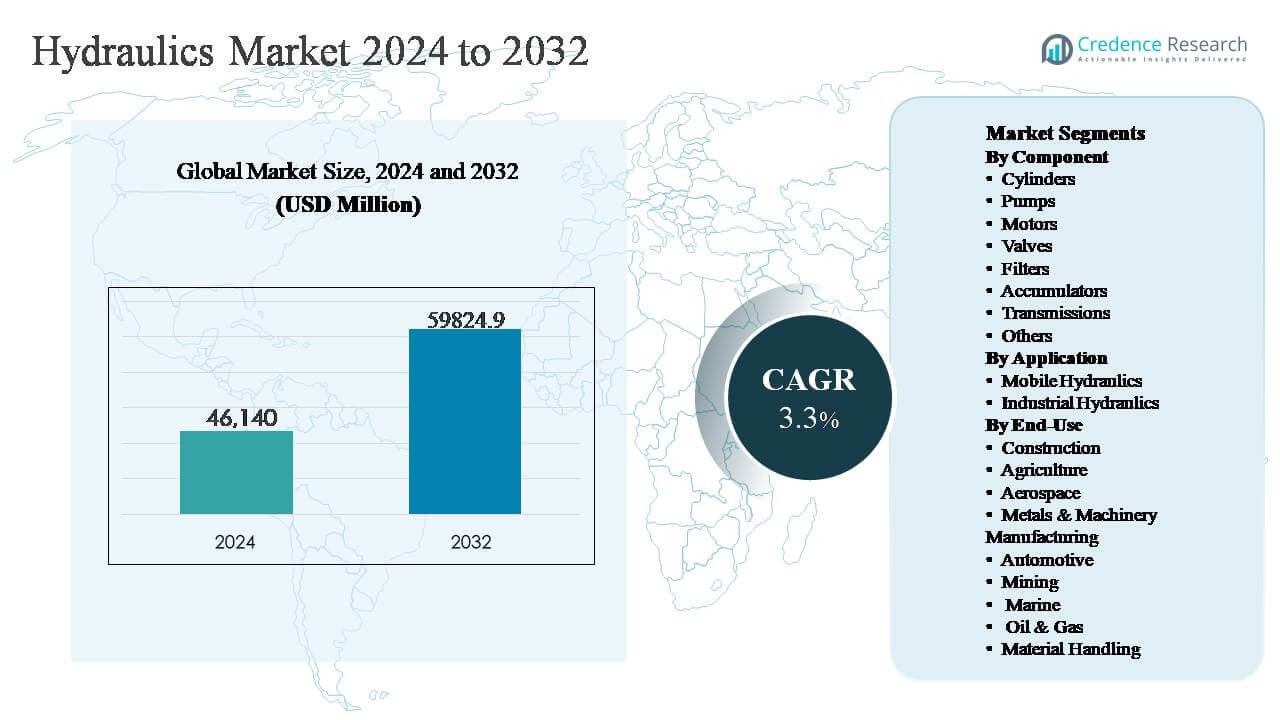
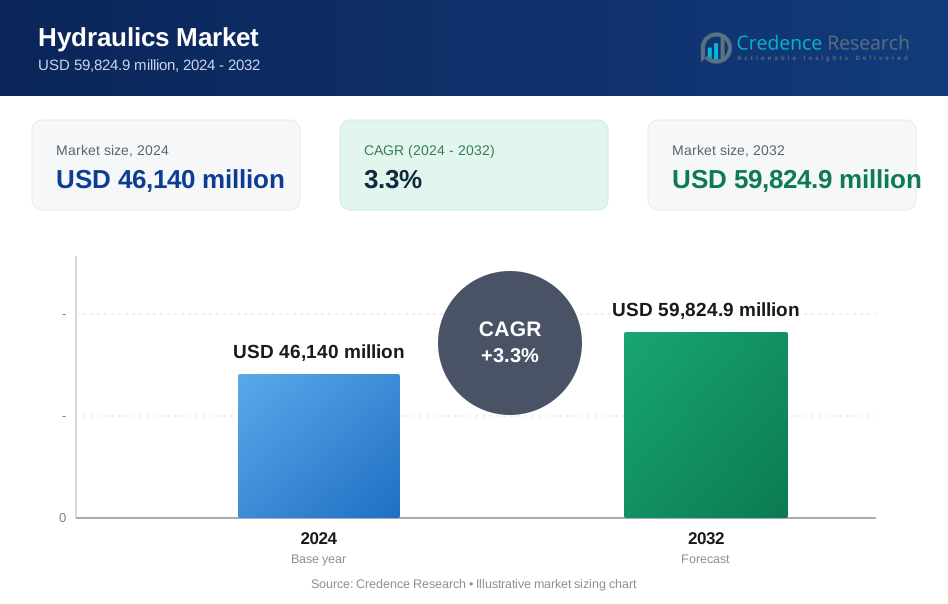
The global hydraulics market was valued at USD 46,140 million in 2024 and is projected to reach USD 59,824.9 million by 2032, expanding at a CAGR of 3.3% during the forecast period.
| REPORT ATTRIBUTE | DETAILS |
|---|---|
| Historical Period | 2020-2023 |
| Base Year | 2024 |
| Forecast Period | 2025-2032 |
| Hydraulics Market Size 2024 | USD 46,140 million |
| Hydraulics Market, CAGR | 3.3% |
| Hydraulics Market Size 2032 | USD 59,824.9 million |
Hydraulics Market Insights
- Market growth is primarily driven by sustained demand from construction, agriculture, mining, and material handling, where hydraulics remains essential for high-load, high-force applications; mobile hydraulics dominates the application segment due to its extensive use in off-highway equipment.
- Key market trends include rising adoption of energy-efficient and electro-hydraulic systems, increased use of smart sensors for condition monitoring, and growing focus on reducing operating costs and improving equipment uptime across industrial and mobile platforms.
- The competitive landscape features global leaders with broad portfolios and strong aftermarket networks, while regional players compete on cost and localization; hydraulic cylinders hold the largest component share, supported by high replacement demand and critical functional importance.
- Regionally, Asia-Pacific leads with ~38% market share, followed by North America (~25%) and Europe (~22%), while Latin America and the Middle East & Africa together account for the remaining share, supported by mining, oil & gas, and infrastructure activity.
Hydraulics Market Segmentation Analysis:
By Component:
The component segment of the hydraulics market is led by hydraulic cylinders, which hold the dominant market share due to their indispensable role in converting fluid power into linear mechanical force across construction, mining, and industrial equipment. Cylinders benefit from high load-bearing capacity, durability, and widespread replacement demand. Pumps represent the second-largest share, driven by continuous upgrades toward variable displacement and energy-efficient designs. Valves and motors see steady adoption as system complexity increases, while filters, accumulators, transmissions, and other auxiliary components support system reliability, pressure control, and lifecycle optimization across diverse operating environments.
- For instance, Bosch Rexroth’s industrial hydraulic cylinders used in heavy press and metal-forming applications are engineered for operating pressures up to 350 bar and can handle axial loads exceeding 3,000 kN, enabling continuous operation in high-duty manufacturing environments.
By Application:
By application, mobile hydraulics dominates the market, accounting for the largest share due to extensive use in construction machinery, agricultural equipment, material handling vehicles, and mining equipment. The segment benefits from infrastructure expansion, mechanization of agriculture, and sustained demand for off-highway vehicles. Industrial hydraulics follows, supported by metal processing, manufacturing automation, and heavy industrial machinery requiring precise force control and continuous-duty performance. While industrial systems emphasize efficiency and control accuracy, mobile hydraulics continues to lead due to higher unit volumes, frequent component replacement cycles, and strong demand from emerging economies.
- For instance, Caterpillar integrates closed-center, load-sensing hydraulic systems in its large excavators, where the main hydraulic pumps deliver oil flow rates exceeding 700 L/min at system pressures up to 35 MPa, enabling simultaneous boom, arm, and swing functions under heavy loads.
By End-Use:
Among end-use industries, construction holds the dominant market share, driven by large-scale infrastructure projects, urbanization, and continuous demand for earthmoving and lifting equipment. Agriculture follows closely, supported by rising mechanization and demand for tractors, harvesters, and irrigation systems. Mining and material handling maintain strong adoption due to high-load requirements, while oil & gas and marine applications rely on hydraulics for reliability in harsh environments. Automotive, aerospace, and metals & machinery manufacturing contribute steadily, leveraging hydraulics for forming, testing, actuation, and precision-controlled industrial processes.
Key Growth Drivers
Expansion of Infrastructure, Construction, and Off-Highway Equipment
Sustained global investment in infrastructure development remains a primary growth driver for the hydraulics market. Large-scale projects in transportation networks, urban development, renewable energy installations, and public utilities continue to drive demand for construction and earthmoving equipment that relies heavily on hydraulic systems. Hydraulics offers high power density, precise control, and durability under extreme load conditions, making it indispensable for excavators, loaders, cranes, and road construction machinery. Rapid urbanization in emerging economies and ongoing infrastructure modernization in developed regions are reinforcing equipment replacement cycles and fleet expansion. Additionally, post-pandemic government stimulus programs and long-term infrastructure funding frameworks are sustaining demand for heavy machinery, directly translating into steady consumption of hydraulic cylinders, pumps, motors, and valves.
- For instance, Komatsu’s PC8000-11 hydraulic mining excavator employs a fully hydraulic front-end system capable of generating breakout forces above 1,200 kN, supporting continuous overburden removal in large-scale mining and infrastructure projects.
Rising Mechanization Across Agriculture, Mining, and Material Handling
The increasing mechanization of agriculture, mining, and logistics operations is significantly accelerating hydraulic system adoption. In agriculture, demand for tractors, harvesters, sprayers, and irrigation equipment continues to grow as labor shortages and productivity requirements intensify. Mining operations depend on hydraulics for drilling rigs, haul trucks, and crushing equipment where reliability and force control are critical. In material handling, forklifts, automated guided vehicles, and lifting systems increasingly integrate hydraulics to manage heavy loads with operational precision. These sectors prioritize equipment uptime and robustness, reinforcing demand for high-performance hydraulic components and aftermarket services, including maintenance, repair, and replacement.
- For instance, John Deere's high-horsepower 9RXseries tractors (including models like the 9RX 830) offer an optional triple hydraulic pump system delivering a maximum combined flow rate of up to 636 L/min (168 gpm), with a maximum operating pressure of 20 MPa (2,900 psi), enabling the simultaneous and efficient operation of large planters, seed drills, and tillage implements.
Industrial Manufacturing Growth and Process Automation
Industrial manufacturing expansion and process automation are strengthening demand for industrial hydraulics across metals processing, machinery manufacturing, automotive production, and aerospace assembly. Hydraulics systems play a central role in forming presses, injection molding machines, testing rigs, and assembly equipment that require consistent force application and precise motion control. As manufacturers modernize production lines to improve throughput, safety, and quality, they continue to invest in advanced hydraulic systems with enhanced control, monitoring, and efficiency. Growth in heavy manufacturing, particularly in Asia-Pacific and selected European markets, further reinforces demand, as hydraulics remains essential in high-load and continuous-duty industrial applications.
Key Trends & Opportunities
Shift Toward Energy-Efficient and Electro-Hydraulic Systems
Energy efficiency has emerged as a key trend shaping hydraulic system design and procurement. Manufacturers are increasingly integrating variable displacement pumps, load-sensing technologies, and electro-hydraulic controls to reduce energy consumption and heat losses. The convergence of hydraulics with electronic control systems enables more precise operation, lower fuel usage in mobile equipment, and reduced operating costs. This shift presents significant opportunities for suppliers offering intelligent hydraulic solutions that balance performance with sustainability. Industries facing stricter energy efficiency standards are accelerating adoption of advanced systems, positioning electro-hydraulics as a critical growth area within both mobile and industrial segments.
- For instance, Eaton’s electrohydraulic motion control systems integrate on-board controllers with proportional valves capable of flow rates up to 250 L/min, enabling fine motion control and reduced energy losses in automated manufacturing and material handling applications.
Digitalization, Condition Monitoring, and Predictive Maintenance
The integration of sensors, connectivity, and data analytics into hydraulic systems is creating new opportunities for condition monitoring and predictive maintenance. Smart hydraulics enables real-time tracking of pressure, temperature, fluid condition, and component wear, helping operators minimize downtime and extend equipment life. This trend is particularly valuable in construction, mining, and industrial environments where unplanned failures result in high operational costs. As industrial digitalization accelerates, demand is rising for hydraulics components that support remote diagnostics and data-driven maintenance strategies, opening avenues for value-added services and long-term customer engagement.
- For instance, Parker Hannifin’s Service Master CONNECT diagnostic system is capable of recording hydraulic pressure, flow, and temperature data at sampling rates up to 10,000 samples per second, enabling high-resolution analysis of transient system behavior and early identification of abnormal performance trends.
Key Challenges
Competition from Electromechanical Alternatives
One of the key challenges facing the hydraulics market is growing competition from electromechanical and fully electric actuation systems. Advances in electric motors, drives, and control technologies are enabling alternatives that offer higher energy efficiency, cleaner operation, and lower maintenance in certain applications. Industries focused on sustainability and reduced environmental impact are increasingly evaluating electric solutions, particularly in light-duty and precision-driven systems. While hydraulics remains indispensable for high-load and harsh environments, the gradual substitution in selected applications poses competitive pressure and requires hydraulic system providers to continuously innovate and improve efficiency.
Environmental Regulations and Maintenance-Intensive Nature
Environmental regulations related to fluid leakage, noise, and energy consumption present ongoing challenges for hydraulic system adoption. Hydraulic systems require regular maintenance, including fluid replacement, seal inspection, and contamination control, which increases operating costs and complexity. Leakage risks and disposal of hydraulic fluids also raise environmental compliance concerns, especially in sensitive applications such as marine, agriculture, and urban construction. These factors can deter adoption in regions with strict environmental standards, compelling manufacturers to invest in leak-resistant designs, biodegradable fluids, and cleaner system architectures to remain competitive.
Regional Analysis
North America
North America accounts for approximately 25% of the global hydraulics market, supported by strong demand from construction, oil & gas, aerospace, and industrial manufacturing sectors. The United States dominates regional consumption due to large fleets of construction and material handling equipment and continued investment in infrastructure renewal. Advanced manufacturing facilities rely heavily on industrial hydraulics for metal forming, automotive production, and aerospace assembly. The region also benefits from high adoption of technologically advanced hydraulic systems, including energy-efficient and electro-hydraulic solutions, driven by productivity optimization, safety standards, and equipment modernization across end-use industries.
Europe
Europe holds nearly 22% of the global hydraulics market, driven by robust industrial manufacturing, automotive production, and machinery exports. Germany, Italy, and France serve as key hubs for hydraulic system manufacturing and consumption, particularly in machine tools, metal processing, and industrial automation. Stringent energy efficiency and environmental regulations are accelerating demand for advanced, low-leakage, and energy-efficient hydraulic systems. Construction activity, supported by infrastructure refurbishment and renewable energy projects, further sustains demand. Europe’s strong focus on precision engineering and automation ensures steady adoption of high-performance hydraulic components across industrial applications.
Asia-Pacific
Asia-Pacific dominates the global hydraulics market with an estimated 38% market share, making it the largest and fastest-growing regional market. Rapid urbanization, infrastructure development, and industrial expansion across China, India, Southeast Asia, and South Korea are major growth drivers. Construction equipment, agricultural machinery, mining equipment, and material handling systems account for significant hydraulic consumption. China leads regional demand due to its extensive manufacturing base and large-scale infrastructure projects, while India shows rising adoption driven by mechanization and industrial growth. Cost-effective manufacturing and expanding equipment fleets continue to reinforce Asia-Pacific’s leadership.
Latin America
Latin America represents approximately 8% of the global hydraulics market, supported by demand from construction, mining, agriculture, and oil & gas industries. Brazil and Mexico are the primary contributors, driven by infrastructure development, mining operations, and agricultural mechanization. Hydraulic systems are widely used in earthmoving equipment, tractors, and material handling machinery across the region. While economic volatility can affect capital investment cycles, replacement demand and maintenance of existing equipment fleets provide stability. Ongoing modernization of industrial and agricultural operations is expected to gradually strengthen hydraulic system adoption across key Latin American economies.
Middle East & Africa
The Middle East & Africa region accounts for around 7% of the global hydraulics market, driven primarily by oil & gas activities, construction, mining, and marine applications. Gulf countries lead regional demand due to large-scale infrastructure projects, energy investments, and port development. Hydraulics plays a critical role in drilling equipment, offshore platforms, cranes, and heavy construction machinery operating in harsh environments. In Africa, mining and agricultural mechanization support steady demand. Although market growth varies by country, long-term investments in energy and infrastructure continue to underpin hydraulic system adoption.
Hydraulics Market Segmentations:
By Component
- Cylinders
- Pumps
- Motors
- Valves
- Filters
- Accumulators
- Transmissions
- Others
By Application
- Mobile Hydraulics
- Industrial Hydraulics
By End-Use
- Construction
- Agriculture
- Aerospace
- Metals & Machinery Manufacturing
- Automotive
- Mining
- Marine
- Oil & Gas
- Material Handling
By Geography
- North America
- U.S.
- Canada
- Mexico
- Europe
- Germany
- France
- U.K.
- Italy
- Spain
- Rest of Europe
- Asia Pacific
- China
- Japan
- India
- South Korea
- South-east Asia
- Rest of Asia Pacific
- Latin America
- Brazil
- Argentina
- Rest of Latin America
- Middle East & Africa
- GCC Countries
- South Africa
- Rest of the Middle East and Africa
Competitive Landscape
The hydraulics market is moderately consolidated and characterized by the presence of several global players alongside strong regional manufacturers competing on technology, reliability, and service capability. Leading companies focus on broad product portfolios encompassing pumps, motors, cylinders, valves, and integrated hydraulic systems to serve both mobile and industrial applications. Competitive differentiation increasingly centers on energy-efficient designs, electro-hydraulic integration, and digital monitoring capabilities that enhance system performance and reduce lifecycle costs. Major players continue to invest in research and development to improve power density, durability, and environmental compliance. Strategic initiatives such as capacity expansions, product innovation, aftermarket service strengthening, and partnerships with OEMs are common across the industry. Additionally, manufacturers are expanding localized production and service networks to support fast-growing emerging markets while maintaining strong positions in mature regions through technology leadership and long-term customer relationships.
Key Player Analysis
- Parker-Hannifin Corporation (US)
- Bosch Rexroth (Germany)
- Danfoss (Denmark)
- Caterpillar (US)
- HYDAC (Germany)
- Kawasaki Heavy Industries (Japan)
- SMC Corporation (Japan)
- KYB Corporation (Japan)
- Enerpac Tool Group (US)
- Wipro Enterprises (India)
Recent Developments
- In May 2025, Caterpillar announced its 2025 Annual Product Update for Cat® hydraulic excavators, introducing enhancements to Grade technologies (including real-time 2D guidance and factory-installed 3D options) to improve jobsite efficiency and machine control.
- In February 2025,Bosch Rexroth demonstrated scalable digital solution modules aimed at electrified off-highway machines to improve productivity and safety, highlighting its direction toward digital and electrified hydraulics.
Report Coverage
The research report offers an in-depth analysis based on Component, Application, End-Use and Geography. It details leading market players, providing an overview of their business, product offerings, investments, revenue streams, and key applications. Additionally, the report includes insights into the competitive environment, SWOT analysis, current market trends, as well as the primary drivers and constraints. Furthermore, it discusses various factors that have driven market expansion in recent years. The report also explores market dynamics, regulatory scenarios, and technological advancements that are shaping the industry. It assesses the impact of external factors and global economic changes on market growth. Lastly, it provides strategic recommendations for new entrants and established companies to navigate the complexities of the market.
Future Outlook
- Hydraulics will remain essential in high-load and harsh-environment applications where electric alternatives cannot yet match power density and durability.
- Demand for mobile hydraulics will continue to rise with sustained growth in construction, agriculture, mining, and material handling equipment fleets.
- Industrial hydraulics will benefit from ongoing modernization of manufacturing facilities and expansion of heavy industrial production.
- Energy-efficient system designs will gain wider adoption as end users prioritize lower operating costs and improved system performance.
- Integration of electronics and controls will accelerate, enabling more precise operation and improved system responsiveness.
- Smart hydraulics with embedded sensors will support predictive maintenance and reduced unplanned equipment downtime.
- Environmental compliance requirements will drive innovation in leak-resistant components and cleaner hydraulic system architectures.
- Aftermarket services and replacement demand will remain a stable revenue stream due to long equipment lifecycles.
- Emerging economies will increasingly adopt hydraulics as infrastructure and mechanization levels rise.
- Strategic partnerships between OEMs and hydraulic system suppliers will strengthen integrated solution offerings.
Request a Free Sample
Fill in your details and we'll send you a free sample report.
- Sample data tables & charts
- Research methodology
Need a Custom Version of This Report?
Tailor the scope, geography, or segments to your exact requirements.
- Custom geography or segment scope
- Direct access to our analyst team
Frequently Asked Questions
What is the current market size for the Hydraulics market, and what is its projected size in 2032?
At what Compound Annual Growth Rate is the Hydraulics market projected to grow between 2024 and 2032?
Which Hydraulics segment held the largest share in 2024?
What are the primary factors fueling the growth of the Hydraulics market?
Who are the leading companies in the Hydraulics market?
Which region commanded the largest share of the Hydraulics market in 2024?
Table of Content
Chapter 1. Report Introduction
- 1.1 Report Description & Purpose
- 1.1.1 Report Title & Market Definition
- 1.1.2 Unique Selling Propositions (USP) & Key Differentiators
- 1.1.3 Value Proposition for Stakeholders
- 1.2 Research Objectives
- 1.2.1 Market Sizing Objectives (Volume & Revenue)
- 1.2.2 Segmentation Objectives
- 1.2.3 Competitive Intelligence Objectives
- 1.2.4 Forecast & Scenario Objectives
- 1.3 Report Scope
- 1.3.1 Hydraulics Scope – Types & Subtypes Covered
- 1.3.2 Geographic Scope – Regions & Countries Covered
- 1.3.3 Historical Period, Base Year & Forecast Period (2024; forecast to 2032)
- 1.3.4 Inclusions & Exclusions
- 1.4 HS Code & Classification Framework
- 1.5 Currency, Units & Pricing Basis
- 1.6 Target Stakeholders
- 1.7 Limitations & Assumptions
Chapter 2. Executive Summary
- 2.1 Global Hydraulics Market Snapshot
- 2.1.1 Market Size – Historical (2024) & Forecast (2024-2032) (2024: USD 46,140 million → 2032: USD 59,824.9 million)
- 2.1.2 Volume & Revenue – Global Totals
- 2.1.3 Key Market Highlights – Top Five Facts
- 2.2 Hydraulics Market Segmentation Snapshot
- 2.2.1 Market Split by Region – 2024 vs. 2032
- 2.3 Competitive Snapshot
- 2.3.1 Top 10 Players by Revenue Share – 2024
- 2.3.2 Top 10 Players by Volume Share – 2024
- 2.3.3 Recent Strategic Developments (18-Month Summary)
- 2.4 Key Investment Highlights & Strategic Conclusions
Chapter 3. Hydraulics Market Dynamics & Industry Analysis
- 3.1 Market Overview & Context
- 3.1.1 Hydraulics Market Position in the Broader Automotive Value Chain
- 3.1.2 OEM vs. Replacement Market Dynamics
- 3.1.3 Market Maturity & Development Stage by Region
- 3.2 Hydraulics Market Drivers
- 3.3 Hydraulics Market Restraints & Challenges
- 3.4 Hydraulics Market Opportunities
- 3.5 Porter's Five Forces Analysis
- 3.5.1 Threat of New Entrants
- 3.5.2 Bargaining Power of Suppliers
- 3.5.3 Bargaining Power of Buyers
- 3.5.4 Threat of Substitutes
- 3.5.5 Competitive Rivalry – Intensity Assessment
- 3.6 Hydraulics Value Chain Analysis
- 3.6.1 Upstream – Raw Material/Input Suppliers
- 3.6.1.1 Raw Material/Input 1
- 3.6.1.2 Raw Material/Input 2
- 3.6.1.3 Raw Material/Input 3
- 3.6.2 Midstream – Production/Manufacturing/Service Delivery
- 3.6.2.1 Production/Process Overview
- 3.6.2.2 Key Facility Locations & Capacity by Manufacturer
- 3.6.3 Downstream – Distribution & End Consumer
- 3.6.3.1 Primary Channel – B2B/OEM
- 3.6.3.2 Secondary Channels – Dealer, Retail, Online, Direct
- 3.6.4 Value Chain Profitability Analysis
- 3.6.1 Upstream – Raw Material/Input Suppliers
- 3.7 PESTEL Analysis
- 3.7.1 Political Factors
- 3.7.2 Economic Factors
- 3.7.3 Social Factors
- 3.7.4 Technological Factors
- 3.7.5 Environmental Factors
- 3.7.6 Legal Factors
- 3.8 Hydraulics Supply Chain Analysis
- 3.8.1 Raw Material/Input Supply Risk Assessment
- 3.8.2 Manufacturing Concentration Risk (Geographic Exposure)
- 3.8.3 Trade Disruption Impact Analysis
- 3.9 Regulatory & Policy Landscape
Note: The regulatory and policy landscape section covers regulations based on their applicability to the market, Hydraulics category, geography, and scope of the study. Only regulatory frameworks with a material impact on operations, compliance, trade, sustainability, or market access are analyzed in detail.
Chapter 4. Key Investment Pockets & Opportunity Analysis
- 4.1 Hydraulics Market Attractiveness Analysis
- 4.1.1 By Region – Investment Attractiveness Matrix (Volume × CAGR)
- 4.2 Absolute Revenue Growth Opportunity
- 4.2.1 By Region – Absolute USD Growth Through 2032
- 4.3 Incremental Volume Opportunity
- 4.3.1 By Region – Incremental Volume Through 2032
- 4.3.2 Segment – Incremental Volume
- 4.4 Emerging Submarket Opportunity Deep Dive (Subject to Applicability)
- 4.5 Emerging Market Opportunity Scorecards
- 4.5.1 United States
- 4.5.2 Europe
- 4.5.3 Asia
- 4.5.4 Middle East & Africa
Note: Emerging Market Opportunity Scorecards will be included based on relevance and strategic importance. Regions listed are indicative and may vary depending on data availability and market dynamics.
Chapter 5. Hydraulics Import-Export Analysis & Trade Flows
- 5.1 Global Trade Overview
- 5.1.1 Global Export Value by Country (2024)
- 5.1.2 Global Export Volume by Country (2024)
- 5.1.3 Global Import Value by Country (2024)
- 5.1.4 Global Import Volume by Country (2024)
- 5.1.5 Net Trade Balance by Country (2024)
- 5.2 Export Analysis – Segment
- 5.2.1 Type 1 (HS Code)
- 5.2.2 Type 2 (HS Code)
- 5.2.3 Type 3 (HS Code)
- 5.2.4 Type 4 (HS Code)
- 5.2.5 Type 5 (HS Code)
- 5.3 Import Analysis – Segment
- 5.3.1 Type 1 (HS Code)
- 5.3.2 Type 2 (HS Code)
- 5.3.3 Type 3 (HS Code)
- 5.3.4 Type 4 (HS Code)
- 5.3.5 Type 5 (HS Code)
- 5.4 Average Unit Trade Prices
- 5.4.1 Average Export Price – Segment & Country
- 5.4.2 Average Import Price – Segment & Source Country
- 5.4.3 Price Trends (2024)
- 5.5 Key Trade Route Analysis
- 5.5.1 Trade Route 1
- 5.5.2 Trade Route 2
- 5.5.3 Trade Route 3
- 5.5.4 Trade Route 4
- 5.5.5 Trade Route 5
- 5.6 Trade Policy Impact Assessment
- 5.6.1 US Anti-Dumping & Section 301 Tariffs
- 5.6.2 EU Customs Union Impact
- 5.6.3 Major Free Trade Agreements
- 5.6.4 USMCA Rules of Origin
Note: Trade policy analysis will be included only where relevant to the Hydraulics market.
Chapter 6. Competitive Landscape & Company Benchmarking
- 6.1 Hydraulics Market Concentration & Structure
- 6.1.1 Herfindahl-Hirschman Index (HHI) – vs. 2024
- 6.1.2 Tier 1, Tier 2 & Tier 3 Market Structure
- 6.1.3 Global, Regional & Local Player Dynamics
- 6.2 Hydraulics Market Share Analysis – 2024
- 6.2.1 Global Revenue Share by Company
- 6.2.2 Global Volume Share by Company
- 6.2.3 Regional Revenue Share
- 6.2.4 Market Share Evolution ( vs. 2024)
- 6.2.5 OEM Segment Share by Company
- 6.2.6 Replacement Segment Share by Company
- 6.3 Production/Delivery Capacity & Facility Analysis
- 6.3.1 Global Installed Capacity
- 6.3.2 Capacity Utilization Rates
- 6.3.3 Production/Output Volume
- 6.3.4 Facility Locations & Capacity Map
- 6.3.5 Planned Capacity Additions
- 6.4 Hydraulics Competitive Benchmarking Matrix
- 6.4.1 Revenue, Volume, CAGR & Profitability Comparison
- 6.4.2 Channel Revenue Mix
- 6.4.3 Geographic Revenue Exposure
- 6.4.4 R&D Intensity
- 6.4.5 Sustainability Maturity
- 6.5 Strategic Developments in Hydraulics (Last 24 Months)
- 6.5.1 Mergers, Acquisitions & Divestments
- 6.5.2 New Hydraulics Launches
- 6.5.3 Facility Expansions
- 6.5.4 Strategic Alliances, Joint Ventures & Partnerships
- 6.5.5 Distribution Expansion & Market Entry
- 6.5.6 Sustainability & ESG Initiatives
- 6.6 Competitive Strategy Mapping
- 6.6.1 Leader, Challenger, Follower & Niche Classification
- 6.6.2 Pricing Strategy Comparison
- 6.6.3 Channel Strategy Matrix
Note: Strategic developments are included based on their materiality and the availability of reliable information.
Chapter 7. Global Hydraulics Market – By Distribution Channel
- 7.1 Segment Overview
- 7.1.1 Volume & Revenue Split by Channel (2024 & 2032)
- 7.1.2 Channel Mix Evolution (2024-2032)
Chapter 8. Regional Market Analysis – Global Overview
- 8.1 Global Regional Overview
- 8.1.1 Regional Volume Share
- 8.1.2 Regional Revenue Share
- 8.1.3 Regional Volume by Region
- 8.1.4 Regional Revenue by Region
- 8.1.5 Regional Forecast Through 2032
- 8.2 Cross-Regional Segment Analysis
- 8.2.1 By Distribution Channel
- 8.2.2 By Brand/Price Tier
Chapter 9. North America Hydraulics Market
- 9.1 United States
- 9.2 Canada
- 9.3 Mexico
Chapter 10. Europe Hydraulics Market
- 10.1 Germany
- 10.2 France
- 10.3 Italy
- 10.4 United Kingdom
- 10.5 Spain
- 10.6 Poland
- 10.7 Russia
- 10.8 Netherlands
- 10.9 Belgium
- 10.10 Sweden
- 10.11 Denmark
- 10.12 Norway
- 10.13 Rest of Europe
Chapter 11. Asia Pacific Hydraulics Market
- 11.1 China
- 11.2 India
- 11.3 Japan
- 11.4 South Korea
- 11.5 Thailand
- 11.6 Indonesia
- 11.7 Vietnam
- 11.8 Malaysia
- 11.9 Australia
- 11.10 Rest of Asia Pacific
Chapter 12. Latin America Hydraulics Market
- 12.1 Brazil
- 12.2 Argentina
- 12.3 Colombia
- 12.4 Chile
- 12.5 Rest of Latin America
Chapter 13. Middle East Hydraulics Market
- 13.1 Saudi Arabia
- 13.2 United Arab Emirates
- 13.3 Turkey
- 13.4 Israel
- 13.5 Iran
- 13.6 Rest of the Middle East
Chapter 14. Africa Hydraulics Market
- 14.1 South Africa
- 14.2 Egypt
- 14.3 Nigeria
- 14.4 Morocco
- 14.5 Rest of Africa
Chapter 15. Hydraulics Company Profiles
- 15.1 [Company 01]
- 15.1.1 Company Overview
- 15.1.2 Key Management Personnel
- 15.1.3 Products & Services Portfolio
- 15.1.4 Financial Performance
- 15.1.5 Key Market Focus & Geographic Presence
- 15.1.6 Recent Developments & Strategic Initiatives
Note: The company profile list is preliminary and may change based on research findings, market developments, data availability, and client requirements.
Chapter 16. Appendices
- Appendix A – List of Abbreviations & Acronyms
- Appendix B – Industry Classification Code Reference – Full Series
- Appendix C – Production & Capacity Data Tables
- Appendix D – End-Use & Demand Base Tables
- Appendix E – Consumption & Replacement Rate Assumptions
- Appendix F – ASP Reference Tables
- Appendix G – Manufacturing & Facility Database
- Appendix H – Import-Export Data Tables
- Appendix I – Regulatory Summary Tables
- Appendix J – Primary Research Participant List (Anonymized)
- Appendix K – Primary Research Questionnaire Framework
- Appendix L – Data Sources & Bibliography
- Appendix M – Market Size Divergence & Source Comparison
Chapter 17. Research Methodology
- 17.1 Research Framework & Philosophy
- 17.2 Secondary Research – Sources, Hierarchy & Data Extraction
- 17.3 Data Modeling – Bottom-Up & Top-Down Market Sizing
- 17.4 Primary Research – Stakeholder Framework, LOI & Sample Sizes
- 17.5 Forecast Methodology – Regression, Scenario & Sensitivity Analysis
- 17.6 Quality Control – Four-Layer Validation Framework
- 17.7 Limitations & Standard Assumptions
- 17.8 Disclaimer
