
Market Overview
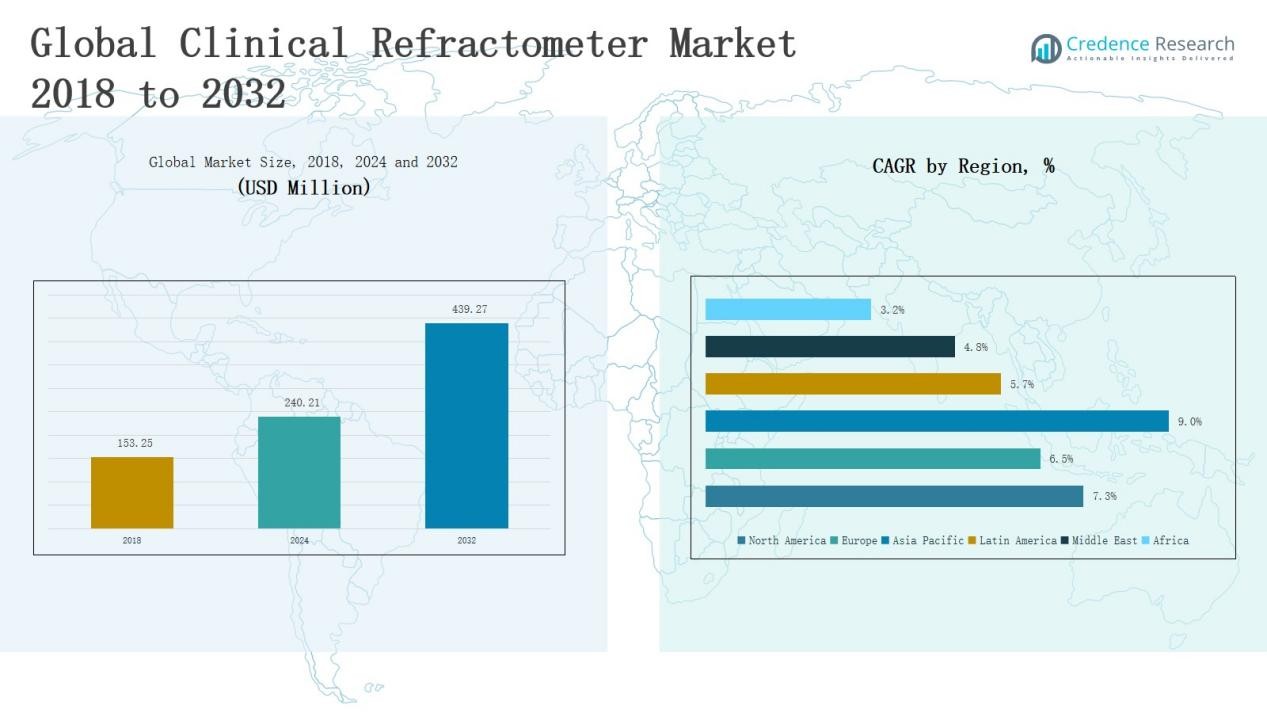
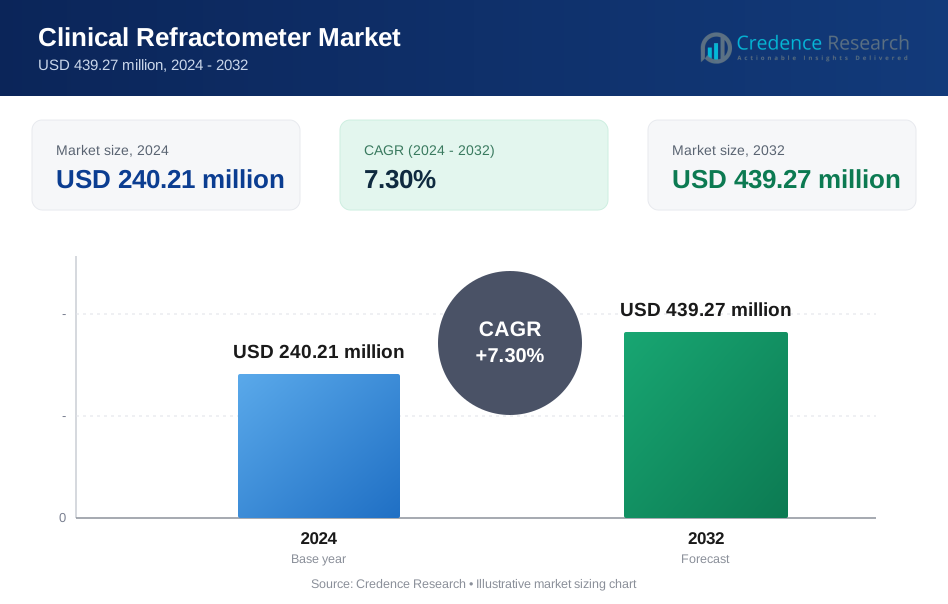
Clinical Refractometer Market size was valued at USD 153.25 million in 2018 to USD 240.21 million in 2024 and is anticipated to reach USD 439.27 million by 2032, at a CAGR of 7.30% during the forecast period.
| REPORT ATTRIBUTE | DETAILS |
|---|---|
| Historical Period | 2020-2024 |
| Base Year | 2024 |
| Forecast Period | 2025-2032 |
| Clinical Refractometer Market Size 2024 | USD 240.21 Million |
| Clinical Refractometer Market, CAGR | 7.30% |
| Clinical Refractometer Market Size 2032 | USD 439.27 Million |
In the Clinical Refractometer Market, key players include Misco (also branded as MISCO Refractometer), Mettler-Toledo, Hanna Instruments, Atago, Rudolph Research Analytical, Thermo Fisher Scientific, G.S.W.S. Compensation Systems, and Bellingham + Stanley, among others. These companies maintain strong competitive positions through advanced product portfolios, precision engineering, and strategic distribution networks targeting hospitals, laboratories, and research institutions. North America stands as the leading region, commanding 35% of the global market share in 2023, supported by a well-established healthcare infrastructure, high adoption of diagnostic technologies, and strong investment in clinical research. The region’s dominance is reinforced by continuous innovation and favorable regulatory frameworks.
Market Insights
- The Clinical Refractometer Market grew from USD 153.25 million in 2018 to USD 240.21 million in 2024 and is expected to reach USD 439.27 million by 2032.
- Advancements in digital and automated technology enhance precision, speed, and usability, increasing adoption across hospitals, research institutions, and pharmaceutical quality control facilities.
- North America leads with a 38.9% share in 2024, driven by advanced healthcare infrastructure, strong research capacity, and high adoption of diagnostic innovations.
- Rising demand for accurate, rapid diagnostics and expanding applications in research and quality control continue to drive market growth globally.
- High initial equipment costs, need for skilled operators, and competition from alternative diagnostic methods remain significant challenges for market expansion.
Market Segment Insights
By Product Type
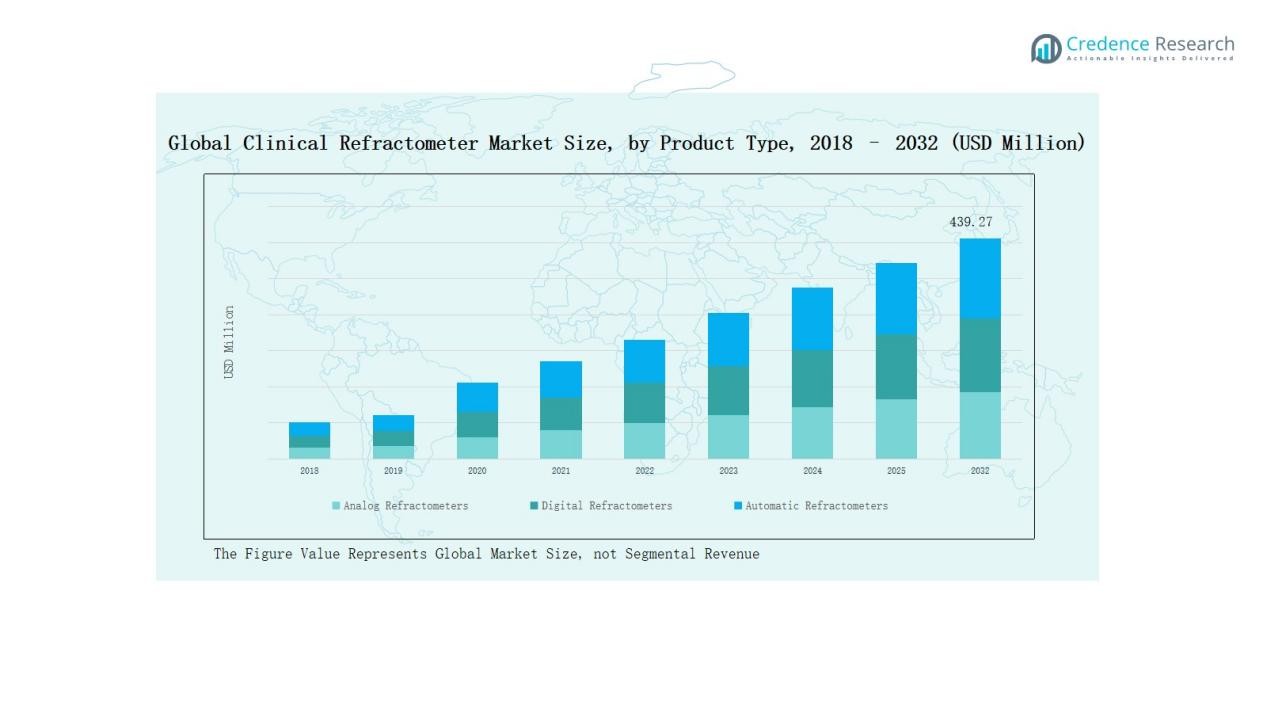
Digital refractometers dominate the Clinical Refractometer Market owing to their precision, ease of operation, and quick measurement capabilities. Automated temperature compensation and advanced interfaces enhance their accuracy, making them ideal for clinical and research settings. Analog refractometers remain valued for affordability and simplicity, while automatic models gain preference in high-volume laboratories seeking efficiency and reduced manual intervention.
- For instance, Thermo Fisher Scientific provides advanced digital models featuring user-friendly interfaces that facilitate quick and accurate sample assessments in healthcare laboratories.
By Application
Clinical diagnosis is the leading application segment, supported by the demand for rapid and reliable diagnostic tools in disease detection and patient monitoring. Refractometers play a vital role in measuring solute concentrations in biological fluids. Research laboratories drive additional growth through biomedical and drug development activities, while quality control applications expand in pharmaceutical manufacturing and laboratory compliance.
- For instance, GAO Tek’s refractometers are used extensively in clinical diagnostics to measure concentrations of urine, serum, and plasma, assisting in diabetes and kidney disease monitoring.
By End User
Hospitals lead the Clinical Refractometer Market, benefiting from high diagnostic testing needs and integration across multiple departments. Their versatility supports applications in pathology, nephrology, and emergency care. Diagnostic laboratories follow closely, driven by outsourced testing demand and advanced equipment requirements. Pharmaceutical companies utilize refractometers for formulation and quality control, while academic institutions apply them for research and specialized training.
Key Growth Drivers
Advancements in Digital and Automated Technology
The Clinical Refractometer Market is experiencing significant growth driven by advancements in digital and automated refractometer technology. Modern devices offer enhanced precision, faster processing, and user-friendly interfaces, enabling more accurate clinical measurements with minimal operator intervention. Automated temperature compensation and connectivity features streamline workflows in laboratories and hospitals. These innovations cater to the growing demand for high-throughput diagnostic testing, reducing human error and improving patient outcomes. Continuous product development by leading manufacturers is expanding adoption across healthcare settings, strengthening the market’s overall growth trajectory.
- For instance, Holmarc’s AR-1700 Automatic Refractometer features automatic temperature compensation and a high-resolution CCD sensor, enabling precise refractive index and Brix measurements with minimal operator input.
Rising Demand for Accurate and Rapid Diagnostics
Increasing emphasis on early disease detection and timely patient care is propelling the demand for accurate and rapid diagnostic tools, such as clinical refractometers. These devices are essential in measuring parameters like specific gravity and solute concentrations in biological samples, supporting critical diagnostic decisions. The growing burden of chronic diseases and the expansion of preventive healthcare programs further drive their use in hospitals, diagnostic laboratories, and point-of-care settings. Enhanced diagnostic capabilities contribute to improved treatment planning and patient management, making refractometers integral to modern clinical workflows.
- For instance, Atago Co., Ltd., a leading manufacturer from Japan, provides digital handheld refractometers widely used in hospitals for swift urine analysis, enabling rapid monitoring of solute concentrations in patient samples.
Expansion of Research and Quality Control Applications
The adoption of clinical refractometers is expanding beyond patient diagnosis into research and quality control applications. Biomedical research institutions use them for accurate fluid analysis in experimental studies, while pharmaceutical companies employ them in formulation testing and compliance verification. The demand for high-precision equipment in drug development pipelines and regulatory quality assurance has increased their presence in manufacturing environments. This diversification of applications provides sustained market growth, as refractometers become a standard tool across various scientific and industrial processes requiring consistent and reliable measurements.
Key Trends & Opportunities
Integration with Digital Health and Data Management Systems
A major trend in the Clinical Refractometer Market is the integration of refractometers with digital health platforms and laboratory information management systems (LIMS). This connectivity allows seamless data transfer, enabling faster reporting, remote monitoring, and better record-keeping. Such integration supports telemedicine initiatives, multi-location diagnostics, and compliance with electronic health record (EHR) standards. Manufacturers are focusing on developing smart, connected devices that enhance operational efficiency, reduce paperwork, and facilitate real-time decision-making, positioning refractometers as part of the broader digital transformation in healthcare diagnostics.
- For instance, Philips developed its HealthSuite Digital Platform to integrate cardiac monitoring data seamlessly into digital health ecosystems for improved patient management and clinical insights.
Emerging Markets Offering Untapped Potential
Rapid healthcare infrastructure development in emerging markets presents a significant growth opportunity for the Clinical Refractometer Market. Countries in Asia Pacific, Latin America, and Africa are investing in advanced diagnostic technologies to improve public health outcomes. The rising prevalence of lifestyle-related diseases, coupled with government initiatives to expand access to diagnostic services, is creating favorable conditions for market penetration. Lower-cost digital refractometer models, tailored to resource-constrained settings, are expected to see strong demand as healthcare providers in these regions modernize their diagnostic capabilities.
- For instance, in Asia-Pacific, companies like Anton Paar are providing highly accurate yet cost-effective digital refractometers designed specifically to meet the quality control and diagnostic needs of resource-constrained healthcare settings.
Key Challenges
High Initial Cost of Advanced Equipment
One of the primary challenges in the Clinical Refractometer Market is the high initial investment required for advanced digital and automatic refractometers. While these devices offer superior accuracy and efficiency, their pricing can limit adoption in smaller clinics, rural healthcare facilities, and low-income regions. Budget constraints often push buyers toward less advanced or refurbished models, impacting manufacturers’ ability to expand premium product sales. Addressing cost barriers through affordable innovations and flexible financing options will be essential to broaden the customer base and increase market accessibility.
Need for Skilled Operators and Training
Despite advancements in automation, effective use of clinical refractometers still requires skilled operators for calibration, maintenance, and accurate interpretation of results. Inadequate training can lead to errors in measurement, compromising diagnostic reliability. Many healthcare facilities, particularly in developing regions, lack structured training programs for laboratory staff. This skills gap can hinder optimal utilization and slow the adoption of advanced refractometer technologies. Industry stakeholders must invest in training modules, certification programs, and user-friendly device interfaces to ensure proper handling and maximize clinical benefits.
Competition from Alternative Diagnostic Methods
The presence of alternative diagnostic methods, such as automated chemistry analyzers and advanced spectroscopy techniques, poses a competitive challenge for the Clinical Refractometer Market. These alternatives may offer broader testing capabilities, integrating multiple parameters into a single platform. As hospitals and laboratories prioritize multifunctional equipment to optimize space and investment, refractometers may face reduced demand in certain applications. To remain competitive, manufacturers must emphasize the unique benefits of refractometers—such as speed, simplicity, and targeted accuracy—while innovating to integrate complementary functionalities.
Regional Analysis
North America
With revenues rising from USD 104.23 million in 2024 to USD 191.13 million by 2032, North America secures the largest global share at 38.9%. The region benefits from a strong concentration of advanced diagnostic facilities, rapid adoption of automated refractometers, and continuous innovation from leading manufacturers. Aging demographics and the growing incidence of chronic illnesses sustain demand across hospitals, research institutions, and diagnostic centers. A CAGR of 7.3% underscores North America’s position as both a technological and commercial leader in the market.
Europe
Europe’s market, valued at USD 66.06 million in 2024 and forecast to reach USD 113.77 million by 2032, holds a 24.6% share. Demand is strengthened by a blend of public sector healthcare modernization, high research activity, and strict compliance with EU-wide quality standards. Countries such as Germany, the UK, and France remain central growth hubs. Pharmaceutical manufacturing expansions and cross-border healthcare collaborations are further increasing the uptake of advanced refractometers.
Asia Pacific
Asia Pacific emerges as the fastest-growing regional market, climbing from USD 49.33 million in 2024 to USD 102.35 million by 2032 at a CAGR of 9.0%. While holding an 18.4% share in 2024, its trajectory is driven by robust economic growth, increasing healthcare budgets, and technology adoption in China, Japan, and India. Government programs for diagnostic modernization and a thriving pharmaceutical sector add momentum, while competitive local manufacturing makes equipment more accessible across diverse healthcare tiers.
Latin America
In Latin America, the market expands from USD 11.69 million in 2024 to USD 19.01 million by 2032, representing 4.4% of global value. Brazil and Mexico lead adoption due to growing private-sector investments, rising awareness of diagnostic accuracy, and gradual improvements in laboratory capabilities. Despite pricing and infrastructure challenges, public-private partnerships and expansion in pharmaceutical production create steady growth prospects, supporting a healthy CAGR of 5.7%.
Middle East
The Middle East market advances from USD 5.72 million in 2024 to USD 8.71 million by 2032, contributing 2.1% of global revenue. Demand stems from an expanding network of specialized medical laboratories, modern hospital infrastructure, and emphasis on high-quality diagnostic practices in the UAE and Saudi Arabia. Steady CAGR growth of 4.8% is expected as governments continue to prioritize healthcare investment and technology imports.
Africa
Africa, while holding the smallest market share at 1.2%, grows from USD 3.18 million in 2024 to USD 4.29 million by 2032. Growth pockets are concentrated in urban centers of South Africa and Egypt, where healthcare upgrades and donor-backed diagnostic projects are most prevalent. Limited affordability, training gaps, and infrastructure constraints slow adoption, yet targeted investments and rising awareness of preventive care signal gradual improvement over the long term.
Market Segmentations:
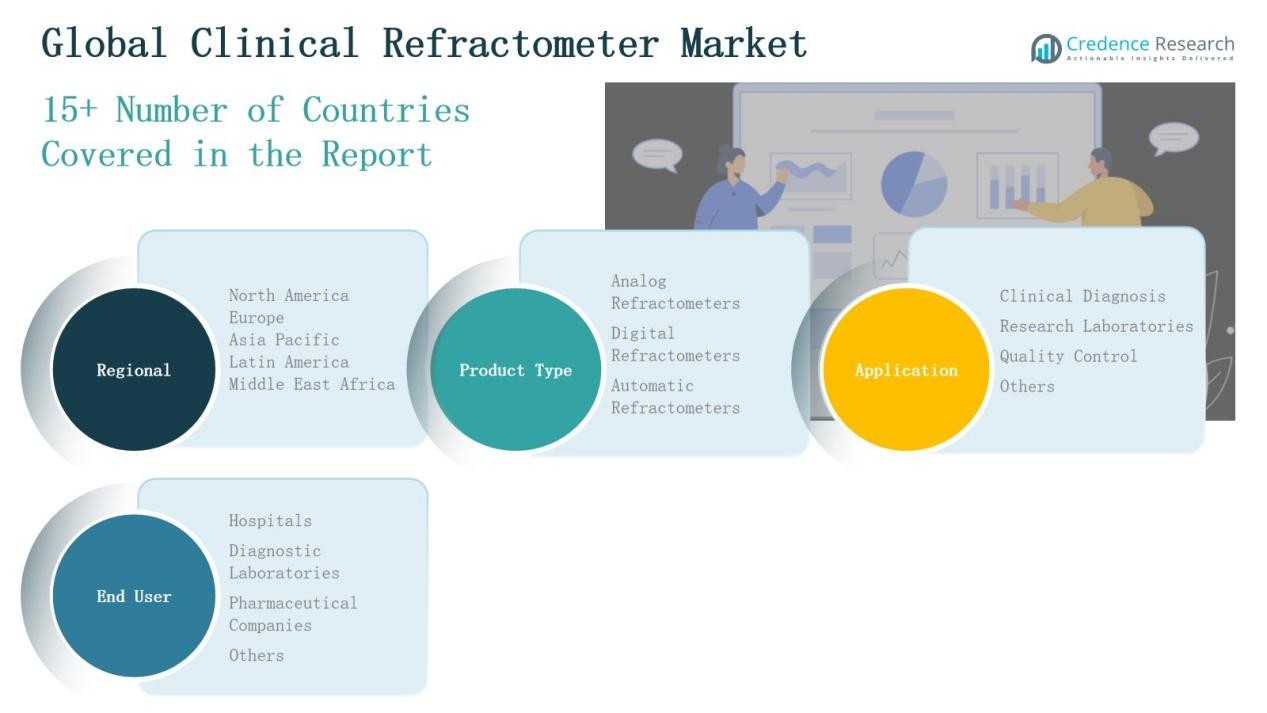
By Product Type
- Analog Refractometers
- Digital Refractometers
- Automatic Refractometers
By Application
- Clinical Diagnosis
- Research Laboratories
- Quality Control
- Others
By End User
- Hospitals
- Diagnostic Laboratories
- Pharmaceutical Companies
- Others
By Region
- North America(U.S., Canada, Mexico)
- Europe(UK, France, Germany, Italy, Spain, Russia, Rest of Europe)
- Asia Pacific(China, Japan, South Korea, India, Australia, Southeast Asia, Rest of Asia Pacific)
- Latin America(Brazil, Argentina, Rest of Latin America)
- Middle East(GCC Countries, Israel, Turkey, Rest of Middle East)
- Africa(South Africa, Egypt, Rest of Africa)
Competitive Landscape
The competitive landscape of the Clinical Refractometer Market is characterized by the presence of established global manufacturers, specialized analytical equipment companies, and emerging regional players competing on technology, accuracy, and application diversity. Leading companies such as ATAGO, METTLER TOLEDO, Thermo Fisher Scientific, Krüss Optronic, and Rudolph Research Analytical maintain strong market positions through continuous product innovation, robust distribution networks, and strategic collaborations with healthcare institutions. These players focus on enhancing device precision, integrating digital interfaces, and improving ease of use to meet the evolving needs of hospitals, diagnostic laboratories, and research facilities. Mid-tier companies and niche manufacturers contribute by offering cost-effective solutions and targeting specific market segments, particularly in developing regions. Competitive strategies include expanding product portfolios, investing in automated and connected device technologies, and strengthening after-sales service capabilities. Intense competition encourages continuous technological advancement, positioning innovation and customer responsiveness as key differentiators in sustaining market leadership.
Key Players
- ATAGO
- METTLER TOLEDO
- Thermo Fisher Scientific
- Krüss Optronic
- Rudolph Research Analytical
- Euromex Microscopen
- Horiba Scientific
- Bellingham + Stanley
- PerkinElmer Inc.
- Jasco Inc.
Recent Developments
- In February 2025, AMETEK, Inc. launched an enhanced version of its Refractix® refractometer, incorporating improved Brix scale measurement capabilities to deliver greater precision and user performance.
- In May 2023, Waters Corporation completed the acquisition of Wyatt Technology, strengthening its portfolio with Wyatt’s differential refractive index technologies focused on molecular characterization.
- In February 2025, AMETEK, Inc. upgraded its Refractix® refractometer by adding enhanced Brix scale measurement, significantly improving precision and usability.
- In June 2025, ATAGO introduced the PAL‑HIKARi set for sour citrus fruits—a combined IR Brix and acidity meter offering dual functionality for sugar‑acid ratio measurement.
Market Concentration & Characteristics
The Clinical Refractometer Market exhibits a moderately concentrated structure, with a few multinational corporations holding significant shares alongside a diverse base of regional and niche players. It is defined by strong competition in technological innovation, product reliability, and application versatility. Leading companies focus on advanced digital and automatic models to address the rising demand for precision, speed, and ease of use in clinical diagnostics, research, and quality control. The market benefits from established distribution networks, strong brand recognition, and long-standing relationships with healthcare institutions. Regional players strengthen their presence by offering competitively priced solutions tailored to local requirements, particularly in emerging markets. Product differentiation is driven by accuracy, user interface design, connectivity features, and compliance with regulatory standards. Strategic partnerships, acquisitions, and continuous R&D investment shape the competitive dynamics, while customer service quality and after-sales support remain critical factors influencing purchasing decisions across hospitals, laboratories, and pharmaceutical companies.
Report Coverage
The research report offers an in-depth analysis based on Product Type, Application, End User and Region. It details leading market players, providing an overview of their business, product offerings, investments, revenue streams, and key applications. Additionally, the report includes insights into the competitive environment, SWOT analysis, current market trends, as well as the primary drivers and constraints. Furthermore, it discusses various factors that have driven market expansion in recent years. The report also explores market dynamics, regulatory scenarios, and technological advancements that are shaping the industry. It assesses the impact of external factors and global economic changes on market growth. Lastly, it provides strategic recommendations for new entrants and established companies to navigate the complexities of the market.
Future Outlook
- Demand for digital and automatic refractometers will increase due to the need for faster and more accurate diagnostics.
- Integration with laboratory information management systems will enhance workflow efficiency.
- Adoption in emerging markets will expand with improving healthcare infrastructure.
- Product development will focus on user-friendly designs and compact models.
- Applications in pharmaceutical quality control will continue to grow.
- Research laboratories will increase usage for advanced biomedical studies.
- Connectivity features will enable real-time data sharing and remote monitoring.
- Competition will intensify as more regional players enter the market.
- Training and support services will become essential to improve device utilization.
- Regulatory compliance will remain a primary factor influencing product development.
Request a Free Sample
Fill in your details and we'll send you a free sample report.
- Sample data tables & charts
- Research methodology
Need a Custom Version of This Report?
Tailor the scope, geography, or segments to your exact requirements.
- Custom geography or segment scope
- Direct access to our analyst team
Frequently Asked Questions
What is the current market size for Clinical Refractometer Market, and what is its projected size in 2032?
At what Compound Annual Growth Rate is the Clinical Refractometer Market projected to grow between 2025 and 2032?
Which Clinical Refractometer Market segment held the largest share in 2024?
What are the primary factors fueling the growth of the Clinical Refractometer Market?
Who are the leading companies in the Clinical Refractometer Market?
Which region commanded the largest share of the Clinical Refractometer Market in 2024?
Table of Content
Chapter 1. Report Introduction
- 1.1 Report Description & Purpose
- 1.1.1 Report Title & Market Definition
- 1.1.2 Unique Selling Propositions (USP) & Key Differentiators
- 1.1.3 Value Proposition for Stakeholders
- 1.2 Research Objectives
- 1.2.1 Market Sizing Objectives (Volume & Revenue)
- 1.2.2 Segmentation Objectives
- 1.2.3 Competitive Intelligence Objectives
- 1.2.4 Forecast & Scenario Objectives
- 1.3 Report Scope
- 1.3.1 Clinical Refractometer Scope – Types & Subtypes Covered
- 1.3.2 Geographic Scope – Regions & Countries Covered
- 1.3.3 Historical Period, Base Year & Forecast Period (2024; forecast to 2032)
- 1.3.4 Inclusions & Exclusions
- 1.4 HS Code & Classification Framework
- 1.5 Currency, Units & Pricing Basis
- 1.6 Target Stakeholders
- 1.7 Limitations & Assumptions
Chapter 2. Executive Summary
- 2.1 Global Clinical Refractometer Market Snapshot
- 2.1.1 Market Size – Historical (2024) & Forecast (2024-2032) (2024: USD 240.21 million → 2032: USD 439.27 million)
- 2.1.2 Volume & Revenue – Global Totals
- 2.1.3 Key Market Highlights – Top Five Facts
- 2.2 Clinical Refractometer Market Segmentation Snapshot
- 2.2.1 Market Split by Region – 2024 vs. 2032
- 2.3 Competitive Snapshot
- 2.3.1 Top 10 Players by Revenue Share – 2024
- 2.3.2 Top 10 Players by Volume Share – 2024
- 2.3.3 Recent Strategic Developments (18-Month Summary)
- 2.4 Key Investment Highlights & Strategic Conclusions
Chapter 3. Clinical Refractometer Market Dynamics & Industry Analysis
- 3.1 Market Overview & Context
- 3.1.1 Clinical Refractometer Market Position in the Broader Automotive Value Chain
- 3.1.2 OEM vs. Replacement Market Dynamics
- 3.1.3 Market Maturity & Development Stage by Region
- 3.2 Clinical Refractometer Market Drivers
- 3.3 Clinical Refractometer Market Restraints & Challenges
- 3.4 Clinical Refractometer Market Opportunities
- 3.5 Porter's Five Forces Analysis
- 3.5.1 Threat of New Entrants
- 3.5.2 Bargaining Power of Suppliers
- 3.5.3 Bargaining Power of Buyers
- 3.5.4 Threat of Substitutes
- 3.5.5 Competitive Rivalry – Intensity Assessment
- 3.6 Clinical Refractometer Value Chain Analysis
- 3.6.1 Upstream – Raw Material/Input Suppliers
- 3.6.1.1 Raw Material/Input 1
- 3.6.1.2 Raw Material/Input 2
- 3.6.1.3 Raw Material/Input 3
- 3.6.2 Midstream – Production/Manufacturing/Service Delivery
- 3.6.2.1 Production/Process Overview
- 3.6.2.2 Key Facility Locations & Capacity by Manufacturer
- 3.6.3 Downstream – Distribution & End Consumer
- 3.6.3.1 Primary Channel – B2B/OEM
- 3.6.3.2 Secondary Channels – Dealer, Retail, Online, Direct
- 3.6.4 Value Chain Profitability Analysis
- 3.6.1 Upstream – Raw Material/Input Suppliers
- 3.7 PESTEL Analysis
- 3.7.1 Political Factors
- 3.7.2 Economic Factors
- 3.7.3 Social Factors
- 3.7.4 Technological Factors
- 3.7.5 Environmental Factors
- 3.7.6 Legal Factors
- 3.8 Clinical Refractometer Supply Chain Analysis
- 3.8.1 Raw Material/Input Supply Risk Assessment
- 3.8.2 Manufacturing Concentration Risk (Geographic Exposure)
- 3.8.3 Trade Disruption Impact Analysis
- 3.9 Regulatory & Policy Landscape
Note: The regulatory and policy landscape section covers regulations based on their applicability to the market, Clinical Refractometer category, geography, and scope of the study. Only regulatory frameworks with a material impact on operations, compliance, trade, sustainability, or market access are analyzed in detail.
Chapter 4. Key Investment Pockets & Opportunity Analysis
- 4.1 Clinical Refractometer Market Attractiveness Analysis
- 4.1.1 By Region – Investment Attractiveness Matrix (Volume × CAGR)
- 4.2 Absolute Revenue Growth Opportunity
- 4.2.1 By Region – Absolute USD Growth Through 2032
- 4.3 Incremental Volume Opportunity
- 4.3.1 By Region – Incremental Volume Through 2032
- 4.3.2 Segment – Incremental Volume
- 4.4 Emerging Submarket Opportunity Deep Dive (Subject to Applicability)
- 4.5 Emerging Market Opportunity Scorecards
- 4.5.1 United States
- 4.5.2 Europe
- 4.5.3 Asia
- 4.5.4 Middle East & Africa
Note: Emerging Market Opportunity Scorecards will be included based on relevance and strategic importance. Regions listed are indicative and may vary depending on data availability and market dynamics.
Chapter 5. Clinical Refractometer Import-Export Analysis & Trade Flows
- 5.1 Global Trade Overview
- 5.1.1 Global Export Value by Country (2024)
- 5.1.2 Global Export Volume by Country (2024)
- 5.1.3 Global Import Value by Country (2024)
- 5.1.4 Global Import Volume by Country (2024)
- 5.1.5 Net Trade Balance by Country (2024)
- 5.2 Export Analysis – Segment
- 5.2.1 Type 1 (HS Code)
- 5.2.2 Type 2 (HS Code)
- 5.2.3 Type 3 (HS Code)
- 5.2.4 Type 4 (HS Code)
- 5.2.5 Type 5 (HS Code)
- 5.3 Import Analysis – Segment
- 5.3.1 Type 1 (HS Code)
- 5.3.2 Type 2 (HS Code)
- 5.3.3 Type 3 (HS Code)
- 5.3.4 Type 4 (HS Code)
- 5.3.5 Type 5 (HS Code)
- 5.4 Average Unit Trade Prices
- 5.4.1 Average Export Price – Segment & Country
- 5.4.2 Average Import Price – Segment & Source Country
- 5.4.3 Price Trends (2024)
- 5.5 Key Trade Route Analysis
- 5.5.1 Trade Route 1
- 5.5.2 Trade Route 2
- 5.5.3 Trade Route 3
- 5.5.4 Trade Route 4
- 5.5.5 Trade Route 5
- 5.6 Trade Policy Impact Assessment
- 5.6.1 US Anti-Dumping & Section 301 Tariffs
- 5.6.2 EU Customs Union Impact
- 5.6.3 Major Free Trade Agreements
- 5.6.4 USMCA Rules of Origin
Note: Trade policy analysis will be included only where relevant to the Clinical Refractometer market.
Chapter 6. Competitive Landscape & Company Benchmarking
- 6.1 Clinical Refractometer Market Concentration & Structure
- 6.1.1 Herfindahl-Hirschman Index (HHI) – vs. 2024
- 6.1.2 Tier 1, Tier 2 & Tier 3 Market Structure
- 6.1.3 Global, Regional & Local Player Dynamics
- 6.2 Clinical Refractometer Market Share Analysis – 2024
- 6.2.1 Global Revenue Share by Company
- 6.2.2 Global Volume Share by Company
- 6.2.3 Regional Revenue Share
- 6.2.4 Market Share Evolution ( vs. 2024)
- 6.2.5 OEM Segment Share by Company
- 6.2.6 Replacement Segment Share by Company
- 6.3 Production/Delivery Capacity & Facility Analysis
- 6.3.1 Global Installed Capacity
- 6.3.2 Capacity Utilization Rates
- 6.3.3 Production/Output Volume
- 6.3.4 Facility Locations & Capacity Map
- 6.3.5 Planned Capacity Additions
- 6.4 Clinical Refractometer Competitive Benchmarking Matrix
- 6.4.1 Revenue, Volume, CAGR & Profitability Comparison
- 6.4.2 Channel Revenue Mix
- 6.4.3 Geographic Revenue Exposure
- 6.4.4 R&D Intensity
- 6.4.5 Sustainability Maturity
- 6.5 Strategic Developments in Clinical Refractometer (Last 24 Months)
- 6.5.1 Mergers, Acquisitions & Divestments
- 6.5.2 New Clinical Refractometer Launches
- 6.5.3 Facility Expansions
- 6.5.4 Strategic Alliances, Joint Ventures & Partnerships
- 6.5.5 Distribution Expansion & Market Entry
- 6.5.6 Sustainability & ESG Initiatives
- 6.6 Competitive Strategy Mapping
- 6.6.1 Leader, Challenger, Follower & Niche Classification
- 6.6.2 Pricing Strategy Comparison
- 6.6.3 Channel Strategy Matrix
Note: Strategic developments are included based on their materiality and the availability of reliable information.
Chapter 7. Global Clinical Refractometer Market – By Distribution Channel
- 7.1 Segment Overview
- 7.1.1 Volume & Revenue Split by Channel (2024 & 2032)
- 7.1.2 Channel Mix Evolution (2024-2032)
Chapter 8. Regional Market Analysis – Global Overview
- 8.1 Global Regional Overview
- 8.1.1 Regional Volume Share
- 8.1.2 Regional Revenue Share
- 8.1.3 Regional Volume by Region
- 8.1.4 Regional Revenue by Region
- 8.1.5 Regional Forecast Through 2032
- 8.2 Cross-Regional Segment Analysis
- 8.2.1 By Distribution Channel
- 8.2.2 By Brand/Price Tier
Chapter 9. North America Clinical Refractometer Market
- 9.1 United States
- 9.2 Canada
- 9.3 Mexico
Chapter 10. Europe Clinical Refractometer Market
- 10.1 Germany
- 10.2 France
- 10.3 Italy
- 10.4 United Kingdom
- 10.5 Spain
- 10.6 Poland
- 10.7 Russia
- 10.8 Netherlands
- 10.9 Belgium
- 10.10 Sweden
- 10.11 Denmark
- 10.12 Norway
- 10.13 Rest of Europe
Chapter 11. Asia Pacific Clinical Refractometer Market
- 11.1 China
- 11.2 India
- 11.3 Japan
- 11.4 South Korea
- 11.5 Thailand
- 11.6 Indonesia
- 11.7 Vietnam
- 11.8 Malaysia
- 11.9 Australia
- 11.10 Rest of Asia Pacific
Chapter 12. Latin America Clinical Refractometer Market
- 12.1 Brazil
- 12.2 Argentina
- 12.3 Colombia
- 12.4 Chile
- 12.5 Rest of Latin America
Chapter 13. Middle East Clinical Refractometer Market
- 13.1 Saudi Arabia
- 13.2 United Arab Emirates
- 13.3 Turkey
- 13.4 Israel
- 13.5 Iran
- 13.6 Rest of the Middle East
Chapter 14. Africa Clinical Refractometer Market
- 14.1 South Africa
- 14.2 Egypt
- 14.3 Nigeria
- 14.4 Morocco
- 14.5 Rest of Africa
Chapter 15. Clinical Refractometer Company Profiles
- 15.1 [Company 01]
- 15.1.1 Company Overview
- 15.1.2 Key Management Personnel
- 15.1.3 Products & Services Portfolio
- 15.1.4 Financial Performance
- 15.1.5 Key Market Focus & Geographic Presence
- 15.1.6 Recent Developments & Strategic Initiatives
Note: The company profile list is preliminary and may change based on research findings, market developments, data availability, and client requirements.
Chapter 16. Appendices
- Appendix A – List of Abbreviations & Acronyms
- Appendix B – Industry Classification Code Reference – Full Series
- Appendix C – Production & Capacity Data Tables
- Appendix D – End-Use & Demand Base Tables
- Appendix E – Consumption & Replacement Rate Assumptions
- Appendix F – ASP Reference Tables
- Appendix G – Manufacturing & Facility Database
- Appendix H – Import-Export Data Tables
- Appendix I – Regulatory Summary Tables
- Appendix J – Primary Research Participant List (Anonymized)
- Appendix K – Primary Research Questionnaire Framework
- Appendix L – Data Sources & Bibliography
- Appendix M – Market Size Divergence & Source Comparison
Chapter 17. Research Methodology
- 17.1 Research Framework & Philosophy
- 17.2 Secondary Research – Sources, Hierarchy & Data Extraction
- 17.3 Data Modeling – Bottom-Up & Top-Down Market Sizing
- 17.4 Primary Research – Stakeholder Framework, LOI & Sample Sizes
- 17.5 Forecast Methodology – Regression, Scenario & Sensitivity Analysis
- 17.6 Quality Control – Four-Layer Validation Framework
- 17.7 Limitations & Standard Assumptions
- 17.8 Disclaimer
