
Combi Cooler Market Overview:
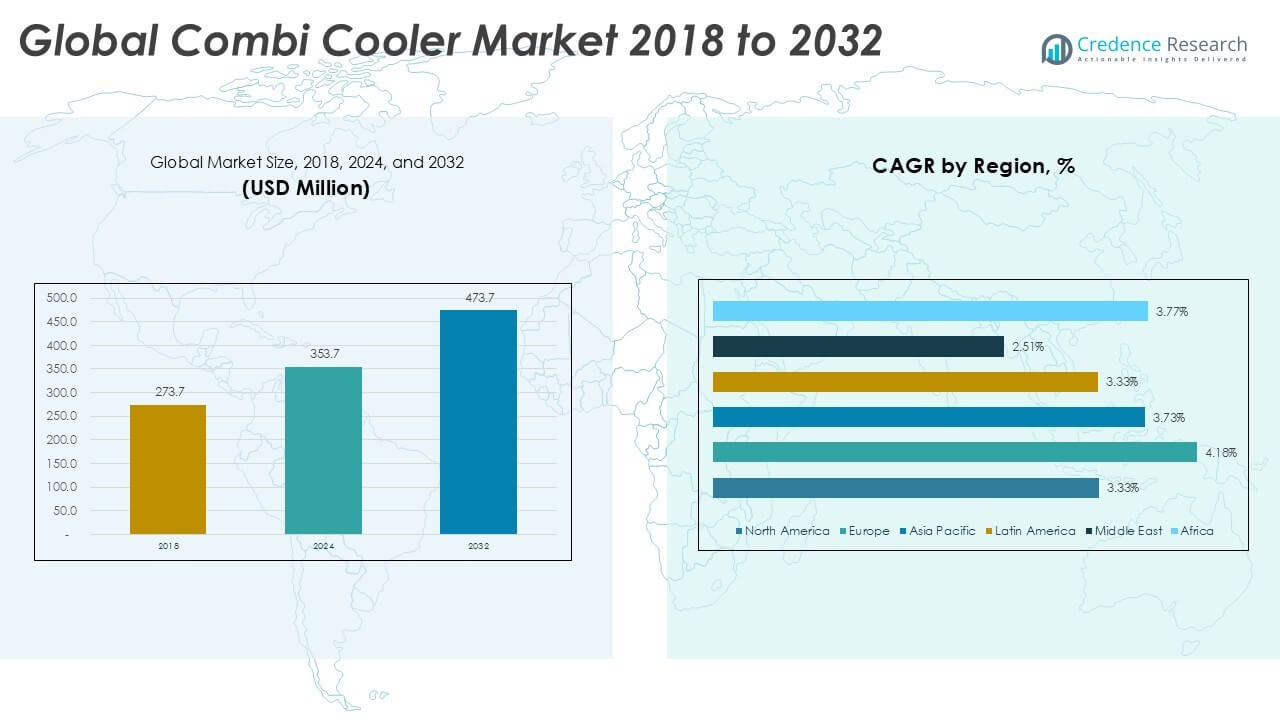
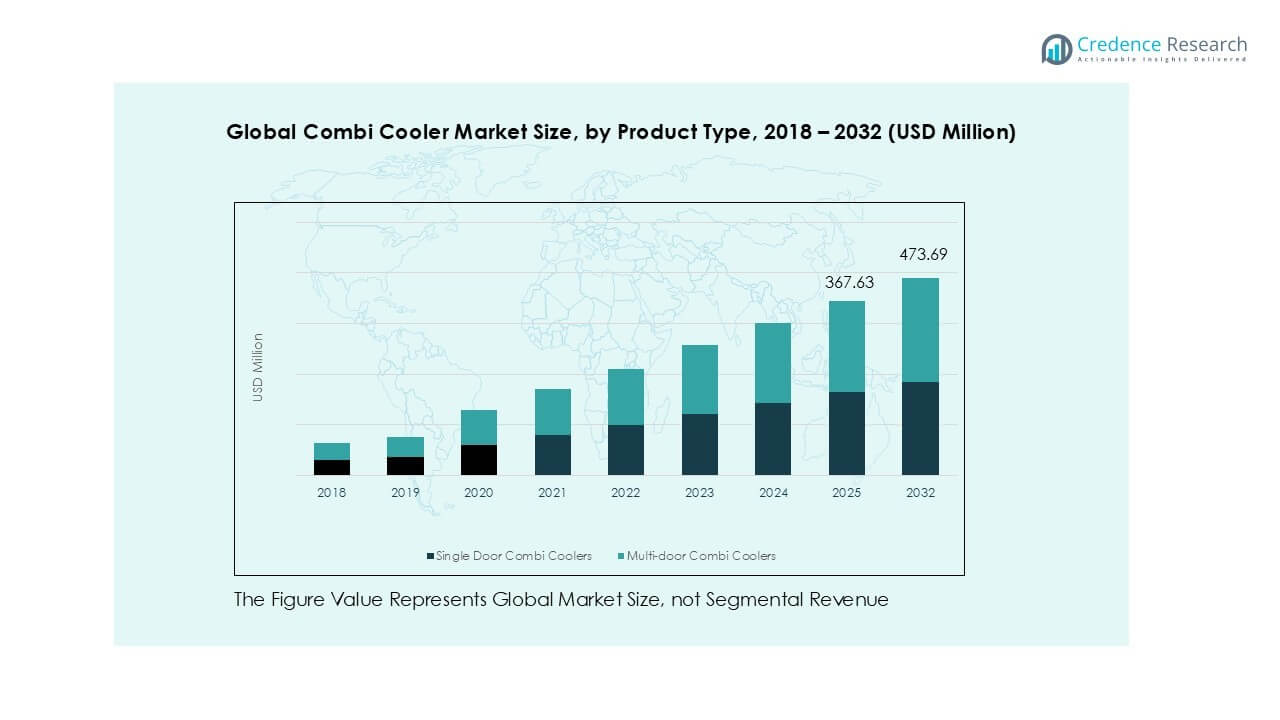
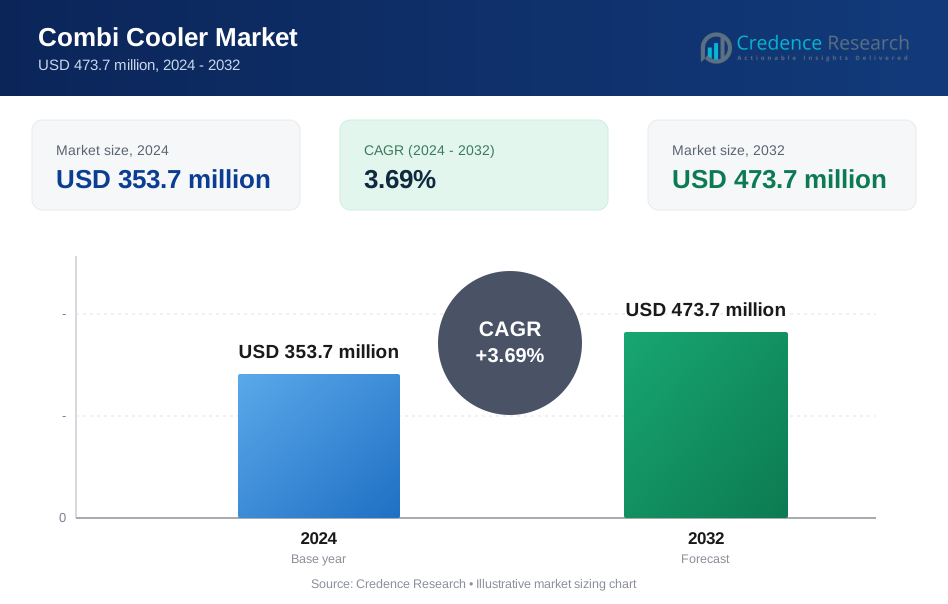
The Global Combi Cooler Market size was valued at USD 273.7 million in 2018, grew to USD 353.7 million in 2024, and is anticipated to reach USD 473.7 million by 2032, at a CAGR of 3.69% during the forecast period.
| REPORT ATTRIBUTE | DETAILS |
|---|---|
| Historical Period | 2020-2023 |
| Base Year | 2024 |
| Forecast Period | 2025-2032 |
| Combi Cooler Market Size 2024 | USD 353.7 million |
| Combi Cooler Market, CAGR | 3.69% |
| Combi Cooler Market Size 2032 | USD 473.7 million |
The global combi cooler market is led by prominent players such as Alfa Laval, Kelvion Holding GmbH, Danfoss A/S, Fsem Auto Radiators, and Darshan Air Solution Pvt. Ltd. These companies compete through advanced product designs, energy-efficient systems, and region-specific strategies. Alfa Laval and Kelvion dominate the high-capacity industrial segment, while Danfoss drives innovation in compact and integrated cooling units. Fsem Auto Radiators and Darshan Air Solution focus on cost-effective solutions for mid-scale industries. Asia Pacific emerges as the leading region, accounting for 34.9% of the global market share in 2024, driven by rapid industrialization, infrastructure growth, and energy sector expansion in China, India, and Southeast Asia.
Combi Cooler Market Insights
- The global combi cooler market was valued at USD 353.7 million in 2024 and is projected to reach USD 473.7 million by 2032, growing at a CAGR of 3.69%.
- Rising demand from power generation, transmission, and oil & gas industries is driving adoption of dual-fluid cooling systems for efficient thermal control in high-load operations.
- Integration of compact, energy-efficient, and IoT-enabled combi coolers is a key trend, especially in industrial automation and smart infrastructure projects.
- Key players such as Alfa Laval, Kelvion Holding GmbH, and Danfoss A/S dominate the market with strong portfolios, while regional manufacturers cater to cost-sensitive markets with customized products.
- Asia Pacific leads with 34.9% share, followed by Europe (27.8%) and North America (23.6%); the 50 to 250 kW power segment holds over 45% share due to its suitability for mid-to-large scale industrial applications, while high upfront costs remain a key restraint.
Combi Cooler Market Segmentation Analysis:
By Product Type:
Multi-door Combi Coolers dominate the product segment, accounting for over 60% of the global market share in 2024. These units offer greater storage flexibility and are preferred in large-scale industrial applications where multi-circuit cooling is essential. Their ability to support complex operations with multiple fluid loops enhances operational efficiency. The rising need for high-capacity and energy-efficient cooling systems in sectors like power transmission and chemical processing further drives the demand for multi-door variants. Single Door Combi Coolers remain popular in compact setups but face limitations in scalability and versatility compared to multi-door models.
- For instance, the Elanpro Reach in Combi 600 + 600 L Capacity and Static 4 Doors, CGN 1200CF combines two 600 L chambers with four doors, letting operators manage separate cooling zones within one unit.
By Power Segment:
The 50 to 250 kW power range holds the largest share, contributing more than 45% to the market in 2024. These combi coolers strike a balance between performance and energy consumption, making them suitable for mid-to-large industrial facilities. Their demand is rising in oil and gas refineries, where cooling efficiency and thermal control are critical. Units above 250 kW are gaining traction in energy transmission hubs due to high-density equipment requirements. Meanwhile, Upto 10 kW and 10 to 50 kW segments serve niche applications, mainly in localized cooling and small-scale process systems.
- For instance, large dual‑door and multi‑door units like the Western 1882 L Triple Door Visi Cooler with Canopy, SRC1800‑GL accommodate high storage volumes with robust cooling circuits suited to facilities needing moderate power capacity.
By Material:
Aluminium-based combi coolers lead the material segment with a share exceeding 50% in 2024. Aluminium’s lightweight properties, corrosion resistance, and high thermal conductivity make it ideal for industrial cooling solutions. Its recyclability also aligns with rising environmental regulations and sustainability goals. Copper remains favored in high-performance applications due to superior heat transfer capabilities but faces cost and weight challenges. Brass and other materials cater to specific custom-built requirements but hold limited market presence. The shift toward cost-efficient and durable solutions continues to boost the adoption of aluminium over other material options.
Combi Cooler Market Key Growth Drivers
Rising Demand Across Power Generation and Transmission Sectors
The power generation and transmission industry is a major growth driver for the global combi cooler market. These industries require reliable thermal management to maintain transformer and generator efficiency under high load. Combi coolers are essential in these applications due to their ability to handle dual-fluid systems like oil and water, ensuring consistent cooling under variable environmental and load conditions. Grid modernization projects across North America, Europe, and parts of Asia-Pacific have increased the deployment of high-capacity transformers and switchgear that rely on advanced cooling systems. With renewable energy integration and rising power demand, the need for compact, energy-efficient cooling solutions continues to rise. The flexibility of combi coolers to handle diverse temperature gradients and reduce equipment downtime further solidifies their adoption across transmission substations and distributed power facilities globally.
- For instance, high‑capacity transformer cooling systems use oil and water cooling circuits to manage heat from core windings and maintain efficient performance under heavy electrical loads.
Expanding Applications in Oil & Gas and Chemical Industries
The oil & gas and chemical processing sectors demand robust cooling systems due to their continuous and high-temperature operations. Combi coolers are increasingly adopted in these sectors for their ability to cool both fluids and gases simultaneously in a compact unit. Offshore rigs, refineries, and chemical plants prioritize equipment that can operate in extreme conditions, and combi coolers fit these needs with corrosion-resistant materials and durable designs. Their reduced maintenance requirements and capacity to integrate with existing systems add to their appeal. Additionally, growing investment in refining capacity across Asia-Pacific, the Middle East, and Africa enhances the deployment potential. Process cooling, heat recovery, and temperature regulation in petrochemical environments are increasingly reliant on combi coolers, strengthening their market penetration. As industrial automation and continuous production become the norm, reliable thermal control solutions like combi coolers will see consistent demand.
- For instance, API Heat Transfer supplies combi coolers engineered with marine-grade aluminum and stainless steel to handle dual-media cooling in harsh refinery and offshore environments, including lube oil, air, and glycol systems.
Shift Toward Compact and Energy-Efficient Cooling Solutions
Space optimization and energy efficiency are now key purchasing criteria across industrial facilities. The combi cooler market benefits from this shift due to its compact form factor and ability to combine multiple cooling systems into a single unit. Unlike conventional separate coolers, combi coolers offer integrated solutions that reduce installation space and simplify system layouts. This leads to savings in both capital and operational expenditure. Moreover, with rising energy costs, industries seek cooling solutions with high thermal efficiency and lower power consumption. Innovations in heat exchanger design, fan systems, and material engineering have made modern combi coolers more efficient, with improved heat transfer rates and reduced environmental impact. Demand is especially strong in Europe and North America, where regulatory bodies enforce energy usage standards and sustainability norms. As industrial facilities undergo modernization, the preference for energy-optimized and space-saving cooling systems will drive the market forward.
Combi Cooler Market Key Trends & Opportunities
Integration of Smart Monitoring and IoT Capabilities
A notable trend reshaping the combi cooler market is the integration of IoT and smart monitoring systems. Manufacturers are embedding sensors, connectivity modules, and control interfaces within cooling units to offer real-time diagnostics, predictive maintenance, and performance tracking. These features help reduce unplanned downtime and improve system reliability by alerting operators about temperature fluctuations, fluid levels, or fan speed anomalies. In high-risk industries such as power and oil & gas, predictive insights allow for proactive decision-making, enhancing operational continuity. This trend is driven by the rising adoption of Industry 4.0 principles, where intelligent equipment supports digital twin technologies and remote monitoring. Furthermore, smart combi coolers are gaining traction in developed markets where digital infrastructure is mature. The ability to optimize cooling performance and energy consumption using data analytics presents significant value to facility managers and system integrators.
- For instance, MITA’s IoT Platform 4.0 lets operators view real‑time performance data, remote diagnostics, and maintenance history for connected coolers via a single interface, enabling proactive service alerts.
Growth Opportunities in Emerging Economies
Emerging economies in Asia-Pacific, Latin America, and parts of Africa present untapped opportunities for the combi cooler market. Rapid industrialization, infrastructure expansion, and energy demand are increasing the need for advanced thermal management solutions. Governments in countries like India, Vietnam, Brazil, and South Africa are investing in large-scale projects across energy, manufacturing, and petrochemical sectors. These initiatives require reliable and scalable cooling technologies, making combi coolers a suitable choice. Additionally, the rise of industrial parks, smart grid deployments, and regional manufacturing hubs fuels demand for versatile cooling systems. Local manufacturing and international partnerships offer a path to cost-effective production and broader distribution. As these regions enhance their energy and industrial capacity, demand for compact, multi-functional, and maintenance-friendly cooling systems will grow. This positions global and regional manufacturers to tap into fast-growing markets with tailored product lines and service networks.
Combi Cooler Market Key Challenges
High Initial Cost and System Complexity
Despite long-term operational benefits, the high upfront cost of combi coolers remains a key barrier, especially for small and mid-sized enterprises. These systems often involve complex engineering to integrate multiple cooling circuits, requiring customization and skilled installation. The cost of raw materials like aluminium or copper, along with the inclusion of control systems and heat exchangers, adds to the total expenditure. For industries in developing regions with constrained capital budgets, this becomes a deterrent. Additionally, integrating combi coolers into legacy systems can be challenging due to compatibility and space constraints. The need for trained personnel for setup and maintenance also increases indirect costs. Unless addressed through cost-optimized product lines and service models, the high initial investment may limit adoption in price-sensitive markets.
Maintenance and Operational Reliability in Harsh Environments
Ensuring consistent performance of combi coolers in harsh and fluctuating environments poses a significant challenge. Industries such as oil & gas, mining, and offshore energy operations expose cooling equipment to extreme temperatures, dust, corrosion, and vibration. In such conditions, system reliability can degrade over time, especially if materials and seals are not adequately engineered. Failures in cooling systems can lead to overheating of critical equipment, resulting in costly downtime. Moreover, the need for periodic maintenance, especially for dual-circuit systems, places pressure on operational schedules. While advanced designs and materials mitigate some risks, many regions lack access to specialized servicing and spare parts. To address this, manufacturers must focus on ruggedized designs, remote diagnostics, and local support networks to maintain reliability under demanding conditions.
Combi Cooler Market Regional Analysis
North America
North America accounted for approximately 23.6% of the global combi cooler market in 2024, with a market size of USD 83.60 million, up from USD 65.99 million in 2018. The region is projected to reach USD 108.95 million by 2032, growing at a CAGR of 3.33%. Growth is driven by aging grid infrastructure upgrades, industrial expansion, and the adoption of energy-efficient cooling in the U.S. and Canada. Power transmission, oil & gas, and process industries are key end-users. Regulatory focus on operational efficiency and emissions reduction supports the demand for advanced thermal management systems across facilities.
Europe
Europe captured 27.8% of the global combi cooler market in 2024, with a market value of USD 98.38 million, rising from USD 73.90 million in 2018. The market is set to reach USD 136.90 million by 2032, at a CAGR of 4.18%, the highest among all regions. Strong demand stems from industrial automation, renewable energy projects, and efficiency regulations across Germany, France, and the UK. The region's emphasis on sustainable design and smart grid deployment supports combi cooler integration. Europe's mature infrastructure and technological adoption make it a critical hub for high-performance thermal management solutions.
Asia Pacific
Asia Pacific led the global combi cooler market in 2024 with the highest market share of 34.9%, reaching USD 123.35 million from USD 95.20 million in 2018. It is projected to hit USD 165.79 million by 2032, growing at a CAGR of 3.73%. Rapid industrialization, rising energy demand, and ongoing infrastructure projects in China, India, and Southeast Asia fuel market growth. The manufacturing, chemical, and power sectors create robust demand for compact, high-capacity cooling systems. Government initiatives supporting grid expansion and smart industry applications further boost the adoption of combi coolers across both urban and rural industrial zones.
Latin America
Latin America represented 7.3% of the global combi cooler market in 2024, with a market size of USD 25.82 million, increasing from USD 20.39 million in 2018. The market is expected to reach USD 33.63 million by 2032 at a CAGR of 3.33%. Brazil, Mexico, and Argentina lead regional demand due to investments in energy, petrochemical, and industrial automation sectors. The need for reliable and compact cooling systems in challenging environments drives product uptake. Despite economic variability, infrastructure development and modernization efforts across key economies sustain a steady demand for efficient thermal management solutions.
Middle East
The Middle East held a 4.5% share of the global combi cooler market in 2024, with a value of USD 15.88 million, up from USD 13.08 million in 2018. It is projected to grow to USD 19.42 million by 2032, at the lowest CAGR of 2.51%. The region’s growth is supported by ongoing oil & gas projects and power infrastructure expansion, especially in Saudi Arabia and the UAE. However, adoption is limited by harsh climatic conditions and high equipment cost. Focused deployment in high-load industrial facilities and government-led diversification efforts are expected to create moderate opportunities in the forecast period.
Africa
Africa contributed 1.9% to the global combi cooler market in 2024, reaching USD 6.68 million from USD 5.15 million in 2018. The market is forecasted to grow to USD 9.00 million by 2032 at a CAGR of 3.77%. This growth is driven by increasing industrialization and energy sector investments across South Africa, Egypt, and Nigeria. Demand is rising for durable and cost-efficient cooling solutions in emerging manufacturing and power infrastructure. While the market is relatively small, growing electrification programs and donor-backed industrial development initiatives are boosting the need for reliable thermal management systems in under-served regions.
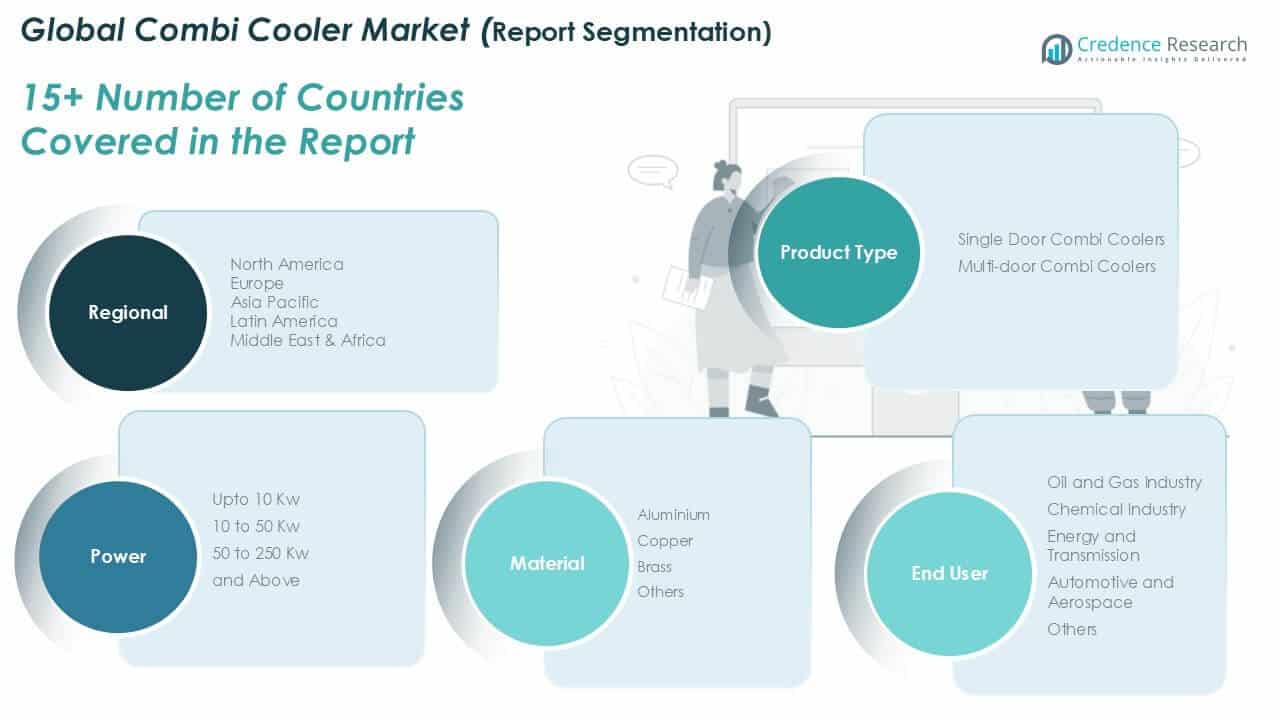
Combi Cooler Market Segmentations:
By Product Type:
- Single Door Combi Coolers
- Multi-door Combi Coolers
By Power Segment:
- Upto 10 kW
- 10 to 50 kW
- 50 to 250 kW
- Above 250 kW
By Material:
- Aluminium
- Copper
- Brass
- Others
By End User:
- Oil and Gas Industry
- Chemical Industry
- Energy and Transmission
- Automotive and Aerospace
- Others
By Geography
- North America
- U.S.
- Canada
- Mexico
- Europe
- Germany
- France
- U.K.
- Italy
- Spain
- Rest of Europe
- Asia Pacific
- China
- Japan
- India
- South Korea
- South-east Asia
- Rest of Asia Pacific
- Latin America
- Brazil
- Argentina
- Rest of Latin America
- Middle East & Africa
- GCC Countries
- South Africa
- Rest of the Middle East and Africa
Combi Cooler Market Competitive Landscape
The global combi cooler market features a mix of established multinational companies and regional manufacturers focused on industrial cooling applications. Key players such as Alfa Laval, Kelvion Holding GmbH, and Danfoss A/S lead through innovation, strong distribution networks, and diversified portfolios in thermal management systems. Alfa Laval emphasizes modular product design and global servicing capabilities, while Kelvion strengthens its presence via tailored cooling solutions for energy and process industries. Danfoss, known for energy-efficient components, integrates combi coolers into broader industrial solutions. Emerging players like Fsem Auto Radiators and Darshan Air Solution Pvt. Ltd. cater to cost-sensitive markets with localized offerings. Competitive strategies include product innovation, smart cooling integration, and regional expansion. Mergers, acquisitions, and technology upgrades remain key growth enablers. The market sees increasing focus on compact design, IoT-enabled diagnostics, and eco-friendly materials, further intensifying the competition among top-tier players and new entrants across regions.
Key Player Analysis
- Alfa Laval
- Kelvion Holding GmbH
- Danfoss A/S
- Fsem Auto Radiators
- Darshan Air Solution Pvt. Ltd.
- Other Key Players
Recent Developments
- In Dec 2025, Danfoss A/S released new PTS staging valves to improve chiller/heat pump performance, aiding energy‑efficient cooling systems
- In 2025, Alfa Laval showcased new thermal technology innovations (marine, energy, and waste heat recovery). Not specific to combi cooler but highlights cooling and heat‑exchange focus.
- In 2025, Alfa Laval hosted Capital Markets Day with presentations on innovation and heat‑transfer solutions at new innovation centre.
Report Coverage
The research report offers an in-depth analysis based on Product Type, Power Segment, Material, End-User and Geography. It details leading market players, providing an overview of their business, product offerings, investments, revenue streams, and key applications. Additionally, the report includes insights into the competitive environment, SWOT analysis, current market trends, as well as the primary drivers and constraints. Furthermore, it discusses various factors that have driven market expansion in recent years. The report also explores market dynamics, regulatory scenarios, and technological advancements that are shaping the industry. It assesses the impact of external factors and global economic changes on market growth. Lastly, it provides strategic recommendations for new entrants and established companies to navigate the complexities of the market.
Future Outlook
- The market will grow steadily driven by industrial automation and thermal efficiency needs.
- Demand will rise in energy, oil & gas, and chemical processing industries worldwide.
- Compact and multi-functional cooling solutions will gain preference across sectors.
- IoT-enabled monitoring and smart diagnostics will become standard in new installations.
- Aluminium-based coolers will dominate due to their lightweight and thermal efficiency.
- The 50 to 250 kW power segment will remain the most in-demand across regions.
- Asia Pacific will continue to lead due to rapid infrastructure and industrial growth.
- Europe will see strong growth supported by energy regulations and green initiatives.
- Cost-sensitive markets will adopt locally produced, efficient cooling systems.
- Product innovation and aftermarket service expansion will define competitive strategies.
Request a Free Sample
Fill in your details and we'll send you a free sample report.
- Sample data tables & charts
- Research methodology
Need a Custom Version of This Report?
Tailor the scope, geography, or segments to your exact requirements.
- Custom geography or segment scope
- Direct access to our analyst team
Frequently Asked Questions
What is the current market size for Global Combi Cooler market, and what is its projected size in 2032?
At what Compound Annual Growth Rate is the Global Combi Cooler market projected to grow between 2024 and 2032?
Which Global Combi Cooler market segment held the largest share in 2024?
What are the primary factors fueling the growth of the Global Combi Cooler market?
Who are the leading companies in the Global Combi Cooler market?
Which region commanded the largest share of the Global Combi Cooler market in 2024?
Table of Content
Chapter 1. Report Introduction
- 1.1 Report Description & Purpose
- 1.1.1 Report Title & Market Definition
- 1.1.2 Unique Selling Propositions (USP) & Key Differentiators
- 1.1.3 Value Proposition for Stakeholders
- 1.2 Research Objectives
- 1.2.1 Market Sizing Objectives (Volume & Revenue)
- 1.2.2 Segmentation Objectives
- 1.2.3 Competitive Intelligence Objectives
- 1.2.4 Forecast & Scenario Objectives
- 1.3 Report Scope
- 1.3.1 Combi Cooler Scope – Types & Subtypes Covered
- 1.3.2 Geographic Scope – Regions & Countries Covered
- 1.3.3 Historical Period, Base Year & Forecast Period (2024; forecast to 2032)
- 1.3.4 Inclusions & Exclusions
- 1.4 HS Code & Classification Framework
- 1.5 Currency, Units & Pricing Basis
- 1.6 Target Stakeholders
- 1.7 Limitations & Assumptions
Chapter 2. Executive Summary
- 2.1 Global Combi Cooler Market Snapshot
- 2.1.1 Market Size – Historical (2024) & Forecast (2024-2032) (2024: USD 353.7 million → 2032: USD 473.7 million)
- 2.1.2 Volume & Revenue – Global Totals
- 2.1.3 Key Market Highlights – Top Five Facts
- 2.2 Combi Cooler Market Segmentation Snapshot
- 2.2.1 Market Split by Region – 2024 vs. 2032
- 2.3 Competitive Snapshot
- 2.3.1 Top 10 Players by Revenue Share – 2024
- 2.3.2 Top 10 Players by Volume Share – 2024
- 2.3.3 Recent Strategic Developments (18-Month Summary)
- 2.4 Key Investment Highlights & Strategic Conclusions
Chapter 3. Combi Cooler Market Dynamics & Industry Analysis
- 3.1 Market Overview & Context
- 3.1.1 Combi Cooler Market Position in the Broader Automotive Value Chain
- 3.1.2 OEM vs. Replacement Market Dynamics
- 3.1.3 Market Maturity & Development Stage by Region
- 3.2 Combi Cooler Market Drivers
- 3.3 Combi Cooler Market Restraints & Challenges
- 3.4 Combi Cooler Market Opportunities
- 3.5 Porter's Five Forces Analysis
- 3.5.1 Threat of New Entrants
- 3.5.2 Bargaining Power of Suppliers
- 3.5.3 Bargaining Power of Buyers
- 3.5.4 Threat of Substitutes
- 3.5.5 Competitive Rivalry – Intensity Assessment
- 3.6 Combi Cooler Value Chain Analysis
- 3.6.1 Upstream – Raw Material/Input Suppliers
- 3.6.1.1 Raw Material/Input 1
- 3.6.1.2 Raw Material/Input 2
- 3.6.1.3 Raw Material/Input 3
- 3.6.2 Midstream – Production/Manufacturing/Service Delivery
- 3.6.2.1 Production/Process Overview
- 3.6.2.2 Key Facility Locations & Capacity by Manufacturer
- 3.6.3 Downstream – Distribution & End Consumer
- 3.6.3.1 Primary Channel – B2B/OEM
- 3.6.3.2 Secondary Channels – Dealer, Retail, Online, Direct
- 3.6.4 Value Chain Profitability Analysis
- 3.6.1 Upstream – Raw Material/Input Suppliers
- 3.7 PESTEL Analysis
- 3.7.1 Political Factors
- 3.7.2 Economic Factors
- 3.7.3 Social Factors
- 3.7.4 Technological Factors
- 3.7.5 Environmental Factors
- 3.7.6 Legal Factors
- 3.8 Combi Cooler Supply Chain Analysis
- 3.8.1 Raw Material/Input Supply Risk Assessment
- 3.8.2 Manufacturing Concentration Risk (Geographic Exposure)
- 3.8.3 Trade Disruption Impact Analysis
- 3.9 Regulatory & Policy Landscape
Note: The regulatory and policy landscape section covers regulations based on their applicability to the market, Combi Cooler category, geography, and scope of the study. Only regulatory frameworks with a material impact on operations, compliance, trade, sustainability, or market access are analyzed in detail.
Chapter 4. Key Investment Pockets & Opportunity Analysis
- 4.1 Combi Cooler Market Attractiveness Analysis
- 4.1.1 By Region – Investment Attractiveness Matrix (Volume × CAGR)
- 4.2 Absolute Revenue Growth Opportunity
- 4.2.1 By Region – Absolute USD Growth Through 2032
- 4.3 Incremental Volume Opportunity
- 4.3.1 By Region – Incremental Volume Through 2032
- 4.3.2 Segment – Incremental Volume
- 4.4 Emerging Submarket Opportunity Deep Dive (Subject to Applicability)
- 4.5 Emerging Market Opportunity Scorecards
- 4.5.1 United States
- 4.5.2 Europe
- 4.5.3 Asia
- 4.5.4 Middle East & Africa
Note: Emerging Market Opportunity Scorecards will be included based on relevance and strategic importance. Regions listed are indicative and may vary depending on data availability and market dynamics.
Chapter 5. Combi Cooler Import-Export Analysis & Trade Flows
- 5.1 Global Trade Overview
- 5.1.1 Global Export Value by Country (2024)
- 5.1.2 Global Export Volume by Country (2024)
- 5.1.3 Global Import Value by Country (2024)
- 5.1.4 Global Import Volume by Country (2024)
- 5.1.5 Net Trade Balance by Country (2024)
- 5.2 Export Analysis – Segment
- 5.2.1 Type 1 (HS Code)
- 5.2.2 Type 2 (HS Code)
- 5.2.3 Type 3 (HS Code)
- 5.2.4 Type 4 (HS Code)
- 5.2.5 Type 5 (HS Code)
- 5.3 Import Analysis – Segment
- 5.3.1 Type 1 (HS Code)
- 5.3.2 Type 2 (HS Code)
- 5.3.3 Type 3 (HS Code)
- 5.3.4 Type 4 (HS Code)
- 5.3.5 Type 5 (HS Code)
- 5.4 Average Unit Trade Prices
- 5.4.1 Average Export Price – Segment & Country
- 5.4.2 Average Import Price – Segment & Source Country
- 5.4.3 Price Trends (2024)
- 5.5 Key Trade Route Analysis
- 5.5.1 Trade Route 1
- 5.5.2 Trade Route 2
- 5.5.3 Trade Route 3
- 5.5.4 Trade Route 4
- 5.5.5 Trade Route 5
- 5.6 Trade Policy Impact Assessment
- 5.6.1 US Anti-Dumping & Section 301 Tariffs
- 5.6.2 EU Customs Union Impact
- 5.6.3 Major Free Trade Agreements
- 5.6.4 USMCA Rules of Origin
Note: Trade policy analysis will be included only where relevant to the Combi Cooler market.
Chapter 6. Competitive Landscape & Company Benchmarking
- 6.1 Combi Cooler Market Concentration & Structure
- 6.1.1 Herfindahl-Hirschman Index (HHI) – vs. 2024
- 6.1.2 Tier 1, Tier 2 & Tier 3 Market Structure
- 6.1.3 Global, Regional & Local Player Dynamics
- 6.2 Combi Cooler Market Share Analysis – 2024
- 6.2.1 Global Revenue Share by Company
- 6.2.2 Global Volume Share by Company
- 6.2.3 Regional Revenue Share
- 6.2.4 Market Share Evolution ( vs. 2024)
- 6.2.5 OEM Segment Share by Company
- 6.2.6 Replacement Segment Share by Company
- 6.3 Production/Delivery Capacity & Facility Analysis
- 6.3.1 Global Installed Capacity
- 6.3.2 Capacity Utilization Rates
- 6.3.3 Production/Output Volume
- 6.3.4 Facility Locations & Capacity Map
- 6.3.5 Planned Capacity Additions
- 6.4 Combi Cooler Competitive Benchmarking Matrix
- 6.4.1 Revenue, Volume, CAGR & Profitability Comparison
- 6.4.2 Channel Revenue Mix
- 6.4.3 Geographic Revenue Exposure
- 6.4.4 R&D Intensity
- 6.4.5 Sustainability Maturity
- 6.5 Strategic Developments in Combi Cooler (Last 24 Months)
- 6.5.1 Mergers, Acquisitions & Divestments
- 6.5.2 New Combi Cooler Launches
- 6.5.3 Facility Expansions
- 6.5.4 Strategic Alliances, Joint Ventures & Partnerships
- 6.5.5 Distribution Expansion & Market Entry
- 6.5.6 Sustainability & ESG Initiatives
- 6.6 Competitive Strategy Mapping
- 6.6.1 Leader, Challenger, Follower & Niche Classification
- 6.6.2 Pricing Strategy Comparison
- 6.6.3 Channel Strategy Matrix
Note: Strategic developments are included based on their materiality and the availability of reliable information.
Chapter 7. Global Combi Cooler Market – By Distribution Channel
- 7.1 Segment Overview
- 7.1.1 Volume & Revenue Split by Channel (2024 & 2032)
- 7.1.2 Channel Mix Evolution (2024-2032)
Chapter 8. Regional Market Analysis – Global Overview
- 8.1 Global Regional Overview
- 8.1.1 Regional Volume Share
- 8.1.2 Regional Revenue Share
- 8.1.3 Regional Volume by Region
- 8.1.4 Regional Revenue by Region
- 8.1.5 Regional Forecast Through 2032
- 8.2 Cross-Regional Segment Analysis
- 8.2.1 By Distribution Channel
- 8.2.2 By Brand/Price Tier
Chapter 9. North America Combi Cooler Market
- 9.1 United States
- 9.2 Canada
- 9.3 Mexico
Chapter 10. Europe Combi Cooler Market
- 10.1 Germany
- 10.2 France
- 10.3 Italy
- 10.4 United Kingdom
- 10.5 Spain
- 10.6 Poland
- 10.7 Russia
- 10.8 Netherlands
- 10.9 Belgium
- 10.10 Sweden
- 10.11 Denmark
- 10.12 Norway
- 10.13 Rest of Europe
Chapter 11. Asia Pacific Combi Cooler Market
- 11.1 China
- 11.2 India
- 11.3 Japan
- 11.4 South Korea
- 11.5 Thailand
- 11.6 Indonesia
- 11.7 Vietnam
- 11.8 Malaysia
- 11.9 Australia
- 11.10 Rest of Asia Pacific
Chapter 12. Latin America Combi Cooler Market
- 12.1 Brazil
- 12.2 Argentina
- 12.3 Colombia
- 12.4 Chile
- 12.5 Rest of Latin America
Chapter 13. Middle East Combi Cooler Market
- 13.1 Saudi Arabia
- 13.2 United Arab Emirates
- 13.3 Turkey
- 13.4 Israel
- 13.5 Iran
- 13.6 Rest of the Middle East
Chapter 14. Africa Combi Cooler Market
- 14.1 South Africa
- 14.2 Egypt
- 14.3 Nigeria
- 14.4 Morocco
- 14.5 Rest of Africa
Chapter 15. Combi Cooler Company Profiles
- 15.1 [Company 01]
- 15.1.1 Company Overview
- 15.1.2 Key Management Personnel
- 15.1.3 Products & Services Portfolio
- 15.1.4 Financial Performance
- 15.1.5 Key Market Focus & Geographic Presence
- 15.1.6 Recent Developments & Strategic Initiatives
Note: The company profile list is preliminary and may change based on research findings, market developments, data availability, and client requirements.
Chapter 16. Appendices
- Appendix A – List of Abbreviations & Acronyms
- Appendix B – Industry Classification Code Reference – Full Series
- Appendix C – Production & Capacity Data Tables
- Appendix D – End-Use & Demand Base Tables
- Appendix E – Consumption & Replacement Rate Assumptions
- Appendix F – ASP Reference Tables
- Appendix G – Manufacturing & Facility Database
- Appendix H – Import-Export Data Tables
- Appendix I – Regulatory Summary Tables
- Appendix J – Primary Research Participant List (Anonymized)
- Appendix K – Primary Research Questionnaire Framework
- Appendix L – Data Sources & Bibliography
- Appendix M – Market Size Divergence & Source Comparison
Chapter 17. Research Methodology
- 17.1 Research Framework & Philosophy
- 17.2 Secondary Research – Sources, Hierarchy & Data Extraction
- 17.3 Data Modeling – Bottom-Up & Top-Down Market Sizing
- 17.4 Primary Research – Stakeholder Framework, LOI & Sample Sizes
- 17.5 Forecast Methodology – Regression, Scenario & Sensitivity Analysis
- 17.6 Quality Control – Four-Layer Validation Framework
- 17.7 Limitations & Standard Assumptions
- 17.8 Disclaimer
