
Commercial Rice Cooker Market Overview:
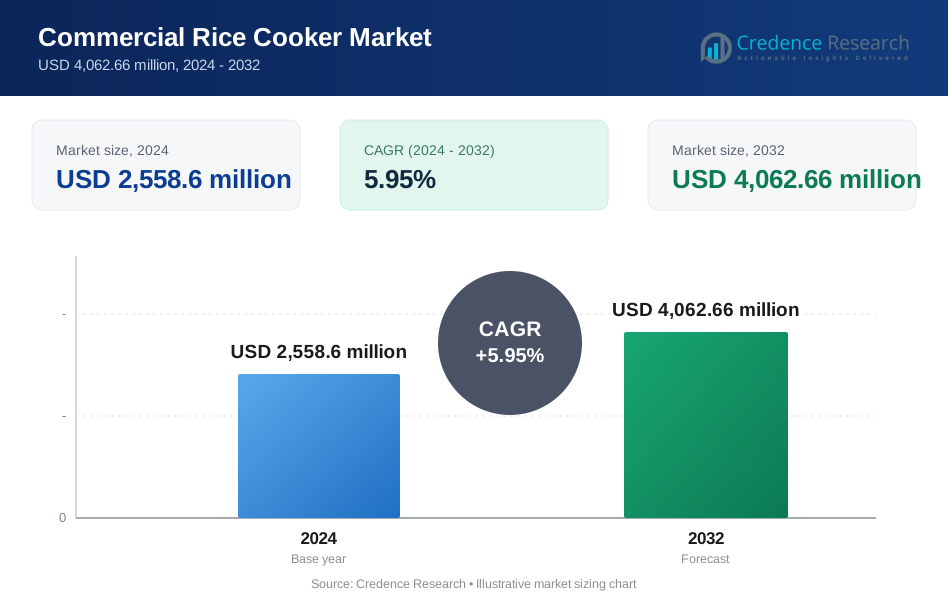
Commercial Rice Cooker Market size was valued USD 2558.6 million in 2024 and is anticipated to reach USD 4062.66 million by 2032, at a CAGR of 5.95% during the forecast period.
| REPORT ATTRIBUTE | DETAILS |
|---|---|
| Historical Period | 2020-2023 |
| Base Year | 2024 |
| Forecast Period | 2025-2032 |
| Commercial Rice Cooker Market Size 2024 | USD 2558.6 million |
| Commercial Rice Cooker Market, CAGR | 5.95% |
| Commercial Rice Cooker Market Size 2032 | USD 4062.66 million |
Commercial Rice Cooker Market Insights
- Market growth is primarily driven by rising demand from restaurants, catering services, and institutional kitchens, with multifunctional and induction-based cookers holding the dominant segment share due to consistent cooking quality, energy efficiency, and high-capacity output.
- Key market trends include the adoption of fuzzy logic controls, stainless-steel inner pots, and IoT-enabled monitoring, enabling operators to improve batch consistency, reduce wastage, and optimize kitchen workflows in commercial environments.
- Competitive dynamics remain strong, as established manufacturers focus on product durability, portfolio expansion across volume ranges, regulatory compliance, and robust after-sales service networks to strengthen long-term customer retention.
- Regionally, Asia-Pacific leads with an exact 38% market share, supported by high rice consumption, dense foodservice infrastructure, and widespread adoption of commercial cooking equipment across China, Japan, South Korea, and Southeast Asia.
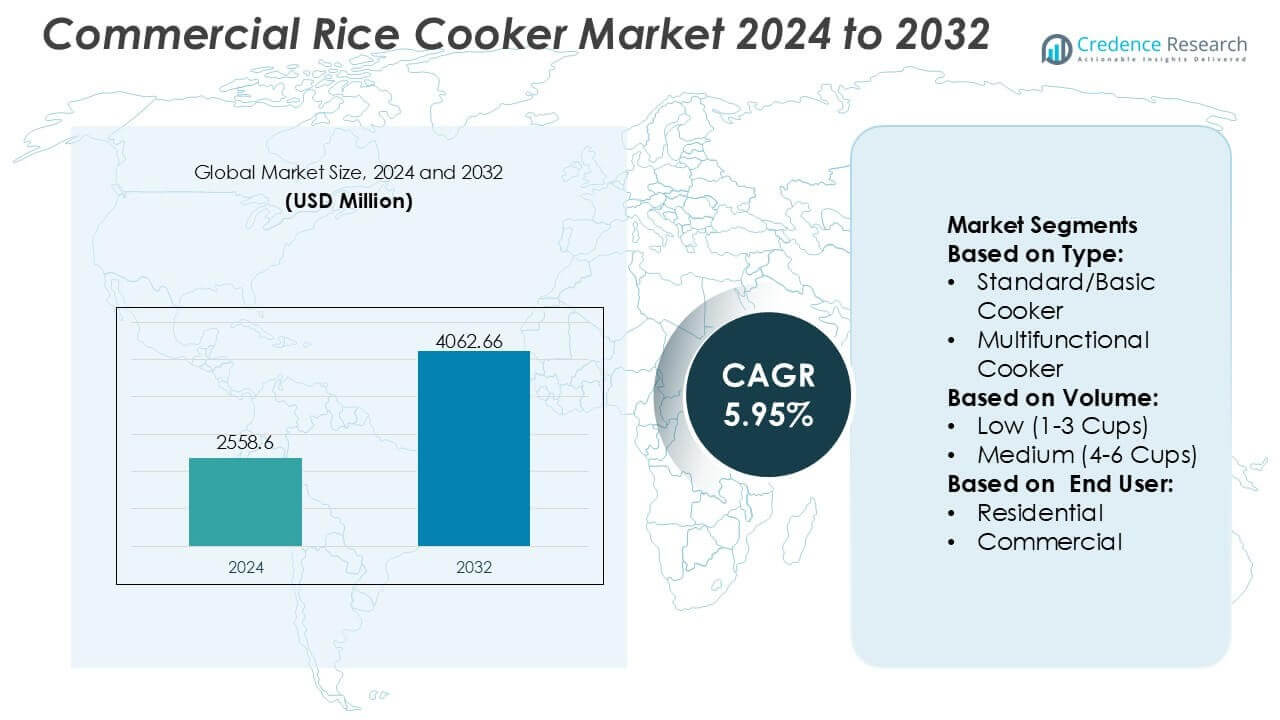
Commercial Rice Cooker Market Segmentation Analysis:
By Type
By type, multifunctional cookers emerge as the dominant sub-segment in the commercial rice cooker market, accounting for approximately 58% market share. Their leadership is driven by versatility, as these units support multiple cooking modes such as steaming, slow cooking, porridge, and soup preparation, reducing the need for separate appliances in professional kitchens. Advanced digital controls, programmable menus, and induction or fuzzy-logic heating systems improve cooking consistency and operational efficiency. Standard or basic cookers maintain relevance in cost-sensitive settings, but the growing demand for menu diversification and space optimization strongly favors multifunctional models.
- For instance, Groupe SEB utilizes advanced IH technology in its flagship models (such as the Tefal Rice Master and Moulinex Cookeo series), with professional-grade platforms operating at power levels up to 1,800 W.
By Volume
By volume, large-capacity cookers (7+ cups) dominate the market with an estimated 46% market share, supported by their widespread use in restaurants, catering services, and institutional foodservice operations. High output capability, uniform heat distribution, and durability for continuous cooking cycles make large units essential for bulk meal preparation. Medium-capacity cookers serve small restaurants and cafés requiring balanced throughput, while low-capacity models remain limited to light-duty applications. Growth in quick-service restaurants and centralized kitchens continues to reinforce demand for large-volume commercial rice cookers.
- For instance, Bajaj Electricals Ltd markets the RCX 1.8 DLX rice cooker, which incorporates a 700 W heating element paired with an automatic keep-warm function that maintains internal temperature after cooking completes.
By End User
By end user, the commercial segment leads with nearly 63% market share, driven by expanding foodservice infrastructure, rising urban dining demand, and increased adoption across hotels, cloud kitchens, and institutional cafeterias. Commercial users prioritize rugged construction, food-grade stainless steel components, and compliance with hygiene and safety standards, which accelerates replacement and upgrade cycles. Residential adoption remains steady, supported by home-based food businesses and premium kitchen upgrades, but lower utilization rates and smaller capacity needs keep residential demand secondary compared to high-frequency commercial usage.
Key Growth Drivers
Expansion of Mining, Metals, and Energy Activities
Australia’s strong mining and metals ecosystem remains a primary growth driver for the industrial gases market. Oxygen, nitrogen, and argon are extensively used in metal refining, steelmaking, and mineral processing to improve combustion efficiency, control oxidation, and enhance product quality. Rising investments in lithium, iron ore, and rare-earth processing projects further increase demand for on-site and bulk gas supply systems. Additionally, growing LNG production and hydrogen-ready energy infrastructure continue to support consistent industrial gas consumption across upstream and downstream operations.
- For instance, Ali Group Worldwide through its subsidiary Convotherm mini pro, launched in March 2025, is the first compact combi oven (only 49.8 cm wide) to feature this AI-driven "Optical Cooking".
Growth of Healthcare and Life Sciences Infrastructure
The expanding healthcare sector significantly drives industrial gas demand, particularly medical oxygen, nitrous oxide, and specialty gas mixtures. Australia’s investments in hospital capacity expansion, diagnostic imaging centers, and surgical facilities have increased reliance on centralized gas pipeline systems and high-purity cylinder supply. Growth in pharmaceutical manufacturing and biotechnology research further accelerates demand for ultra-high-purity gases used in analytical testing, sterilization, and drug formulation. Regulatory emphasis on patient safety and uninterrupted gas supply reinforces long-term procurement contracts.
- For instance, Breville Pty Ltd’s Smart Rice Box™ model incorporates fuzzy logic cooking technology that continuously adjusts temperature throughout the cook cycle to respond to real-time grain hydration conditions, supports up to 25 servings per batch, and uses an anodised ceramic-coated cooking bowl with 5 layers of heat-conductive materials to ensure uniform heat distribution and easy cleaning.
Industrial Automation and Advanced Manufacturing Adoption
Rising adoption of automation and advanced manufacturing technologies is strengthening industrial gas usage across fabrication, electronics, and food processing industries. Gases such as nitrogen and argon support laser cutting, additive manufacturing, and inert-atmosphere welding processes. The push toward precision manufacturing and improved yield efficiency increases demand for controlled gas environments. As Australian manufacturers modernize operations to remain globally competitive, reliance on consistent, high-quality gas supply solutions continues to grow.
Key Trends & Opportunities
Shift Toward On-Site and Bulk Gas Supply Solutions
Industrial users increasingly prefer on-site gas generation and bulk supply systems to reduce logistics dependency and improve cost predictability. Technologies such as pressure swing adsorption (PSA) and membrane-based nitrogen generators enable uninterrupted supply for continuous operations. This trend creates opportunities for gas suppliers to offer integrated solutions combining equipment, maintenance, and long-term service contracts. On-site generation is particularly attractive for remote mining locations and large manufacturing facilities seeking operational resilience.
- For instance, Newell Brands, through its Sunbeam and Oster commercial appliance portfolios, has deployed rice cooker platforms equipped with 1,000–1,200 W sealed heating elements, automatic keep warm systems regulated by bi-metal thermostats, and commercial grade stainless steel inner bowls with capacities exceeding 5 liters, designed for extended heat retention without scorching.
Emergence of Green Hydrogen and Decarbonization Initiatives
Australia’s focus on clean energy transition presents strong opportunities for industrial gas providers, especially in hydrogen production and carbon-reduction technologies. Growing pilot projects for green hydrogen, ammonia blending, and fuel-cell applications increase demand for high-purity hydrogen and oxygen. Industrial gas companies are also investing in carbon capture, utilization, and storage (CCUS) solutions. These developments position industrial gases as critical enablers of Australia’s long-term decarbonization strategy.
- For instance, Prestige PRWO 1.8‑2 Electric Rice Cooker from TTK Prestige Ltd. features a 700 W heating element that delivers controlled power for uniform cooking, a 1.8 L capacity capable of handling rice volumes up to approximately 1.7 kg, and built-in automatic keep warm mode that activates once cooking is complete to maintain internal temperatures without manual intervention.
Rising Demand for Specialty and High-Purity Gases
Demand for specialty gases is increasing due to growth in electronics manufacturing, laboratories, and environmental monitoring applications. High-purity calibration gases and specialty mixtures are essential for semiconductor fabrication, emissions testing, and scientific research. As regulatory compliance tightens and analytical precision requirements increase, suppliers offering customized gas blends and advanced purity control gain competitive advantage in niche, high-value applications.
Key Challenges
High Capital and Infrastructure Investment Requirements
Industrial gas production and distribution require substantial capital investment in air separation units, storage facilities, pipelines, and cryogenic transport infrastructure. Establishing operations in remote or resource-rich regions further elevates costs due to logistics complexity and limited accessibility. These high entry barriers can constrain capacity expansion and delay project timelines. Additionally, long payback periods increase financial risk, particularly during periods of fluctuating industrial demand.
Supply Chain Vulnerability and Regulatory Compliance Pressure
The industrial gases market faces challenges related to supply chain disruptions, cylinder shortages, and transportation constraints, especially during demand surges or emergency situations. Strict safety, environmental, and handling regulations also increase operational complexity and compliance costs. Companies must continuously invest in workforce training, monitoring systems, and certification processes to meet regulatory standards, which can impact margins and operational flexibility.
Regional Analysis
North America
North America represents a mature yet steadily expanding region in the Commercial Rice Cooker Market, accounting for approximately 26% of global market share. Growth is driven by widespread adoption across restaurants, catering services, and institutional kitchens, supported by high food safety standards and demand for energy-efficient appliances. Commercial operators increasingly favor multifunctional and programmable rice cookers to improve consistency and labor efficiency. The region also benefits from strong penetration of Asian cuisine chains and rising demand for bulk cooking solutions in healthcare and education facilities. Replacement demand and premiumization trends continue to support stable regional performance.
Europe
Europe holds nearly 22% of the global commercial rice cooker market, supported by growing multicultural food consumption and expanding foodservice infrastructure. Western Europe leads adoption due to high standards in commercial kitchens and increasing emphasis on automation and precision cooking. Demand is strong among quick-service restaurants, cloud kitchens, and catering companies seeking consistent output and compliance with energy regulations. Eastern Europe shows gradual uptake as hospitality and institutional dining expand. Compact, durable, and easy-to-maintain cookers gain traction, while sustainability-focused purchasing decisions influence equipment upgrades across professional foodservice operators.
Asia-Pacific
Asia-Pacific dominates the Commercial Rice Cooker Market with an estimated 38% market share, driven by rice being a dietary staple and the region’s dense concentration of restaurants, hotels, and institutional kitchens. China, Japan, India, and Southeast Asia lead demand due to large-scale foodservice operations and rapid urbanization. High-volume and multifunctional commercial cookers are widely adopted to meet peak-demand cooking requirements. Growth is further supported by expanding quick-service restaurant chains, food courts, and industrial catering. Continuous innovation in capacity scaling, thermal efficiency, and digital controls strengthens regional leadership.
Latin America
Latin America accounts for roughly 8% of the global market, with growth supported by expanding hospitality, tourism, and institutional foodservice sectors. Countries such as Brazil and Mexico lead regional demand due to increasing restaurant density and adoption of standardized commercial kitchen equipment. Commercial rice cookers are gaining importance in cafeterias, hotels, and catering services focused on portion consistency and operational efficiency. While price sensitivity remains a challenge, demand for durable and medium-capacity units continues to rise. Urbanization and growth of quick-service dining formats are key contributors to regional market expansion.
Middle East & Africa
The Middle East & Africa region holds approximately 6% of the global commercial rice cooker market, driven by growth in hotels, large-scale catering, and institutional dining. Gulf countries lead adoption due to strong hospitality investments, international cuisine penetration, and demand for high-capacity cooking equipment. Rice-based meals are central to regional foodservice menus, supporting steady demand. In Africa, gradual expansion of commercial food outlets and public catering supports moderate growth. Demand increasingly favors robust, energy-efficient models suitable for continuous operation in high-temperature kitchen environments.
Commercial Rice Cooker Market Segmentations:
By Type:
- Standard/Basic Cooker
- Multifunctional Cooker
By Volume:
- Low (1-3 Cups)
- Medium (4-6 Cups)
By End User:
- Residential
- Commercial
By Geography
- North America
- U.S.
- Canada
- Mexico
- Europe
- Germany
- France
- U.K.
- Italy
- Spain
- Rest of Europe
- Asia Pacific
- China
- Japan
- India
- South Korea
- South-east Asia
- Rest of Asia Pacific
- Latin America
- Brazil
- Argentina
- Rest of Latin America
- Middle East & Africa
- GCC Countries
- South Africa
- Rest of the Middle East and Africa
Key Player Analysis
- Panasonic Corporation
- Groupe SEB
- Bajaj Electricals Ltd
- Ali Group Worldwide
- Breville Pty Ltd
- Newell Brands
- TTK Prestige Ltd.
- AB Electrolux
- Wonderchef Home Appliances Pvt. Ltd
- Koninklijke Philips N.V.
Recent Developments
- In August 2024, Toshiba launched the Dew Series rice cooker, featuring the world's first Japanese-style steam replenishment tech for sweet, chewy rice, elevating cooking with dual pots for rice plus side dishes, perfect for modern meals from porridge to steaming buns, offering advanced texture and flavor.
- In December 2023, Midea, a major Chinese appliance maker, launched a new line of eco-friendly electric rice cookers focused on lower energy use and sustainable materials, aligning with their broader "Live Green, Live Smart" strategy for green innovation in smart home tech.
Report Coverage
The research report offers an in-depth analysis based on Type, Volume, End-User and Geography. It details leading market players, providing an overview of their business, product offerings, investments, revenue streams, and key applications. Additionally, the report includes insights into the competitive environment, SWOT analysis, current market trends, as well as the primary drivers and constraints. Furthermore, it discusses various factors that have driven market expansion in recent years. The report also explores market dynamics, regulatory scenarios, and technological advancements that are shaping the industry. It assesses the impact of external factors and global economic changes on market growth. Lastly, it provides strategic recommendations for new entrants and established companies to navigate the complexities of the market.
Future Outlook
- Adoption of multifunctional commercial rice cookers will increase as foodservice operators seek greater menu versatility and space efficiency.
- Demand for high-capacity models will grow in institutional kitchens, catering services, and large restaurant chains.
- Energy-efficient heating technologies will gain importance due to rising operational cost awareness and sustainability goals.
- Smart and programmable controls will see wider integration to improve cooking consistency and reduce manual intervention.
- Expansion of quick-service restaurants and cloud kitchens will directly support market demand.
- Manufacturers will focus on durable materials and longer equipment life to reduce total cost of ownership.
- Compact commercial units will gain traction in urban kitchens with limited space.
- Customization of capacity and functionality will increase to meet diverse regional cooking practices.
- After-sales service and maintenance support will become stronger competitive differentiators.
- Emerging markets will witness higher adoption driven by urbanization and growth in organized foodservice.
Request a Free Sample
Fill in your details and we'll send you a free sample report.
- Sample data tables & charts
- Research methodology
Need a Custom Version of This Report?
Tailor the scope, geography, or segments to your exact requirements.
- Custom geography or segment scope
- Direct access to our analyst team
Frequently Asked Questions
What is the current market size for the Commercial Rice Cooker Market, and what is its projected size in 2032?
At what Compound Annual Growth Rate is the Commercial Rice Cooker Market projected to grow between 2024 and 2032?
Which Commercial Rice Cooker Market segment held the largest share in 2024?
What are the primary factors fueling the growth of the Commercial Rice Cooker Market?
Who are the leading companies in the Commercial Rice Cooker Market?
Which region commanded the largest share of the Commercial Rice Cooker Market in 2024?
Table of Content
Chapter 1. Report Introduction
- 1.1 Report Description & Purpose
- 1.1.1 Report Title & Market Definition
- 1.1.2 Unique Selling Propositions (USP) & Key Differentiators
- 1.1.3 Value Proposition for Stakeholders
- 1.2 Research Objectives
- 1.2.1 Market Sizing Objectives (Volume & Revenue)
- 1.2.2 Segmentation Objectives
- 1.2.3 Competitive Intelligence Objectives
- 1.2.4 Forecast & Scenario Objectives
- 1.3 Report Scope
- 1.3.1 Commercial Rice Cooker Scope – Types & Subtypes Covered
- 1.3.2 Geographic Scope – Regions & Countries Covered
- 1.3.3 Historical Period, Base Year & Forecast Period (2024; forecast to 2032)
- 1.3.4 Inclusions & Exclusions
- 1.4 HS Code & Classification Framework
- 1.5 Currency, Units & Pricing Basis
- 1.6 Target Stakeholders
- 1.7 Limitations & Assumptions
Chapter 2. Executive Summary
- 2.1 Global Commercial Rice Cooker Market Snapshot
- 2.1.1 Market Size – Historical (2024) & Forecast (2024-2032) (2024: USD 2,558.6 million → 2032: USD 4,062.66 million)
- 2.1.2 Volume & Revenue – Global Totals
- 2.1.3 Key Market Highlights – Top Five Facts
- 2.2 Commercial Rice Cooker Market Segmentation Snapshot
- 2.2.1 Market Split by Region – 2024 vs. 2032
- 2.3 Competitive Snapshot
- 2.3.1 Top 10 Players by Revenue Share – 2024
- 2.3.2 Top 10 Players by Volume Share – 2024
- 2.3.3 Recent Strategic Developments (18-Month Summary)
- 2.4 Key Investment Highlights & Strategic Conclusions
Chapter 3. Commercial Rice Cooker Market Dynamics & Industry Analysis
- 3.1 Market Overview & Context
- 3.1.1 Commercial Rice Cooker Market Position in the Broader Automotive Value Chain
- 3.1.2 OEM vs. Replacement Market Dynamics
- 3.1.3 Market Maturity & Development Stage by Region
- 3.2 Commercial Rice Cooker Market Drivers
- 3.3 Commercial Rice Cooker Market Restraints & Challenges
- 3.4 Commercial Rice Cooker Market Opportunities
- 3.5 Porter's Five Forces Analysis
- 3.5.1 Threat of New Entrants
- 3.5.2 Bargaining Power of Suppliers
- 3.5.3 Bargaining Power of Buyers
- 3.5.4 Threat of Substitutes
- 3.5.5 Competitive Rivalry – Intensity Assessment
- 3.6 Commercial Rice Cooker Value Chain Analysis
- 3.6.1 Upstream – Raw Material/Input Suppliers
- 3.6.1.1 Raw Material/Input 1
- 3.6.1.2 Raw Material/Input 2
- 3.6.1.3 Raw Material/Input 3
- 3.6.2 Midstream – Production/Manufacturing/Service Delivery
- 3.6.2.1 Production/Process Overview
- 3.6.2.2 Key Facility Locations & Capacity by Manufacturer
- 3.6.3 Downstream – Distribution & End Consumer
- 3.6.3.1 Primary Channel – B2B/OEM
- 3.6.3.2 Secondary Channels – Dealer, Retail, Online, Direct
- 3.6.4 Value Chain Profitability Analysis
- 3.6.1 Upstream – Raw Material/Input Suppliers
- 3.7 PESTEL Analysis
- 3.7.1 Political Factors
- 3.7.2 Economic Factors
- 3.7.3 Social Factors
- 3.7.4 Technological Factors
- 3.7.5 Environmental Factors
- 3.7.6 Legal Factors
- 3.8 Commercial Rice Cooker Supply Chain Analysis
- 3.8.1 Raw Material/Input Supply Risk Assessment
- 3.8.2 Manufacturing Concentration Risk (Geographic Exposure)
- 3.8.3 Trade Disruption Impact Analysis
- 3.9 Regulatory & Policy Landscape
Note: The regulatory and policy landscape section covers regulations based on their applicability to the market, Commercial Rice Cooker category, geography, and scope of the study. Only regulatory frameworks with a material impact on operations, compliance, trade, sustainability, or market access are analyzed in detail.
Chapter 4. Key Investment Pockets & Opportunity Analysis
- 4.1 Commercial Rice Cooker Market Attractiveness Analysis
- 4.1.1 By Region – Investment Attractiveness Matrix (Volume × CAGR)
- 4.2 Absolute Revenue Growth Opportunity
- 4.2.1 By Region – Absolute USD Growth Through 2032
- 4.3 Incremental Volume Opportunity
- 4.3.1 By Region – Incremental Volume Through 2032
- 4.3.2 Segment – Incremental Volume
- 4.4 Emerging Submarket Opportunity Deep Dive (Subject to Applicability)
- 4.5 Emerging Market Opportunity Scorecards
- 4.5.1 United States
- 4.5.2 Europe
- 4.5.3 Asia
- 4.5.4 Middle East & Africa
Note: Emerging Market Opportunity Scorecards will be included based on relevance and strategic importance. Regions listed are indicative and may vary depending on data availability and market dynamics.
Chapter 5. Commercial Rice Cooker Import-Export Analysis & Trade Flows
- 5.1 Global Trade Overview
- 5.1.1 Global Export Value by Country (2024)
- 5.1.2 Global Export Volume by Country (2024)
- 5.1.3 Global Import Value by Country (2024)
- 5.1.4 Global Import Volume by Country (2024)
- 5.1.5 Net Trade Balance by Country (2024)
- 5.2 Export Analysis – Segment
- 5.2.1 Type 1 (HS Code)
- 5.2.2 Type 2 (HS Code)
- 5.2.3 Type 3 (HS Code)
- 5.2.4 Type 4 (HS Code)
- 5.2.5 Type 5 (HS Code)
- 5.3 Import Analysis – Segment
- 5.3.1 Type 1 (HS Code)
- 5.3.2 Type 2 (HS Code)
- 5.3.3 Type 3 (HS Code)
- 5.3.4 Type 4 (HS Code)
- 5.3.5 Type 5 (HS Code)
- 5.4 Average Unit Trade Prices
- 5.4.1 Average Export Price – Segment & Country
- 5.4.2 Average Import Price – Segment & Source Country
- 5.4.3 Price Trends (2024)
- 5.5 Key Trade Route Analysis
- 5.5.1 Trade Route 1
- 5.5.2 Trade Route 2
- 5.5.3 Trade Route 3
- 5.5.4 Trade Route 4
- 5.5.5 Trade Route 5
- 5.6 Trade Policy Impact Assessment
- 5.6.1 US Anti-Dumping & Section 301 Tariffs
- 5.6.2 EU Customs Union Impact
- 5.6.3 Major Free Trade Agreements
- 5.6.4 USMCA Rules of Origin
Note: Trade policy analysis will be included only where relevant to the Commercial Rice Cooker market.
Chapter 6. Competitive Landscape & Company Benchmarking
- 6.1 Commercial Rice Cooker Market Concentration & Structure
- 6.1.1 Herfindahl-Hirschman Index (HHI) – vs. 2024
- 6.1.2 Tier 1, Tier 2 & Tier 3 Market Structure
- 6.1.3 Global, Regional & Local Player Dynamics
- 6.2 Commercial Rice Cooker Market Share Analysis – 2024
- 6.2.1 Global Revenue Share by Company
- 6.2.2 Global Volume Share by Company
- 6.2.3 Regional Revenue Share
- 6.2.4 Market Share Evolution ( vs. 2024)
- 6.2.5 OEM Segment Share by Company
- 6.2.6 Replacement Segment Share by Company
- 6.3 Production/Delivery Capacity & Facility Analysis
- 6.3.1 Global Installed Capacity
- 6.3.2 Capacity Utilization Rates
- 6.3.3 Production/Output Volume
- 6.3.4 Facility Locations & Capacity Map
- 6.3.5 Planned Capacity Additions
- 6.4 Commercial Rice Cooker Competitive Benchmarking Matrix
- 6.4.1 Revenue, Volume, CAGR & Profitability Comparison
- 6.4.2 Channel Revenue Mix
- 6.4.3 Geographic Revenue Exposure
- 6.4.4 R&D Intensity
- 6.4.5 Sustainability Maturity
- 6.5 Strategic Developments in Commercial Rice Cooker (Last 24 Months)
- 6.5.1 Mergers, Acquisitions & Divestments
- 6.5.2 New Commercial Rice Cooker Launches
- 6.5.3 Facility Expansions
- 6.5.4 Strategic Alliances, Joint Ventures & Partnerships
- 6.5.5 Distribution Expansion & Market Entry
- 6.5.6 Sustainability & ESG Initiatives
- 6.6 Competitive Strategy Mapping
- 6.6.1 Leader, Challenger, Follower & Niche Classification
- 6.6.2 Pricing Strategy Comparison
- 6.6.3 Channel Strategy Matrix
Note: Strategic developments are included based on their materiality and the availability of reliable information.
Chapter 7. Global Commercial Rice Cooker Market – By Distribution Channel
- 7.1 Segment Overview
- 7.1.1 Volume & Revenue Split by Channel (2024 & 2032)
- 7.1.2 Channel Mix Evolution (2024-2032)
Chapter 8. Regional Market Analysis – Global Overview
- 8.1 Global Regional Overview
- 8.1.1 Regional Volume Share
- 8.1.2 Regional Revenue Share
- 8.1.3 Regional Volume by Region
- 8.1.4 Regional Revenue by Region
- 8.1.5 Regional Forecast Through 2032
- 8.2 Cross-Regional Segment Analysis
- 8.2.1 By Distribution Channel
- 8.2.2 By Brand/Price Tier
Chapter 9. North America Commercial Rice Cooker Market
- 9.1 United States
- 9.2 Canada
- 9.3 Mexico
Chapter 10. Europe Commercial Rice Cooker Market
- 10.1 Germany
- 10.2 France
- 10.3 Italy
- 10.4 United Kingdom
- 10.5 Spain
- 10.6 Poland
- 10.7 Russia
- 10.8 Netherlands
- 10.9 Belgium
- 10.10 Sweden
- 10.11 Denmark
- 10.12 Norway
- 10.13 Rest of Europe
Chapter 11. Asia Pacific Commercial Rice Cooker Market
- 11.1 China
- 11.2 India
- 11.3 Japan
- 11.4 South Korea
- 11.5 Thailand
- 11.6 Indonesia
- 11.7 Vietnam
- 11.8 Malaysia
- 11.9 Australia
- 11.10 Rest of Asia Pacific
Chapter 12. Latin America Commercial Rice Cooker Market
- 12.1 Brazil
- 12.2 Argentina
- 12.3 Colombia
- 12.4 Chile
- 12.5 Rest of Latin America
Chapter 13. Middle East Commercial Rice Cooker Market
- 13.1 Saudi Arabia
- 13.2 United Arab Emirates
- 13.3 Turkey
- 13.4 Israel
- 13.5 Iran
- 13.6 Rest of the Middle East
Chapter 14. Africa Commercial Rice Cooker Market
- 14.1 South Africa
- 14.2 Egypt
- 14.3 Nigeria
- 14.4 Morocco
- 14.5 Rest of Africa
Chapter 15. Commercial Rice Cooker Company Profiles
- 15.1 [Company 01]
- 15.1.1 Company Overview
- 15.1.2 Key Management Personnel
- 15.1.3 Products & Services Portfolio
- 15.1.4 Financial Performance
- 15.1.5 Key Market Focus & Geographic Presence
- 15.1.6 Recent Developments & Strategic Initiatives
Note: The company profile list is preliminary and may change based on research findings, market developments, data availability, and client requirements.
Chapter 16. Appendices
- Appendix A – List of Abbreviations & Acronyms
- Appendix B – Industry Classification Code Reference – Full Series
- Appendix C – Production & Capacity Data Tables
- Appendix D – End-Use & Demand Base Tables
- Appendix E – Consumption & Replacement Rate Assumptions
- Appendix F – ASP Reference Tables
- Appendix G – Manufacturing & Facility Database
- Appendix H – Import-Export Data Tables
- Appendix I – Regulatory Summary Tables
- Appendix J – Primary Research Participant List (Anonymized)
- Appendix K – Primary Research Questionnaire Framework
- Appendix L – Data Sources & Bibliography
- Appendix M – Market Size Divergence & Source Comparison
Chapter 17. Research Methodology
- 17.1 Research Framework & Philosophy
- 17.2 Secondary Research – Sources, Hierarchy & Data Extraction
- 17.3 Data Modeling – Bottom-Up & Top-Down Market Sizing
- 17.4 Primary Research – Stakeholder Framework, LOI & Sample Sizes
- 17.5 Forecast Methodology – Regression, Scenario & Sensitivity Analysis
- 17.6 Quality Control – Four-Layer Validation Framework
- 17.7 Limitations & Standard Assumptions
- 17.8 Disclaimer
