
Market Overview:
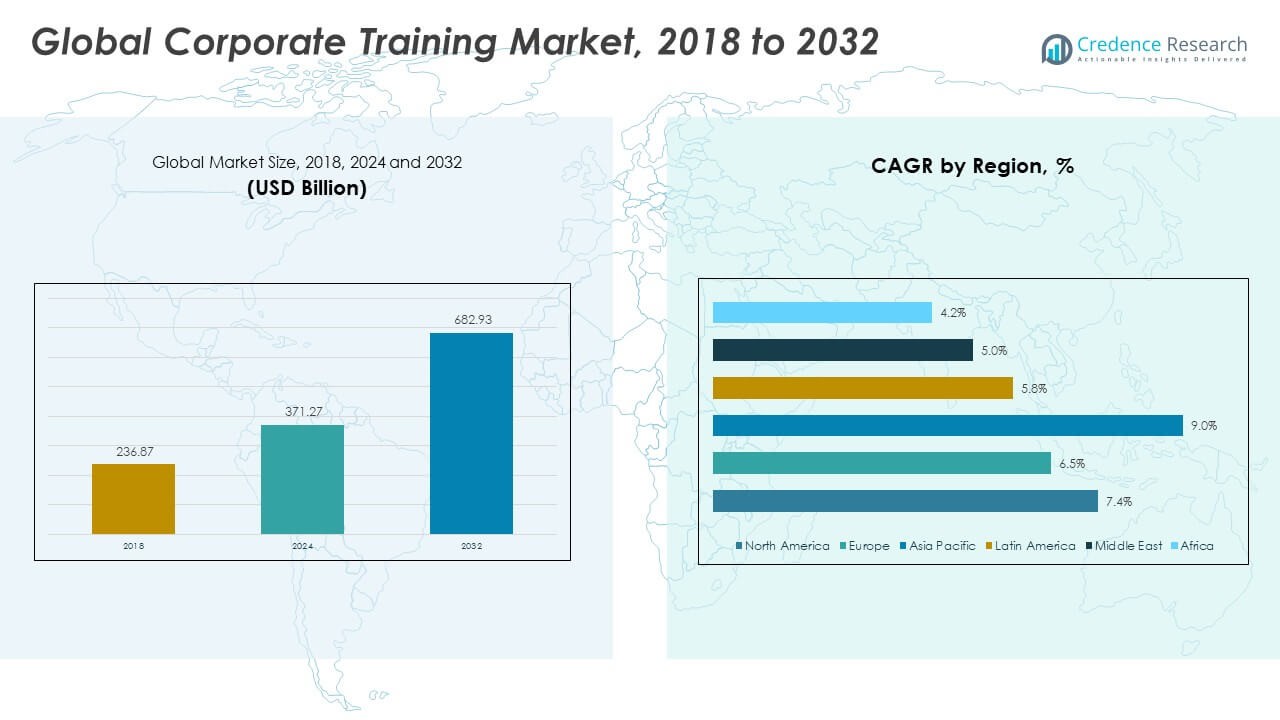
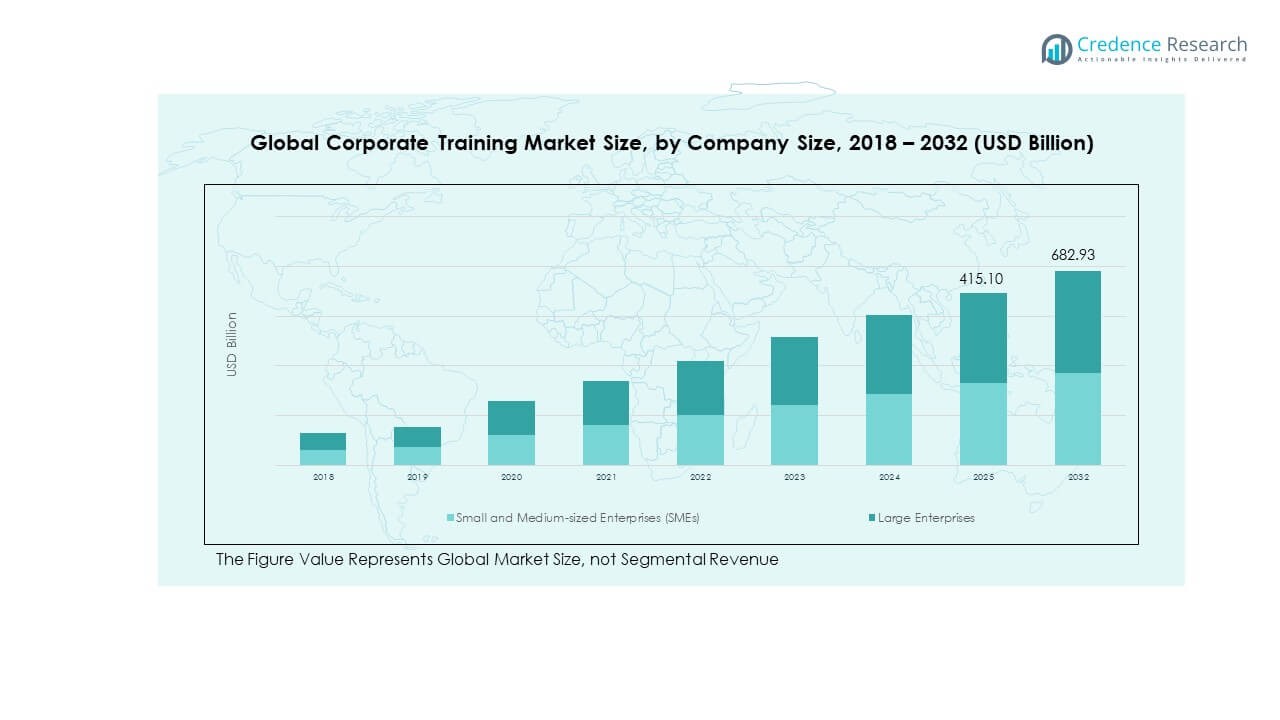
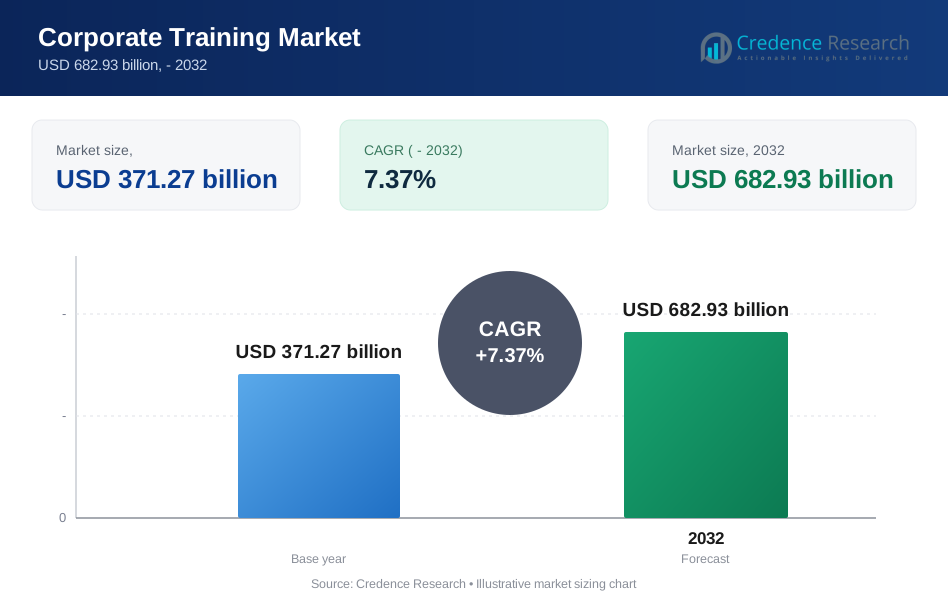
The Global Corporate Training Market size was valued at USD 236.87 billion in 2018 to USD 371.27 billion in 2024 and is anticipated to reach USD 682.93 billion by 2032, at a CAGR of 7.37% during the forecast period.
| REPORT ATTRIBUTE | DETAILS |
|---|---|
| Historical Period | 2020-2023 |
| Base Year | 2024 |
| Forecast Period | 2025-2032 |
| Corporate Training Market Size 2024 | USD 371.27 Billion |
| Corporate Training Market, CAGR | 7.37% |
| Corporate Training Market Size 2032 | USD 682.93 Billion |
Market growth is driven by rapid digital transformation, rising skill gaps, and strong demand for continuous learning across corporate functions. Organizations use AI-assisted and personalized learning models to improve program efficiency and track performance gains. Remote and hybrid workforces push companies to adopt flexible virtual learning systems that maintain productivity. Compliance-heavy sectors expand training modules to meet evolving regulatory needs. Firms strengthen leadership and soft skill programs to support internal mobility and succession planning across global teams.
North America leads due to mature learning ecosystems, high digital adoption, and strong enterprise training budgets. Europe follows with steady demand from industries that prioritize structured compliance training and workforce modernization. Asia Pacific emerges as the fastest-growing region, driven by expanding service sectors, rising digital talent needs, and long-term corporate investments in India, China, and Southeast Asia. Latin America and the Middle East show growing momentum as employers scale digital training formats and adopt modern learning tools to enhance workforce capabilities.
Market Insights:
- The Global Corporate Training Market increased from USD 236.87 billion in 2018 to USD 371.27 billion in 2024 and is projected to reach USD 682.93 billion by 2032, growing at a 7.37% CAGR, driven by digital learning adoption and enterprise-wide capability building.
- North America (44.87%), Europe (25.28%), and Asia Pacific (20.94%) hold the largest shares due to strong training budgets, compliance-led demand, and rapid digital transformation across major industries.
- Asia Pacific, holding 20.94%, stands as the fastest-growing region, supported by expanding service sectors, government-led skilling programs, and rising enterprise investment in digital learning ecosystems.
- Large enterprises form the dominant segment with roughly 70% share, supported by mature training systems, continuous leadership development focus, and larger digital learning investments.
- SMEs account for an estimated 30% share, driven by growing reliance on cost-efficient e-learning platforms and the need to bridge technical and managerial skill gaps.
 Market Drivers:
Rising Need For Digital And Leadership Skill Development
The Global Corporate Training Market grows due to rising pressure on firms to upgrade digital and leadership capabilities. Many organizations face rapid changes pushed by automation and AI. Leaders demand programs that strengthen decision skills across complex business settings. Employees seek structured learning paths that support fast-changing roles. It helps companies reduce performance gaps in daily operations. Digital tools lift program reach across distributed teams. Strong workforce shifts drive long-term demand for continuous learning. Enterprises rely on targeted modules to support internal talent pipelines.
- For instance, LinkedIn Learning reported in 2023 that time spent on leadership and management courses increased by more than 25% year-over-year, reflecting strong enterprise demand for structured leadership development.
Expansion Of Hybrid Work And Remote Learning Models
Hybrid work models reshape learning behavior across major industries. Many firms adopt virtual platforms to support flexible training flows. Remote setups demand content that fits varied schedules and global teams. It pushes companies to prioritize scalable learning systems. Virtual coaching gains wider acceptance for cross-functional roles. Organizations redesign programs to match remote productivity goals. Digital platforms help firms track skill progress with stronger accuracy. Program demand rises due to shifting workplace expectations.
- For instance, Microsoft confirmed that Microsoft Teams reached 320 million monthly active users in 2024, driving widespread enterprise adoption of integrated remote training and collaboration tools.
Growing Compliance And Regulatory Training Requirements
Compliance rules create sustained training demand across regulated sectors. Many industries face stricter oversight that affects workforce duties. Firms invest in structured modules to reduce operational risks. Content libraries expand to match frequent rule changes. It supports employees who manage sensitive processes daily. Companies deploy system-driven checks to improve training accuracy. Compliance teams use data tools to verify participation. Training teams refine plans to meet regulatory deadlines.
Increasing Focus On Workforce Retention And Internal Mobility
Retention goals drive deeper investment in structured learning. Firms use training to support career growth across long-term plans. Many employees seek pathways that improve job stability. It helps organizations reduce hiring pressure in tight labor markets. Talent leaders expand coaching programs for emerging managers. Skill-building supports stronger mobility across departments. Training teams design personalized tracks that fit employee goals. Engagement rises when teams gain access to relevant learning options.
 Market Trends:
Adoption Of AI-Powered Personalized Learning Systems
AI tools shape new patterns across the Global Corporate Training Market. Many companies use adaptive engines to tailor learning paths. Systems adjust content based on role behavior and performance gaps. It improves program efficiency for global teams. AI-driven insights support faster decision-making in training design. Predictive analytics guide leaders toward skill gaps. Automated feedback loops improve learner engagement. Training cycles shorten due to stronger content alignment.
- For instance, Cornerstone’s AI-based Skills Graph analyzes more than 250 million skill-to-role relationships, enabling highly personalized learning recommendations for enterprise users, according to Cornerstone’s published product data.
Shift Toward Microlearning And Short-Form Content Delivery
Microlearning gains traction due to short attention spans across fast-paced roles. Many firms break modules into compact units for quicker consumption. Employees use short sessions to maintain consistent progress. It supports learning during busy work cycles. Bite-sized modules boost retention across operational tasks. Teams use microlearning to reinforce complex concepts. Mobile platforms enhance access for distributed staff. Companies prefer formats that reduce disruption.
- For instance, the underlying principle of microlearning is widely acknowledged in the corporate education sector, with one report mentioning that nearly 60% yearly growth in AI-related skills learning on Udemy Business occurred, highlighting rapid adoption of new, targeted skills training.
Rising Integration Of Immersive Learning Using AR And VR Tools
Immersive tools shape new training experiences across industries. AR and VR support high-risk simulation work. Companies adopt these tools to improve safety and accuracy. It helps teams practice tasks without real-world exposure. Immersive modules lift engagement across technical roles. Training leaders use simulation data to refine content. Developers build advanced scenarios for complex workflows. Adoption grows across engineering, healthcare, and field jobs.
Growing Use Of Data Dashboards And Learning Analytics Platforms
Learning dashboards gain importance for training performance checks. Many firms seek deeper visibility into user progress. Analytics tools track skill development across teams. It supports leaders who need evidence-based planning. Dashboards highlight training gaps quickly. Integration with HR systems improves workforce planning accuracy. Data-led insights guide annual training budgets. Organizations rely on structured reporting to refine learning plans.
 Market Challenges Analysis:
High Content Development Costs And Limited Organizational Bandwidth
Content development costs restrict adoption across many firms. The Global Corporate Training Market faces pressure from complex customization needs. Many organizations struggle to build courses that match evolving roles. It creates delays in training deployment cycles. Teams often lack time to refresh outdated modules. Smaller firms face budget pressure during large-scale rollouts. Rapid tech shifts increase content update frequency. Outsourcing raises total project cost for many industries.
Skill Gap Persistence And Uneven Digital Adoption Across Regions
Skill gaps widen due to fast technology adoption across sectors. Many firms struggle to align training with workforce readiness. It reduces training impact across critical roles. Uneven digital adoption slows program effectiveness in emerging markets. Limited infrastructure weakens access to advanced platforms. Cultural differences also shape training delivery choices. Firms face challenges in standardizing content across regions. Demand rises for tools that balance global and local needs.
Market Opportunities:
Expansion Of AI-Driven Training Platforms Across Global Enterprises
AI-driven platforms create growth prospects for the Global Corporate Training Market. Many firms seek scalable programs that support large teams. It improves analytics depth and program efficiency. This shift helps leaders design targeted learning plans. Adoption expands across service, technology, and financial firms. AI tools simplify assessment cycles. Personalization improves user experience across global workforces. Training providers gain broader market reach.
Emergence Of Specialized Upskilling Pathways In High-Demand Roles
High-demand roles create fresh upskilling opportunities. Many industries seek specialized pathways for digital, technical, and leadership jobs. It drives demand for domain-focused modules. Firms use these programs to strengthen internal hiring pipelines. Industry clusters push training expansion across regional hubs. Structured upskilling supports long-term business resilience. Providers design niche content for deep technical roles. Demand rises due to rapid shifts in skill expectations.
 Market Segmentation Analysis:
Training Delivery Methods
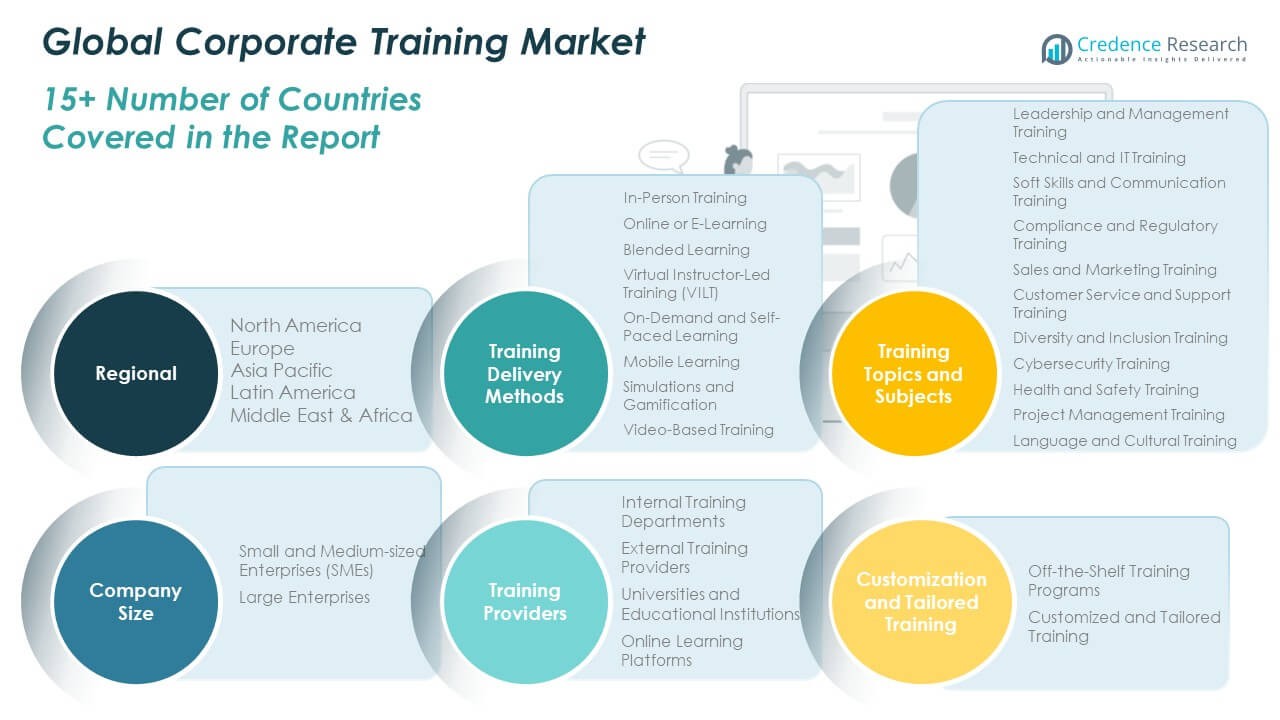
The Global Corporate Training Market expands through diverse delivery formats that support varied learning needs. In-person training remains relevant for skills that require live interaction and hands-on practice. Online or e-learning gains strong traction due to flexible access and lower operational costs. Blended learning delivers high engagement by combining digital and instructor-led models. Virtual Instructor-Led Training supports distributed teams that need structured sessions. On-demand learning and mobile learning grow due to real-time access needs. Simulations and gamification strengthen technical and safety training. Video-based training helps firms scale content across large teams with consistent quality.
Training Topics and Subjects
Training programs across leadership, technical skills, and soft skills drive structured capability building for global firms. Leadership and management training helps organizations prepare future managers. Technical and IT modules address ongoing digital shifts. Soft skills programs support communication improvement across teams. Compliance and regulatory training maintains operational standards in monitored sectors. Sales, marketing, and customer service content improves frontline performance. Diversity, cybersecurity, health and safety, project management, and language training support broader cultural and technical goals across industries.
- For instance, in 2025, enrollment in cybersecurity courses rose in various regions on Coursera, including a 106% increase in Latin America, 20% in Europe, and 14% in Asia Pacific. Meanwhile, Professional Certificate enrollments saw a 37% growth in North America. These trends were driven by rising enterprise focus on digital protection skills and the overall demand for job-relevant credentials.
Company Size, Training Providers, Customization, and Industry Vertical
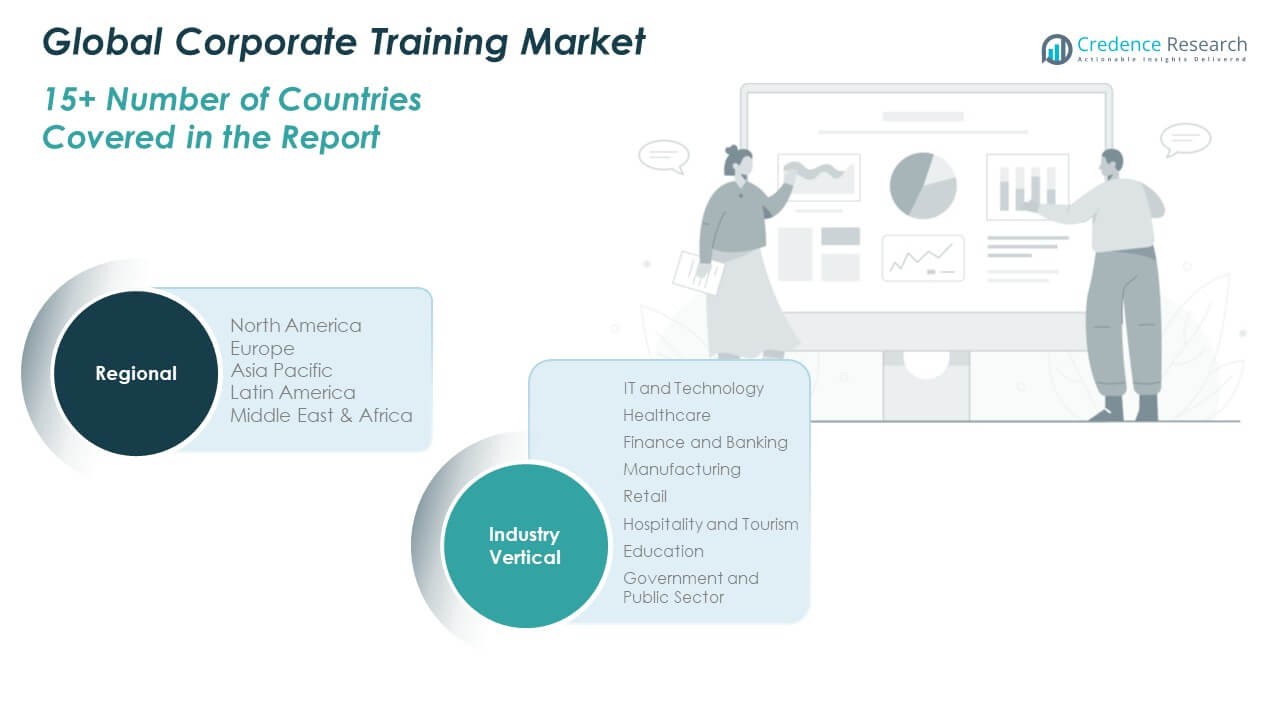
SMEs focus on cost-effective solutions, while large enterprises adopt advanced platforms for scale. Internal training departments handle structured workflows, whereas external providers and universities offer specialized programs. Online platforms support flexible expansion across markets. Off-the-shelf programs meet general needs, and customized training aligns with role-specific tasks. Industry demand varies across IT, healthcare, finance, manufacturing, retail, hospitality, education, and public sector domains.
Segmentation:
Training Delivery Methods
- In-Person Training
- Online or E-Learning
- Blended Learning
- Virtual Instructor-Led Training (VILT)
- On-Demand and Self-Paced Learning
- Mobile Learning
- Simulations and Gamification
- Video-Based Training
Training Topics and Subjects
- Leadership and Management Training
- Technical and IT Training
- Soft Skills and Communication Training
- Compliance and Regulatory Training
- Sales and Marketing Training
- Customer Service and Support Training
- Diversity and Inclusion Training
- Cybersecurity Training
- Health and Safety Training
- Project Management Training
- Language and Cultural Training
Company Size
- Small and Medium-sized Enterprises (SMEs)
- Large Enterprises
Training Providers
- Internal Training Departments
- External Training Providers
- Universities and Educational Institutions
- Online Learning Platforms
Customization and Tailored Training
- Off-the-Shelf Training Programs
- Customized and Tailored Training
Industry Vertical
- IT and Technology
- Healthcare
- Finance and Banking
- Manufacturing
- Retail
- Hospitality and Tourism
- Education
- Government and Public Sector
Region
- North America
- U.S.
- Canada
- Mexico
- Europe
- Germany
- France
- U.K.
- Italy
- Spain
- Rest of Europe
- Asia Pacific
- China
- Japan
- India
- South Korea
- South-east Asia
- Rest of Asia Pacific
- Latin America
- Brazil
- Argentina
- Rest of Latin America
- Middle East & Africa
- GCC Countries
- South Africa
- Rest of the Middle East and Africa
Regional Analysis:
North America
North America Corporate Training Market Overview
The North America Corporate Training Market size was valued at USD 107.36 billion in 2018 to USD 166.59 billion in 2024 and is anticipated to reach USD 307.25 billion by 2032, at a CAGR of 7.4% during the forecast period. North America holds 44.87% share of the Global Corporate Training Market. Strong digital adoption elevates demand for advanced learning systems across sectors. It benefits from mature enterprise environments that prioritize continuous upskilling. Firms expand blended and virtual formats to support remote teams. Regulatory frameworks strengthen needs for structured compliance programs. Enterprises invest in leadership, technical, and multi-domain modules. Robust budgets help providers scale premium learning technologies. The region maintains leadership through strong corporate learning cultures.
Europe
Europe Corporate Training Market Overview
The Europe Corporate Training Market size was valued at USD 62.33 billion in 2018 to USD 93.89 billion in 2024 and is anticipated to reach USD 161.78 billion by 2032, at a CAGR of 6.5% during the forecast period. Europe accounts for 25.28% share of the Global Corporate Training Market. The region benefits from a strong focus on compliance, workforce certification, and process standardization. It records sustained training demand across manufacturing, automotive, and public service roles. Digital transformation strengthens adoption of hybrid learning systems. Enterprises prioritize multilingual content for cross-border operations. ESG goals elevate demand for diversity and leadership training. Large companies maintain structured learning ecosystems. Europe grows steadily due to skilled workforce requirements and regulatory alignment.
Asia Pacific
Asia Pacific Corporate Training Market Overview
The Asia Pacific Corporate Training Market size was valued at USD 45.77 billion in 2018 to USD 77.73 billion in 2024 and is anticipated to reach USD 161.86 billion by 2032, at a CAGR of 9.0% during the forecast period. Asia Pacific holds 20.94% share of the Global Corporate Training Market. Rapid industrial growth strengthens demand for scalable learning programs. It benefits from rising digital employment across IT, finance, and services. Companies adopt large-scale e-learning platforms to train diverse workforces. Multinational firms expand training investments due to market expansion. Governments push national skilling initiatives to support future jobs. Demand increases for leadership, compliance, and advanced technical modules. Asia Pacific leads growth due to dynamic economic activity and workforce expansion.
Latin America
Latin America Corporate Training Market Overview
The Latin America Corporate Training Market size was valued at USD 11.45 billion in 2018 to USD 17.73 billion in 2024 and is anticipated to reach USD 28.95 billion by 2032, at a CAGR of 5.8% during the forecast period. Latin America accounts for 4.77% share of the Global Corporate Training Market. Corporate modernization drives demand for structured learning systems. It records increased needs across banking, retail, and telecommunications. Digital learning supports teams spread across wide geographic regions. Skill shortages push firms toward technical and soft skills programs. Local-language content strengthens adoption and engagement. Government programs promote upskilling in emerging sectors. Steady digital penetration supports market expansion.
Middle East
Middle East Corporate Training Market Overview
The Middle East Corporate Training Market size was valued at USD 6.42 billion in 2018 to USD 9.18 billion in 2024 and is anticipated to reach USD 14.15 billion by 2032, at a CAGR of 5.0% during the forecast period. The Middle East holds 2.47% share of the Global Corporate Training Market. Workforce transformation goals strengthen training adoption across sectors. It records strong activity in energy, construction, and banking. Digital learning models expand due to regional modernization programs. Companies prioritize compliance, safety, and leadership modules. Cross-border enterprises introduce global standards into training systems. Providers develop Arabic and bilingual content to improve uptake. The region advances steadily through strategic diversification plans.
Africa
Africa Corporate Training Market Overview
The Africa Corporate Training Market size was valued at USD 3.54 billion in 2018 to USD 6.15 billion in 2024 and is anticipated to reach USD 8.93 billion by 2032, at a CAGR of 4.2% during the forecast period. Africa holds 1.66% share of the Global Corporate Training Market. Organizations strengthen workforce skills to support economic diversification. It records rising adoption of digital learning due to improving connectivity. Technical skill gaps push companies toward structured training programs. E-learning platforms offer cost-effective access across dispersed regions. Governments promote workforce development in education and healthcare. Providers build localized content to match regional needs. Market growth stays steady as digital inclusion improves.
Key Player Analysis:
- Allen Communication Learning Services
- City and Guilds International Limited
- Cornerstone OnDemand, Inc.
- Wilson Learning Worldwide, Inc.
- Simplilearn Solutions
- D Two L, Business Training Library, Inc.
- Skillsoft
Competitive Analysis:
The Global Corporate Training Market features strong competition driven by technology adoption, content expansion, and platform innovation. Leading providers enhance portfolios with AI-based learning tools and industry-specific modules. It prioritizes scalable delivery systems that support global workforces. Firms compete on personalized learning capability, content depth, and integration with HR systems. Partnerships with enterprises strengthen long-term contracts and retention. Vendors focus on multilingual support to reach diverse markets. New platforms target remote workforces with flexible learning paths. Competitive pressure remains high due to rapid digital transformation and rising skill demands.
Recent Developments:
- In October 2025, City & Guilds announced a landmark acquisition where PeopleCert acquired its commercial awarding and skills training activities through a transformational deal worth €150 million. The acquisition included all of City & Guilds' awarding, assessment and training businesses, including City & Guilds Training, Gen2, Intertrain, ILM, and The Oxford Group brands, along with its headquarters in London and training sites in Cumbria. Additionally, in May 2025, City & Guilds completed the sale of Kineo, its workplace e-learning business, to Mindtools (owned by Cambridge Information Group), enabling both organizations to expand their learning solutions globally.
- In October 2025, Wilson Learning marked a significant milestone by welcoming back Blended Training Services as its official distributor partner in Portugal. This renewed partnership strengthens Wilson Learning's ability to deliver world-class learning solutions across sales effectiveness, leadership development, and workforce performance in the European market. The collaboration reflects Wilson Learning's continued dedication to supporting clients globally and expanding its distributor network to ensure learning solutions remain impactful and adaptable.
- In June 2025, Skillsoft announced a strategic partnership with Salesforce to integrate its AI-powered customer service training capabilities directly into Salesforce's Agentforce platform. The partnership embedded Skillsoft CAISY, the company's conversational AI coaching tool, into the Salesforce ecosystem, allowing support teams to simulate customer conversations and receive real-time coaching without leaving their workflow. Additionally, in September 2024, Skillsoft launched new AI tools for personalized learning, including Smart Content Discovery, AI-Assisted Search, Personalized Coaching features, and a Coding Assistant to enhance skill-building and certification processes. By January 2025, Skillsoft's CAISY AI coach achieved over 1 million launches, demonstrating strong customer adoption of its AI-powered learning capabilities.
Report Coverage:
The research report offers an in-depth analysis based on Training Delivery Methods, Training Topics and Subjects, Company Size, Training Providers, Customization and Tailored Training, Industry Vertical, and Region. It details leading market players, providing an overview of their business, product offerings, investments, revenue streams, and key applications. Additionally, the report includes insights into the competitive environment, SWOT analysis, current market trends, as well as the primary drivers and constraints. Furthermore, it discusses various factors that have driven market expansion in recent years. The report also explores market dynamics, regulatory scenarios, and technological advancements that are shaping the industry. It assesses the impact of external factors and global economic changes on market growth. Lastly, it provides strategic recommendations for new entrants and established companies to navigate the complexities of the market.
Future Outlook:
- AI-powered content recommendations will reshape personalized learning experiences.
- Demand for simulation-based programs will rise across technical industries.
- Remote and hybrid workforces will strengthen adoption of virtual training systems.
- Upskilling and reskilling needs will expand due to rapid digital transformation.
- Multilingual learning libraries will support global workforce integration.
- Compliance training demand will grow with tighter regulatory oversight.
- Leadership development programs will gain priority for succession planning.
- Mobile learning penetration will rise across emerging economies.
- Partnerships between platform providers and enterprises will expand content reach.
- Data-driven learning analytics will guide strategic workforce planning.
Request a Free Sample
Fill in your details and we'll send you a free sample report.
- Sample data tables & charts
- Research methodology
Need a Custom Version of This Report?
Tailor the scope, geography, or segments to your exact requirements.
- Custom geography or segment scope
- Direct access to our analyst team
Frequently Asked Questions
What is the current market size for the Global Corporate Training Market, and what is its projected size in 2032?
At what Compound Annual Growth Rate is the Global Corporate Training Market projected to grow between 2025 and 2032?
Which Global Corporate Training Market segment held the largest share in 2024?
What are the primary factors fueling the growth of the Global Corporate Training Market?
Who are the leading companies in the Global Corporate Training Market?
Which region commanded the largest share of the Global Corporate Training Market in 2024?
Table of Content
Chapter 1. Report Introduction
- 1.1 Report Description & Purpose
- 1.1.1 Report Title & Market Definition
- 1.1.2 Unique Selling Propositions (USP) & Key Differentiators
- 1.1.3 Value Proposition for Stakeholders
- 1.2 Research Objectives
- 1.2.1 Market Sizing Objectives (Volume & Revenue) (Volume Where Applicable)
- 1.2.2 Segmentation Objectives
- 1.2.3 Competitive Intelligence Objectives
- 1.2.4 Forecast & Scenario Objectives
- 1.3 Report Scope
- 1.3.1 Corporate Training Scope – Segments & Subsegments Covered
- 1.3.2 Geographic Scope – Regions & Countries Covered
- 1.3.3 Historical Period, Base Year & Forecast Period (the historical period; forecast to 2032)
- 1.3.4 Inclusions & Exclusions
- 1.4 Industry Classification & Applicable Codes
- 1.5 Currency, Measurement Units & Valuation Basis
- 1.6 Target Stakeholders
- 1.7 Limitations & Assumptions
Chapter 2. Executive Summary
- 2.1 Global Corporate Training Market Snapshot
- 2.1.1 Market Size – Historical (the historical period) & Forecast (2032) (base year: USD 371.27 billion → 2032: USD 682.93 billion)
- 2.1.2 Volume & Revenue – Global Totals (Volume Where Applicable)
- 2.1.3 Key Market Highlights – Top Five Facts
- 2.2 Corporate Training Market Segmentation Snapshot
- 2.2.1 Market Split by Region – vs. 2032
- 2.3 Competitive Snapshot
- 2.3.1 Top 10 Players by Revenue Share –
- 2.3.2 Top 10 Players by Volume Share – (Volume Where Applicable)
- 2.3.3 Recent Strategic Developments (18-Month Summary)
- 2.4 Key Investment Highlights & Strategic Conclusions
Chapter 3. Corporate Training Market Dynamics & Industry Analysis
- 3.1 Market Overview & Context
- 3.1.1 Corporate Training Market Position in the Broader Industry Value Chain
- 3.1.2 Demand Structure & Purchasing Dynamics
- 3.1.3 Market Maturity & Development Stage by Region
- 3.2 Corporate Training Market Drivers
- 3.3 Corporate Training Market Restraints & Challenges
- 3.4 Corporate Training Market Opportunities
- 3.5 Porter's Five Forces Analysis
- 3.5.1 Threat of New Entrants
- 3.5.2 Bargaining Power of Suppliers
- 3.5.3 Bargaining Power of Buyers
- 3.5.4 Threat of Substitutes
- 3.5.5 Competitive Rivalry – Intensity Assessment
- 3.6 Corporate Training Value Chain Analysis
- 3.6.1 Upstream – Key Inputs, Resources & Suppliers
- 3.6.1.1 Key Input/Resource 1
- 3.6.1.2 Key Input/Resource 2
- 3.6.1.3 Key Input/Resource 3
- 3.6.2 Midstream – Core Operations & Value Creation
- 3.6.2.1 Operating Model & Process Overview
- 3.6.2.2 Key Operating Locations & Capabilities by Company
- 3.6.3 Downstream – Market Channels & End Users
- 3.6.3.1 Direct Sales & Customer Engagement Channels
- 3.6.3.2 Indirect Sales, Intermediaries & Partner Channels
- 3.6.4 Value Chain Profitability Analysis
- 3.6.1 Upstream – Key Inputs, Resources & Suppliers
- 3.7 PESTEL Analysis
- 3.7.1 Political Factors
- 3.7.2 Economic Factors
- 3.7.3 Social Factors
- 3.7.4 Technological Factors
- 3.7.5 Environmental Factors
- 3.7.6 Legal Factors
- 3.8 Corporate Training Supply Chain Analysis
- 3.8.1 Critical Input & Resource Availability Risk Assessment
- 3.8.2 Supplier & Operational Concentration Risk (Geographic Exposure)
- 3.8.3 Supply & Service Disruption Impact Analysis
- 3.9 Regulatory & Policy Landscape
Note: The regulatory and policy landscape section covers regulations based on their applicability to the market, Corporate Training category, geography, and scope of the study. Only regulatory frameworks with a material impact on operations, compliance, trade, sustainability, or market access are analyzed in detail.
Chapter 4. Key Investment Pockets & Opportunity Analysis
- 4.1 Corporate Training Market Attractiveness Analysis
- 4.1.1 By Region – Investment Attractiveness Matrix (Market Size × CAGR)
- 4.2 Absolute Revenue Growth Opportunity
- 4.2.1 By Region – Absolute Revenue Growth Through 2032
- 4.3 Incremental Demand Opportunity
- 4.3.1 By Region – Incremental Demand Through 2032
- 4.3.2 Segment – Incremental Demand
- 4.4 Emerging Submarket Opportunity Deep Dive (Subject to Applicability)
- 4.5 Priority Market Opportunity Scorecards
- 4.5.1 United States
- 4.5.2 Europe
- 4.5.3 Asia
- 4.5.4 Middle East & Africa
Note: Priority market opportunity scorecards reflect the geographic scope and strategic relevance of the study. Listed markets are indicative and may be adapted to the industry.
Chapter 5. Corporate Training Cross-Border Trade & Market Access Analysis
- 5.1 International Trade & Cross-Border Activity Overview
- 5.1.1 Global Export Value by Country (the historical period)
- 5.1.2 Global Export Volume by Country (the historical period) (Volume Where Applicable)
- 5.1.3 Global Import Value by Country (the historical period)
- 5.1.4 Global Import Volume by Country (the historical period) (Volume Where Applicable)
- 5.1.5 Net Trade Balance by Country (the historical period)
- 5.2 Export Analysis – Segment
- 5.2.1 Category 1 (Applicable Classification Code)
- 5.2.2 Category 2 (Applicable Classification Code)
- 5.2.3 Category 3 (Applicable Classification Code)
- 5.2.4 Category 4 (Applicable Classification Code)
- 5.2.5 Category 5 (Applicable Classification Code)
- 5.3 Import Analysis – Segment
- 5.3.1 Category 1 (Applicable Classification Code)
- 5.3.2 Category 2 (Applicable Classification Code)
- 5.3.3 Category 3 (Applicable Classification Code)
- 5.3.4 Category 4 (Applicable Classification Code)
- 5.3.5 Category 5 (Applicable Classification Code)
- 5.4 Cross-Border Pricing & Transaction Benchmarks
- 5.4.1 Export Pricing – Segment & Country
- 5.4.2 Import Pricing – Segment & Source Country
- 5.4.3 Price Trends (the historical period)
- 5.5 Key Cross-Border Trade & Delivery Routes
- 5.5.1 Cross-Border Trade/Delivery Route 1
- 5.5.2 Cross-Border Trade/Delivery Route 2
- 5.5.3 Cross-Border Trade/Delivery Route 3
- 5.5.4 Cross-Border Trade/Delivery Route 4
- 5.5.5 Cross-Border Trade/Delivery Route 5
- 5.6 Trade Policy & Market Access Impact Assessment
- 5.6.1 Tariff & Non-Tariff Barriers
- 5.6.2 Regional Trade & Economic Integration Frameworks
- 5.6.3 Bilateral & Multilateral Trade Agreements
- 5.6.4 Cross-Border Operating, Licensing & Localization Requirements
Note: This chapter applies where cross-border trade or delivery is relevant to Corporate Training. Goods, services, and digital offerings are assessed using applicable classifications and transaction measures. Import-export volumes, trade balances, and route analyses are included only where meaningful to the market.
Chapter 6. Competitive Landscape & Company Benchmarking
- 6.1 Corporate Training Market Concentration & Structure
- 6.1.1 Herfindahl-Hirschman Index (HHI) – vs.
- 6.1.2 Leading, Mid-Sized & Emerging Player Structure
- 6.1.3 Global, Regional & Local Player Dynamics
- 6.2 Corporate Training Market Share Analysis –
- 6.2.1 Global Revenue Share by Company
- 6.2.2 Global Volume Share by Company (Volume Where Applicable)
- 6.2.3 Regional Revenue Share
- 6.2.4 Market Share Evolution ( vs. )
- 6.2.5 Company Market Share by Key Segment
- 6.2.6 Company Market Share by Customer Group
- 6.3 Operating Scale, Capacity & Infrastructure Analysis
- 6.3.1 Global Operating Scale & Supply Capacity
- 6.3.2 Resource Utilization & Operating Efficiency
- 6.3.3 Output, Service Delivery & Activity Metrics
- 6.3.4 Operating Footprint & Infrastructure Map
- 6.3.5 Planned Operational & Capacity Expansion
- 6.4 Corporate Training Competitive Benchmarking Matrix
- 6.4.1 Revenue, Growth, Profitability & Operating Metric Comparison
- 6.4.2 Channel Revenue Mix
- 6.4.3 Geographic Revenue Exposure
- 6.4.4 R&D Intensity
- 6.4.5 Sustainability Maturity
- 6.5 Strategic Developments in Corporate Training (Last 24 Months)
- 6.5.1 Mergers, Acquisitions & Divestments
- 6.5.2 New Products, Services & Solutions in Corporate Training
- 6.5.3 Operational & Infrastructure Expansions
- 6.5.4 Strategic Alliances, Joint Ventures & Partnerships
- 6.5.5 Distribution Expansion & Market Entry
- 6.5.6 Sustainability & ESG Initiatives
- 6.6 Competitive Strategy Mapping
- 6.6.1 Leader, Challenger, Follower & Niche Classification
- 6.6.2 Pricing Strategy Comparison
- 6.6.3 Channel Strategy Matrix
Note: Strategic developments are included based on their materiality and the availability of reliable information.
Chapter 7. Global Corporate Training Market – By Sales & Delivery Channel
- 7.1 Segment Overview
- 7.1.1 Volume & Revenue Split by Channel ( & 2032) (Volume Where Applicable)
- 7.1.2 Channel Mix Evolution (2032)
Chapter 8. Regional Market Analysis – Global Overview
- 8.1 Global Regional Overview
- 8.1.1 Regional Volume Share (Volume Where Applicable)
- 8.1.2 Regional Revenue Share
- 8.1.3 Regional Volume by Region (Volume Where Applicable)
- 8.1.4 Regional Revenue by Region
- 8.1.5 Regional Forecast Through 2032
- 8.2 Cross-Regional Segment Analysis
- 8.2.1 By Sales & Delivery Channel
- 8.2.2 By Competitive Positioning & Price Tier
Chapter 9. North America Corporate Training Market
- 9.1 United States
- 9.2 Canada
- 9.3 Mexico
Chapter 10. Europe Corporate Training Market
- 10.1 Germany
- 10.2 France
- 10.3 Italy
- 10.4 United Kingdom
- 10.5 Spain
- 10.6 Poland
- 10.7 Russia
- 10.8 Netherlands
- 10.9 Belgium
- 10.10 Sweden
- 10.11 Denmark
- 10.12 Norway
- 10.13 Rest of Europe
Chapter 11. Asia Pacific Corporate Training Market
- 11.1 China
- 11.2 India
- 11.3 Japan
- 11.4 South Korea
- 11.5 Thailand
- 11.6 Indonesia
- 11.7 Vietnam
- 11.8 Malaysia
- 11.9 Australia
- 11.10 Rest of Asia Pacific
Chapter 12. Latin America Corporate Training Market
- 12.1 Brazil
- 12.2 Argentina
- 12.3 Colombia
- 12.4 Chile
- 12.5 Rest of Latin America
Chapter 13. Middle East Corporate Training Market
- 13.1 Saudi Arabia
- 13.2 United Arab Emirates
- 13.3 Turkey
- 13.4 Israel
- 13.5 Iran
- 13.6 Rest of the Middle East
Chapter 14. Africa Corporate Training Market
- 14.1 South Africa
- 14.2 Egypt
- 14.3 Nigeria
- 14.4 Morocco
- 14.5 Rest of Africa
Chapter 15. Corporate Training Company Profiles
- 15.1 [Company 01]
- 15.1.1 Company Overview
- 15.1.2 Key Management Personnel
- 15.1.3 Products & Services Portfolio
- 15.1.4 Financial Performance
- 15.1.5 Key Market Focus & Geographic Presence
- 15.1.6 Recent Developments & Strategic Initiatives
Note: The company profile list is preliminary and may change based on research findings, market developments, data availability, and client requirements.
Chapter 16. Appendices
- Appendix A – List of Abbreviations & Acronyms
- Appendix B – Industry Classification Code Reference – Full Series
- Appendix C – Supply, Output & Operating Capacity Data Tables
- Appendix D – End-Use & Demand Base Tables
- Appendix E – Demand, Adoption & Usage Assumptions
- Appendix F – Pricing & Revenue Metric Reference Tables
- Appendix G – Company Operations & Infrastructure Database
- Appendix H – Cross-Border Trade & Activity Data Tables (Where Applicable)
- Appendix I – Regulatory Summary Tables
- Appendix J – Primary Research Participant List (Anonymized)
- Appendix K – Primary Research Questionnaire Framework
- Appendix L – Data Sources & Bibliography
- Appendix M – Market Size Divergence & Source Comparison
Chapter 17. Research Methodology
- 17.1 Research Framework & Philosophy
- 17.2 Secondary Research – Sources, Hierarchy & Data Extraction
- 17.3 Data Modeling – Bottom-Up & Top-Down Market Sizing
- 17.4 Primary Research – Stakeholder Framework, LOI & Sample Sizes
- 17.5 Forecast Methodology – Regression, Scenario & Sensitivity Analysis
- 17.6 Quality Control – Four-Layer Validation Framework
- 17.7 Limitations & Standard Assumptions
- 17.8 Disclaimer
