
Single-Mode Fiber Cable Market Overview:
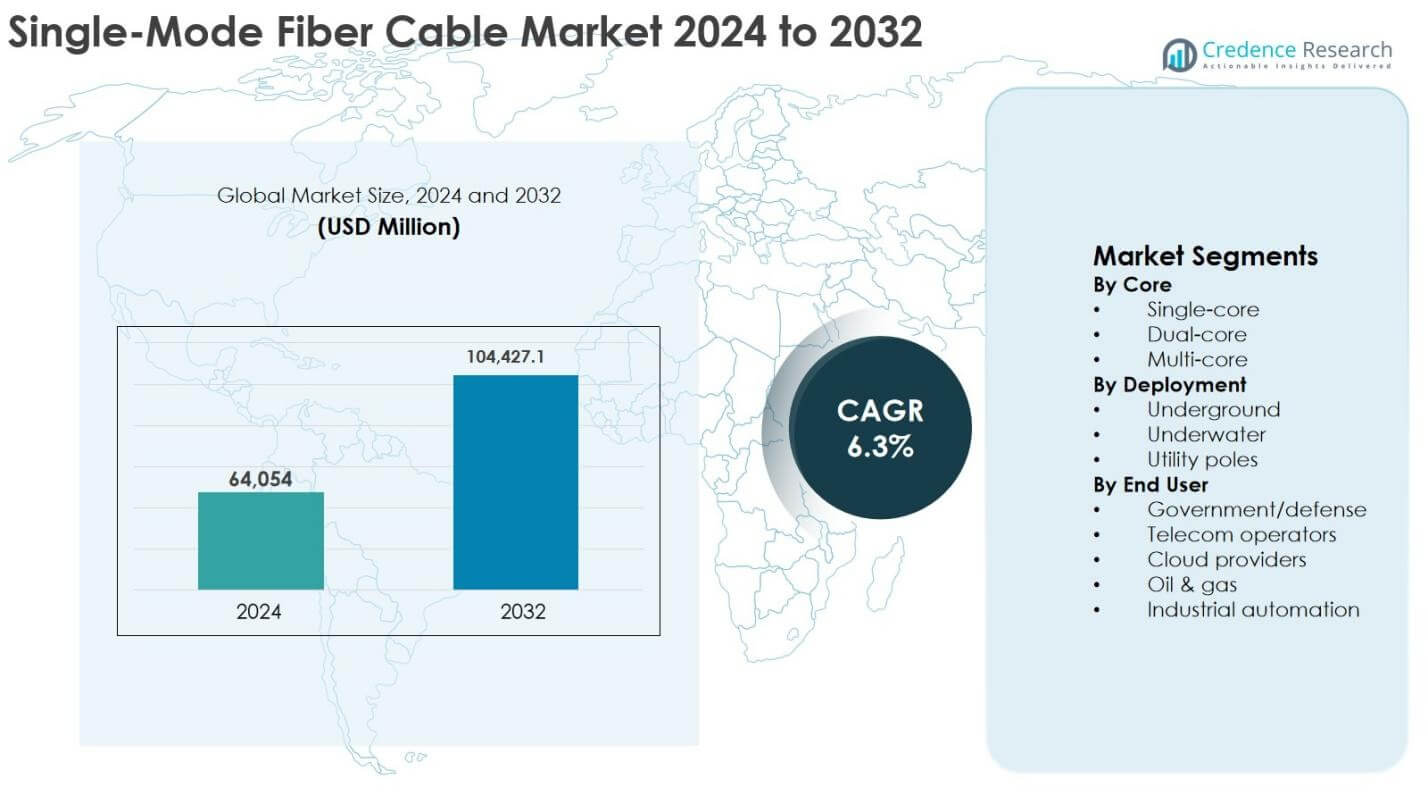
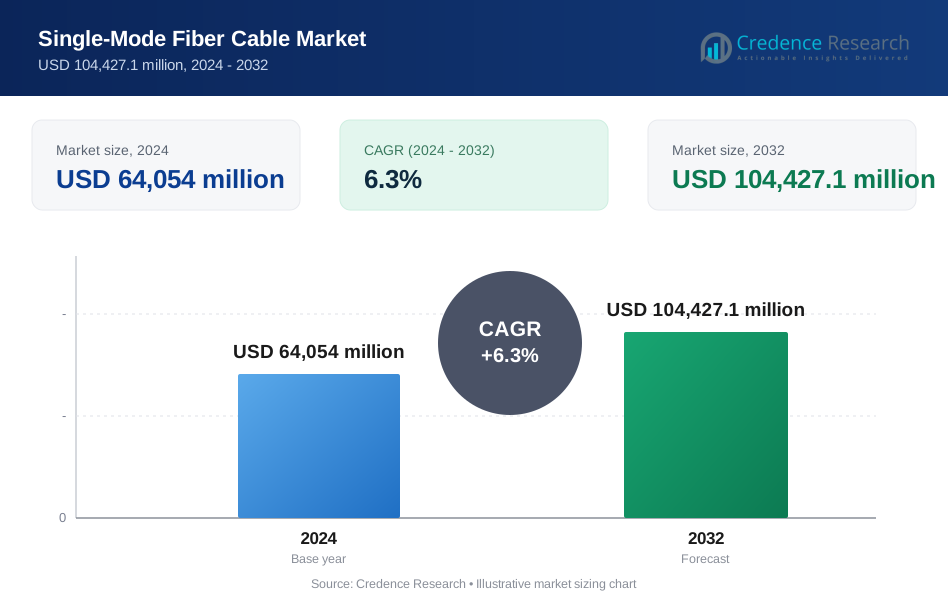
Single-Mode Fiber Cable market size was valued at USD 64,054 million in 2024 and is anticipated to reach USD 104,427.1 million by 2032, growing at a CAGR of 6.3% during the forecast period.
| REPORT ATTRIBUTE | DETAILS |
|---|---|
| Historical Period | 2020-2024 |
| Base Year | 2025 |
| Forecast Period | 2026-2032 |
| Single-Mode Fiber Cable Market Size 2024 | USD 64,054 million |
| Single-Mode Fiber Cable Market, CAGR | 6.3% |
| Single-Mode Fiber Cable Market Size 2032 | USD 104,427.1 million |
Single-Mode Fiber Cable Market Insights
- Market growth is primarily driven by rapid expansion of 5G backhaul networks, fiber-to-the-home deployments, and rising investments in hyperscale data centers, with telecom operators accounting for 46.8% segment share due to continuous network upgrades.
- Key market trends include increasing adoption of high-density and bend-insensitive fiber cables and rising deployment of long-haul and subsea fiber networks, while leading players such as Prysmian, Corning, Nexans, CommScope, Fujikura, and LS Cable & System focus on capacity expansion and advanced fiber designs.
- Market restraints include high installation costs for underground and underwater deployment and volatility in raw material prices, which impact project timelines and margins, particularly in cost-sensitive regions.
- Asia-Pacific dominated the market with a 34.6% share in 2024, followed by North America at 28.4% and Europe at 24.1%, while underground deployment led the deployment segment with a 61.3% share due to higher reliability and network protection benefits.
Single-Mode Fiber Cable Market Segmentation Analysis:
By Core
The Single-Mode Fiber Cable market by core type is led by single-core cables, which accounted for 52.6% market share in 2024, driven by their widespread use in long-haul telecommunications, metro networks, and data center interconnections. Single-core designs offer lower attenuation, superior signal integrity, and cost efficiency for point-to-point transmission, making them the preferred choice for backbone infrastructure. Multi-core cables followed with strong adoption in high-density network environments, supported by rising fiber-to-the-home deployments and urban network expansion, while dual-core cables maintained steady demand in redundancy-focused and specialized industrial applications.
- For instance, Verizon’s long-haul and metro optical backbone in the U.S. relies on single-mode, single-core fiber to support 100G, 400G, and higher-rate wavelengths over thousands of kilometers with minimal signal loss
By Deployment
By deployment mode, underground installation dominated the Single-Mode Fiber Cable market with a 61.3% share in 2024, supported by large-scale urban fiber rollout projects, smart city initiatives, and increasing preference for protected, weather-resilient infrastructure. Underground deployment minimizes physical damage, enhances network reliability, and supports long-term scalability for high-capacity networks. Utility pole installations held a significant share due to lower initial installation costs and rapid rural network expansion, while underwater deployment gained momentum from rising investments in subsea communication cables for international data traffic and offshore energy connectivity.
- For instance, AT&T has been deploying extensive underground single-mode fiber as part of its U.S. fiber-to-the-home and business services, prioritizing buried plant in dense urban corridors to reduce outage risks.
By End User
Telecom operators represented the dominant end-user segment, capturing 46.8% market share in 2024, driven by continuous investments in 5G backhaul, fiber-to-the-home expansion, and network capacity upgrades. Rising mobile data consumption and demand for ultra-low-latency connectivity continue to strengthen fiber adoption among telecom providers. Cloud providers followed, supported by hyperscale data center expansion and inter-data-center connectivity needs. Government and defense users contributed steadily through secure communication projects, while oil & gas and industrial automation sectors adopted single-mode fiber for high-reliability monitoring and control systems.
Key Growth Drivers
Expansion of 5G and Broadband Infrastructure
The rapid global rollout of 5G networks and continuous expansion of fixed broadband infrastructure remain primary growth drivers for the Single-Mode Fiber Cable market. Telecom operators are heavily investing in fiber backhaul and fronthaul networks to support high-capacity, low-latency 5G services. Single-mode fiber cables are essential for long-distance transmission and dense urban deployments due to their low signal attenuation and high bandwidth capabilities. Government-backed broadband initiatives aimed at improving rural connectivity further accelerate demand. Increasing smartphone penetration, video streaming, cloud applications, and IoT traffic are pushing operators to upgrade legacy copper networks with fiber-based infrastructure, reinforcing sustained demand across both developed and emerging economies.
- For instance, Verizon and AT&T in the U.S. have been extending deep fiber for 5G backhaul and fronthaul to support mid-band and mmWave deployments across major cities.
Growth of Data Centers and Cloud Computing
The accelerating adoption of cloud computing, edge computing, and hyperscale data centers is significantly driving demand for single-mode fiber cables. Cloud service providers require high-capacity, secure, and scalable optical connectivity to support inter-data-center links and long-haul data transmission. Single-mode fiber enables ultra-high-speed data transfer over extended distances, making it the preferred choice for backbone and metro networks. Rising enterprise digitalization, AI workloads, and big data analytics increase east–west traffic within data centers, driving continuous network upgrades. Additionally, increasing investments in regional data centers across Asia-Pacific, the Middle East, and Latin America are expanding the addressable market.
- For instance, Microsoft’s Azure and Google Cloud build regional and global backbone networks using single-mode fiber and DWDM systems to connect hyperscale data centers over hundreds to thousands of kilometers.
Government Investments in Digital and Smart Infrastructure
Government-led investments in digital infrastructure, smart cities, and national fiber networks are playing a crucial role in market expansion. Many countries are prioritizing fiber-optic networks to support e-governance, public safety communications, intelligent transportation systems, and defense applications. Single-mode fiber cables offer long-term reliability, high security, and scalability required for critical infrastructure projects. Public–private partnerships and national broadband plans are accelerating large-scale fiber deployments, particularly in emerging markets. The push for digital inclusion and modernization of public communication systems is creating sustained demand for high-performance fiber infrastructure.
Key Trends & Opportunities
Rising Deployment of Subsea and Long-Haul Fiber Networks
The growing volume of international data traffic is driving increased investment in subsea and long-haul single-mode fiber networks. Cloud providers, content delivery networks, and telecom operators are expanding transcontinental connectivity to reduce latency and improve redundancy. Advancements in fiber design, such as improved attenuation performance and higher fiber counts, are enhancing cable efficiency. Emerging opportunities exist in offshore wind farms, oil and gas communication networks, and island connectivity projects. As global data consumption rises, demand for high-capacity, long-distance fiber links continues to create new revenue streams for cable manufacturers and system integrators.
- For instance, Google has invested in multiple transoceanic systems such as Dunant (U.S.–France) and Equiano (Portugal–Africa), both based on high-fiber-count, single-mode subsea cable designs to support cloud and content traffic.
Technological Advancements in Fiber and Cable Design
Continuous innovation in single-mode fiber technology is opening new growth opportunities. Developments such as bend-insensitive fibers, higher fiber-density cables, and improved insulation materials enhance network performance and installation flexibility. These advancements reduce deployment costs and support compact, high-capacity network architectures, particularly in urban and data center environments. The integration of fiber with advanced monitoring and sensing technologies further expands applications in industrial automation and critical infrastructure. As network operators seek future-proof solutions, adoption of next-generation single-mode fiber cables is expected to accelerate.
- For instance, Prysmian and Furukawa Electric offer high-fiber-count cables (including 432‑fiber and higher designs) optimized for duct and data center deployments to maximize capacity in limited space.
Key Challenges
High Installation and Deployment Costs
Despite strong demand, high installation and deployment costs remain a significant challenge for the Single-Mode Fiber Cable market. Underground and underwater deployments require substantial capital investment, skilled labor, and regulatory approvals, increasing overall project costs. In developing regions, limited funding and infrastructure constraints can delay fiber rollout. Additionally, complex right-of-way regulations and lengthy approval processes slow network expansion. These factors may discourage smaller operators from investing aggressively in fiber infrastructure, impacting market penetration in cost-sensitive regions.
Supply Chain Constraints and Raw Material Price Volatility
The market faces challenges related to supply chain disruptions and volatility in raw material prices, particularly for glass preforms, polymers, and protective materials. Fluctuations in input costs directly impact manufacturing margins and pricing strategies for fiber cable producers. Geopolitical tensions and logistics disruptions further strain supply availability and lead times. Maintaining consistent quality while managing cost pressures is a critical concern for manufacturers. These challenges may affect project timelines and profitability, especially during periods of high global demand for fiber infrastructure.
Regional Analysis
North America
North America accounted for 28.4% of the Single-Mode Fiber Cable market share in 2024, supported by extensive investments in 5G backhaul, fiber-to-the-home deployments, and hyperscale data centers. The United States leads regional demand due to strong spending by telecom operators and cloud service providers on high-capacity optical networks. Ongoing upgrades of legacy copper infrastructure and rising adoption of edge computing further strengthen market growth. Government programs aimed at expanding rural broadband connectivity continue to accelerate fiber deployment across underserved areas, reinforcing long-term demand for single-mode fiber cables in the region.
Europe
Europe held 24.1% market share in the Single-Mode Fiber Cable market in 2024, driven by widespread fiber broadband rollout and strong regulatory support for digital infrastructure modernization. Countries such as Germany, the United Kingdom, and France are investing heavily in nationwide fiber networks to support gigabit connectivity targets. Expansion of cross-border data traffic and increasing adoption of cloud services are boosting demand for long-haul and metro fiber networks. Additionally, investments in smart grids, transportation networks, and defense communication systems contribute to sustained growth across the region.
Asia-Pacific
Asia-Pacific dominated the Single-Mode Fiber Cable market with a 34.6% share in 2024, fueled by rapid urbanization, large-scale 5G deployments, and aggressive fiber infrastructure expansion in China, India, Japan, and South Korea. High population density and growing internet penetration are driving extensive fiber-to-the-home projects across the region. Rising investments in data centers and subsea cable networks further support demand. Government-led digital transformation initiatives and smart city projects continue to accelerate adoption, positioning Asia-Pacific as the fastest-growing regional market.
Latin America
Latin America accounted for 7.2% of the Single-Mode Fiber Cable market share in 2024, supported by expanding broadband access and mobile network upgrades. Countries such as Brazil and Mexico are witnessing increased investment in fiber networks to improve internet penetration and support digital services. Telecom operators are upgrading backhaul infrastructure to accommodate rising data traffic and 5G rollout plans. While deployment challenges remain in remote areas, public–private partnerships and regulatory reforms are improving infrastructure development, driving steady market growth across the region.
Middle East & Africa
The Middle East & Africa region captured 5.7% market share in the Single-Mode Fiber Cable market in 2024, driven by investments in smart cities, data centers, and national broadband initiatives. Gulf countries are leading regional adoption through large-scale fiber deployments supporting digital economies and cloud services. In Africa, growing demand for connectivity and international subsea cable projects are improving network capacity. Government-backed infrastructure programs and increasing private-sector participation are gradually strengthening fiber network penetration, supporting long-term market expansion.
Single-Mode Fiber Cable Market Segmentations:
By Core
- Single-core
- Dual-core
- Multi-core
By Deployment
- Underground
- Underwater
- Utility poles
By End User
- Government/defense
- Telecom operators
- Cloud providers
- Oil & gas
- Industrial automation
By Geography
- North America
- U.S.
- Canada
- Mexico
- Europe
- Germany
- France
- U.K.
- Italy
- Spain
- Rest of Europe
- Asia Pacific
- China
- Japan
- India
- South Korea
- South-east Asia
- Rest of Asia Pacific
- Latin America
- Brazil
- Argentina
- Rest of Latin America
- Middle East & Africa
- GCC Countries
- South Africa
- Rest of the Middle East and Africa
Competitive Landscape
The Single-Mode Fiber Cable market is moderately consolidated, with global players competing on product performance, network scale, and long-term supply contracts with telecom operators and data center providers. Prysmian Group, Corning Incorporated, Nexans, CommScope, Fujikura, Furukawa Electric, LS Cable & System, Birla Furukawa, HTGD, and Humanetics play a significant role in shaping market dynamics through extensive manufacturing capabilities and strong regional footprints. Leading companies focus on expanding fiber capacity, enhancing bend-insensitive and high-density cable designs, and supporting large-scale 5G, FTTH, and subsea cable projects. Strategic investments in R&D, capacity expansion, and regional production facilities help players address rising demand and reduce supply-chain risks. Competition is further intensified by long-term contracts with telecom operators, cloud providers, and government agencies, while emerging regional manufacturers increasingly challenge established players on cost competitiveness and localized deployment expertise.
Key Player Analysis
- LS Cable and System
- Corning
- Humanetics
- Prysmian
- Fujikura
- CommScope
- Nexans
- Furukawa
- Birla Furukawa
- HTGD
Recent Developments
- In September 2025, EXA Infrastructure announced Project Visegrád, a major cross-border fibre-backbone build linking Poland, Czechia, Slovakia, and Hungary into its existing network, expanding single-mode fiber connectivity in Central Europe.
- In June 2025, Chile and Google signed an agreement to install the Humboldt trans-Pacific submarine fiber-optic cable system connecting Chile with Australia, marking a strategic partnership in fiber infrastructure deployment.
- In March 2025, EXA Infrastructure partnered with Ultranet to build a new 175-kilometre single-mode fibre route between Genoa and Milan in northern Italy to enhance network resilience and capacity.
Report Coverage
The research report offers an in-depth analysis based on Core, Deployment, End-User and Geography. It details leading market players, providing an overview of their business, product offerings, investments, revenue streams, and key applications. Additionally, the report includes insights into the competitive environment, SWOT analysis, current market trends, as well as the primary drivers and constraints. Furthermore, it discusses various factors that have driven market expansion in recent years. The report also explores market dynamics, regulatory scenarios, and technological advancements that are shaping the industry. It assesses the impact of external factors and global economic changes on market growth. Lastly, it provides strategic recommendations for new entrants and established companies to navigate the complexities of the market.
Future Outlook
- The Single-Mode Fiber Cable market will witness sustained demand driven by continuous 5G network expansion and future 6G readiness initiatives.
- Fiber-to-the-home deployments will accelerate as governments and operators prioritize universal high-speed broadband access.
- Hyperscale and edge data center growth will increase requirements for long-haul and inter-data-center single-mode fiber connectivity.
- Adoption of high-density and bend-insensitive fiber designs will rise to support compact and scalable network architectures.
- Subsea and cross-border fiber projects will expand to handle growing international data traffic and latency-sensitive applications.
- Smart city development will create long-term opportunities for fiber-based communication infrastructure.
- Industrial automation and digitalization will increase fiber adoption in manufacturing, energy, and transportation networks.
- Strategic partnerships between cable manufacturers and telecom operators will strengthen supply stability and deployment efficiency.
- Localization of manufacturing will gain importance to reduce supply-chain risks and delivery timelines.
- Ongoing innovation in fiber materials and cable protection technologies will enhance performance, durability, and network reliability.
Request a Free Sample
Fill in your details and we'll send you a free sample report.
- Sample data tables & charts
- Research methodology
Need a Custom Version of This Report?
Tailor the scope, geography, or segments to your exact requirements.
- Custom geography or segment scope
- Direct access to our analyst team
Frequently Asked Questions
What is the current market size for Single-Mode Fiber Cable market, and what is its projected size in 2032?
At what Compound Annual Growth Rate is the Single-Mode Fiber Cable market projected to grow between 2024 and 2032?
Which Single-Mode Fiber Cable market segment held the largest share in 2024?
What are the primary factors fueling the growth of the Single-Mode Fiber Cable market?
Who are the leading companies in the Single-Mode Fiber Cable market?
Which region commanded the largest share of the Single-Mode Fiber Cable market in 2024?
Table of Content
Chapter 1. Report Introduction
- 1.1 Report Description & Purpose
- 1.1.1 Report Title & Market Definition
- 1.1.2 Unique Selling Propositions (USP) & Key Differentiators
- 1.1.3 Value Proposition for Stakeholders
- 1.2 Research Objectives
- 1.2.1 Market Sizing Objectives (Volume & Revenue) (Volume Where Applicable)
- 1.2.2 Segmentation Objectives
- 1.2.3 Competitive Intelligence Objectives
- 1.2.4 Forecast & Scenario Objectives
- 1.3 Report Scope
- 1.3.1 Single-Mode Fiber Cable Scope – Segments & Subsegments Covered
- 1.3.2 Geographic Scope – Regions & Countries Covered
- 1.3.3 Historical Period, Base Year & Forecast Period (2024; forecast to 2032)
- 1.3.4 Inclusions & Exclusions
- 1.4 Industry Classification & Applicable Codes
- 1.5 Currency, Measurement Units & Valuation Basis
- 1.6 Target Stakeholders
- 1.7 Limitations & Assumptions
Chapter 2. Executive Summary
- 2.1 Global Single-Mode Fiber Cable Market Snapshot
- 2.1.1 Market Size – Historical (2024) & Forecast (2024-2032) (2024: USD 64,054 million → 2032: USD 104,427.1 million)
- 2.1.2 Volume & Revenue – Global Totals (Volume Where Applicable)
- 2.1.3 Key Market Highlights – Top Five Facts
- 2.2 Single-Mode Fiber Cable Market Segmentation Snapshot
- 2.2.1 Market Split by Region – 2024 vs. 2032
- 2.3 Competitive Snapshot
- 2.3.1 Top 10 Players by Revenue Share – 2024
- 2.3.2 Top 10 Players by Volume Share – 2024 (Volume Where Applicable)
- 2.3.3 Recent Strategic Developments (18-Month Summary)
- 2.4 Key Investment Highlights & Strategic Conclusions
Chapter 3. Single-Mode Fiber Cable Market Dynamics & Industry Analysis
- 3.1 Market Overview & Context
- 3.1.1 Single-Mode Fiber Cable Market Position in the Broader Industry Value Chain
- 3.1.2 Demand Structure & Purchasing Dynamics
- 3.1.3 Market Maturity & Development Stage by Region
- 3.2 Single-Mode Fiber Cable Market Drivers
- 3.3 Single-Mode Fiber Cable Market Restraints & Challenges
- 3.4 Single-Mode Fiber Cable Market Opportunities
- 3.5 Porter's Five Forces Analysis
- 3.5.1 Threat of New Entrants
- 3.5.2 Bargaining Power of Suppliers
- 3.5.3 Bargaining Power of Buyers
- 3.5.4 Threat of Substitutes
- 3.5.5 Competitive Rivalry – Intensity Assessment
- 3.6 Single-Mode Fiber Cable Value Chain Analysis
- 3.6.1 Upstream – Key Inputs, Resources & Suppliers
- 3.6.1.1 Key Input/Resource 1
- 3.6.1.2 Key Input/Resource 2
- 3.6.1.3 Key Input/Resource 3
- 3.6.2 Midstream – Core Operations & Value Creation
- 3.6.2.1 Operating Model & Process Overview
- 3.6.2.2 Key Operating Locations & Capabilities by Company
- 3.6.3 Downstream – Market Channels & End Users
- 3.6.3.1 Direct Sales & Customer Engagement Channels
- 3.6.3.2 Indirect Sales, Intermediaries & Partner Channels
- 3.6.4 Value Chain Profitability Analysis
- 3.6.1 Upstream – Key Inputs, Resources & Suppliers
- 3.7 PESTEL Analysis
- 3.7.1 Political Factors
- 3.7.2 Economic Factors
- 3.7.3 Social Factors
- 3.7.4 Technological Factors
- 3.7.5 Environmental Factors
- 3.7.6 Legal Factors
- 3.8 Single-Mode Fiber Cable Supply Chain Analysis
- 3.8.1 Critical Input & Resource Availability Risk Assessment
- 3.8.2 Supplier & Operational Concentration Risk (Geographic Exposure)
- 3.8.3 Supply & Service Disruption Impact Analysis
- 3.9 Regulatory & Policy Landscape
Note: The regulatory and policy landscape section covers regulations based on their applicability to the market, Single-Mode Fiber Cable category, geography, and scope of the study. Only regulatory frameworks with a material impact on operations, compliance, trade, sustainability, or market access are analyzed in detail.
Chapter 4. Key Investment Pockets & Opportunity Analysis
- 4.1 Single-Mode Fiber Cable Market Attractiveness Analysis
- 4.1.1 By Region – Investment Attractiveness Matrix (Market Size × CAGR)
- 4.2 Absolute Revenue Growth Opportunity
- 4.2.1 By Region – Absolute Revenue Growth Through 2032
- 4.3 Incremental Demand Opportunity
- 4.3.1 By Region – Incremental Demand Through 2032
- 4.3.2 Segment – Incremental Demand
- 4.4 Emerging Submarket Opportunity Deep Dive (Subject to Applicability)
- 4.5 Priority Market Opportunity Scorecards
- 4.5.1 United States
- 4.5.2 Europe
- 4.5.3 Asia
- 4.5.4 Middle East & Africa
Note: Priority market opportunity scorecards reflect the geographic scope and strategic relevance of the study. Listed markets are indicative and may be adapted to the industry.
Chapter 5. Single-Mode Fiber Cable Cross-Border Trade & Market Access Analysis
- 5.1 International Trade & Cross-Border Activity Overview
- 5.1.1 Global Export Value by Country (2024)
- 5.1.2 Global Export Volume by Country (2024) (Volume Where Applicable)
- 5.1.3 Global Import Value by Country (2024)
- 5.1.4 Global Import Volume by Country (2024) (Volume Where Applicable)
- 5.1.5 Net Trade Balance by Country (2024)
- 5.2 Export Analysis – Segment
- 5.2.1 Category 1 (Applicable Classification Code)
- 5.2.2 Category 2 (Applicable Classification Code)
- 5.2.3 Category 3 (Applicable Classification Code)
- 5.2.4 Category 4 (Applicable Classification Code)
- 5.2.5 Category 5 (Applicable Classification Code)
- 5.3 Import Analysis – Segment
- 5.3.1 Category 1 (Applicable Classification Code)
- 5.3.2 Category 2 (Applicable Classification Code)
- 5.3.3 Category 3 (Applicable Classification Code)
- 5.3.4 Category 4 (Applicable Classification Code)
- 5.3.5 Category 5 (Applicable Classification Code)
- 5.4 Cross-Border Pricing & Transaction Benchmarks
- 5.4.1 Export Pricing – Segment & Country
- 5.4.2 Import Pricing – Segment & Source Country
- 5.4.3 Price Trends (2024)
- 5.5 Key Cross-Border Trade & Delivery Routes
- 5.5.1 Cross-Border Trade/Delivery Route 1
- 5.5.2 Cross-Border Trade/Delivery Route 2
- 5.5.3 Cross-Border Trade/Delivery Route 3
- 5.5.4 Cross-Border Trade/Delivery Route 4
- 5.5.5 Cross-Border Trade/Delivery Route 5
- 5.6 Trade Policy & Market Access Impact Assessment
- 5.6.1 Tariff & Non-Tariff Barriers
- 5.6.2 Regional Trade & Economic Integration Frameworks
- 5.6.3 Bilateral & Multilateral Trade Agreements
- 5.6.4 Cross-Border Operating, Licensing & Localization Requirements
Note: This chapter applies where cross-border trade or delivery is relevant to Single-Mode Fiber Cable. Goods, services, and digital offerings are assessed using applicable classifications and transaction measures. Import-export volumes, trade balances, and route analyses are included only where meaningful to the market.
Chapter 6. Competitive Landscape & Company Benchmarking
- 6.1 Single-Mode Fiber Cable Market Concentration & Structure
- 6.1.1 Herfindahl-Hirschman Index (HHI) – vs. 2024
- 6.1.2 Leading, Mid-Sized & Emerging Player Structure
- 6.1.3 Global, Regional & Local Player Dynamics
- 6.2 Single-Mode Fiber Cable Market Share Analysis – 2024
- 6.2.1 Global Revenue Share by Company
- 6.2.2 Global Volume Share by Company (Volume Where Applicable)
- 6.2.3 Regional Revenue Share
- 6.2.4 Market Share Evolution ( vs. 2024)
- 6.2.5 Company Market Share by Key Segment
- 6.2.6 Company Market Share by Customer Group
- 6.3 Operating Scale, Capacity & Infrastructure Analysis
- 6.3.1 Global Operating Scale & Supply Capacity
- 6.3.2 Resource Utilization & Operating Efficiency
- 6.3.3 Output, Service Delivery & Activity Metrics
- 6.3.4 Operating Footprint & Infrastructure Map
- 6.3.5 Planned Operational & Capacity Expansion
- 6.4 Single-Mode Fiber Cable Competitive Benchmarking Matrix
- 6.4.1 Revenue, Growth, Profitability & Operating Metric Comparison
- 6.4.2 Channel Revenue Mix
- 6.4.3 Geographic Revenue Exposure
- 6.4.4 R&D Intensity
- 6.4.5 Sustainability Maturity
- 6.5 Strategic Developments in Single-Mode Fiber Cable (Last 24 Months)
- 6.5.1 Mergers, Acquisitions & Divestments
- 6.5.2 New Products, Services & Solutions in Single-Mode Fiber Cable
- 6.5.3 Operational & Infrastructure Expansions
- 6.5.4 Strategic Alliances, Joint Ventures & Partnerships
- 6.5.5 Distribution Expansion & Market Entry
- 6.5.6 Sustainability & ESG Initiatives
- 6.6 Competitive Strategy Mapping
- 6.6.1 Leader, Challenger, Follower & Niche Classification
- 6.6.2 Pricing Strategy Comparison
- 6.6.3 Channel Strategy Matrix
Note: Strategic developments are included based on their materiality and the availability of reliable information.
Chapter 7. Global Single-Mode Fiber Cable Market – By Sales & Delivery Channel
- 7.1 Segment Overview
- 7.1.1 Volume & Revenue Split by Channel (2024 & 2032) (Volume Where Applicable)
- 7.1.2 Channel Mix Evolution (2024-2032)
Chapter 8. Regional Market Analysis – Global Overview
- 8.1 Global Regional Overview
- 8.1.1 Regional Volume Share (Volume Where Applicable)
- 8.1.2 Regional Revenue Share
- 8.1.3 Regional Volume by Region (Volume Where Applicable)
- 8.1.4 Regional Revenue by Region
- 8.1.5 Regional Forecast Through 2032
- 8.2 Cross-Regional Segment Analysis
- 8.2.1 By Sales & Delivery Channel
- 8.2.2 By Competitive Positioning & Price Tier
Chapter 9. North America Single-Mode Fiber Cable Market
- 9.1 United States
- 9.2 Canada
- 9.3 Mexico
Chapter 10. Europe Single-Mode Fiber Cable Market
- 10.1 Germany
- 10.2 France
- 10.3 Italy
- 10.4 United Kingdom
- 10.5 Spain
- 10.6 Poland
- 10.7 Russia
- 10.8 Netherlands
- 10.9 Belgium
- 10.10 Sweden
- 10.11 Denmark
- 10.12 Norway
- 10.13 Rest of Europe
Chapter 11. Asia Pacific Single-Mode Fiber Cable Market
- 11.1 China
- 11.2 India
- 11.3 Japan
- 11.4 South Korea
- 11.5 Thailand
- 11.6 Indonesia
- 11.7 Vietnam
- 11.8 Malaysia
- 11.9 Australia
- 11.10 Rest of Asia Pacific
Chapter 12. Latin America Single-Mode Fiber Cable Market
- 12.1 Brazil
- 12.2 Argentina
- 12.3 Colombia
- 12.4 Chile
- 12.5 Rest of Latin America
Chapter 13. Middle East Single-Mode Fiber Cable Market
- 13.1 Saudi Arabia
- 13.2 United Arab Emirates
- 13.3 Turkey
- 13.4 Israel
- 13.5 Iran
- 13.6 Rest of the Middle East
Chapter 14. Africa Single-Mode Fiber Cable Market
- 14.1 South Africa
- 14.2 Egypt
- 14.3 Nigeria
- 14.4 Morocco
- 14.5 Rest of Africa
Chapter 15. Single-Mode Fiber Cable Company Profiles
- 15.1 [Company 01]
- 15.1.1 Company Overview
- 15.1.2 Key Management Personnel
- 15.1.3 Products & Services Portfolio
- 15.1.4 Financial Performance
- 15.1.5 Key Market Focus & Geographic Presence
- 15.1.6 Recent Developments & Strategic Initiatives
Note: The company profile list is preliminary and may change based on research findings, market developments, data availability, and client requirements.
Chapter 16. Appendices
- Appendix A – List of Abbreviations & Acronyms
- Appendix B – Industry Classification Code Reference – Full Series
- Appendix C – Supply, Output & Operating Capacity Data Tables
- Appendix D – End-Use & Demand Base Tables
- Appendix E – Demand, Adoption & Usage Assumptions
- Appendix F – Pricing & Revenue Metric Reference Tables
- Appendix G – Company Operations & Infrastructure Database
- Appendix H – Cross-Border Trade & Activity Data Tables (Where Applicable)
- Appendix I – Regulatory Summary Tables
- Appendix J – Primary Research Participant List (Anonymized)
- Appendix K – Primary Research Questionnaire Framework
- Appendix L – Data Sources & Bibliography
- Appendix M – Market Size Divergence & Source Comparison
Chapter 17. Research Methodology
- 17.1 Research Framework & Philosophy
- 17.2 Secondary Research – Sources, Hierarchy & Data Extraction
- 17.3 Data Modeling – Bottom-Up & Top-Down Market Sizing
- 17.4 Primary Research – Stakeholder Framework, LOI & Sample Sizes
- 17.5 Forecast Methodology – Regression, Scenario & Sensitivity Analysis
- 17.6 Quality Control – Four-Layer Validation Framework
- 17.7 Limitations & Standard Assumptions
- 17.8 Disclaimer
