
Penetration Testing Market Overview:
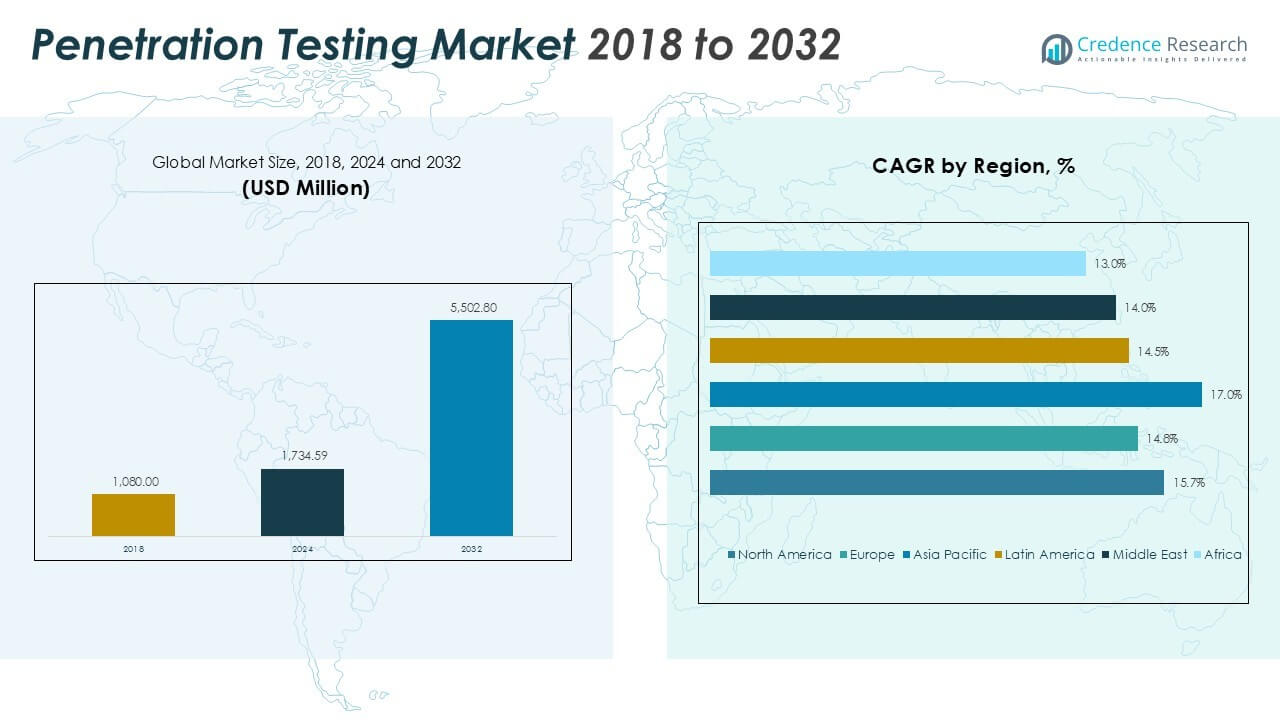
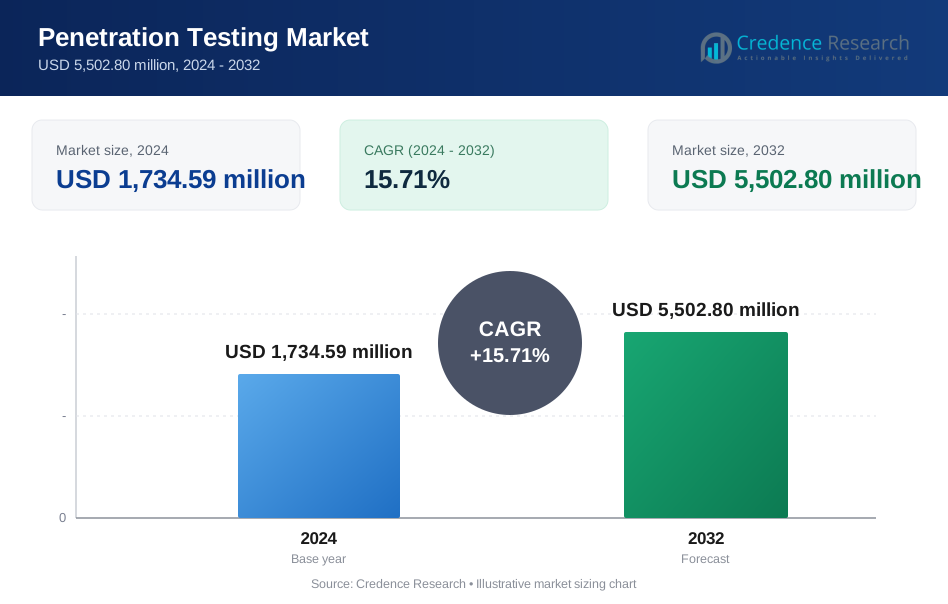
The Penetration Testing market size was valued at USD 1,080.00 million in 2018, increased to USD 1,734.59 million in 2024, and is anticipated to reach USD 5,502.80 million by 2032, at a CAGR of 15.71% during the forecast period.
| REPORT ATTRIBUTE | DETAILS |
|---|---|
| Historical Period | 2020-2023 |
| Base Year | 2024 |
| Forecast Period | 2024-2032 |
| Penetration Testing Market Size 2024 | USD 1,734.59 Million |
| Penetration Testing Market, CAGR | 15.71% |
| Penetration Testing Market Size 2032 | USD 5,502.80 Million |
The Penetration Testing market is led by key players such as Cisco Systems, Inc., IBM Corporation, Fortinet, Inc., CrowdStrike, Inc., Rapid7, and Secureworks, Inc. These companies offer advanced testing solutions integrated with broader cybersecurity platforms, enabling real-time threat detection and compliance support. Specialists like Coalfire Systems, Trustwave Holdings, and Synopsys, Inc. focus on tailored services, including red teaming and secure code testing. North America dominates the global market with a 37.9% share in 2024, driven by high cybersecurity investments, strict regulatory mandates, and strong adoption across BFSI and healthcare sectors. Asia Pacific emerges as the fastest-growing region due to rising digitalization and cloud migration across enterprises. Leading players compete through platform innovation, cloud-native tools, and AI-powered automation to meet rising enterprise demand for scalable and continuous testing solutions.
Market Insights
- The Penetration Testing market was valued at USD 1,080.00 million in 2018, reached USD 1,734.59 million in 2024, and is expected to hit USD 5,502.80 million by 2032, growing at a CAGR of 15.71%.
- Increasing cyberattacks, regulatory compliance needs, and the growing complexity of IT systems drive the market demand across industries.
- AI-powered automation, DevSecOps integration, and demand for red teaming services are key trends enhancing solution adoption.
- North America leads with 37.9% share in 2024, followed by Asia Pacific with 27.9% share and Europe with 22.9%; cloud deployment holds over 60%, while solutions account for 65% share by offering.
- Cost barriers for SMEs and shortage of skilled cybersecurity professionals limit full-scale adoption in emerging markets.
Penetration Testing Market Segmentation Analysis:
By Offering:
The solutions segment holds the dominant share in the penetration testing market, accounting for over 65% of total revenue. Organizations prioritize automated tools for vulnerability assessment, compliance checks, and real-time threat simulation. The rise of complex cyberattacks and evolving threat vectors drives demand for scalable testing platforms. Enterprises adopt integrated testing solutions to improve security posture and regulatory adherence. Meanwhile, the services segment grows steadily as businesses outsource expert-led testing for deeper analysis. Customized assessments, red teaming, and managed testing services appeal to firms lacking internal security expertise.
- For instance, Rapid7 Nexpose maintains a vulnerability database with over 180,000 checks, enabling broad coverage across networks and applications.
By Type:
Web applications remain the leading type segment, contributing more than 35% of the market share. Continuous deployment of customer-facing applications across banking, retail, and healthcare increases vulnerability exposure. Organizations conduct frequent web-based testing to prevent injection flaws, authentication issues, and session mismanagement. Network solutions follow, driven by rising threats targeting internal infrastructure and data exfiltration risks. Mobile applications and cloud environments also expand rapidly due to increased remote access, hybrid IT models, and data privacy mandates. Social engineering testing gains relevance as phishing and impersonation attacks rise.
- For instance, ZAP (formerly OWASP ZAP) remains one of the world's most popular free web security tools; as of 2025, it is started millions of times per month, reflecting its widespread use for both manual and automated web vulnerability scanning.
By Deployment Mode:
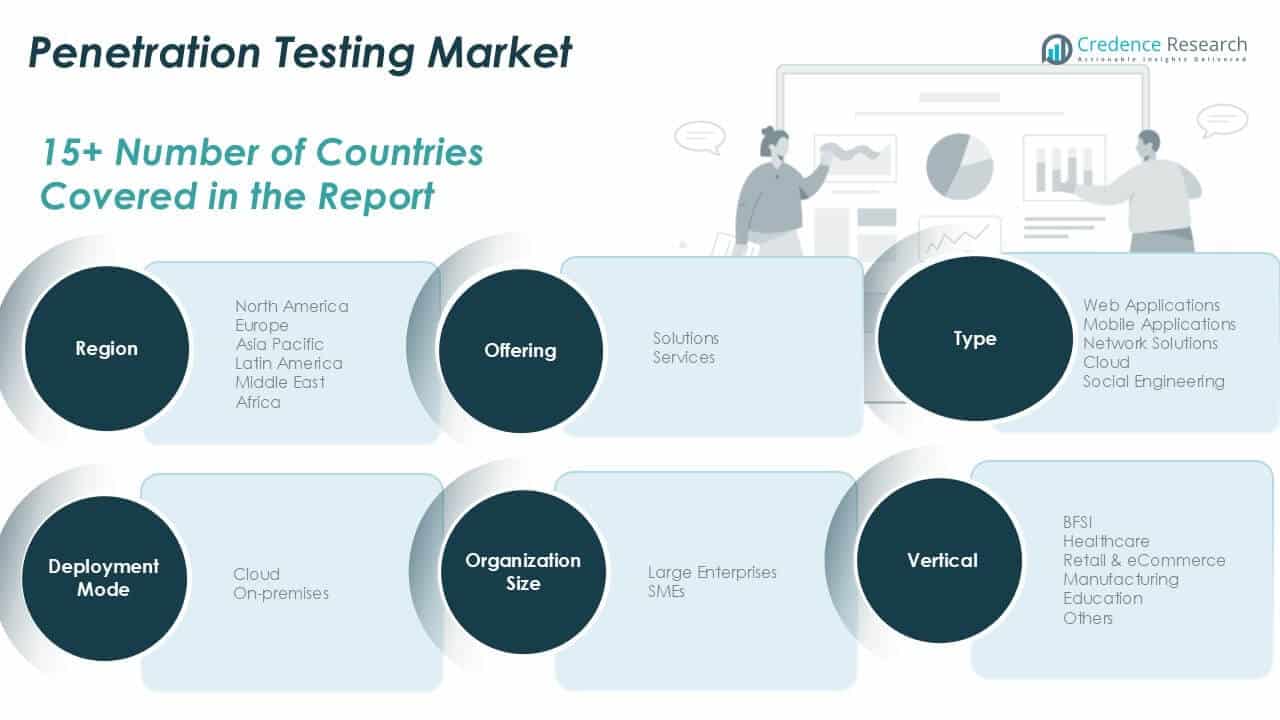
The cloud deployment mode dominates the market, accounting for over 60% share in 2024. Cloud-native applications and remote work infrastructure drive demand for cloud-based penetration testing platforms. These solutions offer faster deployment, remote access, scalability, and lower upfront cost compared to on-premises models. Organizations favor SaaS-based testing tools for continuous assessment across hybrid environments. On-premises deployment remains relevant among highly regulated sectors like defense and finance, where data residency and system control are critical. However, cloud adoption continues to outpace due to operational flexibility and real-time testing needs.
Penetration Testing Market Key Growth Drivers
Rising Cybersecurity Threat Landscape Across Enterprises
The penetration testing market experiences strong growth due to the rising frequency and complexity of cyberattacks targeting enterprises. With advanced persistent threats, ransomware, and zero-day vulnerabilities on the rise, organizations adopt penetration testing to proactively identify security gaps. Business operations increasingly rely on digital platforms, exposing critical systems to exploitation risks. Sectors like BFSI, healthcare, and manufacturing face heavy regulatory pressure to secure data infrastructure. Penetration testing supports compliance with global standards such as GDPR, HIPAA, and PCI-DSS. Enterprises invest in routine testing to assess real-world breach readiness and mitigate costly disruptions. The shift to hybrid work environments further expands the attack surface, driving demand for scalable, continuous security validation tools.
- For instance, CrowdStrike processes more than 1 trillion security events per day through its Falcon platform to identify attack patterns.
Increased Regulatory and Compliance Mandates
Stringent data protection regulations across regions significantly propel the penetration testing market. Governments and industry bodies enforce periodic security audits and vulnerability assessments to safeguard consumer information. Regulations like the EU’s GDPR, California’s CCPA, and India’s DPDP Act require proof of proactive cybersecurity controls. Organizations operating in finance, healthcare, and eCommerce must conduct regular testing to meet audit requirements. Failure to comply results in steep penalties and reputational damage, creating urgency for structured testing programs. Penetration testing helps organizations validate security controls, reduce compliance risks, and generate documented evidence for regulators. The growing enforcement of cybersecurity frameworks like NIST and ISO/IEC 27001 further boosts market adoption.
- For instance, PCI Security Standards Council mandates annual penetration testing for all entities handling cardholder data.
Proliferation of Cloud and Mobile Infrastructure
Widespread cloud adoption and the surge in mobile application deployment accelerate the need for penetration testing. Enterprises transition workloads to multi-cloud environments, increasing exposure to misconfigurations, unauthorized access, and insecure APIs. Simultaneously, mobile-first business models lead to an influx of mobile apps with varied security concerns. Penetration testing evaluates risks across these dynamic environments, helping firms secure endpoints, mobile interfaces, and back-end cloud platforms. Testing solutions now integrate with CI/CD pipelines for real-time vulnerability checks during app development. As businesses digitize operations and enable remote access, penetration testing ensures attack surface visibility, threat prioritization, and adaptive remediation. This infrastructure shift continues to be a major growth enabler.
Penetration Testing Market Key Trends & Opportunities
Adoption of AI-Powered and Automated Testing Tools
Artificial intelligence and automation emerge as key trends enhancing penetration testing effectiveness. AI-powered tools simulate sophisticated attack patterns, uncover hidden vulnerabilities, and learn from evolving threats. Automation allows faster execution of test cycles, reducing manual effort and improving scalability. Organizations adopt automated testing to conduct routine assessments across growing digital ecosystems. Integration with DevSecOps pipelines ensures real-time feedback during software deployment. These innovations help address the shortage of cybersecurity experts and deliver cost-effective, continuous testing. Vendors now offer self-learning tools that prioritize risks and recommend remediation steps. This trend presents opportunities for solution providers to offer intelligent platforms tailored for enterprises seeking speed, accuracy, and flexibility.
- For instance, Darktrace uses self-learning AI trained on over 10,000 enterprise environments to detect abnormal threat patterns without predefined rules.
Growth in Demand for Red Team and Social Engineering Testing
Red teaming and social engineering assessments gain traction as enterprises seek to understand human and process vulnerabilities beyond technical flaws. Red team operations simulate real-world attack scenarios by mimicking adversaries' tactics, techniques, and procedures. This helps assess the organization’s detection and response capabilities. Social engineering testing exposes susceptibility to phishing, pretexting, and insider threats—areas often overlooked in traditional security audits. As cyberattacks grow more targeted and deceptive, businesses prioritize behavioral risk testing. Industries with sensitive data or customer interactions, such as finance and healthcare, show rising interest in these services. This trend creates new service-based opportunities for penetration testing vendors to offer tailored threat simulation packages.
Penetration Testing Market Key Challenges
Shortage of Skilled Cybersecurity Professionals
A major challenge in the penetration testing market is the global shortage of skilled cybersecurity professionals. Qualified ethical hackers, red team specialists, and certified penetration testers remain limited in supply. This talent gap delays project execution, increases service costs, and hampers large-scale testing deployments. Smaller firms and SMEs struggle to attract or retain in-house security expertise, relying heavily on outsourced services. The complexity of modern IT systems, cloud environments, and application architectures demands deep domain knowledge. Vendors must invest in upskilling initiatives, certifications, and knowledge-sharing platforms to address this gap. Without adequate talent, organizations risk delayed assessments, incomplete coverage, and reduced resilience to evolving threats.
High Cost of Advanced Testing Tools and Services
Cost remains a significant barrier, particularly for small and mid-sized enterprises adopting advanced penetration testing solutions. Comprehensive testing, including red teaming, cloud assessments, and real-time simulations, incurs high expenses. Automated tools, while faster, require upfront investment in licenses and integrations. Customized services offered by cybersecurity firms often exceed limited security budgets. Furthermore, regulatory-driven testing obligations add pressure to allocate funds regularly. Many organizations delay or limit assessments due to cost concerns, leaving potential vulnerabilities unaddressed. Vendors must develop scalable, cost-effective packages and modular offerings to improve accessibility. Price sensitivity in emerging markets further complicates adoption, requiring localized pricing models and subscription-based services.
Penetration Testing Market Regional Analysis
North America
North America leads the global penetration testing market, accounting for approximately 37.9% of the revenue in 2024. The market grew from USD 414.72 million in 2018 to USD 658.44 million in 2024, and is projected to reach USD 2,086.12 million by 2032, growing at a CAGR of 15.7%. The region benefits from high cybersecurity spending, early cloud adoption, and strong regulatory enforcement in sectors such as BFSI, healthcare, and defense. Organizations invest heavily in continuous testing to protect digital infrastructure. The U.S. dominates regional growth, driven by a mature threat landscape and advanced IT security frameworks.
Europe
Europe holds a significant 22.9% share of the global penetration testing market in 2024. The market increased from USD 258.12 million in 2018 to USD 396.83 million in 2024, and is expected to reach USD 1,181.74 million by 2032, at a CAGR of 14.8%. Stringent data privacy regulations such as GDPR drive periodic security testing across industries. Germany, the UK, and France lead regional demand due to strong industrial and financial sectors. Enterprises prioritize vulnerability assessments to comply with EU norms and protect against increasing cyber threats, especially amid widespread digital transformation across the continent.
Asia Pacific
Asia Pacific is the fastest-growing region in the penetration testing market, with a CAGR of 17.0% and a 27.9% market share in 2024. The market expanded from USD 289.44 million in 2018 to USD 483.68 million in 2024, and is projected to hit USD 1,680.01 million by 2032. Rapid digitalization, cloud adoption, and regulatory tightening in economies like China, India, Japan, and Australia fuel demand. Cybersecurity awareness increases across BFSI, eCommerce, and manufacturing sectors. Governments invest in national cyber defenses, while enterprises adopt proactive testing to manage expanding attack surfaces and comply with evolving data protection laws.
Latin America
Latin America represents 5.4% of the global penetration testing market in 2024. The regional market grew from USD 58.64 million in 2018 to USD 93.13 million in 2024, and is forecast to reach USD 270.57 million by 2032, at a CAGR of 14.5%. Brazil and Mexico lead adoption due to rising threats in financial and public service sectors. Businesses strengthen digital defenses through scheduled penetration testing and compliance-focused audits. Government cybersecurity initiatives and international collaborations also support testing demand. However, budget constraints among SMEs and limited local expertise continue to challenge broader market expansion.
Middle East
The Middle East accounts for 3.2% of the global penetration testing market in 2024. Valued at USD 36.72 million in 2018, the market rose to USD 54.80 million in 2024, and is projected to reach USD 154.66 million by 2032, growing at a CAGR of 14.0%. Demand is driven by digital transformation projects in the UAE, Saudi Arabia, and Qatar. Government-backed cybersecurity frameworks and sector-specific data protection laws boost testing investments in oil & gas, finance, and infrastructure. Enterprises seek regular assessments to meet compliance standards and mitigate targeted cyber threats amid geopolitical tensions.
Africa
Africa holds a 2.8% share in the global penetration testing market in 2024. The market expanded from USD 22.36 million in 2018 to USD 47.71 million in 2024, and is anticipated to reach USD 129.70 million by 2032, at a CAGR of 13.0%. South Africa, Nigeria, and Kenya lead regional growth, supported by digital banking and telecom expansion. Awareness around cybersecurity rises steadily, driving the adoption of external penetration testing services. However, the market faces challenges such as limited infrastructure and a shortage of certified professionals. International partnerships and policy support are crucial to unlocking future growth potential.
Penetration Testing Market Segmentations:
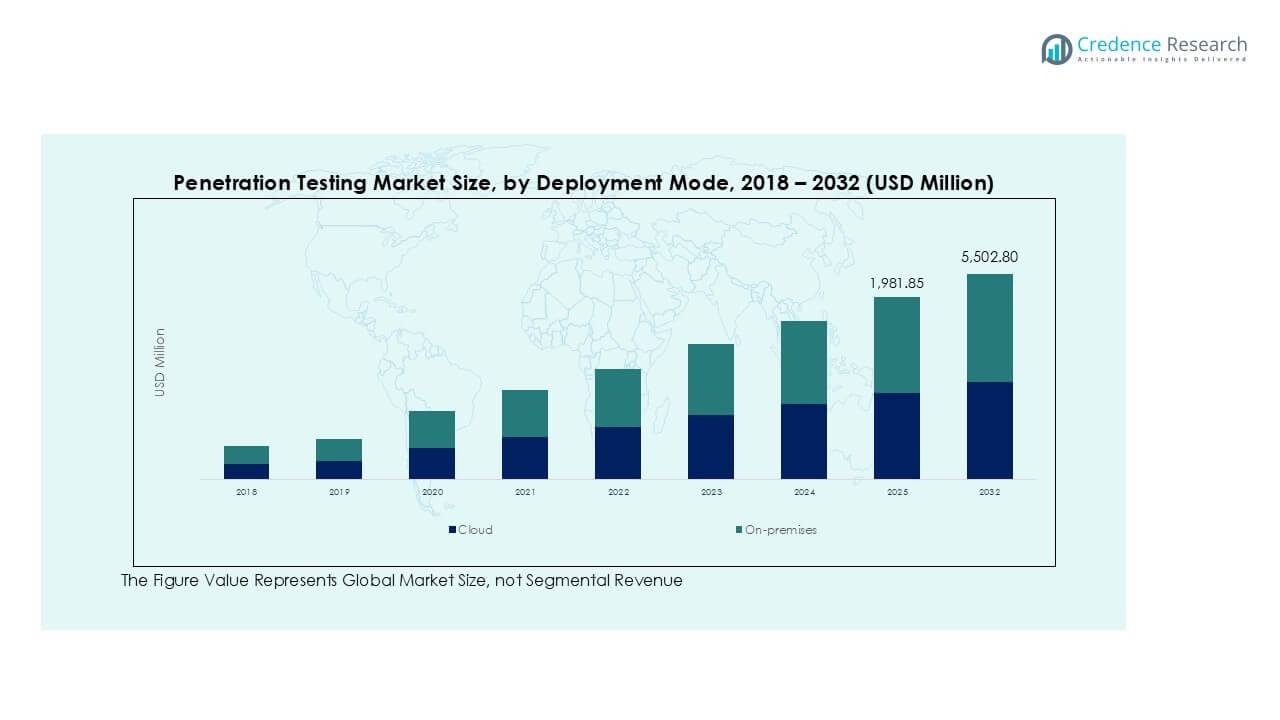
By Offering:
- Solutions
- Services
By Type:
- Web Applications
- Mobile Applications
- Network Solutions
- Cloud
- Social Engineering
By Deployment Mode:
- Cloud
- On-premises
By Organization Size:
- Large Enterprises
- SMEs
By Vertical:
- BFSI
- Healthcare
- Retail & eCommerce
- Manufacturing
- Education
- Others
By Geography:
- North America
- U.S.
- Canada
- Mexico
- Europe
- Germany
- France
- U.K.
- Italy
- Spain
- Rest of Europe
- Asia Pacific
- China
- Japan
- India
- South Korea
- South-east Asia
- Rest of Asia Pacific
- Latin America
- Brazil
- Argentina
- Rest of Latin America
- Middle East & Africa
- GCC Countries
- South Africa
- Rest of the Middle East and Africa
Penetration Testing Market Competitive Landscape
The Global Penetration Testing market features a mix of global cybersecurity leaders and specialized service providers, each focusing on different aspects of vulnerability assessment and threat simulation. Major players such as Cisco Systems, IBM Corporation, Fortinet, and CrowdStrike leverage their broad cybersecurity portfolios to integrate penetration testing with endpoint, network, and cloud protection solutions. Companies like Coalfire Systems, Rapid7, and Secureworks focus on tailored services, including red teaming and compliance testing. Emerging firms such as Isecurion are gaining traction in niche markets by offering cost-effective, region-specific solutions. Strategic partnerships, product enhancements, and AI-driven automation are key approaches adopted across the competitive landscape. For instance, vendors invest in integrating testing tools with CI/CD pipelines to support DevSecOps. Market consolidation is also visible through acquisitions that strengthen service depth and platform integration. The ongoing need for regulatory compliance, coupled with increasing threat complexity, sustains intense competition among solution providers.
Key Player Analysis
- Cisco Systems, Inc.
- Coalfire Systems, Inc.
- CrowdStrike, Inc.
- Fortinet, Inc.
- International Business Machines Corporation
- Isecurion
- Rapid7
- Secureworks, Inc.
- Synopsys, Inc.
- Trustwave Holdings, Inc.
Recent Developments
- In December 2023, Chubb, the publicly traded property and casualty insurance company, announced a partnership with NetSPI, a proactive security provider, to improve its customers' cyber risk profiles through improved attack surface management and penetration testing solutions.
- In August 2023, Coalfire announced the launch of Hexeon, a comprehensive offensive security software as a service (SaaS) to monitor and assess risks throughout its vulnerability management lifecycle. The solution provides enhanced context for threat exposures and allows continued interaction with their pen testers.
- In 2023, BreachLock, a provider of pen testing services, launched the latest solution called Red Teaming as a Service (RTaaS). By offering comprehensive assessment at a reduced cost, this innovative solution aims to change the way Red Teaming services are provided radically.
Report Coverage
The research report offers an in-depth analysis based on Offering, Type, Deployment Mode, Organization Size, Vertical and Geography. It details leading market players, providing an overview of their business, product offerings, investments, revenue streams, and key applications. Additionally, the report includes insights into the competitive environment, SWOT analysis, current market trends, as well as the primary drivers and constraints. Furthermore, it discusses various factors that have driven market expansion in recent years. The report also explores market dynamics, regulatory scenarios, and technological advancements that are shaping the industry. It assesses the impact of external factors and global economic changes on market growth. Lastly, it provides strategic recommendations for new entrants and established companies to navigate the complexities of the market.
Future Outlook
- The market will continue expanding due to stricter global data protection regulations.
- Cloud-based penetration testing solutions will gain wider adoption across enterprise IT environments.
- Automated and AI-driven testing tools will become standard in security assessment workflows.
- Demand for continuous testing will rise with the growth of DevSecOps practices.
- Red teaming and social engineering services will see increased uptake in high-risk industries.
- Asia Pacific will witness the fastest growth, driven by digital transformation in key economies.
- SMEs will adopt more affordable, subscription-based penetration testing solutions.
- Cyber insurance requirements will push companies to validate security through regular testing.
- Integration of testing tools with CI/CD pipelines will become critical for agile teams.
- The need for skilled cybersecurity professionals will drive investment in training and partnerships.
Request a Free Sample
Fill in your details and we'll send you a free sample report.
- Sample data tables & charts
- Research methodology
Need a Custom Version of This Report?
Tailor the scope, geography, or segments to your exact requirements.
- Custom geography or segment scope
- Direct access to our analyst team
Frequently Asked Questions
What is the current market size for Penetration Testing market, and what is its projected size in 2032?
At what Compound Annual Growth Rate is the Penetration Testing market projected to grow between 2024 and 2032?
Which Penetration Testing market segment held the largest share in 2024?
What are the primary factors fueling the growth of the Penetration Testing market?
Who are the leading companies in the Penetration Testing market?
Which region commanded the largest share of the Penetration Testing market in 2024?
Table of Content
Chapter 1. Report Introduction
- 1.1 Report Description & Purpose
- 1.1.1 Report Title & Market Definition
- 1.1.2 Unique Selling Propositions (USP) & Key Differentiators
- 1.1.3 Value Proposition for Stakeholders
- 1.2 Research Objectives
- 1.2.1 Market Sizing Objectives (Volume & Revenue)
- 1.2.2 Segmentation Objectives
- 1.2.3 Competitive Intelligence Objectives
- 1.2.4 Forecast & Scenario Objectives
- 1.3 Report Scope
- 1.3.1 Penetration Testing Scope – Types & Subtypes Covered
- 1.3.2 Geographic Scope – Regions & Countries Covered
- 1.3.3 Historical Period, Base Year & Forecast Period (2024; forecast to 2032)
- 1.3.4 Inclusions & Exclusions
- 1.4 HS Code & Classification Framework
- 1.5 Currency, Units & Pricing Basis
- 1.6 Target Stakeholders
- 1.7 Limitations & Assumptions
Chapter 2. Executive Summary
- 2.1 Global Penetration Testing Market Snapshot
- 2.1.1 Market Size – Historical (2024) & Forecast (2024-2032) (2024: USD 1,734.59 million → 2032: USD 5,502.80 million)
- 2.1.2 Volume & Revenue – Global Totals
- 2.1.3 Key Market Highlights – Top Five Facts
- 2.2 Penetration Testing Market Segmentation Snapshot
- 2.2.1 Market Split by Region – 2024 vs. 2032
- 2.3 Competitive Snapshot
- 2.3.1 Top 10 Players by Revenue Share – 2024
- 2.3.2 Top 10 Players by Volume Share – 2024
- 2.3.3 Recent Strategic Developments (18-Month Summary)
- 2.4 Key Investment Highlights & Strategic Conclusions
Chapter 3. Penetration Testing Market Dynamics & Industry Analysis
- 3.1 Market Overview & Context
- 3.1.1 Penetration Testing Market Position in the Broader Automotive Value Chain
- 3.1.2 OEM vs. Replacement Market Dynamics
- 3.1.3 Market Maturity & Development Stage by Region
- 3.2 Penetration Testing Market Drivers
- 3.3 Penetration Testing Market Restraints & Challenges
- 3.4 Penetration Testing Market Opportunities
- 3.5 Porter's Five Forces Analysis
- 3.5.1 Threat of New Entrants
- 3.5.2 Bargaining Power of Suppliers
- 3.5.3 Bargaining Power of Buyers
- 3.5.4 Threat of Substitutes
- 3.5.5 Competitive Rivalry – Intensity Assessment
- 3.6 Penetration Testing Value Chain Analysis
- 3.6.1 Upstream – Raw Material/Input Suppliers
- 3.6.1.1 Raw Material/Input 1
- 3.6.1.2 Raw Material/Input 2
- 3.6.1.3 Raw Material/Input 3
- 3.6.2 Midstream – Production/Manufacturing/Service Delivery
- 3.6.2.1 Production/Process Overview
- 3.6.2.2 Key Facility Locations & Capacity by Manufacturer
- 3.6.3 Downstream – Distribution & End Consumer
- 3.6.3.1 Primary Channel – B2B/OEM
- 3.6.3.2 Secondary Channels – Dealer, Retail, Online, Direct
- 3.6.4 Value Chain Profitability Analysis
- 3.6.1 Upstream – Raw Material/Input Suppliers
- 3.7 PESTEL Analysis
- 3.7.1 Political Factors
- 3.7.2 Economic Factors
- 3.7.3 Social Factors
- 3.7.4 Technological Factors
- 3.7.5 Environmental Factors
- 3.7.6 Legal Factors
- 3.8 Penetration Testing Supply Chain Analysis
- 3.8.1 Raw Material/Input Supply Risk Assessment
- 3.8.2 Manufacturing Concentration Risk (Geographic Exposure)
- 3.8.3 Trade Disruption Impact Analysis
- 3.9 Regulatory & Policy Landscape
Note: The regulatory and policy landscape section covers regulations based on their applicability to the market, Penetration Testing category, geography, and scope of the study. Only regulatory frameworks with a material impact on operations, compliance, trade, sustainability, or market access are analyzed in detail.
Chapter 4. Key Investment Pockets & Opportunity Analysis
- 4.1 Penetration Testing Market Attractiveness Analysis
- 4.1.1 By Region – Investment Attractiveness Matrix (Volume × CAGR)
- 4.2 Absolute Revenue Growth Opportunity
- 4.2.1 By Region – Absolute USD Growth Through 2032
- 4.3 Incremental Volume Opportunity
- 4.3.1 By Region – Incremental Volume Through 2032
- 4.3.2 Segment – Incremental Volume
- 4.4 Emerging Submarket Opportunity Deep Dive (Subject to Applicability)
- 4.5 Emerging Market Opportunity Scorecards
- 4.5.1 United States
- 4.5.2 Europe
- 4.5.3 Asia
- 4.5.4 Middle East & Africa
Note: Emerging Market Opportunity Scorecards will be included based on relevance and strategic importance. Regions listed are indicative and may vary depending on data availability and market dynamics.
Chapter 5. Penetration Testing Import-Export Analysis & Trade Flows
- 5.1 Global Trade Overview
- 5.1.1 Global Export Value by Country (2024)
- 5.1.2 Global Export Volume by Country (2024)
- 5.1.3 Global Import Value by Country (2024)
- 5.1.4 Global Import Volume by Country (2024)
- 5.1.5 Net Trade Balance by Country (2024)
- 5.2 Export Analysis – Segment
- 5.2.1 Type 1 (HS Code)
- 5.2.2 Type 2 (HS Code)
- 5.2.3 Type 3 (HS Code)
- 5.2.4 Type 4 (HS Code)
- 5.2.5 Type 5 (HS Code)
- 5.3 Import Analysis – Segment
- 5.3.1 Type 1 (HS Code)
- 5.3.2 Type 2 (HS Code)
- 5.3.3 Type 3 (HS Code)
- 5.3.4 Type 4 (HS Code)
- 5.3.5 Type 5 (HS Code)
- 5.4 Average Unit Trade Prices
- 5.4.1 Average Export Price – Segment & Country
- 5.4.2 Average Import Price – Segment & Source Country
- 5.4.3 Price Trends (2024)
- 5.5 Key Trade Route Analysis
- 5.5.1 Trade Route 1
- 5.5.2 Trade Route 2
- 5.5.3 Trade Route 3
- 5.5.4 Trade Route 4
- 5.5.5 Trade Route 5
- 5.6 Trade Policy Impact Assessment
- 5.6.1 US Anti-Dumping & Section 301 Tariffs
- 5.6.2 EU Customs Union Impact
- 5.6.3 Major Free Trade Agreements
- 5.6.4 USMCA Rules of Origin
Note: Trade policy analysis will be included only where relevant to the Penetration Testing market.
Chapter 6. Competitive Landscape & Company Benchmarking
- 6.1 Penetration Testing Market Concentration & Structure
- 6.1.1 Herfindahl-Hirschman Index (HHI) – vs. 2024
- 6.1.2 Tier 1, Tier 2 & Tier 3 Market Structure
- 6.1.3 Global, Regional & Local Player Dynamics
- 6.2 Penetration Testing Market Share Analysis – 2024
- 6.2.1 Global Revenue Share by Company
- 6.2.2 Global Volume Share by Company
- 6.2.3 Regional Revenue Share
- 6.2.4 Market Share Evolution ( vs. 2024)
- 6.2.5 OEM Segment Share by Company
- 6.2.6 Replacement Segment Share by Company
- 6.3 Production/Delivery Capacity & Facility Analysis
- 6.3.1 Global Installed Capacity
- 6.3.2 Capacity Utilization Rates
- 6.3.3 Production/Output Volume
- 6.3.4 Facility Locations & Capacity Map
- 6.3.5 Planned Capacity Additions
- 6.4 Penetration Testing Competitive Benchmarking Matrix
- 6.4.1 Revenue, Volume, CAGR & Profitability Comparison
- 6.4.2 Channel Revenue Mix
- 6.4.3 Geographic Revenue Exposure
- 6.4.4 R&D Intensity
- 6.4.5 Sustainability Maturity
- 6.5 Strategic Developments in Penetration Testing (Last 24 Months)
- 6.5.1 Mergers, Acquisitions & Divestments
- 6.5.2 New Penetration Testing Launches
- 6.5.3 Facility Expansions
- 6.5.4 Strategic Alliances, Joint Ventures & Partnerships
- 6.5.5 Distribution Expansion & Market Entry
- 6.5.6 Sustainability & ESG Initiatives
- 6.6 Competitive Strategy Mapping
- 6.6.1 Leader, Challenger, Follower & Niche Classification
- 6.6.2 Pricing Strategy Comparison
- 6.6.3 Channel Strategy Matrix
Note: Strategic developments are included based on their materiality and the availability of reliable information.
Chapter 7. Global Penetration Testing Market – By Distribution Channel
- 7.1 Segment Overview
- 7.1.1 Volume & Revenue Split by Channel (2024 & 2032)
- 7.1.2 Channel Mix Evolution (2024-2032)
Chapter 8. Regional Market Analysis – Global Overview
- 8.1 Global Regional Overview
- 8.1.1 Regional Volume Share
- 8.1.2 Regional Revenue Share
- 8.1.3 Regional Volume by Region
- 8.1.4 Regional Revenue by Region
- 8.1.5 Regional Forecast Through 2032
- 8.2 Cross-Regional Segment Analysis
- 8.2.1 By Distribution Channel
- 8.2.2 By Brand/Price Tier
Chapter 9. North America Penetration Testing Market
- 9.1 United States
- 9.2 Canada
- 9.3 Mexico
Chapter 10. Europe Penetration Testing Market
- 10.1 Germany
- 10.2 France
- 10.3 Italy
- 10.4 United Kingdom
- 10.5 Spain
- 10.6 Poland
- 10.7 Russia
- 10.8 Netherlands
- 10.9 Belgium
- 10.10 Sweden
- 10.11 Denmark
- 10.12 Norway
- 10.13 Rest of Europe
Chapter 11. Asia Pacific Penetration Testing Market
- 11.1 China
- 11.2 India
- 11.3 Japan
- 11.4 South Korea
- 11.5 Thailand
- 11.6 Indonesia
- 11.7 Vietnam
- 11.8 Malaysia
- 11.9 Australia
- 11.10 Rest of Asia Pacific
Chapter 12. Latin America Penetration Testing Market
- 12.1 Brazil
- 12.2 Argentina
- 12.3 Colombia
- 12.4 Chile
- 12.5 Rest of Latin America
Chapter 13. Middle East Penetration Testing Market
- 13.1 Saudi Arabia
- 13.2 United Arab Emirates
- 13.3 Turkey
- 13.4 Israel
- 13.5 Iran
- 13.6 Rest of the Middle East
Chapter 14. Africa Penetration Testing Market
- 14.1 South Africa
- 14.2 Egypt
- 14.3 Nigeria
- 14.4 Morocco
- 14.5 Rest of Africa
Chapter 15. Penetration Testing Company Profiles
- 15.1 [Company 01]
- 15.1.1 Company Overview
- 15.1.2 Key Management Personnel
- 15.1.3 Products & Services Portfolio
- 15.1.4 Financial Performance
- 15.1.5 Key Market Focus & Geographic Presence
- 15.1.6 Recent Developments & Strategic Initiatives
Note: The company profile list is preliminary and may change based on research findings, market developments, data availability, and client requirements.
Chapter 16. Appendices
- Appendix A – List of Abbreviations & Acronyms
- Appendix B – Industry Classification Code Reference – Full Series
- Appendix C – Production & Capacity Data Tables
- Appendix D – End-Use & Demand Base Tables
- Appendix E – Consumption & Replacement Rate Assumptions
- Appendix F – ASP Reference Tables
- Appendix G – Manufacturing & Facility Database
- Appendix H – Import-Export Data Tables
- Appendix I – Regulatory Summary Tables
- Appendix J – Primary Research Participant List (Anonymized)
- Appendix K – Primary Research Questionnaire Framework
- Appendix L – Data Sources & Bibliography
- Appendix M – Market Size Divergence & Source Comparison
Chapter 17. Research Methodology
- 17.1 Research Framework & Philosophy
- 17.2 Secondary Research – Sources, Hierarchy & Data Extraction
- 17.3 Data Modeling – Bottom-Up & Top-Down Market Sizing
- 17.4 Primary Research – Stakeholder Framework, LOI & Sample Sizes
- 17.5 Forecast Methodology – Regression, Scenario & Sensitivity Analysis
- 17.6 Quality Control – Four-Layer Validation Framework
- 17.7 Limitations & Standard Assumptions
- 17.8 Disclaimer
