
| REPORT ATTRIBUTE | DETAILS |
|---|---|
| Historical Period | 2020-2023 |
| Base Year | 2024 |
| Forecast Period | 2025-2032 |
| Currency Counting Machines Market Size 2023 | USD 226.72 million |
| CCurrency Counting Machines Market, CAGR | 7.8% |
| Currency Counting Machines Market Size 2032 | USD 448.44 million |
Market Overview:
The Currency Counting Machines Market is projected to grow from USD 226.72 million in 2023 to an estimated USD 448.44 million by 2032, with a compound annual growth rate (CAGR) of 7.8% from 2023 to 2032.
Several factors contribute to the robust expansion of the currency counting machines market. Foremost among these is the rising demand for automation in financial institutions, where the need for accurate and rapid cash processing is paramount. Currency counting machines facilitate compliance with stringent regulatory standards and mitigate the risks associated with manual counting errors. Additionally, the retail sector's increasing dependence on automated cash-handling solutions to expedite transactions and minimize discrepancies further propels market growth. Technological advancements have also played a pivotal role; modern machines now incorporate features such as counterfeit detection, high-speed processing, and integration with digital platforms, thereby offering enhanced functionality and security. The proliferation of e-commerce and the corresponding rise in cash transactions necessitate efficient cash management systems, presenting additional opportunities for market expansion.
Regionally, North America has established itself as a significant player in the currency counting machines market, accounting for a substantial share due to the presence of well-established financial institutions and a high demand for advanced cash-handling solutions. Europe follows closely, driven by stringent regulations aimed at combating counterfeit currency and a mature banking infrastructure. The Asia-Pacific region is poised for the most rapid growth, attributed to the rapid expansion of banking services, increasing disposable incomes, and a burgeoning retail sector in countries like China and India. These factors collectively contribute to the region's anticipated dominance in market growth. Emerging economies in Latin America and the Middle East are also witnessing a surge in demand, driven by infrastructural developments and a growing emphasis on financial inclusion.
Market Insights:
- The Currency Counting Machines Market is projected to grow from USD 226.72 million in 2023 to USD 448.44 million by 2032, registering a CAGR of 7.8%, driven by increasing automation in financial institutions and retail sectors.
- Rising demand for accurate, rapid cash processing in banks encourages adoption of currency counting machines that minimize human error and support regulatory compliance through advanced counterfeit detection.
- Technological advancements, including multi-currency recognition, high-speed processing, and connectivity features, enhance machine functionality, broadening applications across banking, retail, hospitality, and government sectors.
- Expansion of retail and hospitality industries fuels market growth as these sectors require efficient cash handling solutions to speed up transactions, reduce discrepancies, and improve staff productivity.
- Emerging economies in Asia-Pacific, Latin America, and the Middle East offer significant opportunities due to increased financial inclusion, upgraded banking infrastructure, and rising cash transaction volumes.
- High initial costs and ongoing maintenance expenses limit adoption among small and medium-sized enterprises, prompting manufacturers to develop cost-effective and scalable models for these segments.
- Frequent updates to currency designs and regulatory standards challenge manufacturers to continuously innovate software and hardware to maintain accuracy and counterfeit detection across diverse markets.
Market Drivers:
Rising Demand for Automation in Financial Institutions to Enhance Accuracy and Efficiency
The Currency Counting Machines Market experiences strong growth driven by increasing automation needs within banks and financial institutions worldwide. Manual currency counting remains prone to human error, delays, and fraud risks, which automated machines effectively mitigate. Financial organizations prioritize operational efficiency and accuracy in cash handling, making automated counting solutions indispensable. Machines equipped with counterfeit detection capabilities strengthen security measures and support regulatory compliance. The growing volume of cash transactions necessitates rapid processing to maintain customer satisfaction and reduce operational costs. By adopting currency counting machines, banks streamline cash management processes, reduce labor dependency, and enhance overall service quality.
- For example, Bank of America announced in June 2023 the expansion of its financial center network into nine new markets, a move that is expected to drive demand for currency counting machines as these centers prioritize operational efficiency and accuracy in cash handling.
Technological Advancements Elevating Functionality and Security Features
Technological innovations play a critical role in propelling the Currency Counting Machines Market forward. Manufacturers integrate advanced features such as multi-currency recognition, high-speed counting, counterfeit detection using ultraviolet (UV), magnetic (MG), and infrared (IR) sensors, and connectivity options for data integration. Such improvements elevate the machines’ reliability and appeal to sectors beyond banking, including retail, hospitality, and government institutions. Continuous upgrades enable currency counting machines to adapt to new banknote designs and security features issued by central banks. This technological evolution supports the growing need for versatile, secure, and efficient cash-handling solutions that address diverse customer requirements and regulatory standards.
- For instance, the PILOT CV-70UV/MG/IR currency counter offers automatic note detection using IR, UV, and MG sensors, dual-screen displays, and real-time voice and error code notifications for suspected counterfeit notes.
Expanding Retail and Hospitality Sectors Driving Cash Handling Requirements
The retail and hospitality industries significantly contribute to market expansion by increasing demand for reliable currency counting solutions. These sectors handle high volumes of cash transactions daily, requiring rapid and accurate cash processing to improve workflow and minimize losses. Currency counting machines facilitate faster cash reconciliation and reduce discrepancies during shift changes or daily closings. The adoption of these machines aids businesses in optimizing staff productivity and lowering the risk of theft or counterfeit currency acceptance. Growing consumer spending and the proliferation of small and medium-sized enterprises (SMEs) further stimulate demand for cost-effective and easy-to-use currency counting devices. These factors collectively reinforce the market's growth trajectory.
Emerging Market Opportunities and Increasing Financial Inclusion in Developing Regions
Emerging economies in Asia-Pacific, Latin America, and the Middle East present significant growth opportunities for the Currency Counting Machines Market. Rising financial inclusion initiatives increase access to banking services and expand cash circulation, thereby increasing the need for efficient cash management tools. Governments and private sectors invest in upgrading banking infrastructure to accommodate growing transactional volumes. The expansion of microfinance and cooperative banking institutions further fuels demand for currency counting machines. Additionally, improving economic conditions and rising disposable incomes in developing countries stimulate retail and service sectors reliant on cash transactions. These regional dynamics create a favorable environment for manufacturers and suppliers to expand their market presence and tailor solutions to meet localized requirements.
Market Trends:
Integration of Advanced Counterfeit Detection Technologies Enhancing Market Competitiveness
A key trend shaping the Currency Counting Machines Market involves the widespread integration of sophisticated counterfeit detection technologies. Machines now routinely incorporate ultraviolet (UV), magnetic (MG), infrared (IR), and watermark sensors to accurately identify fake banknotes. This integration significantly reduces the circulation of counterfeit currency and strengthens trust in cash handling processes. Manufacturers continuously innovate to keep pace with evolving security features of global currencies, ensuring machines remain effective and reliable. The trend drives adoption in sectors with stringent security requirements such as banking, government agencies, and large retail chains. It also supports compliance with increasingly strict anti-counterfeiting regulations imposed by authorities worldwide.
Shift Towards Multi-Currency and High-Speed Counting Machines to Support Global Operations
The Currency Counting Machines Market exhibits growing demand for multi-currency counting capabilities and high-speed processing. Globalization and cross-border trade compel financial institutions and multinational corporations to manage cash in various currencies efficiently. Machines capable of recognizing and counting different denominations across multiple currencies streamline operations and reduce manual errors. High-speed machines enable rapid processing of large cash volumes, which is essential in busy retail environments and cash-intensive businesses. This trend reflects the need for versatile and scalable solutions capable of adapting to dynamic currency landscapes and growing transaction volumes. Market players respond by developing products that combine speed, accuracy, and multi-currency functionality to capture broader customer segments.
- For instance, the Safescan 2985-SX can simultaneously process up to three different currencies in a single batch, leveraging its multi-mix mode for seamless cross-border operations.
Increasing Adoption of Connectivity Features for Real-Time Data Integration and Reporting
Connectivity enhancements in currency counting machines represent a prominent market trend, facilitating real-time data integration and reporting. Machines equipped with USB, Ethernet, Wi-Fi, and Bluetooth capabilities enable seamless connection to enterprise resource planning (ERP) systems and cash management software. This feature allows organizations to monitor cash flow, generate detailed reports, and analyze transactional data remotely. It supports improved decision-making and operational transparency, crucial for large banks and retail chains managing multiple outlets. The integration of connectivity also enables remote diagnostics and software updates, reducing downtime and maintenance costs. The growing emphasis on digital transformation in financial services drives demand for connected currency counting machines, reinforcing their role in modern cash handling.
Rising Demand for Compact and User-Friendly Currency Counting Solutions in Small and Medium Enterprises
Small and medium enterprises (SMEs) increasingly adopt compact and easy-to-use currency counting machines, reflecting a notable trend in the market. These businesses require affordable solutions that offer reliable counting and counterfeit detection without complex features or high costs. Portable and lightweight machines facilitate cash handling in limited-space environments such as small retail shops, restaurants, and kiosks. User-friendly interfaces and minimal training requirements enhance accessibility for non-technical staff, increasing operational efficiency. This trend broadens the customer base beyond large institutions, contributing to market diversification. Manufacturers tailor product designs to meet SME needs, offering cost-effective options with essential functionalities, which supports steady market growth.
- For instance, the Godrej Swift Turbo model, with a hopper capacity of 200 notes, is tailored for small businesses needing reliable, high-speed counting without complex setup.
Market Challenges Analysis:
High Initial Investment and Maintenance Costs Limiting Adoption Among Small Businesses
One of the primary challenges faced by the Currency Counting Machines Market involves the high upfront costs associated with purchasing advanced machines. Small and medium-sized enterprises often find the investment prohibitive, which restricts widespread adoption in these segments. Beyond the initial purchase price, maintenance expenses and occasional software upgrades add to the total cost of ownership. These financial barriers discourage price-sensitive customers from investing in automated cash management solutions. Moreover, businesses with low cash transaction volumes may not perceive sufficient return on investment to justify acquisition. This challenge compels manufacturers to explore cost-effective models and scalable solutions that better align with the budgets of smaller enterprises.
- For instance, the Cassida 6600 UV/MG model, a popular currency counter in the U.S., is priced at around $250–$350 per unit, which can be a significant expense for small businesses operating on tight margins.
Complexity in Handling Diverse Currency Designs and Regulatory Compliance
The Currency Counting Machines Market also faces challenges related to the complexity of managing multiple currency designs and evolving regulatory standards. Central banks frequently update banknote features to combat counterfeiting, requiring machines to undergo timely software and hardware modifications. Failure to keep pace with these changes may result in inaccurate counting or counterfeit detection, undermining customer confidence. Different countries enforce varying compliance requirements, creating difficulties for manufacturers aiming to develop universally compatible products. Additionally, currency wear and tear or damaged notes can affect machine accuracy and performance. These factors necessitate continuous innovation and rigorous quality control to maintain product reliability in diverse and dynamic market conditions.
Market Opportunities:
Expanding Demand for Smart Currency Counting Solutions in Emerging Economies
The Currency Counting Machines Market holds significant opportunities in emerging economies experiencing rapid financial inclusion and banking sector growth. Increasing access to banking services drives demand for efficient cash management solutions in regions such as Asia-Pacific, Latin America, and the Middle East. It creates a fertile environment for introducing smart, affordable currency counting machines tailored to local needs. Governments’ efforts to modernize banking infrastructure and promote digital payments further accelerate market expansion. Manufacturers that customize products for regional currencies and regulatory frameworks can capitalize on these developing markets. Expanding retail and service sectors in these areas also contribute to sustained demand for reliable cash handling systems.
Integration of Artificial Intelligence and IoT to Enhance Product Offerings
Innovations incorporating artificial intelligence (AI) and the Internet of Things (IoT) present lucrative growth avenues in the Currency Counting Machines Market. It enables machines to perform predictive maintenance, real-time error detection, and adaptive counterfeit recognition. IoT connectivity facilitates centralized cash management and remote monitoring, improving operational efficiency for large enterprises. AI-driven analytics offer valuable insights into cash flow patterns, supporting better financial decision-making. These advancements enhance product differentiation and customer value, encouraging adoption across banking, retail, and government sectors. Market players investing in such technologies can strengthen their competitive position and unlock new revenue streams.
Market Segmentation Analysis:
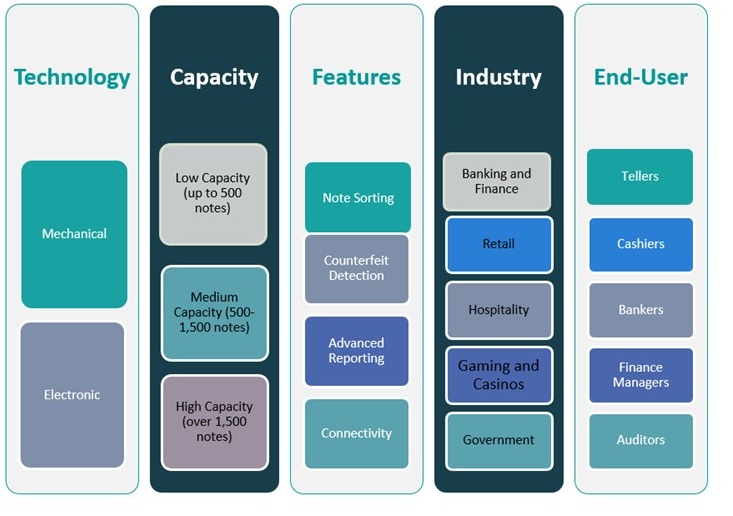
The Currency Counting Machines Market segments its offerings based on capacity, features, end-user, technology, and industry to address diverse operational requirements.
By capacity, low capacity machines (up to 500 notes) cater primarily to small businesses and retail outlets with moderate cash flow, while medium capacity machines (500–1,500 notes) serve mid-sized banks and enterprises requiring faster processing. High capacity machines (over 1,500 notes) target large financial institutions and cash-intensive businesses demanding high-speed and bulk counting capabilities.
By Feature-wise, note sorting remains essential for organizing mixed denominations, whereas counterfeit detection ensures security and regulatory compliance. Advanced reporting functions provide detailed transaction analytics, and connectivity options enable integration with cash management systems, enhancing operational efficiency.
By end-user segment includes tellers, cashiers, bankers, finance managers, and auditors, each benefiting from tailored machine capabilities suited to their specific roles in cash handling and verification.
By Technological segmentation divides the market into mechanical and electronic machines, with electronic variants gaining preference due to their superior speed, accuracy, and multifunctional capabilities.
By Industries such as banking and finance dominate demand due to their critical need for secure and efficient cash processing. Retail and hospitality sectors increasingly adopt currency counting machines to streamline transactions and reduce discrepancies. Gaming and casinos rely on these machines for accurate cash flow management, while government agencies use them for regulatory and security purposes. This segmentation allows the Currency Counting Machines Market to provide versatile solutions that meet the distinct demands across sectors and regions.
Segmentation:
By Capacity:
- Low Capacity (up to 500 notes)
- Medium Capacity (500–1,500 notes)
- High Capacity (over 1,500 notes)
By Features:
- Note Sorting
- Counterfeit Detection
- Advanced Reporting
- Connectivity
By End-User:
- Tellers
- Cashiers
- Bankers
- Finance Managers
- Auditors
By Technology:
- Mechanical
- Electronic
By Industry:
- Banking and Finance
- Retail
- Hospitality
- Gaming and Casinos
- Government
By Region:
- North America
- U.S.
- Canada
- Mexico
- Europe
- UK
- France
- Germany
- Italy
- Spain
- Russia
- Belgium
- Netherlands
- Austria
- Sweden
- Poland
- Denmark
- Switzerland
- Rest of Europe
- Asia Pacific
- China
- Japan
- South Korea
- India
- Australia
- Thailand
- Indonesia
- Vietnam
- Malaysia
- Philippines
- Taiwan
- Rest of Asia Pacific
- Latin America
- Brazil
- Argentina
- Peru
- Chile
- Colombia
- Rest of Latin America
- Middle East
- UAE
- KSA
- Israel
- Turkey
- Iran
- Rest of Middle East
- Africa
- Egypt
- Nigeria
- Algeria
- Morocco
- Rest of Africa
Regional Analysis:
The Currency Counting Machines Market in North America holds a significant share, accounting for nearly 32% of the global market revenue in 2024. The region benefits from a well-established banking infrastructure and the presence of several leading manufacturers and financial institutions. High adoption rates of automated cash management solutions in the United States and Canada drive market growth. Regulatory mandates emphasizing counterfeit currency detection and efficient cash handling further propel demand. The expanding retail and hospitality sectors in the region also increase reliance on currency counting machines for operational efficiency. It continues to witness steady investments in advanced technologies, maintaining its position as a key regional market.
Europe commands approximately 28% of the Currency Counting Machines Market share, driven by stringent regulatory frameworks and high penetration of digital and cash payment systems. Countries such as Germany, the United Kingdom, and France lead in the adoption of advanced currency counting solutions. The region’s emphasis on security and compliance compels financial institutions and enterprises to deploy sophisticated machines with counterfeit detection capabilities. Increasing modernization of banking and retail infrastructure further supports market growth. It experiences a growing trend toward multi-currency counting machines to accommodate cross-border trade and tourism. Innovation in product design and enhanced connectivity features also contribute to the region’s market strength.
The Asia-Pacific region exhibits the fastest growth rate, with an estimated market share of 30% in 2024, expected to expand significantly over the forecast period. Rapid economic development, increasing financial inclusion, and expanding retail sectors in countries such as China, India, Japan, and Australia fuel demand. Governments in the region invest heavily in upgrading banking infrastructure and promoting cashless and semi-cashless economies, creating a robust environment for currency counting machines. The rising volume of cash transactions in rural and urban areas encourages adoption among banks and small businesses alike. It presents lucrative opportunities for manufacturers offering affordable, scalable, and technologically advanced products tailored to regional currency complexities and regulatory needs. Emerging markets in Latin America and the Middle East collectively account for the remaining market share, supported by infrastructural developments and growing emphasis on secure cash handling.
Key Player Analysis:
- Billcon Corp of America
- Crane Payment Innovations
- Glory Global Solutions (International) Ltd.
- GRGBanking
- Kisan Electronics, Inc.
Competitive Analysis:
The Currency Counting Machines Market features intense competition among established global manufacturers and emerging players focusing on innovation and customer-centric solutions. Leading companies such as Cummins Allison, Glory Ltd., Cassida Corporation, and Giesecke+Devrient maintain strong market positions through continuous product development and strategic partnerships. It drives advancements in counterfeit detection, multi-currency support, and connectivity features. Companies emphasize expanding their geographic presence to capture growth opportunities in emerging markets. Competitive pricing, after-sales service, and customized solutions remain critical differentiators in this market. Investment in research and development enables manufacturers to address evolving currency designs and regulatory requirements effectively. The dynamic competitive landscape compels market participants to enhance operational efficiency and innovate consistently to retain and grow their market share.
Recent Developments:
- In May 2025, Crane NXT, the parent company of Crane Payment Innovations, completed the acquisition of De La Rue Authentication, a global leader in security and authentication technologies. This acquisition strengthens Crane’s position in the global authentication market, diversifying its portfolio and enhancing its technology solutions. The company also reported robust financial results for the first quarter of 2025, attributing growth to this acquisition and continued innovation in cash handling and authentication technology.
- In January 2025, Glory Global Solutions was confirmed as the global leader in retail cash recycling solutions, holding a 44% market share outside Japan and 68% including Japan, according to a new industry report. This recognition reflects Glory’s leadership in both point-of-sale and back-office cash recycling deployments. The company’s CASHINFINITY™ and UBIQULAR™ digital services continue to drive efficiency and innovation in retail cash automation.
- In February 2025, GRGBanking demonstrated its commitment to innovation by exhibiting advanced OEM modules, cash processing solutions, and AI-driven smart retail technologies at EuroCIS 2025, one of the leading trade fairs for retail technology. The company’s showcase included high-performance modules for ATMs and self-service kiosks, as well as intelligent cash-handling systems designed to enhance efficiency and security in retail environments.
Market Concentration & Characteristics:
The Currency Counting Machines Market exhibits a moderately concentrated structure, dominated by a few key players holding significant market shares while numerous smaller firms operate regionally. It is characterized by continuous innovation focused on enhancing machine accuracy, speed, and counterfeit detection capabilities. Leading companies invest heavily in research and development to adapt to evolving currency designs and regulatory standards. The market demands high-quality, reliable products with advanced features such as multi-currency recognition and connectivity options. Customer preference for integrated cash management solutions drives collaboration between manufacturers and software providers. It also reflects growing adoption in diverse end-use sectors, including banking, retail, and government institutions. This competitive yet collaborative environment promotes technological advancement and supports steady market growth globally.
Report Coverage:
The research report offers an in-depth analysis based on capacity, features, end-user, technology, and industry. It details leading market players, providing an overview of their business, product offerings, investments, revenue streams, and key applications. Additionally, the report includes insights into the competitive environment, SWOT analysis, current market trends, as well as the primary drivers and constraints. Furthermore, it discusses various factors that have driven market expansion in recent years. The report also explores market dynamics, regulatory scenarios, and technological advancements that are shaping the industry. It assesses the impact of external factors and global economic changes on market growth. Lastly, it provides strategic recommendations for new entrants and established companies to navigate the complexities of the market.
Future Outlook:
- The Currency Counting Machines Market will expand driven by increased automation in banking and retail sectors.
- Integration of artificial intelligence will enhance counterfeit detection accuracy and machine adaptability.
- Growing financial inclusion in emerging economies will boost demand for affordable, scalable counting solutions.
- Multi-currency handling capabilities will become standard to support global trade and cross-border transactions.
- Connectivity features enabling real-time data analytics and remote monitoring will gain widespread adoption.
- Demand for compact, user-friendly machines will rise among small and medium enterprises.
- Regulatory requirements will drive innovation to comply with evolving currency security standards.
- Partnerships between manufacturers and software providers will foster comprehensive cash management systems.
- Expansion of cash-intensive sectors like hospitality and transportation will create new market opportunities.
- Sustainability considerations will encourage development of energy-efficient and durable currency counting machines.

Request a Free Sample
Fill in your details and we'll send you a free sample report.
- Sample data tables & charts
- Research methodology
Market Dynamics
Automation in Financial Institutions
Banks and financial institutions are increasingly adopting currency counting machines to improve accuracy, speed, and compliance in cash handling, reducing human error and operational costs.
Technological Advancements in Counterfeit Detection
Integration of advanced counterfeit detection technologies such as UV, MG, and IR sensors enhances security and regulatory compliance, making these machines indispensable for sectors handling large cash volumes.
Expansion of Retail and Hospitality Sectors
The growth of retail and hospitality industries, which require efficient and rapid cash processing, is driving demand for currency counting machines to streamline transactions and minimize discrepancies.
Rising Financial Inclusion in Emerging Markets
Emerging economies in Asia-Pacific, Latin America, and the Middle East are experiencing increased banking access and cash transaction volumes, creating significant opportunities for affordable and scalable currency counting solutions.
Connectivity and Data Integration Features
The adoption of machines with connectivity options (USB, Ethernet, Wi-Fi) enables real-time data integration and reporting, supporting better cash management and operational transparency for large enterprises.
Need a Custom Version of This Report?
Tailor the scope, geography, or segments to your exact requirements.
- Custom geography or segment scope
- Direct access to our analyst team
Frequently Asked Questions
What is the current size of the Currency Counting Machines Market?
What factors are driving the growth of the Currency Counting Machines Market?
What are the key segments within the Currency Counting Machines Market?
What are some challenges faced by the Currency Counting Machines Market?
Who are the major players in the Currency Counting Machines Market?
Table of Content
Chapter 1 Market Segmentation
- 1.1 Segmentation Framework
- 1.1.1 Product and Service Classification
- 1.1.2 Application and End-Use Classification
- 1.1.3 Technology and Solution Classification
- 1.1.4 Customer and Distribution Channel Classification
- 1.1.5 Geographic Segmentation
- 1.1.6 Market Segment Definitions and Boundaries
- 1.2 By Capacity
- 1.2.1 Low Capacity (up to 500 notes)
- 1.2.2 Medium Capacity (500–1,500 notes)
- 1.2.3 High Capacity (over 1,500 notes)
- 1.3 By Features
- 1.3.1 Note Sorting
- 1.3.2 Counterfeit Detection
- 1.3.3 Advanced Reporting
- 1.3.4 Connectivity
- 1.4 By Industry
- 1.4.1 Banking and Finance
- 1.4.2 Retail
- 1.4.3 Hospitality
- 1.4.4 Gaming and Casinos
- 1.4.5 Government
- 1.5 By Technology
- 1.5.1 Mechanical
- 1.5.2 Electronic
Chapter 2 Introduction
- 2.1 Report Objectives and Scope
- 2.2 Product Definition and Industry Terminology
- 2.3 Market Inclusions and Exclusions
- 2.4 Research Process
- 2.4.1 Primary Research and Expert Interviews
- 2.4.2 Secondary Research and Source Review
- 2.4.3 Top-Down and Bottom-Up Estimation
- 2.4.4 Data Triangulation and Verification
- 2.5 Market Size Measurement Basis
- 2.5.1 2023: USD 226.72 million → 2032: USD 448.44 million
- 2.6 Historical and Forecast Reference Periods
- 2.6.1 Base Year: 2023
- 2.6.2 Forecast Period: 2023-2032
- 2.7 Research Assumptions and Limitations
Chapter 3 Executive Summary
- 3.1 Market Snapshot and Key Findings
- 3.2 Base-Year Market Size, 2023
- 3.3 Forecast Market Size, 2032
- 3.4 Revenue and Volume Growth Outlook
- 3.5 Key Demand and Supply Indicators
- 3.6 Leading Market Segments
- 3.7 Fastest-Growing Market Opportunities
- 3.8 Regional Performance Highlights
- 3.9 Technology and Industry Transformation
- 3.10 Competitive Landscape Summary
- 3.11 Analyst View and Strategic Implications
Chapter 4 Global Currency Counting Machines Market Trends and Developments
- 4.1 Historical Industry Development
- 4.2 Recent Market Trends and Developments
- 4.3 Demand and Customer Behavior Trends
- 4.4 Technology and Product Innovation
- 4.5 Artificial Intelligence, Automation and Digitalization
- 4.6 Local Manufacturing and Supply Chain Realignment
- 4.7 Industry Partnerships, Mergers and Acquisitions
- 4.8 Sustainability and Circular Economy Developments
- 4.9 Government and Private Sector Investment Trends
- 4.10 Emerging Business Models and Commercialization
- 4.11 Industry Developments and Announcements
Chapter 5 Global Currency Counting Machines Market Production, Supply and Demand Analysis
- 5.1 Demand Trend and Consumption Analysis
- 5.2 Demand Forecast, 2023-2032
- 5.3 Production and Output Trend
- 5.4 Production and Output Forecast, 2023-2032
- 5.5 Installed Capacity and Capacity Utilization
- 5.6 Company-Wise Production Plants and Statistics
- 5.6.1 Installed Production Capacity
- 5.6.2 Actual Production
- 5.6.3 Planned Capacity and Expansion Targets
- 5.7 Supply Chain Structure and Procurement Trends
- 5.8 Supply-Demand Gap and Bottlenecks
- 5.9 Import Dependence and Sourcing Structure
- 5.10 Contract Manufacturing and Outsourcing
- 5.11 Regional Supply and Demand Concentration
Chapter 6 Global Currency Counting Machines Market Pricing Analysis
- 6.1 Pricing Structure and Measurement
- 6.2 Historical Pricing Trends
- 6.3 Pricing Outlook, 2023-2032
- 6.4 Average Selling Price and Unit Economics
- 6.5 Pricing by Product and Market Segment
- 6.6 Geographic Pricing Differences
- 6.7 Key Input, Energy, Labor and Logistics Costs
- 6.8 Contract Pricing and Purchasing Models
- 6.9 Pricing Sensitivity and Competitive Positioning
- 6.10 Price, Margin and Profitability Implications
Chapter 7 Global Currency Counting Machines Market Dynamics
- 7.1 Market Growth Drivers
- 7.1.1 Demand-Side Drivers
- 7.1.2 Technology and Innovation Drivers
- 7.1.3 Infrastructure and Investment Drivers
- 7.1.4 Regulatory and Policy Drivers
- 7.2 Market Restraints
- 7.2.1 Cost and Affordability Constraints
- 7.2.2 Technology and Adoption Barriers
- 7.2.3 Supply Chain and Operational Constraints
- 7.3 Market Challenges
- 7.3.1 Competitive Pressure and Margin Erosion
- 7.3.2 Skills, Infrastructure and Implementation Gaps
- 7.4 Emerging Market Opportunities
- 7.5 Market Dynamics Impact and Time-Horizon Assessment
Chapter 8 Global Currency Counting Machines Value Chain Analysis
- 8.1 Industry Value Chain Overview
- 8.2 Upstream Suppliers and Critical Inputs
- 8.3 Technology and Component Providers
- 8.4 Manufacturing or Service Delivery
- 8.5 Distribution, Channel Partners and Integrators
- 8.6 Downstream Applications and End Users
- 8.7 Value Addition and Profit Pools
- 8.8 Vertical Integration and Outsourcing
- 8.9 Supplier Concentration and Risk
- 8.10 Supply Chain Localization and Resilience
Chapter 9 Global Currency Counting Machines Market Regulations and Policies
- 9.1 Relevant Laws, Standards and Compliance Frameworks
- 9.2 Product, Service, Safety and Quality Requirements
- 9.3 Government Policies, Incentives and Subsidies
- 9.4 Imports, Exports and Trade Barriers
- 9.5 Public Procurement and Local Content Requirements
- 9.6 Environmental and Sustainability Compliance
- 9.7 Upcoming Policy Changes and Market Implications
Chapter 10 Global Currency Counting Machines Market Hotspots and Opportunities
- 10.1 Market Opportunity Mapping and Growth Hotspots
- 10.2 High-Growth Applications and Customer Groups
- 10.3 Underserved Markets and White-Space Opportunities
- 10.4 Emerging Technology and Product Opportunities
- 10.5 New Capacity and Investment Hotspots
- 10.6 Market Entry and Expansion Opportunities
- 10.7 Distribution and Partnership Opportunities
- 10.8 Near-Term and Long-Term Commercial Potential
- 10.9 Opportunity Attractiveness and Execution Risks
Chapter 11 Global Currency Counting Machines Market Outlook, 2023-2032
- 11.1 Market Size and Analysis
- 11.1.1 Revenue (Market Measurement: 2023: USD 226.72 million → 2032: USD 448.44 million)
- 11.1.2 Market Volume and Quantity Sold
- 11.1.3 Historical Market Size
- 11.1.4 Base-Year Market Size, 2023
- 11.2 Market Forecast, 2023-2032
- 11.2.1 Revenue Forecast to 2032
- 11.2.2 Volume Forecast to 2032
- 11.2.3 CAGR and Year-on-Year Growth
- 11.2.4 Incremental Revenue Opportunity
- 11.3 Forecast Assumptions and Scenario Analysis
- 11.3.1 Base-Case Forecast
- 11.3.2 Optimistic and Conservative Scenarios
- 11.3.3 Technology, Pricing and Policy Sensitivities
- 11.4 Market Attractiveness and Growth Outlook
Chapter 12 Global Currency Counting Machines Market Segmentation and Outlook
- 12.1 Segmentation Summary and Market Shares, 2023
- 12.2 Largest and Fastest-Growing Segments
- 12.3 By Capacity - Market Size and Forecast, 2023-2032
- 12.3.1 Segment Definition and Scope
- 12.3.2 Historical Market Size
- 12.3.3 Revenue Forecast, 2023-2032
- 12.3.4 Volume Forecast, 2023-2032
- 12.3.5 Base-Year Market Share, 2023
- 12.3.6 Segment CAGR and Growth Drivers
- 12.3.7 Subsegment Market Size and Forecast
- 12.3.7.1 Low Capacity (up to 500 notes)
- 12.3.7.2 Medium Capacity (500–1,500 notes)
- 12.3.7.3 High Capacity (over 1,500 notes)
- 12.3.8 Subsegment Pricing and Adoption Trends
- 12.3.9 Leading Suppliers and Competition
- 12.3.10 Regional Demand and Opportunities
- 12.4 By Features - Market Size and Forecast, 2023-2032
- 12.4.1 Segment Definition and Scope
- 12.4.2 Historical Market Size
- 12.4.3 Revenue Forecast, 2023-2032
- 12.4.4 Volume Forecast, 2023-2032
- 12.4.5 Base-Year Market Share, 2023
- 12.4.6 Segment CAGR and Growth Drivers
- 12.4.7 Subsegment Market Size and Forecast
- 12.4.7.1 Note Sorting
- 12.4.7.2 Counterfeit Detection
- 12.4.7.3 Advanced Reporting
- 12.4.7.4 Connectivity
- 12.4.8 Subsegment Pricing and Adoption Trends
- 12.4.9 Leading Suppliers and Competition
- 12.4.10 Regional Demand and Opportunities
- 12.5 By Industry - Market Size and Forecast, 2023-2032
- 12.5.1 Segment Definition and Scope
- 12.5.2 Historical Market Size
- 12.5.3 Revenue Forecast, 2023-2032
- 12.5.4 Volume Forecast, 2023-2032
- 12.5.5 Base-Year Market Share, 2023
- 12.5.6 Segment CAGR and Growth Drivers
- 12.5.7 Subsegment Market Size and Forecast
- 12.5.7.1 Banking and Finance
- 12.5.7.2 Retail
- 12.5.7.3 Hospitality
- 12.5.7.4 Gaming and Casinos
- 12.5.7.5 Government
- 12.5.8 Subsegment Pricing and Adoption Trends
- 12.5.9 Leading Suppliers and Competition
- 12.5.10 Regional Demand and Opportunities
- 12.6 By Technology - Market Size and Forecast, 2023-2032
- 12.6.1 Segment Definition and Scope
- 12.6.2 Historical Market Size
- 12.6.3 Revenue Forecast, 2023-2032
- 12.6.4 Volume Forecast, 2023-2032
- 12.6.5 Base-Year Market Share, 2023
- 12.6.6 Segment CAGR and Growth Drivers
- 12.6.7 Subsegment Market Size and Forecast
- 12.6.7.1 Mechanical
- 12.6.7.2 Electronic
- 12.6.8 Subsegment Pricing and Adoption Trends
- 12.6.9 Leading Suppliers and Competition
- 12.6.10 Regional Demand and Opportunities
- 12.7 Segment Growth Comparison
- 12.8 Segment Attractiveness and Priority Matrix
Chapter 13 Global Currency Counting Machines End-Use and Application Market Outlook
- 13.1 End-Use Industry and Customer Demand Structure
- 13.2 Leading Applications and Customer Groups
- 13.3 End-Use Market Size, Share and Forecast
- 13.4 Major End-Use Industry Deep Dives
- 13.4.1 Customer Requirements and Use Cases
- 13.4.2 Demand and Replacement Cycles
- 13.4.3 Technical and Regulatory Considerations
- 13.4.4 Purchasing and Procurement Models
- 13.4.5 Leading Vendors and Distribution Channels
- 13.4.6 Forecast and Commercial Opportunities
- 13.5 Emerging Applications and Cross-Segment Demand
- 13.6 End-Use Industry Investment Priorities
Chapter 14 Global Currency Counting Machines Geographic Market Outlook, 2023-2032
- 14.1 Regional Market Size and Share, 2023
- 14.2 Regional Market Forecast, 2023-2032
- 14.3 Regional Pricing, Production and Demand Differences
- 14.4 North America
- 14.4.1 United States
- 14.4.2 Canada
- 14.4.3 Mexico
- 14.5 Europe
- 14.5.1 Germany
- 14.5.2 France
- 14.5.3 Italy
- 14.5.4 United Kingdom
- 14.5.5 Spain
- 14.5.6 Poland
- 14.5.7 Russia
- 14.5.8 Netherlands
- 14.5.9 Belgium
- 14.5.10 Sweden
- 14.5.11 Denmark
- 14.5.12 Norway
- 14.5.13 Rest of Europe
- 14.6 Asia Pacific
- 14.6.1 China
- 14.6.2 India
- 14.6.3 Japan
- 14.6.4 South Korea
- 14.6.5 Thailand
- 14.6.6 Indonesia
- 14.6.7 Vietnam
- 14.6.8 Malaysia
- 14.6.9 Australia
- 14.6.10 Rest of Asia Pacific
- 14.7 Latin America
- 14.7.1 Brazil
- 14.7.2 Argentina
- 14.7.3 Colombia
- 14.7.4 Chile
- 14.7.5 Rest of Latin America
- 14.8 Middle East
- 14.8.1 Saudi Arabia
- 14.8.2 United Arab Emirates
- 14.8.3 Turkey
- 14.8.4 Israel
- 14.8.5 Iran
- 14.8.6 Rest of the Middle East
- 14.9 Africa
- 14.9.1 South Africa
- 14.9.2 Egypt
- 14.9.3 Nigeria
- 14.9.4 Morocco
- 14.9.5 Rest of Africa
- 14.10 Regional Investment, Policy and Supply Chain Differences
- 14.11 Regional Competitive Landscape
- 14.12 Geographic Growth Hotspots
Chapter 15 Global Currency Counting Machines Technology, Innovation and Sustainability Outlook
- 15.1 Technology Landscape and Maturity
- 15.2 Product, Process and Service Innovation
- 15.3 AI, Automation and Digital Tools in the Industry
- 15.4 Technology Adoption and Performance Benchmarking
- 15.5 Innovation Pipeline and R&D Investment
- 15.6 Patent and Intellectual Property Trends
- 15.7 Energy Efficiency and Resource Management
- 15.8 Sustainability, Recycling and Circularity
- 15.9 Technology Roadmap, 2023-2032
- 15.10 Risks of Obsolescence and Technology Substitution
Chapter 16 Global Currency Counting Machines Market Key Strategic Imperatives
- 16.1 Growth and Market Entry Priorities
- 16.2 High-Return Products and Segments
- 16.3 Pricing, Profitability and Cost Optimization
- 16.4 Technology Investment and Product Differentiation
- 16.5 Supply Chain Localization and Resilience
- 16.6 Distribution and Customer Acquisition
- 16.7 Partnership, Acquisition and Capacity Strategy
- 16.8 Regional Expansion Priorities
- 16.9 Short-, Medium- and Long-Term Actions
Chapter 17 Competition Outlook
- 17.1 Industry Competition Characteristics
- 17.2 Market Structure and Concentration
- 17.3 Market Share and Competitive Positioning, 2023
- 17.4 Company-Wise Revenue and Product Benchmarking
- 17.5 Production and Service Capacity Benchmarking
- 17.6 Technology, Pricing and Differentiation
- 17.7 Regional Footprint and Distribution Strength
- 17.8 Mergers, Acquisitions and Strategic Alliances
- 17.9 New Entrants and Competitive Threats
- 17.10 Porter's Five Forces and Industry Attractiveness
- 17.11 Competitive Outlook, 2023-2032
Chapter 18 Company Profiles
- 18.1 Company Coverage and Selection Criteria
- 18.2 Glory Global Solutions
- 18.2.1 Business Description
- 18.2.2 Company Ownership and Geographic Presence
- 18.2.3 Product and Service Portfolio
- 18.2.4 Manufacturing and Operating Footprint
- 18.2.5 Production Capacity and Expansion Plans
- 18.2.6 Financial Performance and Investment
- 18.2.7 Market Share and Competitive Position
- 18.2.8 Technology and Innovation Capabilities
- 18.2.9 Strategic Alliances or Partnerships
- 18.2.10 Recent Developments
- 18.2.11 Growth Strategy and Outlook
- 18.3 Crane Payment Innovations
- 18.4 GRGBanking
- 18.5 Billcon Corp of America
- 18.6 Kisan Electronics, Inc.
- 18.7 Cummins Allison
- 18.8 Cassida Corporation
- 18.9 Giesecke+Devrient
- 18.10 Godrej Security Solutions
- 18.11 Safescan
- 18.12 Other Relevant Market Participants
Note: Every listed company is profiled on the structure shown under the first company. The company list is preliminary and may change based on research findings, market developments, data availability and client requirements.
Chapter 19 Disclaimer
- 19.1 Research and Forecast Disclaimer
- 19.2 Data Source and Estimation Limitations
Note: The depth of individual sections depends on data availability for this market. Volume, capacity, trade and other unit-based metrics are included where applicable.

