
Data Democratization in Healthcare Market Overview:
The Data Democratization In Healthcare Market is shaped by the need to make trusted data usable across clinical, operational, financial and research workflows. Health systems are prioritizing faster decision-making and broader self-service access to analytics, while maintaining governance, privacy, and auditability for protected health information. Adoption is also supported by interoperability progress and growing use of AI-driven tools that depend on well-curated, accessible datasets. Demand is strongest where provider networks are digitized, data standards are widely adopted, and executive teams are focused on measurable improvements in efficiency, care coordination, and outcomes.
| REPORT ATTRIBUTE | DETAILS |
|---|---|
| Historical Period | 2020-2024 |
| Base Year | 2025 |
| Forecast Period | 2026-2032 |
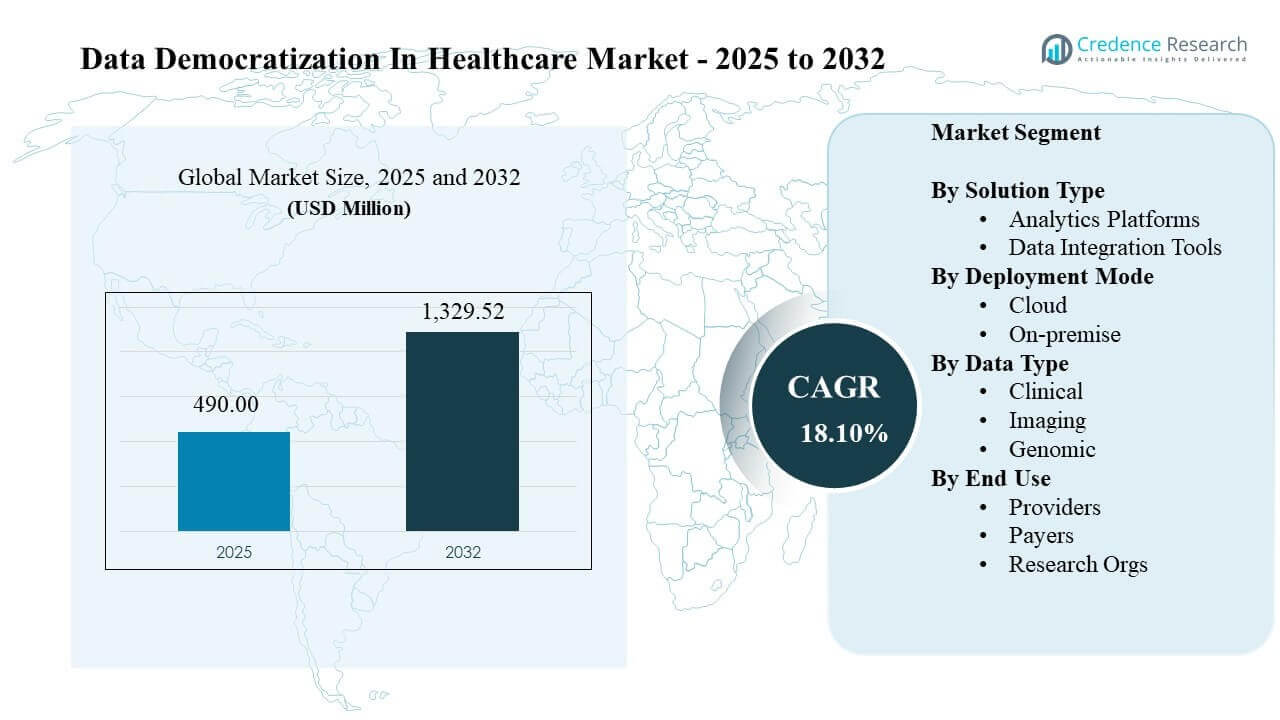
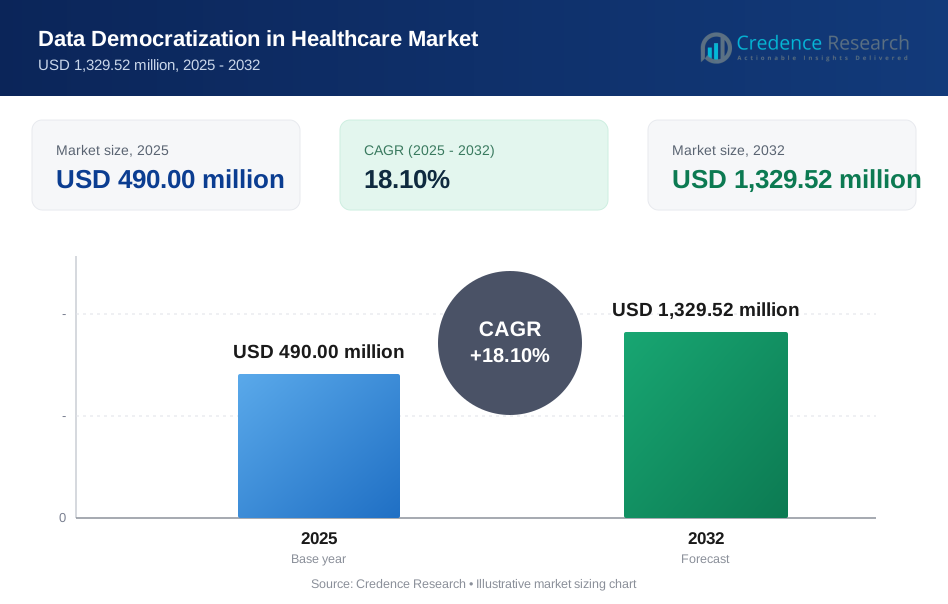
| Data Democratization In Healthcare Market Size 2025 | USD 490.00 million |
| Data Democratization In Healthcare Market, CAGR | 18.10% |
| Data Democratization In Healthcare Market Size 2032 | USD 1,329.52 million |
Key Market Trends & Insights
- The global Data Democratization In Healthcare Market size was estimated at USD 490.00 million in 2025 and is expected to reach USD 1,329.52 million by 2032, reflecting strong growth momentum during 2025–2032.
- Healthcare organizations are moving from centralized reporting models to governed self-service analytics so business and clinical teams can answer questions without long BI backlogs.
- Interoperability-led architectures are accelerating, with greater reliance on APIs and standardized data models to connect EHR, imaging, lab and claims environments.
- Data governance is becoming a primary buying criterion, with emphasis on lineage, role-based access, consent-aware sharing, and end-to-end auditability.
- AI enablement is pushing investments in metadata management, data quality, and reusable data products that can be safely accessed across departments.
- Buyer preference is shifting toward platforms that reduce integration friction and simplify cross-domain analytics across clinical, imaging, and genomic modalities.
Segment Analysis
Data democratization in healthcare is increasingly tied to the ability to unify diverse datasets and make them usable beyond data engineering teams. Providers and payer organizations are adopting operating models where analytics consumers can find, understand, and use data through curated catalogs, standardized definitions, and guardrails that reduce risk. This shift is also influenced by workforce constraints, where automation, reusable pipelines, and governed self-service help teams accomplish more with limited specialized talent.
Solutions are being selected based on how well they balance speed and control. Organizations want broad accessibility without creating compliance exposure, inconsistent definitions, or quality issues that undermine trust. As adoption expands, usability, integration depth, and governance maturity become differentiators, particularly when multiple stakeholders rely on the same datasets for care delivery, financial decisions, and research.
By Solution Type Insights
Analytics Platforms are adopted to help broader teams explore, visualize, and operationalize healthcare data without heavy reliance on specialized analysts. Strong demand is linked to improved usability, shared metrics definitions, and workflow integration that makes insights actionable. Governance capabilities, such as access controls and auditing, become critical as user populations expand. Data Integration Tools remain essential because democratization depends on reliable, standardized data pipelines that reduce fragmentation across EHR, imaging, lab, and claims sources.
By Deployment Mode Insights
Cloud deployments support rapid scaling of data access across sites and functions, especially when healthcare organizations want to centralize governance and enable collaboration. Cloud also improves agility for advanced analytics and AI workloads that benefit from elastic compute. On-premise deployments persist where organizations prioritize local control, legacy integration patterns, or highly sensitive workflows. Many buyers operate hybrid environments, choosing architectures that keep critical systems stable while expanding democratized access through modern platform layers.
By Data Type Insights
Clinical data is foundational for democratization because it underpins care delivery, quality management, and performance improvement initiatives. Imaging and genomic data introduce added complexity due to file sizes, modality-specific standards, and specialized workflows, which increases the need for robust orchestration and metadata practices. As more stakeholders require cross-domain insights, platform choices increasingly reflect the ability to support multimodal analytics. Data quality and consistent definitions remain essential because broader access can amplify the impact of errors.
By End Use Insights
Providers adopt data democratization to improve care coordination, throughput, and operational decision-making, particularly when multiple departments need aligned, real-time visibility. Payers focus on integrated analytics that supports utilization management, risk programs, and care management strategies that rely on consistent datasets across claims and clinical inputs. Research organizations value controlled access to curated datasets and reproducible pipelines that support collaboration while protecting sensitive information. Across end users, success depends on governance frameworks that enable access without sacrificing trust and compliance.
Data Democratization In Healthcare Market Drivers
Rising need for faster, cross-functional decision-making
Healthcare organizations face operational pressure to improve efficiency and outcomes using data already generated across care settings. Data democratization reduces delays caused by centralized reporting and limited analyst capacity. Broader access lets clinicians, managers, and revenue-cycle teams act on insights sooner, improving throughput and patient experience. Demand increases when platforms standardize definitions, automate refresh cycles, and limit time spent reconciling conflicting reports across departments daily.
- For instance, Texas Children’s Hospital reported a 69 percent decrease in time to build reports, 25 percent faster turnaround on remaining EMR reports, and 67 percent savings in labor costs after implementing a healthcare enterprise data warehouse, highlighting how faster access to standardized information can accelerate decision-making across teams.
Interoperability progress and API-driven integration
Healthcare data sharing improves when systems align with modern interoperability standards and API-based exchange patterns. This alignment simplifies connecting EHR, imaging, lab, and claims data into usable analytical views for care, finance, and operations. As integration becomes more standardized, organizations can expand access to a wider user base without custom interfaces. Buyers favor solutions that speed onboarding of new sources, minimize maintenance burden.
- For instance, Orlando Health integrated encounter billing summary system data 245 days faster with 1.0 fewer FTE, and integrated infection control system data 56 days faster with 0.4 fewer FTE, demonstrating how a more streamlined integration approach can reduce effort while connecting previously separate data environments.
Governance and compliance as prerequisites for scale
Data democratization expands the number of users and use cases that touch sensitive healthcare information. This growth elevates the importance of role-based access, audit trails, consent-aware controls, and policy enforcement across teams and partners. Governance maturity shapes adoption speed because organizations need guardrails that prevent misuse, reduce compliance exposure, and maintain trust in shared datasets. Platforms that embed governance in everyday workflows gain traction faster.
AI adoption increases the value of curated, accessible data
AI initiatives depend on reliable, well-documented datasets and repeatable pipelines that deliver consistent results. Data democratization supports AI by improving discovery, enabling reuse of curated data products, and promoting shared definitions across functions. Organizations prioritize platforms that operationalize model outputs inside clinical and business workflows, with monitoring and governance built in. This driver strengthens as AI programs move beyond pilots into scaled production deployments across enterprises.
Data Democratization In Healthcare Market Challenges
Healthcare data fragmentation remains a central barrier because data sits across multiple systems with different standards, identifiers, and quality levels. Without strong integration and consistent definitions, democratization can produce conflicting insights and reduce trust. Organizations also face change management challenges, including training users, aligning governance policies, and shifting from siloed reporting to shared metrics.
- For instance, Epic states that organizations using Care Everywhere exchange over 20 million patient records daily, with around half of those exchanges occurring with organizations running a different EHR, which shows how large-scale interoperability depends on standardization, reconciliation, and cross-system trust.
Privacy and compliance risks increase as more users access sensitive datasets. Access expansion requires careful design of security controls, consent-aware sharing, and monitoring. If governance is weak, democratization can increase the risk of inappropriate access or misuse. Buyers often proceed cautiously, prioritizing strong controls and evidence of operational safety.
Market Trends and Opportunities
Healthcare organizations are investing in data catalogs, semantic layers, and standardized definitions so non-technical users can confidently find and interpret data. This creates opportunities for vendors that improve discoverability and reduce the need for custom data engineering. Solutions that package repeatable data products and embed guardrails into workflows are well positioned.
- For instance, Froedtert & the Medical College of Wisconsin used Collibra to build its Data 360° governance platform, which contains metadata for over 45 databases, 850+ metrics, and 3,240+ views accessed by 1,330 users, while the organization also reported a 50% reduction in time to analyze financial performance, cutting analysis time to seconds from five to ten minutes.
There is growing opportunity in multimodal analytics that combines clinical, imaging, and genomic data to support advanced decision-making. Organizations want platforms that can orchestrate diverse data types without increasing complexity for end users. Vendors that simplify cross-domain workflows and support scalable governance can expand adoption across departments and partner ecosystems.
Regional Insights
North America
Demand is supported by digitized provider environments, high adoption of analytics platforms, and strong emphasis on compliance-ready governance. Health systems focus on operational efficiency and care coordination, which increases the need for broad access to trusted data. Organizations also tend to invest in interoperability and platform modernization that enables self-service analytics across functions.
Europe
Adoption is influenced by structured governance expectations and the need for consistent data use across multi-site and cross-border contexts. Organizations prioritize strong privacy controls and standardized definitions to support reliable decision-making. Demand increases when platforms help align multiple stakeholders around shared metrics and reproducible analytical workflows.
Asia Pacific
Growth is supported by expanding healthcare digitization and modernization initiatives across large provider networks. Organizations seek scalable approaches to unify data and enable access across geographies and care settings. Platforms that simplify integration and governance are favored, particularly where rapid system expansion creates complexity.
Latin America
Adoption is developing as organizations strengthen digital infrastructure and look to improve operational visibility. Buyers prioritize practical integration and usability, often focusing on high-impact workflows first. Platforms that reduce implementation complexity and provide clear governance pathways can accelerate uptake.
Middle East & Africa
Interest is shaped by modernization programs, growing health data initiatives, and the need to improve data usability for system planning and service delivery. Adoption increases when platforms offer strong governance, scalable architectures, and support for heterogeneous environments. Organizations often prioritize foundational data management capabilities before broader democratization.
Competitive Landscape
Competition centers on platform breadth, interoperability depth, governance maturity, and the ability to support healthcare-specific workflows. Vendors differentiate through integration ecosystems, embedded security and compliance controls, and accelerators that speed implementation. Buyers often favor solutions that reduce time-to-value and make data usable across clinical, operational, and research stakeholders without increasing risk.
Microsoft typically competes through integrated cloud and analytics capabilities that align data management, governance, and analytics workflows into a unified platform approach. Its positioning often emphasizes scaling data access across teams while maintaining policy controls and operational manageability. Differentiation also comes from broad enterprise integration options and tools that support analytics adoption across non-technical user groups.
The industry research and growth report includes detailed analyses of the competitive landscape of the market and information about key companies, including:
- Microsoft
- Google Cloud
- Amazon Web Services
- IBM
- Oracle
- SAP
- Palantir
- Snowflake
- Databricks
- Health Catalyst
Qualitative and quantitative analysis of companies has been conducted to help clients understand the wider business environment as well as the strengths and weaknesses of key industry players. Data is qualitatively analyzed to categorize companies as pure play, category-focused, industry-focused, and diversified; it is quantitatively analyzed to categorize companies as dominant, leading, strong, tentative, and weak.
Recent Developments
- In a January 2026, Onyx announced the acquisition of InteropX, a healthcare data and interoperability services company. The deal was positioned to strengthen Onyx’s capabilities in electronic prior authorization, payer-to-payer data exchange, provider access, and patient access APIs, which are all closely linked to broader healthcare data democratization efforts.
- In April 2026, eHealth Exchange partnered with b.well Connected Health and DaVita to demonstrate how patients can securely access their health records through a trusted consumer application at a CMS-hosted event in Washington, DC. This partnership is notable because it supports patient-facing data access and practical interoperability, both of which are central themes in healthcare data democratization.
- In September 2025, Milliman MedInsight launched the MedInsight Innovation Portal, an AI-powered cloud analytics platform for healthcare organizations. The company said the new platform expands capabilities from its earlier Data Science Portal and is designed to help healthcare organizations work with data more intuitively in complex care and operating environments.
- In a June 2025, Milliman MedInsight expanded its Payer Platform by launching the new Payer Insights application. The company described it as an advance beyond traditional analytics, aimed at giving healthcare payers broader and more actionable data-driven insight, which supports wider internal access to healthcare intelligence
Report Scope
| Report Attribute | Details |
| Market size value in base year | Not specified in this qualitative version |
| Revenue forecast in forecast year | Not specified in this qualitative version |
| Growth rate (CAGR) | Not specified in this qualitative version |
| Base year | 2025 |
| Forecast period | 2026–2032 |
| Quantitative units | Not specified in this qualitative version |
| Segments covered | By Solution Type Outlook: Analytics Platforms, Data Integration Tools; By Deployment Mode Outlook: Cloud, On-premise; By Data Type Outlook: Clinical, Imaging, Genomic; By End Use Outlook: Providers, Payers, Research Orgs |
| Regional scope | North America, Europe, Asia Pacific, Latin America, Middle East & Africa |
| Key companies profiled | Microsoft; Google Cloud; Amazon Web Services; IBM; Oracle; SAP; Palantir; Snowflake; Databricks; Health Catalyst |
| No. of Pages | 338 |
Segmentation
By Solution Type
- Analytics Platforms
- Data Integration Tools
By Deployment Mode
- Cloud
- On-premise
By Data Type
- Clinical
- Imaging
- Genomic
By End Use
- Providers
- Payers
- Research Orgs
By Region
- North America
- U.S.
- Canada
- Mexico
- Europe
- Germany
- France
- U.K.
- Italy
- Spain
- Rest of Europe
- Asia Pacific
- China
- Japan
- India
- South Korea
- South-east Asia
- Rest of Asia Pacific
- Latin America
- Brazil
- Argentina
- Rest of Latin America
- Middle East & Africa
- GCC Countries
- South Africa
- Rest of the Middle East and Africa
Request a Free Sample
Fill in your details and we'll send you a free sample report.
- Sample data tables & charts
- Research methodology
Need a Custom Version of This Report?
Tailor the scope, geography, or segments to your exact requirements.
- Custom geography or segment scope
- Direct access to our analyst team
Frequently Asked Questions
What is the current size of the Data Democratization In Healthcare Market?
What is the forecast value for the Data Democratization In Healthcare Market?
What is the CAGR of the Data Democratization In Healthcare Market?
What are the main growth factors in the Data Democratization In Healthcare Market?
Which companies are leading the Data Democratization In Healthcare Market?
Which region is expected to lead the Data Democratization In Healthcare Market?
Table of Content
Chapter 1. Report Introduction
- 1.1 Report Description & Purpose
- 1.1.1 Report Title & Market Definition
- 1.1.2 Unique Selling Propositions (USP) & Key Differentiators
- 1.1.3 Value Proposition for Stakeholders
- 1.2 Research Objectives
- 1.2.1 Market Sizing Objectives (Volume & Revenue)
- 1.2.2 Segmentation Objectives
- 1.2.3 Competitive Intelligence Objectives
- 1.2.4 Forecast & Scenario Objectives
- 1.3 Report Scope
- 1.3.1 Data Democratization in Healthcare Scope – Types & Subtypes Covered
- 1.3.2 Geographic Scope – Regions & Countries Covered
- 1.3.3 Historical Period, Base Year & Forecast Period (2025; forecast to 2032)
- 1.3.4 Inclusions & Exclusions
- 1.4 HS Code & Classification Framework
- 1.5 Currency, Units & Pricing Basis
- 1.6 Target Stakeholders
- 1.7 Limitations & Assumptions
Chapter 2. Executive Summary
- 2.1 Global Data Democratization in Healthcare Market Snapshot
- 2.1.1 Market Size – Historical (2025) & Forecast (2025-2032) (2025: USD 490.00 million → 2032: USD 1,329.52 million)
- 2.1.2 Volume & Revenue – Global Totals
- 2.1.3 Key Market Highlights – Top Five Facts
- 2.2 Data Democratization in Healthcare Market Segmentation Snapshot
- 2.2.1 Market Split by Region – 2025 vs. 2032
- 2.3 Competitive Snapshot
- 2.3.1 Top 10 Players by Revenue Share – 2025
- 2.3.2 Top 10 Players by Volume Share – 2025
- 2.3.3 Recent Strategic Developments (18-Month Summary)
- 2.4 Key Investment Highlights & Strategic Conclusions
Chapter 3. Data Democratization in Healthcare Market Dynamics & Industry Analysis
- 3.1 Market Overview & Context
- 3.1.1 Data Democratization in Healthcare Market Position in the Broader Automotive Value Chain
- 3.1.2 OEM vs. Replacement Market Dynamics
- 3.1.3 Market Maturity & Development Stage by Region
- 3.2 Data Democratization in Healthcare Market Drivers
- 3.3 Data Democratization in Healthcare Market Restraints & Challenges
- 3.4 Data Democratization in Healthcare Market Opportunities
- 3.5 Porter's Five Forces Analysis
- 3.5.1 Threat of New Entrants
- 3.5.2 Bargaining Power of Suppliers
- 3.5.3 Bargaining Power of Buyers
- 3.5.4 Threat of Substitutes
- 3.5.5 Competitive Rivalry – Intensity Assessment
- 3.6 Data Democratization in Healthcare Value Chain Analysis
- 3.6.1 Upstream – Raw Material/Input Suppliers
- 3.6.1.1 Raw Material/Input 1
- 3.6.1.2 Raw Material/Input 2
- 3.6.1.3 Raw Material/Input 3
- 3.6.2 Midstream – Production/Manufacturing/Service Delivery
- 3.6.2.1 Production/Process Overview
- 3.6.2.2 Key Facility Locations & Capacity by Manufacturer
- 3.6.3 Downstream – Distribution & End Consumer
- 3.6.3.1 Primary Channel – B2B/OEM
- 3.6.3.2 Secondary Channels – Dealer, Retail, Online, Direct
- 3.6.4 Value Chain Profitability Analysis
- 3.6.1 Upstream – Raw Material/Input Suppliers
- 3.7 PESTEL Analysis
- 3.7.1 Political Factors
- 3.7.2 Economic Factors
- 3.7.3 Social Factors
- 3.7.4 Technological Factors
- 3.7.5 Environmental Factors
- 3.7.6 Legal Factors
- 3.8 Data Democratization in Healthcare Supply Chain Analysis
- 3.8.1 Raw Material/Input Supply Risk Assessment
- 3.8.2 Manufacturing Concentration Risk (Geographic Exposure)
- 3.8.3 Trade Disruption Impact Analysis
- 3.9 Regulatory & Policy Landscape
Note: The regulatory and policy landscape section covers regulations based on their applicability to the market, Data Democratization in Healthcare category, geography, and scope of the study. Only regulatory frameworks with a material impact on operations, compliance, trade, sustainability, or market access are analyzed in detail.
Chapter 4. Key Investment Pockets & Opportunity Analysis
- 4.1 Data Democratization in Healthcare Market Attractiveness Analysis
- 4.1.1 By Region – Investment Attractiveness Matrix (Volume × CAGR)
- 4.2 Absolute Revenue Growth Opportunity
- 4.2.1 By Region – Absolute USD Growth Through 2032
- 4.3 Incremental Volume Opportunity
- 4.3.1 By Region – Incremental Volume Through 2032
- 4.3.2 Segment – Incremental Volume
- 4.4 Emerging Submarket Opportunity Deep Dive (Subject to Applicability)
- 4.5 Emerging Market Opportunity Scorecards
- 4.5.1 United States
- 4.5.2 Europe
- 4.5.3 Asia
- 4.5.4 Middle East & Africa
Note: Emerging Market Opportunity Scorecards will be included based on relevance and strategic importance. Regions listed are indicative and may vary depending on data availability and market dynamics.
Chapter 5. Data Democratization in Healthcare Import-Export Analysis & Trade Flows
- 5.1 Global Trade Overview
- 5.1.1 Global Export Value by Country (2025)
- 5.1.2 Global Export Volume by Country (2025)
- 5.1.3 Global Import Value by Country (2025)
- 5.1.4 Global Import Volume by Country (2025)
- 5.1.5 Net Trade Balance by Country (2025)
- 5.2 Export Analysis – Segment
- 5.2.1 Type 1 (HS Code)
- 5.2.2 Type 2 (HS Code)
- 5.2.3 Type 3 (HS Code)
- 5.2.4 Type 4 (HS Code)
- 5.2.5 Type 5 (HS Code)
- 5.3 Import Analysis – Segment
- 5.3.1 Type 1 (HS Code)
- 5.3.2 Type 2 (HS Code)
- 5.3.3 Type 3 (HS Code)
- 5.3.4 Type 4 (HS Code)
- 5.3.5 Type 5 (HS Code)
- 5.4 Average Unit Trade Prices
- 5.4.1 Average Export Price – Segment & Country
- 5.4.2 Average Import Price – Segment & Source Country
- 5.4.3 Price Trends (2025)
- 5.5 Key Trade Route Analysis
- 5.5.1 Trade Route 1
- 5.5.2 Trade Route 2
- 5.5.3 Trade Route 3
- 5.5.4 Trade Route 4
- 5.5.5 Trade Route 5
- 5.6 Trade Policy Impact Assessment
- 5.6.1 US Anti-Dumping & Section 301 Tariffs
- 5.6.2 EU Customs Union Impact
- 5.6.3 Major Free Trade Agreements
- 5.6.4 USMCA Rules of Origin
Note: Trade policy analysis will be included only where relevant to the Data Democratization in Healthcare market.
Chapter 6. Competitive Landscape & Company Benchmarking
- 6.1 Data Democratization in Healthcare Market Concentration & Structure
- 6.1.1 Herfindahl-Hirschman Index (HHI) – vs. 2025
- 6.1.2 Tier 1, Tier 2 & Tier 3 Market Structure
- 6.1.3 Global, Regional & Local Player Dynamics
- 6.2 Data Democratization in Healthcare Market Share Analysis – 2025
- 6.2.1 Global Revenue Share by Company
- 6.2.2 Global Volume Share by Company
- 6.2.3 Regional Revenue Share
- 6.2.4 Market Share Evolution ( vs. 2025)
- 6.2.5 OEM Segment Share by Company
- 6.2.6 Replacement Segment Share by Company
- 6.3 Production/Delivery Capacity & Facility Analysis
- 6.3.1 Global Installed Capacity
- 6.3.2 Capacity Utilization Rates
- 6.3.3 Production/Output Volume
- 6.3.4 Facility Locations & Capacity Map
- 6.3.5 Planned Capacity Additions
- 6.4 Data Democratization in Healthcare Competitive Benchmarking Matrix
- 6.4.1 Revenue, Volume, CAGR & Profitability Comparison
- 6.4.2 Channel Revenue Mix
- 6.4.3 Geographic Revenue Exposure
- 6.4.4 R&D Intensity
- 6.4.5 Sustainability Maturity
- 6.5 Strategic Developments in Data Democratization in Healthcare (Last 24 Months)
- 6.5.1 Mergers, Acquisitions & Divestments
- 6.5.2 New Data Democratization in Healthcare Launches
- 6.5.3 Facility Expansions
- 6.5.4 Strategic Alliances, Joint Ventures & Partnerships
- 6.5.5 Distribution Expansion & Market Entry
- 6.5.6 Sustainability & ESG Initiatives
- 6.6 Competitive Strategy Mapping
- 6.6.1 Leader, Challenger, Follower & Niche Classification
- 6.6.2 Pricing Strategy Comparison
- 6.6.3 Channel Strategy Matrix
Note: Strategic developments are included based on their materiality and the availability of reliable information.
Chapter 7. Global Data Democratization in Healthcare Market – By Distribution Channel
- 7.1 Segment Overview
- 7.1.1 Volume & Revenue Split by Channel (2025 & 2032)
- 7.1.2 Channel Mix Evolution (2025-2032)
Chapter 8. Regional Market Analysis – Global Overview
- 8.1 Global Regional Overview
- 8.1.1 Regional Volume Share
- 8.1.2 Regional Revenue Share
- 8.1.3 Regional Volume by Region
- 8.1.4 Regional Revenue by Region
- 8.1.5 Regional Forecast Through 2032
- 8.2 Cross-Regional Segment Analysis
- 8.2.1 By Distribution Channel
- 8.2.2 By Brand/Price Tier
Chapter 9. North America Data Democratization in Healthcare Market
- 9.1 United States
- 9.2 Canada
- 9.3 Mexico
Chapter 10. Europe Data Democratization in Healthcare Market
- 10.1 Germany
- 10.2 France
- 10.3 Italy
- 10.4 United Kingdom
- 10.5 Spain
- 10.6 Poland
- 10.7 Russia
- 10.8 Netherlands
- 10.9 Belgium
- 10.10 Sweden
- 10.11 Denmark
- 10.12 Norway
- 10.13 Rest of Europe
Chapter 11. Asia Pacific Data Democratization in Healthcare Market
- 11.1 China
- 11.2 India
- 11.3 Japan
- 11.4 South Korea
- 11.5 Thailand
- 11.6 Indonesia
- 11.7 Vietnam
- 11.8 Malaysia
- 11.9 Australia
- 11.10 Rest of Asia Pacific
Chapter 12. Latin America Data Democratization in Healthcare Market
- 12.1 Brazil
- 12.2 Argentina
- 12.3 Colombia
- 12.4 Chile
- 12.5 Rest of Latin America
Chapter 13. Middle East Data Democratization in Healthcare Market
- 13.1 Saudi Arabia
- 13.2 United Arab Emirates
- 13.3 Turkey
- 13.4 Israel
- 13.5 Iran
- 13.6 Rest of the Middle East
Chapter 14. Africa Data Democratization in Healthcare Market
- 14.1 South Africa
- 14.2 Egypt
- 14.3 Nigeria
- 14.4 Morocco
- 14.5 Rest of Africa
Chapter 15. Data Democratization in Healthcare Company Profiles
- 15.1 [Company 01]
- 15.1.1 Company Overview
- 15.1.2 Key Management Personnel
- 15.1.3 Products & Services Portfolio
- 15.1.4 Financial Performance
- 15.1.5 Key Market Focus & Geographic Presence
- 15.1.6 Recent Developments & Strategic Initiatives
Note: The company profile list is preliminary and may change based on research findings, market developments, data availability, and client requirements.
Chapter 16. Appendices
- Appendix A – List of Abbreviations & Acronyms
- Appendix B – Industry Classification Code Reference – Full Series
- Appendix C – Production & Capacity Data Tables
- Appendix D – End-Use & Demand Base Tables
- Appendix E – Consumption & Replacement Rate Assumptions
- Appendix F – ASP Reference Tables
- Appendix G – Manufacturing & Facility Database
- Appendix H – Import-Export Data Tables
- Appendix I – Regulatory Summary Tables
- Appendix J – Primary Research Participant List (Anonymized)
- Appendix K – Primary Research Questionnaire Framework
- Appendix L – Data Sources & Bibliography
- Appendix M – Market Size Divergence & Source Comparison
Chapter 17. Research Methodology
- 17.1 Research Framework & Philosophy
- 17.2 Secondary Research – Sources, Hierarchy & Data Extraction
- 17.3 Data Modeling – Bottom-Up & Top-Down Market Sizing
- 17.4 Primary Research – Stakeholder Framework, LOI & Sample Sizes
- 17.5 Forecast Methodology – Regression, Scenario & Sensitivity Analysis
- 17.6 Quality Control – Four-Layer Validation Framework
- 17.7 Limitations & Standard Assumptions
- 17.8 Disclaimer
