
Market Overview:
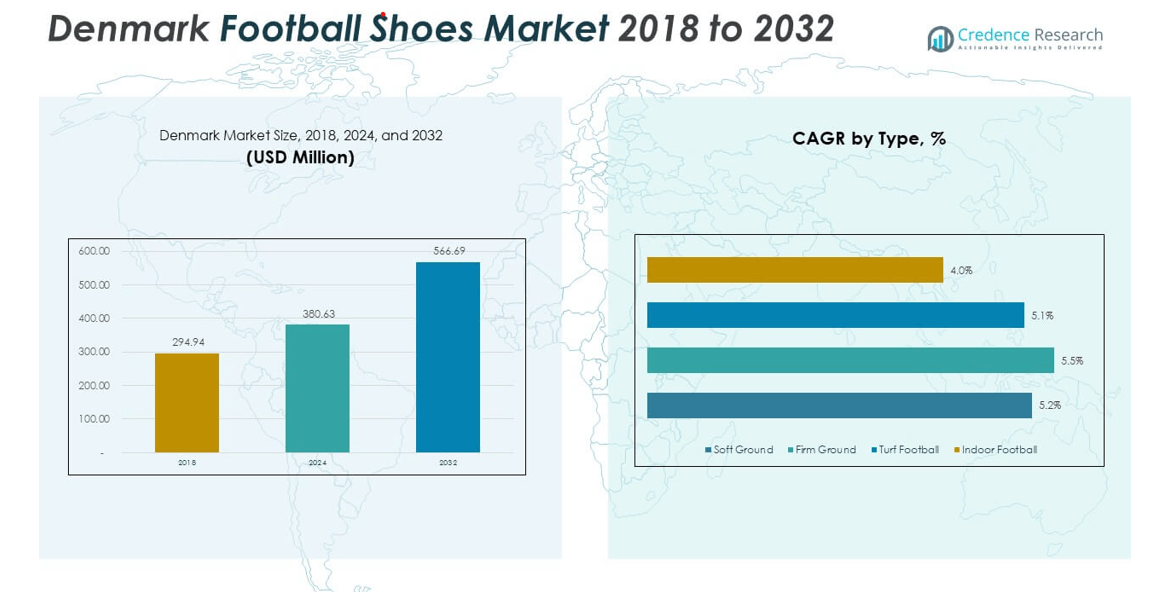
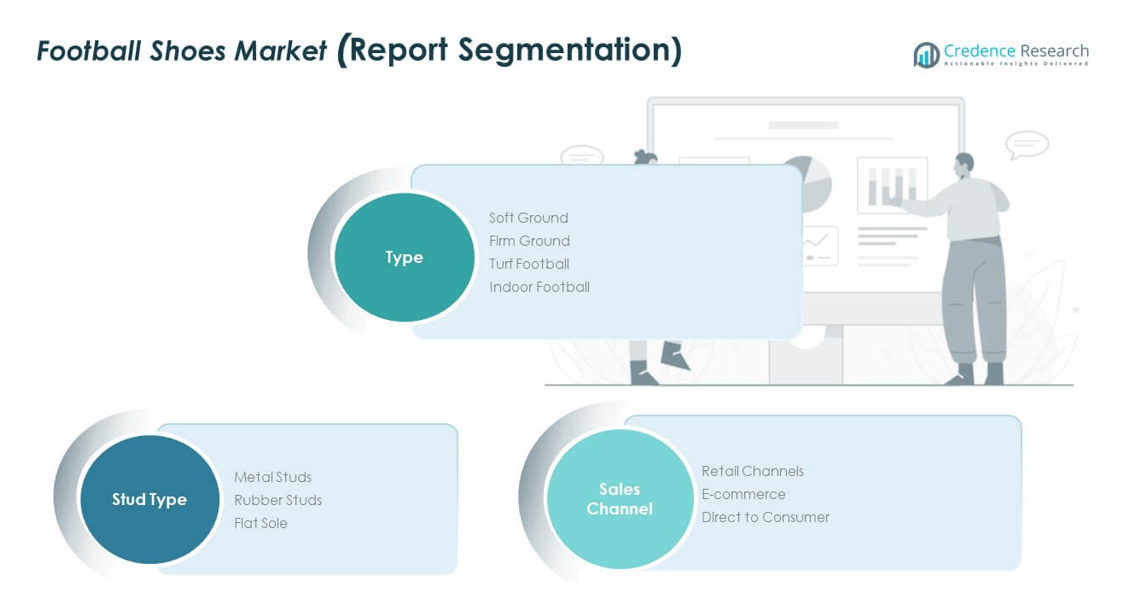
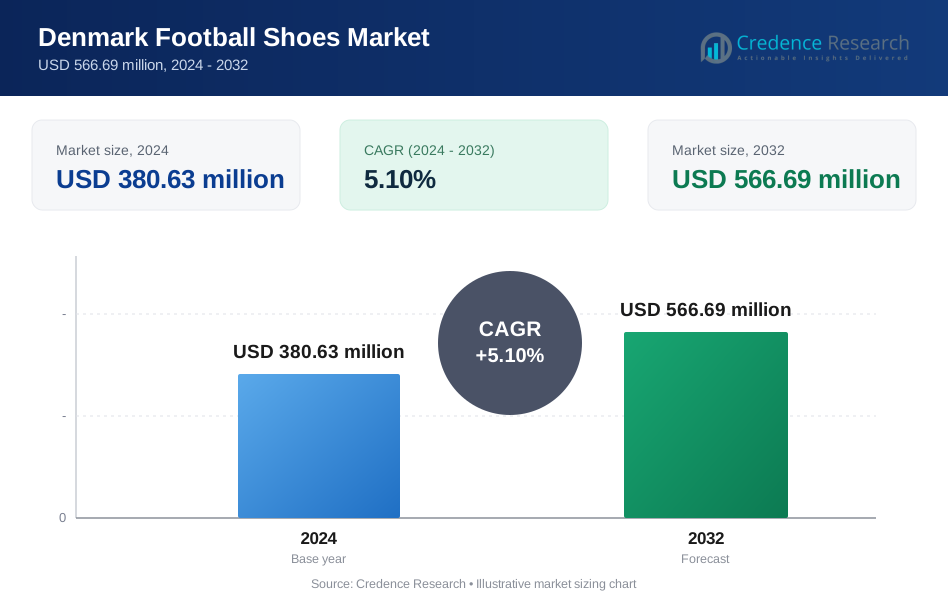
The Denmark Football Shoes Market size was valued at USD 294.94 million in 2018 to USD 380.63 million in 2024 and is anticipated to reach USD 566.69 million by 2032, at a CAGR of 5.10% during the forecast period.
| REPORT ATTRIBUTE | DETAILS |
|---|---|
| Historical Period | 2020-2023 |
| Base Year | 2024 |
| Forecast Period | 2025-2032 |
| Denmark Football Shoes Market Size 2024 | USD 380.63 million |
| Denmark Football Shoes Market, CAGR | 5.10% |
| Denmark Football Shoes Market Size 2032 | USD 566.69 million |
Market growth is driven by Denmark’s strong football culture, high participation across all age groups, and rising consumer preference for durable, performance-focused footwear. Professional leagues and grassroots clubs encourage continuous engagement, while international tournaments further fuel enthusiasm. Brands integrate lightweight materials, advanced traction systems, and comfortable designs to meet evolving player expectations. Endorsements by athletes and visibility in major competitions enhance brand recall, reinforcing consumer confidence in premium football shoes. These drivers collectively strengthen long-term demand in the market.
The Capital Region leads the Denmark Football Shoes Market due to strong retail networks, higher consumer spending, and concentration of professional clubs. Central Denmark follows, benefiting from vibrant community participation and steady demand from training academies. Southern Denmark shows growing momentum supported by Odense’s football infrastructure, while Northern Jutland emerges as an important contributor driven by local leagues and youth programs. It highlights a nationwide spread of football culture where established regions secure dominance and emerging areas expand participation. This balance ensures market stability and diversified growth across Denmark.
Market Insights
- The Denmark Football Shoes Market was valued at USD 294.94 million in 2018, reached USD 380.63 million in 2024, and is projected to grow to USD 566.69 million by 2032, registering a CAGR of 5.10%.
- The Capital Region leads with 42% share due to high consumer spending, retail strength, and strong presence of professional clubs, while Central Denmark follows with 28% share supported by community participation and training academies.
- Southern Denmark holds 19% share with Odense driving demand through local clubs and facilities, while Northern Jutland contributes 11%, making it the fastest-growing region backed by youth programs and increasing e-commerce adoption.
- Firm Ground shoes dominate segment share with 38%, driven by widespread use across natural and artificial pitches, making them the most preferred choice for both professional and amateur players.
- Indoor Football shoes account for 25% of the segment share, reflecting strong adoption from Denmark’s growing futsal culture and popularity of indoor leagues across urban and suburban areas.
Market Drivers
Growing Football Participation Across All Age Groups
Football remains the most popular sport in Denmark, and participation continues to rise. Youth academies, grassroots clubs, and school programs ensure steady engagement at community levels. Families encourage children to join football, creating steady demand for footwear. Professional leagues further inspire young players to purchase performance-oriented shoes. The Denmark Football Shoes Market benefits directly from this cultural alignment. It supports growing sales volume and consistent replacement cycles. Government-backed sports initiatives create strong foundations for sustained interest. The market gains strength from this broad, long-term consumer base.
- For instance, FC Midtjylland established Denmark’s first youth academy in 2004, which has produced multiple Danish national team players including Simon Kjær and Rasmus Kristensen, and led the club to four Danish Superliga titles since its founding in 1999.
Consumer Preference for Advanced and Durable Footwear Designs
Shifting consumer preference toward lightweight and durable designs strongly influences the market. Players expect shoes with high traction and comfort that improve performance. Brands integrate advanced materials for better durability on natural and synthetic turfs. Performance-driven features appeal to both professional and recreational players. The Denmark Football Shoes Market grows stronger by catering to these rising needs. It allows manufacturers to differentiate through innovation. Endorsements highlight functional benefits and reinforce purchasing confidence. Consumer adoption accelerates when shoes provide measurable advantages on the field.
Influence of Professional Leagues and Star Athlete Endorsements
Professional football leagues in Denmark increase the demand for high-performance footwear. Star athletes showcase branded shoes, inspiring consumer trust and adoption. Visibility during matches and tournaments builds strong brand recognition among fans. The Denmark Football Shoes Market gains momentum from this promotional strength. It ensures demand across all consumer categories, from professionals to casual players. Clubs and academies often partner with major brands to standardize footwear. It encourages uniform adoption and enhances player loyalty. The cycle reinforces recurring sales and deeper consumer connection with brands.
- For instance, in February 2025, Danish international and Brighton & Hove Albion midfielder Matt O'Riley was signed as the first Danish football ambassador for Skechers and began wearing Skechers Razor 1.5 Elite FG boots during professional matches, marking the brand’s entry into the Danish elite football endorsement space.
Role of Football Infrastructure and Sports Retail Expansion
Investment in sports infrastructure creates wider access to football facilities. Newly built stadiums and artificial pitches promote frequent participation in football activities. Retail expansion increases the visibility of advanced football shoes across urban and suburban areas. The Denmark Football Shoes Market benefits when products reach wider audiences efficiently. It ensures availability of shoes across multiple price ranges. Growing e-commerce channels complement physical retail stores with broader offerings. It creates seamless purchase experiences that boost consumer confidence. This integrated availability strengthens long-term adoption and brand penetration.
Market Trends
Integration of Sustainable Materials and Eco-Friendly Footwear Designs
Sustainability has become a key trend influencing purchasing behavior in Denmark. Consumers favor football shoes designed from recycled and eco-friendly materials. Global brands invest in greener manufacturing to meet this expectation. The Denmark Football Shoes Market evolves as sustainability aligns with consumer identity. It attracts eco-conscious buyers without compromising product quality. Athletes and retailers promote these shoes as performance-ready and environmentally responsible. It enhances brand value and long-term loyalty among consumers. Sustainability becomes a defining feature shaping purchasing decisions in this market.
Digital Customization Platforms Enhancing Consumer Engagement
Brands are introducing digital platforms that allow personalized shoe designs. Consumers create unique colorways and patterns to reflect personal style. The Denmark Football Shoes Market leverages customization as a strong differentiator. It transforms football footwear from a functional product to an identity statement. Digital tools increase engagement and encourage repeat purchases. It allows brands to charge premium prices for personalized products. Customization also boosts social media visibility through user-shared content. This trend strengthens emotional connections between consumers and football shoe brands.
- For instance, Nike By You allows Danish consumers to customize performance football boots such as the Phantom Luna 2 Elite, integrating user-specified materials and graphics directly through the online platform.
Advances in Smart Football Footwear Technology
Technology is playing a growing role in performance tracking footwear. Brands integrate sensors that monitor movement, speed, and ball control. The Denmark Football Shoes Market benefits from early adoption of smart solutions. It attracts players who want data-driven insights into performance improvement. Advanced features are promoted in professional training environments and academies. It ensures credibility and accelerates wider adoption. Tech-driven shoes support market differentiation and premium positioning. This trend creates opportunities for brands to merge innovation with sports performance.
- For example, in January 2024, PUMA launched the Future 7 featuring FUZIONFIT360 adaptive compression technology, PWRPRINT, and a redesigned stud system for agility and control. Worn by professionals in European leagues, the boot highlights advanced play-tested design with public details on its technical construction.
Rising Popularity of Lifestyle-Oriented Football Shoe Collections
Football shoes are increasingly worn beyond the pitch for fashion appeal. Global brands design collections that blend performance with lifestyle aesthetics. The Denmark Football Shoes Market capitalizes on this trend to expand audiences. It attracts non-players who purchase football-inspired shoes for casual wear. Streetwear culture and fashion collaborations reinforce this demand. It increases product versatility and extends market reach. Lifestyle-oriented designs drive higher profitability through premium positioning. This dual purpose broadens the role of football shoes in consumer wardrobes.
Market Challenges Analysis
High Competition Among Established Brands and New Entrants
The competitive landscape presents major challenges for global and local manufacturers. Established players dominate with strong distribution and endorsement contracts. Smaller entrants find it difficult to compete on scale and visibility. The Denmark Football Shoes Market faces continuous price pressure from this rivalry. It restricts margins for smaller brands and limits innovation scope. Large brands maintain control through aggressive marketing campaigns and athlete sponsorships. It forces smaller competitors to focus on niche offerings. Intense competition creates challenges in sustaining long-term profitability.
Impact of Seasonal Demand Fluctuations and Price Sensitivity
Seasonal football demand often disrupts consistent sales cycles across regions. Colder months reduce outdoor football activity, affecting shoe purchases. The Denmark Football Shoes Market experiences weaker demand during these phases. It pressures retailers to manage inventory and promotions more carefully. Consumers also remain highly price sensitive when selecting footwear. It limits the success of premium-priced models during weaker demand cycles. Brands must balance innovation with affordability to maintain reach. This challenge requires precise planning and flexible strategies to address market volatility.
Market Opportunities
Expansion of E-Commerce Platforms and Direct-To-Consumer Channels
The rapid growth of e-commerce offers strong opportunities for football shoe brands. Online platforms provide broad product visibility and convenient purchasing. The Denmark Football Shoes Market gains traction as digital sales channels strengthen. It helps brands reach rural and suburban consumers without large retail investments. Direct-to-consumer models increase profit margins and improve brand engagement. It creates opportunities for personalization and exclusive launches. Strong logistics networks further support seamless delivery. This opportunity aligns with consumer preference for digital-first shopping experiences.
Collaborations With Football Clubs and Training Academies
Strategic partnerships with clubs and academies offer long-term growth potential. Brands supply shoes to players and trainees, fostering early loyalty. The Denmark Football Shoes Market benefits when such collaborations shape future demand. It enables brands to showcase durability and performance in real-world conditions. Partnerships also strengthen brand presence in professional competitions. It creates trust among players and fans, reinforcing brand credibility. These collaborations expand reach across grassroots and professional levels. The opportunity builds sustainable demand and deeper consumer connections.
Market Segmentation Analysis
By type, firm ground shoes hold the leading position due to their versatility on natural and artificial pitches. Soft ground shoes maintain demand among professional players competing in wet conditions, while turf football shoes gain traction in community training environments. Indoor football shoes register steady adoption, supported by Denmark’s growing interest in futsal and indoor leagues. The Denmark Football Shoes Market benefits from this balanced product mix that caters to varying playing surfaces. It ensures sustained growth by aligning product availability with local football preferences.
- For instance, Adidas produces specialized turf variants of its popular lines, with the firm’s FG and turf-configured models available in Denmark as part of its globally leading soccer footwear range. Indoor football shoes register steady adoption, supported by Denmark’s growing interest in futsal and indoor leagues.
By stud configuration, rubber studs dominate due to durability and suitability across training and competitive play. Metal studs remain relevant in professional environments where grip on wet pitches is critical. Flat sole shoes gain preference in indoor and futsal games, supporting steady subsegment growth. It reflects how footwear choices adapt to pitch types and game intensity. This segmentation highlights the importance of targeted designs for diverse playing conditions.
- For example, Nike’s Phantom GX Elite and Mercurial Vapor XVI, used by professional athletes like Vitinha (PSG), integrate controversial metal stud configurations for optimized traction on moist grass, documented by elite-level match reports and image-based boot spotting.
By sales channel, retail channels continue to lead due to established networks and in-store trial benefits. E-commerce is expanding quickly, offering consumers a broader product range and personalization options. Direct-to-consumer strategies allow brands to control pricing, engagement, and product launches more effectively. It strengthens loyalty while improving margins for key players. Together, these channels create a strong commercial structure supporting the market’s growth trajectory.
Segmentation
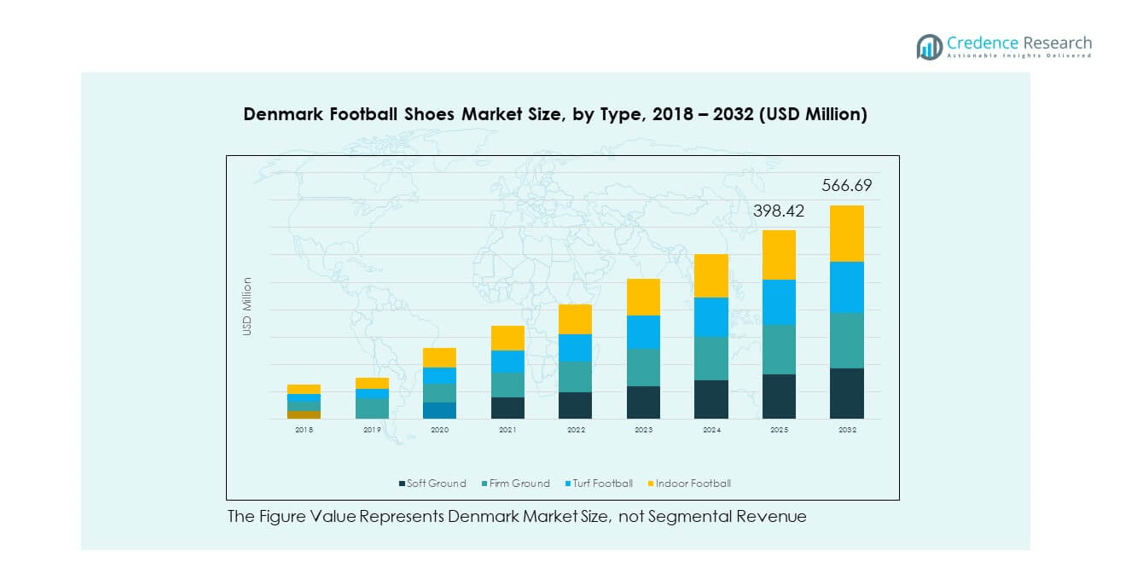
By Type
- Soft Ground
- Firm Ground
- Turf Football
- Indoor Football
By Stud
- Metal Studs
- Rubber Studs
- Flat Sole
By Sales Channel
- Retail Channels
- E-commerce
- Direct to Consumer
Regional Analysis
Capital Region of Denmark
The Capital Region accounts for 42% of the Denmark Football Shoes Market, supported by high urban density and strong consumer spending. Copenhagen dominates with established football clubs, international tournaments, and modern sports infrastructure. Retail networks are extensive, with flagship outlets and specialty stores increasing accessibility to premium footwear. It benefits from strong endorsements and collaborations with professional players, boosting demand for high-performance models. E-commerce penetration is also strongest here, helping expand reach across younger consumers. The region drives innovation adoption, making it the core growth center.
Central Denmark Region
The Central Denmark Region holds 28% share, led by Aarhus and surrounding football communities. It features a balance between professional leagues and grassroots participation, strengthening footwear sales across demographics. Retail presence is moderate but supported by expanding online sales channels. It benefits from active local academies and regional tournaments that fuel consistent demand. Players in this region favor durable mid-range shoes suited for frequent training. The market here shows resilience due to steady participation rates and growing club-level investments. This subregion acts as a stable contributor to overall growth.
Southern Denmark and Other Regions
Southern Denmark captures 19% share, supported by Odense’s football culture and growing training facilities. Demand is driven by community-level engagement and smaller professional clubs, creating preference for both entry-level and mid-tier footwear. It faces slower adoption of premium models but continues to benefit from youth participation programs. Northern Jutland contributes 11% share, with Aalborg leading demand through local leagues and sports schools. It relies on both retail outlets and increasing e-commerce adoption for growth. The Denmark Football Shoes Market gains balanced momentum from these subregions, ensuring nationwide demand stability.
Key Player Analysis
- Nike Inc.
- Adidas AG
- Puma SE
- Umbro
- Mizuno
- Lotto Sport Italia
- New Balance
- Hummel
- MASCOT
- Sokito
- Other Key Players
Competitive Analysis
The Denmark Football Shoes Market is shaped by global leaders and regional brands competing on performance, design, and distribution reach. Nike, Adidas, and Puma dominate market share with strong endorsements, advanced technologies, and extensive retail presence. It benefits from premium positioning, product innovation, and high consumer trust. Local brands such as Hummel and Sokito strengthen their presence by appealing to national identity and sustainability-focused buyers. Competition intensifies as companies invest in eco-friendly materials and smart shoe technologies to differentiate offerings. E-commerce and direct-to-consumer channels increase competition by providing smaller brands visibility alongside global players. It creates a highly competitive landscape where price, innovation, and brand loyalty determine long-term success.
Recent Developments
- In June 2024, R-GOL, a multi-brand distributor in Central & Eastern Europe backed by Innova Capital, acquired Unisport (Denmark-based online football merchandise retailer) from Nordic Capital. The merger aims to scale expansion in Europe and globally, combining strengths in distribution and digital channels.
- In March 2025, Danish footwear brand Anonymous Copenhagen entered the sneaker segment with the launch of its first sneaker collection for the Spring/Summer 2025 season. The B-Corp-certified company unveiled a line focused on ethical and stylish design, reflecting both contemporary trends and its sustainable philosophy.
- In February 2025, Skechers signed Matt O’Riley, Danish national team and Brighton & Hove Albion midfielder, to its football boot roster. He now competes in the Skechers Razor 1.5 Elite FG boots and appears in marketing campaigns in Denmark.
Report Coverage
The research report offers an in-depth analysis based on Type, Stud and Sales Channel. It details leading market players, providing an overview of their business, product offerings, investments, revenue streams, and key applications. Additionally, the report includes insights into the competitive environment, SWOT analysis, current market trends, as well as the primary drivers and constraints. Furthermore, it discusses various factors that have driven market expansion in recent years. The report also explores market dynamics, regulatory scenarios, and technological advancements that are shaping the industry. It assesses the impact of external factors and global economic changes on market growth. Lastly, it provides strategic recommendations for new entrants and established companies to navigate the complexities of the market.
Future Outlook
- The Denmark Football Shoes Market will expand through higher adoption of advanced performance footwear across all age groups.
- Growing demand for eco-friendly designs will encourage brands to introduce sustainable football shoes.
- E-commerce will strengthen as a primary channel, offering broader accessibility and personalized buying experiences.
- Collaborations with clubs and academies will create loyalty-driven growth for major and emerging players.
- Fashion-driven collections will expand consumer bases by integrating football shoes into lifestyle markets.
- Smart footwear technologies with performance tracking will attract professional players and elite training academies.
- Regional growth will diversify as Southern Denmark and Northern Jutland see steady youth participation.
- Endorsements from national players and international stars will continue to shape purchasing preferences.
- Competition will intensify with both global leaders and local brands investing in product differentiation.
- The market will sustain momentum through innovation, cultural alignment, and long-term consumer engagement.
Request a Free Sample
Fill in your details and we'll send you a free sample report.
- Sample data tables & charts
- Research methodology
Need a Custom Version of This Report?
Tailor the scope, geography, or segments to your exact requirements.
- Custom geography or segment scope
- Direct access to our analyst team
Frequently Asked Questions
What is the current market size for Denmark Football Shoes Market, and what is its projected size in 2032?
At what Compound Annual Growth Rate is the Denmark Football Shoes Market projected to grow between 2024 and 2032?
Which Denmark Football Shoes Market segment held the largest share in 2024?
What are the primary factors fueling the growth of the Denmark Football Shoes Market?
Who are the leading companies in the Denmark Football Shoes Market?
Table of Content
Chapter 1. Report Introduction
- 1.1 Report Description & Purpose
- 1.1.1 Report Title & Market Definition
- 1.1.2 Unique Selling Propositions (USP) & Key Differentiators
- 1.1.3 Value Proposition for Stakeholders
- 1.2 Research Objectives
- 1.2.1 Market Sizing Objectives (Volume & Revenue)
- 1.2.2 Segmentation Objectives
- 1.2.3 Competitive Intelligence Objectives
- 1.2.4 Forecast & Scenario Objectives
- 1.3 Report Scope
- 1.3.1 Denmark Football Shoes Scope – Types & Subtypes Covered
- 1.3.2 Geographic Scope – Regions & Countries Covered
- 1.3.3 Historical Period, Base Year & Forecast Period (2024; forecast to 2032)
- 1.3.4 Inclusions & Exclusions
- 1.4 HS Code & Classification Framework
- 1.5 Currency, Units & Pricing Basis
- 1.6 Target Stakeholders
- 1.7 Limitations & Assumptions
Chapter 2. Executive Summary
- 2.1 Global Denmark Football Shoes Market Snapshot
- 2.1.1 Market Size – Historical (2024) & Forecast (2024-2032) (2024: USD 380.63 million → 2032: USD 566.69 million)
- 2.1.2 Volume & Revenue – Global Totals
- 2.1.3 Key Market Highlights – Top Five Facts
- 2.2 Denmark Football Shoes Market Segmentation Snapshot
- 2.2.1 Market Split by Region – 2024 vs. 2032
- 2.3 Competitive Snapshot
- 2.3.1 Top 10 Players by Revenue Share – 2024
- 2.3.2 Top 10 Players by Volume Share – 2024
- 2.3.3 Recent Strategic Developments (18-Month Summary)
- 2.4 Key Investment Highlights & Strategic Conclusions
Chapter 3. Denmark Football Shoes Market Dynamics & Industry Analysis
- 3.1 Market Overview & Context
- 3.1.1 Denmark Football Shoes Market Position in the Broader Automotive Value Chain
- 3.1.2 OEM vs. Replacement Market Dynamics
- 3.1.3 Market Maturity & Development Stage by Region
- 3.2 Denmark Football Shoes Market Drivers
- 3.3 Denmark Football Shoes Market Restraints & Challenges
- 3.4 Denmark Football Shoes Market Opportunities
- 3.5 Porter's Five Forces Analysis
- 3.5.1 Threat of New Entrants
- 3.5.2 Bargaining Power of Suppliers
- 3.5.3 Bargaining Power of Buyers
- 3.5.4 Threat of Substitutes
- 3.5.5 Competitive Rivalry – Intensity Assessment
- 3.6 Denmark Football Shoes Value Chain Analysis
- 3.6.1 Upstream – Raw Material/Input Suppliers
- 3.6.1.1 Raw Material/Input 1
- 3.6.1.2 Raw Material/Input 2
- 3.6.1.3 Raw Material/Input 3
- 3.6.2 Midstream – Production/Manufacturing/Service Delivery
- 3.6.2.1 Production/Process Overview
- 3.6.2.2 Key Facility Locations & Capacity by Manufacturer
- 3.6.3 Downstream – Distribution & End Consumer
- 3.6.3.1 Primary Channel – B2B/OEM
- 3.6.3.2 Secondary Channels – Dealer, Retail, Online, Direct
- 3.6.4 Value Chain Profitability Analysis
- 3.6.1 Upstream – Raw Material/Input Suppliers
- 3.7 PESTEL Analysis
- 3.7.1 Political Factors
- 3.7.2 Economic Factors
- 3.7.3 Social Factors
- 3.7.4 Technological Factors
- 3.7.5 Environmental Factors
- 3.7.6 Legal Factors
- 3.8 Denmark Football Shoes Supply Chain Analysis
- 3.8.1 Raw Material/Input Supply Risk Assessment
- 3.8.2 Manufacturing Concentration Risk (Geographic Exposure)
- 3.8.3 Trade Disruption Impact Analysis
- 3.9 Regulatory & Policy Landscape
Note: The regulatory and policy landscape section covers regulations based on their applicability to the market, Denmark Football Shoes category, geography, and scope of the study. Only regulatory frameworks with a material impact on operations, compliance, trade, sustainability, or market access are analyzed in detail.
Chapter 4. Key Investment Pockets & Opportunity Analysis
- 4.1 Denmark Football Shoes Market Attractiveness Analysis
- 4.1.1 By Region – Investment Attractiveness Matrix (Volume × CAGR)
- 4.2 Absolute Revenue Growth Opportunity
- 4.2.1 By Region – Absolute USD Growth Through 2032
- 4.3 Incremental Volume Opportunity
- 4.3.1 By Region – Incremental Volume Through 2032
- 4.3.2 Segment – Incremental Volume
- 4.4 Emerging Submarket Opportunity Deep Dive (Subject to Applicability)
- 4.5 Emerging Market Opportunity Scorecards
- 4.5.1 United States
- 4.5.2 Europe
- 4.5.3 Asia
- 4.5.4 Middle East & Africa
Note: Emerging Market Opportunity Scorecards will be included based on relevance and strategic importance. Regions listed are indicative and may vary depending on data availability and market dynamics.
Chapter 5. Denmark Football Shoes Import-Export Analysis & Trade Flows
- 5.1 Global Trade Overview
- 5.1.1 Global Export Value by Country (2024)
- 5.1.2 Global Export Volume by Country (2024)
- 5.1.3 Global Import Value by Country (2024)
- 5.1.4 Global Import Volume by Country (2024)
- 5.1.5 Net Trade Balance by Country (2024)
- 5.2 Export Analysis – Segment
- 5.2.1 Type 1 (HS Code)
- 5.2.2 Type 2 (HS Code)
- 5.2.3 Type 3 (HS Code)
- 5.2.4 Type 4 (HS Code)
- 5.2.5 Type 5 (HS Code)
- 5.3 Import Analysis – Segment
- 5.3.1 Type 1 (HS Code)
- 5.3.2 Type 2 (HS Code)
- 5.3.3 Type 3 (HS Code)
- 5.3.4 Type 4 (HS Code)
- 5.3.5 Type 5 (HS Code)
- 5.4 Average Unit Trade Prices
- 5.4.1 Average Export Price – Segment & Country
- 5.4.2 Average Import Price – Segment & Source Country
- 5.4.3 Price Trends (2024)
- 5.5 Key Trade Route Analysis
- 5.5.1 Trade Route 1
- 5.5.2 Trade Route 2
- 5.5.3 Trade Route 3
- 5.5.4 Trade Route 4
- 5.5.5 Trade Route 5
- 5.6 Trade Policy Impact Assessment
- 5.6.1 US Anti-Dumping & Section 301 Tariffs
- 5.6.2 EU Customs Union Impact
- 5.6.3 Major Free Trade Agreements
- 5.6.4 USMCA Rules of Origin
Note: Trade policy analysis will be included only where relevant to the Denmark Football Shoes market.
Chapter 6. Competitive Landscape & Company Benchmarking
- 6.1 Denmark Football Shoes Market Concentration & Structure
- 6.1.1 Herfindahl-Hirschman Index (HHI) – vs. 2024
- 6.1.2 Tier 1, Tier 2 & Tier 3 Market Structure
- 6.1.3 Global, Regional & Local Player Dynamics
- 6.2 Denmark Football Shoes Market Share Analysis – 2024
- 6.2.1 Global Revenue Share by Company
- 6.2.2 Global Volume Share by Company
- 6.2.3 Regional Revenue Share
- 6.2.4 Market Share Evolution ( vs. 2024)
- 6.2.5 OEM Segment Share by Company
- 6.2.6 Replacement Segment Share by Company
- 6.3 Production/Delivery Capacity & Facility Analysis
- 6.3.1 Global Installed Capacity
- 6.3.2 Capacity Utilization Rates
- 6.3.3 Production/Output Volume
- 6.3.4 Facility Locations & Capacity Map
- 6.3.5 Planned Capacity Additions
- 6.4 Denmark Football Shoes Competitive Benchmarking Matrix
- 6.4.1 Revenue, Volume, CAGR & Profitability Comparison
- 6.4.2 Channel Revenue Mix
- 6.4.3 Geographic Revenue Exposure
- 6.4.4 R&D Intensity
- 6.4.5 Sustainability Maturity
- 6.5 Strategic Developments in Denmark Football Shoes (Last 24 Months)
- 6.5.1 Mergers, Acquisitions & Divestments
- 6.5.2 New Denmark Football Shoes Launches
- 6.5.3 Facility Expansions
- 6.5.4 Strategic Alliances, Joint Ventures & Partnerships
- 6.5.5 Distribution Expansion & Market Entry
- 6.5.6 Sustainability & ESG Initiatives
- 6.6 Competitive Strategy Mapping
- 6.6.1 Leader, Challenger, Follower & Niche Classification
- 6.6.2 Pricing Strategy Comparison
- 6.6.3 Channel Strategy Matrix
Note: Strategic developments are included based on their materiality and the availability of reliable information.
Chapter 7. Global Denmark Football Shoes Market – By Distribution Channel
- 7.1 Segment Overview
- 7.1.1 Volume & Revenue Split by Channel (2024 & 2032)
- 7.1.2 Channel Mix Evolution (2024-2032)
Chapter 8. Regional Market Analysis – Global Overview
- 8.1 Global Regional Overview
- 8.1.1 Regional Volume Share
- 8.1.2 Regional Revenue Share
- 8.1.3 Regional Volume by Region
- 8.1.4 Regional Revenue by Region
- 8.1.5 Regional Forecast Through 2032
- 8.2 Cross-Regional Segment Analysis
- 8.2.1 By Distribution Channel
- 8.2.2 By Brand/Price Tier
Chapter 9. North America Denmark Football Shoes Market
- 9.1 United States
- 9.2 Canada
- 9.3 Mexico
Chapter 10. Europe Denmark Football Shoes Market
- 10.1 Germany
- 10.2 France
- 10.3 Italy
- 10.4 United Kingdom
- 10.5 Spain
- 10.6 Poland
- 10.7 Russia
- 10.8 Netherlands
- 10.9 Belgium
- 10.10 Sweden
- 10.11 Denmark
- 10.12 Norway
- 10.13 Rest of Europe
Chapter 11. Asia Pacific Denmark Football Shoes Market
- 11.1 China
- 11.2 India
- 11.3 Japan
- 11.4 South Korea
- 11.5 Thailand
- 11.6 Indonesia
- 11.7 Vietnam
- 11.8 Malaysia
- 11.9 Australia
- 11.10 Rest of Asia Pacific
Chapter 12. Latin America Denmark Football Shoes Market
- 12.1 Brazil
- 12.2 Argentina
- 12.3 Colombia
- 12.4 Chile
- 12.5 Rest of Latin America
Chapter 13. Middle East Denmark Football Shoes Market
- 13.1 Saudi Arabia
- 13.2 United Arab Emirates
- 13.3 Turkey
- 13.4 Israel
- 13.5 Iran
- 13.6 Rest of the Middle East
Chapter 14. Africa Denmark Football Shoes Market
- 14.1 South Africa
- 14.2 Egypt
- 14.3 Nigeria
- 14.4 Morocco
- 14.5 Rest of Africa
Chapter 15. Denmark Football Shoes Company Profiles
- 15.1 [Company 01]
- 15.1.1 Company Overview
- 15.1.2 Key Management Personnel
- 15.1.3 Products & Services Portfolio
- 15.1.4 Financial Performance
- 15.1.5 Key Market Focus & Geographic Presence
- 15.1.6 Recent Developments & Strategic Initiatives
Note: The company profile list is preliminary and may change based on research findings, market developments, data availability, and client requirements.
Chapter 16. Appendices
- Appendix A – List of Abbreviations & Acronyms
- Appendix B – Industry Classification Code Reference – Full Series
- Appendix C – Production & Capacity Data Tables
- Appendix D – End-Use & Demand Base Tables
- Appendix E – Consumption & Replacement Rate Assumptions
- Appendix F – ASP Reference Tables
- Appendix G – Manufacturing & Facility Database
- Appendix H – Import-Export Data Tables
- Appendix I – Regulatory Summary Tables
- Appendix J – Primary Research Participant List (Anonymized)
- Appendix K – Primary Research Questionnaire Framework
- Appendix L – Data Sources & Bibliography
- Appendix M – Market Size Divergence & Source Comparison
Chapter 17. Research Methodology
- 17.1 Research Framework & Philosophy
- 17.2 Secondary Research – Sources, Hierarchy & Data Extraction
- 17.3 Data Modeling – Bottom-Up & Top-Down Market Sizing
- 17.4 Primary Research – Stakeholder Framework, LOI & Sample Sizes
- 17.5 Forecast Methodology – Regression, Scenario & Sensitivity Analysis
- 17.6 Quality Control – Four-Layer Validation Framework
- 17.7 Limitations & Standard Assumptions
- 17.8 Disclaimer
