
Cardiovascular Drugs Market Overview:
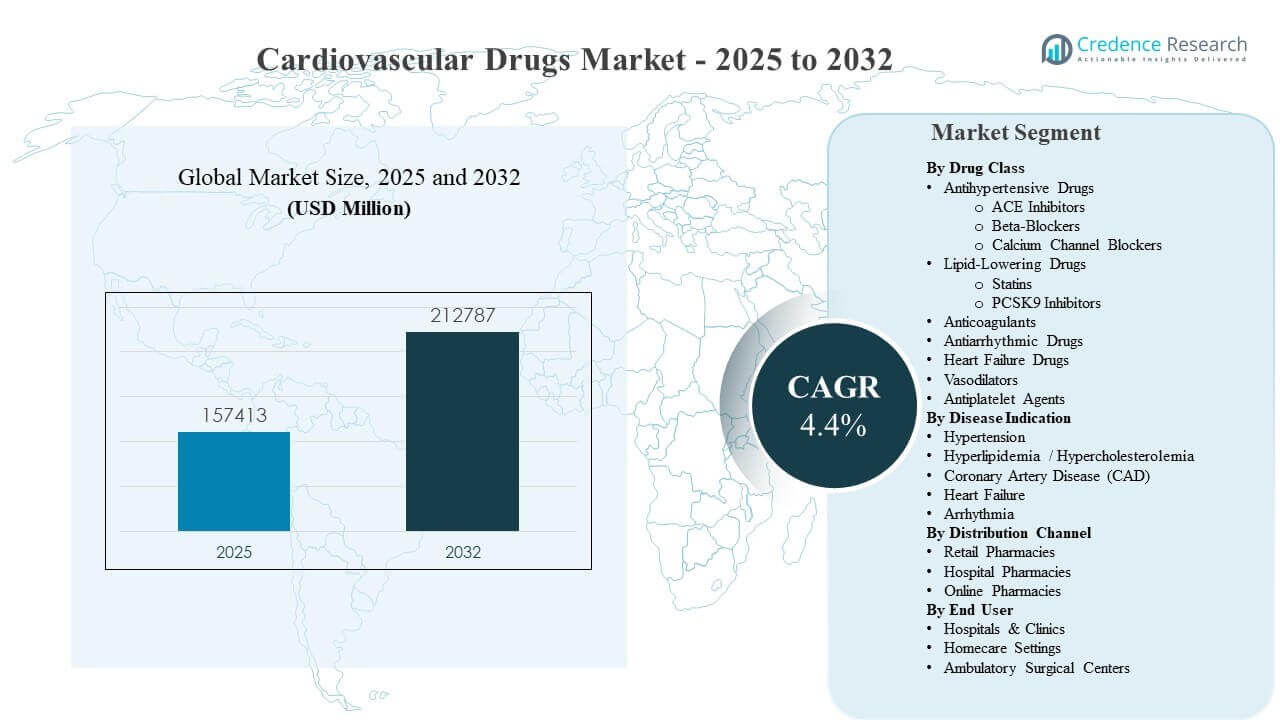
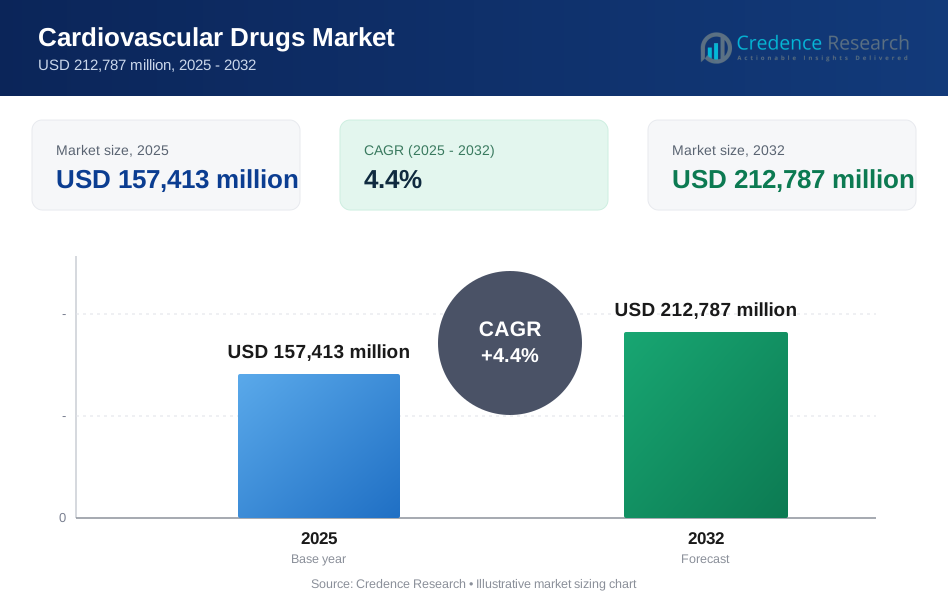
The global Cardiovascular Drugs Market size was estimated at USD 157,413 million in 2025 and is expected to reach USD 212,787 million by 2032, growing at a CAGR of 4.4% from 2025 to 2032. The sustained rise in long-term cardiovascular risk management, especially chronic control of blood pressure, lipids, and thrombotic risk, continues to expand treated patient pools and prescription persistence across primary and secondary prevention. Cardiovascular Drugs Market momentum is also reinforced by broader screening, guideline-driven intensification, and improving access pathways across major healthcare systems.
| REPORT ATTRIBUTE | DETAILS |
|---|---|
| Historical Period | 2020-2024 |
| Base Year | 2025 |
| Forecast Period | 2026-2032 |
| Cardiovascular Drugs Market Size 2025 | USD 157,413 million |
| Cardiovascular Drugs Market , CAGR | 4.4% |
| Cardiovascular Drugs Market Size 2032 | USD 212,787 million |
Key Market Trends & Insights
- The Cardiovascular Drugs Market is projected to expand from USD 157,413 million (2025) to USD 212,787 million (2032) at 4.4% CAGR (2025–2032).
- North America held 42.8% share in 2025, supported by high diagnosis rates and mature chronic therapy uptake.
- Europe accounted for 30.2% share in 2025, reflecting strong reimbursement coverage for long-duration cardiovascular pharmacotherapy.
- Anticoagulants represented 67.8% share in 2025 within the leading drug-class mix, reflecting sustained thromboembolic risk management demand.
- Retail Pharmacies captured 66.1% share in 2025, driven by repeat refills and proximity-based access for chronic medication adherence.
Segment Analysis
Cardiovascular Drugs Market demand is anchored in chronic therapy continuity, where patients often remain on multi-drug regimens over long periods, creating stable refill volumes and strong channel dependence on distribution efficiency. The market continues to benefit from structured clinical pathways that prioritize preventive pharmacotherapy for large-risk cohorts and enable earlier initiation and escalation. A notable consumption pattern in antihypertensive care is the rising penetration of combination therapy, as fixed-dose and multi-agent approaches are increasingly used to improve control and simplify dosing.
Cardiovascular Drugs Market segmentation is shaped by disease burden concentration in hypertension and dyslipidemia, and by therapy intensity escalation in coronary artery disease, heart failure, and arrhythmias. Prescribers increasingly emphasize therapies that offer predictable efficacy, tolerability, and lower monitoring burden for long-term use. Over time, adherence services, patient support, and affordability programs materially influence brand choice and switching behavior, especially in maintenance therapy where outcomes are linked to consistency of use.
Cardiovascular Drugs Market channel mix reflects the dominance of retail dispensing for chronic refills, with hospital pharmacy influence concentrated around acute episodes, discharge initiation, and therapy titration. Digital ordering and home delivery are strengthening persistence in selected patient groups by reducing refill friction. End-user dynamics increasingly reflect a shift toward long-term management outside tertiary centers, especially where monitoring tools and coordinated primary care models support medication continuity.
By Drug Class Insights
Anticoagulants accounted for the largest share of 67.8% in 2025. Anticoagulants lead because stroke prevention and venous thromboembolism management remain core priorities across atrial fibrillation and post-acute care pathways. Cardiovascular Drugs Market prescribing is reinforced by guideline-driven anticoagulation expansion and longer therapy duration for high-risk populations. Product differentiation in bleeding-risk profile, dosing convenience, and interaction management continues to influence selection within this class. Cardiovascular Drugs Market adoption is also strengthened by structured monitoring and adherence programs that protect long-term outcomes in chronic anticoagulation.
By Disease Indication Insights
Hypertension accounted for the largest share of 38.6% in 2025. Hypertension leads due to the scale of diagnosed patients and the high prevalence of lifelong treatment, often requiring combination therapy and stepwise intensification. Cardiovascular Drugs Market volumes increase as screening improves and clinical targets tighten, driving more frequent initiation and medication optimization. Persistent comorbid overlap with diabetes, obesity, and chronic kidney disease elevates therapy complexity and increases the number of prescriptions per patient. Cardiovascular Drugs Market demand is further reinforced by standardized primary care protocols that sustain refill continuity.
By Distribution Channel Insights
Retail Pharmacies accounted for the largest share of 66.1% in 2025. Retail pharmacies dominate because cardiovascular therapy is refill-heavy and favors local access, payer-network alignment, and continuity of dispensing. Cardiovascular Drugs Market maintenance prescriptions are frequently renewed through community pharmacy touchpoints that support adherence counseling and substitution workflows. Hospital pharmacies remain important for initiation and stabilization after acute cardiovascular events, but ongoing volumes concentrate in retail due to long-term outpatient management. Cardiovascular Drugs Market channel evolution is also shaped by growing digital enablement in retail settings, including reminders, auto-refills, and synchronized pickup.
By End User Insights
Hospitals & clinics remain the primary setting for diagnosis, therapy initiation, dose titration, and management of complex cardiovascular cases requiring closer supervision. Cardiovascular Drugs Market demand increasingly extends into homecare settings as chronic control expands and patients seek convenient refill and monitoring support outside clinical visits. Ambulatory surgical centers influence therapy use around procedural episodes, but the largest recurring drug volumes remain tied to chronic outpatient disease management. Cardiovascular Drugs Market end-user patterns are therefore shaped more by long-term care continuity than by episodic procedural utilization.
Cardiovascular Drugs Market Drivers
Expanding Chronic Cardiovascular Disease Burden
Cardiovascular Drugs Market growth is driven by a rising base of patients requiring long-duration pharmacotherapy for hypertension, dyslipidemia, coronary artery disease, and heart failure. Earlier diagnosis and continuous risk stratification increase initiation rates and accelerate escalation to combination regimens. Standardized clinical targets reinforce consistent therapy, which increases refill volumes over time. Cardiovascular Drugs Market demand also strengthens as integrated care models emphasize preventive medication to reduce acute events and downstream costs.
Guideline-Driven Treatment Intensification and Combination Therapy
Cardiovascular Drugs Market adoption is supported by guidelines that promote earlier treatment initiation and intensification to achieve tighter control of blood pressure and lipid levels. Combination therapy increases prescription count per patient and improves clinical control, reducing treatment inertia. Fixed-dose combinations can simplify regimens and improve adherence, supporting sustained use. Cardiovascular Drugs Market momentum is reinforced as clinicians prioritize therapies with predictable efficacy and favorable long-term tolerability.
- For instance, Boehringer Ingelheim and Eli Lilly demonstrated the clinical value of guideline-aligned intensification through the EMPEROR-Reduced trial of Jardiance (empagliflozin) in 3,730 HFrEF patients, where the therapy reduced the combined relative risk of cardiovascular death or hospitalization for heart failure by 25% versus placebo, while also cutting first and recurrent hospitalizations for heart failure by 30%.
Improved Access Pathways and Distribution Efficiency
Cardiovascular Drugs Market expansion benefits from strengthening reimbursement systems, procurement mechanisms, and wider dispensing reach across many countries. Retail pharmacy scale and improving supply reliability reduce refill interruptions for chronic therapies. Patient support programs and affordability initiatives help maintain persistence in long-term therapy categories. Cardiovascular Drugs Market performance is further supported when digital tools enable reminders, automated refills, and adherence tracking.
Innovation, Lifecycle Management, and Portfolio Optimization
Cardiovascular Drugs Market competitiveness is reinforced by ongoing product lifecycle strategies, including label expansions, improved formulations, and combination approaches. Innovation also targets safety, tolerability, and convenience features that improve acceptance in chronic use settings. Portfolio optimization supports stronger positioning in high-volume indications and improves resilience against price pressure. Cardiovascular Drugs Market differentiation increasingly depends on real-world effectiveness evidence and care pathway integration.
- For instance, Pfizer's lifecycle strategy for tafamidis (VYNDAQEL/VYNDAMAX) in transthyretin amyloid cardiomyopathy illustrates the depth of evidence required for sustainable differentiation: the pivotal ATTR-ACT trial over 30 months demonstrated a 30% reduction in mortality risk (all-cause mortality 29.5% vs. 42.9%; HR 0.70; 95% CI 0.51–0.96) and a 32% reduction in the rate of cardiovascular-related hospitalizations versus placebo.
Cardiovascular Drugs Market Challenges
Cardiovascular Drugs Market faces persistent pricing pressure due to broad generic penetration in several high-volume classes, which compresses margins and intensifies tender-based competition. Payer controls, step therapy, and substitution policies can limit branded uptake and create access friction in chronic care. Cardiovascular Drugs Market performance can also be constrained by adherence challenges, where discontinuation, irregular refills, and polypharmacy reduce realized treatment benefit. These issues amplify the importance of patient support, simplified regimens, and refill continuity programs.
- For instance, Novartis’ siRNA-based Leqvio (inclisiran), given on Day 1, Day 90, and then every 6 months, reduced LDL-C by 52% versus placebo at Day 510 in the 1,561-patient ORION-10 trial, demonstrating how less frequent dosing can help address adherence and refill-continuity barriers in long-term cardiovascular therapy.
Cardiovascular Drugs Market growth is challenged by heterogeneous access and affordability across regions, particularly where reimbursement coverage is limited and out-of-pocket costs remain high. Supply variability and distribution inefficiencies can disrupt therapy continuity in resource-constrained settings. Cardiovascular Drugs Market outcomes are also affected by clinical complexity, including comorbid disease management and variability in physician practice patterns. As a result, market expansion often depends on strengthening primary care capacity and chronic disease management infrastructure.
Cardiovascular Drugs Market Trends and Opportunities
Cardiovascular Drugs Market trends increasingly emphasize integrated cardio-renal-metabolic management, where therapies are positioned for multi-condition benefit and sustained risk reduction. Real-world evidence and outcomes-based discussions are becoming more important in payer negotiations and formulary placement. Cardiovascular Drugs Market opportunities expand where digital adherence tools, remote monitoring, and refill automation improve persistence and reduce therapy drop-off. These capabilities favor channels and brands that can embed support into long-term patient journeys.
- For instance, Bayer’s FIDELITY pooled phase 3 analysis showed that finerenone reduced the risk of cardiovascular events by 14% and kidney events by 23% versus placebo in patients with chronic kidney disease and type 2 diabetes, reinforcing its value in integrated cardio-renal-metabolic treatment strategies.
Cardiovascular Drugs Market is also seeing opportunities in regimen simplification, including combination approaches that reduce pill burden and support adherence. Growth in online pharmacies and home delivery supports chronic refill continuity, particularly in urban markets with digital health adoption. Cardiovascular Drugs Market potential is further supported by expanding diagnosis and screening initiatives that bring more patients into treatment pathways earlier. Emerging markets present additional opportunities as procurement systems mature and essential cardiovascular drug availability improves.
Regional Insights
North America
Cardiovascular Drugs Market in North America holds 42.8% share in 2025 and remains the largest regional contributor, supported by strong diagnosis rates, mature preventive care frameworks, and broad access to both branded and generic cardiovascular therapies. Chronic disease management programs sustain long refill cycles and facilitate therapy intensification for high-risk patients. Retail dispensing strength supports adherence through consistent access and patient counseling. The region also benefits from strong commercialization capabilities and payer engagement strategies that shape uptake across therapy classes.
Europe
Cardiovascular Drugs Market in Europe accounts for 30.2% share in 2025, supported by structured reimbursement coverage, guideline-driven prescribing, and stable demand across hypertension, lipid management, anticoagulation, and heart failure therapy. Health systems emphasize long-term risk reduction, reinforcing persistent medication use. Regional procurement and substitution frameworks drive intense price competition, particularly in mature generic categories. Market performance improves where patient pathways reduce therapy discontinuation and ensure consistent access.
Asia Pacific
Cardiovascular Drugs Market in Asia Pacific represents 20.5% share in 2025, strengthened by rising diagnosis, growing awareness, and increasing access as healthcare coverage expands. Urbanization and lifestyle shifts increase demand for long-term risk-factor management, particularly in hypertension and dyslipidemia. Market expansion is supported by improved distribution and wider availability of essential therapies. Competitive intensity rises as local and multinational manufacturers expand portfolios and strengthen channel reach.
Latin America
Cardiovascular Drugs Market in Latin America holds 4.1% share in 2025 and continues to develop as public health programs and chronic disease management initiatives expand access to long-term cardiovascular medications. Pricing sensitivity and reimbursement variability influence product selection and persistence. Retail pharmacy networks play a central role in refill continuity, particularly in metropolitan areas. Market potential increases as supply reliability improves and screening initiatives expand treated patient pools.
Middle East & Africa
Cardiovascular Drugs Market in the Middle East & Africa accounts for 2.4% share in 2025 and is shaped by uneven healthcare access and varying reimbursement depth, resulting in differentiated adoption across countries. Expanding hospital infrastructure and improving primary care capacity support broader diagnosis and long-term therapy initiation. Chronic medication availability and distribution efficiency remain critical to sustaining refill continuity. Market growth improves as procurement systems strengthen and essential cardiovascular medicine access expands.
Competitive Landscape
Cardiovascular Drugs Market competition is led by multinational pharmaceutical companies with broad cardiovascular portfolios and strong commercialization capabilities across major regions. Companies compete through portfolio breadth, lifecycle strategies, payer access strength, and differentiation on tolerability, convenience, and patient support in chronic therapy. The market features intense competition in mature generic-heavy categories, alongside selective innovation-driven competition in specialized cardiovascular indications. Strategic collaborations, targeted acquisitions, and access initiatives further shape competitive positioning.
Pfizer Inc. maintains a diversified approach across established and specialty therapeutic areas, leveraging global scale, strong commercial execution, and broad channel access to sustain cardiovascular-facing revenue exposure. Cardiovascular Drugs Market participation for Pfizer is supported by disciplined portfolio management and focus on expanding treatment reach through access programs and integrated care pathways. The company’s strategy typically emphasizes sustained uptake in chronic therapy settings by aligning payer access, prescribing confidence, and patient adherence support. This positioning supports competitiveness in a market where long-term refill continuity is central to share retention.
The industry research and growth report includes detailed analyses of the competitive landscape of the market and information about key companies, including:
- Pfizer Inc.
- Novartis AG
- AstraZeneca plc
- Bristol-Myers Squibb
- Merck & Co., Inc.
- Sanofi S.A.
- Bayer AG
- Johnson & Johnson
- Amgen Inc.
- Boehringer Ingelheim
- AbbVie Inc.
- Daiichi Sankyo
- GlaxoSmithKline (GSK)
- Eli Lilly and Company
- United Therapeutics Corporation
Qualitative and quantitative analysis of companies has been conducted to help clients understand the wider business environment as well as the strengths and weaknesses of key industry players. Data is qualitatively analyzed to categorize companies as pure play, category-focused, industry-focused, and diversified; it is quantitatively analyzed to categorize companies as dominant, leading, strong, tentative, and weak.
Recent Developments
- In March 2025, Alnylam Pharmaceuticals announced the U.S. FDA approval of AMVUTTRA (vutrisiran) for adults with ATTR amyloidosis with cardiomyopathy, making it a notable new product launch in the cardiovascular drugs market. Alnylam said the approval expanded AMVUTTRA’s indication and made it the first RNAi therapeutic approved to reduce cardiovascular death, hospitalizations, and urgent heart failure visits in adults with ATTR-CM.
- In June 2025, Bayer and the Broad Institute announced a five-year extension of their cardiovascular research collaboration, marking an important partnership update in the market. The expanded agreement focuses on precision cardiology target identification, rapid validation through a human cardiomyocyte platform, and discovery of novel cardiovascular therapies.
- In June 2025, Alnylam Pharmaceuticals also received European Commission approval for AMVUTTRA for the treatment of wild-type or hereditary ATTR amyloidosis with cardiomyopathy in adults, adding another significant product expansion in cardiovascular drugs. The company said this approval made AMVUTTRA the first RNAi therapeutic cleared by the European Commission for this indication.
- In September 2025, Novartis announced an agreement to acquire Tourmaline Bio for $48 per share in cash, valuing the company at about $1.4 billion and making it a major acquisition update in the cardiovascular drugs market. Novartis said the deal would complement its cardiovascular pipeline, and the transaction was expected to close in the fourth quarter of 2025 subject to customary conditions.
Report Scope
| Report Attribute | Details |
| Market size value in 2025 | USD 157,413 million |
| Revenue forecast in 2032 | USD 212,787 million |
| Growth rate (CAGR) | 4.4% (2025–2032) |
| Base year | 2025 |
| Forecast period | 2026-2032 |
| Quantitative units | USD million |
| Segments covered | By Drug Class Outlook: Antihypertensive Drugs (ACE Inhibitors, Beta-Blockers, Calcium Channel Blockers), Lipid-Lowering Drugs (Statins, PCSK9 Inhibitors), Anticoagulants, Antiarrhythmic Drugs, Heart Failure Drugs, Vasodilators, Antiplatelet Agents; By Disease Indication Outlook: Hypertension, Hyperlipidemia / Hypercholesterolemia, Coronary Artery Disease (CAD), Heart Failure, Arrhythmia; By Distribution Channel Outlook: Retail Pharmacies, Hospital Pharmacies, Online Pharmacies; By End User Outlook: Hospitals & Clinics, Homecare Settings, Ambulatory Surgical Centers |
| Regional scope | North America, Europe, Asia Pacific, Latin America, Middle East & Africa |
| Key companies profiled | Pfizer Inc.; Novartis AG; AstraZeneca plc; Bristol-Myers Squibb; Merck & Co., Inc.; Sanofi S.A.; Bayer AG; Johnson & Johnson; Amgen Inc.; Boehringer Ingelheim; AbbVie Inc.; Daiichi Sankyo; GlaxoSmithKline (GSK); Eli Lilly and Company; United Therapeutics Corporation |
| No.of Pages | 342 |
Segmentation
By Drug Class
- Antihypertensive Drugs
- ACE Inhibitors
- Beta-Blockers
- Calcium Channel Blockers
- Lipid-Lowering Drugs
- Statins
- PCSK9 Inhibitors
- Anticoagulants
- Antiarrhythmic Drugs
- Heart Failure Drugs
- Vasodilators
- Antiplatelet Agents
By Disease Indication
- Hypertension
- Hyperlipidemia / Hypercholesterolemia
- Coronary Artery Disease (CAD)
- Heart Failure
- Arrhythmia
By Distribution Channel
- Retail Pharmacies
- Hospital Pharmacies
- Online Pharmacies
By End User
- Hospitals & Clinics
- Homecare Settings
- Ambulatory Surgical Centers
By Region
- North America
- U.S.
- Canada
- Mexico
- Europe
- Germany
- France
- U.K.
- Italy
- Spain
- Rest of Europe
- Asia Pacific
- China
- Japan
- India
- South Korea
- South-east Asia
- Rest of Asia Pacific
- Latin America
- Brazil
- Argentina
- Rest of Latin America
- Middle East & Africa
- GCC Countries
- South Africa
- Rest of the Middle East and Africa
Request a Free Sample
Fill in your details and we'll send you a free sample report.
- Sample data tables & charts
- Research methodology
Need a Custom Version of This Report?
Tailor the scope, geography, or segments to your exact requirements.
- Custom geography or segment scope
- Direct access to our analyst team
Frequently Asked Questions
What is the market size and forecast for the Cardiovascular Drugs Market?
What is the growth rate of the Cardiovascular Drugs Market?
What is the largest segment in the Cardiovascular Drugs Market?
What factors are driving growth in the Cardiovascular Drugs Market?
Who are the leading companies in the Cardiovascular Drugs Market?
Which region leads the Cardiovascular Drugs Market?
Table of Content
Chapter 1. Report Introduction
- 1.1 Report Description & Purpose
- 1.1.1 Report Title & Market Definition
- 1.1.2 Unique Selling Propositions (USP) & Key Differentiators
- 1.1.3 Value Proposition for Stakeholders
- 1.2 Research Objectives
- 1.2.1 Market Sizing Objectives (Volume & Revenue)
- 1.2.2 Segmentation Objectives
- 1.2.3 Competitive Intelligence Objectives
- 1.2.4 Forecast & Scenario Objectives
- 1.3 Report Scope
- 1.3.1 Cardiovascular Drugs Scope – Types & Subtypes Covered
- 1.3.2 Geographic Scope – Regions & Countries Covered
- 1.3.3 Historical Period, Base Year & Forecast Period (2025; forecast to 2032)
- 1.3.4 Inclusions & Exclusions
- 1.4 HS Code & Classification Framework
- 1.5 Currency, Units & Pricing Basis
- 1.6 Target Stakeholders
- 1.7 Limitations & Assumptions
Chapter 2. Executive Summary
- 2.1 Global Cardiovascular Drugs Market Snapshot
- 2.1.1 Market Size – Historical (2025) & Forecast (2025-2032) (2025: USD 157,413 million → 2032: USD 212,787 million)
- 2.1.2 Volume & Revenue – Global Totals
- 2.1.3 Key Market Highlights – Top Five Facts
- 2.2 Cardiovascular Drugs Market Segmentation Snapshot
- 2.2.1 Market Split by Region – 2025 vs. 2032
- 2.3 Competitive Snapshot
- 2.3.1 Top 10 Players by Revenue Share – 2025
- 2.3.2 Top 10 Players by Volume Share – 2025
- 2.3.3 Recent Strategic Developments (18-Month Summary)
- 2.4 Key Investment Highlights & Strategic Conclusions
Chapter 3. Cardiovascular Drugs Market Dynamics & Industry Analysis
- 3.1 Market Overview & Context
- 3.1.1 Cardiovascular Drugs Market Position in the Broader Automotive Value Chain
- 3.1.2 OEM vs. Replacement Market Dynamics
- 3.1.3 Market Maturity & Development Stage by Region
- 3.2 Cardiovascular Drugs Market Drivers
- 3.3 Cardiovascular Drugs Market Restraints & Challenges
- 3.4 Cardiovascular Drugs Market Opportunities
- 3.5 Porter's Five Forces Analysis
- 3.5.1 Threat of New Entrants
- 3.5.2 Bargaining Power of Suppliers
- 3.5.3 Bargaining Power of Buyers
- 3.5.4 Threat of Substitutes
- 3.5.5 Competitive Rivalry – Intensity Assessment
- 3.6 Cardiovascular Drugs Value Chain Analysis
- 3.6.1 Upstream – Raw Material/Input Suppliers
- 3.6.1.1 Raw Material/Input 1
- 3.6.1.2 Raw Material/Input 2
- 3.6.1.3 Raw Material/Input 3
- 3.6.2 Midstream – Production/Manufacturing/Service Delivery
- 3.6.2.1 Production/Process Overview
- 3.6.2.2 Key Facility Locations & Capacity by Manufacturer
- 3.6.3 Downstream – Distribution & End Consumer
- 3.6.3.1 Primary Channel – B2B/OEM
- 3.6.3.2 Secondary Channels – Dealer, Retail, Online, Direct
- 3.6.4 Value Chain Profitability Analysis
- 3.6.1 Upstream – Raw Material/Input Suppliers
- 3.7 PESTEL Analysis
- 3.7.1 Political Factors
- 3.7.2 Economic Factors
- 3.7.3 Social Factors
- 3.7.4 Technological Factors
- 3.7.5 Environmental Factors
- 3.7.6 Legal Factors
- 3.8 Cardiovascular Drugs Supply Chain Analysis
- 3.8.1 Raw Material/Input Supply Risk Assessment
- 3.8.2 Manufacturing Concentration Risk (Geographic Exposure)
- 3.8.3 Trade Disruption Impact Analysis
- 3.9 Regulatory & Policy Landscape
Note: The regulatory and policy landscape section covers regulations based on their applicability to the market, Cardiovascular Drugs category, geography, and scope of the study. Only regulatory frameworks with a material impact on operations, compliance, trade, sustainability, or market access are analyzed in detail.
Chapter 4. Key Investment Pockets & Opportunity Analysis
- 4.1 Cardiovascular Drugs Market Attractiveness Analysis
- 4.1.1 By Region – Investment Attractiveness Matrix (Volume × CAGR)
- 4.2 Absolute Revenue Growth Opportunity
- 4.2.1 By Region – Absolute USD Growth Through 2032
- 4.3 Incremental Volume Opportunity
- 4.3.1 By Region – Incremental Volume Through 2032
- 4.3.2 Segment – Incremental Volume
- 4.4 Emerging Submarket Opportunity Deep Dive (Subject to Applicability)
- 4.5 Emerging Market Opportunity Scorecards
- 4.5.1 United States
- 4.5.2 Europe
- 4.5.3 Asia
- 4.5.4 Middle East & Africa
Note: Emerging Market Opportunity Scorecards will be included based on relevance and strategic importance. Regions listed are indicative and may vary depending on data availability and market dynamics.
Chapter 5. Cardiovascular Drugs Import-Export Analysis & Trade Flows
- 5.1 Global Trade Overview
- 5.1.1 Global Export Value by Country (2025)
- 5.1.2 Global Export Volume by Country (2025)
- 5.1.3 Global Import Value by Country (2025)
- 5.1.4 Global Import Volume by Country (2025)
- 5.1.5 Net Trade Balance by Country (2025)
- 5.2 Export Analysis – Segment
- 5.2.1 Type 1 (HS Code)
- 5.2.2 Type 2 (HS Code)
- 5.2.3 Type 3 (HS Code)
- 5.2.4 Type 4 (HS Code)
- 5.2.5 Type 5 (HS Code)
- 5.3 Import Analysis – Segment
- 5.3.1 Type 1 (HS Code)
- 5.3.2 Type 2 (HS Code)
- 5.3.3 Type 3 (HS Code)
- 5.3.4 Type 4 (HS Code)
- 5.3.5 Type 5 (HS Code)
- 5.4 Average Unit Trade Prices
- 5.4.1 Average Export Price – Segment & Country
- 5.4.2 Average Import Price – Segment & Source Country
- 5.4.3 Price Trends (2025)
- 5.5 Key Trade Route Analysis
- 5.5.1 Trade Route 1
- 5.5.2 Trade Route 2
- 5.5.3 Trade Route 3
- 5.5.4 Trade Route 4
- 5.5.5 Trade Route 5
- 5.6 Trade Policy Impact Assessment
- 5.6.1 US Anti-Dumping & Section 301 Tariffs
- 5.6.2 EU Customs Union Impact
- 5.6.3 Major Free Trade Agreements
- 5.6.4 USMCA Rules of Origin
Note: Trade policy analysis will be included only where relevant to the Cardiovascular Drugs market.
Chapter 6. Competitive Landscape & Company Benchmarking
- 6.1 Cardiovascular Drugs Market Concentration & Structure
- 6.1.1 Herfindahl-Hirschman Index (HHI) – vs. 2025
- 6.1.2 Tier 1, Tier 2 & Tier 3 Market Structure
- 6.1.3 Global, Regional & Local Player Dynamics
- 6.2 Cardiovascular Drugs Market Share Analysis – 2025
- 6.2.1 Global Revenue Share by Company
- 6.2.2 Global Volume Share by Company
- 6.2.3 Regional Revenue Share
- 6.2.4 Market Share Evolution ( vs. 2025)
- 6.2.5 OEM Segment Share by Company
- 6.2.6 Replacement Segment Share by Company
- 6.3 Production/Delivery Capacity & Facility Analysis
- 6.3.1 Global Installed Capacity
- 6.3.2 Capacity Utilization Rates
- 6.3.3 Production/Output Volume
- 6.3.4 Facility Locations & Capacity Map
- 6.3.5 Planned Capacity Additions
- 6.4 Cardiovascular Drugs Competitive Benchmarking Matrix
- 6.4.1 Revenue, Volume, CAGR & Profitability Comparison
- 6.4.2 Channel Revenue Mix
- 6.4.3 Geographic Revenue Exposure
- 6.4.4 R&D Intensity
- 6.4.5 Sustainability Maturity
- 6.5 Strategic Developments in Cardiovascular Drugs (Last 24 Months)
- 6.5.1 Mergers, Acquisitions & Divestments
- 6.5.2 New Cardiovascular Drugs Launches
- 6.5.3 Facility Expansions
- 6.5.4 Strategic Alliances, Joint Ventures & Partnerships
- 6.5.5 Distribution Expansion & Market Entry
- 6.5.6 Sustainability & ESG Initiatives
- 6.6 Competitive Strategy Mapping
- 6.6.1 Leader, Challenger, Follower & Niche Classification
- 6.6.2 Pricing Strategy Comparison
- 6.6.3 Channel Strategy Matrix
Note: Strategic developments are included based on their materiality and the availability of reliable information.
Chapter 7. Global Cardiovascular Drugs Market – By Distribution Channel
- 7.1 Segment Overview
- 7.1.1 Volume & Revenue Split by Channel (2025 & 2032)
- 7.1.2 Channel Mix Evolution (2025-2032)
Chapter 8. Regional Market Analysis – Global Overview
- 8.1 Global Regional Overview
- 8.1.1 Regional Volume Share
- 8.1.2 Regional Revenue Share
- 8.1.3 Regional Volume by Region
- 8.1.4 Regional Revenue by Region
- 8.1.5 Regional Forecast Through 2032
- 8.2 Cross-Regional Segment Analysis
- 8.2.1 By Distribution Channel
- 8.2.2 By Brand/Price Tier
Chapter 9. North America Cardiovascular Drugs Market
- 9.1 United States
- 9.2 Canada
- 9.3 Mexico
Chapter 10. Europe Cardiovascular Drugs Market
- 10.1 Germany
- 10.2 France
- 10.3 Italy
- 10.4 United Kingdom
- 10.5 Spain
- 10.6 Poland
- 10.7 Russia
- 10.8 Netherlands
- 10.9 Belgium
- 10.10 Sweden
- 10.11 Denmark
- 10.12 Norway
- 10.13 Rest of Europe
Chapter 11. Asia Pacific Cardiovascular Drugs Market
- 11.1 China
- 11.2 India
- 11.3 Japan
- 11.4 South Korea
- 11.5 Thailand
- 11.6 Indonesia
- 11.7 Vietnam
- 11.8 Malaysia
- 11.9 Australia
- 11.10 Rest of Asia Pacific
Chapter 12. Latin America Cardiovascular Drugs Market
- 12.1 Brazil
- 12.2 Argentina
- 12.3 Colombia
- 12.4 Chile
- 12.5 Rest of Latin America
Chapter 13. Middle East Cardiovascular Drugs Market
- 13.1 Saudi Arabia
- 13.2 United Arab Emirates
- 13.3 Turkey
- 13.4 Israel
- 13.5 Iran
- 13.6 Rest of the Middle East
Chapter 14. Africa Cardiovascular Drugs Market
- 14.1 South Africa
- 14.2 Egypt
- 14.3 Nigeria
- 14.4 Morocco
- 14.5 Rest of Africa
Chapter 15. Cardiovascular Drugs Company Profiles
- 15.1 [Company 01]
- 15.1.1 Company Overview
- 15.1.2 Key Management Personnel
- 15.1.3 Products & Services Portfolio
- 15.1.4 Financial Performance
- 15.1.5 Key Market Focus & Geographic Presence
- 15.1.6 Recent Developments & Strategic Initiatives
Note: The company profile list is preliminary and may change based on research findings, market developments, data availability, and client requirements.
Chapter 16. Appendices
- Appendix A – List of Abbreviations & Acronyms
- Appendix B – Industry Classification Code Reference – Full Series
- Appendix C – Production & Capacity Data Tables
- Appendix D – End-Use & Demand Base Tables
- Appendix E – Consumption & Replacement Rate Assumptions
- Appendix F – ASP Reference Tables
- Appendix G – Manufacturing & Facility Database
- Appendix H – Import-Export Data Tables
- Appendix I – Regulatory Summary Tables
- Appendix J – Primary Research Participant List (Anonymized)
- Appendix K – Primary Research Questionnaire Framework
- Appendix L – Data Sources & Bibliography
- Appendix M – Market Size Divergence & Source Comparison
Chapter 17. Research Methodology
- 17.1 Research Framework & Philosophy
- 17.2 Secondary Research – Sources, Hierarchy & Data Extraction
- 17.3 Data Modeling – Bottom-Up & Top-Down Market Sizing
- 17.4 Primary Research – Stakeholder Framework, LOI & Sample Sizes
- 17.5 Forecast Methodology – Regression, Scenario & Sensitivity Analysis
- 17.6 Quality Control – Four-Layer Validation Framework
- 17.7 Limitations & Standard Assumptions
- 17.8 Disclaimer
