Dietary Fiber Beverage Market Overview:
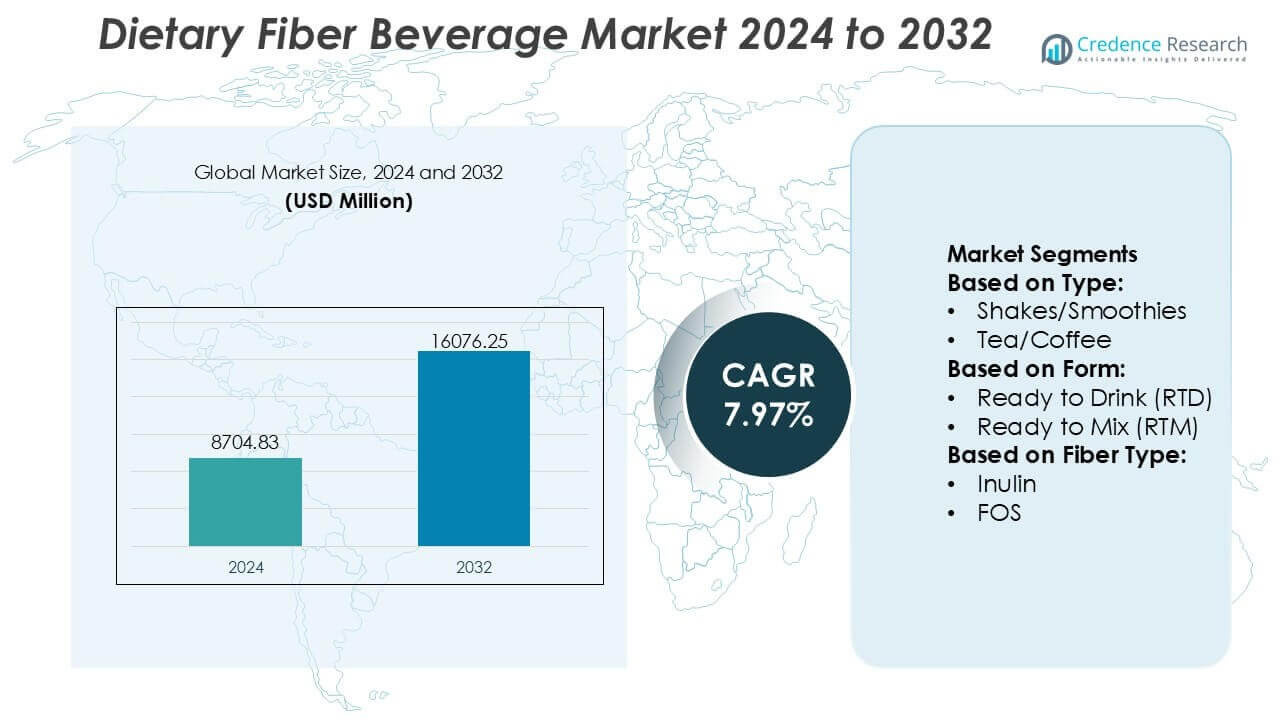
Dietary Fiber Beverage Market size was valued USD 8704.83 million in 2024 and is anticipated to reach USD 16076.25 million by 2032, at a CAGR of 7.97% during the forecast period.
| REPORT ATTRIBUTE | DETAILS |
|---|---|
| Historical Period | 2020-2023 |
| Base Year | 2024 |
| Forecast Period | 2025-2032 |
| Dietary Fiber Beverage Market Size 2024 | USD 8704.83 million |
| Dietary Fiber Beverage Market, CAGR | 7.97% |
| Dietary Fiber Beverage Market Size 2032 | USD 16076.25 million |
Dietary Fiber Beverage Market Insights
- Key market drivers include increasing awareness of digestive and metabolic health, rising incidence of lifestyle-related disorders, and growing preference for fiber-enriched daily nutrition solutions in convenient beverage formats.
- Major market trends highlight strong demand for clean-label, plant-based fibers, taste-masked formulations, and ready-to-drink products, with RTD beverages accounting for an estimated 56% segment share due to ease of consumption.
- The competitive landscape remains moderately consolidated, with leading players leveraging clinical validation, proprietary fiber blends, and global distribution networks to strengthen brand trust and expand portfolios.
- Regionally, North America leads the market with an exact 41% share, driven by high gut-health awareness, strong functional beverage penetration, advanced retail infrastructure, and rapid uptake of premium nutrition products.
Dietary Fiber Beverage Market Segmentation Analysis:
By Type
By type, shakes and smoothies dominate the dietary fiber beverage market, accounting for an estimated around 44% market share. Their leadership is driven by high satiety value, compatibility with soluble fibers, and strong alignment with meal-replacement and digestive wellness trends. These beverages effectively incorporate inulin, FOS, and blended fibers without compromising taste or texture, supporting daily fiber intake targets. Tea and coffee follow due to habitual consumption patterns and growing demand for functional hot beverages, while carbonated drinks gain traction through fiber-enriched gut-health sodas. Other formats remain niche, catering to specialized dietary preferences.
- For instance, GSK developed single-serve shakes delivering more than 8 grams of soluble fiber (such as resistant maltodextrin or partially hydrolyzed guar gum) to support gastrointestinal wellness.
By Form
By form, ready-to-drink (RTD) beverages hold a dominant approximately 63% market share, supported by convenience, on-the-go consumption, and strong penetration in retail and foodservice channels. RTD fiber beverages appeal to urban consumers seeking effortless digestive health solutions without preparation time. Advances in shelf-stable formulations and fiber solubility further strengthen this segment. Ready-to-mix (RTM) products trail but show steady adoption among cost-conscious and fitness-oriented consumers who prefer dosage flexibility and bulk purchasing. The ability to customize fiber intake supports RTM demand, though it remains secondary to the immediacy of RTD offerings.
- For instance, Archer Daniels Midland has commercialized soluble corn- and wheat-based fiber systems under its Fibersol® portfolio that demonstrate solubility above 70 grams per liter at ambient temperature, maintain pH stability between 2.8 and 7.0, and withstand UHT processing at 135 °C for 3–5 seconds without precipitation or sensory degradation, as documented in ADM technical formulation guides.
By Fiber Type
By fiber type, inulin leads the dietary fiber beverage market with an estimated around 38% market share, driven by its neutral taste, high solubility, and strong prebiotic efficacy. Inulin integrates seamlessly into both hot and cold beverages, enabling wide application across shakes, teas, and RTD formats. Fructo-oligosaccharides (FOS) follow due to their digestive tolerance and sweetness-enhancing properties, while galacto-oligosaccharides (GOS) gain relevance in gut-microbiome-focused formulations. Other fibers, including resistant dextrins and polydextrose, serve niche functional roles but face formulation and labeling constraints compared to inulin.
Key Growth Drivers
Rising Preventive Health and Digestive Wellness Awareness
Growing consumer focus on preventive healthcare strongly drives demand for dietary fiber beverages. Urban lifestyles, irregular eating habits, and increasing digestive disorders have heightened awareness of gut health, satiety management, and metabolic balance. Fiber beverages offer a convenient solution by delivering functional benefits such as improved digestion, blood sugar moderation, and cholesterol management without major dietary changes. Health-conscious consumers increasingly view these beverages as daily wellness enhancers rather than therapeutic products, supporting frequent consumption. Expanding public discourse around microbiome health and long-term wellness further reinforces sustained demand across multiple age groups.
- For instance, Herbalife Nutrition Ltd. provides 5 grams of dietary fiber. When added to a Formula 1 Shake, it allows consumers to conveniently reach their daily fiber goals while maintaining a balanced nutrient profile of proteins and vitamins.
Convenience-Oriented Functional Nutrition Consumption
Busy lifestyles continue to shift consumer preferences toward convenient, ready-to-consume nutrition formats, accelerating adoption of dietary fiber beverages. Ready-to-drink and ready-to-mix fiber beverages align well with on-the-go consumption patterns while eliminating preparation barriers associated with traditional fiber sources. This convenience factor is particularly influential among working professionals, students, and urban populations seeking functional benefits within time-constrained routines. The ability to integrate fiber intake into beverages such as smoothies, coffee, and flavored drinks enhances daily compliance, making fiber beverages an attractive alternative to capsules, powders, and high-fiber foods.
- For instance, Abbott has documented in product technical dossiers that its adult nutrition beverages formulated with soluble corn fiber deliver 3–5 grams of dietary fiber per serving, remain fully suspended after 12 months of ambient storage, and tolerate UHT processing at 140 °C for up to 6 seconds without phase separation.
Expanding Applications in Weight Management and Metabolic Health
Dietary fiber beverages benefit from strong demand linked to weight management and metabolic health goals. Soluble fibers that promote fullness and slow digestion are increasingly incorporated into beverages targeting appetite control and calorie management. Rising concerns over obesity, diabetes, and lifestyle-related conditions encourage consumers to adopt fiber-enriched drinks as part of structured wellness regimens. These beverages support controlled energy intake without compromising taste or convenience. As functional nutrition increasingly intersects with personalized health programs, fiber beverages gain traction as accessible tools for managing long-term metabolic health.
Key Trends & Opportunities
Innovation in Fiber Types and Sensory Optimization
Product innovation focused on advanced fiber types presents significant growth opportunities in the dietary fiber beverage market. Manufacturers increasingly utilize prebiotic fibers that support gut microbiota while minimizing taste, texture, and solubility challenges. Improved formulation technologies enable smoother mouthfeel and better flavor compatibility, overcoming historical sensory barriers associated with fiber fortification. This trend allows brands to expand fiber inclusion across diverse beverage formats without compromising consumer experience. Ongoing innovation creates opportunities to target premium wellness segments with differentiated functional claims and enhanced consumption appeal.
- For instance, Nature’s Sunshine utilizes chicory root extract in its fiber and gut health products (e.g., in the NutriBiome portfolio), which typically deliver 4 to 5 grams of prebiotic fiber per recommended scoop.
Premiumization and Clean-Label Positioning
Premiumization trends are shaping opportunities for dietary fiber beverages through clean-label, natural, and minimally processed positioning. Consumers increasingly scrutinize ingredient transparency, favoring beverages formulated with plant-based fibers, low sugar content, and recognizable ingredients. Clean-label claims combined with digestive and immune health benefits support higher perceived value and brand loyalty. This trend enables manufacturers to differentiate offerings through organic sourcing, non-GMO certifications, and reduced artificial additives. As wellness oriented consumers trade up for perceived quality and safety, premium fiber beverages gain stronger shelf presence and pricing power.
- For instance, Bayer AG discloses in technical documentation for its nutrition and consumer-health formulations that selected plant-derived soluble fibers used in drinkable wellness products deliver 3 grams of fiber per serving, meet non-GMO verification standards, and comply with EU Regulation (EC) No 1333/2008 additive purity thresholds.
Key Challenges
Formulation Complexity and Taste Acceptance
Maintaining palatable taste and texture remains a key challenge for dietary fiber beverage manufacturers. High fiber inclusion can negatively affect mouthfeel, clarity, and flavor stability, potentially limiting repeat consumption. Balancing functional dosage with sensory appeal requires advanced formulation expertise and increases development costs. Inconsistent consumer acceptance across different beverage bases further complicates product standardization. Brands must invest in continuous formulation optimization to ensure fiber beverages meet both health expectations and taste preferences, making product development resource-intensive and time-consuming.
Regulatory and Health Claim Compliance
Navigating evolving regulatory frameworks poses challenges for the dietary fiber beverage market. Fiber classification, labeling standards, and permissible health claims vary across regions, increasing compliance complexity for global brands. Stricter scrutiny on digestive and metabolic health claims requires robust scientific substantiation, limiting marketing flexibility. Misalignment between consumer expectations and approved claims can reduce communication effectiveness at the point of sale. Ensuring regulatory compliance while maintaining compelling value propositions demands sustained investment in research, documentation, and regulatory expertise.
Regional Analysis
North America
North America leads the dietary fiber beverage market, accounting for an estimated 38% market share, driven by high consumer awareness of digestive health and preventive nutrition. Strong demand for functional beverages, combined with widespread adoption of clean-label and low-sugar formulations, supports market dominance. Consumers actively seek fiber-enriched RTD beverages and smoothies as part of weight management and gut health routines. Advanced product innovation, robust retail distribution, and strong marketing around microbiome health further accelerate adoption. The presence of established functional beverage brands and high per-capita spending on health and wellness continue to reinforce North America’s leading position.
Europe
Europe holds approximately 27% market share in the dietary fiber beverage market, supported by strong regulatory emphasis on health claims, nutrition labeling, and digestive wellness. Consumers show growing preference for fiber beverages formulated with natural and plant-based ingredients, aligning with clean-label and sustainability trends. High awareness of cholesterol management, metabolic health, and aging-related digestive concerns drives steady consumption. Western Europe leads regional demand, while Eastern Europe shows gradual adoption as functional beverage penetration expands. The region’s mature food and beverage industry and rising interest in preventive healthcare sustain long-term market stability.
Asia-Pacific
Asia-Pacific accounts for around 25% market share and represents the fastest-growing regional market for dietary fiber beverages. Rapid urbanization, changing dietary habits, and increasing incidence of lifestyle-related disorders drive demand for convenient functional nutrition. Consumers increasingly adopt fiber beverages to address digestive issues and balance high-carbohydrate diets. Growing middle-class populations and expanding modern retail channels further support market expansion. Countries with strong beverage consumption cultures show higher adoption of fiber-infused teas, juices, and RTD products. Ongoing product localization and affordability-focused innovation continue to enhance penetration across diverse consumer segments.
Latin America
Latin America captures nearly 6% market share, supported by rising awareness of digestive health and increasing demand for functional beverages. Urban consumers are gradually shifting toward fiber-enriched drinks as part of weight management and wellness routines. While traditional diets remain fiber-rich, modern lifestyles and processed food consumption create opportunities for fortified beverages. Market growth is aided by expanding retail infrastructure and improving product availability. However, price sensitivity and limited consumer education in some markets moderate adoption rates. As health-focused marketing and product affordability improve, fiber beverages gain broader regional acceptance.
Middle East & Africa
The Middle East & Africa region holds an estimated 4% market share, reflecting early-stage but growing adoption of dietary fiber beverages. Increasing prevalence of obesity, diabetes, and digestive disorders is driving interest in functional nutrition solutions. Urban populations show rising demand for convenient health beverages, particularly in premium retail segments. However, limited product awareness, lower penetration of functional beverages, and price constraints restrict rapid growth. Expansion of modern retail channels, coupled with targeted health education initiatives, is expected to gradually improve market penetration and support long-term growth across the region.
Dietary Fiber Beverage Market Segmentations:
By Type:
- Shakes/Smoothies
- Tea/Coffee
By Form:
- Ready to Drink (RTD)
- Ready to Mix (RTM)
By Fiber Type:
- Inulin
- FOS
By Geography
- North America
- U.S.
- Canada
- Mexico
- Europe
- Germany
- France
- U.K.
- Italy
- Spain
- Rest of Europe
- Asia Pacific
- China
- Japan
- India
- South Korea
- South-east Asia
- Rest of Asia Pacific
- Latin America
- Brazil
- Argentina
- Rest of Latin America
- Middle East & Africa
- GCC Countries
- South Africa
- Rest of the Middle East and Africa
Competitive Landscape
The competitive landscape of the dietary fiber beverage market players such as GlaxoSmithKline plc., Archer Daniels Midland, Herbalife Nutrition Ltd., Abbott, Nature's Sunshine Products, Inc., Bayer AG, NU SKIN, Pfizer Inc., Glanbia plc, Amway Corp. The dietary fiber beverage market exhibits a competitive landscape shaped by continuous product innovation, formulation differentiation, and expanding health-focused positioning. Market participants compete by enhancing fiber solubility, taste masking, and bioavailability to improve consumer compliance and repeat usage. Strong emphasis is placed on scientifically supported digestive, metabolic, and immune health benefits, supported by clinical validation and regulatory alignment. Companies increasingly prioritize ready-to-drink and ready-to-mix formats to address convenience-driven consumption patterns, while clean-label claims, reduced sugar content, and natural ingredient sourcing strengthen brand appeal. Advanced sourcing strategies and optimized supply chains help manage raw material volatility and ensure consistent product quality. In addition, omnichannel distribution, including direct-to-consumer platforms and pharmacy-led retail, plays a critical role in market penetration. Competitive intensity continues to rise as players balance premium functional positioning with affordability to capture a broad consumer base.
Key Player Analysis
- GlaxoSmithKline plc.
- Archer Daniels Midland
- Herbalife Nutrition Ltd.
- Abbott
- Nature's Sunshine Products, Inc.
- Bayer AG
- NU SKIN
- Pfizer Inc.
- Glanbia plc
- Amway Corp.
Recent Developments
- In March 2025, PepsiCo, Inc. has announced its definitive agreement to acquire poppi, a leading prebiotic soda brand. PepsiCo continues to diversify its beverage portfolio with functional, health-conscious options to meet evolving consumer demand.
- In February 2025, Oobli and Ingredion announced a partnership in February 2025 to accelerate access to sweet proteins, combining them with natural sweeteners like stevia to offer healthier, lower-cost sugar alternatives for the food and beverage industry, leveraging Oobli's fermentation-produced proteins for products like sodas, yogurts, and baked goods, and aiming to reduce sugar content significantly.
- In January 2025, Celsius Holdings, Inc. introduced CELSIUS HYDRATION™, a new line of electrolyte-based powder sticks to support hydration with zero sugar, B vitamins, essential electrolytes and the refreshing, fruit-forward flavors of CELSIUS energy drinks.
Report Coverage
The research report offers an in-depth analysis based on Type, Form, Fiber Type and Geography. It details leading market players, providing an overview of their business, product offerings, investments, revenue streams, and key applications. Additionally, the report includes insights into the competitive environment, SWOT analysis, current market trends, as well as the primary drivers and constraints. Furthermore, it discusses various factors that have driven market expansion in recent years. The report also explores market dynamics, regulatory scenarios, and technological advancements that are shaping the industry. It assesses the impact of external factors and global economic changes on market growth. Lastly, it provides strategic recommendations for new entrants and established companies to navigate the complexities of the market.
Future Outlook
- Dietary fiber beverages will gain wider adoption as preventive digestive health becomes a daily wellness priority.
- Product innovation will focus on improving taste, clarity, and solubility of fiber formulations to enhance consumer acceptance.
- Ready-to-drink and single-serve formats will expand rapidly, driven by convenience-oriented consumption habits.
- Demand for clean-label, plant-based, and naturally sourced fibers will strengthen product differentiation.
- Personalized nutrition and condition-specific fiber blends will create new premium product categories.
- Integration of fibers supporting metabolic and immune health will broaden functional positioning beyond digestion.
- Digital health platforms and direct-to-consumer channels will play a larger role in consumer engagement and education.
- Regulatory compliance and substantiated health claims will increasingly influence product development strategies.
- Emerging markets will witness faster penetration due to rising awareness of gut health and lifestyle diseases.
- Sustainability-focused sourcing and recyclable packaging will become critical factors in long-term brand competitiveness.

Request a Free Sample
Fill in your details and we'll send you a free sample report.
- Sample data tables & charts
- Research methodology
Need a Custom Version of This Report?
Tailor the scope, geography, or segments to your exact requirements.
- Custom geography or segment scope
- Direct access to our analyst team
Frequently Asked Questions
What is the current market size for the Dietary Fiber Beverage Market, and what is its projected size in 2032?
At what Compound Annual Growth Rate is the Dietary Fiber Beverage Market projected to grow between 2024 and 2032?
Which Dietary Fiber Beverage Market segment held the largest share in 2024?
What are the primary factors fueling the growth of the Dietary Fiber Beverage Market?
Who are the leading companies in the Dietary Fiber Beverage Market?
Which region commanded the largest share of the Dietary Fiber Beverage Market in 2024?
Table of Content
Chapter 1 Market Segmentation
- 1.1 Segmentation Framework
- 1.1.1 Product and Service Classification
- 1.1.2 Application and End-Use Classification
- 1.1.3 Technology and Solution Classification
- 1.1.4 Customer and Distribution Channel Classification
- 1.1.5 Geographic Segmentation
- 1.1.6 Market Segment Definitions and Boundaries
Chapter 2 Introduction
- 2.1 Report Objectives and Scope
- 2.2 Product Definition and Industry Terminology
- 2.3 Market Inclusions and Exclusions
- 2.4 Research Process
- 2.4.1 Primary Research and Expert Interviews
- 2.4.2 Secondary Research and Source Review
- 2.4.3 Top-Down and Bottom-Up Estimation
- 2.4.4 Data Triangulation and Verification
- 2.5 Market Size Measurement Basis
- 2.5.1 2024: USD 8704.83 million → 2032: USD 16076.25 million
- 2.6 Historical and Forecast Reference Periods
- 2.6.1 Base Year: 2024
- 2.6.2 Forecast Period: 2024-2032
- 2.7 Research Assumptions and Limitations
Chapter 3 Executive Summary
- 3.1 Market Snapshot and Key Findings
- 3.2 Base-Year Market Size, 2024
- 3.3 Forecast Market Size, 2032
- 3.4 Revenue and Volume Growth Outlook
- 3.5 Key Demand and Supply Indicators
- 3.6 Leading Market Segments
- 3.7 Fastest-Growing Market Opportunities
- 3.8 Regional Performance Highlights
- 3.9 Technology and Industry Transformation
- 3.10 Competitive Landscape Summary
- 3.11 Analyst View and Strategic Implications
Chapter 4 Global Dietary Fiber Beverage Market Trends and Developments
- 4.1 Historical Industry Development
- 4.2 Recent Market Trends and Developments
- 4.3 Demand and Customer Behavior Trends
- 4.4 Technology and Product Innovation
- 4.5 Artificial Intelligence, Automation and Digitalization
- 4.6 Local Manufacturing and Supply Chain Realignment
- 4.7 Industry Partnerships, Mergers and Acquisitions
- 4.8 Sustainability and Circular Economy Developments
- 4.9 Government and Private Sector Investment Trends
- 4.10 Emerging Business Models and Commercialization
- 4.11 Industry Developments and Announcements
Chapter 5 Global Dietary Fiber Beverage Market Production, Supply and Demand Analysis
- 5.1 Demand Trend and Consumption Analysis
- 5.2 Demand Forecast, 2024-2032
- 5.3 Production and Output Trend
- 5.4 Production and Output Forecast, 2024-2032
- 5.5 Installed Capacity and Capacity Utilization
- 5.6 Company-Wise Production Plants and Statistics
- 5.6.1 Installed Production Capacity
- 5.6.2 Actual Production
- 5.6.3 Planned Capacity and Expansion Targets
- 5.7 Supply Chain Structure and Procurement Trends
- 5.8 Supply-Demand Gap and Bottlenecks
- 5.9 Import Dependence and Sourcing Structure
- 5.10 Contract Manufacturing and Outsourcing
- 5.11 Regional Supply and Demand Concentration
Chapter 6 Global Dietary Fiber Beverage Market Pricing Analysis
- 6.1 Pricing Structure and Measurement
- 6.2 Historical Pricing Trends
- 6.3 Pricing Outlook, 2024-2032
- 6.4 Average Selling Price and Unit Economics
- 6.5 Pricing by Product and Market Segment
- 6.6 Geographic Pricing Differences
- 6.7 Key Input, Energy, Labor and Logistics Costs
- 6.8 Contract Pricing and Purchasing Models
- 6.9 Pricing Sensitivity and Competitive Positioning
- 6.10 Price, Margin and Profitability Implications
Chapter 7 Global Dietary Fiber Beverage Market Dynamics
- 7.1 Market Growth Drivers
- 7.1.1 Demand-Side Drivers
- 7.1.2 Technology and Innovation Drivers
- 7.1.3 Infrastructure and Investment Drivers
- 7.1.4 Regulatory and Policy Drivers
- 7.2 Market Restraints
- 7.2.1 Cost and Affordability Constraints
- 7.2.2 Technology and Adoption Barriers
- 7.2.3 Supply Chain and Operational Constraints
- 7.3 Market Challenges
- 7.3.1 Competitive Pressure and Margin Erosion
- 7.3.2 Skills, Infrastructure and Implementation Gaps
- 7.4 Emerging Market Opportunities
- 7.5 Market Dynamics Impact and Time-Horizon Assessment
Chapter 8 Global Dietary Fiber Beverage Value Chain Analysis
- 8.1 Industry Value Chain Overview
- 8.2 Upstream Suppliers and Critical Inputs
- 8.3 Technology and Component Providers
- 8.4 Manufacturing or Service Delivery
- 8.5 Distribution, Channel Partners and Integrators
- 8.6 Downstream Applications and End Users
- 8.7 Value Addition and Profit Pools
- 8.8 Vertical Integration and Outsourcing
- 8.9 Supplier Concentration and Risk
- 8.10 Supply Chain Localization and Resilience
Chapter 9 Global Dietary Fiber Beverage Market Regulations and Policies
- 9.1 Relevant Laws, Standards and Compliance Frameworks
- 9.2 Product, Service, Safety and Quality Requirements
- 9.3 Government Policies, Incentives and Subsidies
- 9.4 Imports, Exports and Trade Barriers
- 9.5 Public Procurement and Local Content Requirements
- 9.6 Environmental and Sustainability Compliance
- 9.7 Upcoming Policy Changes and Market Implications
Chapter 10 Global Dietary Fiber Beverage Market Hotspots and Opportunities
- 10.1 Market Opportunity Mapping and Growth Hotspots
- 10.2 High-Growth Applications and Customer Groups
- 10.3 Underserved Markets and White-Space Opportunities
- 10.4 Emerging Technology and Product Opportunities
- 10.5 New Capacity and Investment Hotspots
- 10.6 Market Entry and Expansion Opportunities
- 10.7 Distribution and Partnership Opportunities
- 10.8 Near-Term and Long-Term Commercial Potential
- 10.9 Opportunity Attractiveness and Execution Risks
Chapter 11 Global Dietary Fiber Beverage Market Outlook, 2024-2032
- 11.1 Market Size and Analysis
- 11.1.1 Revenue (Market Measurement: 2024: USD 8704.83 million → 2032: USD 16076.25 million)
- 11.1.2 Market Volume and Quantity Sold
- 11.1.3 Historical Market Size
- 11.1.4 Base-Year Market Size, 2024
- 11.2 Market Forecast, 2024-2032
- 11.2.1 Revenue Forecast to 2032
- 11.2.2 Volume Forecast to 2032
- 11.2.3 CAGR and Year-on-Year Growth
- 11.2.4 Incremental Revenue Opportunity
- 11.3 Forecast Assumptions and Scenario Analysis
- 11.3.1 Base-Case Forecast
- 11.3.2 Optimistic and Conservative Scenarios
- 11.3.3 Technology, Pricing and Policy Sensitivities
- 11.4 Market Attractiveness and Growth Outlook
Chapter 12 Global Dietary Fiber Beverage Market Segmentation and Outlook
- 12.1 Segmentation Summary and Market Shares, 2024
- 12.2 Largest and Fastest-Growing Segments
- 12.3 Segment Growth Comparison
- 12.4 Segment Attractiveness and Priority Matrix
Chapter 13 Global Dietary Fiber Beverage Geographic Market Outlook, 2024-2032
- 13.1 Regional Market Size and Share, 2024
- 13.2 Regional Market Forecast, 2024-2032
- 13.3 Regional Pricing, Production and Demand Differences
- 13.4 North America
- 13.4.1 United States
- 13.4.2 Canada
- 13.4.3 Mexico
- 13.5 Europe
- 13.5.1 Germany
- 13.5.2 France
- 13.5.3 Italy
- 13.5.4 United Kingdom
- 13.5.5 Spain
- 13.5.6 Poland
- 13.5.7 Russia
- 13.5.8 Netherlands
- 13.5.9 Belgium
- 13.5.10 Sweden
- 13.5.11 Denmark
- 13.5.12 Norway
- 13.5.13 Rest of Europe
- 13.6 Asia Pacific
- 13.6.1 China
- 13.6.2 India
- 13.6.3 Japan
- 13.6.4 South Korea
- 13.6.5 Thailand
- 13.6.6 Indonesia
- 13.6.7 Vietnam
- 13.6.8 Malaysia
- 13.6.9 Australia
- 13.6.10 Rest of Asia Pacific
- 13.7 Latin America
- 13.7.1 Brazil
- 13.7.2 Argentina
- 13.7.3 Colombia
- 13.7.4 Chile
- 13.7.5 Rest of Latin America
- 13.8 Middle East
- 13.8.1 Saudi Arabia
- 13.8.2 United Arab Emirates
- 13.8.3 Turkey
- 13.8.4 Israel
- 13.8.5 Iran
- 13.8.6 Rest of the Middle East
- 13.9 Africa
- 13.9.1 South Africa
- 13.9.2 Egypt
- 13.9.3 Nigeria
- 13.9.4 Morocco
- 13.9.5 Rest of Africa
- 13.10 Regional Investment, Policy and Supply Chain Differences
- 13.11 Regional Competitive Landscape
- 13.12 Geographic Growth Hotspots
Chapter 14 Global Dietary Fiber Beverage Technology, Innovation and Sustainability Outlook
- 14.1 Technology Landscape and Maturity
- 14.2 Product, Process and Service Innovation
- 14.3 AI, Automation and Digital Tools in the Industry
- 14.4 Technology Adoption and Performance Benchmarking
- 14.5 Innovation Pipeline and R&D Investment
- 14.6 Patent and Intellectual Property Trends
- 14.7 Energy Efficiency and Resource Management
- 14.8 Sustainability, Recycling and Circularity
- 14.9 Technology Roadmap, 2024-2032
- 14.10 Risks of Obsolescence and Technology Substitution
Chapter 15 Global Dietary Fiber Beverage Market Key Strategic Imperatives
- 15.1 Growth and Market Entry Priorities
- 15.2 High-Return Products and Segments
- 15.3 Pricing, Profitability and Cost Optimization
- 15.4 Technology Investment and Product Differentiation
- 15.5 Supply Chain Localization and Resilience
- 15.6 Distribution and Customer Acquisition
- 15.7 Partnership, Acquisition and Capacity Strategy
- 15.8 Regional Expansion Priorities
- 15.9 Short-, Medium- and Long-Term Actions
Chapter 16 Competition Outlook
- 16.1 Industry Competition Characteristics
- 16.2 Market Structure and Concentration
- 16.3 Market Share and Competitive Positioning, 2024
- 16.4 Company-Wise Revenue and Product Benchmarking
- 16.5 Production and Service Capacity Benchmarking
- 16.6 Technology, Pricing and Differentiation
- 16.7 Regional Footprint and Distribution Strength
- 16.8 Mergers, Acquisitions and Strategic Alliances
- 16.9 New Entrants and Competitive Threats
- 16.10 Porter's Five Forces and Industry Attractiveness
- 16.11 Competitive Outlook, 2024-2032
Chapter 17 Company Profiles
- 17.1 Company Coverage and Selection Criteria
- 17.2 Leading Market Participants – Standard Profile Structure
- 17.2.1 Business Description
- 17.2.2 Company Ownership and Geographic Presence
- 17.2.3 Product and Service Portfolio
- 17.2.4 Manufacturing and Operating Footprint
- 17.2.5 Production Capacity and Expansion Plans
- 17.2.6 Financial Performance and Investment
- 17.2.7 Market Share and Competitive Position
- 17.2.8 Technology and Innovation Capabilities
- 17.2.9 Strategic Alliances or Partnerships
- 17.2.10 Recent Developments
- 17.2.11 Growth Strategy and Outlook
- 17.3 Other Relevant Market Participants
Note: Every listed company is profiled on the structure shown under the first company. The company list is preliminary and may change based on research findings, market developments, data availability and client requirements.
Chapter 18 Disclaimer
- 18.1 Research and Forecast Disclaimer
- 18.2 Data Source and Estimation Limitations
Note: The depth of individual sections depends on data availability for this market. Volume, capacity, trade and other unit-based metrics are included where applicable.