
| REPORT ATTRIBUTE | DETAILS |
|---|---|
| Historical Period | 2020-2023 |
| Base Year | 2024 |
| Forecast Period | 2025-2032 |
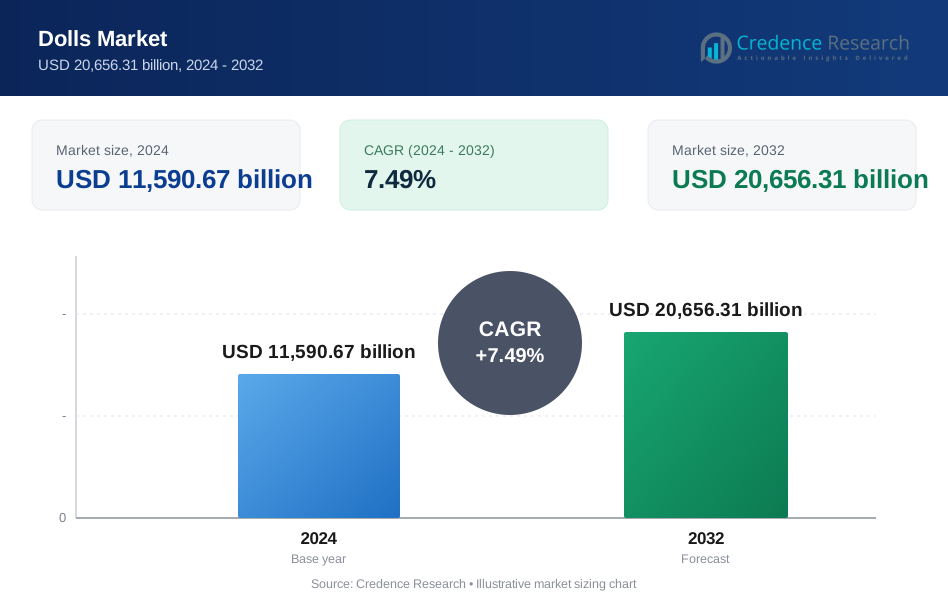
| Dolls MarketSize 2024 | USD 11,590.67 billion |
| Dolls Market, CAGR | 7.49% |
| Dolls Market Size 2032 | USD 20,656.31 billion |
Market Overview
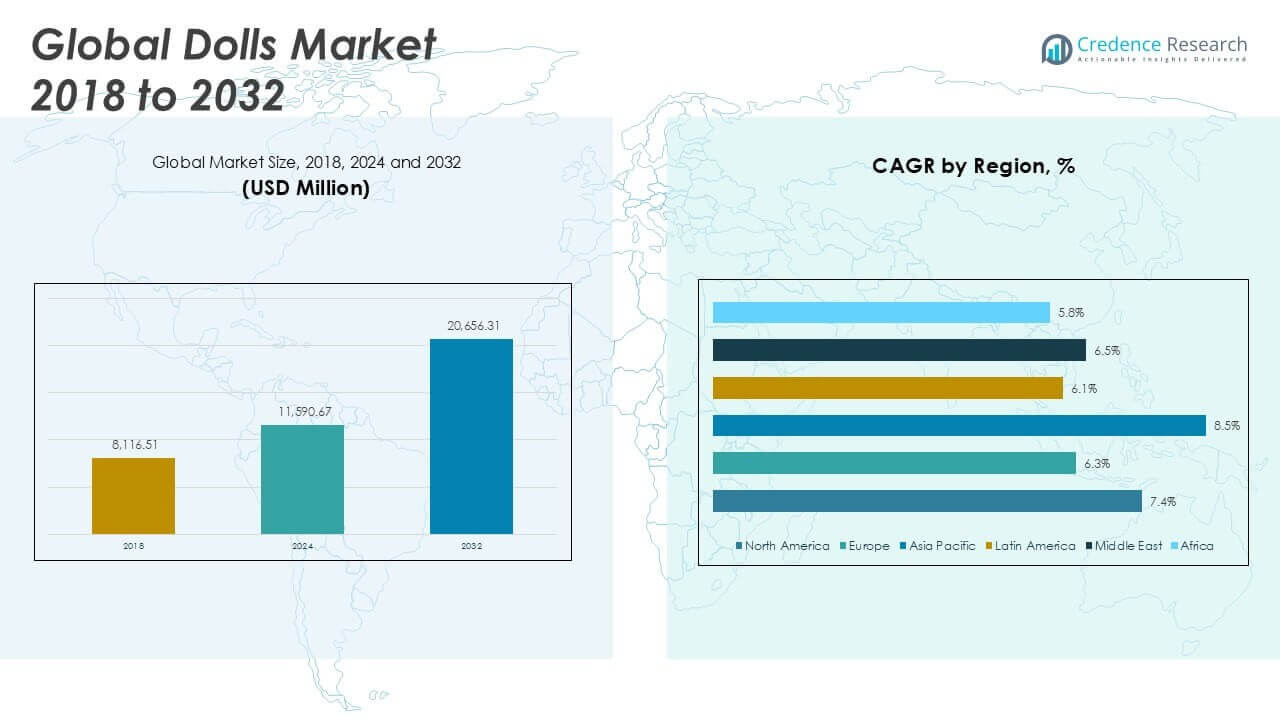
Dolls Market size was valued at USD 8,116.51 billion in 2018 to USD 11,590.67 billion in 2024 and is anticipated to reach USD 20,656.31 billion by 2032, at a CAGR of 7.49% during the forecast period.
The Dolls Market is experiencing steady growth, propelled by increasing disposable incomes, evolving parenting practices, and a surge in demand for educational and themed dolls across global markets. Manufacturers introduce a wide variety of products that reflect popular culture, diversity, and inclusivity, appealing to modern consumer preferences and fostering emotional connections with young audiences. It benefits from the influence of digital media, as well as strategic licensing agreements with entertainment franchises, which boost brand visibility and drive sales. E-commerce platforms and omnichannel retailing expand accessibility, allowing consumers to discover and purchase innovative doll products with ease. Sustainability trends are prompting companies to explore eco-friendly materials and packaging, responding to rising environmental awareness among parents and children. Social media marketing and influencer collaborations further shape market trends, promoting interactive, collectible, and tech-integrated dolls that align with contemporary play patterns. Collectively, these factors support robust and diversified market expansion.
The Dolls Market demonstrates vibrant growth across key regions, with North America, Europe, and Asia Pacific emerging as primary hubs for both production and consumption. North America leads with robust consumer spending and the popularity of iconic brands, while Europe benefits from a strong collector culture and a focus on educational and sustainable toys in markets such as the United Kingdom, Germany, and France. Asia Pacific is experiencing rapid expansion, fueled by urbanization, rising incomes, and the influence of popular media in countries like China, Japan, and India. Key players shaping the competitive landscape include Mattel, MGA Entertainment, Hasbro, and Disney, each known for their extensive portfolios, global distribution networks, and ongoing product innovation. These companies set industry trends and adapt quickly to evolving consumer preferences, ensuring strong brand presence across diverse geographies.
Market Insights
- The Dolls Market was valued at USD 11,590.67 billion in 2024 and is projected to reach USD 20,656.31 billion by 2032, with a CAGR of 7.49% during the forecast period.
- Increasing disposable incomes, changing family dynamics, and the popularity of educational and themed dolls are driving robust demand worldwide.
- Diversity, inclusivity, and sustainability are key trends, with manufacturers introducing dolls representing various ethnicities, abilities, and eco-friendly materials.
- Leading players such as Mattel, MGA Entertainment, Hasbro, and Disney maintain their positions through product innovation, brand partnerships, and expansive distribution networks.
- The market faces restraints from regulatory compliance requirements, heightened price sensitivity, and the proliferation of low-cost and counterfeit products.
- North America, Europe, and Asia Pacific are the major regions, with Asia Pacific expected to post the fastest growth due to rising incomes and expanding urban populations.
- Brands are leveraging e-commerce, influencer marketing, and personalized product offerings to expand reach and strengthen consumer engagement across diverse markets.
Market Drivers
Rising Disposable Incomes and Changing Family Structures Fuel Growth
Increasing disposable incomes in both developed and emerging economies play a pivotal role in driving the Dolls Market. Parents with higher spending capacity invest in a broader range of toys, including premium, collectible, and interactive dolls. Dual-income households and smaller family sizes support greater discretionary spending per child, stimulating demand for high-quality and themed doll products. The market benefits from gifting culture and the tradition of purchasing dolls for birthdays, holidays, and special occasions. Urbanization and modern lifestyles increase the focus on play-based learning, encouraging parents to seek toys that contribute to child development. It leverages these socioeconomic shifts to maintain robust sales momentum across regions.
- For instance, urbanization and modern lifestyles have contributed to the growing focus on play-based learning, encouraging parents to seek toys that support child development.
Product Innovation and Brand Licensing Expand Consumer Appeal
Ongoing product innovation shapes the competitive landscape of the Dolls Market, with manufacturers introducing dolls that reflect diversity, popular culture, and evolving play patterns. Licensing agreements with major entertainment franchises boost brand recognition and attract young consumers. Companies frequently update product lines to include interactive features, educational themes, and customizable options, aligning with contemporary parental preferences. The market witnesses strong collaboration between toy makers and content creators, enabling rapid adaptation to current trends and media influences. Collectible and limited-edition dolls further stimulate consumer interest and drive repeat purchases. It thrives by anticipating and responding to changing consumer tastes.
Digitalization and E-commerce Revolutionize Market Accessibility
The rapid adoption of e-commerce and digital marketing transforms the Dolls Market, making it easier for consumers to discover and purchase products globally. Online platforms allow brands to reach new audiences, offer personalized shopping experiences, and provide direct-to-consumer sales channels. Digital content, including social media campaigns and influencer partnerships, enhances brand engagement and awareness. Manufacturers leverage virtual try-ons, interactive videos, and online customization tools to attract tech-savvy parents and children. E-commerce supports a broader product assortment, competitive pricing, and convenient delivery, further stimulating market growth. It capitalizes on digital transformation to strengthen market penetration and responsiveness.
- For instance, licensing agreements with major entertainment franchises have led to increased sales of dolls featuring characters from blockbuster films.
Sustainability and Ethical Production Gain Importance
Environmental consciousness drives demand for sustainable dolls made from eco-friendly materials and packaging. The Dolls Market responds to consumer expectations for ethical sourcing, safety, and transparency in manufacturing processes. Regulatory requirements and consumer advocacy shape industry standards, prompting companies to innovate with recyclable, biodegradable, or recycled components. Brands that prioritize sustainability enjoy increased trust and loyalty, differentiating themselves in a competitive landscape. It invests in green technologies, supply chain transparency, and responsible marketing to meet evolving environmental and social expectations. This commitment to sustainability reinforces long-term market resilience and supports responsible industry growth.
Market Trends
Diversity and Inclusivity Drive Product Development
The Dolls Market sees a pronounced shift toward diversity and inclusivity, reflecting changing societal values and consumer expectations. Manufacturers introduce dolls that represent various ethnicities, abilities, and family structures, making play more relatable and empowering for children from different backgrounds. This trend extends to gender-neutral and non-traditional character designs, which broaden the market’s appeal and address evolving social norms. It encourages brands to collaborate with advocates and community organizations to develop authentic, culturally relevant products. The emphasis on inclusivity boosts brand reputation and resonates with parents seeking positive role models for their children. This focus on representation supports both customer loyalty and industry leadership.
- For instance, manufacturers are increasingly introducing dolls that represent various ethnicities, abilities, and family structures to promote inclusivity in children's play.
Technology Integration Elevates Play Experience
The integration of technology in dolls is reshaping the Dolls Market, creating more interactive and immersive play experiences. Smart dolls equipped with sensors, voice recognition, and augmented reality features appeal to tech-savvy families and align with the growing popularity of STEM-focused toys. It enables children to engage in personalized storytelling, educational games, and real-time connectivity with apps or other devices. Technology-driven products capture consumer interest and drive premium pricing, providing companies with new avenues for differentiation. The market supports continuous product enhancement, leveraging feedback from parents and children to refine tech-enabled features. This trend enhances engagement and positions the industry for future innovation.
- For instance, interactive dolls with voice recognition, artificial intelligence, and augmented reality features are gaining popularity among tech-savvy families.
Sustainability Initiatives Influence Consumer Choices
Sustainability remains a core trend, influencing how manufacturers source materials and design packaging in the Dolls Market. Eco-friendly dolls made from recycled, biodegradable, or plant-based components appeal to environmentally conscious consumers. It motivates brands to adopt transparent labeling, reduce plastic use, and implement circular economy principles in their supply chains. Collaboration with environmental organizations and investment in green technologies help companies stay ahead of regulatory requirements. Sustainability messaging and green certifications enhance brand credibility and create differentiation in a crowded marketplace. This commitment to responsible production reflects broader industry values and secures long-term consumer trust.
Personalization and Collector Culture Expand Market Reach
A growing appetite for personalized and collectible dolls shapes purchasing behaviors and brand strategies. The Dolls Market introduces customizable options, such as name engraving, outfit selection, and character accessories, to satisfy consumer desire for unique experiences. Limited-edition releases and collaborations with designers or celebrities create exclusivity, fueling demand among collectors of all ages. Social media communities and digital platforms amplify collector culture, supporting secondary markets and brand engagement. Personalization features foster emotional connections and encourage repeat purchases. It capitalizes on these trends by developing innovative collections and enhancing direct-to-consumer engagement strategies.
Market Challenges Analysis
Regulatory Compliance and Safety Standards Raise Operational Demands
The Dolls Market faces increasing complexity from evolving regulatory frameworks and stringent safety standards across global markets. It must ensure all products meet strict requirements for material safety, labeling, and manufacturing processes, especially for younger age groups. Frequent changes in compliance rules demand ongoing investments in testing, certification, and supply chain transparency. Non-compliance can lead to product recalls, legal liabilities, and reputational risks, making proactive quality assurance essential. Brands face the challenge of harmonizing standards across multiple regions, adding to operational and logistical pressures. These regulatory demands elevate costs and require continuous adaptation to maintain access to key markets.
- For instance, toy safety regulations such as the Consumer Product Safety Improvement Act (CPSIA) in the U.S. and the European Union’s Toy Safety Directive mandate rigorous testing and certification for dolls to ensure child safety.
Price Sensitivity and Market Saturation Intensify Competition
Rising price sensitivity among consumers and increasing market saturation present persistent challenges in the Dolls Market. It contends with competition from both established brands and low-cost alternatives, putting pressure on margins and driving frequent price wars. Economic uncertainty influences discretionary spending, leading to fluctuating demand and slower sales growth, particularly in emerging regions. The influx of generic and counterfeit products undermines brand value and complicates market dynamics. To stay competitive, companies must balance affordability with product quality, innovation, and effective marketing. These factors demand strategic agility and a sharp focus on customer engagement to retain market share.
Market Opportunities
Expansion into Emerging Markets and Diverse Demographics
Rising urbanization and income growth in emerging markets offer significant opportunities for the Dolls Market to broaden its consumer base. It can increase market penetration by introducing affordable and culturally relevant doll collections tailored to local preferences and traditions. Collaborating with regional retailers and e-commerce platforms allows brands to reach new audiences and respond swiftly to shifting demand. Understanding the preferences of different age groups and family structures supports targeted product innovation and marketing strategies. Brands that invest in education-focused campaigns and interactive content foster brand loyalty and long-term engagement. These initiatives create pathways to sustainable growth in untapped geographies.
Innovation in Eco-Friendly and Technology-Driven Products
Sustained interest in sustainability and digital integration opens new avenues for product development in the Dolls Market. It can leverage advanced materials and smart technologies to introduce dolls that meet environmental standards and appeal to tech-savvy consumers. Launching collections with customizable, interactive features enhances brand differentiation and supports premium pricing. Partnerships with technology companies and environmental organizations help develop unique value propositions and expand market presence. Clear communication of green credentials and safety standards builds consumer trust and competitive advantage. Continuous investment in innovation and sustainability positions brands to capture emerging trends and lead industry transformation.
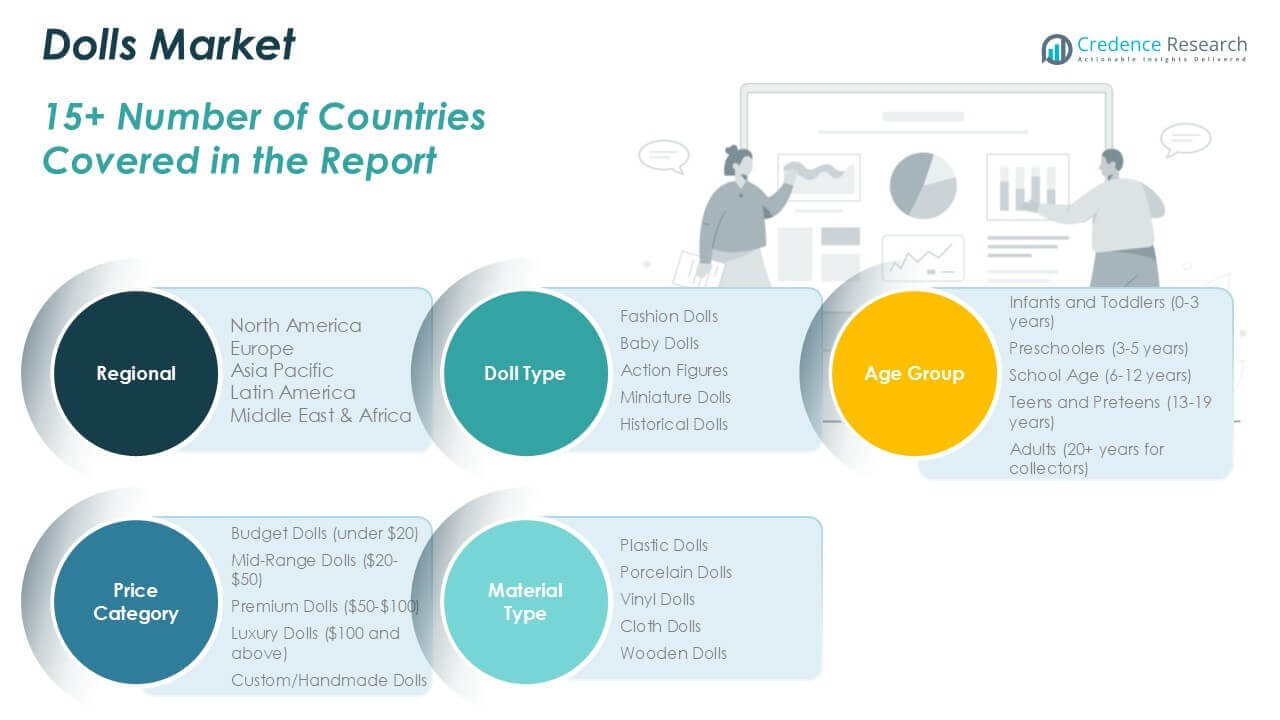
Market Segmentation Analysis:
By Type:
The Dolls Market demonstrates a diverse segmentation strategy, effectively serving a wide spectrum of consumer preferences, age groups, and price sensitivities. By type, fashion dolls and baby dolls dominate sales, driven by their strong association with imaginative play and popular cultural trends. Action figures hold significant appeal for both younger children and collectors, often reflecting characters from films, television, and comics. Miniature dolls attract consumers interested in detailed playsets and accessories, while historical dolls cater to educational interests and the collector community, reflecting different eras and cultural backgrounds.
By Age Group:
By age group, the market offers specialized products for infants and toddlers, focusing on safety, tactile development, and early learning. Preschoolers and school-age children represent a core consumer segment, with demand for dolls that foster creativity, storytelling, and social skills. Teens and preteens seek themed or collectible dolls, often connected to trends or digital content, while adults engage with high-value, limited-edition, and custom dolls for personal collections or gifts.
By Price:
The Dolls Market segments pricing to ensure accessibility and market penetration across diverse consumer bases. Budget dolls under $20 meet the needs of value-conscious shoppers and enable impulse buying. Mid-range dolls, priced between $20 and $50, balance affordability with branded features, appealing to parents seeking quality and durability. Premium dolls in the $50–$100 range offer enhanced customization, branded collections, and innovative designs, attracting both children and adult buyers. Luxury dolls, priced above $100, and custom or handmade dolls appeal to collectors and those seeking exclusivity, artistry, or unique design elements.
Segments:
Based on Type:
- Fashion Dolls
- Baby Dolls
- Action Figures
- Miniature Dolls
- Historical Dolls
Based on Age Group:
- Infants and Toddlers (0–3 years)
- Preschoolers (3–5 years)
- School Age (6–12 years)
- Teens and Preteens (13–19 years)
- Adults (20+ years for collectors)
Based on Price:
- Budget Dolls (under $20)
- Mid-Range Dolls ($20–$50)
- Premium Dolls ($50–$100)
- Luxury Dolls ($100 and above)
- Custom/Handmade Dolls
Based on Material Type:
- Plastic Dolls
- Porcelain Dolls
- Vinyl Dolls
- Cloth Dolls
- Wooden Dolls
Based on the Geography:
- North America
- U.S.
- Canada
- Mexico
- Europe
- UK
- France
- Germany
- Italy
- Spain
- Russia
- Belgium
- Netherlands
- Austria
- Sweden
- Poland
- Denmark
- Switzerland
- Rest of Europe
- Asia Pacific
- China
- Japan
- South Korea
- India
- Australia
- Thailand
- Indonesia
- Vietnam
- Malaysia
- Philippines
- Taiwan
- Rest of Asia Pacific
- Latin America
- Brazil
- Argentina
- Peru
- Chile
- Colombia
- Rest of Latin America
- Middle East
- UAE
- KSA
- Israel
- Turkey
- Iran
- Rest of Middle East
- Africa
- Egypt
- Nigeria
- Algeria
- Morocco
- Rest of Africa
Regional Analysis
North America Dolls Market
North America Dolls Market grew from USD 2,771.92 billion in 2018 to USD 3,905.83 billion in 2024 and is projected to reach USD 6,985.57 billion by 2032, reflecting a compound annual growth rate (CAGR) of 7.4%. North America holds approximately 34% market share, with the United States leading in demand, followed by Canada and Mexico. The region benefits from high disposable incomes, a strong culture of gifting, and the influence of major entertainment franchises that frequently launch doll collections. E-commerce penetration and widespread retail distribution support rapid product adoption and consumer access. The U.S. continues to drive innovation with tech-integrated and themed dolls, while Canadian and Mexican markets show increasing interest in educational and sustainable products. Brands maintain competitiveness by investing in product diversity and engaging digital marketing strategies.
Europe Dolls Market
Europe Dolls Market grew from USD 1,746.12 billion in 2018 to USD 2,374.98 billion in 2024 and is forecast to reach USD 3,902.07 billion by 2032, posting a CAGR of 6.3%. Europe accounts for roughly 19% of global market share, with key contributions from the United Kingdom, Germany, and France. Regional demand stems from cultural emphasis on educational and historical toys, as well as robust collector communities. Stringent safety regulations and a growing preference for eco-friendly dolls shape product development and marketing. Retailers in Western Europe focus on both traditional specialty stores and online platforms. Markets in Eastern Europe show emerging potential, particularly for affordable and diverse doll ranges.
Asia Pacific Dolls Market
Asia Pacific Dolls Market grew from USD 2,374.21 billion in 2018 to USD 3,577.48 billion in 2024 and is projected to reach USD 6,946.55 billion by 2032, registering the highest CAGR of 8.5%. The region holds about 34% market share, led by China, Japan, and India. Urbanization, rising disposable incomes, and the popularity of global pop culture drive robust growth. The market thrives on product customization and rapid new launches tailored to local tastes. E-commerce growth and the influence of regional festivals and traditions further boost sales. Manufacturers adapt quickly to consumer demand for themed, collectible, and tech-enabled dolls, creating strong competition and innovation.
Latin America Dolls Market
Latin America Dolls Market grew from USD 469.34 billion in 2018 to USD 663.43 billion in 2024 and is anticipated to reach USD 1,071.62 billion by 2032, growing at a CAGR of 6.1%. Latin America represents around 5% of the global market share, with Brazil and Mexico as the primary markets. The region experiences rising demand for affordable dolls and those featuring popular media characters. Seasonal celebrations and cultural events drive steady consumption patterns. Distribution channels include supermarkets, toy retailers, and a growing presence of online sales. Suppliers tailor product offerings to regional tastes and invest in localized marketing campaigns.
Middle East Dolls Market
Middle East Dolls Market grew from USD 509.12 billion in 2018 to USD 699.15 billion in 2024 and is projected to reach USD 1,163.36 billion by 2032, reflecting a CAGR of 6.5%. The region accounts for nearly 6% market share, led by the United Arab Emirates and Saudi Arabia. Cultural celebrations, festivals, and high-value gifting traditions stimulate demand for both luxury and mass-market dolls. Retailers expand product assortments to capture interest from both expatriate and local populations. The market benefits from a growing focus on imported branded dolls and a rising awareness of educational value in toys. E-commerce channels continue to gain momentum, particularly in urban centers.
Africa Dolls Market
Africa Dolls Market grew from USD 245.79 billion in 2018 to USD 369.79 billion in 2024 and is forecast to reach USD 587.14 billion by 2032, at a CAGR of 5.8%. Africa holds about 3% of the global market share, with Nigeria and South Africa as the leading countries. Young and growing populations, urbanization, and increased access to organized retail support long-term potential. Price sensitivity and limited distribution infrastructure remain key challenges. Localized designs and affordable product lines appeal to diverse markets across the continent. Brands investing in community engagement and partnerships with local retailers see gradual increases in market penetration.
Key Player Analysis
- Mattel
- MGA Entertainment
- Hasbro
- Disney
- Madame Alexander
- Jakks Pacific
- LEGO
- Bandai
- HABA
- Maison Battat
- Miniland
- Melissa & Doug
- Tru Kids
- Lammily
- Winarea
Competitive Analysis
The Dolls Market features an intensely competitive landscape, led by prominent players such as Mattel, MGA Entertainment, Hasbro, Disney, Madame Alexander, Jakks Pacific, LEGO, Bandai, HABA, Maison Battat, Miniland, Melissa & Doug, Tru Kids, Lammily, and Winarea. These companies command significant influence through strong brand recognition, extensive product portfolios, and global distribution networks. Leading players continually invest in product innovation, introducing dolls that reflect diversity, inclusivity, and evolving play patterns to align with changing consumer preferences. Strategic partnerships and licensing agreements with entertainment franchises allow them to capitalize on pop culture trends and expand their audience reach. Digital marketing, influencer collaborations, and omnichannel retail strategies further strengthen their market presence. Top brands prioritize safety and sustainability, responding to regulatory demands and consumer expectations for ethical production. Competitive pressure drives constant enhancement of product quality, design, and interactive features, ensuring continued relevance in both core and emerging markets. By leveraging these strategies, leading players set industry standards and sustain their positions in the global Dolls Market.
Recent Developments
- In 2024, Miniland expanded its line of inclusive dolls, including new dolls with Down syndrome representing Asian and Latin American children, as well as dolls with hearing implants and glasses.
- In September 2024, Miniland partnered with the National Down Syndrome Society (NDSS) for the NYC Buddy Walk, gifting dolls with Down syndrome to attendees and promoting inclusivity.
- In November 2024, Disney revealed new dolls and playsets inspired by the upcoming "Moana 2" film, with products from Mattel, Jakks Pacific, and others.
Market Concentration & Characteristics
The Dolls Market displays a moderate to high level of market concentration, with a few global giants and numerous regional and niche brands shaping industry dynamics. It is characterized by rapid product innovation, short life cycles, and strong responsiveness to trends in popular culture, technology, and social values. Companies compete on the basis of brand reputation, product variety, safety, and design, constantly introducing new collections to capture evolving consumer interests. The Dolls Market relies heavily on strategic licensing, collaborations, and digital marketing to drive engagement and maintain visibility. Sustainability and diversity have become defining features, pushing manufacturers to adopt eco-friendly materials and represent broader social identities. E-commerce and omnichannel distribution support global reach and customization, allowing brands to connect directly with consumers across demographics and regions. The market’s structure and characteristics reflect an environment where agility, creativity, and alignment with consumer values are critical to sustained success.
Report Coverage
The research report offers an in-depth analysis based on Type, Age Group, Price, Material Type and Geography. It details leading market players, providing an overview of their business, product offerings, investments, revenue streams, and key applications. Additionally, the report includes insights into the competitive environment, SWOT analysis, current market trends, as well as the primary drivers and constraints. Furthermore, it discusses various factors that have driven market expansion in recent years. The report also explores market dynamics, regulatory scenarios, and technological advancements that are shaping the industry. It assesses the impact of external factors and global economic changes on market growth. Lastly, it provides strategic recommendations for new entrants and established companies to navigate the complexities of the market.
Future Outlook
- The dolls market is expected to grow steadily due to increasing demand for themed and character-based dolls.
- Rising popularity of collectible and limited-edition dolls is likely to drive consumer interest.
- Growing influence of pop culture and animated series is anticipated to boost sales of branded dolls.
- Manufacturers are focusing on innovation and customization to cater to diverse consumer preferences.
- Expanding e-commerce platforms will continue to offer significant growth opportunities for doll brands.
- Increasing parental focus on educational and role-play benefits of dolls will support market expansion.
- Sustainable and eco-friendly doll materials are gaining traction among environmentally conscious buyers.
- The adult collector segment is projected to contribute notably to market demand.
- Technologically integrated dolls with interactive features are expected to attract tech-savvy consumers.
- Emerging markets in Asia-Pacific and Latin America are poised to become key growth regions for the dolls market.
Request a Free Sample
Fill in your details and we'll send you a free sample report.
- Sample data tables & charts
- Research methodology
Need a Custom Version of This Report?
Tailor the scope, geography, or segments to your exact requirements.
- Custom geography or segment scope
- Direct access to our analyst team
Frequently Asked Questions
What is the current size of the Dolls Market?
What factors are driving the growth of the Dolls Market?
What are some challenges faced by the Dolls Market?
Who are the major players in the Dolls Market?
Table of Content
Chapter 1. Report Introduction
- 1.1 Report Description & Purpose
- 1.1.1 Report Title & Market Definition
- 1.1.2 Unique Selling Propositions (USP) & Key Differentiators
- 1.1.3 Value Proposition for Stakeholders
- 1.2 Research Objectives
- 1.2.1 Market Sizing Objectives (Volume & Revenue) (Volume Where Applicable)
- 1.2.2 Segmentation Objectives
- 1.2.3 Competitive Intelligence Objectives
- 1.2.4 Forecast & Scenario Objectives
- 1.3 Report Scope
- 1.3.1 Dolls Scope – Segments & Subsegments Covered
- 1.3.2 Geographic Scope – Regions & Countries Covered
- 1.3.3 Historical Period, Base Year & Forecast Period (2024; forecast to 2032)
- 1.3.4 Inclusions & Exclusions
- 1.4 Industry Classification & Applicable Codes
- 1.5 Currency, Measurement Units & Valuation Basis
- 1.6 Target Stakeholders
- 1.7 Limitations & Assumptions
Chapter 2. Executive Summary
- 2.1 Global Dolls Market Snapshot
- 2.1.1 Market Size – Historical (2024) & Forecast (2024-2032) (2024: USD 11,590.67 billion → 2032: USD 20,656.31 billion)
- 2.1.2 Volume & Revenue – Global Totals (Volume Where Applicable)
- 2.1.3 Key Market Highlights – Top Five Facts
- 2.2 Dolls Market Segmentation Snapshot
- 2.2.1 Market Split by Region – 2024 vs. 2032
- 2.3 Competitive Snapshot
- 2.3.1 Top 10 Players by Revenue Share – 2024
- 2.3.2 Top 10 Players by Volume Share – 2024 (Volume Where Applicable)
- 2.3.3 Recent Strategic Developments (18-Month Summary)
- 2.4 Key Investment Highlights & Strategic Conclusions
Chapter 3. Dolls Market Dynamics & Industry Analysis
- 3.1 Market Overview & Context
- 3.1.1 Dolls Market Position in the Broader Industry Value Chain
- 3.1.2 Demand Structure & Purchasing Dynamics
- 3.1.3 Market Maturity & Development Stage by Region
- 3.2 Dolls Market Drivers
- 3.3 Dolls Market Restraints & Challenges
- 3.4 Dolls Market Opportunities
- 3.5 Porter's Five Forces Analysis
- 3.5.1 Threat of New Entrants
- 3.5.2 Bargaining Power of Suppliers
- 3.5.3 Bargaining Power of Buyers
- 3.5.4 Threat of Substitutes
- 3.5.5 Competitive Rivalry – Intensity Assessment
- 3.6 Dolls Value Chain Analysis
- 3.6.1 Upstream – Key Inputs, Resources & Suppliers
- 3.6.1.1 Key Input/Resource 1
- 3.6.1.2 Key Input/Resource 2
- 3.6.1.3 Key Input/Resource 3
- 3.6.2 Midstream – Core Operations & Value Creation
- 3.6.2.1 Operating Model & Process Overview
- 3.6.2.2 Key Operating Locations & Capabilities by Company
- 3.6.3 Downstream – Market Channels & End Users
- 3.6.3.1 Direct Sales & Customer Engagement Channels
- 3.6.3.2 Indirect Sales, Intermediaries & Partner Channels
- 3.6.4 Value Chain Profitability Analysis
- 3.6.1 Upstream – Key Inputs, Resources & Suppliers
- 3.7 PESTEL Analysis
- 3.7.1 Political Factors
- 3.7.2 Economic Factors
- 3.7.3 Social Factors
- 3.7.4 Technological Factors
- 3.7.5 Environmental Factors
- 3.7.6 Legal Factors
- 3.8 Dolls Supply Chain Analysis
- 3.8.1 Critical Input & Resource Availability Risk Assessment
- 3.8.2 Supplier & Operational Concentration Risk (Geographic Exposure)
- 3.8.3 Supply & Service Disruption Impact Analysis
- 3.9 Regulatory & Policy Landscape
Note: The regulatory and policy landscape section covers regulations based on their applicability to the market, Dolls category, geography, and scope of the study. Only regulatory frameworks with a material impact on operations, compliance, trade, sustainability, or market access are analyzed in detail.
Chapter 4. Key Investment Pockets & Opportunity Analysis
- 4.1 Dolls Market Attractiveness Analysis
- 4.1.1 By Region – Investment Attractiveness Matrix (Market Size × CAGR)
- 4.2 Absolute Revenue Growth Opportunity
- 4.2.1 By Region – Absolute Revenue Growth Through 2032
- 4.3 Incremental Demand Opportunity
- 4.3.1 By Region – Incremental Demand Through 2032
- 4.3.2 Segment – Incremental Demand
- 4.4 Emerging Submarket Opportunity Deep Dive (Subject to Applicability)
- 4.5 Priority Market Opportunity Scorecards
- 4.5.1 United States
- 4.5.2 Europe
- 4.5.3 Asia
- 4.5.4 Middle East & Africa
Note: Priority market opportunity scorecards reflect the geographic scope and strategic relevance of the study. Listed markets are indicative and may be adapted to the industry.
Chapter 5. Dolls Cross-Border Trade & Market Access Analysis
- 5.1 International Trade & Cross-Border Activity Overview
- 5.1.1 Global Export Value by Country (2024)
- 5.1.2 Global Export Volume by Country (2024) (Volume Where Applicable)
- 5.1.3 Global Import Value by Country (2024)
- 5.1.4 Global Import Volume by Country (2024) (Volume Where Applicable)
- 5.1.5 Net Trade Balance by Country (2024)
- 5.2 Export Analysis – Segment
- 5.2.1 Category 1 (Applicable Classification Code)
- 5.2.2 Category 2 (Applicable Classification Code)
- 5.2.3 Category 3 (Applicable Classification Code)
- 5.2.4 Category 4 (Applicable Classification Code)
- 5.2.5 Category 5 (Applicable Classification Code)
- 5.3 Import Analysis – Segment
- 5.3.1 Category 1 (Applicable Classification Code)
- 5.3.2 Category 2 (Applicable Classification Code)
- 5.3.3 Category 3 (Applicable Classification Code)
- 5.3.4 Category 4 (Applicable Classification Code)
- 5.3.5 Category 5 (Applicable Classification Code)
- 5.4 Cross-Border Pricing & Transaction Benchmarks
- 5.4.1 Export Pricing – Segment & Country
- 5.4.2 Import Pricing – Segment & Source Country
- 5.4.3 Price Trends (2024)
- 5.5 Key Cross-Border Trade & Delivery Routes
- 5.5.1 Cross-Border Trade/Delivery Route 1
- 5.5.2 Cross-Border Trade/Delivery Route 2
- 5.5.3 Cross-Border Trade/Delivery Route 3
- 5.5.4 Cross-Border Trade/Delivery Route 4
- 5.5.5 Cross-Border Trade/Delivery Route 5
- 5.6 Trade Policy & Market Access Impact Assessment
- 5.6.1 Tariff & Non-Tariff Barriers
- 5.6.2 Regional Trade & Economic Integration Frameworks
- 5.6.3 Bilateral & Multilateral Trade Agreements
- 5.6.4 Cross-Border Operating, Licensing & Localization Requirements
Note: This chapter applies where cross-border trade or delivery is relevant to Dolls. Goods, services, and digital offerings are assessed using applicable classifications and transaction measures. Import-export volumes, trade balances, and route analyses are included only where meaningful to the market.
Chapter 6. Competitive Landscape & Company Benchmarking
- 6.1 Dolls Market Concentration & Structure
- 6.1.1 Herfindahl-Hirschman Index (HHI) – vs. 2024
- 6.1.2 Leading, Mid-Sized & Emerging Player Structure
- 6.1.3 Global, Regional & Local Player Dynamics
- 6.2 Dolls Market Share Analysis – 2024
- 6.2.1 Global Revenue Share by Company
- 6.2.2 Global Volume Share by Company (Volume Where Applicable)
- 6.2.3 Regional Revenue Share
- 6.2.4 Market Share Evolution ( vs. 2024)
- 6.2.5 Company Market Share by Key Segment
- 6.2.6 Company Market Share by Customer Group
- 6.3 Operating Scale, Capacity & Infrastructure Analysis
- 6.3.1 Global Operating Scale & Supply Capacity
- 6.3.2 Resource Utilization & Operating Efficiency
- 6.3.3 Output, Service Delivery & Activity Metrics
- 6.3.4 Operating Footprint & Infrastructure Map
- 6.3.5 Planned Operational & Capacity Expansion
- 6.4 Dolls Competitive Benchmarking Matrix
- 6.4.1 Revenue, Growth, Profitability & Operating Metric Comparison
- 6.4.2 Channel Revenue Mix
- 6.4.3 Geographic Revenue Exposure
- 6.4.4 R&D Intensity
- 6.4.5 Sustainability Maturity
- 6.5 Strategic Developments in Dolls (Last 24 Months)
- 6.5.1 Mergers, Acquisitions & Divestments
- 6.5.2 New Products, Services & Solutions in Dolls
- 6.5.3 Operational & Infrastructure Expansions
- 6.5.4 Strategic Alliances, Joint Ventures & Partnerships
- 6.5.5 Distribution Expansion & Market Entry
- 6.5.6 Sustainability & ESG Initiatives
- 6.6 Competitive Strategy Mapping
- 6.6.1 Leader, Challenger, Follower & Niche Classification
- 6.6.2 Pricing Strategy Comparison
- 6.6.3 Channel Strategy Matrix
Note: Strategic developments are included based on their materiality and the availability of reliable information.
Chapter 7. Global Dolls Market – By Sales & Delivery Channel
- 7.1 Segment Overview
- 7.1.1 Volume & Revenue Split by Channel (2024 & 2032) (Volume Where Applicable)
- 7.1.2 Channel Mix Evolution (2024-2032)
Chapter 8. Regional Market Analysis – Global Overview
- 8.1 Global Regional Overview
- 8.1.1 Regional Volume Share (Volume Where Applicable)
- 8.1.2 Regional Revenue Share
- 8.1.3 Regional Volume by Region (Volume Where Applicable)
- 8.1.4 Regional Revenue by Region
- 8.1.5 Regional Forecast Through 2032
- 8.2 Cross-Regional Segment Analysis
- 8.2.1 By Sales & Delivery Channel
- 8.2.2 By Competitive Positioning & Price Tier
Chapter 9. North America Dolls Market
- 9.1 United States
- 9.2 Canada
- 9.3 Mexico
Chapter 10. Europe Dolls Market
- 10.1 Germany
- 10.2 France
- 10.3 Italy
- 10.4 United Kingdom
- 10.5 Spain
- 10.6 Poland
- 10.7 Russia
- 10.8 Netherlands
- 10.9 Belgium
- 10.10 Sweden
- 10.11 Denmark
- 10.12 Norway
- 10.13 Rest of Europe
Chapter 11. Asia Pacific Dolls Market
- 11.1 China
- 11.2 India
- 11.3 Japan
- 11.4 South Korea
- 11.5 Thailand
- 11.6 Indonesia
- 11.7 Vietnam
- 11.8 Malaysia
- 11.9 Australia
- 11.10 Rest of Asia Pacific
Chapter 12. Latin America Dolls Market
- 12.1 Brazil
- 12.2 Argentina
- 12.3 Colombia
- 12.4 Chile
- 12.5 Rest of Latin America
Chapter 13. Middle East Dolls Market
- 13.1 Saudi Arabia
- 13.2 United Arab Emirates
- 13.3 Turkey
- 13.4 Israel
- 13.5 Iran
- 13.6 Rest of the Middle East
Chapter 14. Africa Dolls Market
- 14.1 South Africa
- 14.2 Egypt
- 14.3 Nigeria
- 14.4 Morocco
- 14.5 Rest of Africa
Chapter 15. Dolls Company Profiles
- 15.1 [Company 01]
- 15.1.1 Company Overview
- 15.1.2 Key Management Personnel
- 15.1.3 Products & Services Portfolio
- 15.1.4 Financial Performance
- 15.1.5 Key Market Focus & Geographic Presence
- 15.1.6 Recent Developments & Strategic Initiatives
Note: The company profile list is preliminary and may change based on research findings, market developments, data availability, and client requirements.
Chapter 16. Appendices
- Appendix A – List of Abbreviations & Acronyms
- Appendix B – Industry Classification Code Reference – Full Series
- Appendix C – Supply, Output & Operating Capacity Data Tables
- Appendix D – End-Use & Demand Base Tables
- Appendix E – Demand, Adoption & Usage Assumptions
- Appendix F – Pricing & Revenue Metric Reference Tables
- Appendix G – Company Operations & Infrastructure Database
- Appendix H – Cross-Border Trade & Activity Data Tables (Where Applicable)
- Appendix I – Regulatory Summary Tables
- Appendix J – Primary Research Participant List (Anonymized)
- Appendix K – Primary Research Questionnaire Framework
- Appendix L – Data Sources & Bibliography
- Appendix M – Market Size Divergence & Source Comparison
Chapter 17. Research Methodology
- 17.1 Research Framework & Philosophy
- 17.2 Secondary Research – Sources, Hierarchy & Data Extraction
- 17.3 Data Modeling – Bottom-Up & Top-Down Market Sizing
- 17.4 Primary Research – Stakeholder Framework, LOI & Sample Sizes
- 17.5 Forecast Methodology – Regression, Scenario & Sensitivity Analysis
- 17.6 Quality Control – Four-Layer Validation Framework
- 17.7 Limitations & Standard Assumptions
- 17.8 Disclaimer
