Dropper Squeeze Bottle Market Overview:
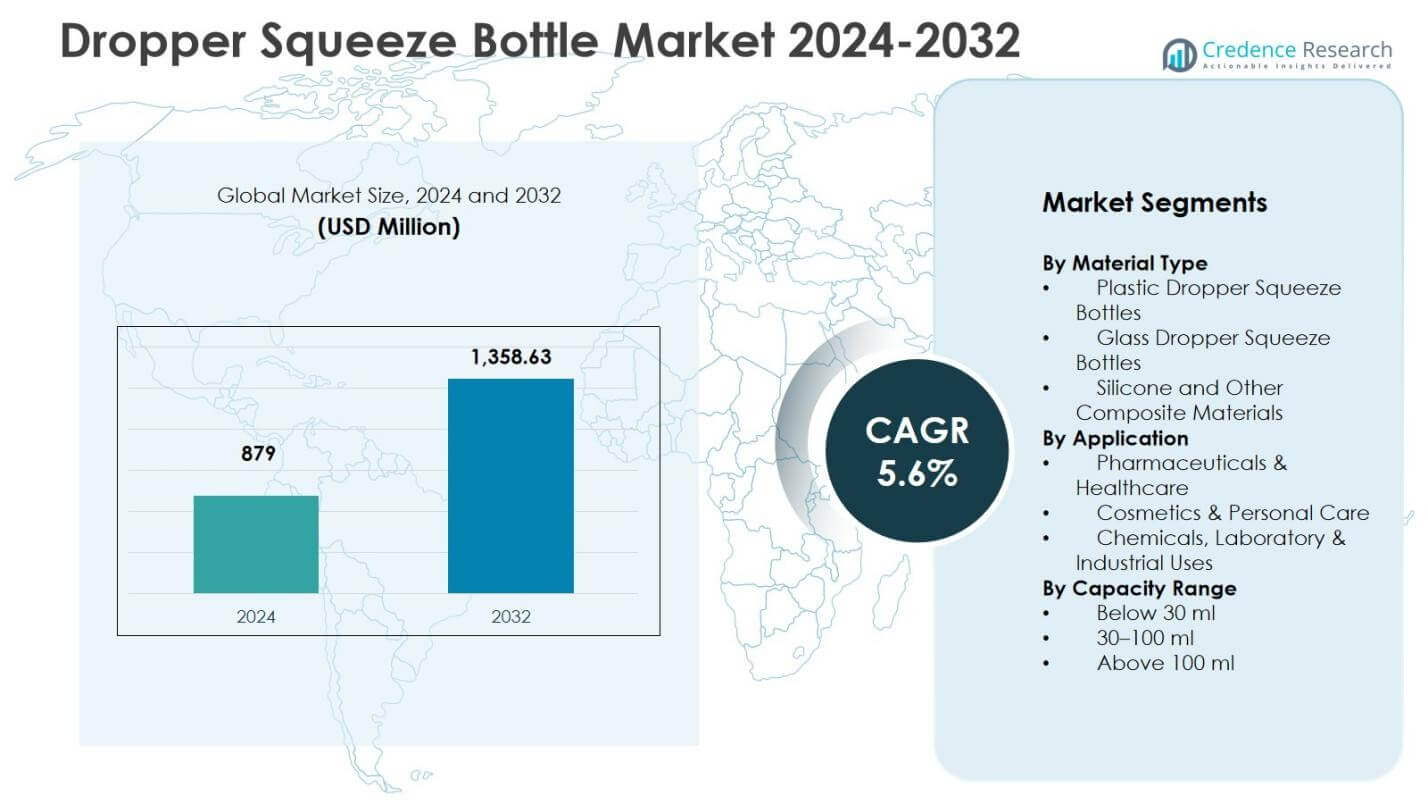
Dropper Squeeze Bottle Market size was valued USD 879 Million in 2024 and is anticipated to reach USD 1,358.63 Million by 2032, at a CAGR of 5.6% during the forecast period.
| REPORT ATTRIBUTE | DETAILS |
|---|---|
| Historical Period | 2020-2023 |
| Base Year | 2024 |
| Forecast Period | 2025-2032 |
| Dropper Squeeze Bottle Market Size 2024 | USD 879 million |
| Dropper Squeeze Bottle Market, CAGR | 5.6% |
| Dropper Squeeze Bottle Market Size 2032 | USD 1,358.63 million |
Dropper Squeeze Bottle Market Insights
- Growth is driven by rising demand for precision dosing in pharmaceuticals, ophthalmic care, skincare serums, and nutraceutical liquids, supported by packaging adoption across healthcare markets.
- Market trends include increasing use of recyclable plastics and glass droppers, skincare positioning, tamper-evident closures, and ergonomic dispenser designs improving safety, dosing accuracy, and experience.
- Leading manufacturers enhance material innovation, sterile packaging compatibility, and automated molding capabilities, strengthening reliability, customization, and cost efficiency across plastic, glass, and composite dropper solutions.
- Regional outlook shows North America holding 32.6% share in 2024, followed by Europe and Asia-Pacific, while Plastic Dropper Squeeze Bottles lead with 67.3 share.
Dropper Squeeze Bottle Market Segmentation Analysis:
By Material Type
The Dropper Squeeze Bottle Market by material type is led by Plastic Dropper Squeeze Bottles, which accounted for 67.3% market share in 2024 due to their flexibility, lightweight structure, low production cost, and suitability for mass-scale pharmaceutical and cosmetic packaging. Plastic variants such as LDPE and HDPE enable precision dosing and strong chemical resistance, driving wider adoption in ophthalmic, dermatology, and essential oil applications. Glass bottles maintain demand in premium skincare and medical use-cases, while silicone and composite materials gain traction in niche, high-durability environments supported by sustainability initiatives and reusable packaging trends.
- For instance, Virospack supplies moulded glass dropper bottles to Estée Lauder for Advanced Night Repair serum, featuring precise pipette dosing and ergonomic design for reliable nightly application in premium skincare.
By Application
Based on application, Pharmaceuticals & Healthcare emerged as the dominant sub-segment with 54.8% market share in 2024, driven by the expanding use of droppers in eye drops, ear drops, nasal solutions, and pediatric liquid formulations. The demand is further strengthened by stringent dosing accuracy requirements, sterile packaging needs, and the growth of chronic disease treatments across hospitals and retail pharmacies. Cosmetics & Personal Care continues to grow in facial serums, essential oils, and skincare concentrates, while Chemicals, Laboratory & Industrial Uses segment benefits from rising adoption in analytical reagents, sample handling, and precision dispensing applications.
- For instance, Aptar Pharma’s Ophthalmic Squeeze Dispenser (OSD) platform is widely adopted as a preservative-free, multi-dose eye drop system that enables microbiological integrity and precise dosing for OTC and prescription ophthalmic drugs.
By Capacity Range
In terms of capacity range, the 30–100 ml segment dominated the market with 46.2% market share in 2024, as it offers the optimal balance between portability, dosage control, and storage volume across pharmaceutical, cosmetic, and laboratory applications. This range is widely preferred for eye care solutions, skincare serums, aromatherapy liquids, and diagnostic reagents, supporting strong commercial uptake. The Below 30 ml segment remains relevant for premium skincare and travel-size formats, while Above 100 ml bottles gain traction in industrial fluids and bulk laboratory dispensing, supported by increasing demand for controlled liquid handling solutions.
Key Growth Drivers
Rising Demand from Pharmaceuticals and Healthcare
The Dropper Squeeze Bottle Market experiences strong growth driven by increasing adoption across pharmaceuticals and healthcare applications, particularly in eye drops, ear drops, nasal formulations, pediatric medications, and liquid therapeutics that require precision dosing. The rise in chronic conditions, expanding geriatric population, and growth in over-the-counter medication consumption significantly strengthen market demand. Regulatory emphasis on patient safety and accurate dispensing further accelerates product adoption. Additionally, the expansion of telehealth and home-based medication routines supports increased usage of portable liquid packaging formats, reinforcing steady consumption across hospital, clinical, and retail pharmacy networks.
- For instance, TRB Chemedica launched VISMED Multi in 2011 as the first commercial product using Aptar Pharma's OSD in a 10 ml multi-dose bottle for artificial tears. The preservative-free 0.18% hyaluronic acid formulation targets dry eye relief from conditions like superficial keratitis or extended screen use.
Expansion of Cosmetics, Skincare, and Personal Care Applications
Growth in cosmetics and personal care industries plays a pivotal role in driving market expansion, as dropper squeeze bottles are increasingly used for serums, essential oils, facial treatments, hair care solutions, and high-value skincare formulations. The premiumization of beauty products and demand for controlled dispensing support strong uptake among cosmetic brands. Packaging aesthetics, consumer preference for hygienic and spill-free application, and growing online beauty commerce further stimulate adoption. Rapid product innovation in dermatology-based skincare, aromatherapy blends, and organic cosmetic formulations also increases reliance on dropper packaging to deliver precision, branding appeal, and product longevity.
- For instance, Vichy presents Minéral 89 Probiotic Fractions Concentrate in a clear molded glass bottle with a precision dropper, emphasizing purity and scientific efficacy for daily skin strengthening with hyaluronic acid.
Cost Efficiency, Lightweight Packaging, and Manufacturing Advantages
Cost-effective production, lightweight material usage, and high manufacturing scalability significantly contribute to market growth, especially across plastic-based dropper squeeze bottles. These bottles offer durability, flexibility, low transport costs, and compatibility with mass-production technologies including injection molding and extrusion blow molding. Manufacturers benefit from reduced material waste, faster production cycles, and improved customization capabilities for closures, nozzles, and tamper-evident seals. The preference for compact, travel-friendly, and recyclable packaging formats strengthens demand across pharmaceuticals, cosmetics, and laboratory segments, while continuous packaging optimization enhances efficiency across large-volume distribution networks.
Key Trends and Opportunities
Shift Toward Sustainable, Recyclable, and Eco-Friendly Packaging
A major trend shaping the Dropper Squeeze Bottle Market is the increasing transition toward sustainable packaging solutions, driven by environmental regulations and brand-led sustainability commitments. Manufacturers are adopting recyclables such as PET and PP, along with bio-based polymers and refill-capable dropper formats to reduce material footprint. Glass droppers are gaining traction in premium skincare and nutraceuticals as brands emphasize eco-conscious branding. The opportunity lies in developing lightweight recyclable designs, reusable closures, and circular packaging models. Companies investing in green packaging portfolios, waste-reduction initiatives, and eco-certified materials are well positioned to capture emerging sustainability-driven demand.
- For instance, Virospack's patented Eco Dropper, made entirely from 100% polypropylene (PP), enables full recyclability in a single stream while providing precise dosing for serums and oils.
Increasing Customization, Design Innovation, and Premium Product Positioning
Growing emphasis on product differentiation and brand identity is fueling innovation in bottle design, closure mechanisms, dropper tips, and labeling aesthetics. Custom-engineered droppers tailored for viscosity control, dosing precision, and enhanced user convenience are gaining prominence across pharmaceuticals and cosmetics. Opportunities are emerging in premium packaging for high-value serums, specialty formulations, nutraceutical drops, and aromatherapy liquids, where visual appearance and functional ergonomics drive consumer perception. Advancements in decorative finishes, matte textures, UV-protective coatings, and smart packaging features further enable manufacturers to offer value-added solutions and strengthen customer loyalty across evolving end-use segments.
- For instance, Lumson launched its Techno Airless Glass (TAG) bottles, combining glass elegance with airless functionality to protect sensitive skincare formulas from oxidation.
Key Challenges
Environmental Concerns and Regulatory Pressures on Plastic Usage
Despite strong demand, the market faces challenges associated with increasing scrutiny on plastic waste, single-use packaging, and environmental sustainability regulations across multiple regions. Restrictions on non-recyclable plastics, packaging waste compliance requirements, and extended producer responsibility frameworks create operational and cost-related pressures for manufacturers. Transitioning toward sustainable materials often requires investment in new tooling, supply-chain adaptation, and compatibility testing for chemical formulations. Balancing regulatory compliance, performance durability, and cost competitiveness remains a critical challenge, especially for companies dependent on low-cost plastic-based dropper bottles in high-volume applications.
Product Quality, Sterility, and Leakage-Prevention Requirements
Ensuring product integrity, sterility, and leak-proof performance presents another major challenge, particularly in pharmaceutical and laboratory applications where precision dosing and contamination control are essential. Manufacturing defects, closure misalignment, material incompatibility with active ingredients, and dropper-tip wear can result in product failures and market recalls. Producers must maintain stringent quality-control standards, advanced molding accuracy, and robust sealing technologies to meet regulatory and clinical expectations. The need for consistent performance across transport, storage, and end-user handling increases production complexity and elevates operational costs for high-reliability dropper squeeze bottle solutions.
Regional Analysis
North America
North America holds a leading position in the Dropper Squeeze Bottle Market, driven by strong demand from pharmaceuticals, ophthalmic products, nutraceuticals, and premium skincare formulations. The region accounted for 32.6% market share in 2024, supported by advanced healthcare infrastructure, strict dosing and packaging regulations, and rising consumption of prescription and over-the-counter liquid medications. Growth in dermatology-based cosmetics, essential oils, and laboratory reagent applications further strengthens market penetration. Manufacturers benefit from mature packaging supply chains, high product innovation, and increasing adoption of child-resistant and tamper-evident closures across medical and consumer applications.
Europe
Europe represents a significant market driven by the rapid shift toward sustainable packaging, premium cosmetic brands, and strong regulatory emphasis on product safety and environmental compliance. The region captured 28.1% market share in 2024, supported by expanding demand in pharmaceutical dispensing solutions, organic skincare serums, aromatherapy liquids, and laboratory diagnostics. The presence of leading glass packaging and specialty bottle manufacturers enhances product availability across healthcare and beauty applications. Increasing consumer preference for recyclable materials and precision-dosing packaging encourages wider adoption of both plastic and glass dropper squeeze bottles across Western and Central European markets.
Asia-Pacific
Asia-Pacific emerges as the fastest-growing regional market, supported by expanding pharmaceutical production, rising cosmetic consumption, and large-scale contract manufacturing activities across China, India, South Korea, and Southeast Asia. The region accounted for 23.4% market share in 2024, driven by population growth, rising healthcare expenditure, and increasing adoption of affordable OTC liquid medications and skincare products. Rapid growth in e-commerce beauty distribution, aromatherapy blends, and laboratory testing applications further accelerates demand. Local packaging manufacturers benefit from cost-efficient production capabilities, while international brands increasingly source dropper packaging solutions from regional manufacturing hubs.
Latin America
Latin America shows steady growth in the Dropper Squeeze Bottle Market, with demand supported by expanding pharmaceutical distribution networks, increasing consumer spending on personal care products, and rising adoption of liquid therapeutic formulations. The region recorded 9.3% market share in 2024, driven by growing usage of eye drops, pediatric medicines, essential oils, and dermatology-based skincare solutions. Urbanization, improving healthcare access, and strengthening retail pharmacy channels enhance product deployment across key markets such as Brazil, Mexico, and Argentina. Local packaging suppliers and multinational brands are investing in cost-efficient, lightweight, and durable dropper packaging formats to support market expansion.
Middle East & Africa
The Middle East and Africa region is developing as an emerging market, supported by increasing investments in healthcare infrastructure, rising demand for pharmaceutical liquid formulations, and growing penetration of cosmetic and personal care products. The region accounted for 6.6% market share in 2024, with adoption primarily concentrated in urban healthcare centers, dermatology clinics, and specialty beauty markets. Growth in laboratory diagnostics, nutraceutical drops, and essential oil applications further contributes to rising consumption. Expanding import-based packaging supply chains and gradual establishment of regional manufacturing facilities are creating new opportunities for dropper squeeze bottle suppliers across key GCC and African economies.
Dropper Squeeze Bottle Market Segmentations:
By Material Type
- Plastic Dropper Squeeze Bottles
- Glass Dropper Squeeze Bottles
- Silicone and Other Composite Materials
By Application
- Pharmaceuticals & Healthcare
- Cosmetics & Personal Care
- Chemicals, Laboratory & Industrial Uses
By Capacity Range
- Below 30 ml
- 30–100 ml
- Above 100 ml
By Geography
- North America
- U.S.
- Canada
- Mexico
- Europe
- Germany
- France
- U.K.
- Italy
- Spain
- Rest of Europe
- Asia Pacific
- China
- Japan
- India
- South Korea
- South-east Asia
- Rest of Asia Pacific
- Latin America
- Brazil
- Argentina
- Rest of Latin America
- Middle East & Africa
- GCC Countries
- South Africa
- Rest of the Middle East and Africa
Competitive Landscape
Competitive landscape analysis in the Dropper Squeeze Bottle Market is defined by the presence of leading packaging manufacturers such as Gerresheimer AG, Aptar Group, Berry Global Inc., Virospack SLU, SGD Pharma, Bormioli Pharma S.p.A., LUMSON, SKS Bottle & Packaging, Comar LLC, and Pacific Vial Manufacturing. The market remains moderately consolidated, with global players competing on product quality, dosing precision, material innovation, and sustainability-driven packaging solutions. Companies focus on expanding portfolios across plastic, glass, and specialty composite droppers to address diverse applications in pharmaceuticals, cosmetics, and laboratory sectors. Strategic priorities include lightweight designs, tamper-evident closures, sterilization compatibility, and enhanced customization for viscosity-specific formulations. Manufacturers are also investing in automated molding technologies, cleanroom production capabilities, and circular packaging initiatives to strengthen regulatory compliance and environmental positioning. Partnerships with pharmaceutical brands, contract manufacturers, and cosmetic producers further support market penetration, while emerging regional players intensify competition through cost-efficient manufacturing and private-label packaging supply models.
Key Player Analysis
- Gerresheimer AG
- Aptar Group
- Berry Global Inc.
- Virospack SLU
- SGD Pharma
- Bormioli Pharma S.p.A.
- LUMSON
- SKS Bottle & Packaging
- Comar LLC
- Pacific Vial Manufacturing
Recent Developments
- In July 2025, Virospack introduced Translucent Harmony, a sustainable line of translucent droppers paired with color-painted glass bottles designed for premium skincare brands.
- In March 2025, Comar introduced its new Glass Ball Tip Dropper Assemblies, offering premium precision and customizable design options for cosmetic and beauty packaging, enhancing application performance and visual appeal.
Report Coverage
The research report offers an in-depth analysis based on Material Type, Application, Capacity Range and Geography. It details leading market players, providing an overview of their business, product offerings, investments, revenue streams, and key applications. Additionally, the report includes insights into the competitive environment, SWOT analysis, current market trends, as well as the primary drivers and constraints. Furthermore, it discusses various factors that have driven market expansion in recent years. The report also explores market dynamics, regulatory scenarios, and technological advancements that are shaping the industry. It assesses the impact of external factors and global economic changes on market growth. Lastly, it provides strategic recommendations for new entrants and established companies to navigate the complexities of the market.
Future Outlook
- The market will experience sustained growth as demand increases across pharmaceuticals, nutraceuticals, cosmetics, and laboratory applications.
- Manufacturers will focus on developing recyclable, bio-based, and refill-ready dropper packaging to support sustainability goals.
- Precision dosing, tamper-evident closures, and child-safe designs will gain wider adoption in regulated healthcare markets.
- Premium skincare and specialty cosmetic serums will continue to drive demand for aesthetically enhanced dropper bottles.
- Automation, cleanroom molding, and advanced sealing technologies will strengthen product quality and consistency.
- Customization, branding-focused designs, and viscosity-specific droppers will create new differentiation opportunities for suppliers.
- Growth in e-commerce beauty and over-the-counter medication sales will increase consumption of compact dropper formats.
- Regional manufacturing expansion and contract packaging partnerships will improve supply-chain competitiveness.
- Sustainability regulations and material-recycling mandates will accelerate the transition toward eco-friendly dropper materials.
- Innovation in smart labeling and traceability features will support safety, authenticity, and compliance in high-value applications.

Request a Free Sample
Fill in your details and we'll send you a free sample report.
- Sample data tables & charts
- Research methodology
Need a Custom Version of This Report?
Tailor the scope, geography, or segments to your exact requirements.
- Custom geography or segment scope
- Direct access to our analyst team
Frequently Asked Questions
What is the current market size for the Dropper Squeeze Bottle Market, and what is its projected size in 2032?
At what Compound Annual Growth Rate is the Dropper Squeeze Bottle Market projected to grow between 2024 and 2032?
Which Dropper Squeeze Bottle Market segment held the largest share in 2024?
What are the primary factors fueling the growth of the Dropper Squeeze Bottle Market?
Who are the leading companies in the Dropper Squeeze Bottle Market?
Which region commanded the largest share of the Dropper Squeeze Bottle Market in 2024?
Table of Content
Chapter 1 Market Segmentation
- 1.1 Segmentation Framework
- 1.1.1 Product and Service Classification
- 1.1.2 Application and End-Use Classification
- 1.1.3 Technology and Solution Classification
- 1.1.4 Customer and Distribution Channel Classification
- 1.1.5 Geographic Segmentation
- 1.1.6 Market Segment Definitions and Boundaries
Chapter 2 Introduction
- 2.1 Report Objectives and Scope
- 2.2 Product Definition and Industry Terminology
- 2.3 Market Inclusions and Exclusions
- 2.4 Research Process
- 2.4.1 Primary Research and Expert Interviews
- 2.4.2 Secondary Research and Source Review
- 2.4.3 Top-Down and Bottom-Up Estimation
- 2.4.4 Data Triangulation and Verification
- 2.5 Market Size Measurement Basis
- 2.5.1 2024: USD 879 Million → 2032: USD 1,358.63 Million
- 2.6 Historical and Forecast Reference Periods
- 2.6.1 Base Year: 2024
- 2.6.2 Forecast Period: 2024-2032
- 2.7 Research Assumptions and Limitations
Chapter 3 Executive Summary
- 3.1 Market Snapshot and Key Findings
- 3.2 Base-Year Market Size, 2024
- 3.3 Forecast Market Size, 2032
- 3.4 Revenue and Volume Growth Outlook
- 3.5 Key Demand and Supply Indicators
- 3.6 Leading Market Segments
- 3.7 Fastest-Growing Market Opportunities
- 3.8 Regional Performance Highlights
- 3.9 Technology and Industry Transformation
- 3.10 Competitive Landscape Summary
- 3.11 Analyst View and Strategic Implications
Chapter 4 Global Dropper Squeeze Bottle Market Trends and Developments
- 4.1 Historical Industry Development
- 4.2 Recent Market Trends and Developments
- 4.3 Demand and Customer Behavior Trends
- 4.4 Technology and Product Innovation
- 4.5 Artificial Intelligence, Automation and Digitalization
- 4.6 Local Manufacturing and Supply Chain Realignment
- 4.7 Industry Partnerships, Mergers and Acquisitions
- 4.8 Sustainability and Circular Economy Developments
- 4.9 Government and Private Sector Investment Trends
- 4.10 Emerging Business Models and Commercialization
- 4.11 Industry Developments and Announcements
Chapter 5 Global Dropper Squeeze Bottle Market Production, Supply and Demand Analysis
- 5.1 Demand Trend and Consumption Analysis
- 5.2 Demand Forecast, 2024-2032
- 5.3 Production and Output Trend
- 5.4 Production and Output Forecast, 2024-2032
- 5.5 Installed Capacity and Capacity Utilization
- 5.6 Company-Wise Production Plants and Statistics
- 5.6.1 Installed Production Capacity
- 5.6.2 Actual Production
- 5.6.3 Planned Capacity and Expansion Targets
- 5.7 Supply Chain Structure and Procurement Trends
- 5.8 Supply-Demand Gap and Bottlenecks
- 5.9 Import Dependence and Sourcing Structure
- 5.10 Contract Manufacturing and Outsourcing
- 5.11 Regional Supply and Demand Concentration
Chapter 6 Global Dropper Squeeze Bottle Market Pricing Analysis
- 6.1 Pricing Structure and Measurement
- 6.2 Historical Pricing Trends
- 6.3 Pricing Outlook, 2024-2032
- 6.4 Average Selling Price and Unit Economics
- 6.5 Pricing by Product and Market Segment
- 6.6 Geographic Pricing Differences
- 6.7 Key Input, Energy, Labor and Logistics Costs
- 6.8 Contract Pricing and Purchasing Models
- 6.9 Pricing Sensitivity and Competitive Positioning
- 6.10 Price, Margin and Profitability Implications
Chapter 7 Global Dropper Squeeze Bottle Market Dynamics
- 7.1 Market Growth Drivers
- 7.1.1 Demand-Side Drivers
- 7.1.2 Technology and Innovation Drivers
- 7.1.3 Infrastructure and Investment Drivers
- 7.1.4 Regulatory and Policy Drivers
- 7.2 Market Restraints
- 7.2.1 Cost and Affordability Constraints
- 7.2.2 Technology and Adoption Barriers
- 7.2.3 Supply Chain and Operational Constraints
- 7.3 Market Challenges
- 7.3.1 Competitive Pressure and Margin Erosion
- 7.3.2 Skills, Infrastructure and Implementation Gaps
- 7.4 Emerging Market Opportunities
- 7.5 Market Dynamics Impact and Time-Horizon Assessment
Chapter 8 Global Dropper Squeeze Bottle Value Chain Analysis
- 8.1 Industry Value Chain Overview
- 8.2 Upstream Suppliers and Critical Inputs
- 8.3 Technology and Component Providers
- 8.4 Manufacturing or Service Delivery
- 8.5 Distribution, Channel Partners and Integrators
- 8.6 Downstream Applications and End Users
- 8.7 Value Addition and Profit Pools
- 8.8 Vertical Integration and Outsourcing
- 8.9 Supplier Concentration and Risk
- 8.10 Supply Chain Localization and Resilience
Chapter 9 Global Dropper Squeeze Bottle Market Regulations and Policies
- 9.1 Relevant Laws, Standards and Compliance Frameworks
- 9.2 Product, Service, Safety and Quality Requirements
- 9.3 Government Policies, Incentives and Subsidies
- 9.4 Imports, Exports and Trade Barriers
- 9.5 Public Procurement and Local Content Requirements
- 9.6 Environmental and Sustainability Compliance
- 9.7 Upcoming Policy Changes and Market Implications
Chapter 10 Global Dropper Squeeze Bottle Market Hotspots and Opportunities
- 10.1 Market Opportunity Mapping and Growth Hotspots
- 10.2 High-Growth Applications and Customer Groups
- 10.3 Underserved Markets and White-Space Opportunities
- 10.4 Emerging Technology and Product Opportunities
- 10.5 New Capacity and Investment Hotspots
- 10.6 Market Entry and Expansion Opportunities
- 10.7 Distribution and Partnership Opportunities
- 10.8 Near-Term and Long-Term Commercial Potential
- 10.9 Opportunity Attractiveness and Execution Risks
Chapter 11 Global Dropper Squeeze Bottle Market Outlook, 2024-2032
- 11.1 Market Size and Analysis
- 11.1.1 Revenue (Market Measurement: 2024: USD 879 Million → 2032: USD 1,358.63 Million)
- 11.1.2 Market Volume and Quantity Sold
- 11.1.3 Historical Market Size
- 11.1.4 Base-Year Market Size, 2024
- 11.2 Market Forecast, 2024-2032
- 11.2.1 Revenue Forecast to 2032
- 11.2.2 Volume Forecast to 2032
- 11.2.3 CAGR and Year-on-Year Growth
- 11.2.4 Incremental Revenue Opportunity
- 11.3 Forecast Assumptions and Scenario Analysis
- 11.3.1 Base-Case Forecast
- 11.3.2 Optimistic and Conservative Scenarios
- 11.3.3 Technology, Pricing and Policy Sensitivities
- 11.4 Market Attractiveness and Growth Outlook
Chapter 12 Global Dropper Squeeze Bottle Market Segmentation and Outlook
- 12.1 Segmentation Summary and Market Shares, 2024
- 12.2 Largest and Fastest-Growing Segments
- 12.3 Segment Growth Comparison
- 12.4 Segment Attractiveness and Priority Matrix
Chapter 13 Global Dropper Squeeze Bottle Geographic Market Outlook, 2024-2032
- 13.1 Regional Market Size and Share, 2024
- 13.2 Regional Market Forecast, 2024-2032
- 13.3 Regional Pricing, Production and Demand Differences
- 13.4 North America
- 13.4.1 United States
- 13.4.2 Canada
- 13.4.3 Mexico
- 13.5 Europe
- 13.5.1 Germany
- 13.5.2 France
- 13.5.3 Italy
- 13.5.4 United Kingdom
- 13.5.5 Spain
- 13.5.6 Poland
- 13.5.7 Russia
- 13.5.8 Netherlands
- 13.5.9 Belgium
- 13.5.10 Sweden
- 13.5.11 Denmark
- 13.5.12 Norway
- 13.5.13 Rest of Europe
- 13.6 Asia Pacific
- 13.6.1 China
- 13.6.2 India
- 13.6.3 Japan
- 13.6.4 South Korea
- 13.6.5 Thailand
- 13.6.6 Indonesia
- 13.6.7 Vietnam
- 13.6.8 Malaysia
- 13.6.9 Australia
- 13.6.10 Rest of Asia Pacific
- 13.7 Latin America
- 13.7.1 Brazil
- 13.7.2 Argentina
- 13.7.3 Colombia
- 13.7.4 Chile
- 13.7.5 Rest of Latin America
- 13.8 Middle East
- 13.8.1 Saudi Arabia
- 13.8.2 United Arab Emirates
- 13.8.3 Turkey
- 13.8.4 Israel
- 13.8.5 Iran
- 13.8.6 Rest of the Middle East
- 13.9 Africa
- 13.9.1 South Africa
- 13.9.2 Egypt
- 13.9.3 Nigeria
- 13.9.4 Morocco
- 13.9.5 Rest of Africa
- 13.10 Regional Investment, Policy and Supply Chain Differences
- 13.11 Regional Competitive Landscape
- 13.12 Geographic Growth Hotspots
Chapter 14 Global Dropper Squeeze Bottle Technology, Innovation and Sustainability Outlook
- 14.1 Technology Landscape and Maturity
- 14.2 Product, Process and Service Innovation
- 14.3 AI, Automation and Digital Tools in the Industry
- 14.4 Technology Adoption and Performance Benchmarking
- 14.5 Innovation Pipeline and R&D Investment
- 14.6 Patent and Intellectual Property Trends
- 14.7 Energy Efficiency and Resource Management
- 14.8 Sustainability, Recycling and Circularity
- 14.9 Technology Roadmap, 2024-2032
- 14.10 Risks of Obsolescence and Technology Substitution
Chapter 15 Global Dropper Squeeze Bottle Market Key Strategic Imperatives
- 15.1 Growth and Market Entry Priorities
- 15.2 High-Return Products and Segments
- 15.3 Pricing, Profitability and Cost Optimization
- 15.4 Technology Investment and Product Differentiation
- 15.5 Supply Chain Localization and Resilience
- 15.6 Distribution and Customer Acquisition
- 15.7 Partnership, Acquisition and Capacity Strategy
- 15.8 Regional Expansion Priorities
- 15.9 Short-, Medium- and Long-Term Actions
Chapter 16 Competition Outlook
- 16.1 Industry Competition Characteristics
- 16.2 Market Structure and Concentration
- 16.3 Market Share and Competitive Positioning, 2024
- 16.4 Company-Wise Revenue and Product Benchmarking
- 16.5 Production and Service Capacity Benchmarking
- 16.6 Technology, Pricing and Differentiation
- 16.7 Regional Footprint and Distribution Strength
- 16.8 Mergers, Acquisitions and Strategic Alliances
- 16.9 New Entrants and Competitive Threats
- 16.10 Porter's Five Forces and Industry Attractiveness
- 16.11 Competitive Outlook, 2024-2032
Chapter 17 Company Profiles
- 17.1 Company Coverage and Selection Criteria
- 17.2 Leading Market Participants – Standard Profile Structure
- 17.2.1 Business Description
- 17.2.2 Company Ownership and Geographic Presence
- 17.2.3 Product and Service Portfolio
- 17.2.4 Manufacturing and Operating Footprint
- 17.2.5 Production Capacity and Expansion Plans
- 17.2.6 Financial Performance and Investment
- 17.2.7 Market Share and Competitive Position
- 17.2.8 Technology and Innovation Capabilities
- 17.2.9 Strategic Alliances or Partnerships
- 17.2.10 Recent Developments
- 17.2.11 Growth Strategy and Outlook
- 17.3 Other Relevant Market Participants
Note: Every listed company is profiled on the structure shown under the first company. The company list is preliminary and may change based on research findings, market developments, data availability and client requirements.
Chapter 18 Disclaimer
- 18.1 Research and Forecast Disclaimer
- 18.2 Data Source and Estimation Limitations
Note: The depth of individual sections depends on data availability for this market. Volume, capacity, trade and other unit-based metrics are included where applicable.